
THE COMMUNITY MULTISCALE AIR QUALITY CMAQ MODEL Model


- Slides: 37
THE COMMUNITY MULTISCALE AIR QUALITY (CMAQ) MODEL: Model Configuration and Enhancements for 2006 Air Quality Forecasting • Rohit Mathur, Jonathan Pleim, Kenneth Schere, George Pouliot, Jeffrey Young, Tanya Otte • • • Atmospheric Sciences Modeling Division ARL/NOAA NERL/U. S. EPA • Hsin-Mu Lin, Daiwen Kang, Daniel Tong, Shaocai Yu, • Science and Technology Corporation
Acknowledgements • Jeff Mc. Queen, Pius Lee, Marina Tsidulko • Paula Davidson Disclaimer: The research presented here was performed under the Memorandum of Understanding between the U. S. Environmental Protection Agency (EPA) and the U. S. Department of Commerce’s National Oceanic and Atmospheric Administration (NOAA) and under agreement number DW 13921548. This work constitutes a contribution to the NOAA Air Quality Program. Although it has been reviewed by EPA and NOAA and approved for publication, it does not necessarily reflect their views or policies.
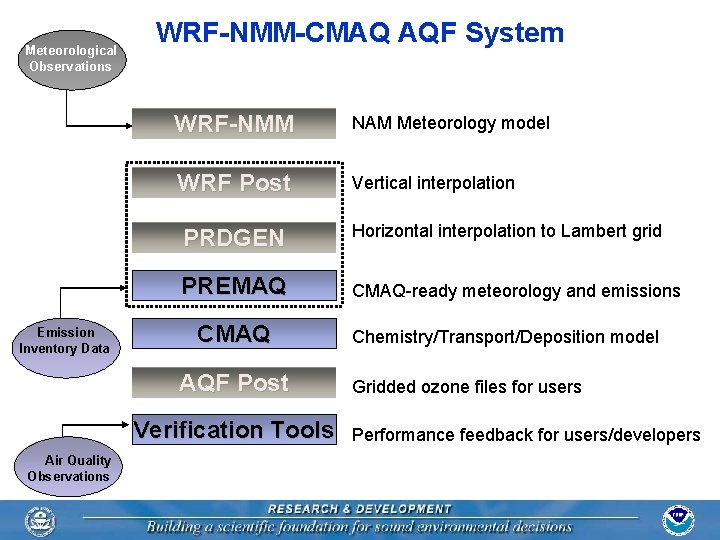
Meteorological Observations Emission Inventory Data WRF-NMM-CMAQ AQF System WRF-NMM NAM Meteorology model WRF Post Vertical interpolation PRDGEN Horizontal interpolation to Lambert grid PREMAQ CMAQ-ready meteorology and emissions CMAQ AQF Post Verification Tools Air Quality Observations Chemistry/Transport/Deposition model Gridded ozone files for users Performance feedback for users/developers
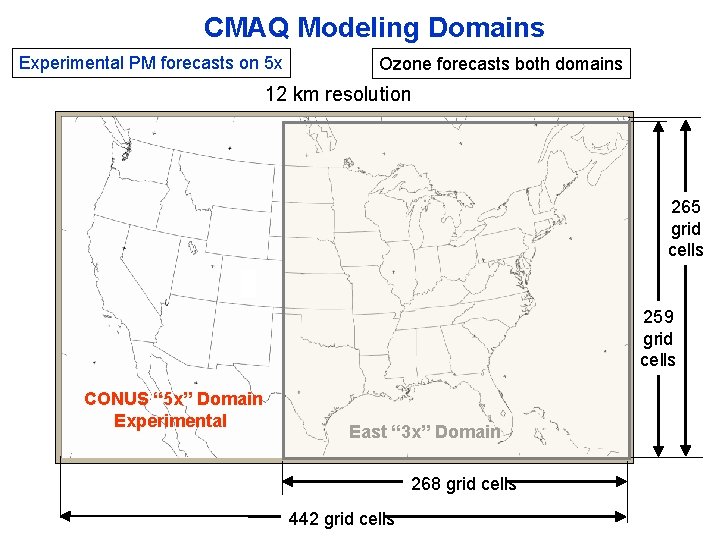
CMAQ Modeling Domains Experimental PM forecasts on 5 x Ozone forecasts both domains 12 km resolution 265 grid cells 259 grid cells CONUS “ 5 x” Domain Experimental East “ 3 x” Domain 268 grid cells 442 grid cells
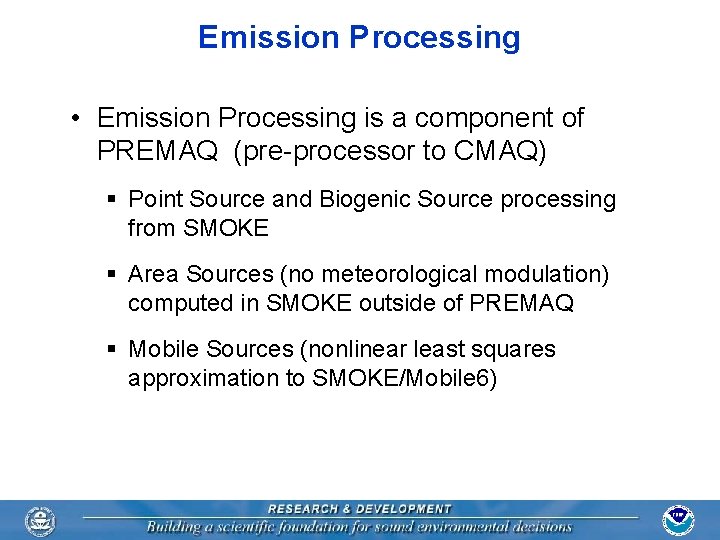
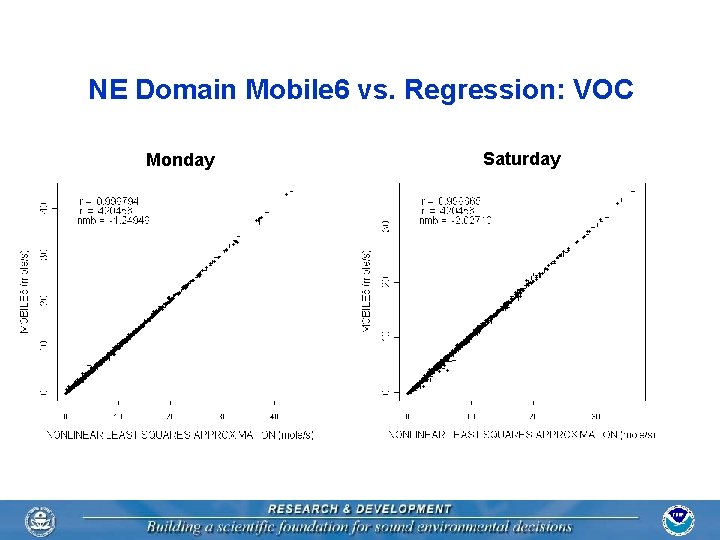
Emission Processing • Emission Processing is a component of PREMAQ (pre-processor to CMAQ) § Point Source and Biogenic Source processing from SMOKE § Area Sources (no meteorological modulation) computed in SMOKE outside of PREMAQ § Mobile Sources (nonlinear least squares approximation to SMOKE/Mobile 6)
Area and Biogenic Sources • Area Sources: Computed outside of PREMAQ § 2001 NEI version 3 inventory used. (CAIR) No changes made to inventory. § Replaced year specific with average (1996 -2002) estimates for fires • Biogenic Sources: BEIS 3. 13 included directly into PREMAQ. • Canadian Inventory: 1995 used (includes all provinces) • Mexican Inventory: BRAVO 1999 used for point sources
Mobile Sources • SMOKE/MOBILE 6 not efficient for real-time forecasting • SMOKE/MOBILE 6 used to create retrospective emissions for AQF grid § 2006 (projected from 2001) VMT data used for input to Mobile 6 § 2006 Vehicle Fleet used for input to Mobile 6 • For 13 counties in Metropolitan Atlanta area, VMT based on 2005 run of a travel demand model and Mobile 6 inputs from Georgia DNR
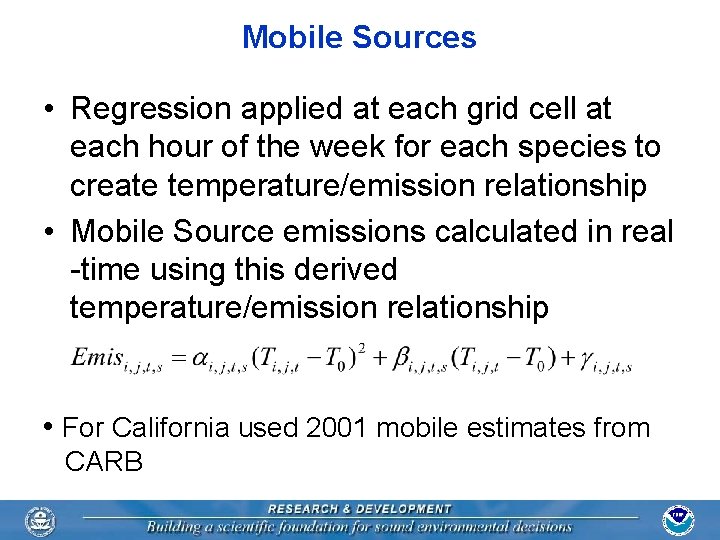
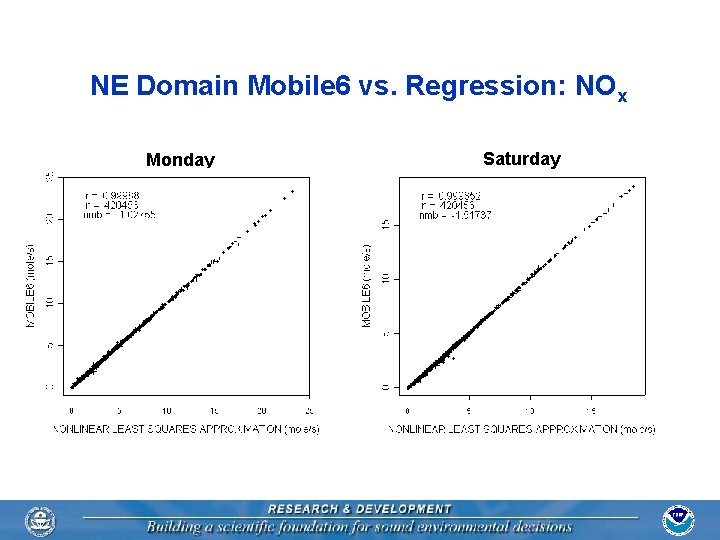
Mobile Sources • Regression applied at each grid cell at each hour of the week for each species to create temperature/emission relationship • Mobile Source emissions calculated in real -time using this derived temperature/emission relationship • For California used 2001 mobile estimates from CARB
NE Domain Mobile 6 vs. Regression: NOx Monday Saturday
NE Domain Mobile 6 vs. Regression: VOC Monday Saturday
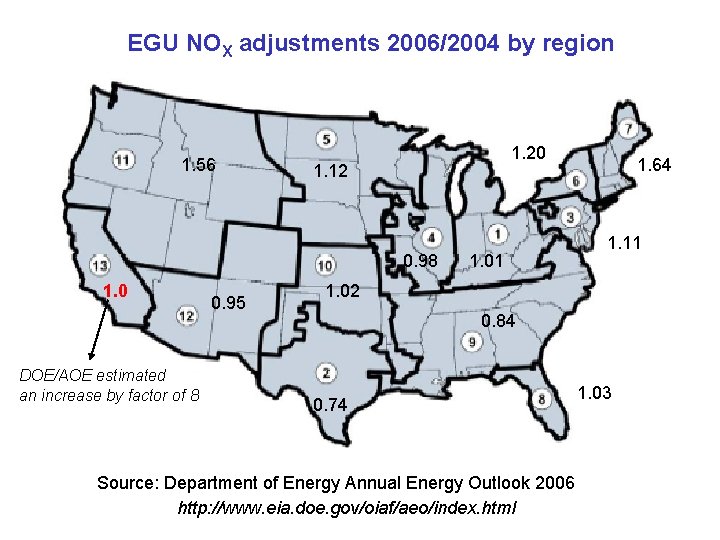
Point Sources • 2004 Continuous Emissions Monitoring for NOx and SO 2 § Monthly temporal profiles on a state-by-state basis derived from 2004 CEM • For other pollutants and non-EGU: 2001 NEIv 3 § Georgia non-EGU based on 2002 inventory from GADNR • Modified EGU NOx emissions using DOE’s Annual Energy Outlook (Jan. 2006) • Calculated 2006/2004 NOx and SO 2 annual emission ratios on a regional basis (from DOE data) § Exception California
EGU NOX adjustments 2006/2004 by region 1. 56 1. 20 1. 12 0. 98 1. 0 DOE/AOE estimated an increase by factor of 8 0. 95 1. 01 1. 64 1. 11 1. 02 0. 84 0. 74 Source: Department of Energy Annual Energy Outlook 2006 http: //www. eia. doe. gov/oiaf/aeo/index. html 1. 03
CMAQ Configuration • Advection § Horizontal: Piecewise Parabolic Method § Vertical: Upstream with rediagnosed vertical velocity to satisfy mass conservation • Turbulent Mixing § K-theory; PBL height from WRF-NMM § Minimum value of Kz allowed to vary spatially depending on urban fraction (furban) • Kz = 0. 1 m 2/s, furban = 0 • Kz = 2. 0 m 2/s, furban = 1 § allows min. Kz in rural areas to fall off to lower values than urban regions during night-time § prevents precursor concentrations (e. g. , CO, NOx) in urban areas from becoming too large at night; reduced mixing intensity) in non-urban areas results in increased night-time O 3 titration
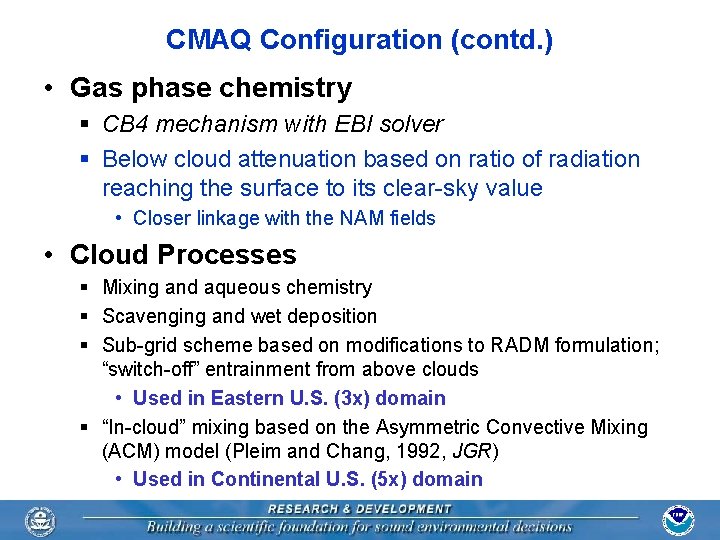
CMAQ Configuration (contd. ) • Gas phase chemistry § CB 4 mechanism with EBI solver § Below cloud attenuation based on ratio of radiation reaching the surface to its clear-sky value • Closer linkage with the NAM fields • Cloud Processes § Mixing and aqueous chemistry § Scavenging and wet deposition § Sub-grid scheme based on modifications to RADM formulation; “switch-off” entrainment from above clouds • Used in Eastern U. S. (3 x) domain § “In-cloud” mixing based on the Asymmetric Convective Mixing (ACM) model (Pleim and Chang, 1992, JGR) • Used in Continental U. S. (5 x) domain
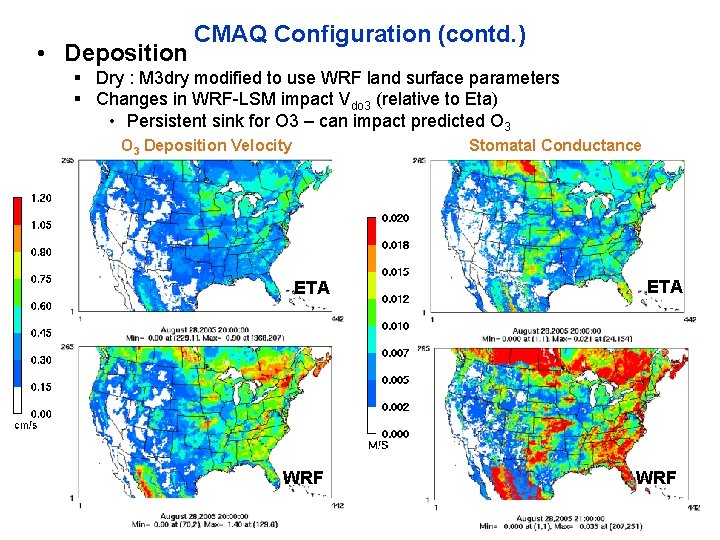
• Deposition CMAQ Configuration (contd. ) § Dry : M 3 dry modified to use WRF land surface parameters § Changes in WRF-LSM impact Vdo 3 (relative to Eta) • Persistent sink for O 3 – can impact predicted O 3 Deposition Velocity Stomatal Conductance ETA WRF
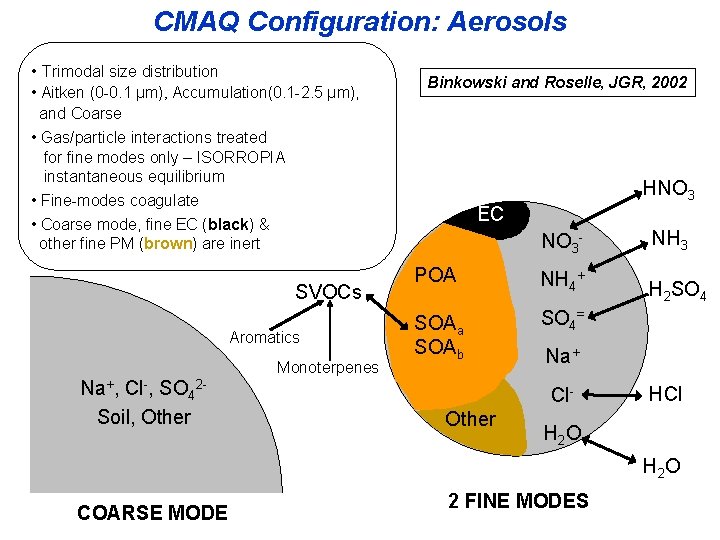
CMAQ Configuration: Aerosols • Trimodal size distribution • Aitken (0 -0. 1 µm), Accumulation(0. 1 -2. 5 µm), and Coarse • Gas/particle interactions treated for fine modes only – ISORROPIA instantaneous equilibrium • Fine-modes coagulate • Coarse mode, fine EC (black) & other fine PM (brown) are inert SVOCs Aromatics Monoterpenes Na+, Cl-, SO 42 Soil, Other Binkowski and Roselle, JGR, 2002 HNO 3 EC NO 3 - NH 3 POA NH 4+ H 2 SO 4 SOAa SOAb SO 4= Na+ Cl- Other HCl H 2 O COARSE MODE 2 FINE MODES
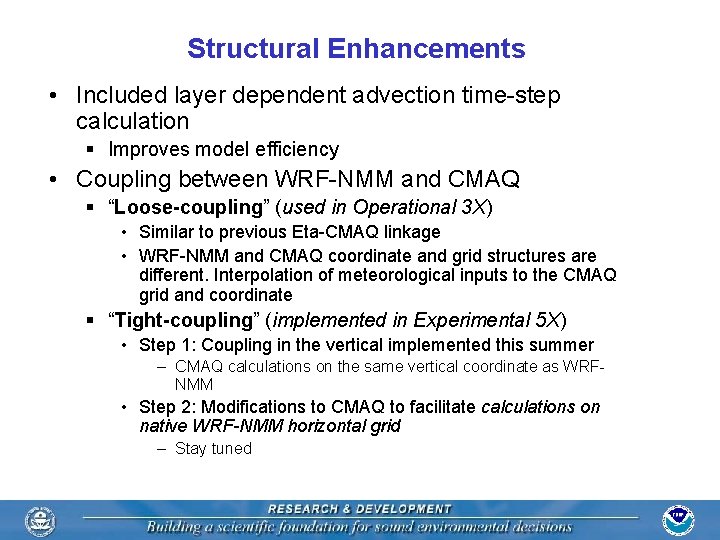
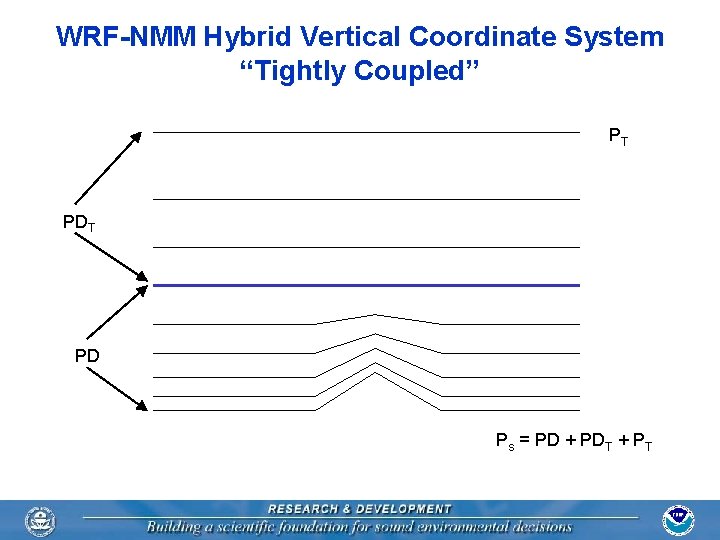
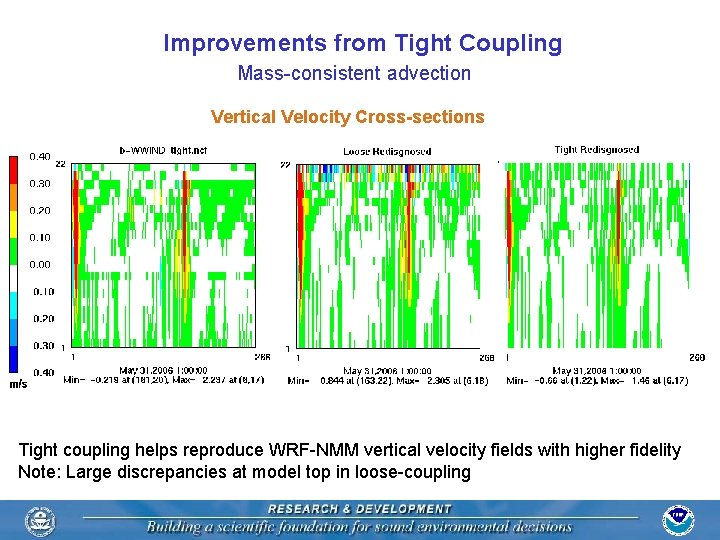
Structural Enhancements • Included layer dependent advection time-step calculation § Improves model efficiency • Coupling between WRF-NMM and CMAQ § “Loose-coupling” (used in Operational 3 X) • Similar to previous Eta-CMAQ linkage • WRF-NMM and CMAQ coordinate and grid structures are different. Interpolation of meteorological inputs to the CMAQ grid and coordinate § “Tight-coupling” (implemented in Experimental 5 X) • Step 1: Coupling in the vertical implemented this summer – CMAQ calculations on the same vertical coordinate as WRFNMM • Step 2: Modifications to CMAQ to facilitate calculations on native WRF-NMM horizontal grid – Stay tuned
WRF-NMM Hybrid Vertical Coordinate System “Tightly Coupled” PT PD Ps = PD + PDT + PT
Tightly Coupled System Conversion to use WRF-NMM vertical coordinate in PREMAQ and CMAQ s’s limited to 0 -1 Jacobian: encapsulates coordinate transformations between physical and computational space Jacobian across the interface
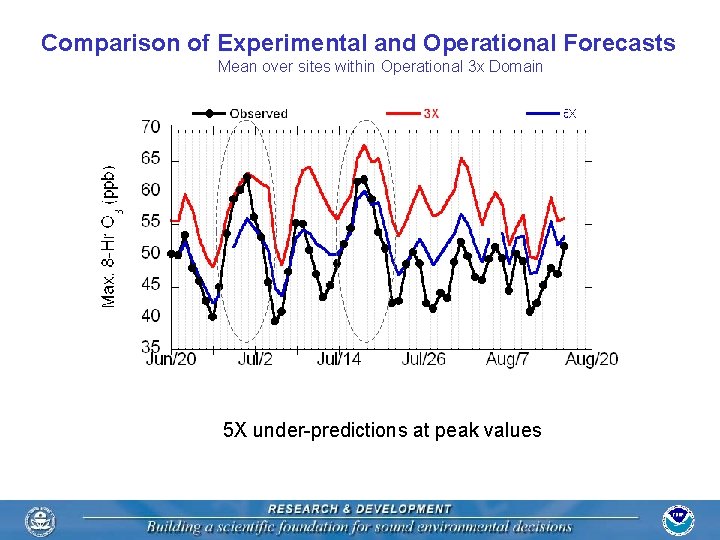
Comparison of Experimental and Operational Forecasts Mean over sites within Operational 3 x Domain 5 X under-predictions at peak values
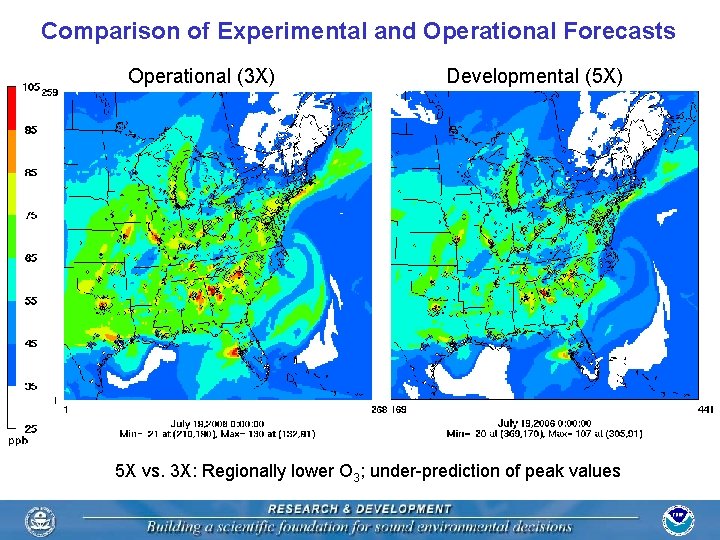
Comparison of Experimental and Operational Forecasts Operational (3 X) Developmental (5 X) 5 X vs. 3 X: Regionally lower O 3; under-prediction of peak values
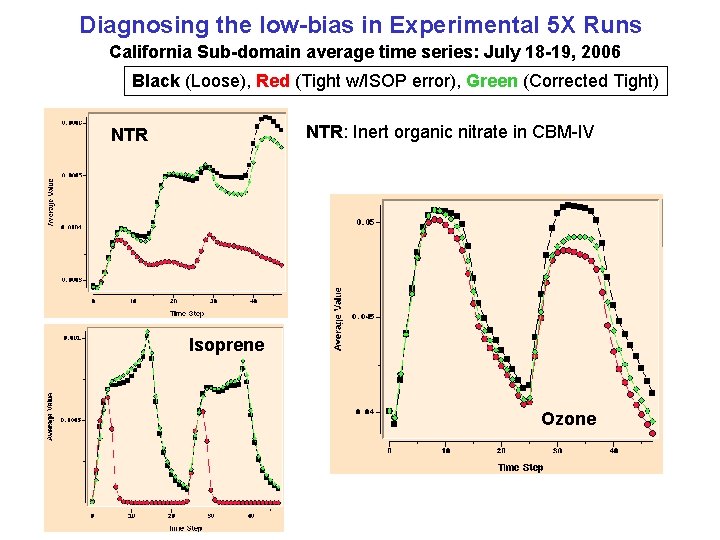
Diagnosing the low-bias in Experimental 5 X Runs California Sub-domain average time series: July 18 -19, 2006 Black (Loose), Red (Tight w/ISOP error), Green (Corrected Tight) NTR: Inert organic nitrate in CBM-IV NTR Isoprene Ozone
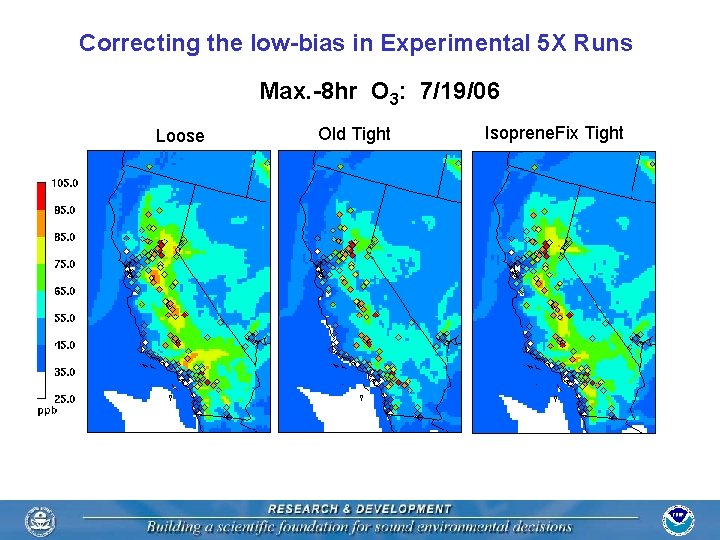
Correcting the low-bias in Experimental 5 X Runs Max. -8 hr O 3: 7/19/06 Loose Old Tight Isoprene. Fix Tight
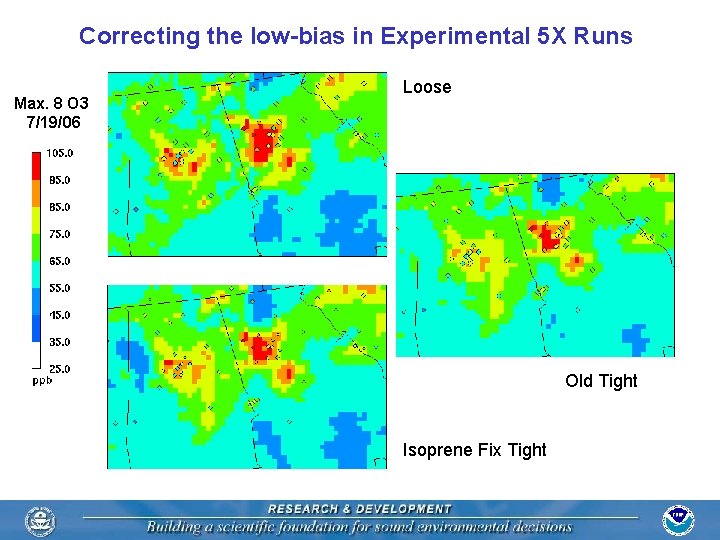
Correcting the low-bias in Experimental 5 X Runs Max. 8 O 3 7/19/06 Loose Old Tight Isoprene Fix Tight
Improvements from Tight Coupling Mass-consistent advection Vertical Velocity Cross-sections Tight coupling helps reproduce WRF-NMM vertical velocity fields with higher fidelity Note: Large discrepancies at model top in loose-coupling
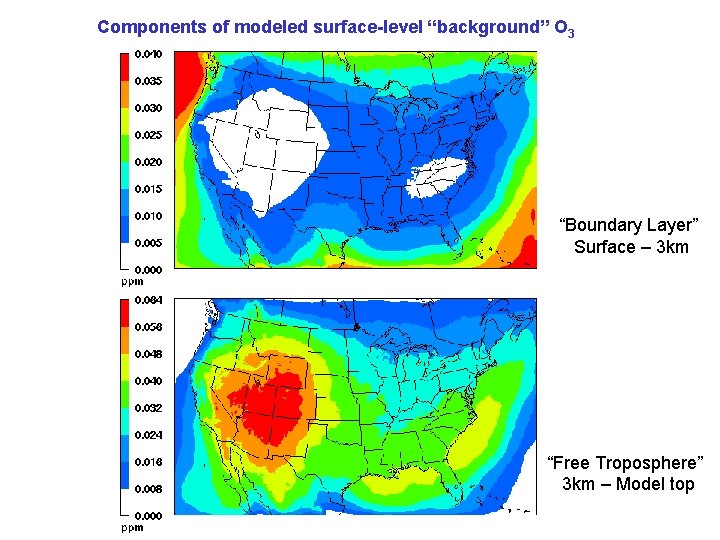
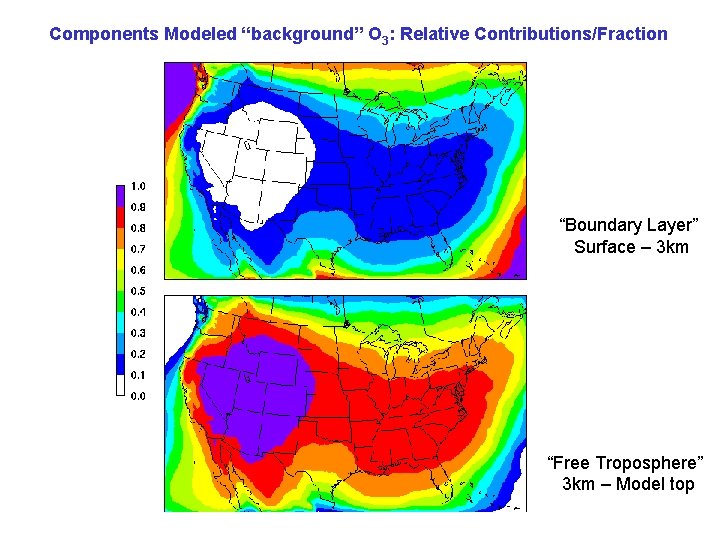
Lateral Boundary Condition Specification • A key uncertainty in long term modeling over limited area domains § Determines “model background” • Approach in Operational Runs: Combination of § Static default profiles • “Clean” tropospheric background values § Top most CMAQ-layer: O 3 profiles from NCEP’s Global Forecast System (GFS) model • O 3 is a 3 -d prognostic variable • Initialized with Solar Backscatter Ultra-Violet (SBUV-2) satellite observations • Approach in Experimental Runs § Static default profiles § Added diagnostic tracers to quantify “model background” O 3 • Tracked impact of lateral boundary conditions (surface-3 km and 3 km-model top)
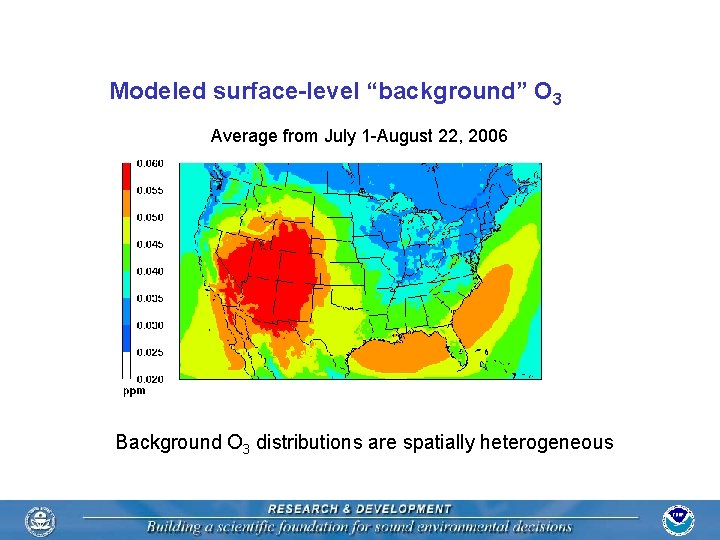
Modeled surface-level “background” O 3 Average from July 1 -August 22, 2006 Background O 3 distributions are spatially heterogeneous
Components of modeled surface-level “background” O 3 “Boundary Layer” Surface – 3 km “Free Troposphere” 3 km – Model top
Components Modeled “background” O 3: Relative Contributions/Fraction “Boundary Layer” Surface – 3 km “Free Troposphere” 3 km – Model top
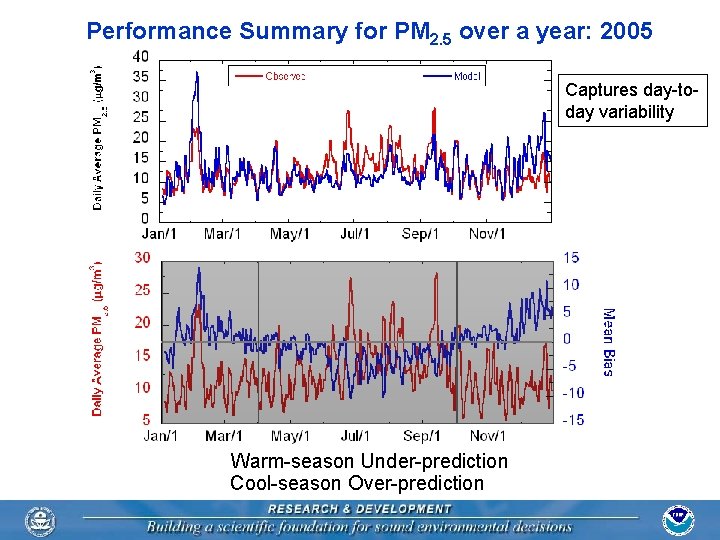
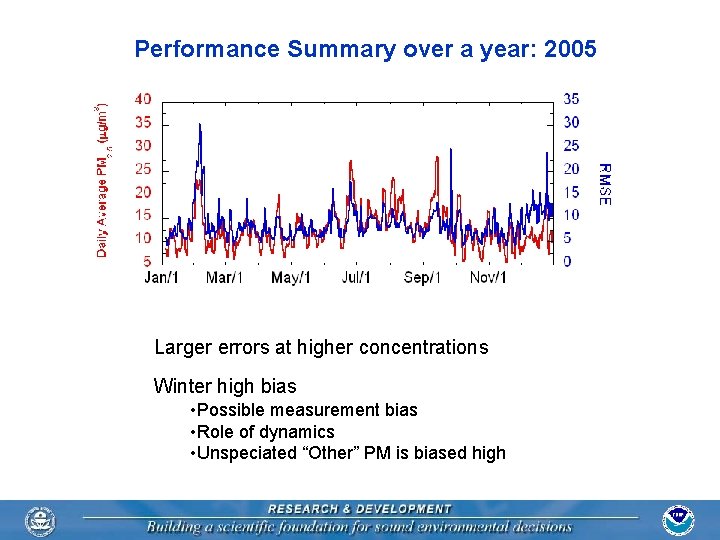
Performance Summary for PM 2. 5 over a year: 2005 Captures day-today variability Warm-season Under-prediction Cool-season Over-prediction
Performance Summary over a year: 2005 Larger errors at higher concentrations Winter high bias • Possible measurement bias • Role of dynamics • Unspeciated “Other” PM is biased high
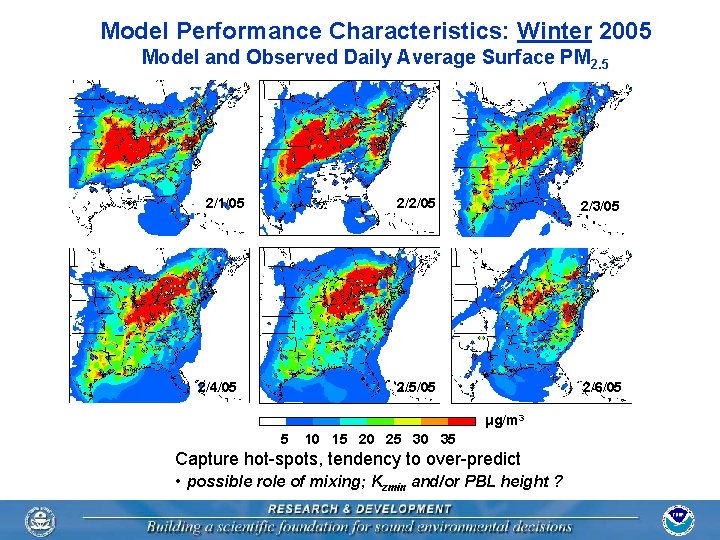
Model Performance Characteristics: Winter 2005 Model and Observed Daily Average Surface PM 2. 5 2/1/05 2/4/05 2/2/05 2/3/05 2/5/05 2/6/05 μg/m 3 5 10 15 20 25 30 35 Capture hot-spots, tendency to over-predict • possible role of mixing; Kzmin and/or PBL height ?
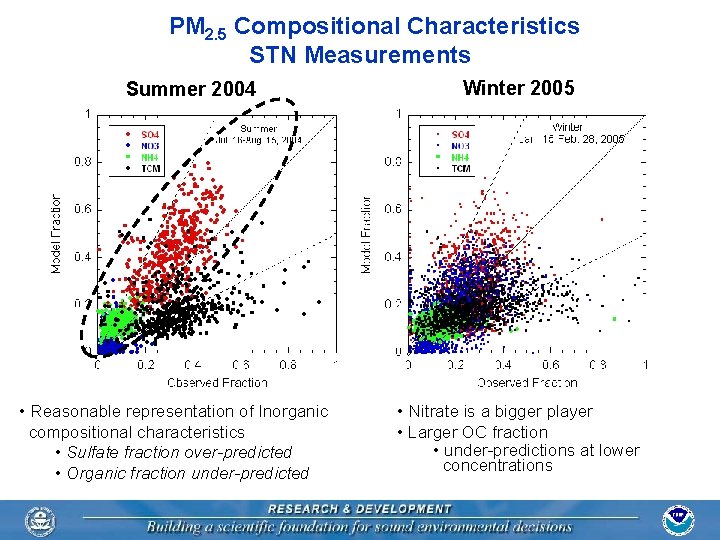
PM 2. 5 Compositional Characteristics STN Measurements Summer 2004 • Reasonable representation of Inorganic compositional characteristics • Sulfate fraction over-predicted • Organic fraction under-predicted Winter 2005 • Nitrate is a bigger player • Larger OC fraction • under-predictions at lower concentrations
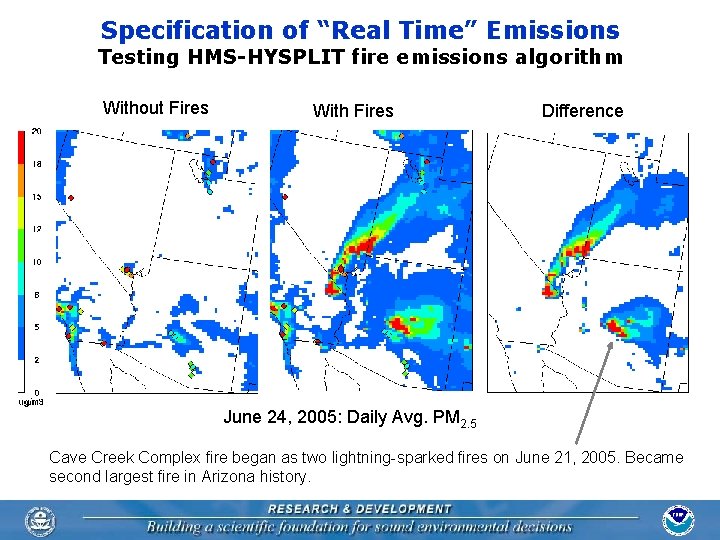
Specification of “Real Time” Emissions Testing HMS-HYSPLIT fire emissions algorithm Without Fires With Fires Difference June 24, 2005: Daily Avg. PM 2. 5 Cave Creek Complex fire began as two lightning-sparked fires on June 21, 2005. Became second largest fire in Arizona history.
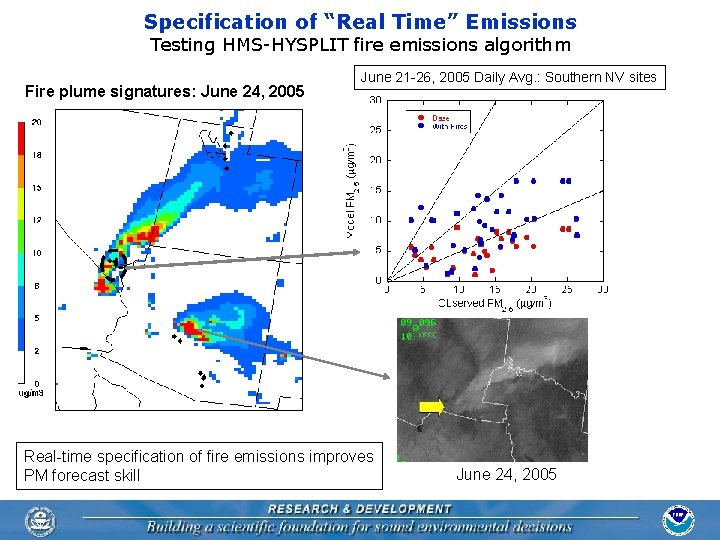
Specification of “Real Time” Emissions Testing HMS-HYSPLIT fire emissions algorithm Fire plume signatures: June 24, 2005 June 21 -26, 2005 Daily Avg. : Southern NV sites Real-time specification of fire emissions improves PM forecast skill June 24, 2005
Summary/Looking Ahead • AQF system transitioned to WRF-NMM § Growing pains with a new and evolving modeling system • WRF-NMM based dry-deposition velocities are higher than those derived from Eta § Persistent sink- can systematically impact predicted O 3 • Implemented the first step in tighter coupling between CMAQ and WRF-NMM computational grids § CMAQ calculations using the WRF-NMM vertical coordinate § Modifications to CMAQ to use the E-grid and rotated lat/lon coordinate underway • Under-predictions for surface O 3 in experimental predictions were found to arise from error in isoprene emission calculations § Un-initialized lat/lon fields
Summary/Looking Ahead • Initial analysis of boundary tracers indicate that modeled O 3 background values are strongly influenced by free tropospheric LBC values § Locations at which O 3 is over-predicted generally also correspond to high background but low observed values • Rigorous analysis of developmental PM simulations underway § Seasonal trends/biases similar to hind-cast CMAQ applications § Speciated PM verifications with surface network (STN, CASTNet, IMPROVE, SEARCH) and aloft (ICARTT) data • Initial testing of a methodology for specifying “realtime” fire emissions tested § Initial results are encouraging