
The Community Directed Intervention CDI Process Module 3
- Slides: 59
The Community. Directed Intervention (CDI) Process Module 3 Version 2
Learning objectives • By the end of this module, learners will be able to: • • • Define the CDI approach Describe program coverage benefits of using CDI Explain the role of the health facility (HF) in the CDI process Outline the steps to establish a CDI program List key approaches in gaining community commitment for a CDI program • Describe the steps in selecting and training community health workers (CHWs) • Explain how CDI can be adapted for use in controlling malaria in pregnancy (Mi. P) 1
What is CDI? • For many years, health services and nongovernmental organizations have been distributing health commodities to communities, for example: • • • Immunizations Vitamin A Bed nets Ivermectin Guinea worm filters • CDI happens when communities take charge of distributing health commodities themselves with guidance from the health service 2
What is CDI? (cont. ) • “Ownership” differentiates community-based intervention from CDI: • In a community-based intervention, the ministry of health, HF, civil society organization, community-based organization, faithbased organization can still own the intervention • In a CDI, the community owns the intervention • When communities are in charge there is often better coverage than when there is centrally organized distribution by a health agency 3
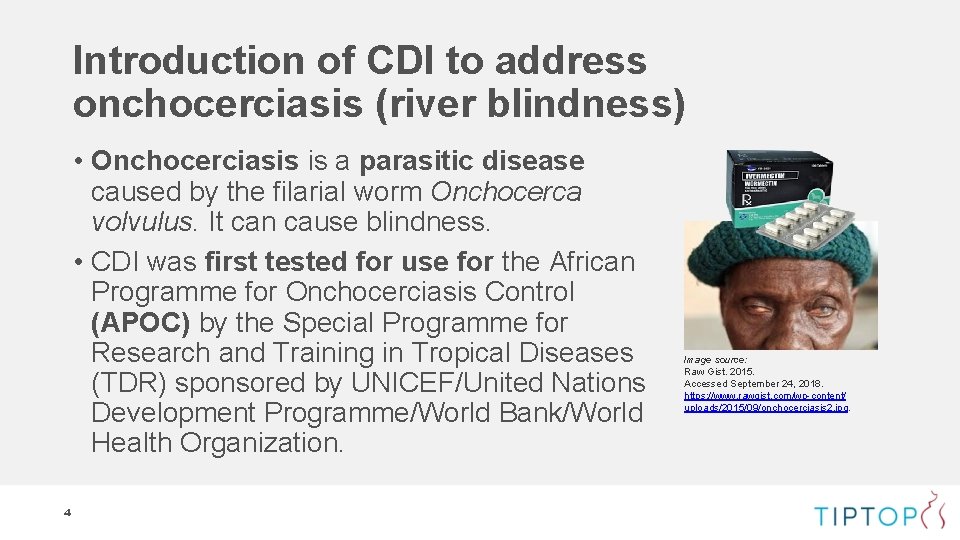
Introduction of CDI to address onchocerciasis (river blindness) • Onchocerciasis is a parasitic disease caused by the filarial worm Onchocerca volvulus. It can cause blindness. • CDI was first tested for use for the African Programme for Onchocerciasis Control (APOC) by the Special Programme for Research and Training in Tropical Diseases (TDR) sponsored by UNICEF/United Nations Development Programme/World Bank/World Health Organization. 4 Image source: Raw Gist. 2015. Accessed September 24, 2018. https: //www. rawgist. com/wp-content/ uploads/2015/09/onchocerciasis 2. jpg.
Introduction of CDI to address onchocerciasis (river blindness), cont. • TDR conducted research to learn whether communities could deliver the drug ivermectin more effectively than agencies had in the past. 5
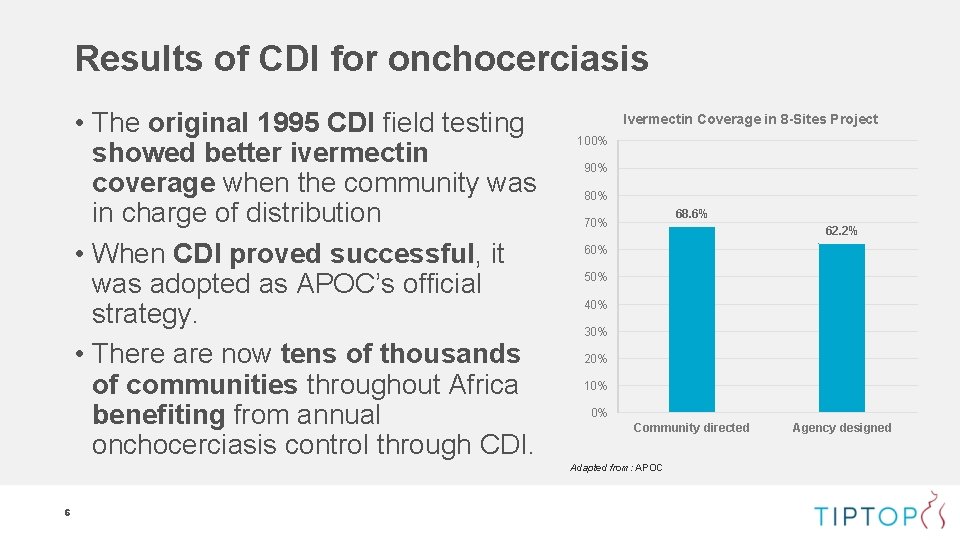
Results of CDI for onchocerciasis • The original 1995 CDI field testing showed better ivermectin coverage when the community was in charge of distribution • When CDI proved successful, it was adopted as APOC’s official strategy. • There are now tens of thousands of communities throughout Africa benefiting from annual onchocerciasis control through CDI. Ivermectin Coverage in 8 -Sites Project 100% 90% 80% 68. 6% 70% 62. 2% 60% 50% 40% 30% 20% 10% 0% Community directed Adapted from: APOC 6 Agency designed
Expanding CDI beyond onchocerciasis • Recently APOC observed that the CDI approach is being used for other issues • Studies have documented CDI being used to promote: • • • 7 Guinea worm control Schistosomiasis control Immunization programs Vitamin A distribution Water and sanitation projects
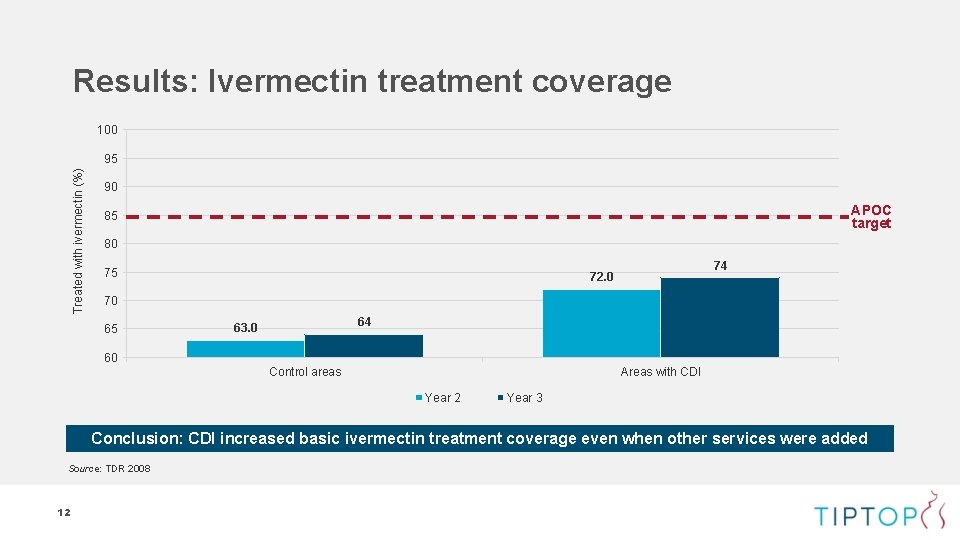
Using CDI for malaria control • TDR has specifically tested CDI for malaria control • Seven-site study (CDI Study Group 2010) in Cameroon, Nigeria, and Uganda: • Existing ivermectin distribution continued • Through CDI, intervention groups received: • Vitamin A • Home management of malaria (HMM) with artemisinin-based combination therapies • Insecticide-treated bed nets (ITNs) • Tuberculosis case detection and follow-up for case completion • The study showed benefits in malaria control and ivermectin coverage 8
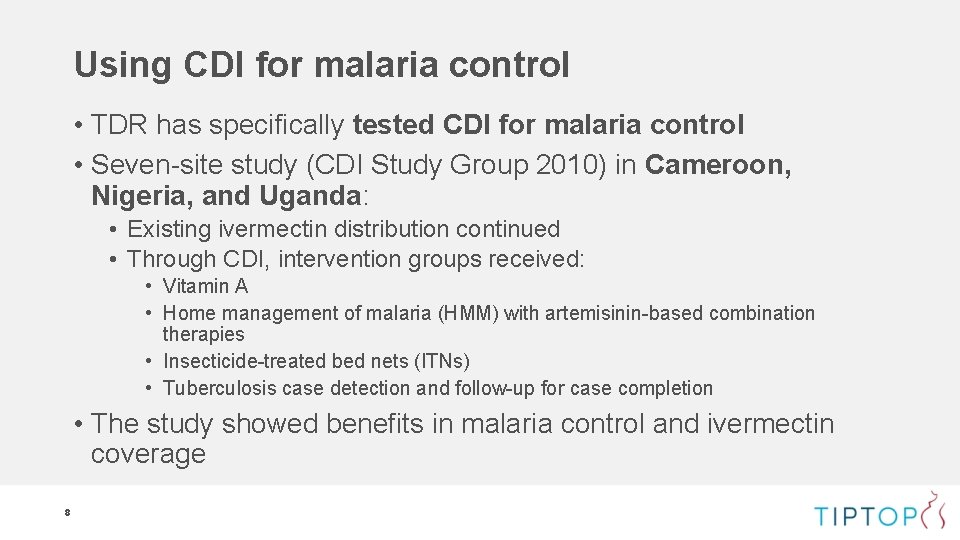
% of children sleeping under ITN previous night Results: Children sleeping under an ITN 100 90 80 70 60 50 36 40 35 33 30 20 10 16 11 9 0 Control areas Areas rec'd ITN through CDI in year 3 Year 2 Areas rec'd ITN through CDI in years 2 and 3 Year 3 Conclusion: CDI increased proportion of children sleeping under ITNs 9 Roll Back Malaria (RBM) target 2005
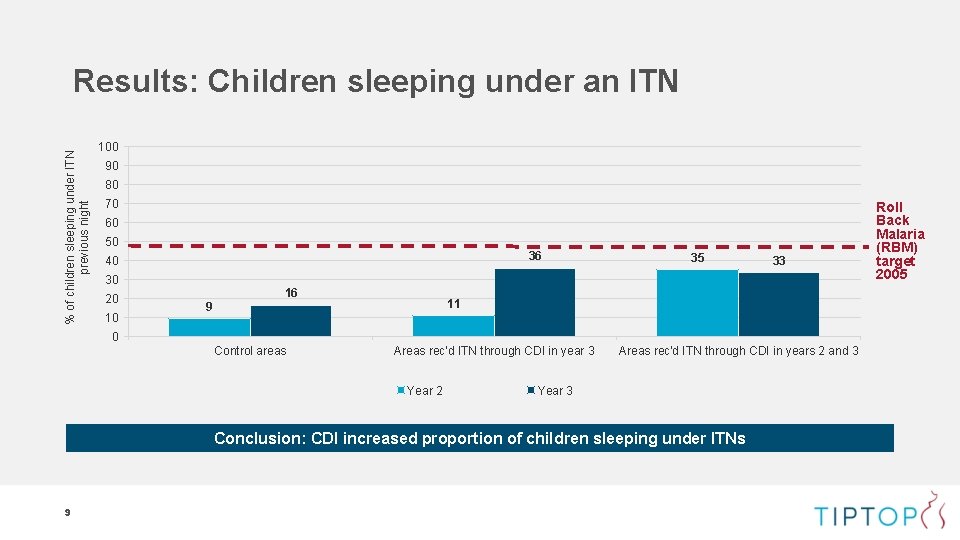
% of pregnant women sleeping under ITN previous night Results: Pregnant women sleeping under ITN 100 90 80 70 60 57 50 40 49 37 33 30 20 10 8 4 0 Control areas Areas rec'd ITN through CDI in year 3 Year 2 Areas rec'd ITN through CDI in years 2 and 3 Year 3 Conclusion: CDI increased proportion of pregnant women sleeping under ITNs 10 RBM target 2005
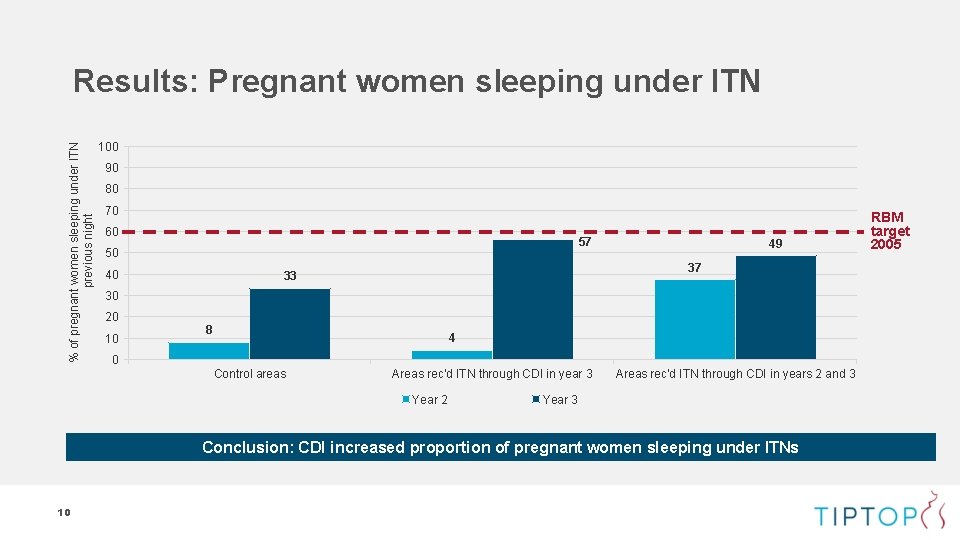
Results: Appropriate treatment of children with fever % children with fever who received appropriate treatment 100 90 80 69 70 60 55 50 48 40 30 29 28 21 20 10 0 Control areas Areas rec'd HMM through CDI in year 3 Year 2 Areas rec'd HMM through CDI in years 2 and 3 Year 3 Conclusion: CDI increased proportion of children with fever who received appropriate treatment 11 RBM target 2005
Results: Ivermectin treatment coverage 100 Treated with ivermectin (%) 95 90 APOC target 85 80 75 74 72. 0 70 65 64 63. 0 60 Control areas Areas with CDI Year 2 Year 3 Conclusion: CDI increased basic ivermectin treatment coverage even when other services were added Source: TDR 2008 12
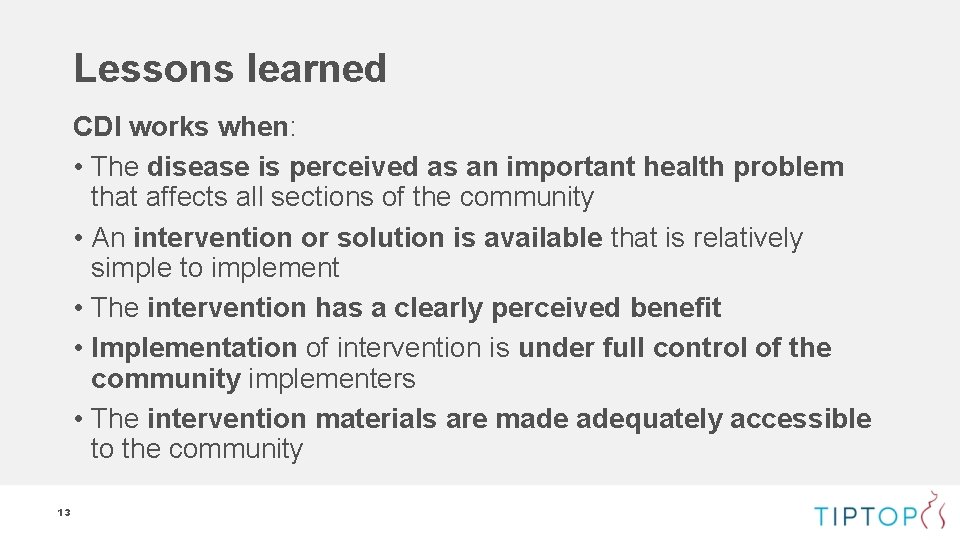
Lessons learned CDI works when: • The disease is perceived as an important health problem that affects all sections of the community • An intervention or solution is available that is relatively simple to implement • The intervention has a clearly perceived benefit • Implementation of intervention is under full control of the community implementers • The intervention materials are made adequately accessible to the community 13
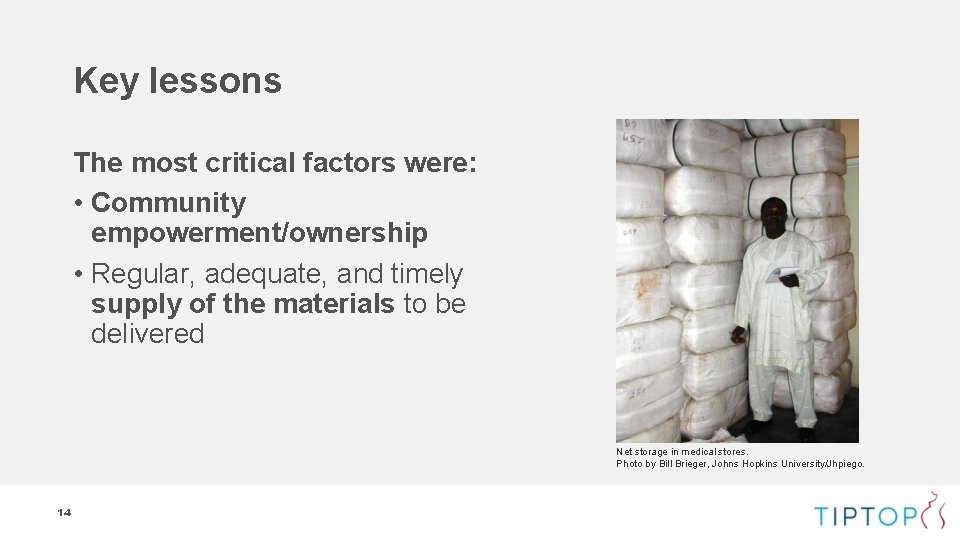
Key lessons The most critical factors were: • Community empowerment/ownership • Regular, adequate, and timely supply of the materials to be delivered Net storage in medical stores. Photo by Bill Brieger, Johns Hopkins University/Jhpiego. 14
Learning how to implement CDI 15
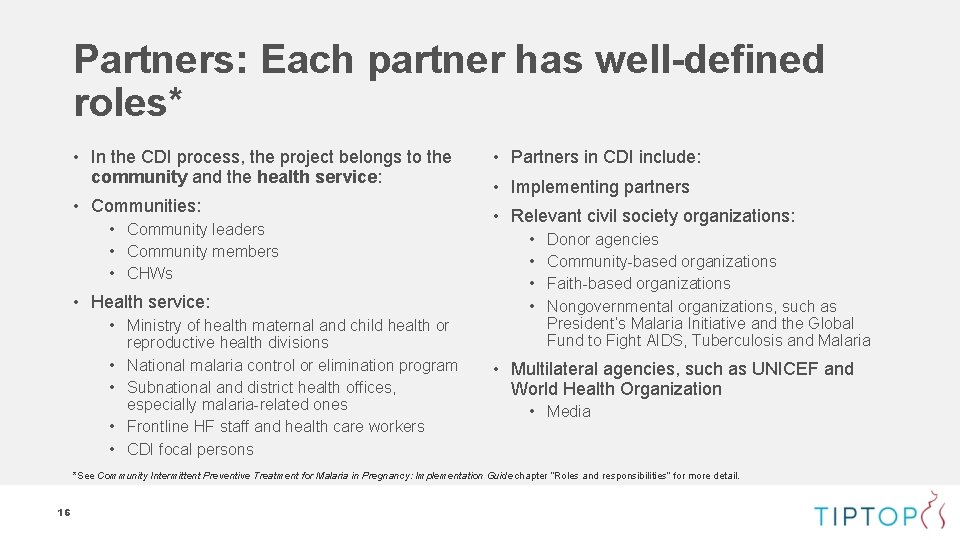
Partners: Each partner has well-defined roles* • In the CDI process, the project belongs to the community and the health service: • Communities: • Community leaders • Community members • CHWs • Health service: • Ministry of health maternal and child health or reproductive health divisions • National malaria control or elimination program • Subnational and district health offices, especially malaria-related ones • Frontline HF staff and health care workers • CDI focal persons • Partners in CDI include: • Implementing partners • Relevant civil society organizations: • • Donor agencies Community-based organizations Faith-based organizations Nongovernmental organizations, such as President’s Malaria Initiative and the Global Fund to Fight AIDS, Tuberculosis and Malaria • Multilateral agencies, such as UNICEF and World Health Organization • Media *See Community Intermittent Preventive Treatment for Malaria in Pregnancy: Implementation Guide chapter “Roles and responsibilities” for more detail. 16
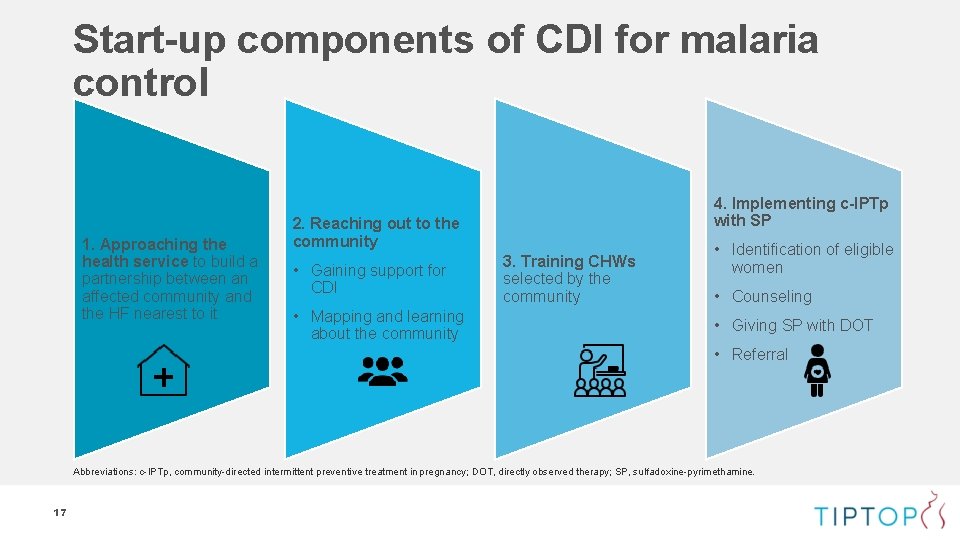
Start-up components of CDI for malaria control 1. Approaching the health service to build a partnership between an affected community and the HF nearest to it 4. Implementing c-IPTp with SP 2. Reaching out to the community • Gaining support for CDI • Mapping and learning about the community 3. Training CHWs selected by the community • Identification of eligible women • Counseling • Giving SP with DOT • Referral Abbreviations: c-IPTp, community-directed intermittent preventive treatment in pregnancy; DOT, directly observed therapy; SP, sulfadoxine-pyrimethamine. 17
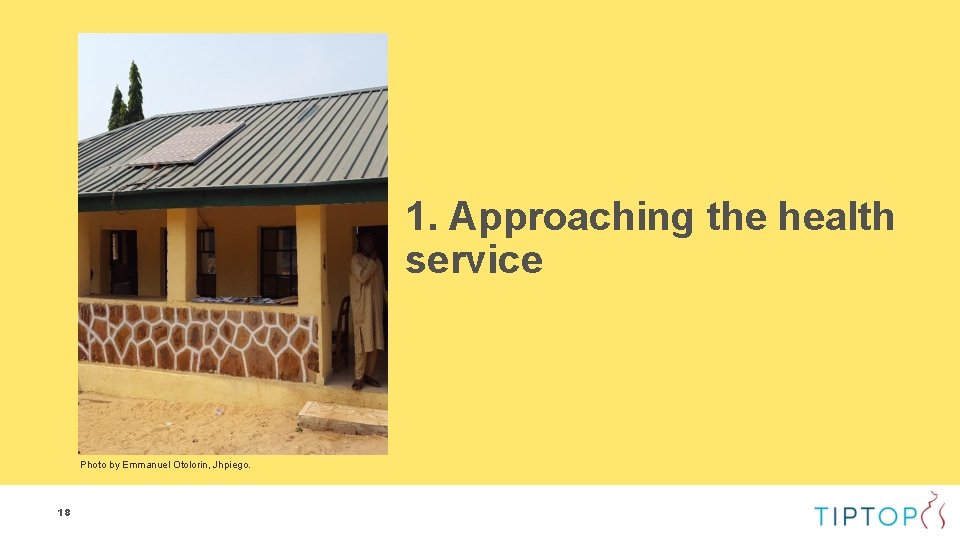
1. Approaching the health service Photo by Emmanuel Otolorin, Jhpiego. 18
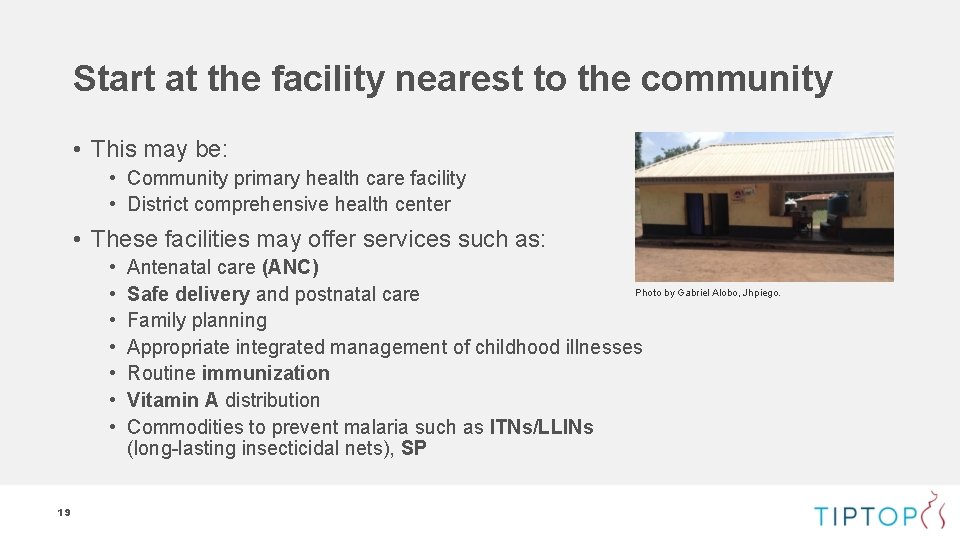
Start at the facility nearest to the community • This may be: • Community primary health care facility • District comprehensive health center • These facilities may offer services such as: • • 19 Antenatal care (ANC) Photo by Gabriel Alobo, Jhpiego. Safe delivery and postnatal care Family planning Appropriate integrated management of childhood illnesses Routine immunization Vitamin A distribution Commodities to prevent malaria such as ITNs/LLINs (long-lasting insecticidal nets), SP
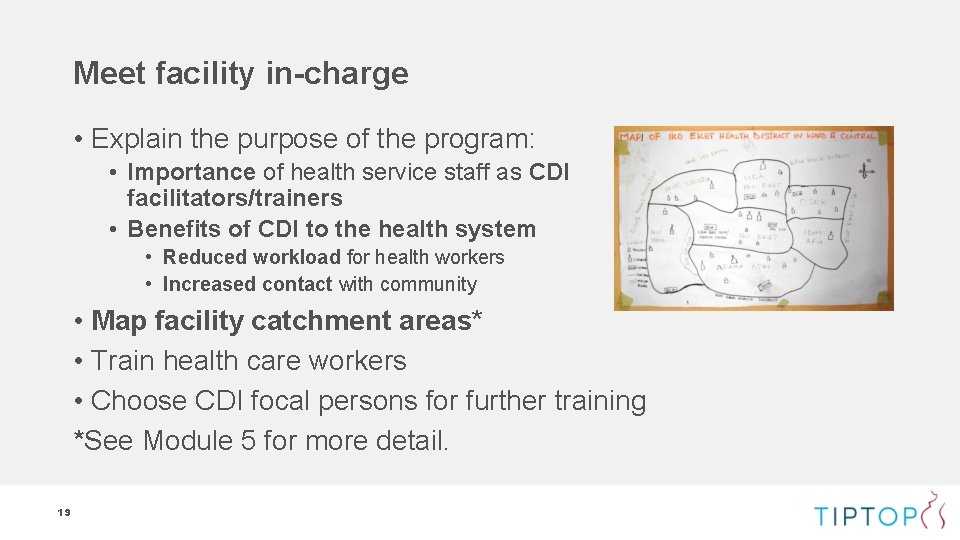
Meet facility in-charge • Explain the purpose of the program: • Importance of health service staff as CDI facilitators/trainers • Benefits of CDI to the health system • Reduced workload for health workers • Increased contact with community • Map facility catchment areas* • Train health care workers • Choose CDI focal persons for further training *See Module 5 for more detail. 19
Training CDI focal persons for their roles as trainers of CHWs • Teach skills for training adults and semiliterate CHWs based on adult learning principles (see Module 10 for details): • • Pre- and post-tests Illustrations Motivation Interactive learning methods such as: • Role-play (e. g. , health education counseling) • Demonstration (e. g. , how to set up ITNs/LLINs) • Observed practice and feedback • Teach skills for monitoring and evaluation (see Module 8 for details) 20
Training CDI focal persons for their roles as trainers of CHWs, cont. • Teach skills for supportive supervision (see Module 11 for details): • Clearly define performance standards before initiating supervision • Use checklists to assess performance • Appreciate the information from the field • Provide immediate feedback to CHWs • Coach the CHW to use the feedback; if possible, have the CHW try again and then immediately evaluate 21
Training health workers for their roles • Planning and documentation • Just addressing the initial objectives after the job was done • Goal definition (e. g. , women getting three or more doses of intermittent preventive treatment in pregnancy [IPTp] increased to 50%) • Setting timeline for CHW trainings • Reporting • Passing information to supervisors and supervisees (e. g. , from district health office to HF to CHWs) • How was it documented and transmitted (e. g. , training information) 22
Roles of the CDI focal person • Ensuring that all communities in the facility’s catchment area participate in the program • Organizing meetings to mobilize support and commitment for CDI • Facilitating community census and mapping • Reviewing census and mapping results to estimate needed commodities, supplies • Providing drug box so CHWs can keep commodities 23
Roles of the CDI focal person, cont. • Buy supplementary medicines for the community (e. g. , analgesics) • Advocacy visits to facilities and local government headquarters to ensure adequate and timely supplies of commodities • Maintaining stocks of basic health commodities for CDI, for example: • Quality-assured SP • ITNs/LLINs • Community registers 24
Roles of the CDI focal person, cont. • Coordinating: • CDI training: • Training community-selected CHWs • Providing retraining to refresh CHWs and replace dropouts • Supervision: • Conducting supportive supervisory visits • Commodity storage • Recordkeeping: • Ensuring communities and CHWs submit data in a timely manner • Incorporating community data with facility data for onward transmission 25
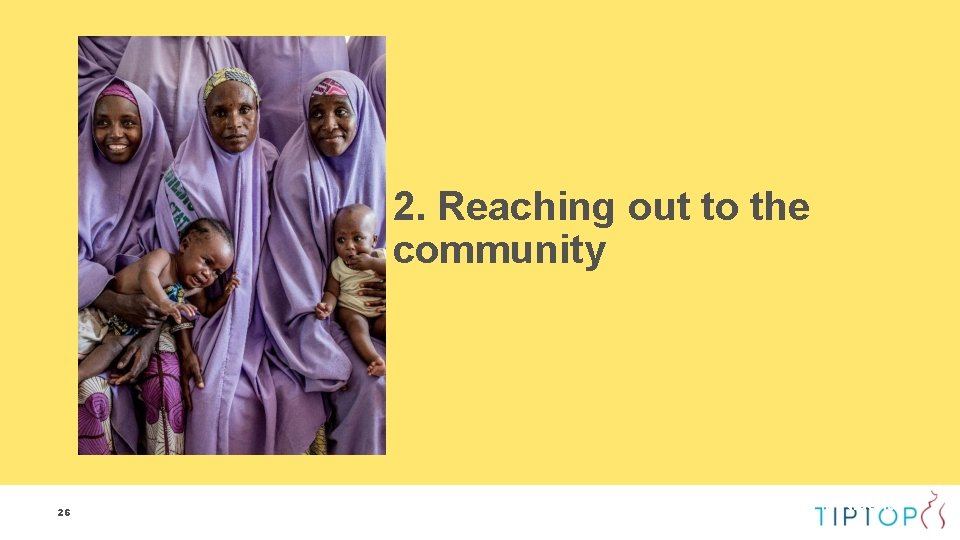
2. Reaching out to the community 26 Mothers Savings and Loans Club members in Nigeria. Photo by Karen Kasmauski.
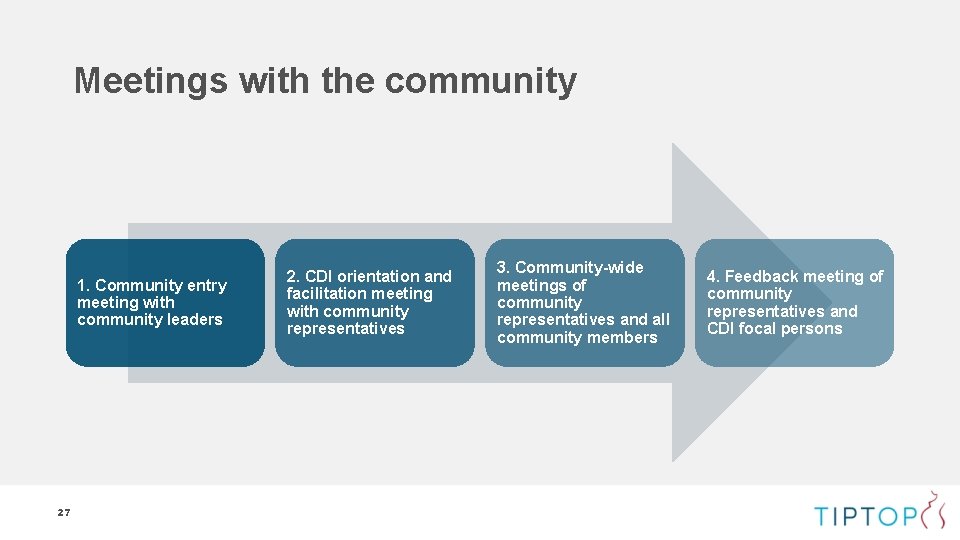
Meetings with the community 1. Community entry meeting with community leaders 27 2. CDI orientation and facilitation meeting with community representatives 3. Community-wide meetings of community representatives and all community members 4. Feedback meeting of community representatives and CDI focal persons
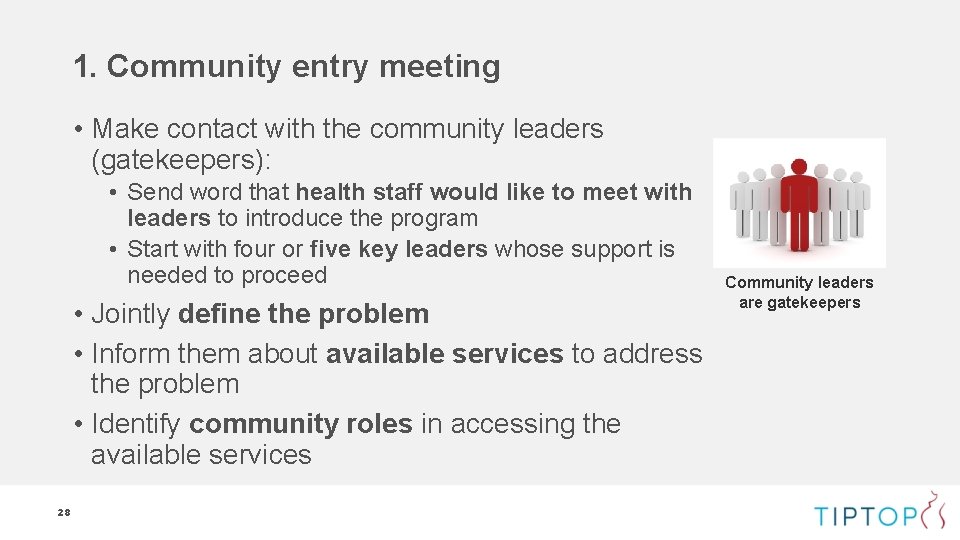
1. Community entry meeting • Make contact with the community leaders (gatekeepers): • Send word that health staff would like to meet with leaders to introduce the program • Start with four or five key leaders whose support is needed to proceed • Jointly define the problem • Inform them about available services to address the problem • Identify community roles in accessing the available services 28 Community leaders are gatekeepers
1. Community entry meeting, cont. • Explain CDI to the leaders and answer their questions • Obtain a clear sense of commitment • Arrange a larger CDI orientation and facilitation meeting with community representatives 29
2. CDI orientation and facilitation meeting • It may not be possible to do everything at one meeting • Reach out to the entire community through representatives • Leaders should invite representatives for all villagers: men, women, youth, and even “visitors” like farm laborers 30
2. CDI orientation and facilitation meeting, cont. • Jointly define the problem • Inform them about available services or solutions • Identify potential community roles in accessing the available services or solutions • Decide on criteria for CHW selection • Discuss and gain commitment for community roles 31
Roles for the community • Map the community • Conduct village census to aid in estimating commodity needs • Develop and help maintain village register of pregnant women • Support the CHWs in their activities (provide incentives). 32
Roles for the community, cont. • Monitor implementation process (community self-monitoring); indicators to measure might include: • Referrals to ANC clinic • Community compliance with ITN/LLIN use, follow-up IPTp doses • CHW performance (adherence to treatment procedures, treatment of all eligible persons) 33
Roles for the CHW • Collect health commodities at nearest HF • Distribute intervention commodities and deliver services in the community (including referral) • Keep good records and summarize information from the CHW register to report back to the HF 34
3. Community-wide meetings • Request community meet on its own to discuss community implementation plan, including distribution of commodities • This meeting is intended to engage everyone in the CDI process • It may not be possible to do everything at one meeting; the community should hold follow-up meetings as needed 35
Discuss and gain commitment for community roles including. . . • CHW selection: Developing criteria of type of residents best suited to the work of CHW • Census/mapping exercises • Conducting village census to aid in estimating commodity needs • Mapping the community (see Module 5 for more detail) 36
4. Feedback meeting: Incorporating feedback from the community • Community representatives report back from communitywide meetings • Decide convenient days, times, and means for distribution of health commodities • Document the community action plan • Reiterate the importance of community playing its roles 37
4. Feedback meeting: Incorporating feedback from the community, cont. • Select CHWs: • Use basic selection criteria as well as criteria community members developed in community-wide meetings • Create list of selected CHWs • Plan training of CHWs: • Sponsor/support CHWs to attend c-IPTp training • Identify timing, venue, requirements • Share information on training logistics with CHWs and training facilitators 38
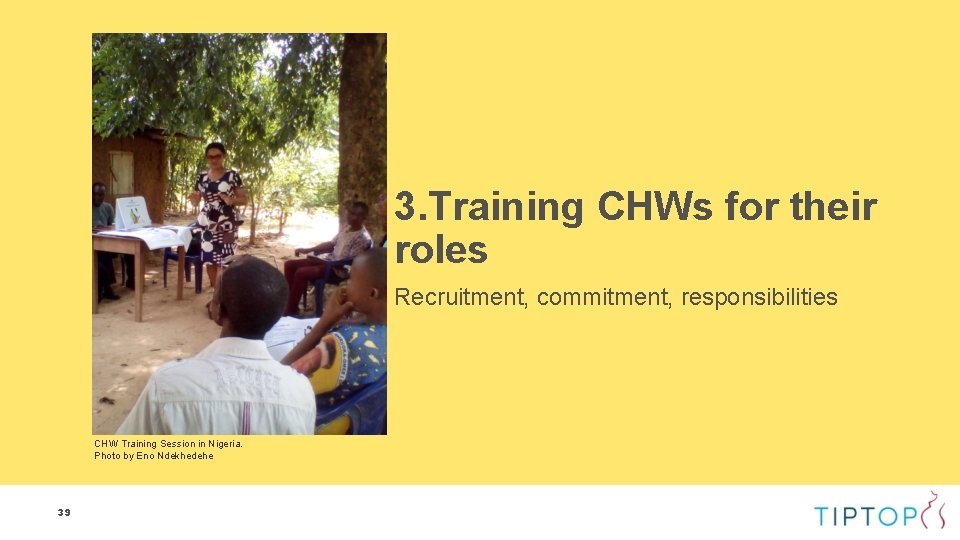
3. Training CHWs for their roles Recruitment, commitment, responsibilities CHW Training Session in Nigeria. Photo by Eno Ndekhedehe 39
Make a training plan for CHWs • Venue: should be open, within the community, not classrooms, to create community awareness • Involve community leaders in the training (e. g. , to declare sessions open and closed) • Identify training requirements and materials • Ensure information, education, and communication materials are appropriate to the CHWs’ education level • Plan for refreshment • Make training and trainers lively and supportive 40
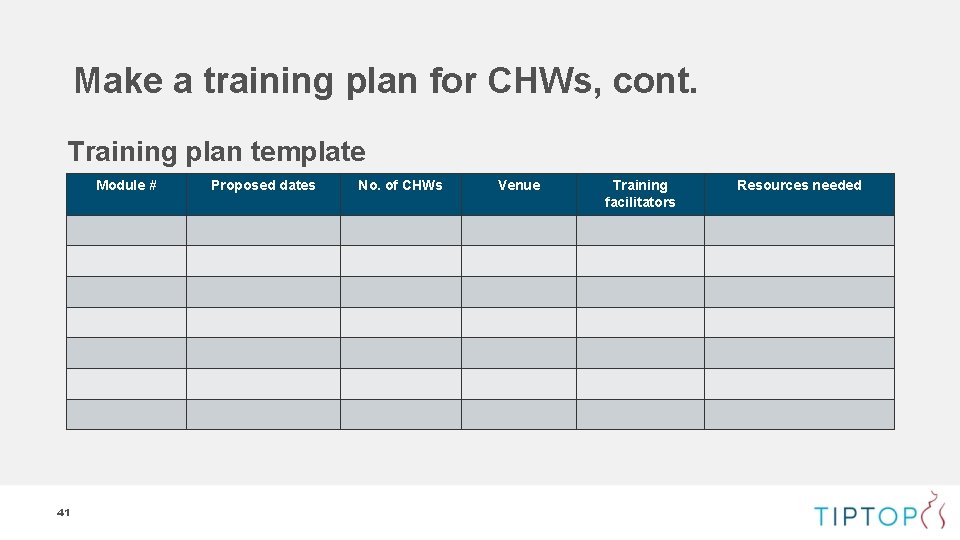
Make a training plan for CHWs, cont. Training plan template Module # 41 Proposed dates No. of CHWs Venue Training facilitators Resources needed
Training content for CHWs • Make sessions interactive, starting with CHW’s knowledge (prompt for issues not mentioned) • Start with general discussion on participants’ experience with malaria • Discuss experience with Mi. P 42
Training content for CHWs, cont. • Discuss the management of malaria in the community. Note the different modes of management, for example: • Prevention by sleeping inside ITNs/LLINs • Provision of a minimum of three doses of SP to all pregnant women • Early detection of malaria fever and treatment with appropriate antimalarial drugs in accordance with national guidelines • Discuss drug availability within the community • Direct discussion to management of Mi. P, especially c-IPTp with quality-assured SP 43
Skills training for CHWs • Emphasize the limits of the skills CHWs will acquire (not to go beyond their scope of work) • Identification of eligible pregnant women • Health education to community: • Using Interpersonal Communication for Prevention and Control of Malaria in Pregnancy: Community Health Workers’ Counseling Flip Chart (the Counseling Flip Chart) • Targeting all segments of community separately (especially pregnant women but also including men) • Share appropriate job aids: • Job aids for IPTp provision • Pregnancy wheel for gestational age estimation 44
Skills training for CHWs, cont. • Prevention: • How to hang ITNs/LLINs • How to assess women for IPTp eligibility • Giving IPTp with SP by DOT • Treatment: • Drugs available (artemisinin-based combination therapies) • Treatment modes, regimen, requirements, possible reactions, reaction management • Referral: • Conditions for referral • Referral points 45
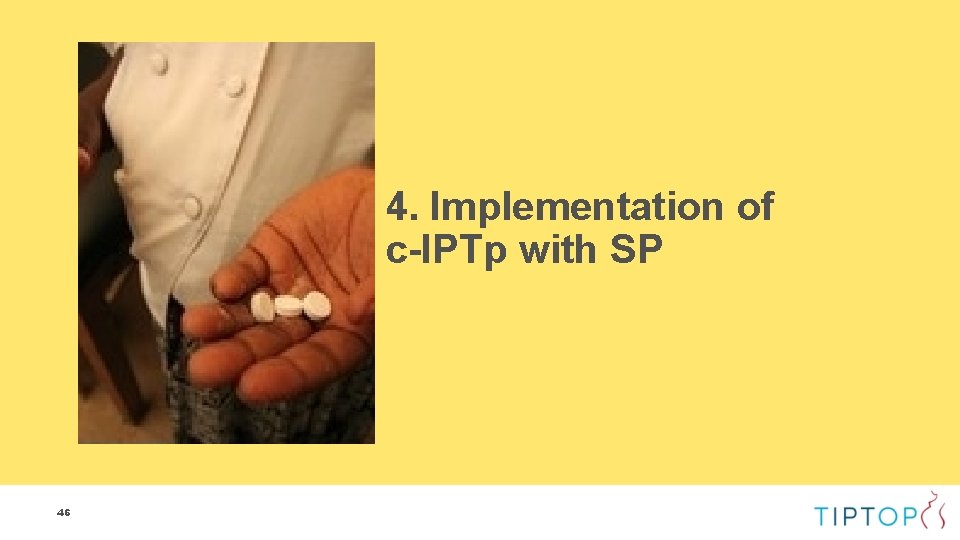
4. Implementation of c-IPTp with SP 46
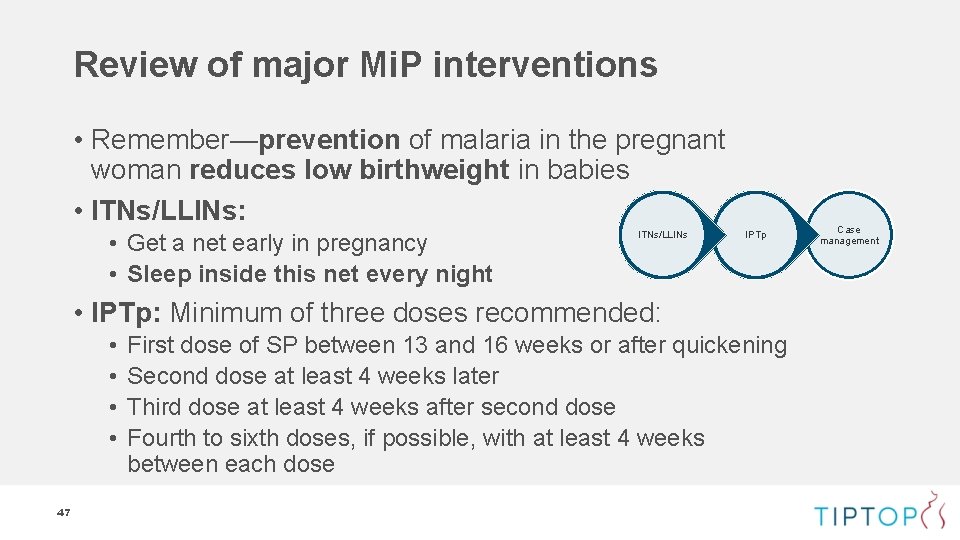
Review of major Mi. P interventions • Remember—prevention of malaria in the pregnant woman reduces low birthweight in babies • ITNs/LLINs: • Get a net early in pregnancy • Sleep inside this net every night ITNs/LLINs IPTp • IPTp: Minimum of three doses recommended: • • 47 First dose of SP between 13 and 16 weeks or after quickening Second dose at least 4 weeks later Third dose at least 4 weeks after second dose Fourth to sixth doses, if possible, with at least 4 weeks between each dose Case management
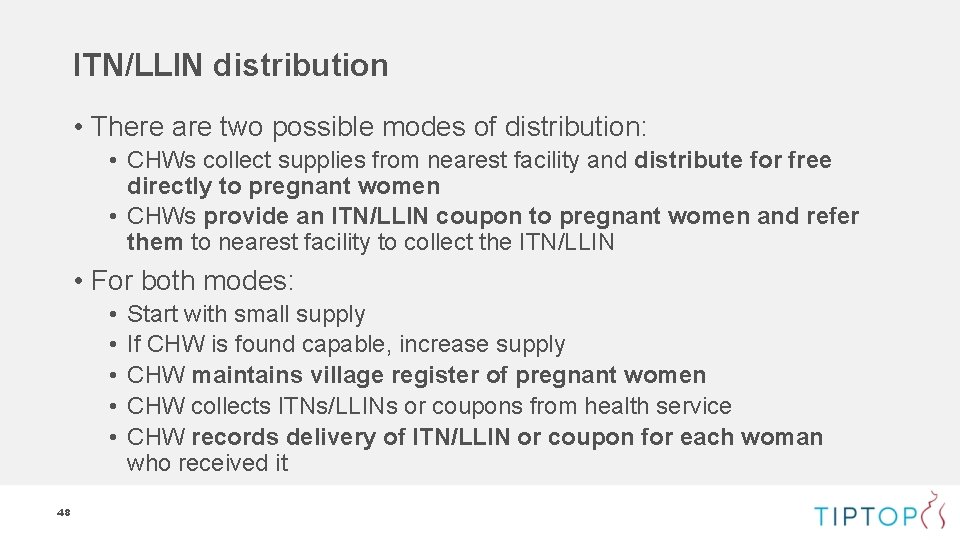
ITN/LLIN distribution • There are two possible modes of distribution: • CHWs collect supplies from nearest facility and distribute for free directly to pregnant women • CHWs provide an ITN/LLIN coupon to pregnant women and refer them to nearest facility to collect the ITN/LLIN • For both modes: • • • 48 Start with small supply If CHW is found capable, increase supply CHW maintains village register of pregnant women CHW collects ITNs/LLINs or coupons from health service CHW records delivery of ITN/LLIN or coupon for each woman who received it
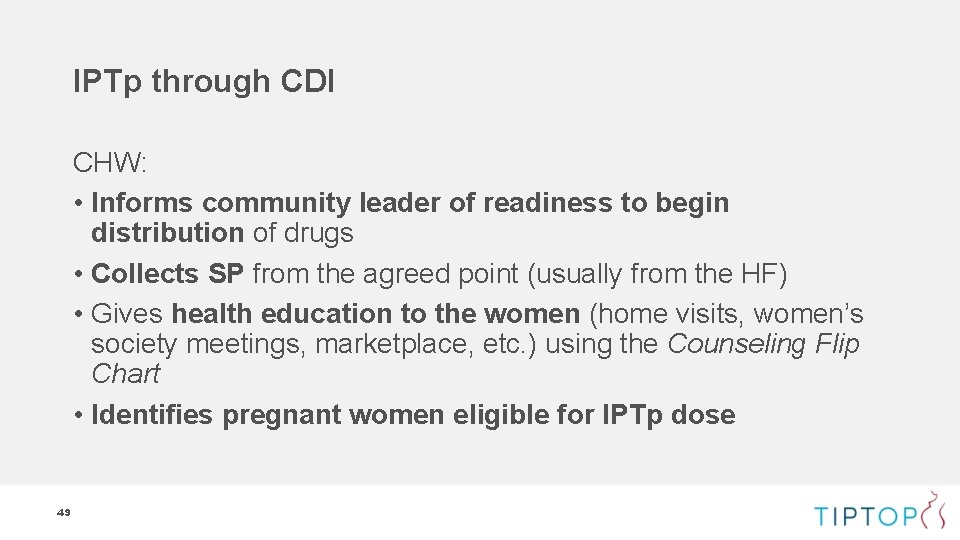
IPTp through CDI CHW: • Informs community leader of readiness to begin distribution of drugs • Collects SP from the agreed point (usually from the HF) • Gives health education to the women (home visits, women’s society meetings, marketplace, etc. ) using the Counseling Flip Chart • Identifies pregnant women eligible for IPTp dose 49
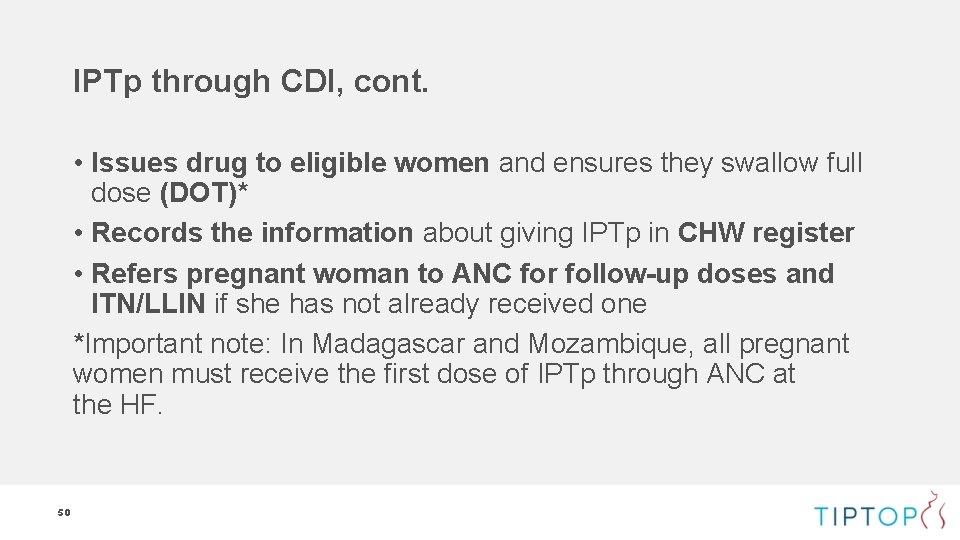
IPTp through CDI, cont. • Issues drug to eligible women and ensures they swallow full dose (DOT)* • Records the information about giving IPTp in CHW register • Refers pregnant woman to ANC for follow-up doses and ITN/LLIN if she has not already received one *Important note: In Madagascar and Mozambique, all pregnant women must receive the first dose of IPTp through ANC at the HF. 50
Notes on IPTp dosing • When gestational age can be accurately determined (by known date of last normal menstrual period, ultrasound, or clinical exam), the first IPTp dose should be given as early as possible in the second trimester (at 13 weeks). When in doubt, wait till the mother can feel the baby move inside her womb (quickening usually occurs by 16 weeks). • It is best for the woman to get the second dose at the ANC clinic, where trained staff can check and test the mother and baby to ensure that the pregnancy is going well. 51
Key health education messages on IPTp • CHW delivers key messages using the Counseling Flip Chart: • Malaria parasites may be in your blood even if you don’t feel sick • Malaria makes your blood weak • When the mother has malaria, the newborn is too small at birth and can get sick easily • IPTp with SP prevents Mi. P 52
CHWs and referrals • CHW refers woman to nearest ANC clinic to get comprehensive ANC and other commodities • CDI focal persons should spot-check CHW register against ANC beneficiaries at monthly supportive supervision meetings 53
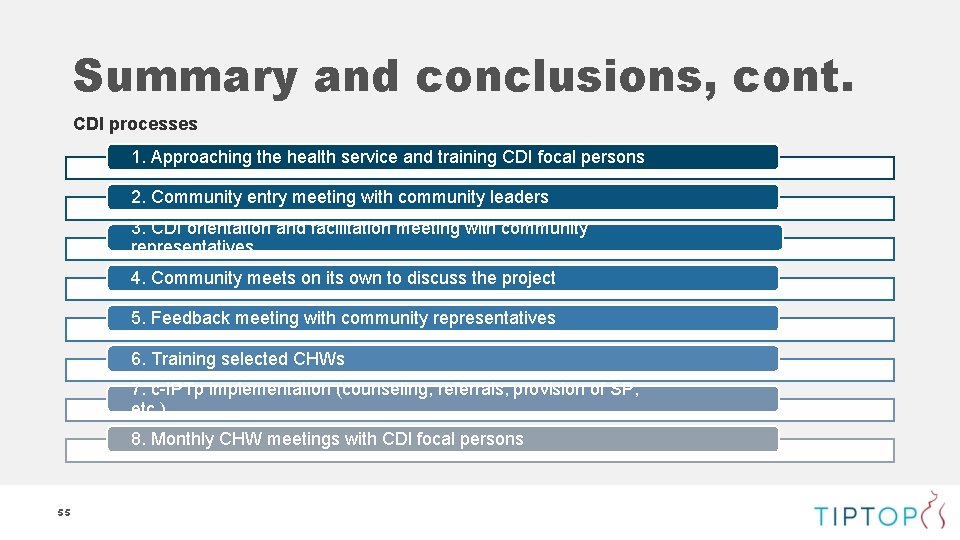
Summary and conclusions • CDI was first tested for use by TDR for APOC and the approach proved successful • Communities CAN carry out the task of distributing health commodities very well • Community-directed distributors or CHWs do not replace HF workers but rather complement their services • CDI happens when communities take charge of distributing health commodities themselves with guidance from the health service 54
Summary and conclusions, cont. CDI processes 1. Approaching the health service and training CDI focal persons 2. Community entry meeting with community leaders 3. CDI orientation and facilitation meeting with community representatives 4. Community meets on its own to discuss the project 5. Feedback meeting with community representatives 6. Training selected CHWs 7. c-IPTp implementation (counseling, referrals, provision of SP, etc. ) 8. Monthly CHW meetings with CDI focal persons 55
References • CDI Study Group. 2010. Community-directed interventions for priority health problems in Africa: results of a multicountry study. Bull World Health Organ. 88(7): 509– 518. doi: 10. 2471/BLT. 09. 069203. • TDR (Special Programme for Research and Training in Tropical Diseases). 2008. Community-Directed Interventions for Major Health Problems in Africa: A Multi-country Study; Final Report. Geneva, Switzerland: TDR/World Health Organization. http: //www. who. int/tdr/publications/documents/cdi_report_08. pdf. Accessed October 18, 2018. 56
Thank you! Any questions or comments? 57