
THE COMMON RULE HABITS THE COMMON RULE HABITS
THE COMMON RULE HABITS
THE COMMON RULE HABITS — MAKE A LIFE ▸ A Rule of Life is a set of habits in order to grow in your love for God and neighbor. ▸ "Habits form much more than our schedules, they form our hearts. ” ~ Justin Whitmel Earley ▸ “All our life, so far as it has definite form, is but a mass of habits—practical, emotional, and intellectual—systematically organized for our weal or woe, and bearing us irresistibly toward our destiny. ~ William James ▸ “Understanding habits is the most important thing I’ve learned in the army…You want to fall asleep fast and wake up feeling good? Pay attention to your nighttime patterns and what you automatically do when you get up. You want to make running easy? Create triggers to make it a routine. I drill my kids on this stuff. My wife and I write out habit plans for our marriage. ” ~ US Major

THE COMMON RULE HABITS — WHAT ARE THEY? ▸ Four Distinct Components ▸ Cue/Trigger — This is what tells a habit that its time to engage (IE: Stress) ▸ Routine — The act of the habit (IE: Smoking) ▸ Reward — Why your brain imprinted the habit to begin with… ▸ Craving — This is glue that holds it all together
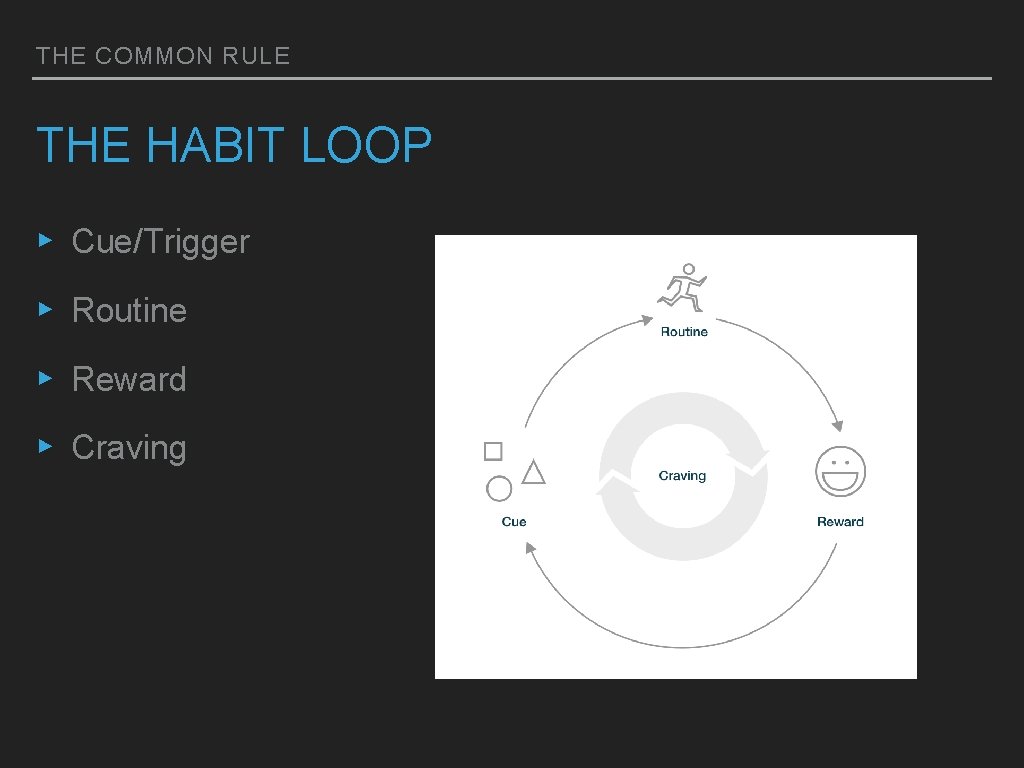
THE COMMON RULE THE HABIT LOOP ▸ Cue/Trigger ▸ Routine ▸ Reward ▸ Craving
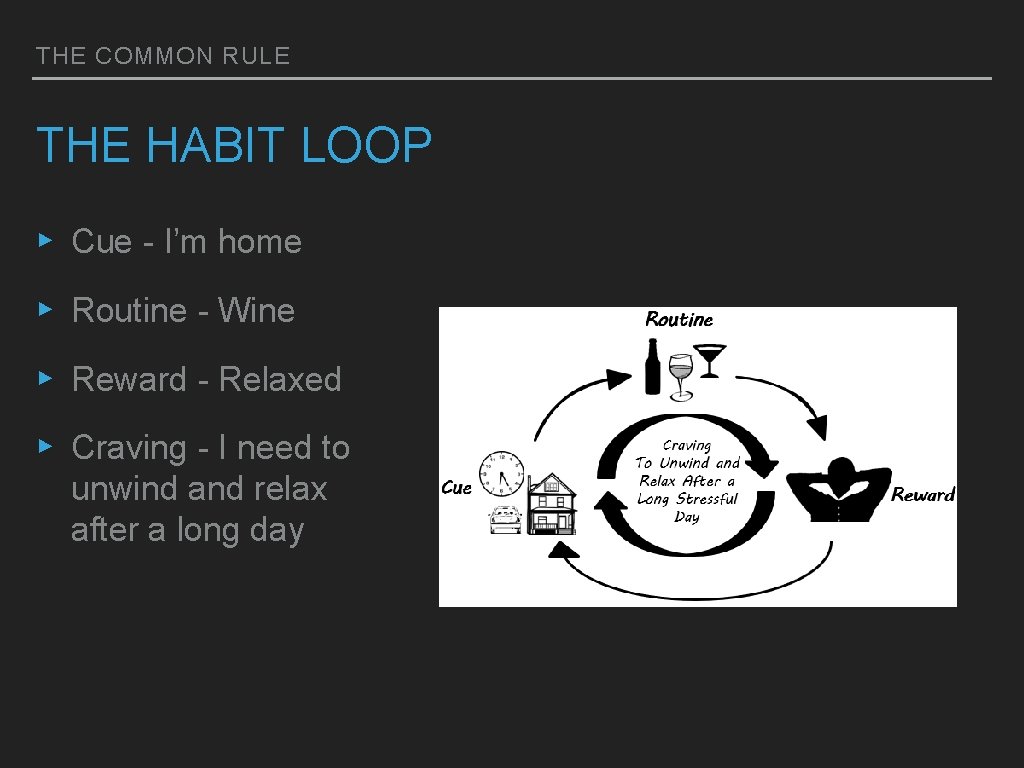
THE COMMON RULE THE HABIT LOOP ▸ Cue - I’m home ▸ Routine - Wine ▸ Reward - Relaxed ▸ Craving - I need to unwind and relax after a long day
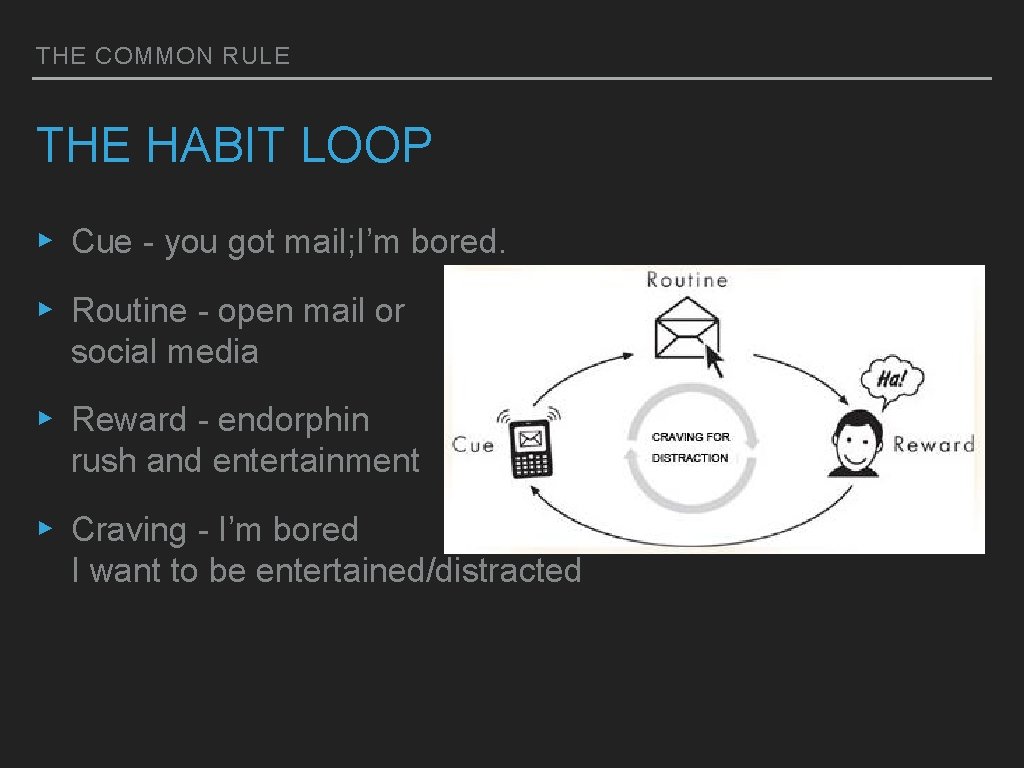
THE COMMON RULE THE HABIT LOOP ▸ Cue - you got mail; I’m bored. ▸ Routine - open mail or social media ▸ Reward - endorphin rush and entertainment ▸ Craving - I’m bored I want to be entertained/distracted
THE COMMON RULE HABITS - WHAT ARE THEY? ▸ A Habit is a behavior that has been repeated enough times to become automatic. ▸ Habits are simply, reliable solutions to recurring problems in our environment. As habits are created, the level of activity in the brain decreases. ▸ Habits are mental shortcuts learned from experience. Without them, our brains would be paralyzed. Without habit loops, our brains would shut down, overwhelmed by the minutiae of daily life.
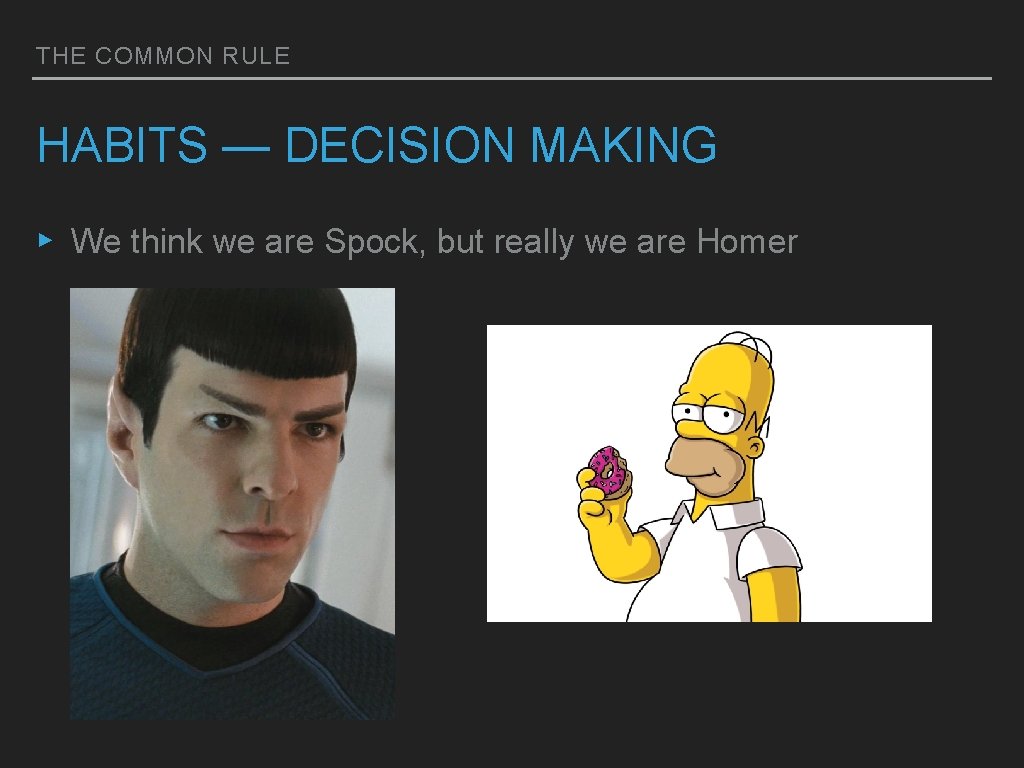
THE COMMON RULE HABITS — DECISION MAKING ▸ We think we are Spock, but really we are Homer
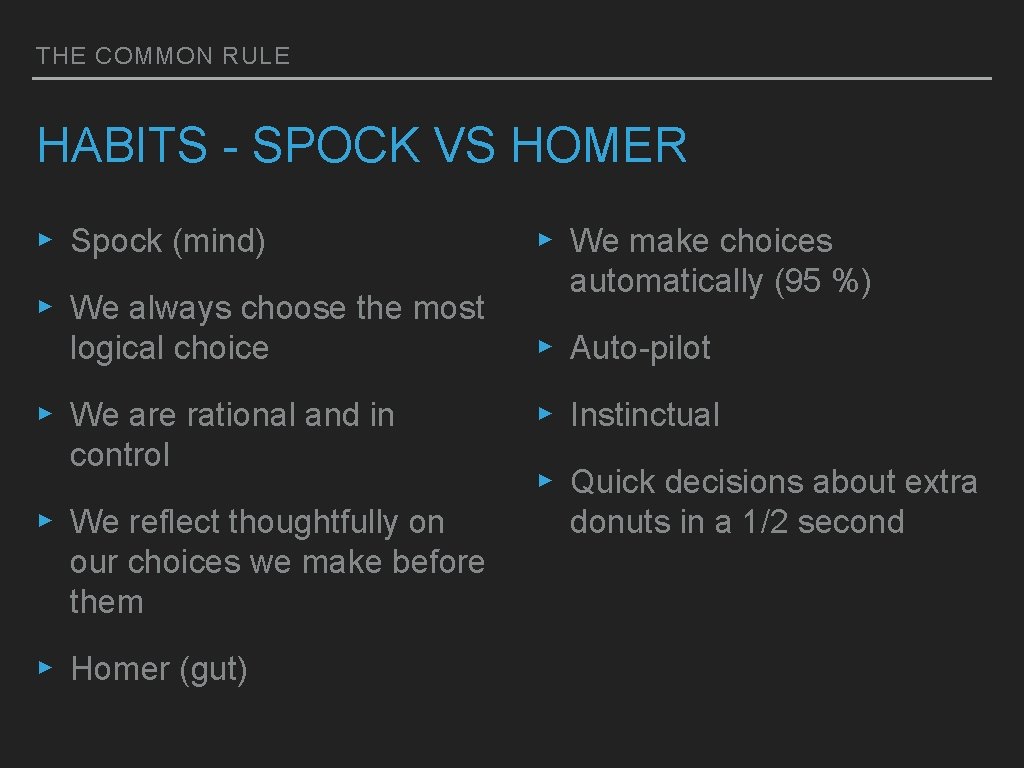
THE COMMON RULE HABITS - SPOCK VS HOMER ▸ Spock (mind) ▸ We always choose the most logical choice ▸ We are rational and in control ▸ We reflect thoughtfully on our choices we make before them ▸ Homer (gut) ▸ We make choices automatically (95 %) ▸ Auto-pilot ▸ Instinctual ▸ Quick decisions about extra donuts in a 1/2 second
THE COMMON RULE HABITS - SPOCK VS HOMER ▸ We think we are Spock when actually we are Homer. ▸ Spock and Homer are in constant conflict ▸ “Spock” is trying to promote your long-term welfare, but “Homer” disrupts this by complying with feelings, temptations, and strong will. ▸ Research has found that the two parts of the brain are in severe conflict – some parts of the brain get tempted while other parts are able to resist. The brain is in battle with either “Homer” or “Spock” bound to lose. The goal is to help give the part of the brain able to resist temptation a gentle nudge in the right direction.
THE COMMON RULE HABITS — SPOCK VS HOMER ▸ Homer wins ▸ When we see the benefits now and costs later (IE: I enjoy this donut now and will pay the cost for it later. I’ll have a cool house now and pay the bill later. ▸ When encountering decisions we make infrequently. We get better with practice. ▸ When feedback isn’t immediate. ▸ When it’s hard to imagine the outcome.

THE COMMON RULE HABITS —UNDERSTANDING HOMER ▸ Battling Homer ▸ Our Biases ▸ Anchoring Bias — we are heavily biased by where we start, an initial piece of info (Odometer reading when buying a used car — an experts opinion — presuppositions) ▸ Availability Bias — we overestimate the likelihood of events we can remember or things that come quickly to our mind. (IE: Population of ABQ — a smoker who lived to a 100; well - known story) ▸ Representative Bias - We sometimes see a pattern where there are none. (IE: Cruise Ships; librarians; farmers) ▸ Unrealistic Optimism — We all think we are better than average (IE: the curve; live longer; more successful) ▸ Loss Aversion — We are happy when we gain something, but twice as unhappy when we lose it. (golf towel/sunglasses) ▸ Status Quo Bias — We rarely overcome inertia. (monthly billing) ▸ Framing Bias — 10 out of 100 die; 90 out of 100 are cured…options are presented with positive or negative semantics (penalty vs. reward for early registration; employment rates vs. unemployment) ▸ Priming Bias — What we see or her immediately before a choice affects how we behave. (have you tried carrot cake)
THE COMMON RULE HABITS — UNDERSTANDING HOMER; THE SPOCK - HOMER EMPATHY GAP ▸ We succumb to temptation! ▸ Your planner doesn’t fully appreciate how much your behaviors are altered when you are under the influence of temptation. ▸ Planner vs. Doer ▸ What are your temptations? ▸ Why do you succumb to them?
THE COMMON RULE HABITS — UNDERSTANDING HOMER — AUTOPILOT ▸ Mindless Choosing — your autopilot just continues doing what it’s used to - driving the same route, or continuing to eat when there’s food in front of you. ▸ Example: participants were given very stale popcorn, either a large bag or a small bag, and then watched a movie. Participants with the large bag ate 34% more, just because it was there and they were on autopilot.
THE COMMON RULE HABITS — UNDERSTANDING HOMER ▸ We follow the Herd! ▸ We like to conform. This is at the root of speculative bubbles, internet memes, and ice bucket challenges. ▸ One phenomenon that drives us to conform is the “spotlight effect, ” which makes us feel like people are paying closer attention to us--especially when we’re not conforming--than they really are. ▸ Popularity Lists: One particularly interesting ramification of the herd behavior is its effect on popularity lists. One experiment offered different groups of people the same set of downloadable mp 3 s with visible popularity data. In the end, the most popular songs for each group were not predictable and were not similar from group to group, except that they were lucky and picked by the first users of the system
THE COMMON RULE HABITS — BEATING HOMER — UNDERSTANDING HABITS ▸ How can we help Spock beat Homer? ▸ By joining Him…making good habits mindless! ▸ This is both the result of habits and why we need habits. ▸ By changing the habit loop — awakened to cues, triggers and nudges with new routines and new nudges ▸ When a habit becomes part of your identity… ▸ More on these next week
THE COMMON RULE HOMEWORK — A HABIT AUDIT ▸ Become more aware of your habits. ▸ Make a list of your daily habits. ▸ Morning Routine ▸ Work-Day/School-Day/Parent-Day Routine ▸ Evening and Nighttime Routine ▸ Can be simple or more detailed
THE COMMON RULE A HABIT AUDIT ▸ Once you have a full list, look at each behavior, and ask yourself, ▸ “Is this a good habit, a bad habit, or a neutral habit? ” ▸ If it is a good habit, write “+” next to it. ▸ If it is a bad habit, write “-” next to it. ▸ If it is a neutral habit, write “=” next to it. ▸ Does this habit help me to love God, love people, love myself? Does this habit form Jesus in me; shape me to look more like Jesus? Remember liturgies (sometimes things are more deformative than we realize.

TEXT
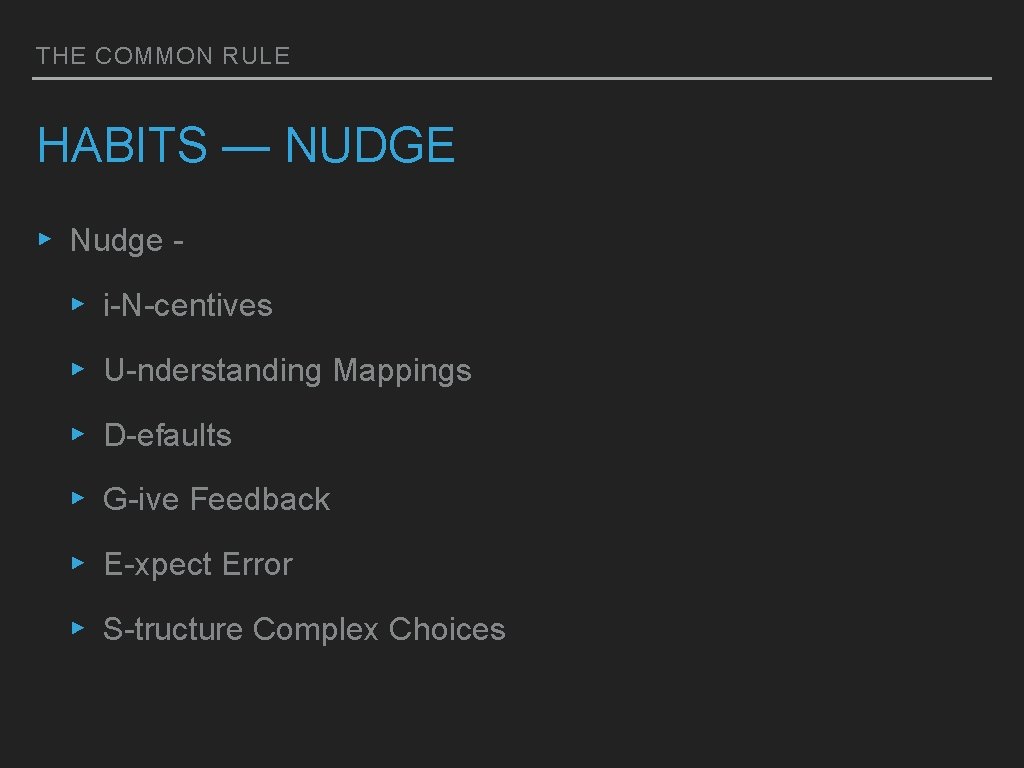
THE COMMON RULE HABITS — NUDGE ▸ Nudge ▸ i-N-centives ▸ U-nderstanding Mappings ▸ D-efaults ▸ G-ive Feedback ▸ E-xpect Error ▸ S-tructure Complex Choices
- Slides: 20