
The Common Man Illustration By R K Laxman
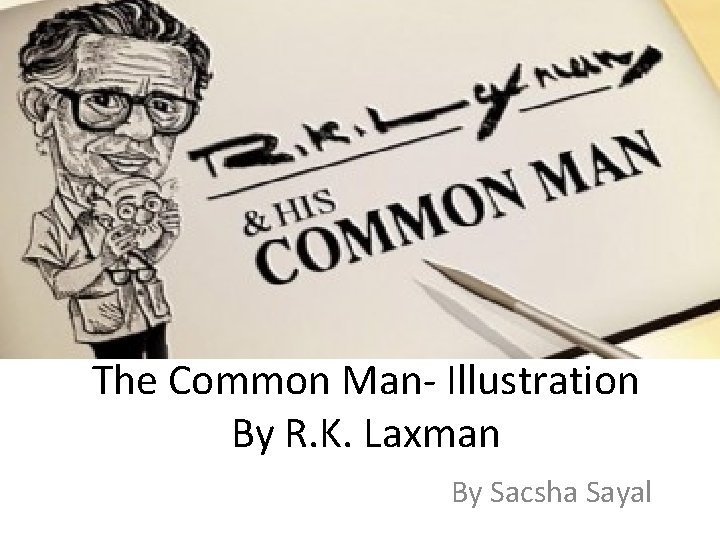
The Common Man- Illustration By R. K. Laxman By Sacsha Sayal
The Common Man- Introduction There's a morning ritual in India that lasted for decades. Each day, millions of Indians would look at the cover of The Times of India to check in on The Common Man, in the ‘You Said It” cartoon strip, the cartoon character created by cartoonist R. K. Laxman.
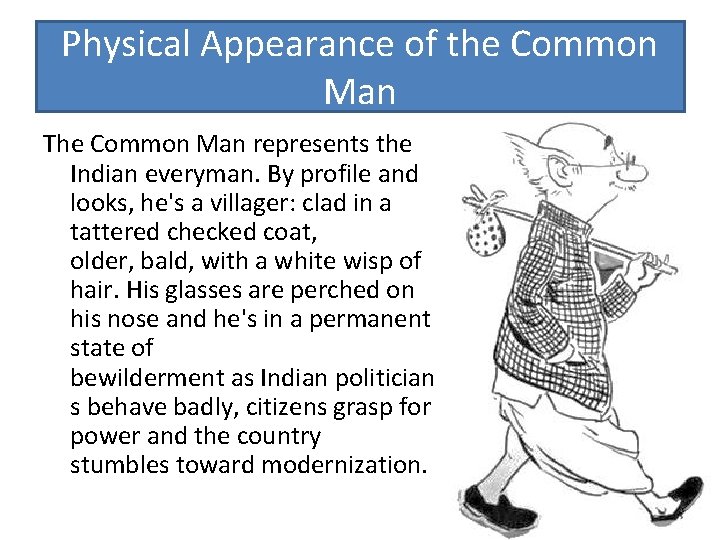
Physical Appearance of the Common Man The Common Man represents the Indian everyman. By profile and looks, he's a villager: clad in a tattered checked coat, older, bald, with a white wisp of hair. His glasses are perched on his nose and he's in a permanent state of bewilderment as Indian politician s behave badly, citizens grasp for power and the country stumbles toward modernization.
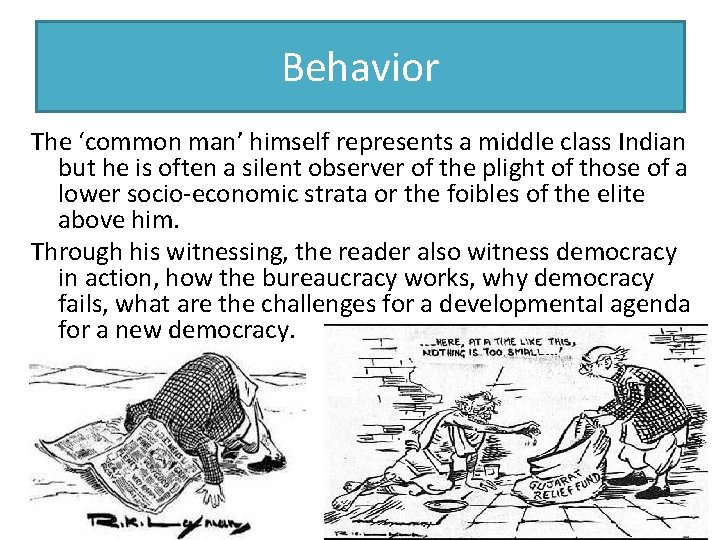
Behavior The ‘common man’ himself represents a middle class Indian but he is often a silent observer of the plight of those of a lower socio-economic strata or the foibles of the elite above him. Through his witnessing, the reader also witness democracy in action, how the bureaucracy works, why democracy fails, what are the challenges for a developmental agenda for a new democracy.
Passivity and Omnipresence of the character He seems to be the subject in contexts but like an object to the surroundings. He is a keen observer (wide eyes open most of the times) but not responsive. Yet has a passive worry, accepting and helpless expression. Silently forming public opinion and passively convincing them in support of it. Non verbal (body language) expression of agitation but passive response delivered in the scene.
How The common Man Character Came to Be? When Laxman's works started being too polarized with political characterization, the TOI authorities suggested him to create something from ‘a common man’s point of view’. Thus Laxman started exploring the possibilities of representation of the scenario from a common man’s point of view, thus ending up using a particular ambiguous character repeatedly to present his opinion which was popularly recognized as the Common Man.


Analysing His Physical Appearance Laxman's Common Man seems as a generalized approach towards a common Indian middle aged man, belonging to roughly a middle class. His signature look comprises of: Signature style dhoti kurta – which suggests him to be a follower of Swadeshi dressing, but not particularly suggesting identity of any state dress.
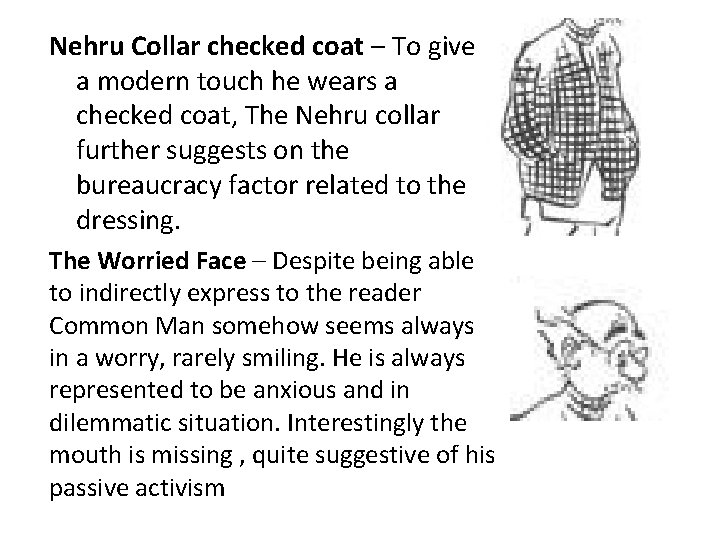
Nehru Collar checked coat – To give a modern touch he wears a checked coat, The Nehru collar further suggests on the bureaucracy factor related to the dressing. The Worried Face – Despite being able to indirectly express to the reader Common Man somehow seems always in a worry, rarely smiling. He is always represented to be anxious and in dilemmatic situation. Interestingly the mouth is missing , quite suggestive of his passive activism
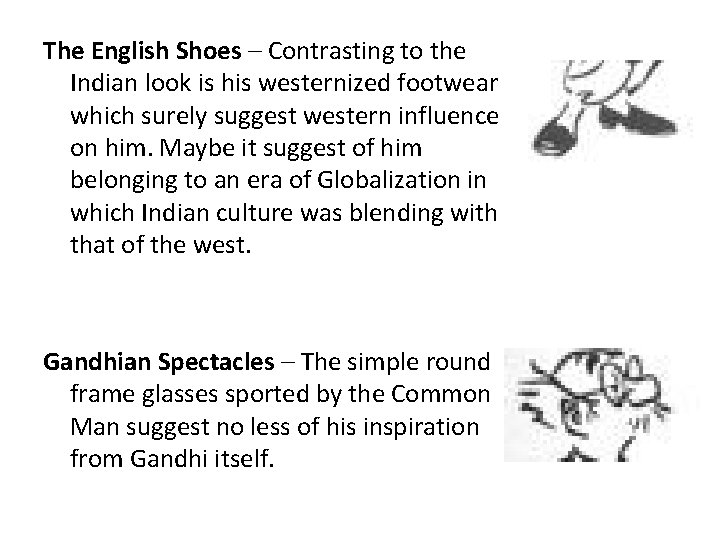
The English Shoes – Contrasting to the Indian look is his westernized footwear which surely suggest western influence on him. Maybe it suggest of him belonging to an era of Globalization in which Indian culture was blending with that of the west. Gandhian Spectacles – The simple round frame glasses sported by the Common Man suggest no less of his inspiration from Gandhi itself.
Illustration Techniques Used by Laxman uses strong lines to draw his characters and makes effective use of light, texture and form to get across a clear message through his pocket size cartoon. The quality and strength of the lines, whether they are curvy, straight or zigzag adds its own connotation to the image. R K Laxman adds text to most of his cartoons in order to add humor or irony to the image and to make the message clearer for his audience. He also makes use of proportion to imply the power and strength of character or to emphasize a point.
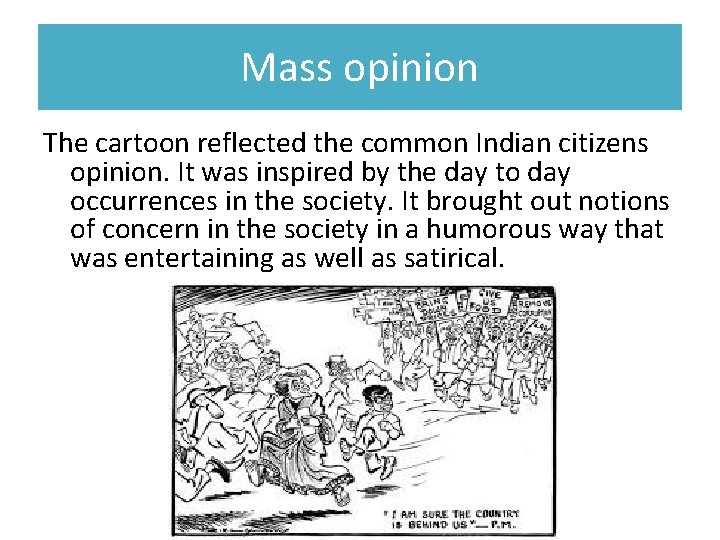
Mass opinion The cartoon reflected the common Indian citizens opinion. It was inspired by the day to day occurrences in the society. It brought out notions of concern in the society in a humorous way that was entertaining as well as satirical.
R. K. Laxman’s Views In his autobiography ‘The Tunnel of Time’ he writes about his character – “ The bespectacled Common Man in his checked coat had walked into my cartoon spontaneously, as if I had no hand in his creation. Equally effortlessly he became a silent spectator of events, moving with ease from drought-stricken villages to the airport to watch foreign delegations arriving. . . In the course of time I was surprised to discover that my readers looked upon me not merely as a cartoonist who tickled their sense of humour, but as a profound thinker, a social reformer, a political scientist, a critic of errant politicians and so on. ”
Conclusion On how the ‘common man’ influences there perception of events, the respondents feel that the ‘common man’ cartoon is thought provoking. Along with a humorous take on the things it doesn’t allow us to forget the gravity/seriousness of the situation. The middle class constitutes the majority of the percentage of India’s population and is directly affected by all social, political and financial happening/situations/events around us, readers are able to empathize with what the “common man “feels and based on the same logic, “common man” is able to drive the point home.
- Slides: 14