
The Common Editing Strategy and the Data Processing

- Slides: 9
The Common Editing Strategy and the Data Processing of Business Statistics Surveys UNECE - Work Session on Statistical Editing (Topic iii – Macro Editing Methods) Étienne Saint-Pierre and Mario Bricault, Statistics Canada Ljubljana, Slovenia, May 9 th 2011
Context of the Implementation of the Common Editing Strategy § Integrated Business Statistics Program § Major integration project for business surveys to: – Enhance quality assurance – Achieve efficiencies – Improve responsiveness in the delivery of new programs § Covers all aspects of the business surveys § 120 surveys in 10 different programs integrated by 2016 – Two key features to achieve the goals: Rolling Estimates and the Common Editing Strategy. 2 Statistics Canada • Statistique Canada 2021 -06 -09
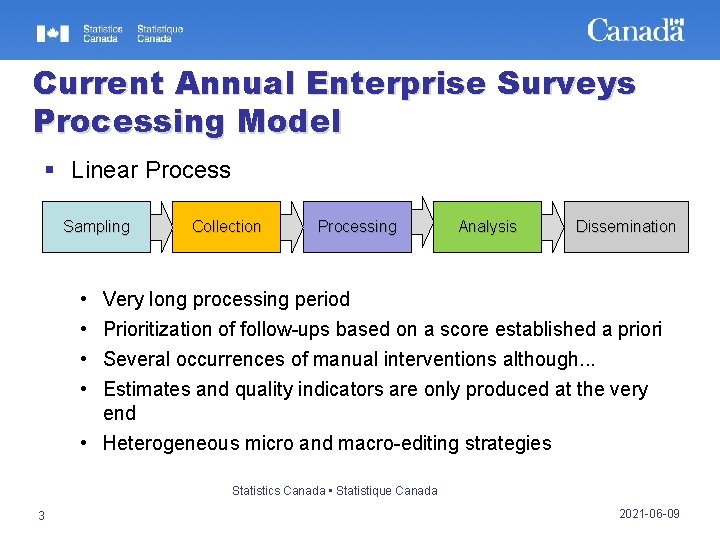
Current Annual Enterprise Surveys Processing Model § Linear Process Sampling Collection Processing Analysis Dissemination • • Very long processing period Prioritization of follow-ups based on a score established a priori Several occurrences of manual interventions although. . . Estimates and quality indicators are only produced at the very end • Heterogeneous micro and macro-editing strategies Statistics Canada • Statistique Canada 3 2021 -06 -09
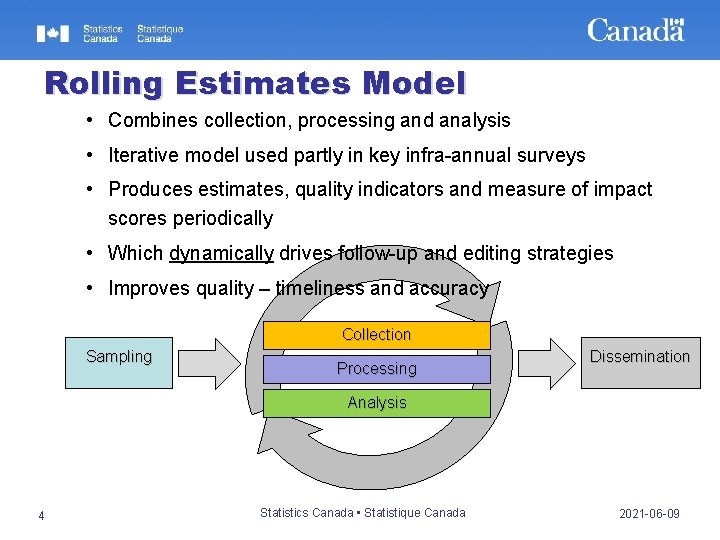
Rolling Estimates Model • Combines collection, processing and analysis • Iterative model used partly in key infra-annual surveys • Produces estimates, quality indicators and measure of impact scores periodically • Which dynamically drives follow-up and editing strategies • Improves quality – timeliness and accuracy Collection Sampling Processing Dissemination Analysis 4 Statistics Canada • Statistique Canada 2021 -06 -09
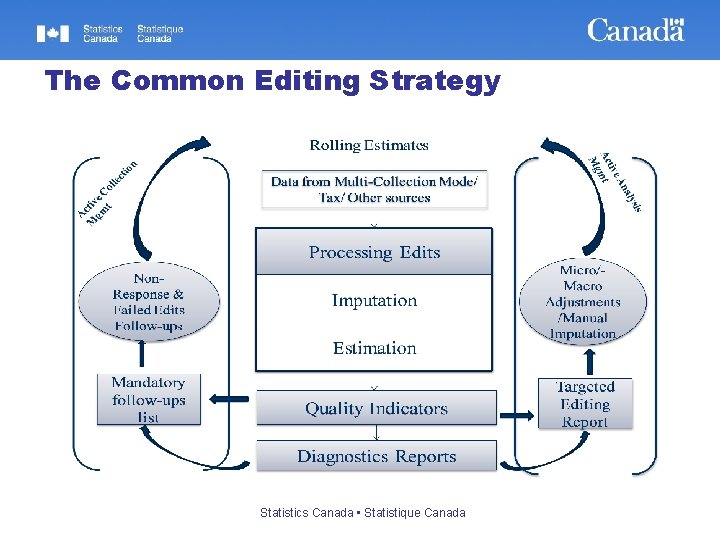
The Common Editing Strategy Statistics Canada • Statistique Canada
Common Editing Strategy – Key components • Initiative in line with the concept of selective editing in an integrated survey framework implemented in several statistical agencies. • New Edits Rules Framework § Maximize automated imputation § Most edits are applied in processing rather than at the collection stage • Quality Indicators - QI § Calculated for key domains of estimation after each iteration § Proactively helps to identify problems § Trigger signal to end follow-ups § Details in Godbout, Beaucage, Turmelle (2011) 6 Statistics Canada • Statistique Canada 2021 -06 -09
Common Editing Strategy – Key Components • Micro-Record Impact Scores (MI) § Enhanced score functions – Dynamically adjusted after each iteration § Identify influential units to prioritize follow-ups and editing § Details in Godbout, Beaucage, Turmelle (2011) • Active Collection Management § 2 conditions to follow-up a unit: – Unit in a domain of estimation under the target quality level – Influential unit in terms of quality and impact on the estimates • Active Analysis Management § Standard framework for analysis § Building knowledge prior to analysis § QI embedded systematically with estimates § MI to help target influential records in domains that need to be investigated 7 Statistics Canada • Statistique Canada 2021 -06 -09
Future Work • Introduction of a basic version of Rolling Estimates and Common Editing Strategy for 58 business surveys in 2011 (parallel run) § 4 iterations § Production of QIs (weighted response rates and CVs) and MIs § Based on a variety of key variables § Derive thresholds defining influential units to maximize quality under a given collection budget § Measure potential impact on the collection / editing effort for given quality targets § Simulations to be repeated in 2012 and 2013. 8 Statistics Canada • Statistique Canada 2021 -06 -09
• For more information, please contact: Pour plus d’information, veuillez contacter: Etienne. Saint-Pierre@statcan. gc. ca Mario. Bricault@statcan. gc. ca 9 Statistics Canada • Statistique Canada 2021 -06 -09