
The Committee of 5 John Adams Thomas Jefferson
- Slides: 6
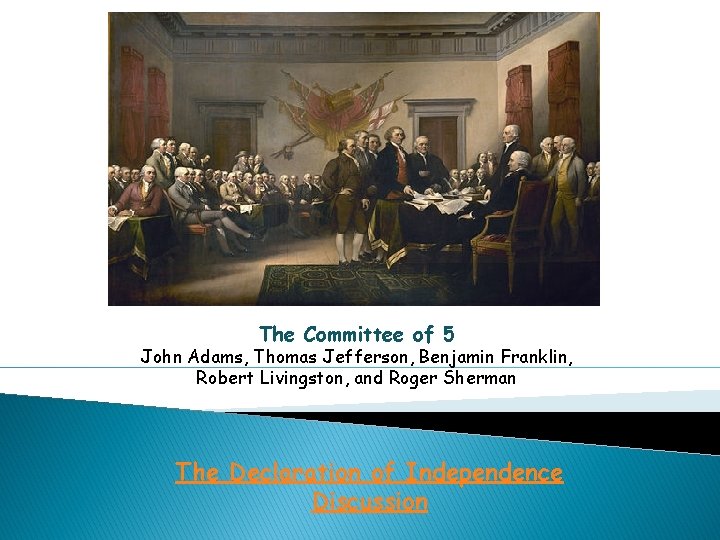
The Committee of 5 John Adams, Thomas Jefferson, Benjamin Franklin, Robert Livingston, and Roger Sherman The Declaration of Independence Discussion
Events Leading Up To the Writing of The Declaration of Independence 1754 -1763 - French and Indian War 1763 – Proclamation Act 1764 - Sugar Act 1765 - Stamp Act 1767 - Townshend Act 1770 - The Boston Massacre 1773 – The Tea Act and The Boston Tea Party 1774 -The Intolerable Acts and The First Continental Congress 1775 - Paul Revere & Concord and Lexington, and Bunker Hill The Second Continental Congress meets. 1776 -The Declaration of Independence
Natural Rights q John Locke was a philosopher and Englishman in the 1600’s that believed that by being born, a person is entitled to his life, not a government. q He expressed the radical view that government is morally obliged to serve people, namely by protecting life, liberty, and property. He explained the principle of checks and balances to limit government power. He favored representative government and a rule of law. He denounced tyranny. He insisted that when government violates individual rights, people may legitimately rebel. q It is clear that Thomas Jefferson used Locke’s beliefs in the writing of The Declaration of Independence. “Life, Liberty, and the Pursuit of Happiness”
Drawing on documents, such as the Virginia Declaration of Rights, state and local calls for independence, and his own draft of a Virginia constitution, Jefferson wrote a stunning statement of the colonists' right to rebel against the British government and establish their own based on the premise that all men are created equal and have the inalienable rights of life, liberty, and the pursuit of happiness. Jefferson was critical of changes to the document, particularly the removal of a long paragraph that attributed responsibility of the slave trade to British King George III. Jefferson was justly proud of his role in writing the Declaration of Independence and skillfully defended his authorship of this hallowed document.
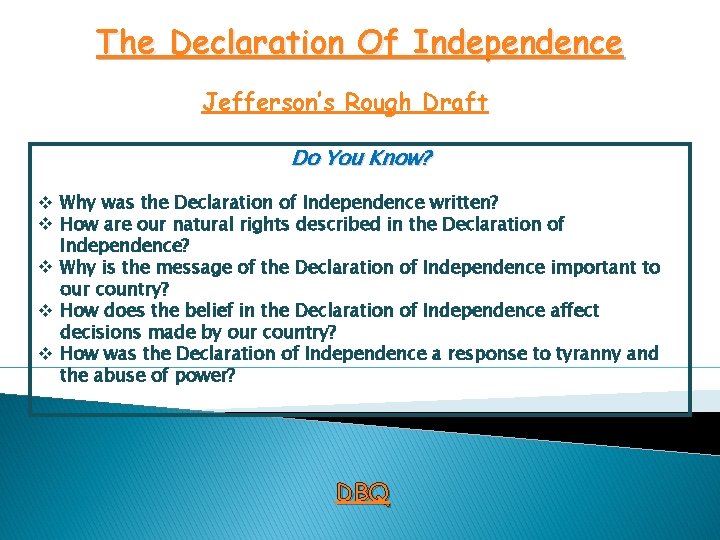
The Declaration Of Independence Jefferson’s Rough Draft Do You Know? v Why was the Declaration of Independence written? v How are our natural rights described in the Declaration of Independence? v Why is the message of the Declaration of Independence important to our country? v How does the belief in the Declaration of Independence affect decisions made by our country? v How was the Declaration of Independence a response to tyranny and the abuse of power? DBQ
References ü Declaration retrieved from http: //www. youtube. com/watch? v=yb 7 MI 8 NQLoo ü Discussion retrieved from http: //www. youtube. com/watch? v=n. Mueh 4 TQi. K 8 ü Declaration document retrieved from http: //www. archives. gov/exhibits/charters/declaration _transcript. html ü Thomas Jefferson’s Rough Draft retrieved from http: //www. ushistory. org/declaration/document /rough. htm ü DBQ is on page 29 of the GPStandards document https: //www. georgisstandards. org/Frameworks/ GSO%20 Frameworks/SS_Gr_4_Unit_4_10 -20 -09_ PRchgs. pdf