
The combined use of MODIS CALIPSO and OMI
The combined use of MODIS, CALIPSO and OMI level 2 aerosol products for calculating direct aerosol radiative effects Jens Redemann, M. Vaughan, Y. Shinozuka, P. Russell, J. Livingston, A. Clarke, L. Remer, C. Hostetler, R. Ferrare, J. Hair, P. Pilewskie, S. Schmidt, E. Bierwirth BAERI – NASA Langley - NASA Ames – SRI – UHawaii - NASA Goddard - UColorado http: //geo. arc. nasa. gov/AATS-website/ email: Jens. Redemann-1@nasa. gov
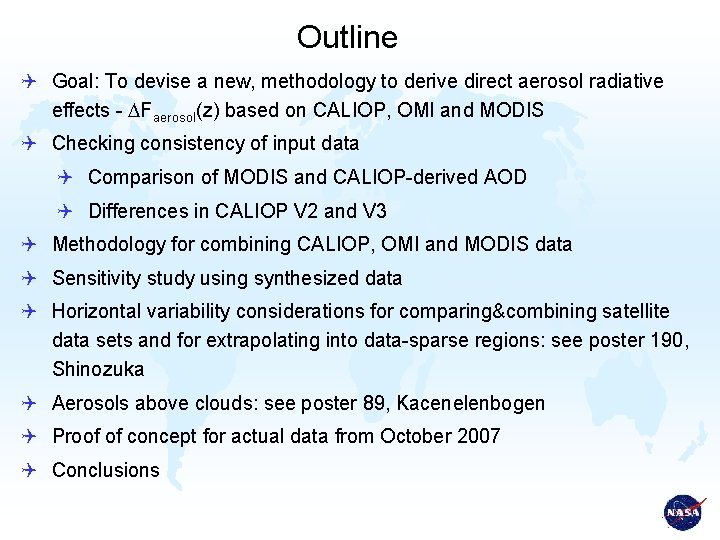
Outline Q Goal: To devise a new, methodology to derive direct aerosol radiative effects - DFaerosol(z) based on CALIOP, OMI and MODIS Q Checking consistency of input data Q Comparison of MODIS and CALIOP-derived AOD Q Differences in CALIOP V 2 and V 3 Q Methodology for combining CALIOP, OMI and MODIS data Q Sensitivity study using synthesized data Q Horizontal variability considerations for comparing&combining satellite data sets and for extrapolating into data-sparse regions: see poster 190, Shinozuka Q Aerosols above clouds: see poster 89, Kacenelenbogen Q Proof of concept for actual data from October 2007 Q Conclusions
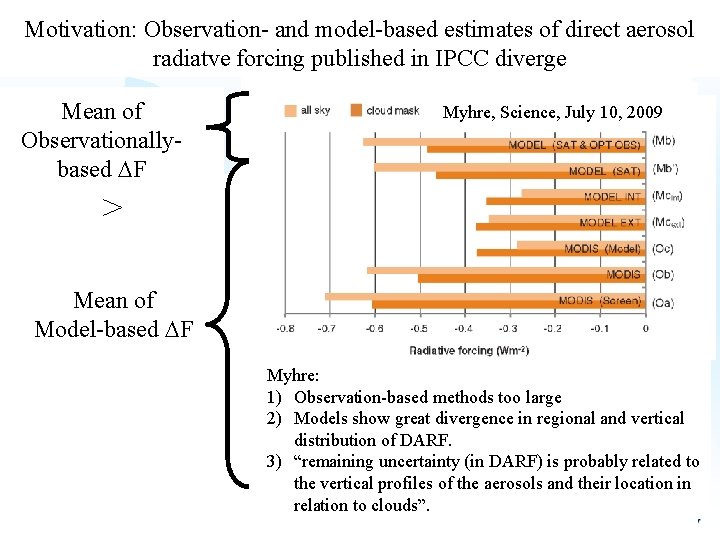
Motivation: Observation- and model-based estimates of direct aerosol radiatve forcing published in IPCC diverge # of Observationally. Mean of based DF based Observationallybased DF Myhre, Science, July 10, 2009 > < Mean of # of Model-based DF Myhre: 1) Observation-based methods too large 2) Models show great divergence in regional and vertical distribution of DARF. 3) “remaining uncertainty (in DARF) is probably related to the vertical profiles of the aerosols and their location in relation to clouds”.
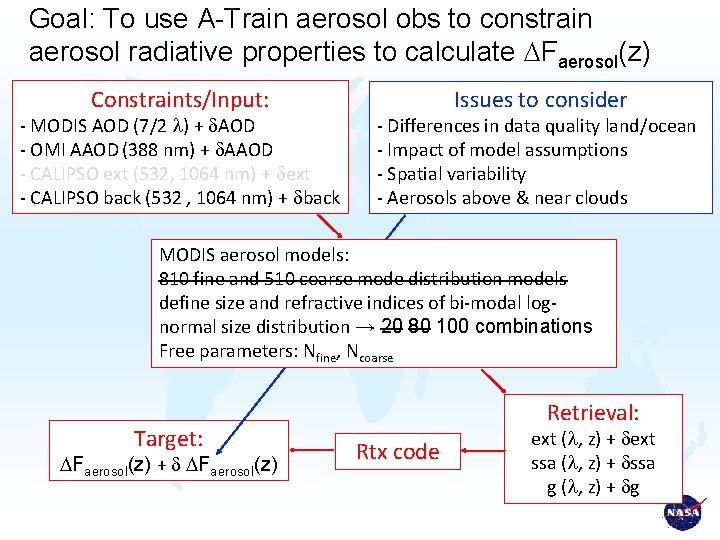
Goal: To use A-Train aerosol obs to constrain aerosol radiative properties to calculate DFaerosol(z) Constraints/Input: - MODIS AOD (7/2 l) + d. AOD - OMI AAOD (388 nm) + d. AAOD - CALIPSO ext (532, 1064 nm) + dext - CALIPSO back (532 , 1064 nm) + dback Issues to consider - Differences in data quality land/ocean - Impact of model assumptions - Spatial variability - Aerosols above & near clouds MODIS aerosol models: 810 fine and 510 coarse mode distribution models define size and refractive indices of bi-modal lognormal size distribution → 20 80 100 combinations Free parameters: Nfine, Ncoarse Target: DFaerosol(z) + d DFaerosol(z) Retrieval: Rtx code ext (l, z) + dext ssa (l, z) + dssa g (l, z) + dg
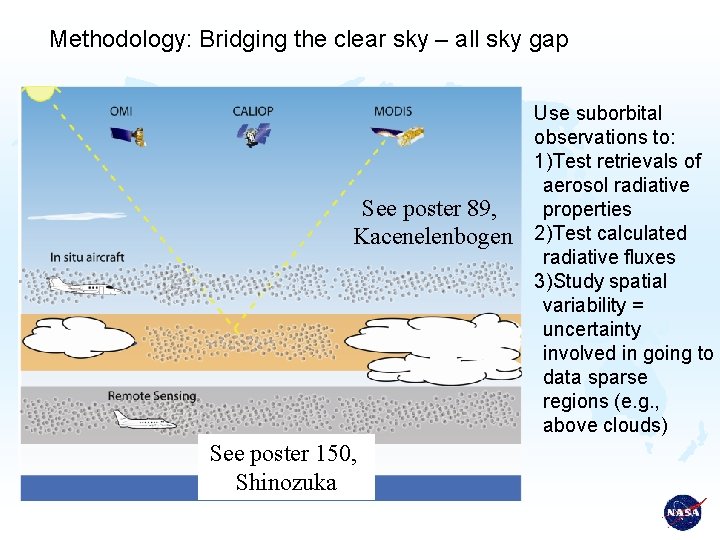
Methodology: Bridging the clear sky – all sky gap See poster 89, Kacenelenbogen See poster 150, Shinozuka Use suborbital observations to: 1)Test retrievals of aerosol radiative properties 2)Test calculated radiative fluxes 3)Study spatial variability = uncertainty involved in going to data sparse regions (e. g. , above clouds)
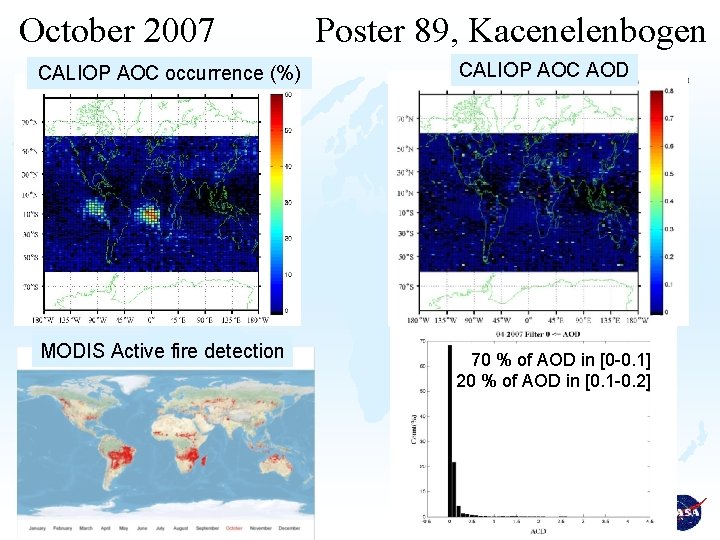
October 2007 Poster 89, Kacenelenbogen CALIOP AOC occurrence (%) MODIS Active fire detection CALIOP AOC AOD 70 % of AOD in [0 -0. 1] 20 % of AOD in [0. 1 -0. 2]
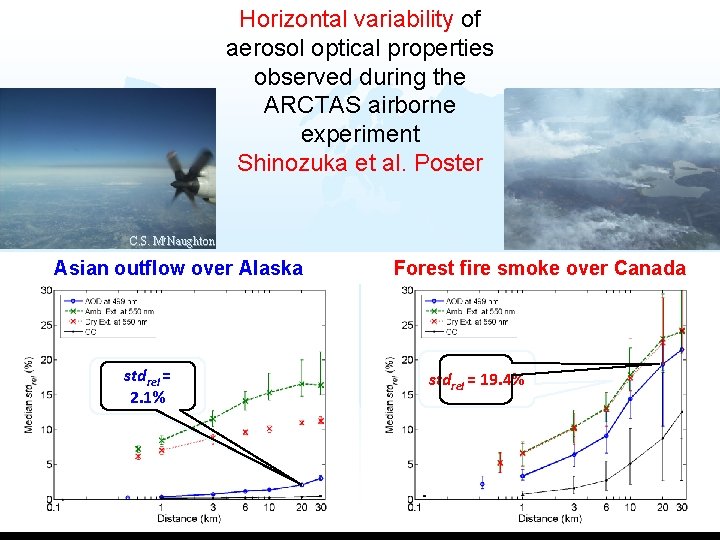
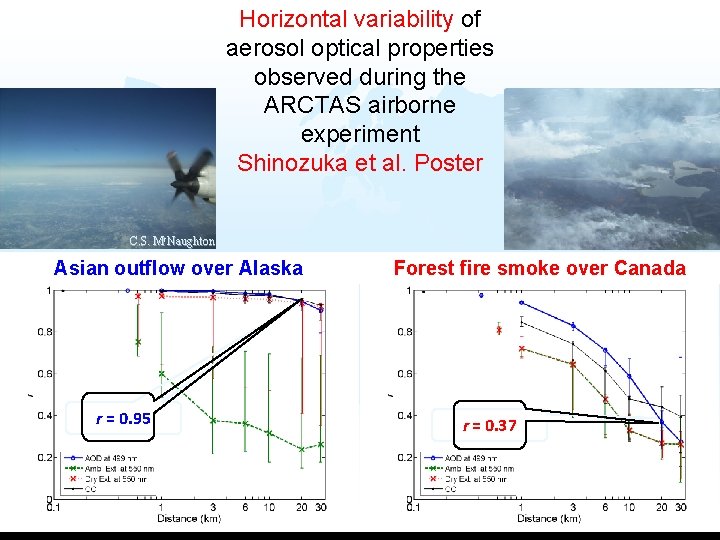
Horizontal variability of aerosol optical properties observed during the ARCTAS airborne experiment Shinozuka et al. Poster C. S. Mc. Naughton Asian outflow over Alaska stdrel = 2. 1% Forest fire smoke over Canada stdrel = 19. 4%
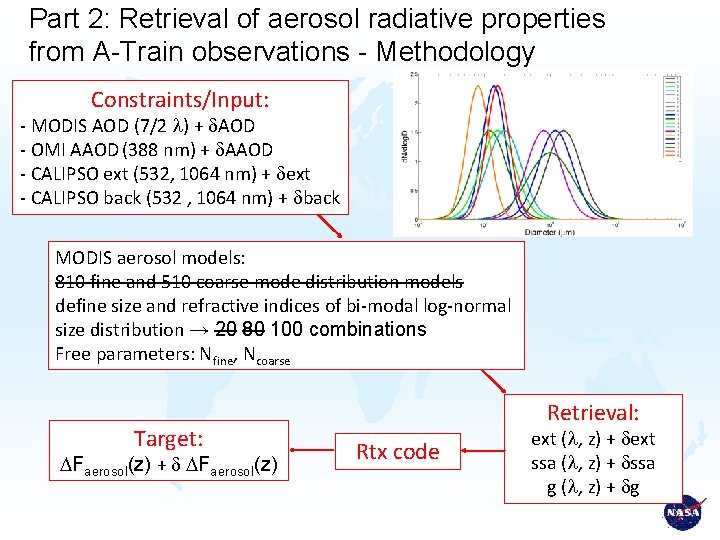
Part 2: Retrieval of aerosol radiative properties from A-Train observations - Methodology Constraints/Input: - MODIS AOD (7/2 l) + d. AOD - OMI AAOD (388 nm) + d. AAOD - CALIPSO ext (532, 1064 nm) + dext - CALIPSO back (532 , 1064 nm) + dback MODIS aerosol models: 810 fine and 510 coarse mode distribution models define size and refractive indices of bi-modal log-normal size distribution → 20 80 100 combinations Free parameters: Nfine, Ncoarse Target: DFaerosol(z) + d DFaerosol(z) Retrieval: Rtx code ext (l, z) + dext ssa (l, z) + dssa g (l, z) + dg
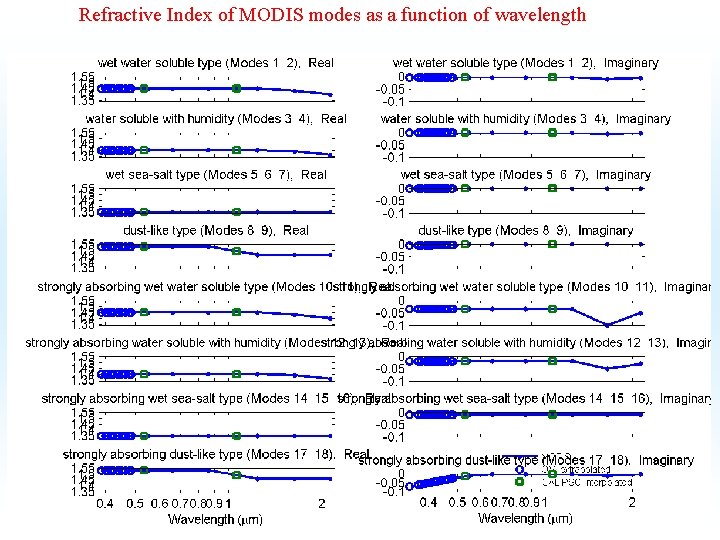
Refractive Index of MODIS modes as a function of wavelength
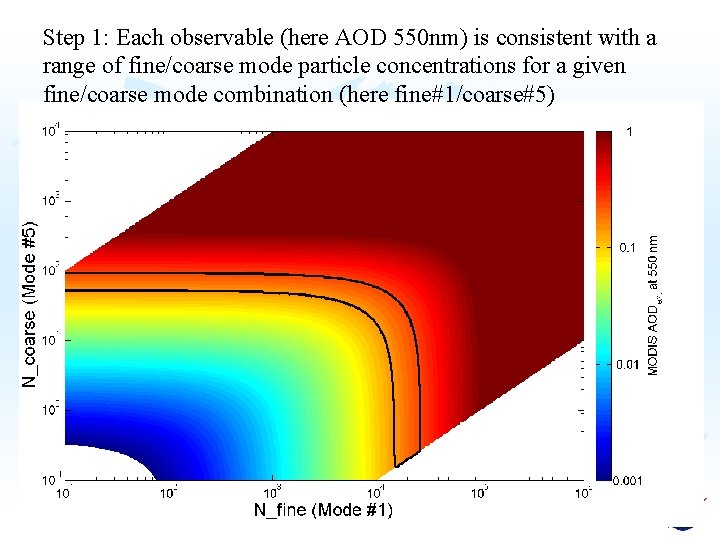
Step 1: Each observable (here AOD 550 nm) is consistent with a range of fine/coarse mode particle concentrations for a given fine/coarse mode combination (here fine#1/coarse#5)
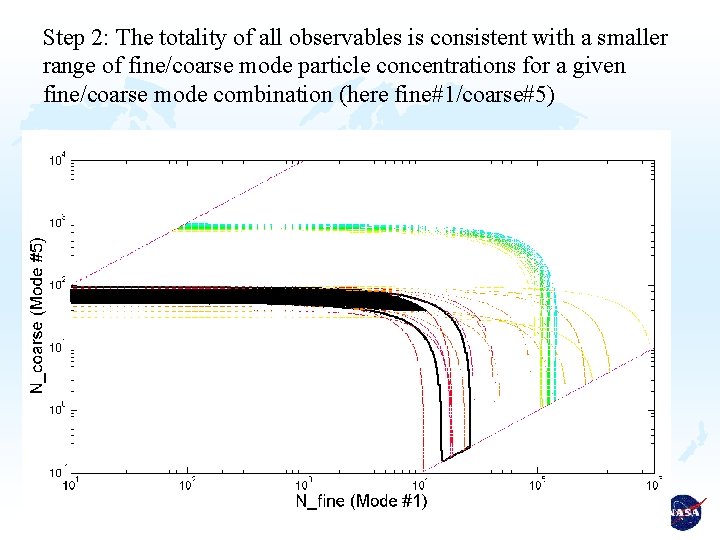
Step 2: The totality of all observables is consistent with a smaller range of fine/coarse mode particle concentrations for a given fine/coarse mode combination (here fine#1/coarse#5)
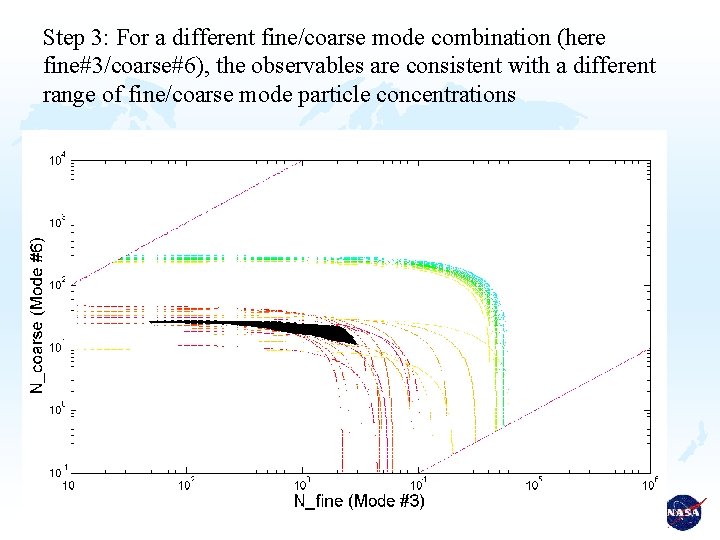
Step 3: For a different fine/coarse mode combination (here fine#3/coarse#6), the observables are consistent with a different range of fine/coarse mode particle concentrations
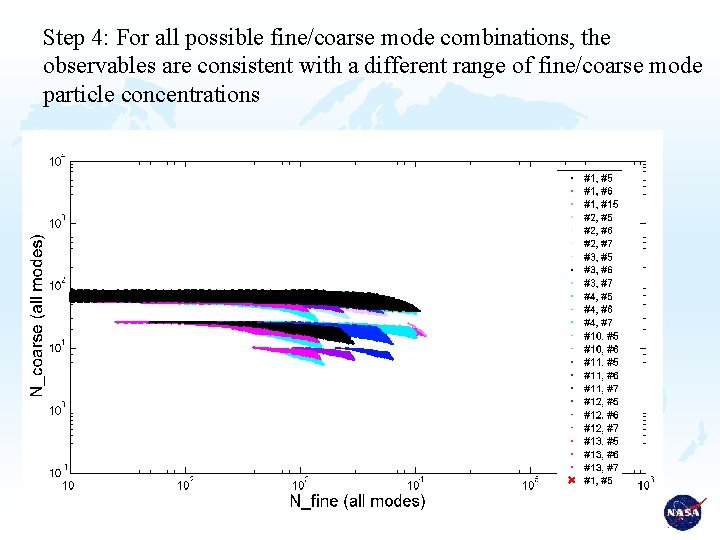
Step 4: For all possible fine/coarse mode combinations, the observables are consistent with a different range of fine/coarse mode particle concentrations
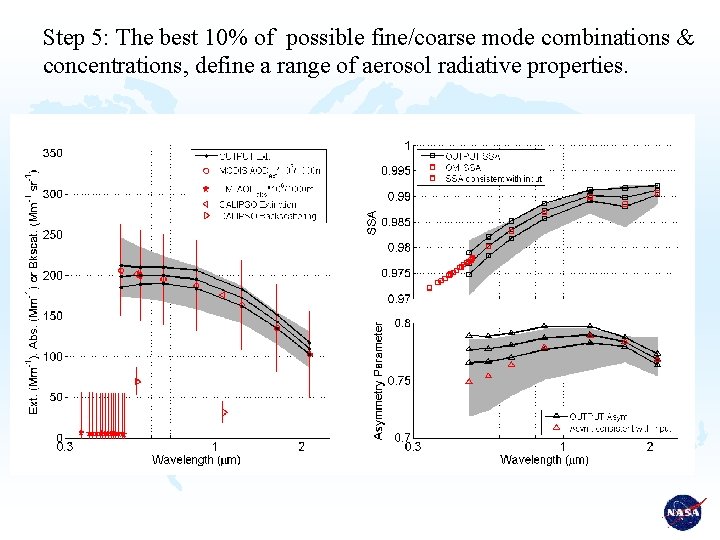
Step 5: The best 10% of possible fine/coarse mode combinations & concentrations, define a range of aerosol radiative properties.
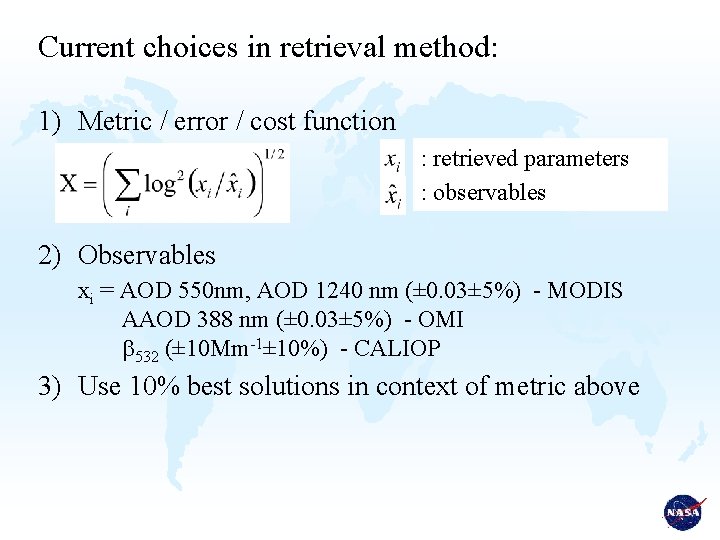
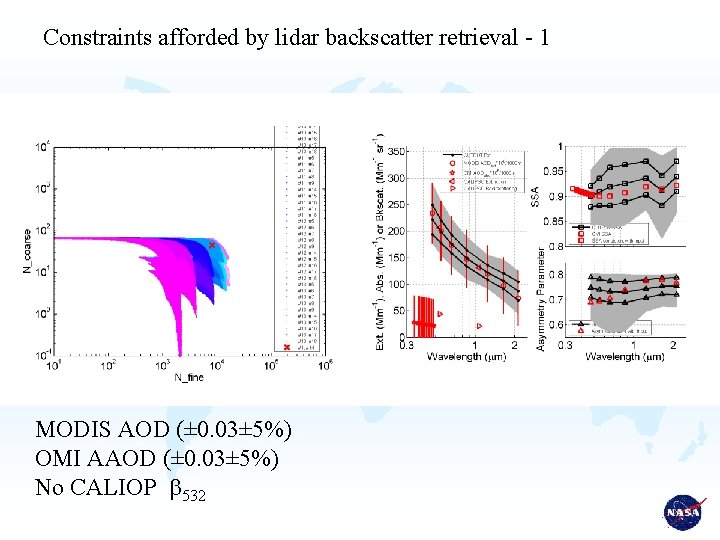
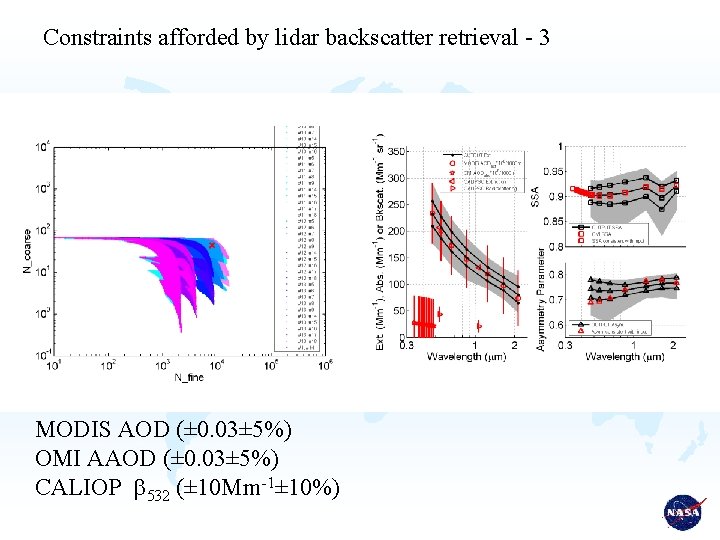
Current choices in retrieval method: 1) Metric / error / cost function : retrieved parameters : observables 2) Observables xi = AOD 550 nm, AOD 1240 nm (± 0. 03± 5%) - MODIS AAOD 388 nm (± 0. 03± 5%) - OMI b 532 (± 10 Mm-1± 10%) - CALIOP 3) Use 10% best solutions in context of metric above
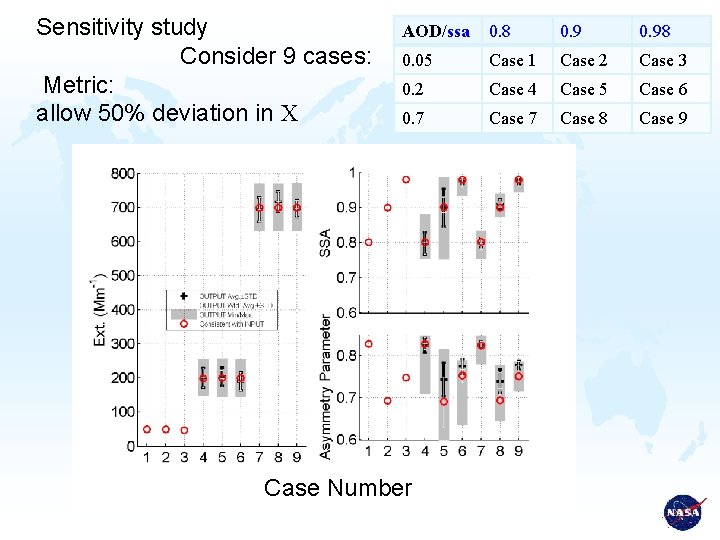
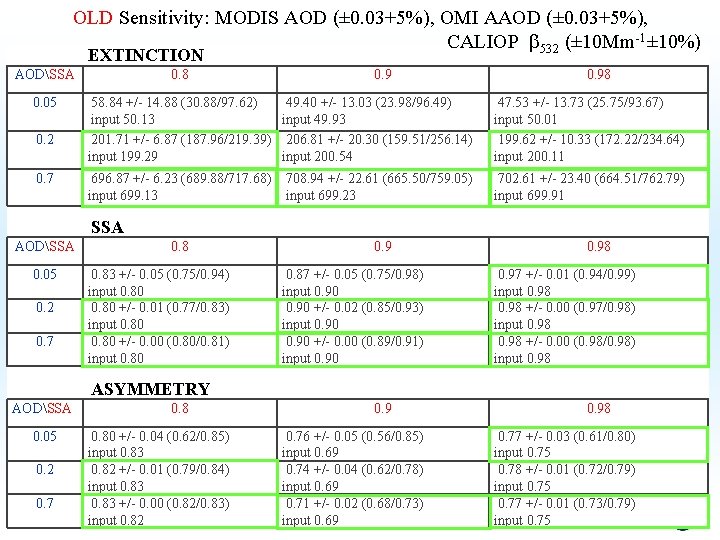
Sensitivity study Consider 9 cases: Metric: allow 50% deviation in C AOD/ssa 0. 8 0. 98 0. 05 Case 1 Case 2 Case 3 0. 2 Case 4 Case 5 Case 6 0. 7 Case 8 Case 9 Case Number
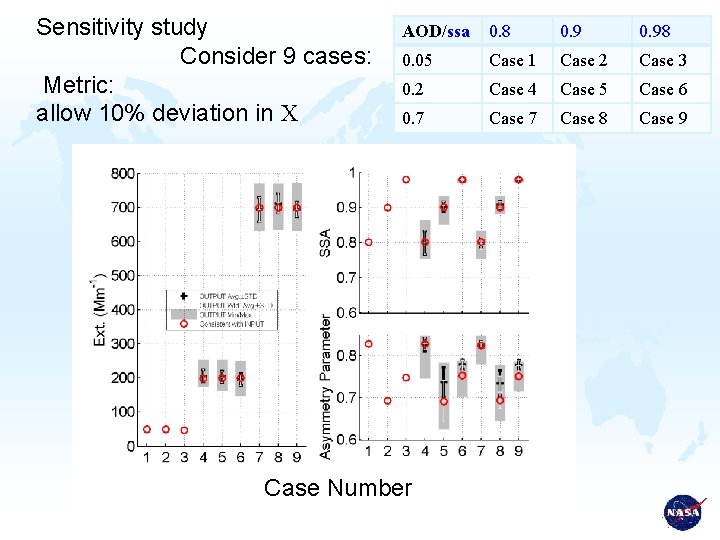
Sensitivity study Consider 9 cases: Metric: allow 10% deviation in C AOD/ssa 0. 8 0. 98 0. 05 Case 1 Case 2 Case 3 0. 2 Case 4 Case 5 Case 6 0. 7 Case 8 Case 9 Case Number
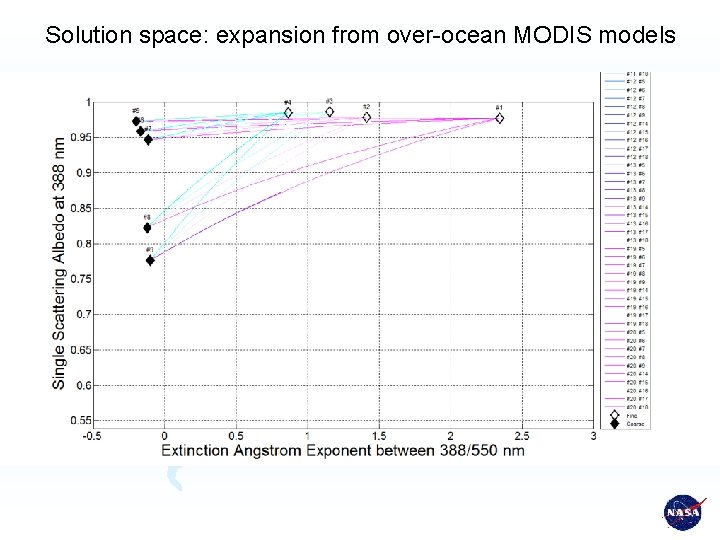
Solution space: expansion from over-ocean MODIS models
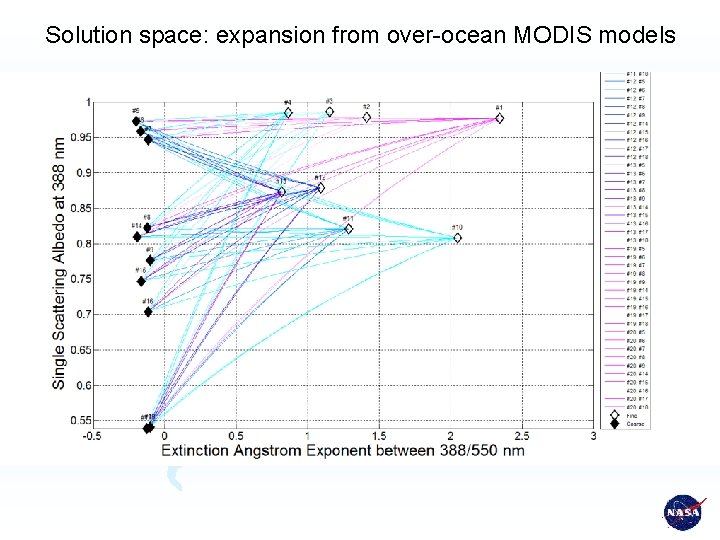
Solution space: expansion from over-ocean MODIS models
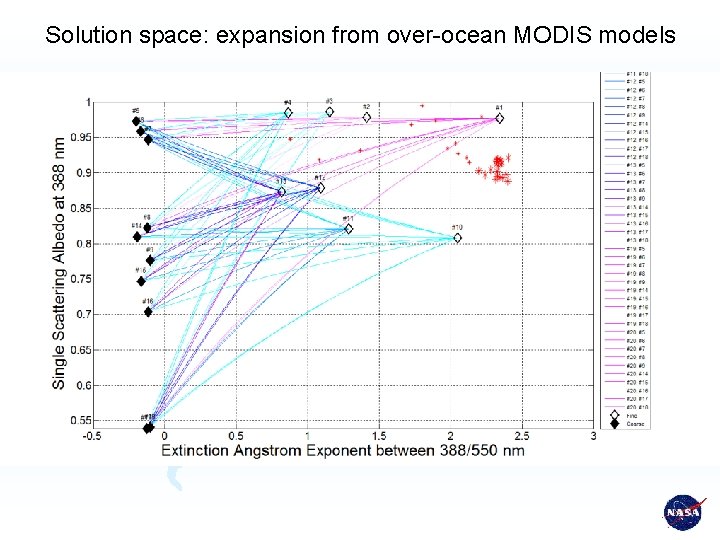
Solution space: expansion from over-ocean MODIS models
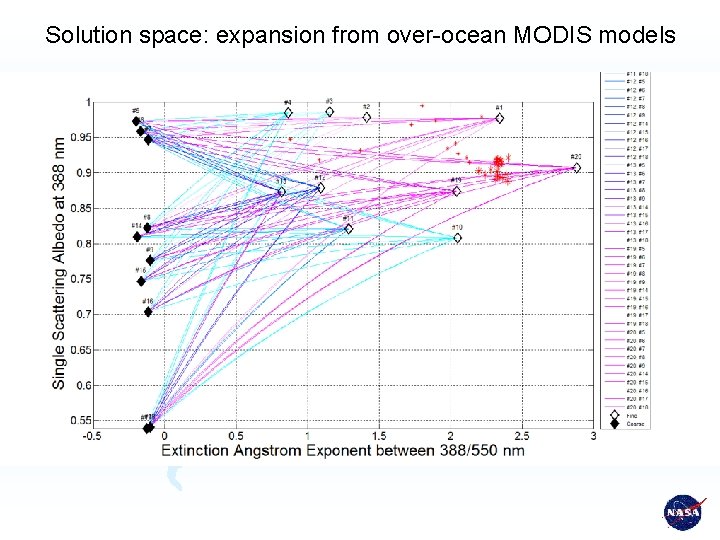
Solution space: expansion from over-ocean MODIS models
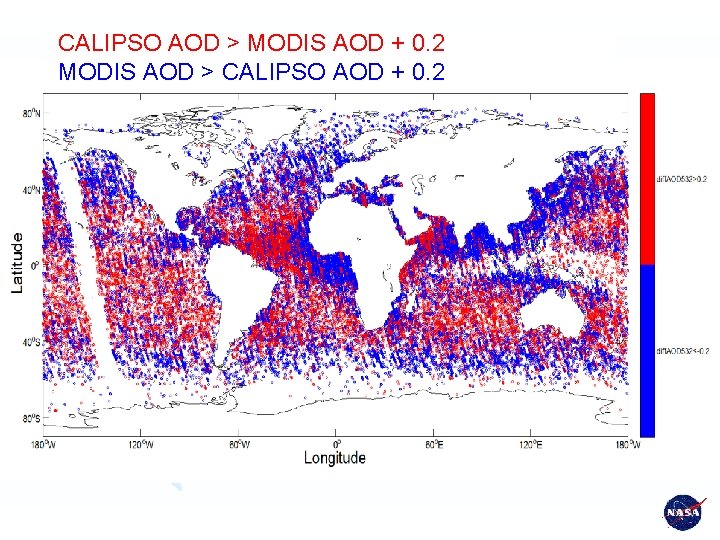
Aerosol Optical Depth comparisons (CALIOP V 2/V 3) Q Eight months of data: January, April, July and October 2007 and 2009 Q Use CALIOP 5/40 km-avg. (V 3/V 2) aerosol extinction profiles, and 5 km aerosol and cloud layer products Q Find all instantaneously collocated, MODIS MYD 04_L 2 (10 x 10 km) aerosol retrievals traversed by 40 km CALIPSO track Q For V 2, apply three CALIPSO profile quality criteria: 1. Alt_top_aerosol > Alt_top_cloud 2. EQC 532_flag = 0 or 1 3. Integrated attenuated backscatter @ 532 <=0. 011 Q Stratify by MODIS cloud fraction and FMF Q Break down geographically → zonal mean AOD comparisons and representativeness of MODIS obs. along CALIPSO track for ALL MODIS obs. Q Compare zonal means

1) Alt_top_aerosol > Alt_top_cloud 2) EQC 532_flag = 0 or 1 3) Integrated attenuated backscatter @ 532 <=0. 011




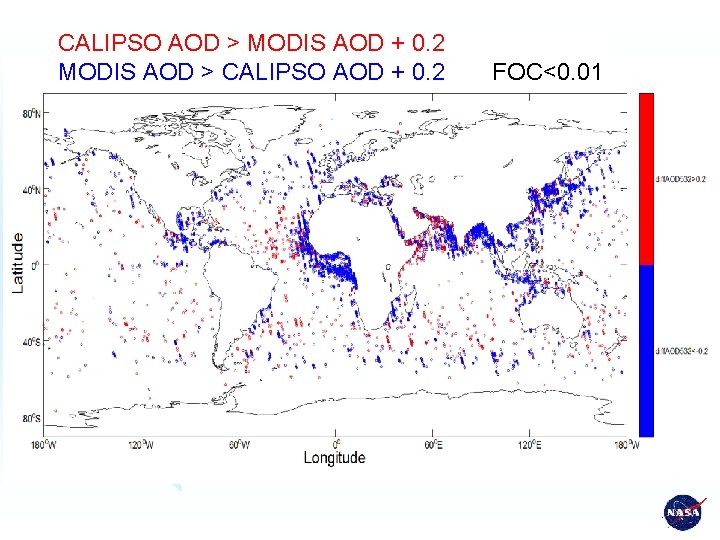
CALIPSO AOD > MODIS AOD + 0. 2 MODIS AOD > CALIPSO AOD + 0. 2 FOC<0. 01
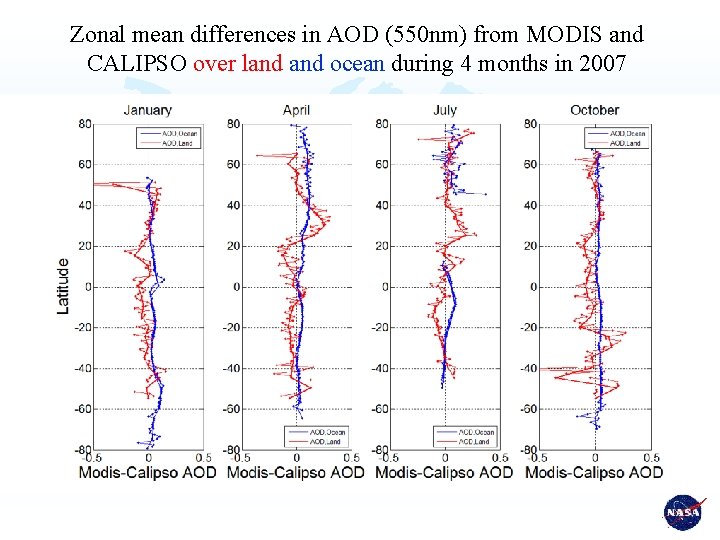
Zonal mean differences in AOD (550 nm) from MODIS and CALIPSO over land ocean during 4 months in 2007
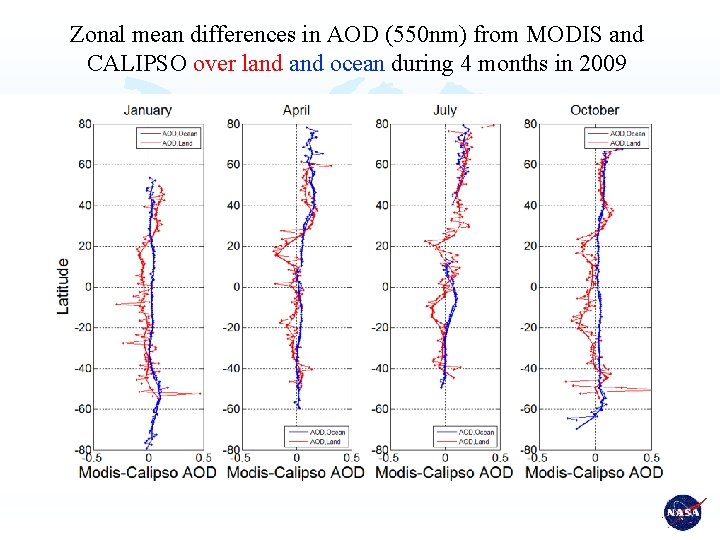
Zonal mean differences in AOD (550 nm) from MODIS and CALIPSO over land ocean during 4 months in 2009
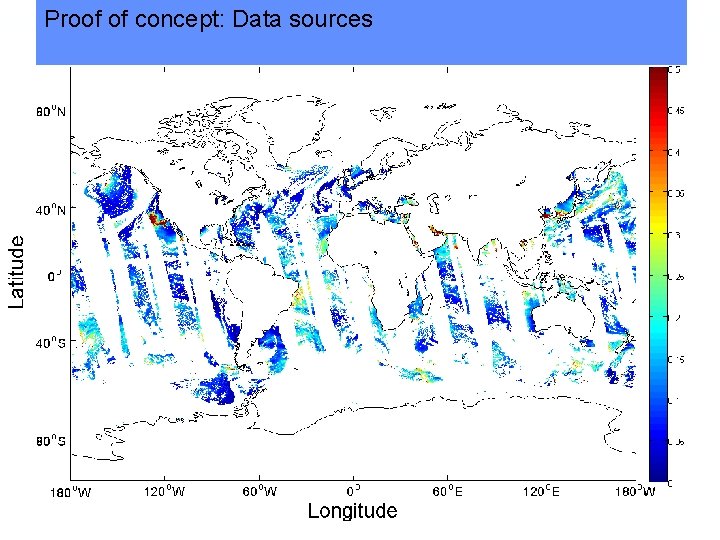
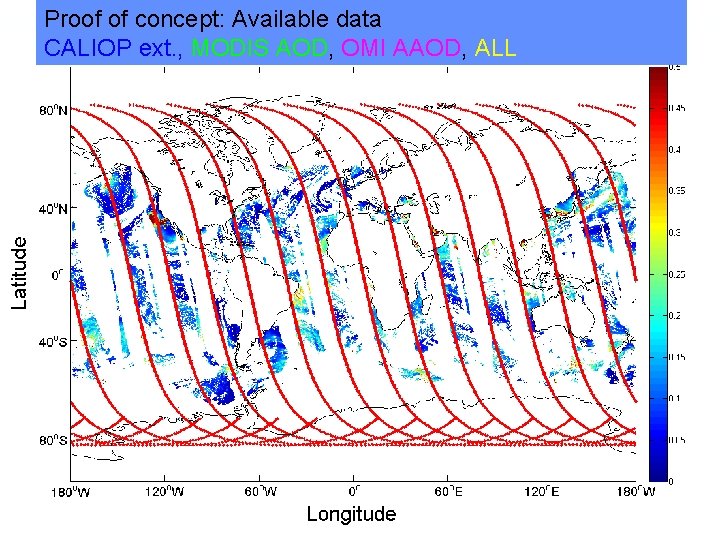
Proof of concept: Data sources
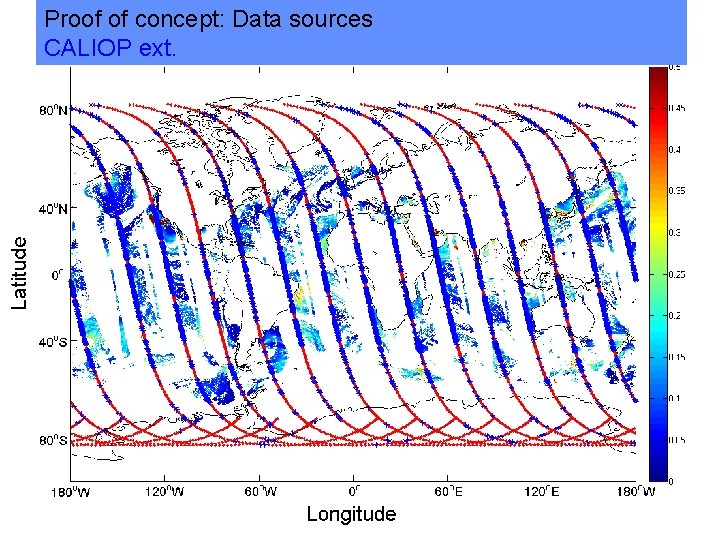
Proof of concept: Data sources CALIOP ext.
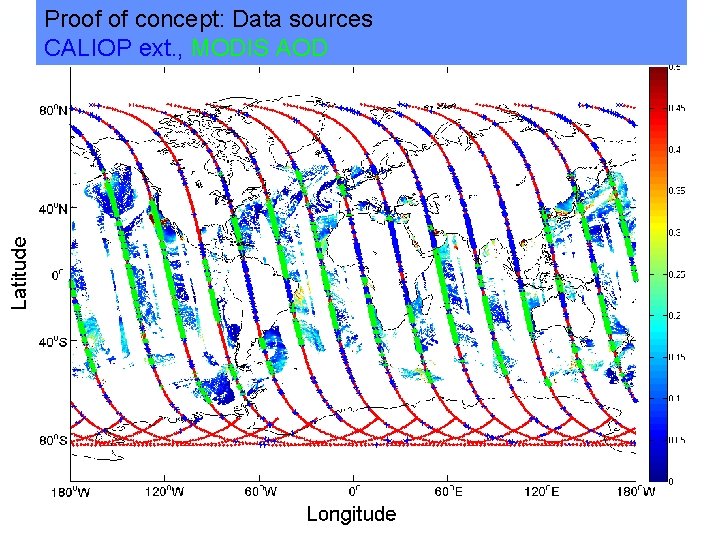
Proof of concept: Data sources CALIOP ext. , MODIS AOD
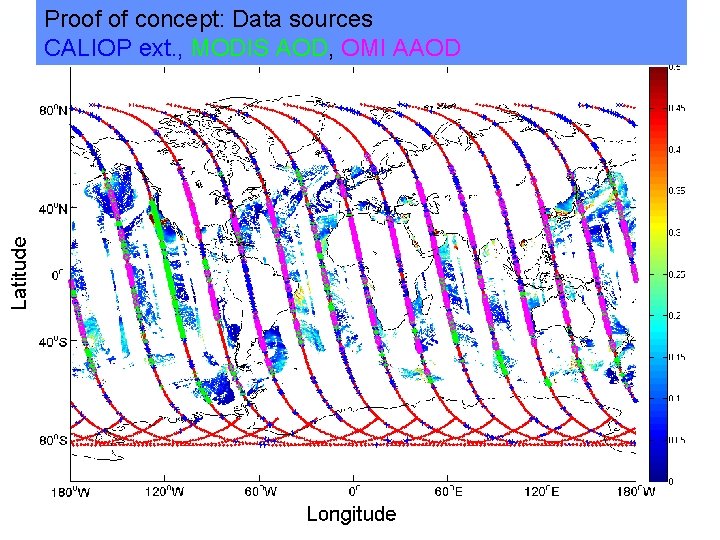
Proof of concept: Data sources CALIOP ext. , MODIS AOD, OMI AAOD
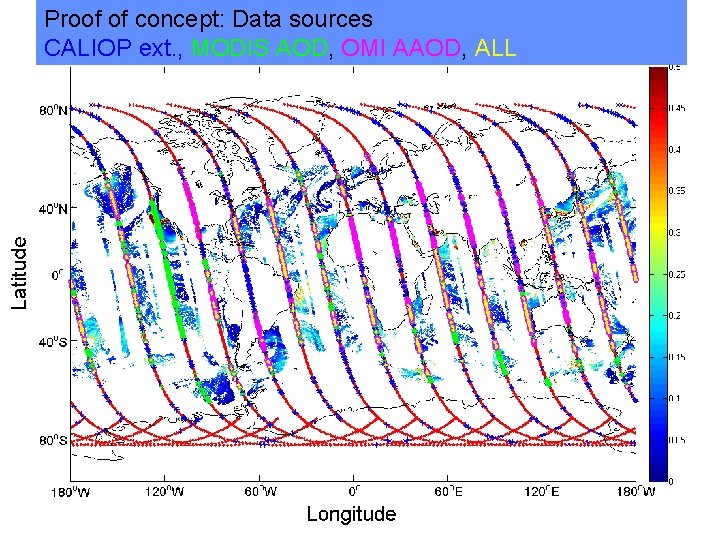
Proof of concept: Data sources CALIOP ext. , MODIS AOD, OMI AAOD, ALL
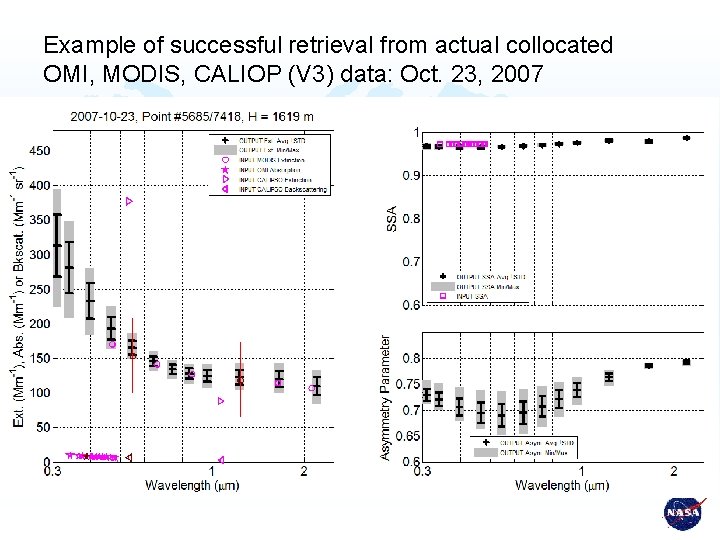
Example of successful retrieval from actual collocated OMI, MODIS, CALIOP (V 3) data: Oct. 23, 2007
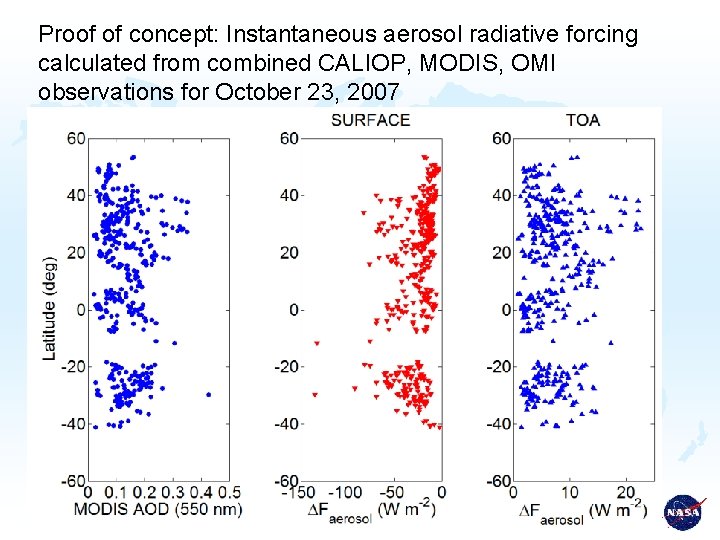
Proof of concept: Instantaneous aerosol radiative forcing calculated from combined CALIOP, MODIS, OMI observations for October 23, 2007
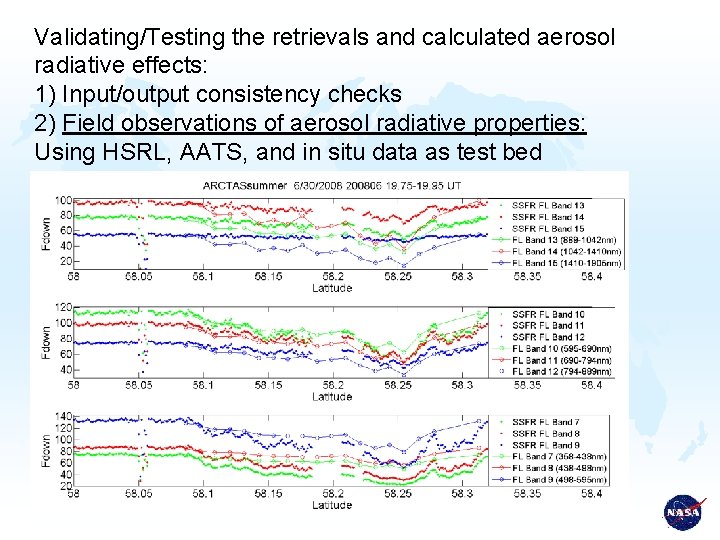
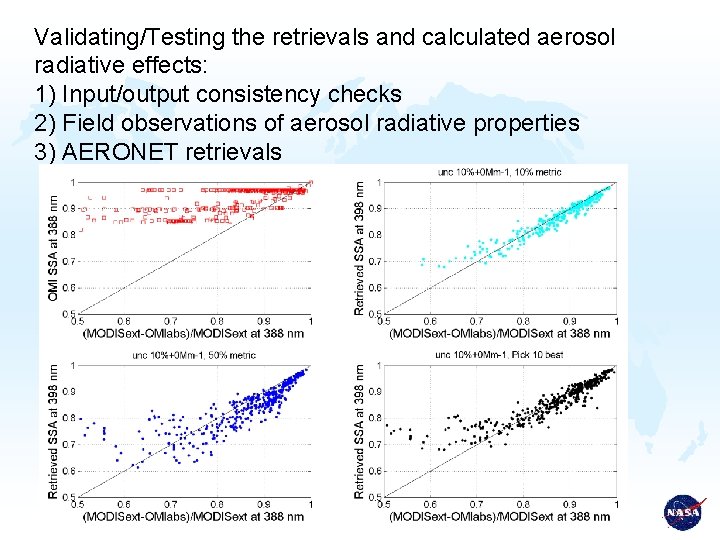
Validating/Testing the retrievals and calculated aerosol radiative effects: 1) Input/output consistency checks 2) Field observations of aerosol radiative properties: Using HSRL, AATS, and in situ data as test bed
Conclusions A. B. C. D. E. Instantaneous MODIS-CALIOP AOD comparisons show decent agreement after severe cloud clearing, and regional and zonal averaging. Zonal mean MODIS over ocean AOD is greater than CALIOP AOD by 0. 05 - 0. 1. Increased data density in V 3 comes without accuracy loss by comparison to V 2. A methodology for the retrieval of aerosol radiative properties from MODIS AOD, OMI AAOD and CALIPSO b 532&b 1064 has been devised. A sensitivity study of current method shows good retrievals for almost all AOD/ssa combinations with AOD greater or equal to 0. 2. Solution space issues remain to be resolved. Proof of concept study complete for one day of data in October 2007. Next steps: 1) Continue test of retrieval assumptions (metric, solution space, etc. ) and output against suborbital data 2) Constrain OMI AOD retrievals with CALIOP height input 3) Test CALIOP aerosol above cloud measurements 4) Extrapolation of radiative properties to data-sparse regions 5) Testing additional constraints afforded by APS 6) Comparisons to CERES results
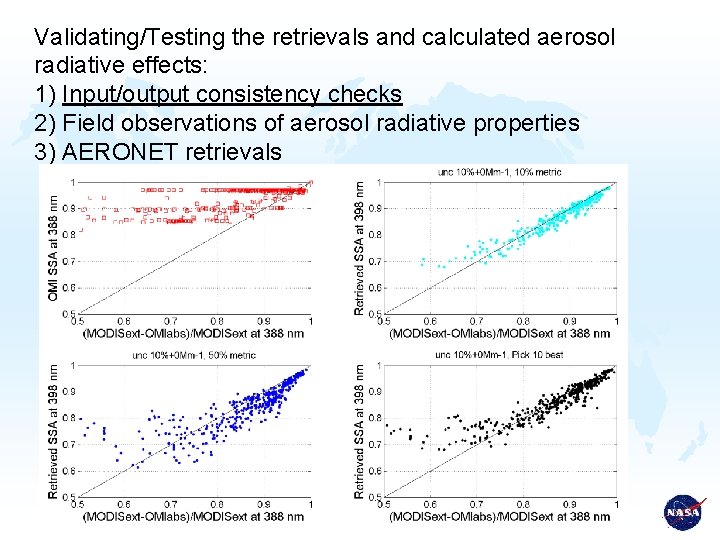
Validating/Testing the retrievals and calculated aerosol radiative effects: 1) Input/output consistency checks 2) Field observations of aerosol radiative properties 3) AERONET retrievals
CALIPSO AOD > MODIS AOD + 0. 2 MODIS AOD > CALIPSO AOD + 0. 2
Validating/Testing the retrievals and calculated aerosol radiative effects: 1) Input/output consistency checks 2) Field observations of aerosol radiative properties 3) AERONET retrievals
Proof of concept: Available data CALIOP ext. , MODIS AOD, OMI AAOD, ALL
Retrieving aerosol radiative properties above clouds • Importance (IPCC uncertainty) • Is the thickness of the aerosol layers overlying clouds significant enough to even consider retrieving aerosol radiative properties? • Where and when are there aerosols over clouds on the globe? • Devise a method of retrieving aerosol radiative properties above clouds using CALIOP and OMI (no MODIS data) Preliminary results using CALIPSO level 2 -5 km layer product data in 2007…
Constraints afforded by lidar backscatter retrieval - 1 MODIS AOD (± 0. 03± 5%) OMI AAOD (± 0. 03± 5%) No CALIOP b 532
Constraints afforded by lidar backscatter retrieval - 3 MODIS AOD (± 0. 03± 5%) OMI AAOD (± 0. 03± 5%) CALIOP b 532 (± 10 Mm-1± 10%)
OLD Sensitivity: MODIS AOD (± 0. 03+5%), OMI AAOD (± 0. 03+5%), CALIOP b 532 (± 10 Mm-1± 10%) EXTINCTION AODSSA 0. 8 0. 9 0. 05 58. 84 +/- 14. 88 (30. 88/97. 62) input 50. 13 201. 71 +/- 6. 87 (187. 96/219. 39) input 199. 29 49. 40 +/- 13. 03 (23. 98/96. 49) input 49. 93 206. 81 +/- 20. 30 (159. 51/256. 14) input 200. 54 47. 53 +/- 13. 73 (25. 75/93. 67) input 50. 01 199. 62 +/- 10. 33 (172. 22/234. 64) input 200. 11 696. 87 +/- 6. 23 (689. 88/717. 68) 708. 94 +/- 22. 61 (665. 50/759. 05) input 699. 13 input 699. 23 SSA AODSSA 0. 8 0. 9 702. 61 +/- 23. 40 (664. 51/762. 79) input 699. 91 0. 2 0. 7 0. 05 0. 2 0. 7 AODSSA 0. 05 0. 2 0. 7 0. 83 +/- 0. 05 (0. 75/0. 94) input 0. 80 +/- 0. 01 (0. 77/0. 83) input 0. 80 +/- 0. 00 (0. 80/0. 81) input 0. 80 ASYMMETRY 0. 80 +/- 0. 04 (0. 62/0. 85) input 0. 83 0. 82 +/- 0. 01 (0. 79/0. 84) input 0. 83 +/- 0. 00 (0. 82/0. 83) input 0. 82 0. 87 +/- 0. 05 (0. 75/0. 98) input 0. 90 +/- 0. 02 (0. 85/0. 93) input 0. 90 +/- 0. 00 (0. 89/0. 91) input 0. 90 0. 9 0. 76 +/- 0. 05 (0. 56/0. 85) input 0. 69 0. 74 +/- 0. 04 (0. 62/0. 78) input 0. 69 0. 71 +/- 0. 02 (0. 68/0. 73) input 0. 69 0. 98 0. 97 +/- 0. 01 (0. 94/0. 99) input 0. 98 +/- 0. 00 (0. 97/0. 98) input 0. 98 +/- 0. 00 (0. 98/0. 98) input 0. 98 0. 77 +/- 0. 03 (0. 61/0. 80) input 0. 75 0. 78 +/- 0. 01 (0. 72/0. 79) input 0. 75 0. 77 +/- 0. 01 (0. 73/0. 79) input 0. 75
Horizontal variability of aerosol optical properties observed during the ARCTAS airborne experiment Shinozuka et al. Poster C. S. Mc. Naughton Asian outflow over Alaska r = 0. 95 Forest fire smoke over Canada r = 0. 37
- Slides: 49