
The Combat Stress Training Programme Building Trauma Informed
The Combat Stress Training Programme Building Trauma Informed Organisations Module 4 of 4
WELCOME & INTRODUCTIONS • Your facilitators are Dr Jen Bateman, Lead Clinical Psychologist and Jolandi du Preez, Lead Occupational Therapist. • The webinar will be recorded and the recording shared on our ‘on-demand’ training webpage: https: //www. combatstress. org. uk/Combat. Stress. Training. For. Organisations • We will be taking questions, please do submit these in the Q&A box and we will have a Q&A session at the end of the webinar.
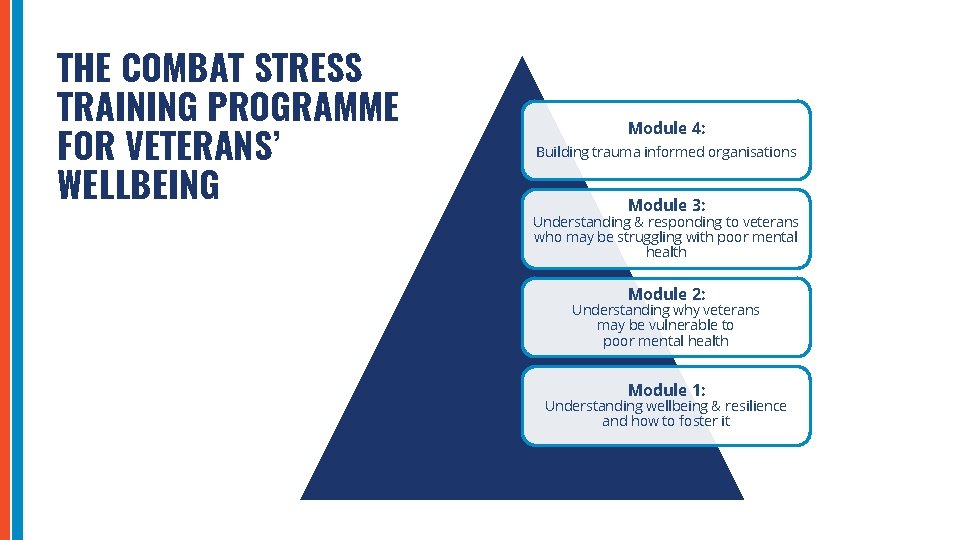
THE COMBAT STRESS TRAINING PROGRAMME FOR VETERANS’ WELLBEING Module 4: Building trauma informed organisations Module 3: Understanding & responding to veterans who may be struggling with poor mental health Module 2: Understanding why veterans may be vulnerable to poor mental health Module 1: Understanding wellbeing & resilience and how to foster it
OUTLINE OF TODAY’S TRAINING Module 4: Building Trauma Informed Organisations Understand recognise some of the ways that trauma might be affecting veterans you meet, especially how they view relationships Responding and working more effectively with veterans by taking into account the impact trauma has had on them Taking a ‘trauma informed lens’ to your role and making a plan for your own work and organisation
TAKING CARE OF YOURSELF • You may find some of themes in this module distressing so it’s important to only work through this material if you are feeling able to. • If at any point you feel distressed, please pause watching and take care of yourself. • You may want to speak to a trusted colleague or friend about how you’re feeling, distract yourself with an enjoyable or soothing activity, or talk to your supervisor or line manager. You can always resume at another time, perhaps alongside a colleague if that feels easier. • When we are busy supporting others in our work, we can forget to pay attention to our own needs. To be able to support others safely and effectively, we first need to take care of ourselves. Towards the end we’ll share some ideas about self-care and your wellbeing.
PART 1: UNDERSTAND RECOGNISE SOME OF THE WAYS THAT TRAUMA MIGHT BE AFFECTING VETERANS YOU MEET, ESPECIALLY HOW THEY VIEW RELATIONSHIPS
WHAT IS TRAUMA? “Trauma results from an event, series of events or set of circumstances experienced by an individual as physically or emotionally harmful or life-threatening with lasting adverse effect on a person” SAMHSA 2014 It’s important to note that the trauma can result from events that a person may witness, as well as those they are directly involved in.
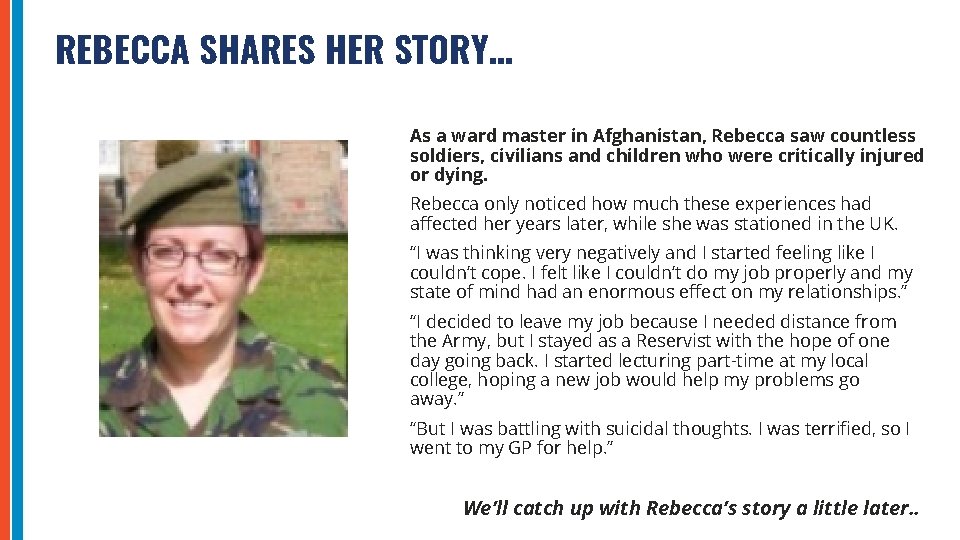
REBECCA SHARES HER STORY… As a ward master in Afghanistan, Rebecca saw countless soldiers, civilians and children who were critically injured or dying. Rebecca only noticed how much these experiences had affected her years later, while she was stationed in the UK. “I was thinking very negatively and I started feeling like I couldn’t cope. I felt like I couldn’t do my job properly and my state of mind had an enormous effect on my relationships. ” “I decided to leave my job because I needed distance from the Army, but I stayed as a Reservist with the hope of one day going back. I started lecturing part-time at my local college, hoping a new job would help my problems go away. ” “But I was battling with suicidal thoughts. I was terrified, so I went to my GP for help. ” We’ll catch up with Rebecca’s story a little later. .
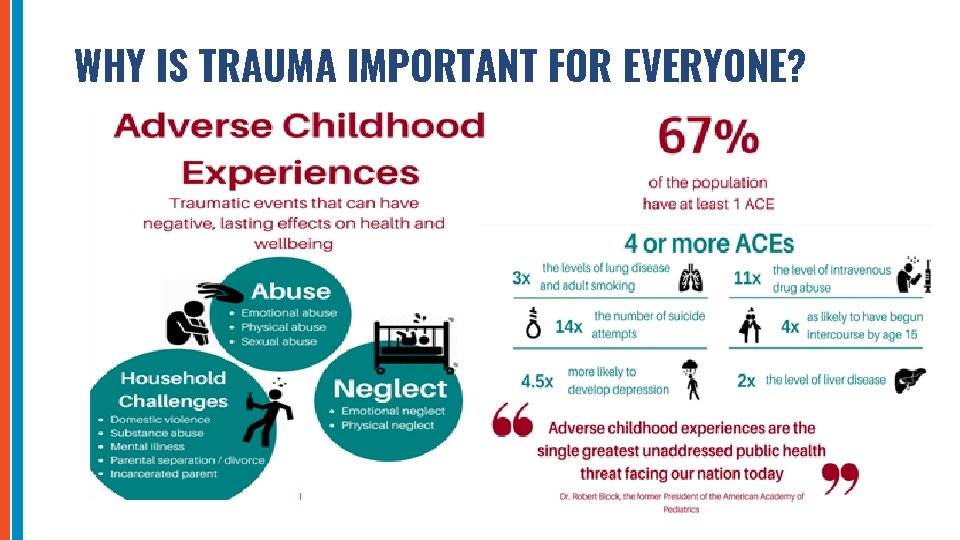
WHY IS TRAUMA IMPORTANT FOR EVERYONE?
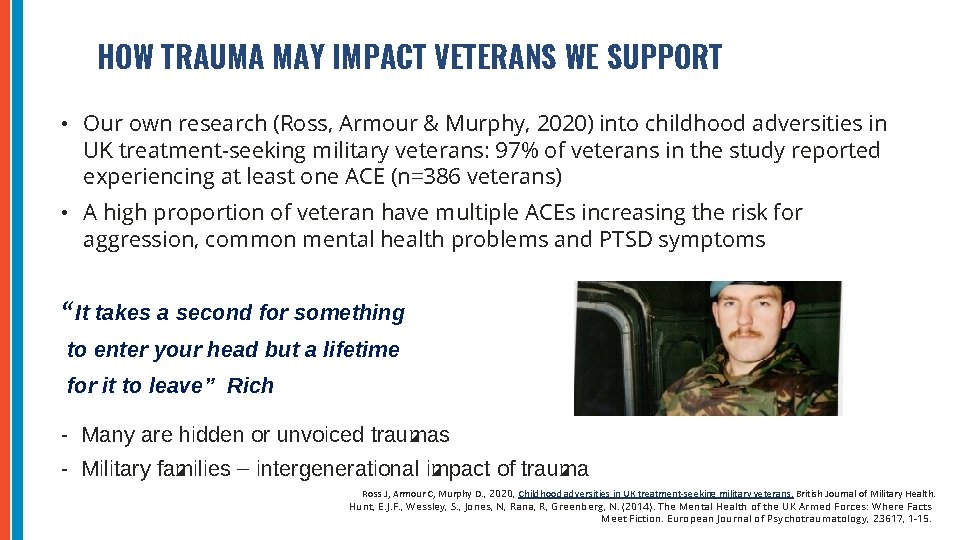
HOW TRAUMA MAY IMPACT VETERANS WE SUPPORT • Our own research (Ross, Armour & Murphy, 2020) into childhood adversities in UK treatment-seeking military veterans: 97% of veterans in the study reported experiencing at least one ACE (n=386 veterans) • A high proportion of veteran have multiple ACEs increasing the risk for aggression, common mental health problems and PTSD symptoms “It takes a second for something to enter your head but a lifetime for it to leave” Rich - Many are hidden or unvoiced traumas - Military families – intergenerational impact of trauma Ross J, Armour C, Murphy D. , 2020, Childhood adversities in UK treatment-seeking military veterans. British Journal of Military Health. Hunt, E. J. F. , Wessley, S. , Jones, N, Rana, R, Greenberg, N. (2014). The Mental Health of the UK Armed Forces: Where Facts Meet Fiction. European Journal of Psychotraumatology, 23617, 1 -15.
MILITARY AND ADULT TRAUMA • Military service members are at risk of cumulative trauma exposures and a high percentage are exposed to multiple traumas in a combat role in the military • Many have either witnessed traumatic events or directly experienced them during their service, making them increasingly susceptible to PTSD symptoms • Traumatic events include exposure to grave human suffering, traumatic loss, and morally injurious experiences, exposure to severely injured, dying, or dead people and threat to self • Combat Stress treatment primarily focus on understanding and treating these adult military traumas. Your role is very different but you do play an important role in a person’s journey. PODCAST: Veterans describe the situations that left them with moral injuries https: //www. combatstress. org. uk/combat-stress-100 -podcast
PART 2: RESPONDING AND WORKING MORE EFFECTIVELY WITH VETERANS BY TAKING INTO ACCOUNT THE IMPACT TRAUMA HAS HAD ON THEM
BECOMING A TRAUMA-INFORMED ORGANISATON Why do we need to be trauma-informed? • Trauma is everyone’s business. This doesn’t mean you are responsible for dealing with the consequences of trauma, but you play an important role In supporting those who have experienced trauma. • A workforce who is capable of recognising where people are affected by trauma and adversity: • Helps us to respond in ways that prevent further harm. • Supports recovery. • PLEASE WATCH THE FOLLOWING 10 MINUTE ANIMATION (Courtesy of NHS Education for Scotland)

‘OPENING DOORS ANIMATION’ Courtesy of NHS Education for Scotland https: //vimeo. com/274703693
RECOGNISING THE IMPACT OF TRAUMA IN YOUR ORGANISATION q How might their experience of trauma affect a veteran as they come into contact with you and your colleagues? q Try to think of some examples of behaviours or responses you might see, or have seen in veterans you’ve come into contact with? q How might the impact of a veteran’s experience of trauma be relevant for your role, and the work that you do with the veterans you come into contact with?
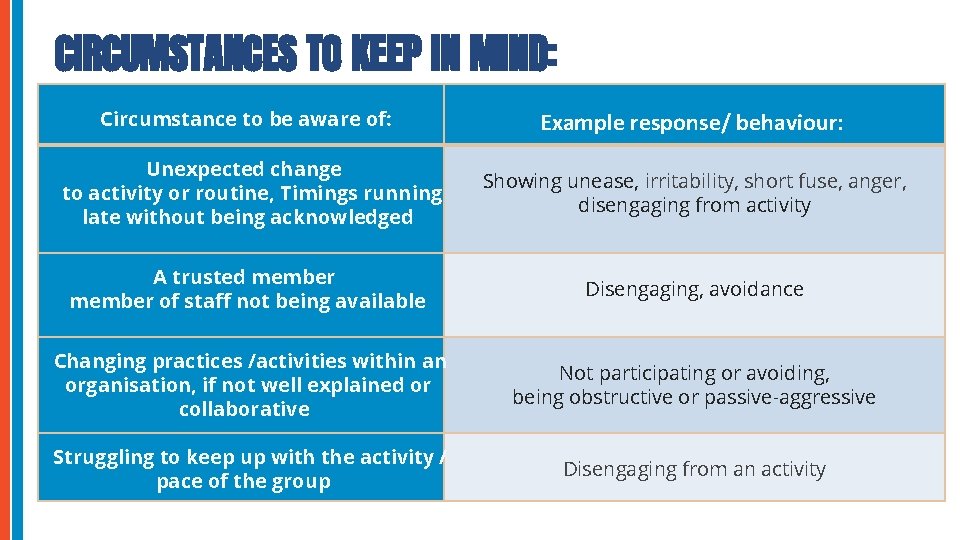
CIRCUMSTANCES TO KEEP IN MIND: Circumstance to be aware of: Example response/ behaviour: Unexpected change to activity or routine, Timings running late without being acknowledged Showing unease, irritability, short fuse, anger, disengaging from activity A trusted member of staff not being available Disengaging, avoidance Changing practices /activities within an organisation, if not well explained or collaborative Not participating or avoiding, being obstructive or passive-aggressive Struggling to keep up with the activity / pace of the group Disengaging from an activity
PART 3. 1 TAKING A ‘TRAUMA INFORMED LENS’ TO YOUR ROLE
TAKING A ‘TRAUMA INFORMED LENS’ TO YOUR ROLE q Take a mental walk through every contact or experience a veteran might have with you within your organisation, from beginning to end q Consider how a veteran affected by trauma might experience every contact and interaction with you To what extent: - Is the veteran offered a sense of safety? - Can they trust you to do what you say you will do? - Is there a collaborative relationship between you? - Are they empowered to make choices?
CONSIDER… Doing what you say you will do, when you will do it (consider managing expectations) Consider gender issues / being in both 1: 1 and in group settings Consider continuity/familiarity in relationships and possible impact of staff changes Keep in mind that most veterans enjoy being with other veterans but there is a proportion who find it a challenging reminder
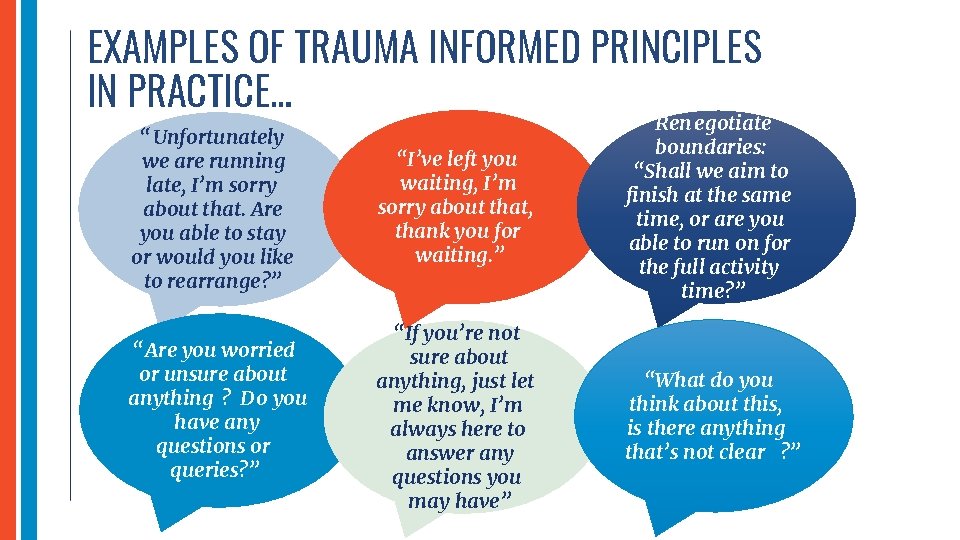
EXAMPLES OF TRAUMA INFORMED PRINCIPLES IN PRACTICE… “Unfortunately we are running late, I’m sorry about that. Are you able to stay or would you like to rearrange? ” “I’ve left you waiting, I’m sorry about that, thank you for waiting. ” Ren egotiate boundaries: “Shall we aim to finish at the same time, or are you able to run on for the full activity time? ” “Are you worried or unsure about anything ? Do you have any questions or queries? ” “If you’re not sure about anything, just let me know, I’m always here to answer any questions you may have” “What do you think about this, is there anything that’s not clear ? ”
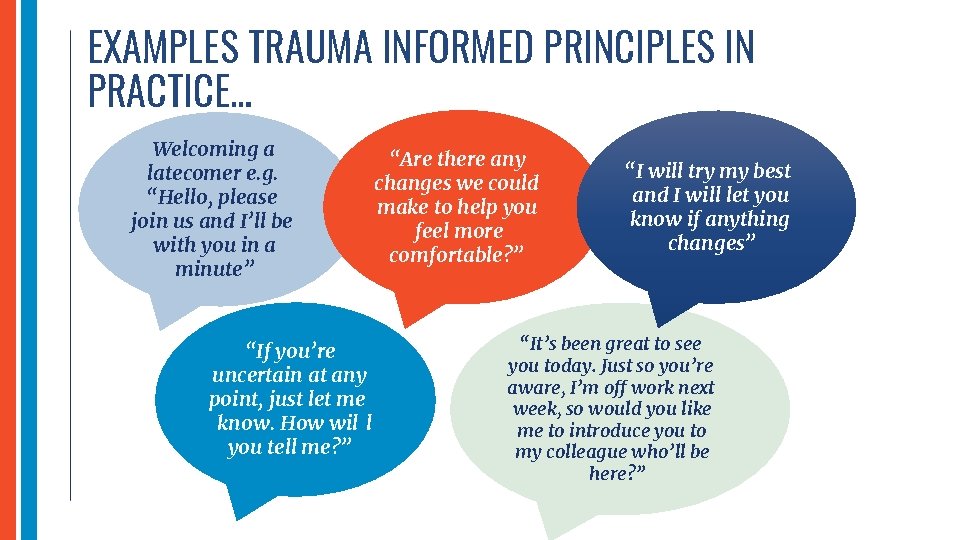
EXAMPLES TRAUMA INFORMED PRINCIPLES IN PRACTICE… Welcoming a latecomer e. g. “Hello, please join us and I’ll be with you in a minute” “If you’re uncertain at any point, just let me know. How wil l you tell me? ” “Are there any changes we could make to help you feel more comfortable? ” “I will try my best and I will let you know if anything changes” “It’s been great to see you today. Just so you’re aware, I’m off work next week, so would you like me to introduce you to my colleague who’ll be here? ”
PART 3. 2 MAKING A PLAN FOR YOUR OWN ROLE & ORGANISATION
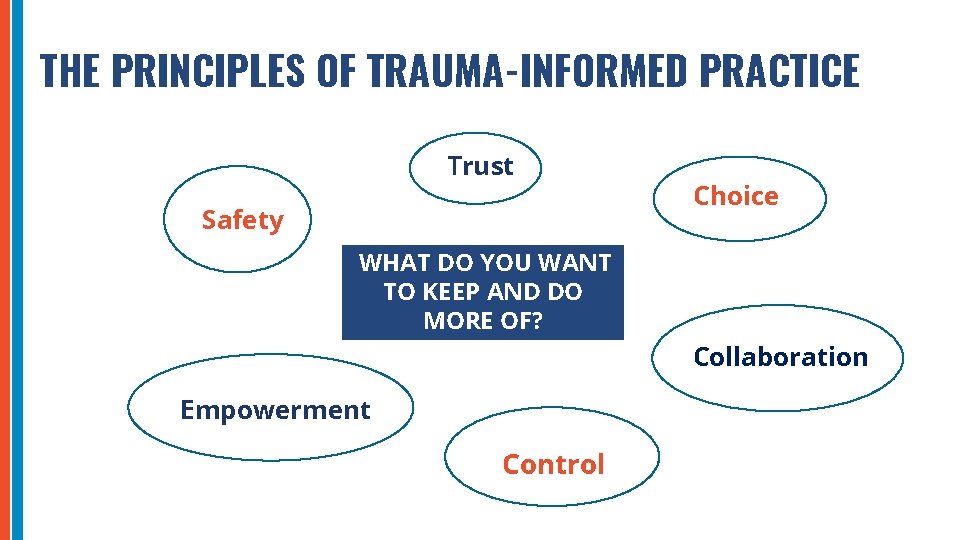
THE PRINCIPLES OF TRAUMA-INFORMED PRACTICE Trust Safety Choice WHAT DO YOU WANT TO KEEP AND DO MORE OF? Collaboration Empowerment Control
WHAT DO YOU WANT TO STOP OR CHANGE SO THAT THE IMPACT OF TRAUMA IS ADEQUATELY RECOGNISED AND RESPONDED TO? - Are there any areas in your organisation where the impact of trauma is not recognised? - Any experiences that may be disempowering, coercive or lacking? - Are there places where a person affected by trauma may feel unsafe or trust breached? *FOCUS ON WHAT IS POSSIBLE*
WHAT DO YOU WANT TO ADD INTO YOUR PRACTICE SO THAT THE IMPACT OF TRAUMA IS ADEQUATELY RECOGNISED AND RESPONDED TO? - Are there opportunities for empowerment and collaboration that are currently missed? - Are there opportunities where sense of safety could be strengthened or trust created? - Are there opportunities for supporting recovery from the impact of trauma that are currently missed? *FOCUS ON WHAT IS POSSIBLE*
TAKING CARE OF YOURSELF WITHIN THE WORK SETTING
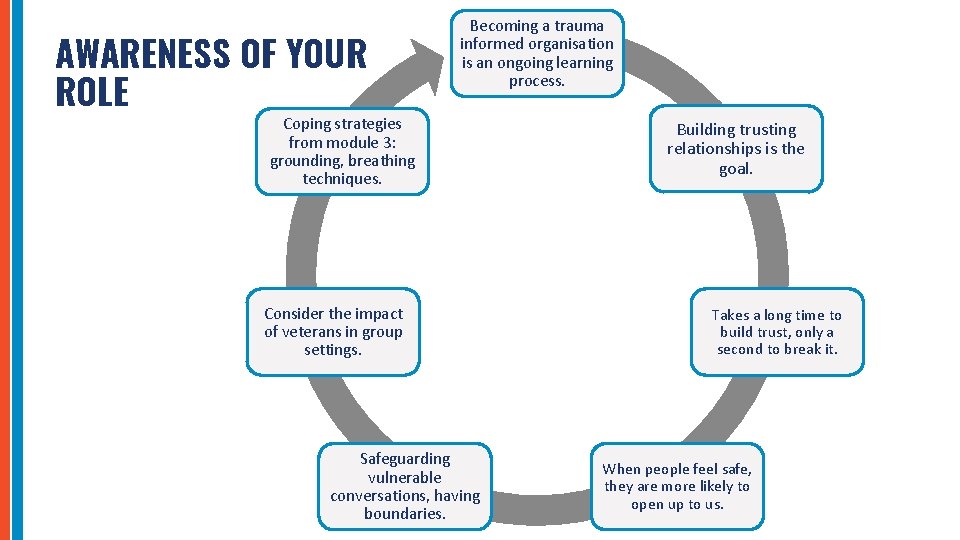
AWARENESS OF YOUR ROLE Becoming a trauma informed organisation is an ongoing learning process. Coping strategies from module 3: grounding, breathing techniques. Consider the impact of veterans in group settings. Safeguarding vulnerable conversations, having boundaries. Building trusting relationships is the goal. Takes a long time to build trust, only a second to break it. When people feel safe, they are more likely to open up to us.
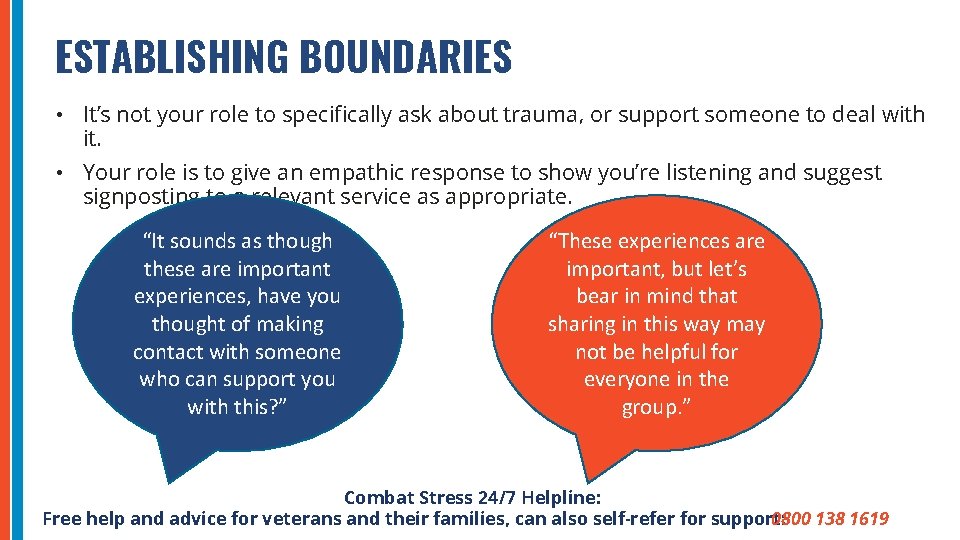
ESTABLISHING BOUNDARIES • It’s not your role to specifically ask about trauma, or support someone to deal with it. • Your role is to give an empathic response to show you’re listening and suggest signposting to a relevant service as appropriate. “It sounds as though these are important experiences, have you thought of making contact with someone who can support you with this? ” “These experiences are important, but let’s bear in mind that sharing in this way may not be helpful for everyone in the group. ” Combat Stress 24/7 Helpline: Free help and advice for veterans and their families, can also self-refer for support: 0800 138 1619
TAKING CARE OF YOURSELF • Supporting others who have experienced trauma can have an impact. It’s natural to have reactions. • ‘Vicarious trauma’ is the term for changes we can experience from empathic engagement with trauma survivors. • Those of us who have experienced trauma ourselves may be more vulnerable • Awareness of the signs for yourself and others is important: • Being preoccupied with thoughts of a person outside of the work situation • Experiencing lingering feelings of sadness/anger about a person’s situation • Experiencing ‘bystander’ guilt, shame feelings of self-doubt • Loss of hope, pessimism, cynicism • Difficulty maintaining appropriate boundaries with the person e. g. overextending yourself, trying to more that is usual to help the person https: //www. bma. org. uk/advice-and-support/your-wellbeing/vicarious-trauma-signs-and-strategies-for-coping
TAKING CARE OF YOURSELF Here are some coping strategies to reduce the risks. • Seek support from colleagues - consider using a buddy system, peer support and both formal and informal opportunities to debrief/talk about the impact of your work. • Increase your self-observation - recognise your signs of stress and burnout. • Take care of yourself emotionally - engage in relaxing and self-soothing activities, nurture self-care. • Maintain a healthy work/life balance - have outside interests. • Be realistic about what you can accomplish. • Avoid taking on responsibility for the person’s wellbeing instead signpost to tools to look after themselves. • Take regular breaks, take time off when you need to. • If you feel you would like more support, take up time-limited therapy.
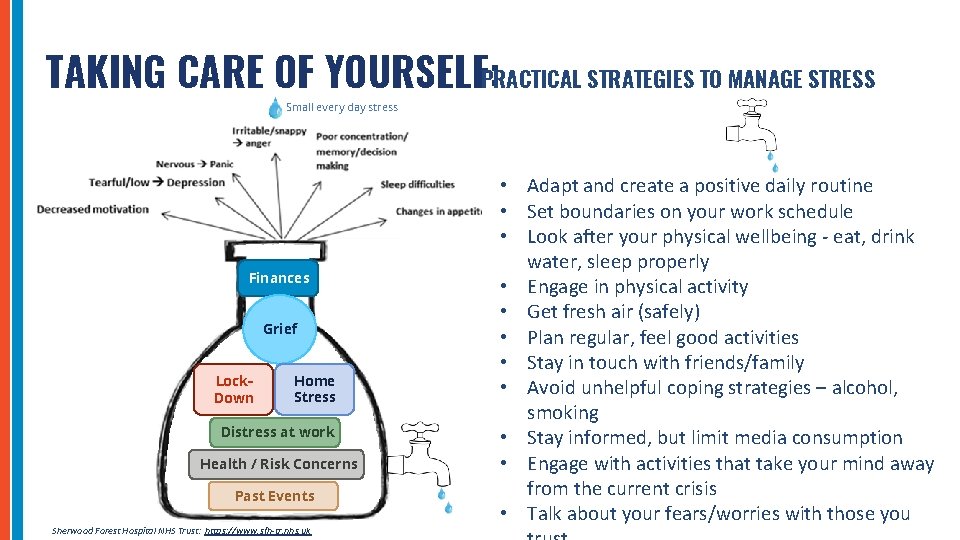
TAKING CARE OF YOURSELF: PRACTICAL STRATEGIES TO MANAGE STRESS Small every day stress Finances Grief Lock. Down Home Stress Distress at work Health / Risk Concerns Past Events Sherwood Forest Hospital NHS Trust: https: //www. sfh-tr. nhs. uk • Adapt and create a positive daily routine • Set boundaries on your work schedule • Look after your physical wellbeing - eat, drink water, sleep properly • Engage in physical activity • Get fresh air (safely) • Plan regular, feel good activities • Stay in touch with friends/family • Avoid unhelpful coping strategies – alcohol, smoking • Stay informed, but limit media consumption • Engage with activities that take your mind away from the current crisis • Talk about your fears/worries with those you
YOUR OWN SELF-CARE AND WELLBEING For all of us, as well as veterans, our relationships at work should embody the same principles: SAFETY……. . TRUST……. CHOICE……. COLLABORATION……. CONTROL…… EMPOWERMENT Explore some wellbeing apps: • Headfit: Tools for Mental Fitness https: //headfit. org • Sleepio / Calm: Help with sleep https: //www. sleepio. com; https: //www. calm. com/ • Catch It and Unmind : Support for managing emotions and problem solving https: //unmind. com https: //www. nhs. uk/apps-library/catch-it/ If you are responsible for managing/supervising others aim to keep the topic of self-care on the agenda of your regular 1: 1 and team meetings, so colleagues can share ideas and support each other.
REFLECTIONS… What are your next steps? Are there any action points that you would like to commit to putting into practice /discuss with your colleagues, supervisor or line manager?
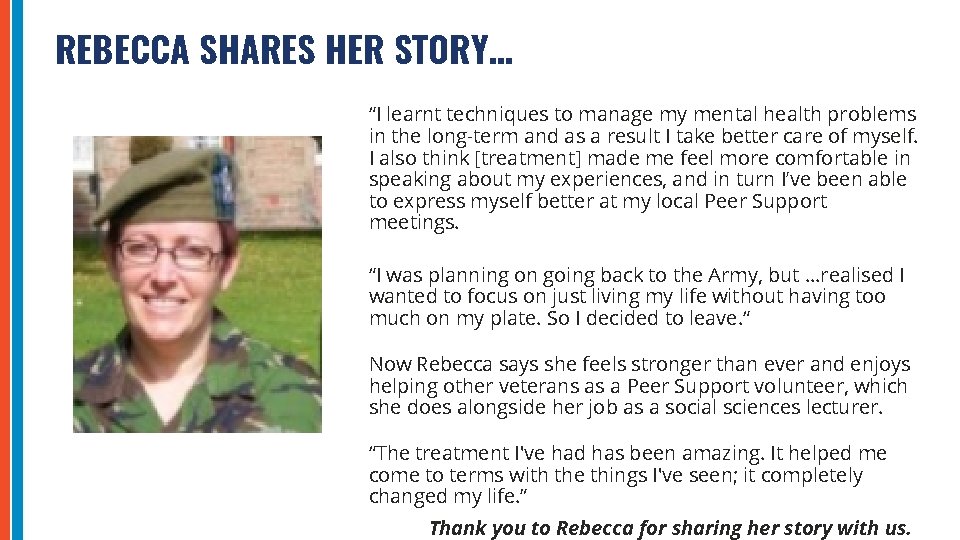
REBECCA SHARES HER STORY… “I learnt techniques to manage my mental health problems in the long-term and as a result I take better care of myself. I also think [treatment] made me feel more comfortable in speaking about my experiences, and in turn I’ve been able to express myself better at my local Peer Support meetings. “I was planning on going back to the Army, but …realised I wanted to focus on just living my life without having too much on my plate. So I decided to leave. “ Now Rebecca says she feels stronger than ever and enjoys helping other veterans as a Peer Support volunteer, which she does alongside her job as a social sciences lecturer. “The treatment I've had has been amazing. It helped me come to terms with the things I've seen; it completely changed my life. ” Thank you to Rebecca for sharing her story with us.
SUMMARY 1 2 3 4 Trauma is ‘everybody’s business’ and by completing this module you’ve made an important start in ensuring every touch point that a veteran has with your organisation, promotes their recovery. Discuss these ideas with your colleagues, supervisors and line managers. Keep the vision of being a ‘trauma-informed organisation’ on the agenda at team meetings and reviews. Consider sharing your learning and swapping best-practice ideas. Remember to take care of yourself and your own wellbeing as you do your valuable work with veterans
QUESTIONS & NEXT STEPS 1 Question & answer time. 2 What’s one takeaway or action step for yourself / your project? 3 This is module 4 of 4 – next steps. 4 Self-assessment quiz and certificate of attendance. 5 Evaluation and Feedback: https: //www. surveymonkey. co. uk/r/CSTraining. CS 2 Thank you for your time, attention & commitment to support veterans in your organisation
ACKNOWLEDGEMENTS * Special thanks to our co-authors: Jolandi du Preez (Lead Occupational Therapist), Naomi Wilson (Consultant Clinical Psychologist and Head of Psychological Therapies), Jen Bateman (Clinical Psychologist) and all contributors from the Combat Stress National Veterans’ Voice. * Thank you to Combat Stress colleagues who contributed to the development / slides within this training, including all colleagues in the DVMHS Working Group. * Sincere thanks to the Armed Forces Covenant Fund Trust for their generous funding of this programme and to the Strategic Partners for all their support
REFERENCES & FURTHER RESOURCES * * British Medical Association (2020). Vicarious Trauma, Signs and Strategies for Coping, accessed online January 2021 https: //www. bma. org. uk/advice-and-support/yourwellbeing/vicarious-trauma-signs-and-strategies-for-coping Hunt, E. J. F. , Wessley, S. , Jones, N, Rana, R, Greenberg, N. (2014). The Mental Health of the UK Armed Forces: Where Facts Meet Fiction. European Journal of Psychotraumatology, 23617, 1 -15. NHS Education for Scotland (2020). National Trauma Training website and resources: https: //transformingpsychologicaltrauma. scot/ accessed online January 2021. NHS Education for Scotland (2020). Opening doors animation, accessed online January 2021 https: //vimeo. com/274703693
REFERENCES & FURTHER RESOURCES * Ross J, Armour C, Murphy D. Childhood adversities in UK treatment-seeking military veterans. BMJ Mil Health. 2020 Feb 27: jramc-2019 -001297. doi: 10. 1136/jramc-2019001297. * Sherwood Forest Hospital NHS Trust (2020). The Stress Bottle , Accessed online May 2020. https: //www. sfh-tr. nhs. uk/for-patients-visitors/psychological-wellbeingresources/the-stress-bottle/ * Stevelink, S. A et al (2018). Mental health outcomes at the end of the British involvement in the Iraq and Afghanistan conflicts: a cohort study. The British Journal of Psychiatry, 213, 690 -697.
- Slides: 39