
The Colorado River Interim Guidelines for Lake Powell
- Slides: 12
The Colorado River: Interim Guidelines for Lake Powell and Lake Mead National Integrated Drought Information System Workshop October 1, 2008
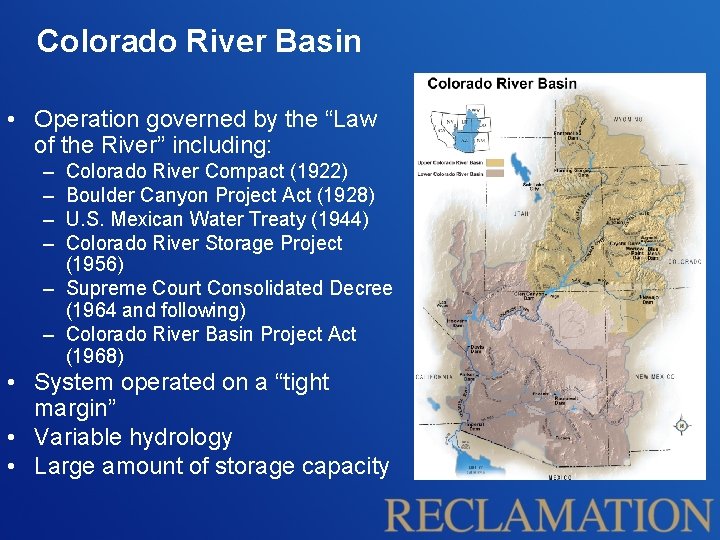
Colorado River Basin • Operation governed by the “Law of the River” including: – – Colorado River Compact (1922) Boulder Canyon Project Act (1928) U. S. Mexican Water Treaty (1944) Colorado River Storage Project (1956) – Supreme Court Consolidated Decree (1964 and following) – Colorado River Basin Project Act (1968) • System operated on a “tight margin” • Variable hydrology • Large amount of storage capacity
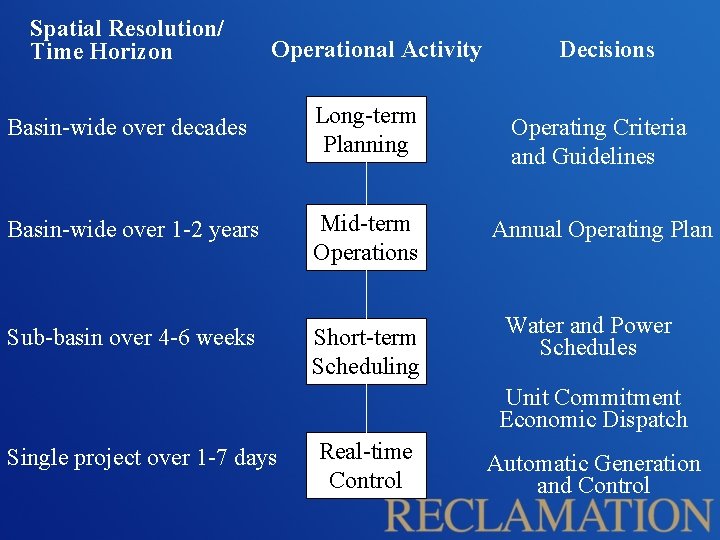
Spatial Resolution/ Time Horizon Operational Activity Decisions Basin-wide over decades Long-term Planning Operating Criteria and Guidelines Basin-wide over 1 -2 years Mid-term Operations Annual Operating Plan Sub-basin over 4 -6 weeks Short-term Scheduling Water and Power Schedules Unit Commitment Economic Dispatch Single project over 1 -7 days Real-time Control Automatic Generation and Control
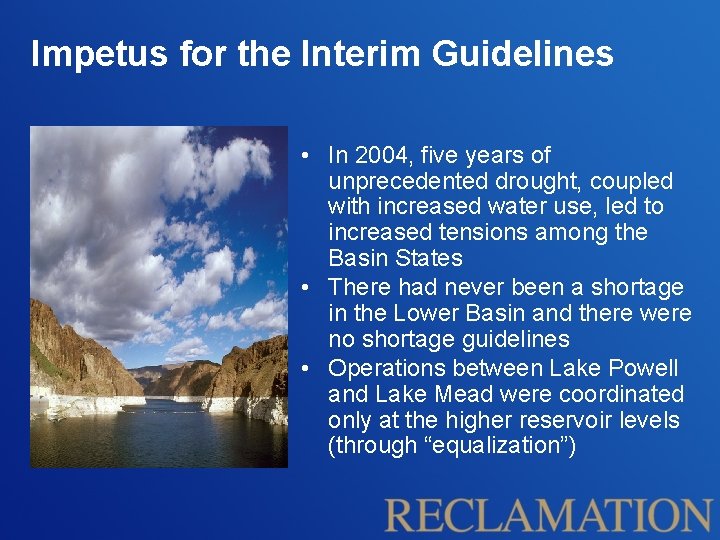
Impetus for the Interim Guidelines • In 2004, five years of unprecedented drought, coupled with increased water use, led to increased tensions among the Basin States • There had never been a shortage in the Lower Basin and there were no shortage guidelines • Operations between Lake Powell and Lake Mead were coordinated only at the higher reservoir levels (through “equalization”)
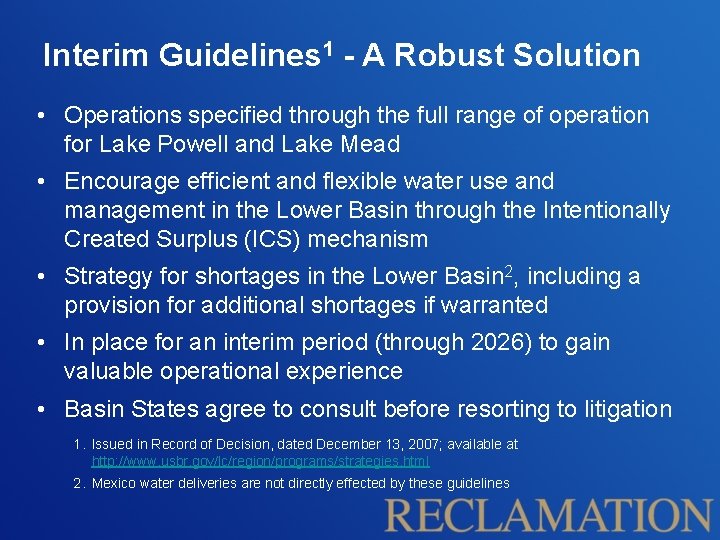
Interim Guidelines 1 - A Robust Solution • Operations specified through the full range of operation for Lake Powell and Lake Mead • Encourage efficient and flexible water use and management in the Lower Basin through the Intentionally Created Surplus (ICS) mechanism • Strategy for shortages in the Lower Basin 2, including a provision for additional shortages if warranted • In place for an interim period (through 2026) to gain valuable operational experience • Basin States agree to consult before resorting to litigation 1. Issued in Record of Decision, dated December 13, 2007; available at http: //www. usbr. gov/lc/region/programs/strategies. html 2. Mexico water deliveries are not directly effected by these guidelines
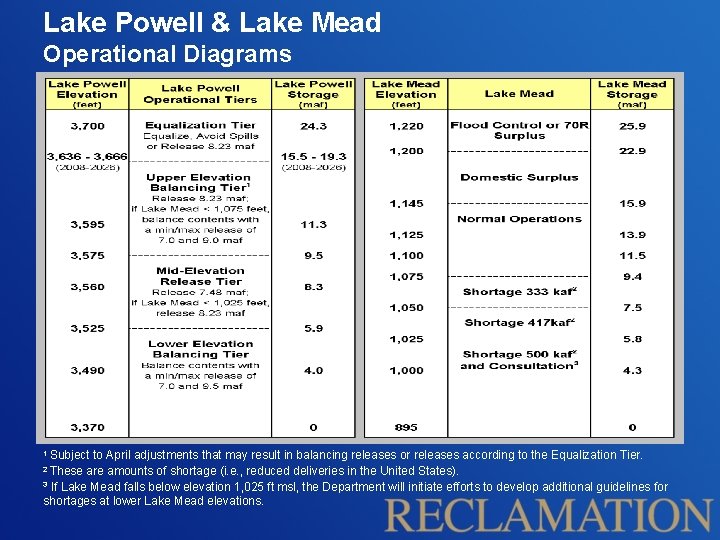
Lake Powell & Lake Mead Operational Diagrams 1 Subject to April adjustments that may result in balancing releases or releases according to the Equalization Tier. are amounts of shortage (i. e. , reduced deliveries in the United States). 3 If Lake Mead falls below elevation 1, 025 ft msl, the Department will initiate efforts to develop additional guidelines for shortages at lower Lake Mead elevations. 2 These
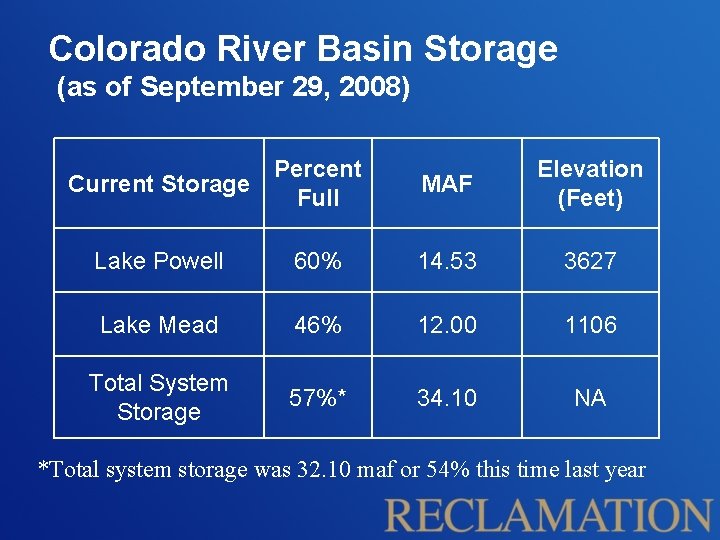
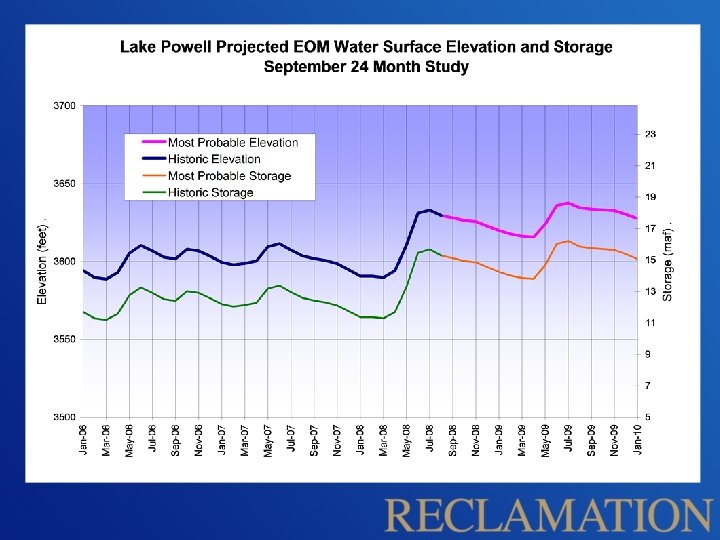
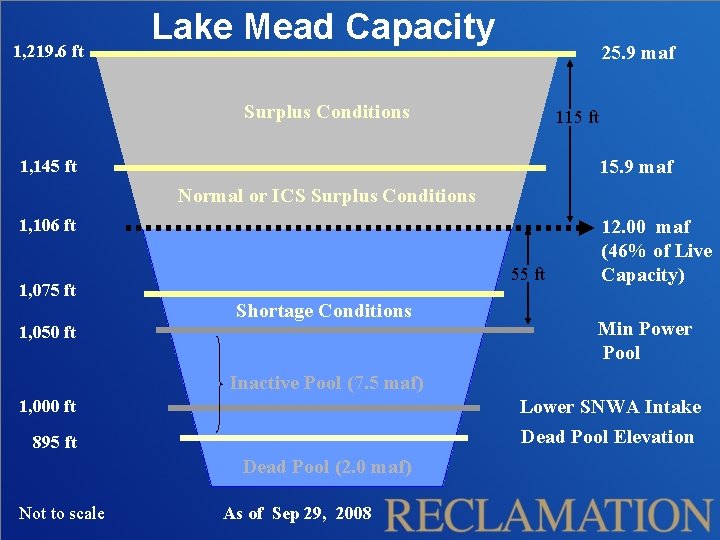
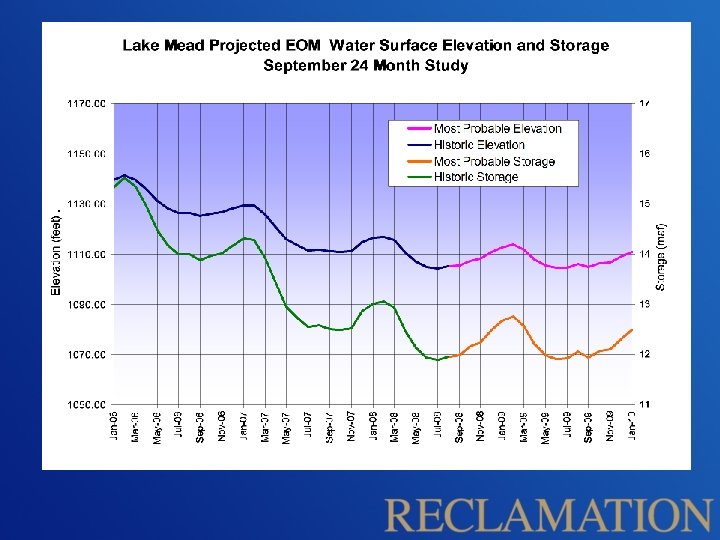
Colorado River Basin Storage (as of September 29, 2008) Current Storage Percent Full MAF Elevation (Feet) Lake Powell 60% 14. 53 3627 Lake Mead 46% 12. 00 1106 Total System Storage 57%* 34. 10 NA *Total system storage was 32. 10 maf or 54% this time last year
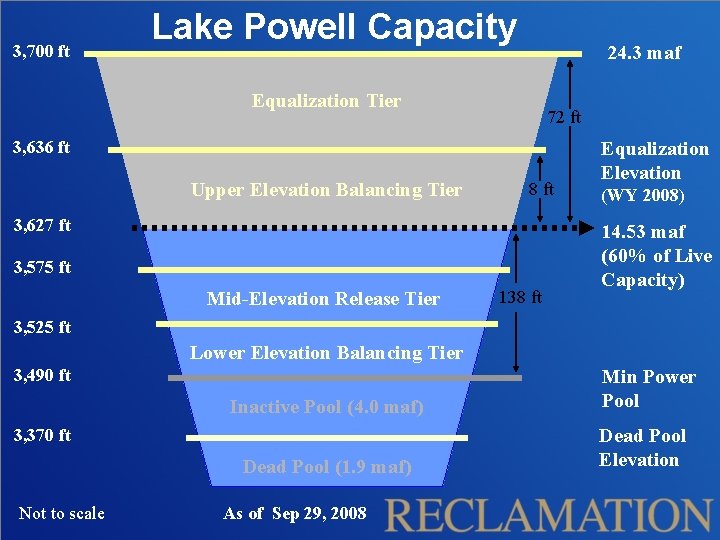
3, 700 ft Lake Powell Capacity 24. 3 maf Equalization Tier 72 ft 3, 636 ft Upper Elevation Balancing Tier 8 ft 3, 627 ft 3, 575 ft Mid-Elevation Release Tier 138 ft Equalization Elevation (WY 2008) 14. 53 maf (60% of Live Capacity) 3, 525 ft Lower Elevation Balancing Tier 3, 490 ft Inactive Pool (4. 0 maf) 3, 370 ft Dead Pool (1. 9 maf) Not to scale As of Sep 29, 2008 Min Power Pool Dead Pool Elevation
1, 219. 6 ft Lake Mead Capacity 25. 9 maf Surplus Conditions 115 ft 15. 9 maf 1, 145 ft Normal or ICS Surplus Conditions 1, 106 ft 1, 075 ft 55 ft Shortage Conditions 1, 050 ft 12. 00 maf (46% of Live Capacity) Min Power Pool Inactive Pool (7. 5 maf) Lower SNWA Intake Dead Pool Elevation 1, 000 ft 895 ft Dead Pool (2. 0 maf) Not to scale As of Sep 29, 2008
The Colorado River: Interim Guidelines for Lake Powell and Lake Mead For further information: http: //www. usbr. gov/lc/region