
The Color Glass Condensate Raju Venugopalan Lecture II











- Slides: 44
The Color Glass Condensate Raju Venugopalan Lecture II: UCT, February, 2012
Outline of lectures u Lecture I: QCD and the Quark-Gluon Plasma u Lecture II: Gluon Saturation and the Color Glass Condensate u Lecture III: Quantum field theory in strong fields. Factorization and the Glasma u Lecture IV: Quantum field theory in strong fields. Instabilities and the spectrum of initial quantum fluctuations u Lecture V: Quantum field theory in strong fields. Decoherence, hydrodynamics, Bose-Einstein Condensation and thermalization u Lecture VI: Future prospects: RHIC, LHC and the EIC
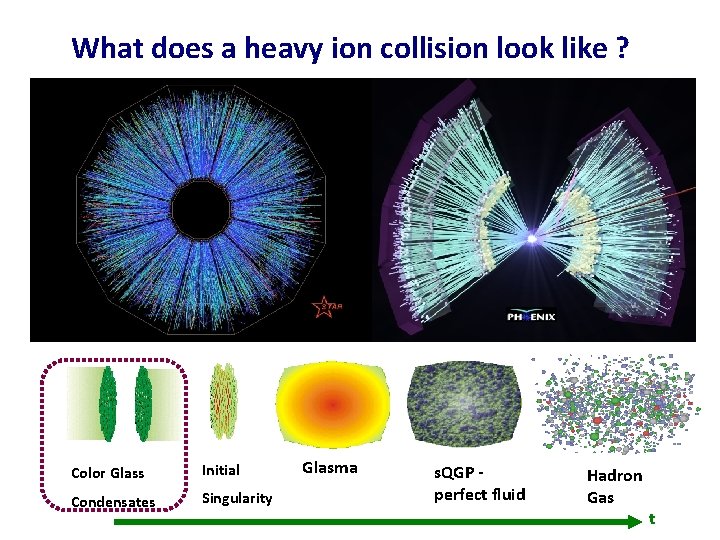
What does a heavy ion collision look like ? Color Glass Initial Condensates Singularity Glasma s. QGP perfect fluid Hadron Gas t
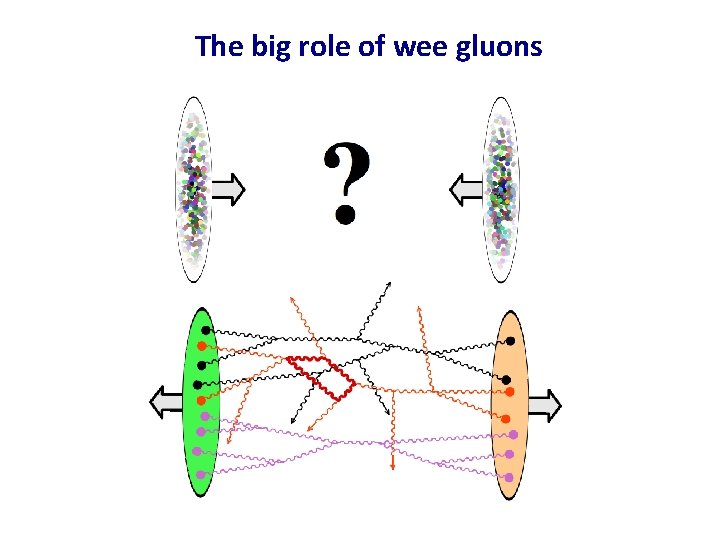
The big role of wee gluons
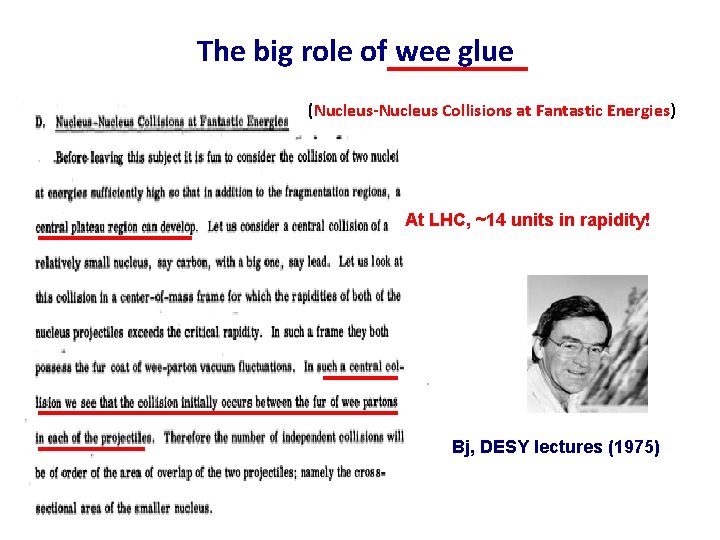
The big role of wee glue (Nucleus-Nucleus Collisions at Fantastic Energies) At LHC, ~14 units in rapidity! Bj, DESY lectures (1975)
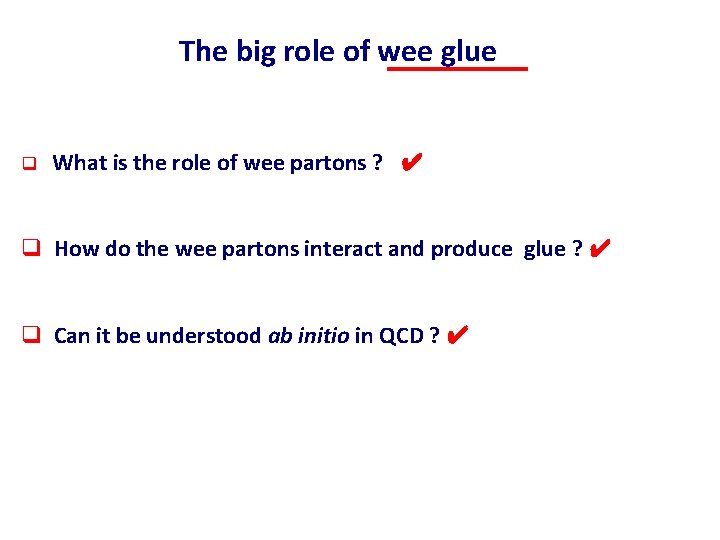
The big role of wee glue q What is the role of wee partons ? ✔ q How do the wee partons interact and produce glue ? ✔ q Can it be understood ab initio in QCD ? ✔
The DIS Paradigm Measure of resolution power Measure of inelasticity Measure of momentum fraction of struck quark+anti-quark mom. dists. gluon mom. dists
Nobel to Friedman, Kendall, Taylor Bj-scaling: apparent scale invariance of structure functions
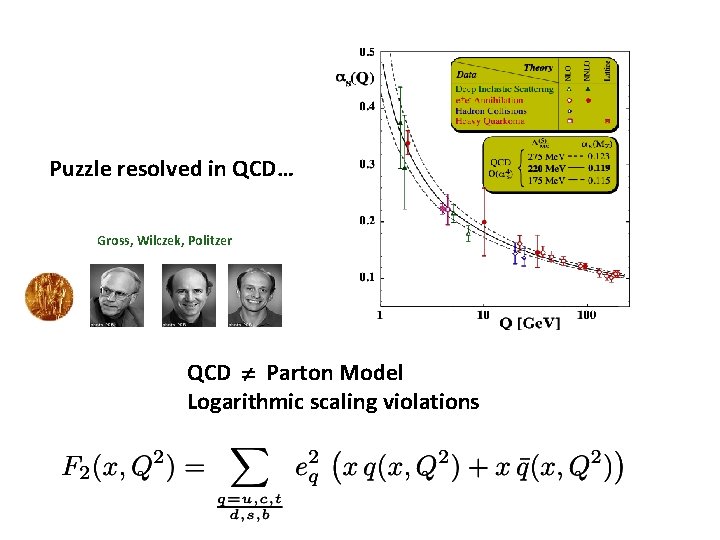
Puzzle resolved in QCD… Gross, Wilczek, Politzer QCD Parton Model Logarithmic scaling violations
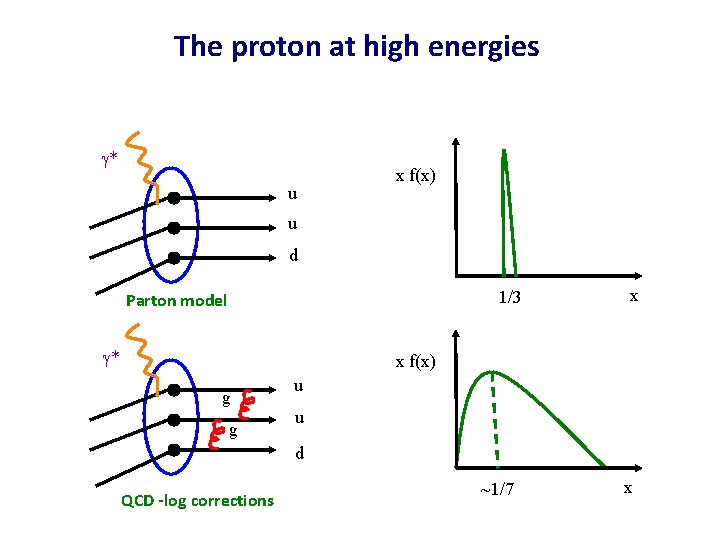
The proton at high energies * u x f(x) u d 1/3 Parton model * x x f(x) g g u u d QCD -log corrections ~1/7 x
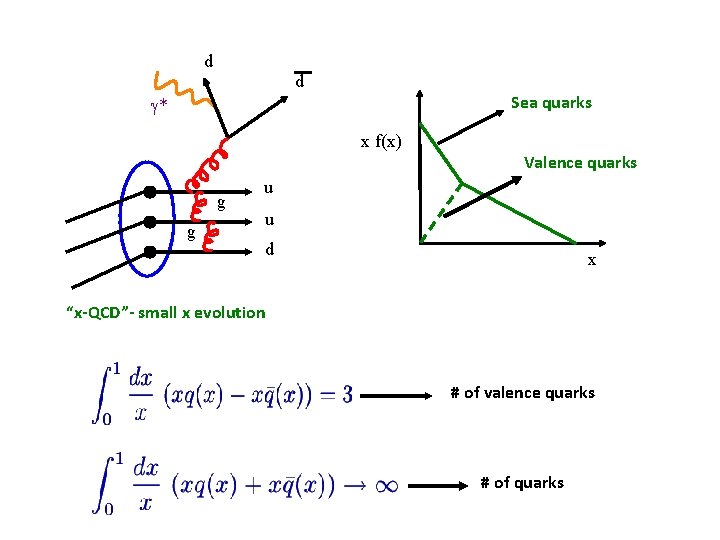
d d Sea quarks * x f(x) g g Valence quarks u u d x “x-QCD”- small x evolution # of valence quarks # of quarks
Structure functions grow rapidly at small x
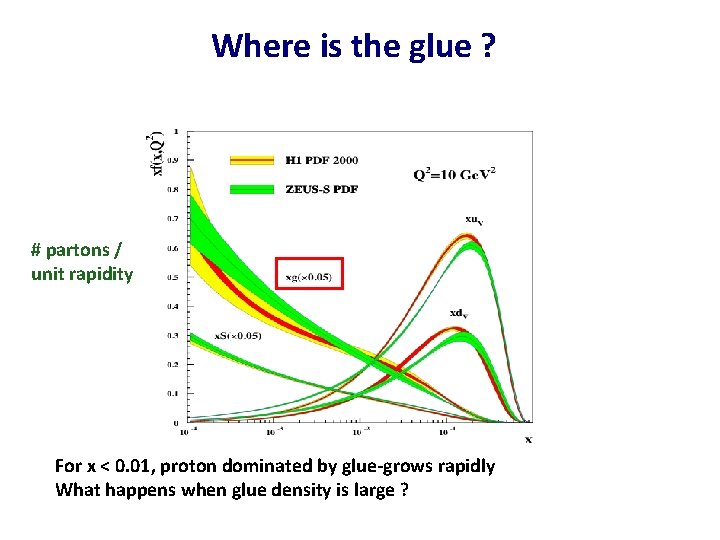
Where is the glue ? # partons / unit rapidity For x < 0. 01, proton dominated by glue-grows rapidly What happens when glue density is large ?
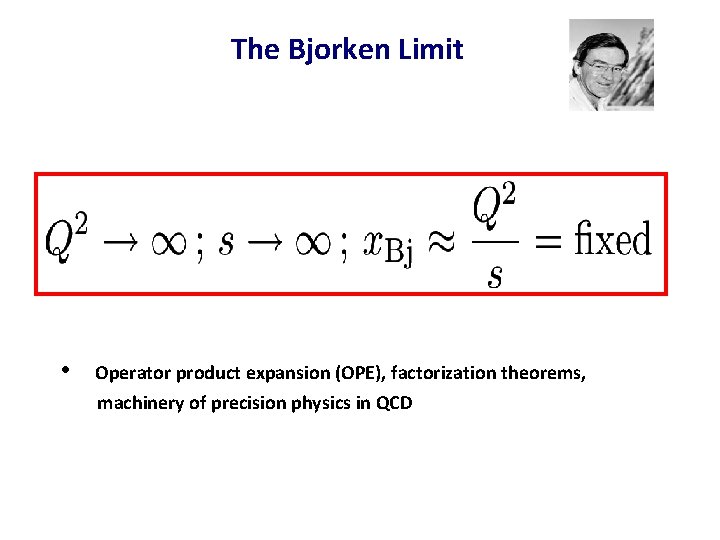
The Bjorken Limit • Operator product expansion (OPE), factorization theorems, machinery of precision physics in QCD
Structure of higher order perturbative contributions in QCD * Q 2 , x + + … + higher twist (power suppressed) contributions… Q 0 2 , x 0 P £ Coefficient functions C - computed to NNLO for many processes £ Splitting functions P - computed to 3 -loops
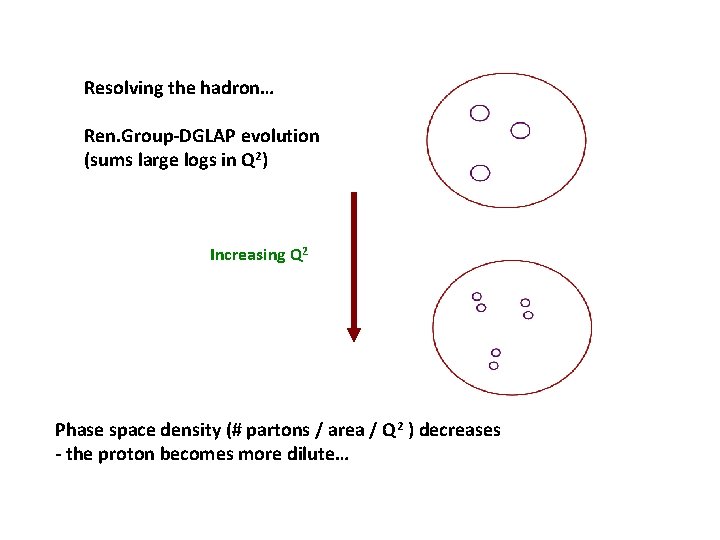
Resolving the hadron… Ren. Group-DGLAP evolution (sums large logs in Q 2) Increasing Q 2 Phase space density (# partons / area / Q 2 ) decreases - the proton becomes more dilute…
BEYOND p. QCD IN THE Bj LIMIT • Works great for inclusive, high Q 2 processes • Higher twists important when Q 2 ≈ QS 2(x) • Problematic for diffractive/exclusive processes • Formalism not designed to treat shadowing, multiple scattering, diffraction, energy loss, impact parameter dependence, thermalization…
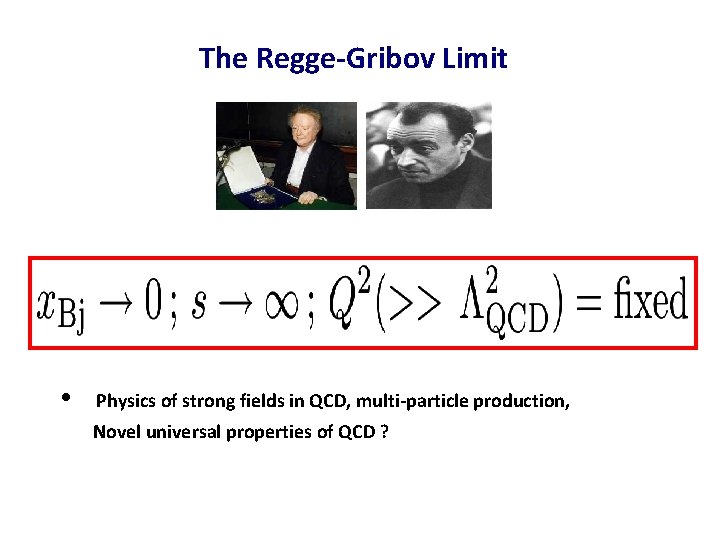
The Regge-Gribov Limit • Physics of strong fields in QCD, multi-particle production, Novel universal properties of QCD ?
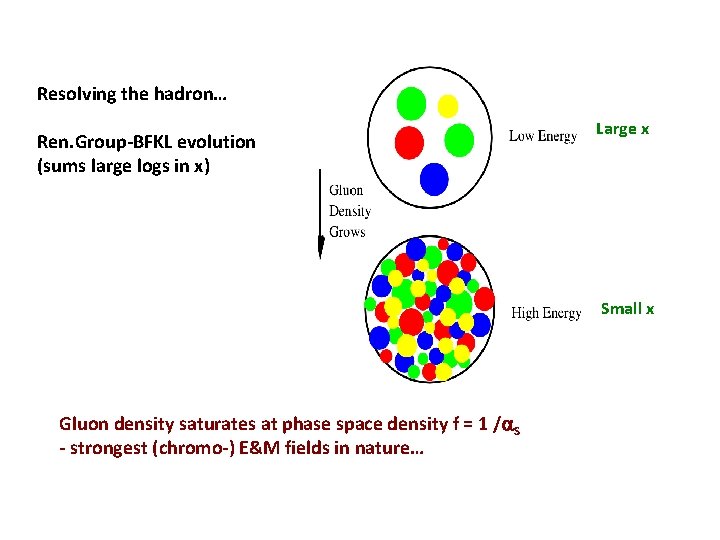
Resolving the hadron… Ren. Group-BFKL evolution (sums large logs in x) Large x Small x Gluon density saturates at phase space density f = 1 / S - strongest (chromo-) E&M fields in nature…
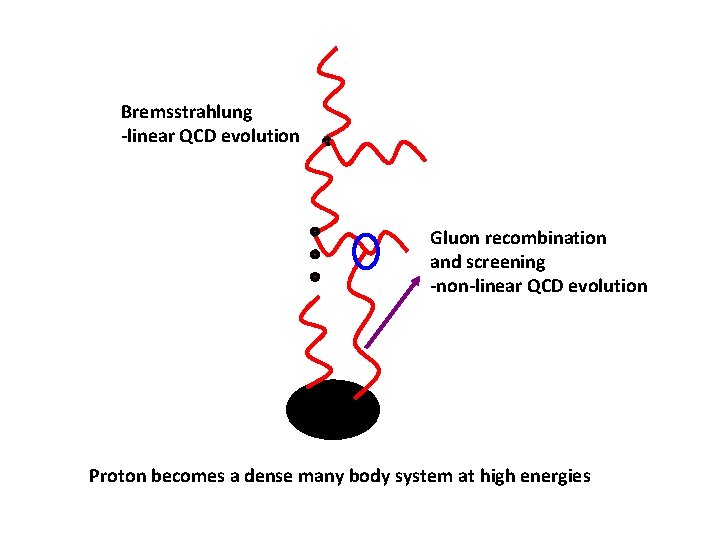
Bremsstrahlung -linear QCD evolution Gluon recombination and screening -non-linear QCD evolution Proton becomes a dense many body system at high energies
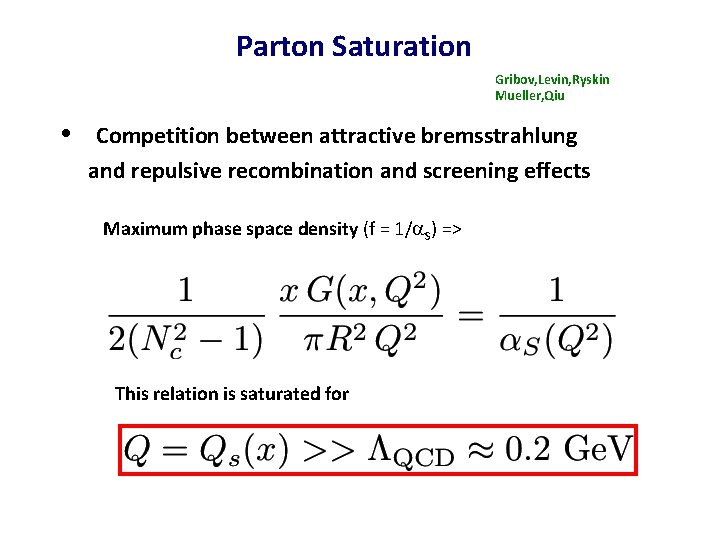
Parton Saturation Gribov, Levin, Ryskin Mueller, Qiu • Competition between attractive bremsstrahlung and repulsive recombination and screening effects Maximum phase space density (f = 1/ S) => This relation is saturated for
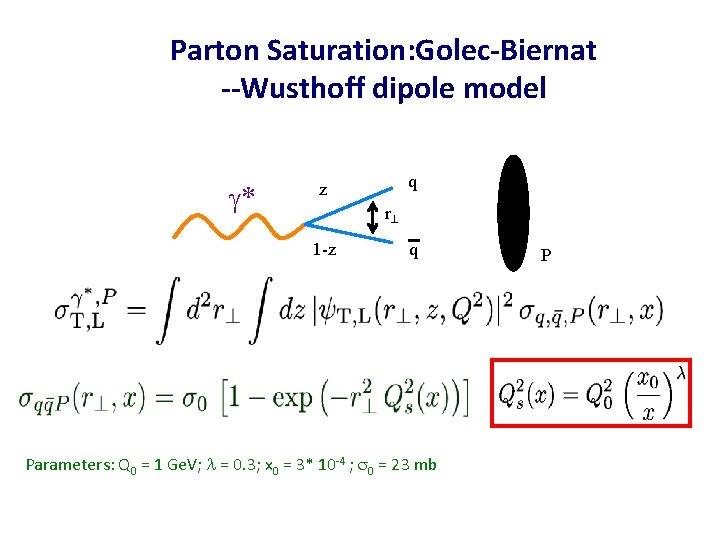
Parton Saturation: Golec-Biernat --Wusthoff dipole model * q z r 1 -z q Parameters: Q 0 = 1 Ge. V; = 0. 3; x 0 = 3* 10 -4 ; 0 = 23 mb P
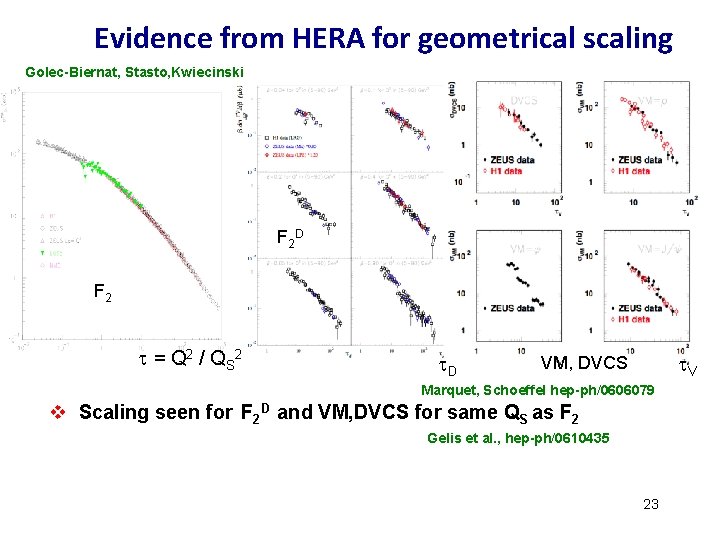
Evidence from HERA for geometrical scaling Golec-Biernat, Stasto, Kwiecinski F 2 D F 2 = Q 2 / QS 2 D V VM, DVCS Marquet, Schoeffel hep-ph/0606079 v Scaling seen for F 2 D and VM, DVCS for same QS as F 2 Gelis et al. , hep-ph/0610435 23
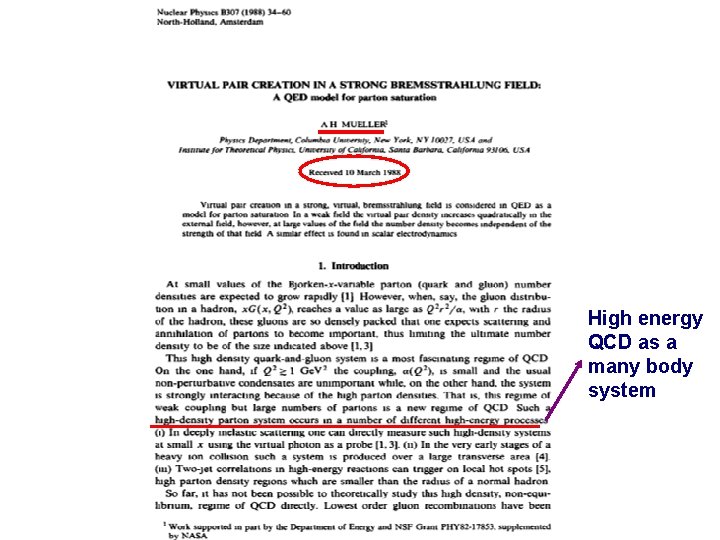
High energy QCD as a many body system
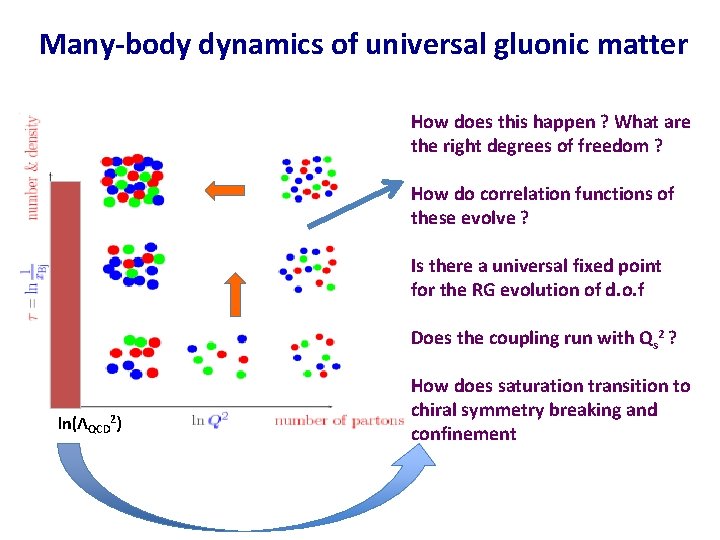
Many-body dynamics of universal gluonic matter How does this happen ? What are the right degrees of freedom ? How do correlation functions of these evolve ? Is there a universal fixed point for the RG evolution of d. o. f Does the coupling run with Qs 2 ? ln(ΛQCD 2) How does saturation transition to chiral symmetry breaking and confinement
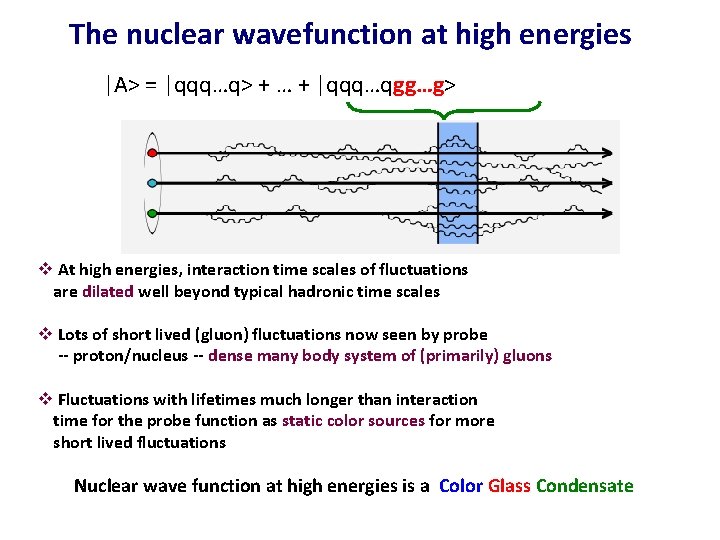
The nuclear wavefunction at high energies |A> = |qqq…q> + … + |qqq…qgg…g> v At high energies, interaction time scales of fluctuations are dilated well beyond typical hadronic time scales v Lots of short lived (gluon) fluctuations now seen by probe -- proton/nucleus -- dense many body system of (primarily) gluons v Fluctuations with lifetimes much longer than interaction time for the probe function as static color sources for more short lived fluctuations Nuclear wave function at high energies is a Color Glass Condensate
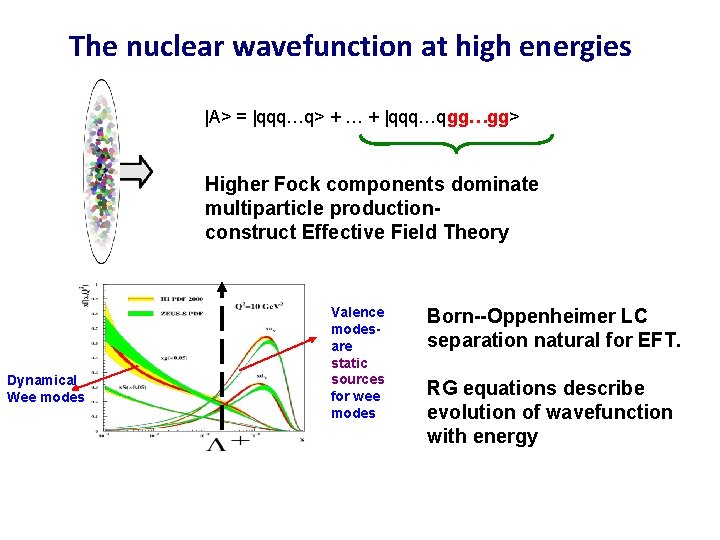
The nuclear wavefunction at high energies |A> = |qqq…q> + … + |qqq…qgg…gg> Higher Fock components dominate multiparticle productionconstruct Effective Field Theory Dynamical Wee modes Valence modesare static sources for wee modes Born--Oppenheimer LC separation natural for EFT. RG equations describe evolution of wavefunction with energy
Effective Field Theory on Light Front Susskind Bardacki-Halpern Poincare group on LF isomorphism Galilean sub-group of 2 D Quantum Mechanics Eg. , LF dispersion relation Energy Momentum Mass Large x (P+) modes: static LF (color) sources a Small x (k+ <<P+) modes: dynamical fields Mc. Lerran, RV CGC: Coarse grained many body EFT on LF non-pert. gauge invariant “density matrix” defined at initial scale 0+ RG equations describe evolution of W with x JIMWLK, BK
The Color Glass Condensate Mc. Lerran, RV Jalilian-Marian, Kovner, Weigert Iancu, Leonidov, Mc. Lerran In the saturation regime: Strongest fields in nature! CGC: Classical effective theory of QCD describing dynamical gluon fields + static color sources in non-linear regime o Novel renormalization group equations (JIMWLK/BK) describe how the QCD dynamics changes with energy o A universal saturation scale QS arises naturally in theory 29
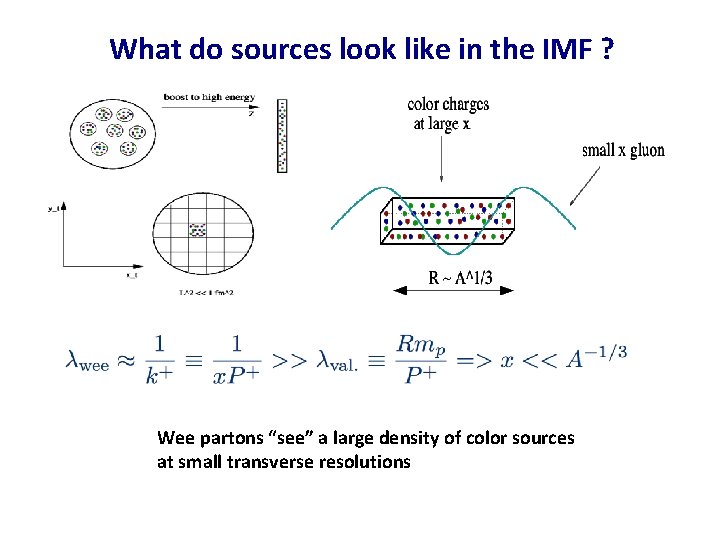
What do sources look like in the IMF ? Wee partons “see” a large density of color sources at small transverse resolutions
Classical field of a large nucleus For a large nucleus, A >>1, “Pomeron” excitations Mc. Lerran, RV Kovchegov Jeon, RV Acl from 1/ QCD Wee parton dist. : “Odderon” excitations 2 R / determined from RG
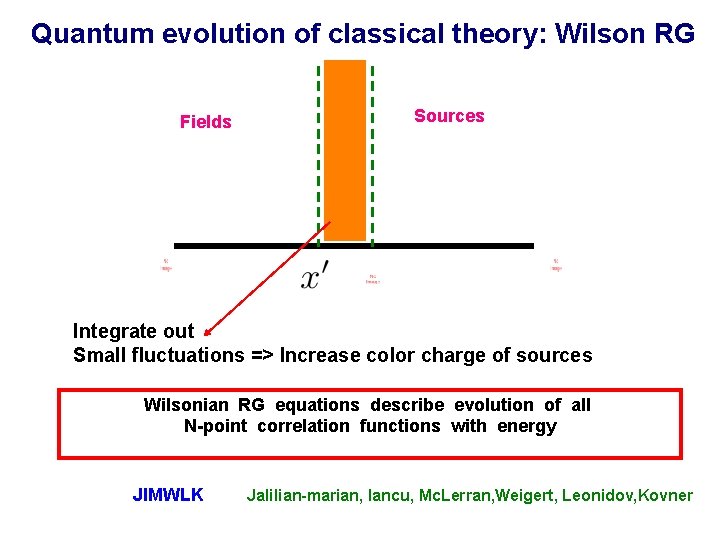
Quantum evolution of classical theory: Wilson RG Fields Sources Integrate out Small fluctuations => Increase color charge of sources Wilsonian RG equations describe evolution of all N-point correlation functions with energy JIMWLK Jalilian-marian, Iancu, Mc. Lerran, Weigert, Leonidov, Kovner
Saturation scale grows with energy Typical gluon momenta are large Typical gluon k. T in hadron/nuclear wave function Bulk of high energy cross-sections: a) obey dynamics of novel non-linear QCD regime b) Can be computed systematically in weak coupling 33
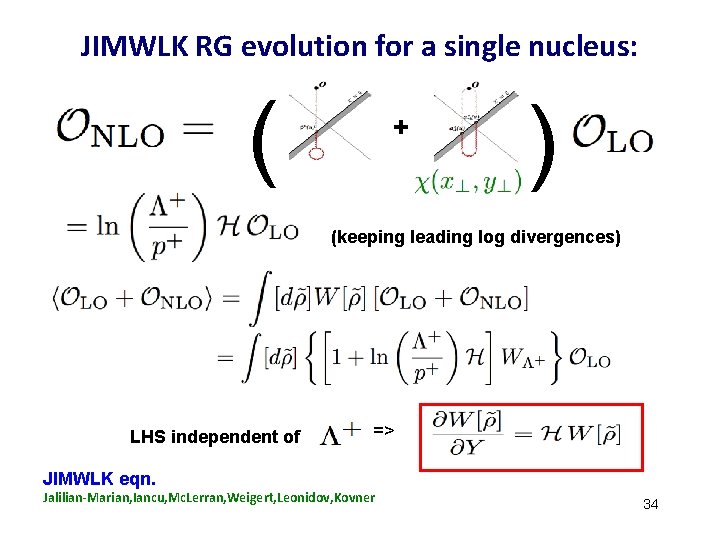
JIMWLK RG evolution for a single nucleus: ( + ) (keeping leading log divergences) LHS independent of => JIMWLK eqn. Jalilian-Marian, Iancu, Mc. Lerran, Weigert, Leonidov, Kovner 34
CGC Effective Theory: B-JIMWLK hierarchy of correlators “time” “diffusion coefficient” At high energies, the d. o. f that describe the frozen many-body gluon configurations are novel objects: dipoles, quadrupoles, … Universal – appear in a number of processes in p+A and e+A; how do these evolve with energy ? 35
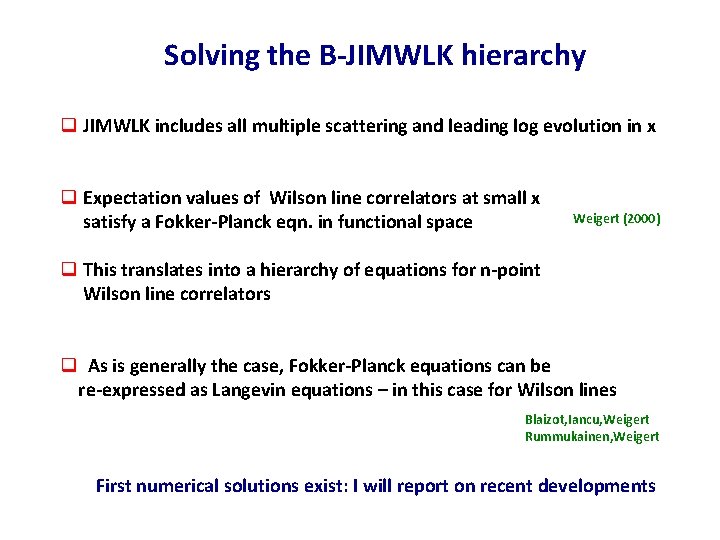
Solving the B-JIMWLK hierarchy q JIMWLK includes all multiple scattering and leading log evolution in x q Expectation values of Wilson line correlators at small x satisfy a Fokker-Planck eqn. in functional space Weigert (2000) q This translates into a hierarchy of equations for n-point Wilson line correlators q As is generally the case, Fokker-Planck equations can be re-expressed as Langevin equations – in this case for Wilson lines Blaizot, Iancu, Weigert Rummukainen, Weigert First numerical solutions exist: I will report on recent developments
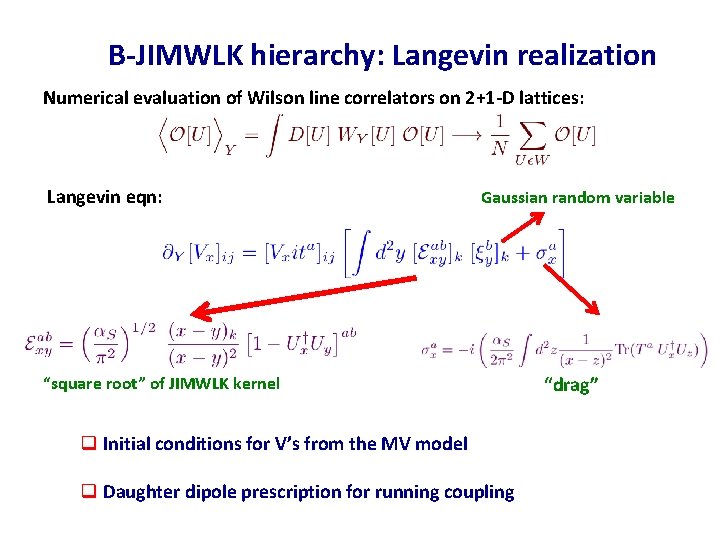
B-JIMWLK hierarchy: Langevin realization Numerical evaluation of Wilson line correlators on 2+1 -D lattices: Langevin eqn: Gaussian random variable “square root” of JIMWLK kernel q Initial conditions for V’s from the MV model q Daughter dipole prescription for running coupling “drag”
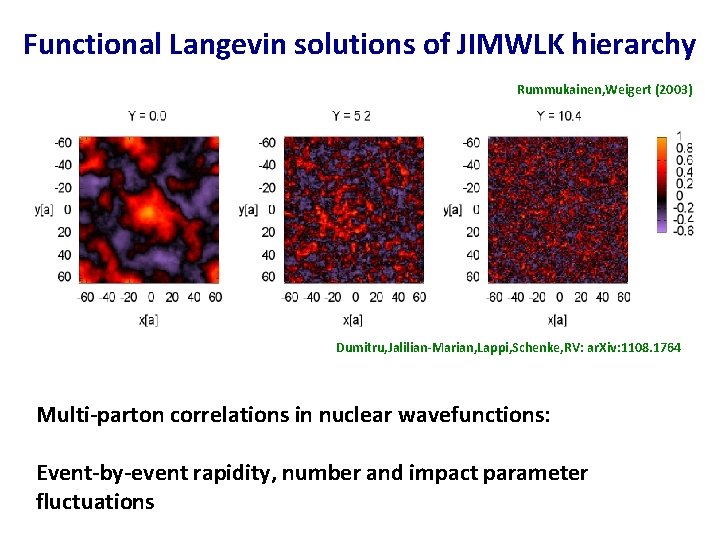
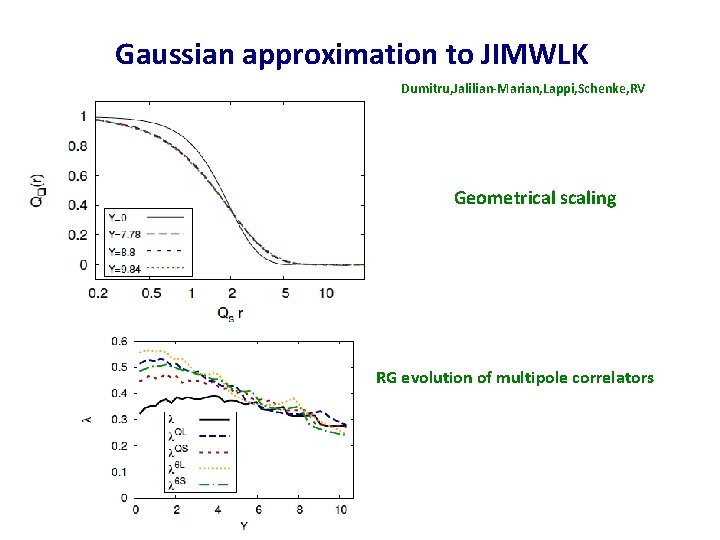
Functional Langevin solutions of JIMWLK hierarchy Rummukainen, Weigert (2003) Dumitru, Jalilian-Marian, Lappi, Schenke, RV: ar. Xiv: 1108. 1764 Multi-parton correlations in nuclear wavefunctions: Event-by-event rapidity, number and impact parameter fluctuations
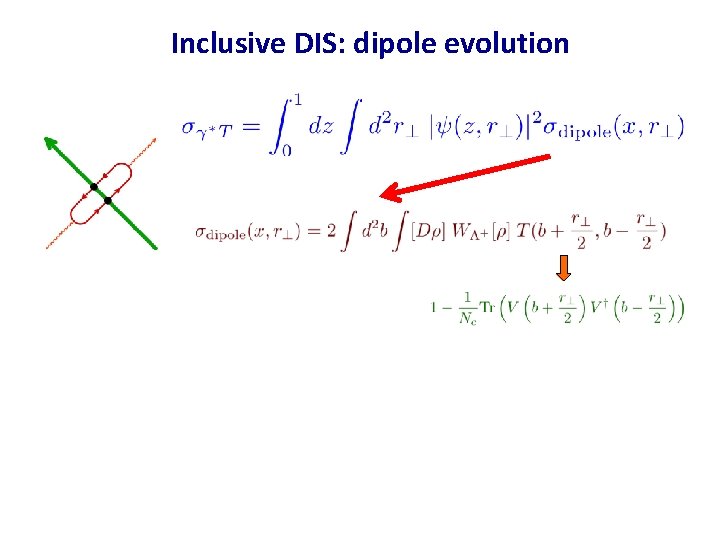
Inclusive DIS: dipole evolution
Inclusive DIS: dipole evolution B-JIMWLK eqn. for dipole correlator Dipole factorization: Nc ∞ Resulting closed form eqn. is the Balitsky-Kovchegov eqn. Widely used in phenomenological applications
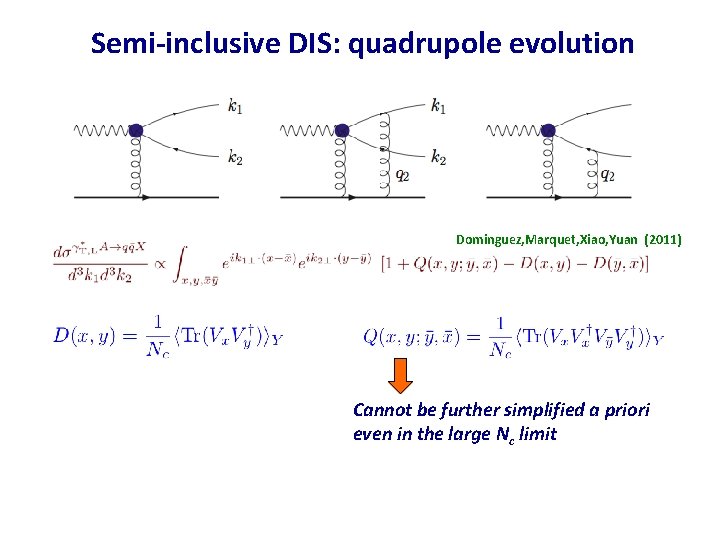
Semi-inclusive DIS: quadrupole evolution Dominguez, Marquet, Xiao, Yuan (2011) Cannot be further simplified a priori even in the large Nc limit
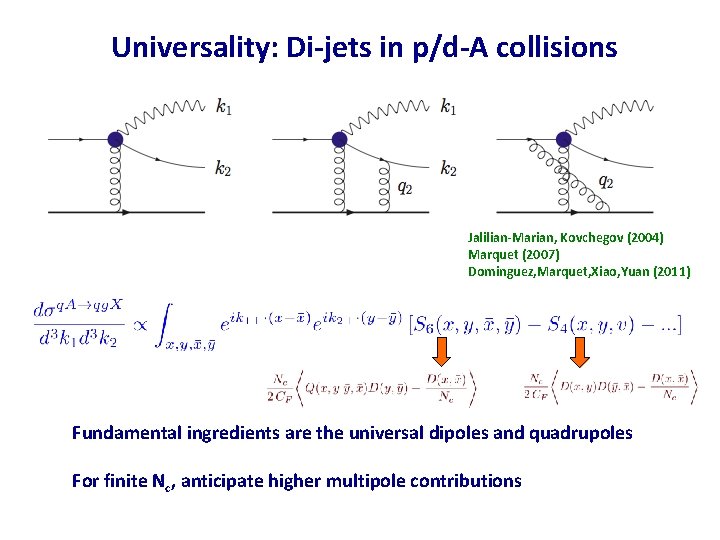
Universality: Di-jets in p/d-A collisions Jalilian-Marian, Kovchegov (2004) Marquet (2007) Dominguez, Marquet, Xiao, Yuan (2011) Fundamental ingredients are the universal dipoles and quadrupoles For finite Nc, anticipate higher multipole contributions
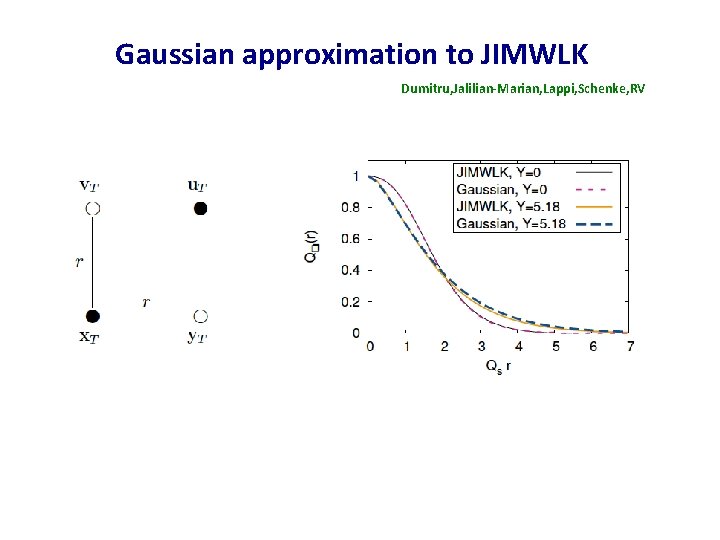
Gaussian approximation to JIMWLK Dumitru, Jalilian-Marian, Lappi, Schenke, RV
Gaussian approximation to JIMWLK Dumitru, Jalilian-Marian, Lappi, Schenke, RV Geometrical scaling RG evolution of multipole correlators