
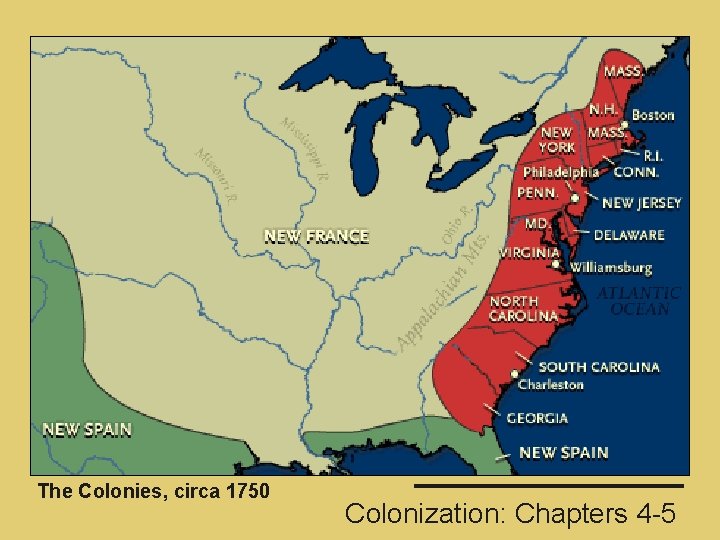
The Colonies circa 1750 Colonization Chapters 4 5
- Slides: 28
The Colonies, circa 1750 Colonization: Chapters 4 -5
Look How Smart We’ll Be: • Evaluate the lives of colonists in the Chesapeake region and how disease, family life, crop demands, and social hierarchy impacted their culture. • Contrast southern colonial life to early New England life focusing on the items listed above, as well as the economic and moral environment. • Compare seventeenth-century colonial society with eighteenth-century colonial society. – Evaluate how society became more complex and hierarchical, more ethnically and religiously diverse, and more economically and politically developed. • Identify distinct American qualities in such areas as evangelical religion, education, press freedom, and selfgovernment.
Just to Jog Your Memory: • Split into groups and make posters comparing the North, South, and Middle colonies: – Social – Political – Economic – Religious
What about the guys who were here first? • Disorganization - No dense concentrations of population as in the Aztec empire. – Intertribal and intratribal warfare • Perished from Old World diseases. • English had different views of natives than the Spanish – Did not marry or incorporate indigenous culture into their own – disposability.
Life in the South • Short life expectancy – Disease-ravaged environment – Almost no grandparents, few adult parents • Scarce number of women – 6 to 1 in 1650 – Those there had more property rights • Weak family ties – Mono-generational • Continue to grow – By 1700, Virginia was the most populous colony (followed by Maryland)
Labor in the South • Tobacco crop required laborers – Indians died off too quickly – Turned to indentured servants using the “head-right system” • 1618 • Whoever paid for the passage of a laborer received the right to acquire 50 acres person • 100, 000 “white slaves” in the Chesapeake by 1700 – Majority of land in the hands of a few • No chance for incoming poor farmers to get land
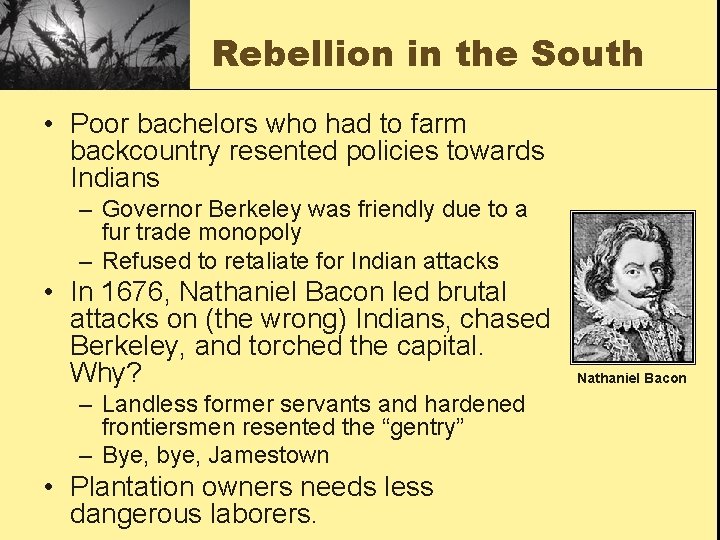
Rebellion in the South • Poor bachelors who had to farm backcountry resented policies towards Indians – Governor Berkeley was friendly due to a fur trade monopoly – Refused to retaliate for Indian attacks • In 1676, Nathaniel Bacon led brutal attacks on (the wrong) Indians, chased Berkeley, and torched the capital. Why? – Landless former servants and hardened frontiersmen resented the “gentry” – Bye, bye, Jamestown • Plantation owners needs less dangerous laborers. Nathaniel Bacon
The Wrong Solution • Increased demand for slaves 1. Less migration from England—wages increasing there 2. Dependable work force—large landowners disturbed by political demands of small farmers & indentured servants. (wanted control over their workers) 3. Cheap labor—tobacco prices fell, needed large numbers of unskilled workers for rice & indigo 4. End of the Royal African Company’s monopoly. 5. First Africans come to Virginia in 1619 - began to come en masse in 1680 s.
The Institution of Slavery • Began for economic purposes • Slave laws permanently institutionalized slavery in American society – Some colonies made it a crime to teach slaves to read and write. – 1661, Virginia—Children automatically inherit their mother’s slave status for life. – 1664, Maryland—Baptism does not affect slave status & white women cannot marry black men. • The overall affect: blacks become social inferiors, racism & slavery become an integral part of colonial society • Creation of a racially hierarchical society in the South
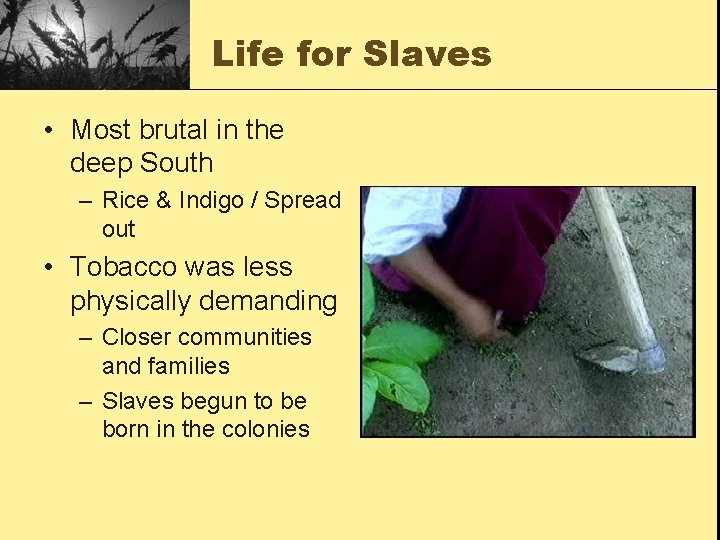
Life for Slaves • Most brutal in the deep South – Rice & Indigo / Spread out • Tobacco was less physically demanding – Closer communities and families – Slaves begun to be born in the colonies
Life in the North • Longer life expectancy – Clean water and cooler temperatures – No hard labor like in the South – Added 10 years to their life span • Early marriage and childbearing – Average: 8 children! • Strong family ties – Obedience and guidance • Strong and active communities • Heavy emphasis on education
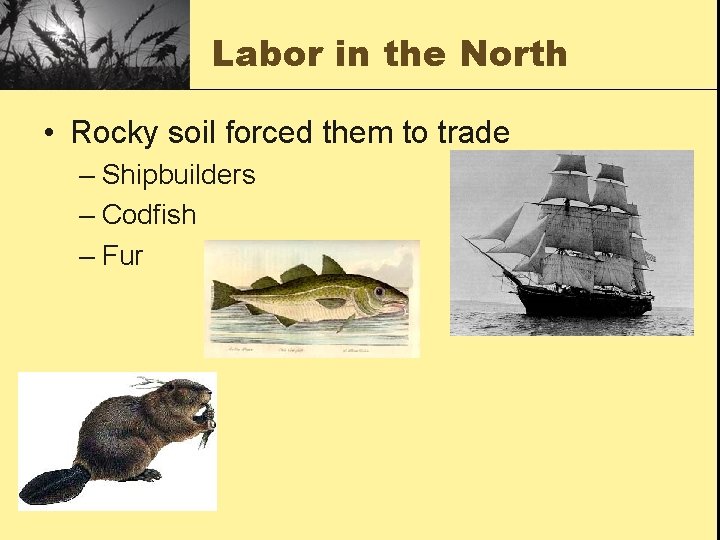
Labor in the North • Rocky soil forced them to trade – Shipbuilders – Codfish – Fur
Religion in the North • Religious zeal waned from the first generation. – Decline in conversions • Half-Way Covenant – Admit baptism, but not full communion, to children of existing members – Weaken the distinction between the elect and others
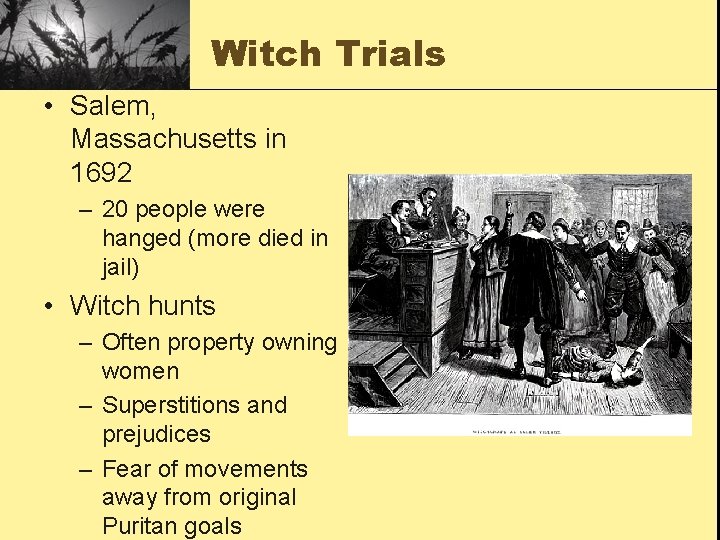
Witch Trials • Salem, Massachusetts in 1692 – 20 people were hanged (more died in jail) • Witch hunts – Often property owning women – Superstitions and prejudices – Fear of movements away from original Puritan goals
Colonial Society
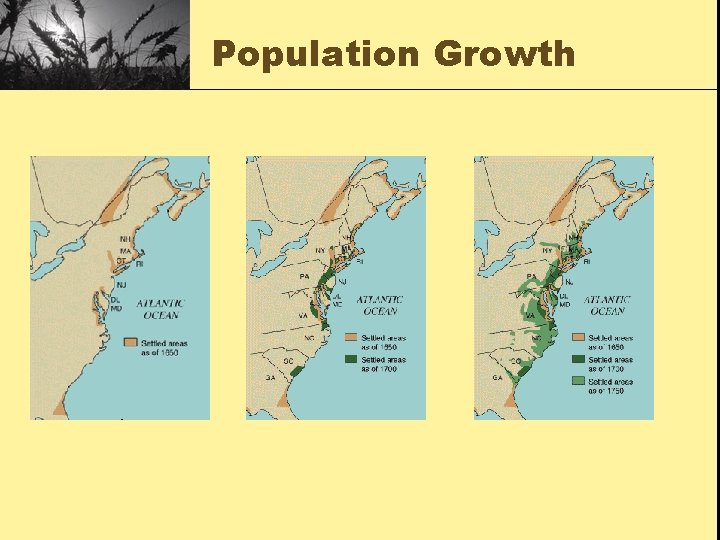
Life in the Colonies • • Self-government Social mobility Religious toleration Colonists lived in abundance compared to their European peers. • Land was cheap, but passage cost money – most colonists were the middle class. • Population was beginning to grow more quickly
Population Growth
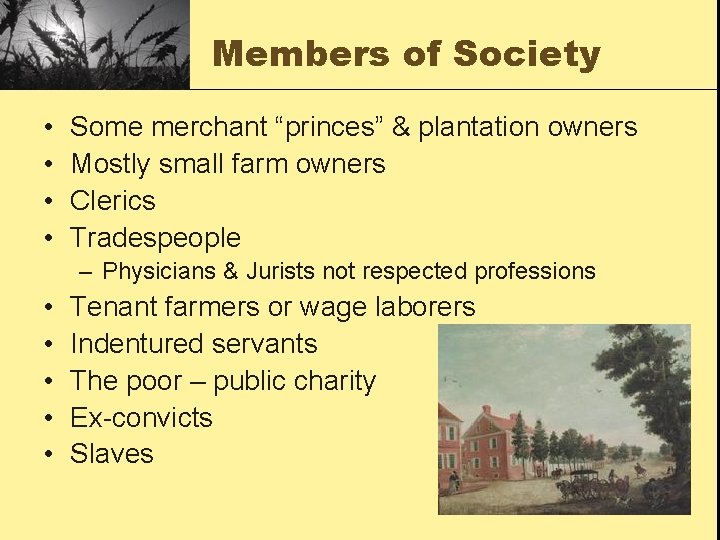
Members of Society • • Some merchant “princes” & plantation owners Mostly small farm owners Clerics Tradespeople – Physicians & Jurists not respected professions • • • Tenant farmers or wage laborers Indentured servants The poor – public charity Ex-convicts Slaves
Colonial Religion • Dominance of Protestant Religions – Two “established” denominations: Anglican (South) & Congregations Church (MA, CT) • supported by taxes – EVERYONE pays, regardless of faith – policies changed by time of Revolution – Other denominations: Presbyterians, Dutch. Reform, Lutherans, Mennonites, and Quakers • Churchgoers complained about boring sermons and too much “hell & brim fire”
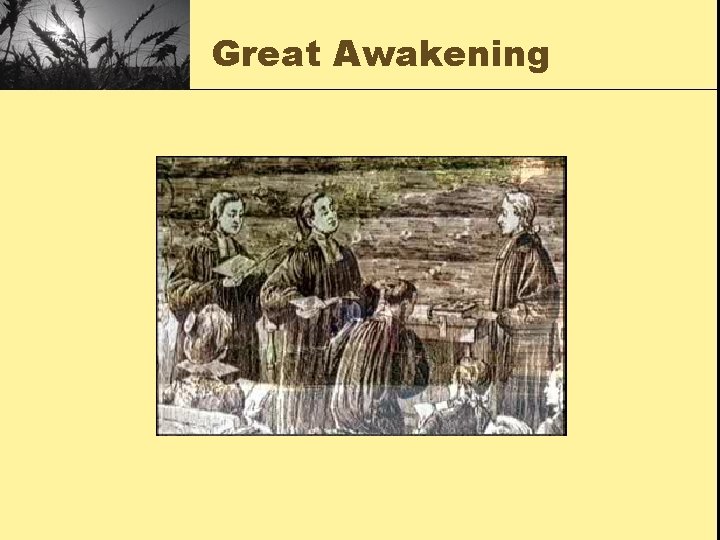
Great Awakening
The Great Awakening • Movement of fervent expressions of religious feeling among masses of people • Strongest in the 1730 s and 1740 s • Initiated by Jonathan Edwards of Northampton, MA • God is angry with human sinfulness, express penitence or eternal damnation • Expanded by George Whitefield – all over colonies in barns, tents, fields – audiences up to 10, 000 • God is all-powerful, save only those who openly state belief in Jesus, send everyone else to hell • Ordinary people with sincere faith didn’t need ministers
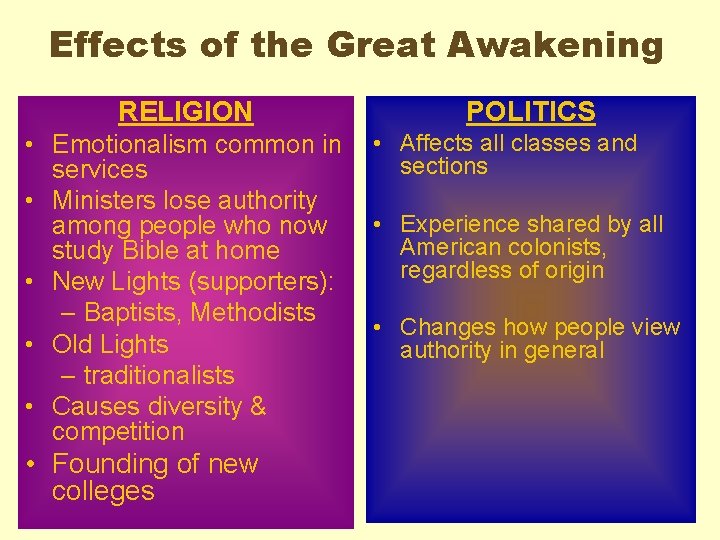
Effects of the Great Awakening RELIGION • Emotionalism common in services • Ministers lose authority among people who now study Bible at home • New Lights (supporters): – Baptists, Methodists • Old Lights – traditionalists • Causes diversity & competition • Founding of new colleges POLITICS • Affects all classes and sections • Experience shared by all American colonists, regardless of origin • Changes how people view authority in general
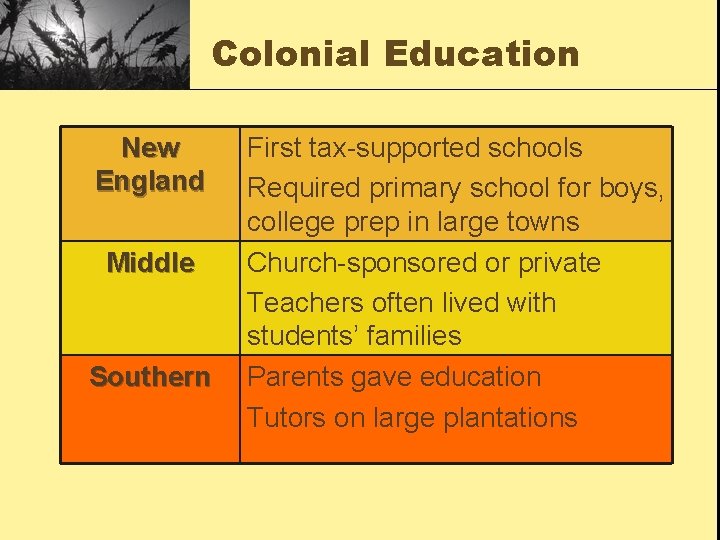
Colonial Education New England Middle Southern First tax-supported schools Required primary school for boys, college prep in large towns Church-sponsored or private Teachers often lived with students’ families Parents gave education Tutors on large plantations
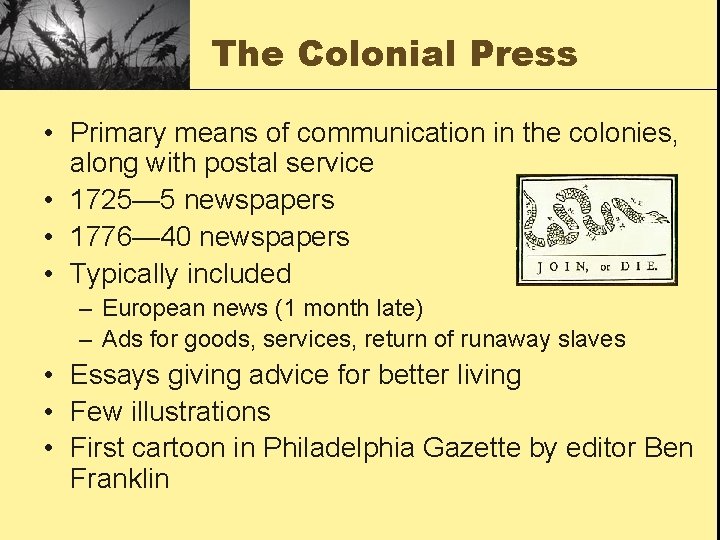
The Colonial Press • Primary means of communication in the colonies, along with postal service • 1725— 5 newspapers • 1776— 40 newspapers • Typically included – European news (1 month late) – Ads for goods, services, return of runaway slaves • Essays giving advice for better living • Few illustrations • First cartoon in Philadelphia Gazette by editor Ben Franklin
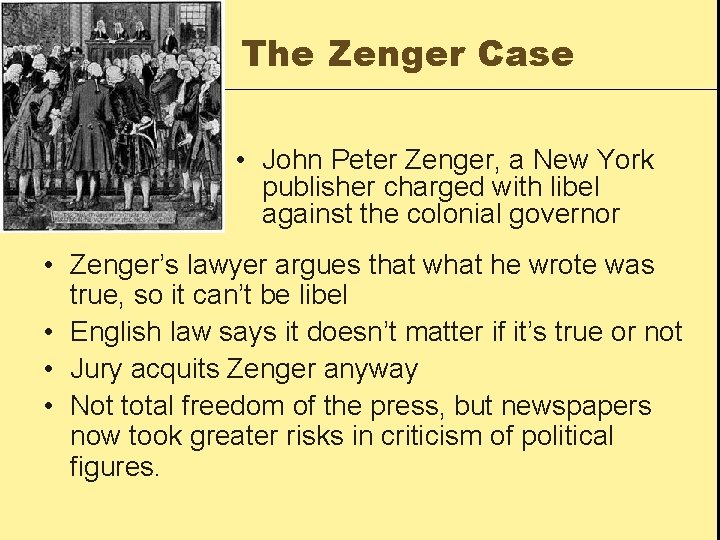
The Zenger Case • John Peter Zenger, a New York publisher charged with libel against the colonial governor • Zenger’s lawyer argues that what he wrote was true, so it can’t be libel • English law says it doesn’t matter if it’s true or not • Jury acquits Zenger anyway • Not total freedom of the press, but newspapers now took greater risks in criticism of political figures.
Political Backdrop of Revolution • All colonies had bicameral legislatures • Lower House Elected – Voted on taxation (with representation—get it? ) • Governors/Upper Houses chosen differently – 8 colonies (NH, MA, NY, NJ, VA, NC, SC) chosen by the crown – 3 (MD, PA, DE) appointed by proprietors – 2 (CT, RI) had elected governors • Local Government most important to people – New England: Town meetings – South: Sheriff/county administrators
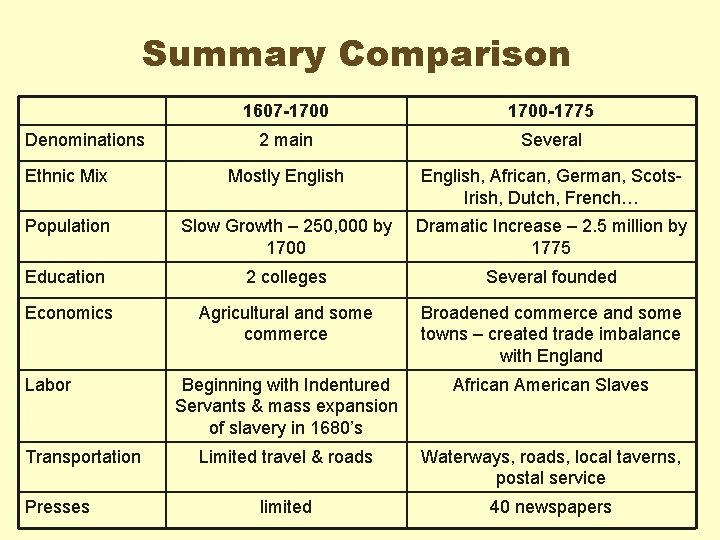
Summary Comparison 1607 -1700 -1775 2 main Several Ethnic Mix Mostly English, African, German, Scots. Irish, Dutch, French… Population Slow Growth – 250, 000 by 1700 Dramatic Increase – 2. 5 million by 1775 Education 2 colleges Several founded Economics Agricultural and some commerce Broadened commerce and some towns – created trade imbalance with England Beginning with Indentured Servants & mass expansion of slavery in 1680’s African American Slaves Limited travel & roads Waterways, roads, local taverns, postal service limited 40 newspapers Denominations Labor Transportation Presses
• http: //www. ambrosevideo. com/resources/docs/112. JPG • http: //www. english. upenn. edu/~bushnell/english 330/materials/introduction/elizabeth_1 -g 2. jpeg • http: //www. millikin. edu/history/religiousviolence/images/jamestown. j pg • http: //www. lewiscountyherald. com/tobacco. jpg • http: //www. seacoastnh. com/arts/res/smith 1. jpeg • http: //library. yale. edu/Map. Coll/britain. GIF • http: //www. culturalresources. com/images/Lord. Baltimore. jpg • http: //www. etsu. edu/cas/history/resources/Private/Faculty/Fac_To 1 877 Chapter. Doc. Files/Chapter. Images/Ch 3 hooker. jpg • http: //www. poorwilliam. net/pix/salem-witch. jpg • http: //occawlonline. pearsoned. com/bookbind/pubbooks/garraty 8 e_a wl/medialib/animaps/04 popul. html