
The Colonial Political Experience 2 Basic Questions Why
The Colonial Political Experience
2 Basic Questions Ü Why did the Englishmen rebel against Englishmen? Colonies were settled by English, with the intent to remain English. Ü Why did constitutional government evolve in the colonies as opposed to the “English System”?
Simple Answer…. . Ü Many differences, which over time, guaranteed the Revolution and eventually, the formation of the American Republic.
Differences and Effects I. Purpose for colonies: People move to America for 3 basic reasons. A. Economic. 1. Some colonies formed to create a profit. a. London Company in Virginia. b. Many times these were people who were already
B. Religious. 1. Some move to escape religious persecution. a. Pennsylvania-settled by William Penn and the Quakers. b. Maryland-Settled by Sir George Calvert (Lord Baltimore) and the Catholics. 2. To strengthen their own beliefs concerning the role of God in the state. a. Puritans-settled in America to
C. A fresh start. 1. Poor people with no political power and little hope. a. Wanted to create a better life for themselves and families.
II. Geography. A. Distance. 1. England was 3, 000 miles and 2 months away. 2. Ruling class in England had little impact in colonies which could not wait so long for decisions. a. Colonies had to “help” themselves.
B. Frontier. 1. Population spread out over a large territory. 2. Many times there was a great distance between settlements. 3. Local governments, which tend to be more responsible to the people, become important. 4. Accurate news and community important to survival.

Diversity. A. Many people came from nations other than England brought many cultures. 1. These cultures “mix” with the English. 2. An American identity is created. As time grew, these issues became more important and many Americans feel that the King didn’t understand. III.
Creation of Colonies-done by grants from the king. I. 3 types of colonies. A. Royal Colonies (there were eventually 8 of them). 1. Governor and his assistants appointed by the king. 2. Governor advised by a council which is appointed by the king. 3. Colonies elect a representative assembly but its actions could be checked by

Proprietary Colony (there were 3). 1. King gave a grant of land to a proprietor. a. Governor appointed by proprietor. C. Charter Colonies (2 of them). 1. Ruled by a governor elected by the citizens of the colony. 2. King had some authority as B.
Salutary Neglect. I. II. Government of Great Britain ignored violations of law and processes for almost 160 years. Everyone was benefiting from the colonial ventures and no one wanted to disrupt that relationship.
Settlement I. Virginia. A. Jamestown settled in 1607. B. Provision of London Company charter guaranteed that they would have the same “rights as Englishmen”. as those in England. C. 1619, first Virginia assembly met, modeled after Parliament. 1. Upper house was the Governor's Council. 2. Lower house became the 1 st elective representative assembly
II. Massachusetts. A. Separatists (Pilgrims) head to Virginia on Mayflower. 1. Blown off course in a storm and land at Massachusetts. 2. Make decision to stay. B. Area was outside of colony of Virginia, no government.
C. 41 men sign the Mayflower Compact. 1. Established Compact Theory of government. a. Agreement among governed. 2. 1 st step toward selfgovernment, Pilgrims created open-discussion town meetings.
III. Connecticut. A. 1636, a group of puritans, led by Rev. Thomas Hooker, seeking more land religious toleration, settled in Hartford, Connecticut. B. 1639, they sign the Fundamental Orders of Connecticut, the 1 st written constitution in America.
IV. Maryland. A. Settled as a haven for Catholics. B. 1649, Religious Toleration Act. 1. Allowed complete religious freedom to anyone whose religion endorsed the doctrine of Christ as Savior.
V. New England Confederation (1643). A. A confederation is a loose organization of states bound together for a common purpose (usually defense). B. 1 st attempt to unite a number of colonies. 1. Formed for defense against the Native Americans.
John Peter Zenger Case (173435). A. Charged with libel. B. Found not guilty, established the concept of “free press”. VII. Albany Plan of Union, 1754. A. Plan developed by Benjamin Franklin. B. Called for annual congress of delegates from all 13 colonies. C. Would have power to raise military, make war, regulate VI.
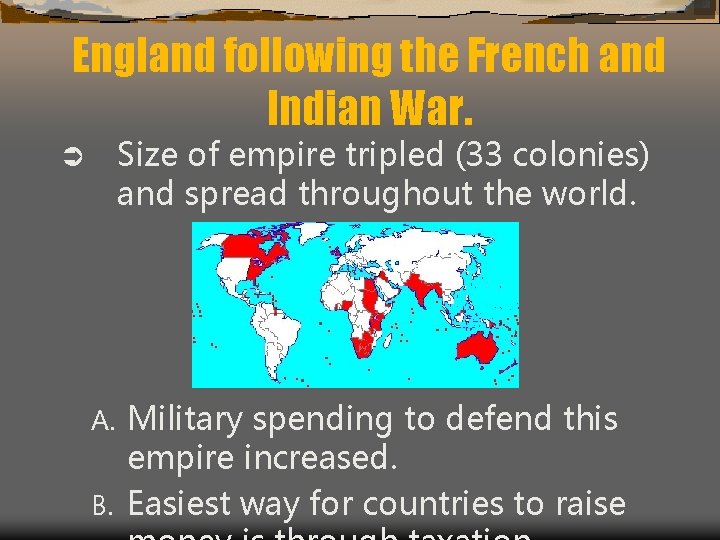
England following the French and Indian War. Size of empire tripled (33 colonies) and spread throughout the world. Ü Military spending to defend this empire increased. B. Easiest way for countries to raise A.
II. Sugar Act of 1764. A. Tax on sugar and molasses. B. Allowed for enforcement and collection. C. Molasses was needed to produce rum, popular drink and used for trade. D. Colonists continued to ignore tax and smuggle it in. **Indirect taxation: tax built into the cost

III. Stamp Act of 1765 A. Tax on paper. 1. Direct tax paid on paper items. 2. Stamped when purchased to prove payment of tax. All colonists realized they were now being taxed and began to protest. C. Tax repealed in 1766. B.
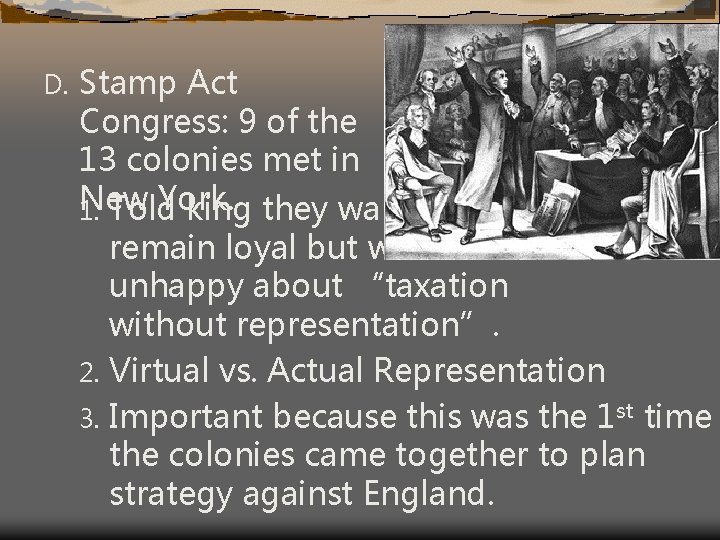
D. Stamp Act Congress: 9 of the 13 colonies met in New York. 1. Told king they want to remain loyal but were unhappy about “taxation without representation”. 2. Virtual vs. Actual Representation 3. Important because this was the 1 st time the colonies came together to plan strategy against England.
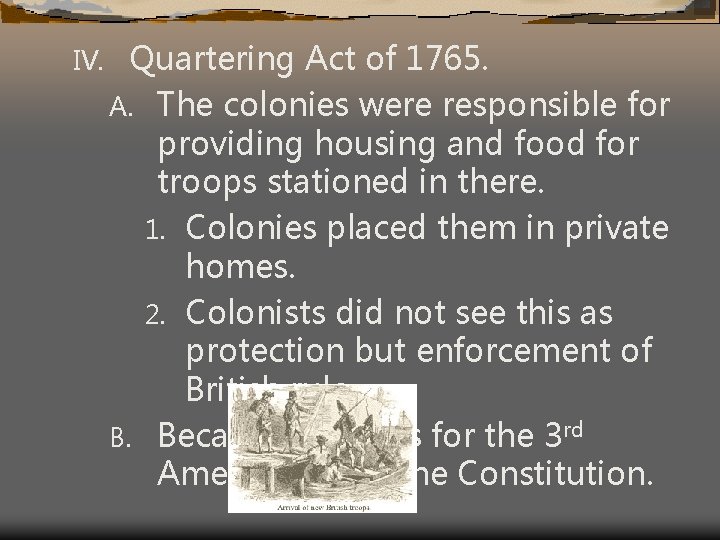
IV. Quartering Act of 1765. A. The colonies were responsible for providing housing and food for troops stationed in there. 1. Colonies placed them in private homes. 2. Colonists did not see this as protection but enforcement of British rule. B. Became the basis for the 3 rd Amendment of the Constitution.
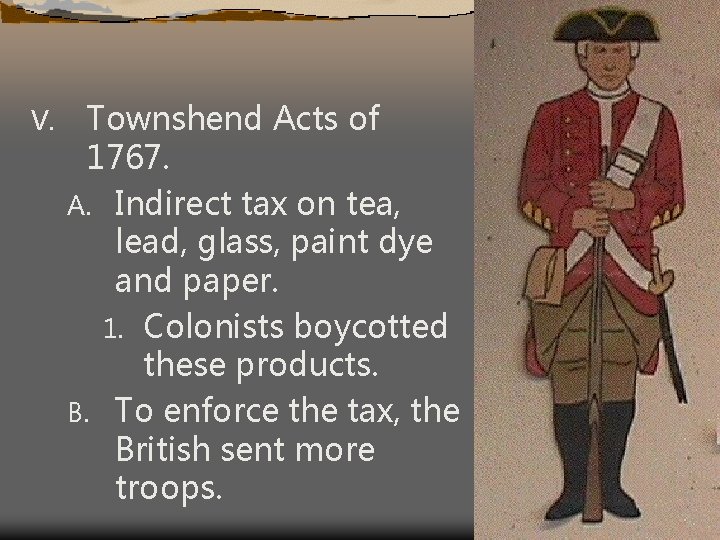
V. Townshend Acts of 1767. A. Indirect tax on tea, lead, glass, paint dye and paper. 1. Colonists boycotted these products. B. To enforce the tax, the British sent more troops.
Legalize Writs of Assistance. 1. Open-ended search warrants, British officials could search anyone, anytime, for anything. 2. Reaction would eventually become the basis for the 4 th Amendment to the Constitution. D. Townshend Acts (except for tax on tea) repealed after the Boston Massacre in March of 1770. C.
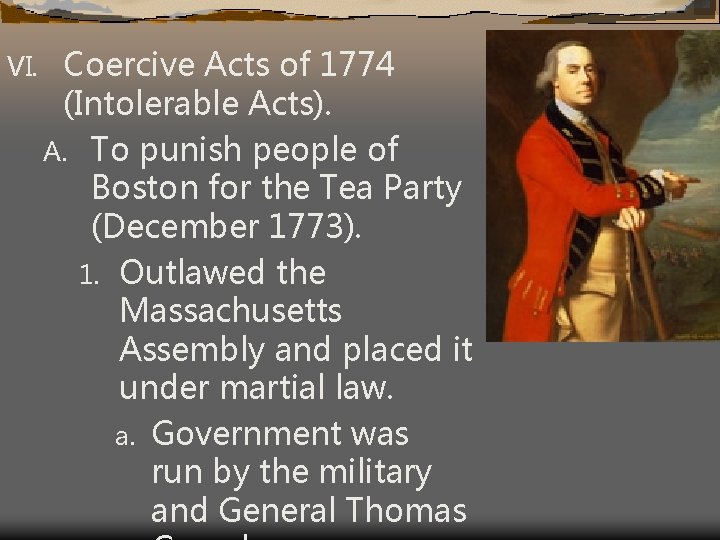
VI. Coercive Acts of 1774 (Intolerable Acts). A. To punish people of Boston for the Tea Party (December 1773). 1. Outlawed the Massachusetts Assembly and placed it under martial law. a. Government was run by the military and General Thomas
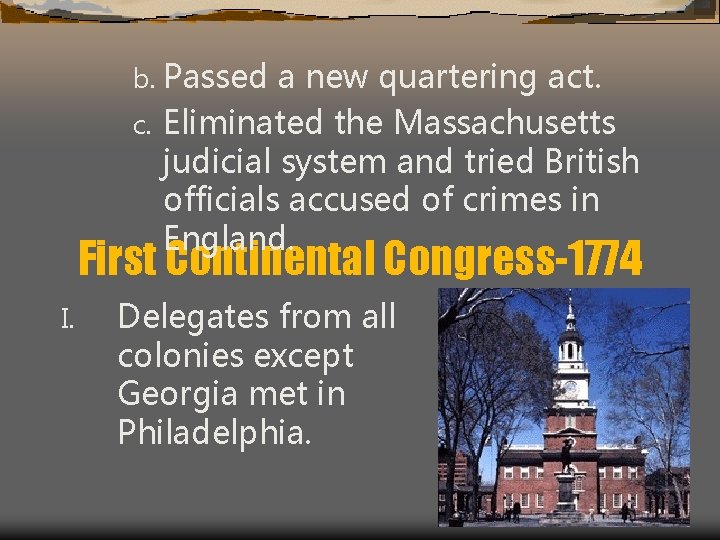
b. Passed a new quartering act. c. Eliminated the Massachusetts judicial system and tried British officials accused of crimes in England. First Continental Congress-1774 I. Delegates from all colonies except Georgia met in Philadelphia.
Reasons for meeting: 1. They wanted to remain loyal but want king to recognize their “rights as Englishmen”. 2. Mostly a show of solidarity and strength. 3. Agreed to meet again in 1775 if the Intolerable Acts were not repealed. Second Continental Congress meets in May 1775. A. II.
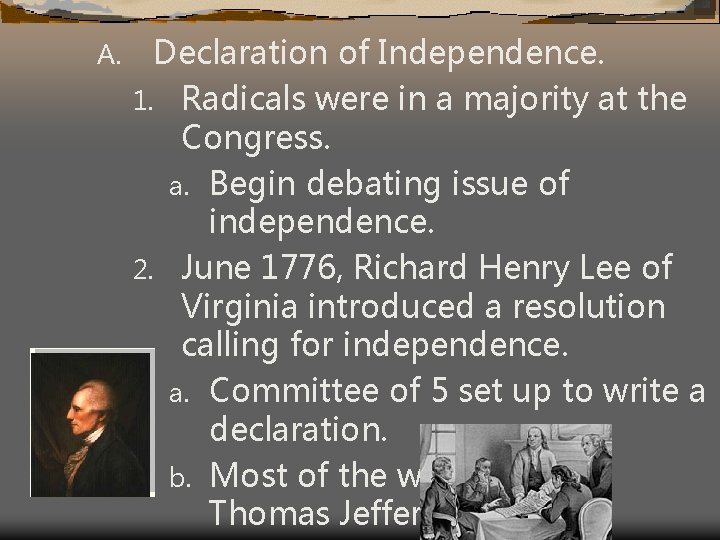
A. Declaration of Independence. 1. Radicals were in a majority at the Congress. a. Begin debating issue of independence. 2. June 1776, Richard Henry Lee of Virginia introduced a resolution calling for independence. a. Committee of 5 set up to write a declaration. b. Most of the work done by Thomas Jefferson.

3. Adopted on July 2, 1776 a. Signed by 55 delegates representing all 13 b. colonies. John Hancock, president of the Congress signed 1 st.
Creating a National Government I. Following the Declaration of Independence, the colonies needed to form a new “national” government. A. Guide to follow was the Declaration of Independence. 1. A republic. 2. Power in the hands of the people. 3. Independent state sovereignty.
B. Fears which influenced the formation. 1. Fear of a strong centralized government. a. People believed that small “communities” best opportunity for a success in a republic. b. Large central governments not responsive to the needs of the people. c. Large central governments more likely to violate “natural rights” and civil liberties.
2. Fear some states would dominate over others. a. Small states feared larger ones. b. Majority could use power at the expense of the minority. Articles of Confederation I. July 12, 1777; the committee chaired by John Dickinson presented the Articles to Congress for approval. A. In November it was presented to the states for ratification.
By 1779 all states had ratified except Maryland. 1. Question of western lands. 2. Congress will pass a resolution asking all western lands be given to Congress. 3. All states eventually agreed. C. March 1781, Maryland ratified and the Articles take effect. B.
II. Organization of the Articles. A. Unicameral congress. 1. Each state received 1 vote. 2. To pass, 9 of 13 needed to agree. 3. Changes to the Articles required unanimous vote. B. Powers of new national government. 1. Most power remained with states. 2. Congress given power to declare war, make peace, sign treaties, conduct foreign affairs, and deal with Indians.
Congress could not: a. Tax. b. Control trade between states. c. And did not have authority over any person in any state. 4. Many laws of Congress would become mere “suggestions” to the states. 3.
III. Strengths and successes of the Articles. A. As a “confederation” the government under the articles was a huge success. 1. Was only intended as a “league of friendship”, not a strong central government. B. Did allow states to have a relationship with each other. 1. Some of those relationships carry
States recognize laws, records, and court decisions of other states (i. e. marriage). c. Allowed citizens to move freely from state to state and be treated as citizens of that state. C. Did win the Revolutionary War and through a series of treaties kept Indians under control. b.
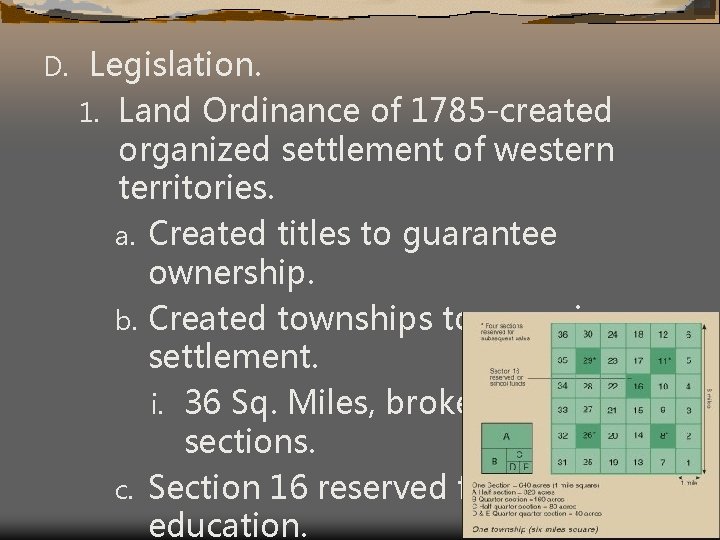
D. Legislation. 1. Land Ordinance of 1785 -created organized settlement of western territories. a. Created titles to guarantee ownership. b. Created townships to organize settlement. i. 36 Sq. Miles, broken into 36 sections. c. Section 16 reserved for education.
4 sections reserved for local government. i. Could sell extra land. e. Rest sold to make money for the U. S. or given to soldiers for discharge payment (Bounty Land). f. Sold by whole sections (640 Acres), half (320 Acres), or quarter (160 Acres). g. Townships control fire and police protection, roads, education. h. Important because it created a d.
2. Northwest Ordinance of 1787. Settlers moved in which created need to further organize territory. i. Set up the Northwest Territory and government. b. Must eventually be divided into states: more than 3, no more than 5. i. Ohio, Indiana, Illinois, Michigan, Wisconsin. c. Could elect a legislature after population reached 5, 000 adult a.
d. After 60, 000; they could write a constitution and apply for statehood. i. Ohio is the 1 st in 1803. e. Important-it provided a plan for governing new territories. Beginning of the End I. After just a few years, many problems began to plague the government. A. Many believed it was to weak to be taken seriously by other nations. B. Intended weakness (i. e. taxes and no control of trade between states), created
II. The Annapolis Convention. A. In 1785, George Washington called for a meeting between Maryland Virginia to resolve trade differences. 1. They decide the problem is bigger than just their 2 states. 2. Called for a general trade conference in September 1786 to be held at Annapolis, Maryland. B. 5 of 13 states sent delegates. 1. Could make no decision but do agree another meeting should be
III. Shays’ rebellion. A. New taxes in Massachusetts had hit western farmers hard. 1. State began foreclosing on farms to collect taxes. B. 2, 000 angry farmers, led by militia captain Daniel Shays, marched on Massachusetts courts. 1. Put down at Springfield in February of 1787.
Although it failed, it had a great impact on public opinion. 1. Many believed government was to weak to maintain order and security. D. Congress called for a convention of all states to be held in May 1787 for the “sole and express purpose of revising the Articles of Confederation. ” C.
- Slides: 46