
The Cologne Database for Molecular Spectroscopy CDMS in
The Cologne Database for Molecular Spectroscopy, CDMS, in Times of Herschel, SOFIA and ALMA Holger S. P. Müller, Jürgen Stutzki, Stephan Schlemmer I. Physikalisches Institut Universität zu Köln 50937 Cologne, Germany 64 th International Symposium on Molecular Spectroscopy; WH 07
Overview I. Introduction II. The CDMS III. Other Resources IV. Considerations for Herschel and SOFIA V. Considerations for ALMA
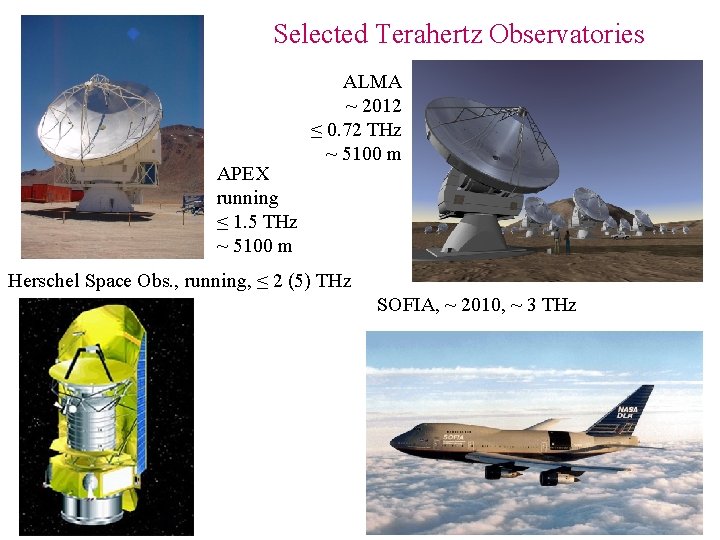
Selected Terahertz Observatories APEX running ≤ 1. 5 THz ~ 5100 m ALMA ~ 2012 ≤ 0. 72 THz ~ 5100 m Herschel Space Obs. , running, ≤ 2 (5) THz SOFIA, ~ 2010, ~ 3 THz
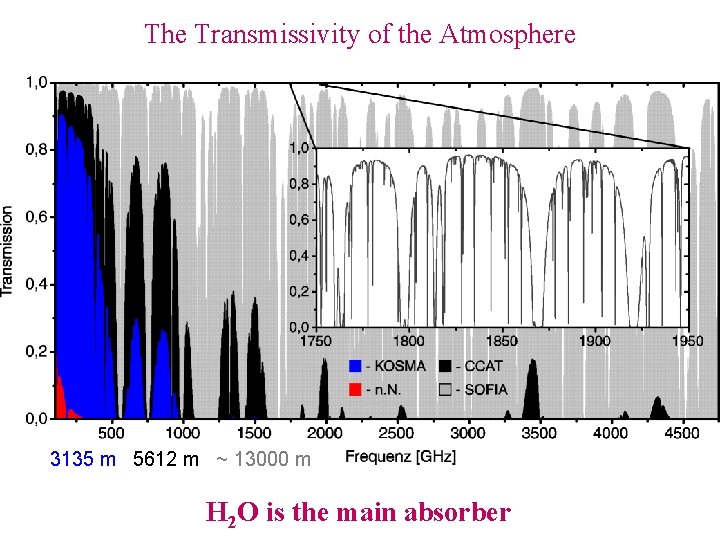
The Transmissivity of the Atmosphere 3135 m 5612 m ~ 13000 m H 2 O is the main absorber
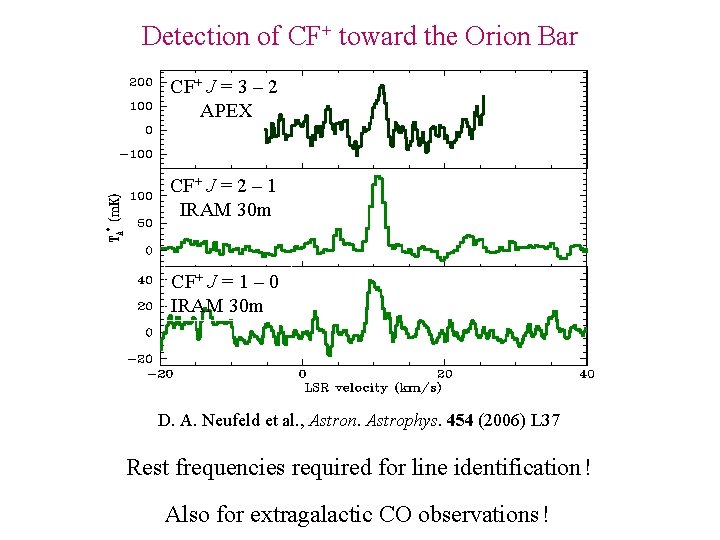
Detection of CF+ toward the Orion Bar CF+ J = 3 – 2 APEX CF+ J = 2 – 1 IRAM 30 m CF+ J = 1 – 0 IRAM 30 m D. A. Neufeld et al. , Astron. Astrophys. 454 (2006) L 37 Rest frequencies required for line identification ! Also for extragalactic CO observations !
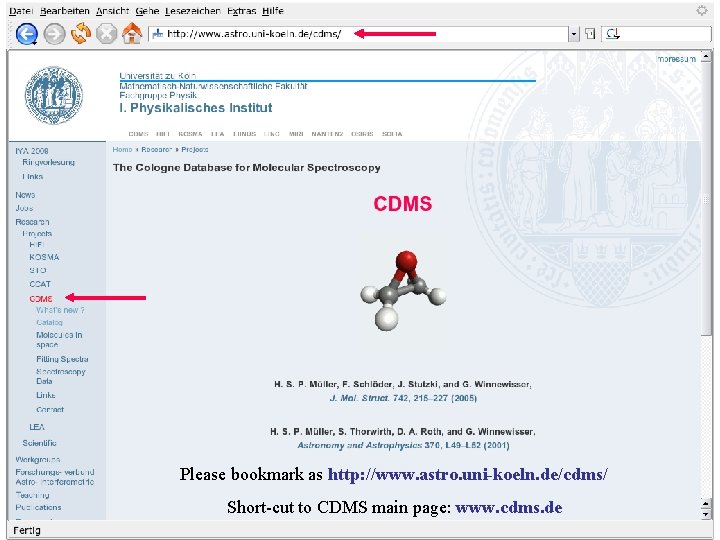
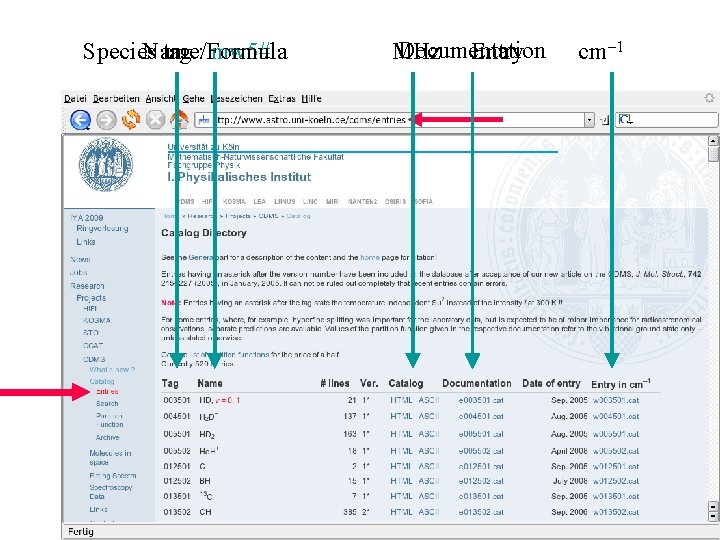
CDMS Main Page Please bookmark as http: //www. astro. uni-koeln. de/cdms/ Short-cut to CDMS main page: www. cdms. de
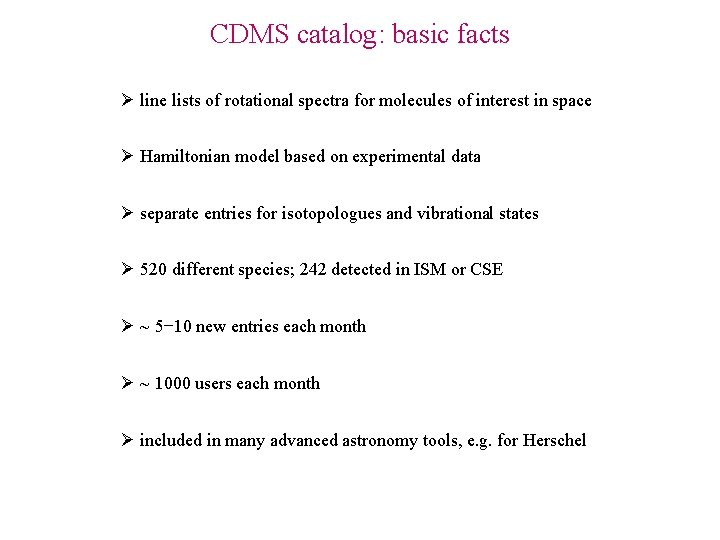
CDMS catalog: basic facts Ø line lists of rotational spectra for molecules of interest in space Ø Hamiltonian model based on experimental data Ø separate entries for isotopologues and vibrational states Ø 520 different species; 242 detected in ISM or CSE Ø ~ 5− 10 new entries each month Ø ~ 1000 users each month Ø included in many advanced astronomy tools, e. g. for Herschel
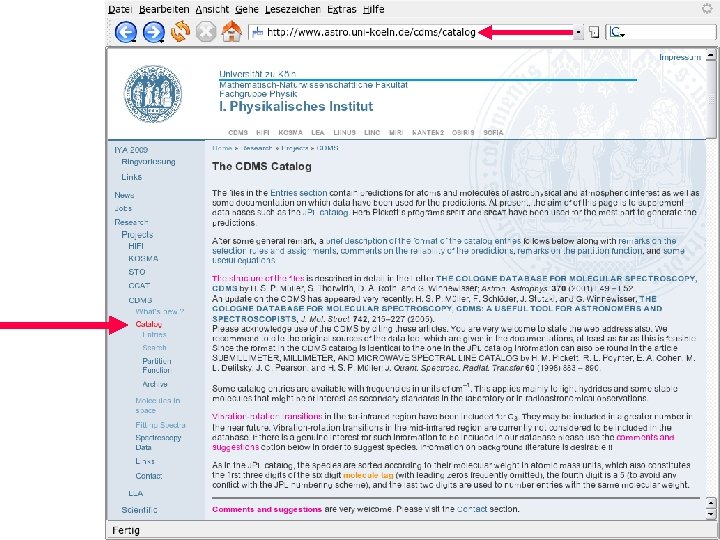
General
Name/Formula Species tag. : mw 5# Documentation MHz Entry Entries cm– 1
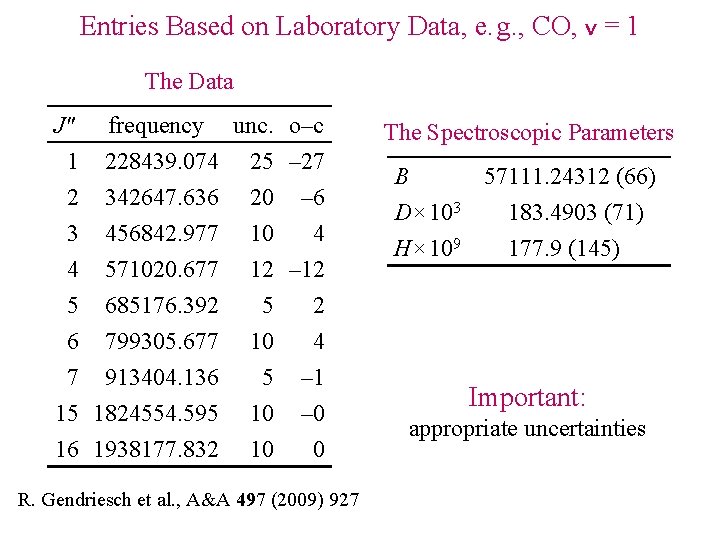
Entries Based on Laboratory Data, e. g. , CO, v = 1 The Data J" 1 2 3 frequency unc. o–c 228439. 074 25 – 27 342647. 636 20 – 6 456842. 977 10 4 4 571020. 677 5 685176. 392 6 799305. 677 7 913404. 136 15 1824554. 595 16 1938177. 832 12 – 12 5 2 10 4 5 – 1 10 – 0 10 0 R. Gendriesch et al. , A&A 497 (2009) 927 The Spectroscopic Parameters B 57111. 24312 (66) D × 103 183. 4903 (71) H × 109 177. 9 (145) Important: appropriate uncertainties
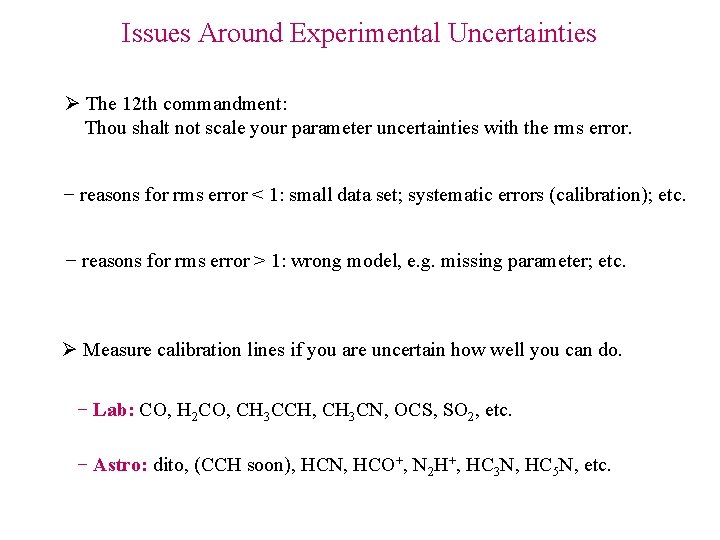
Issues Around Experimental Uncertainties Ø The 12 th commandment: Thou shalt not scale your parameter uncertainties with the rms error. − reasons for rms error < 1: small data set; systematic errors (calibration); etc. − reasons for rms error > 1: wrong model, e. g. missing parameter; etc. Ø Measure calibration lines if you are uncertain how well you can do. − Lab: CO, H 2 CO, CH 3 CCH, CH 3 CN, OCS, SO 2, etc. − Astro: dito, (CCH soon), HCN, HCO+, N 2 H+, HC 3 N, HC 5 N, etc.
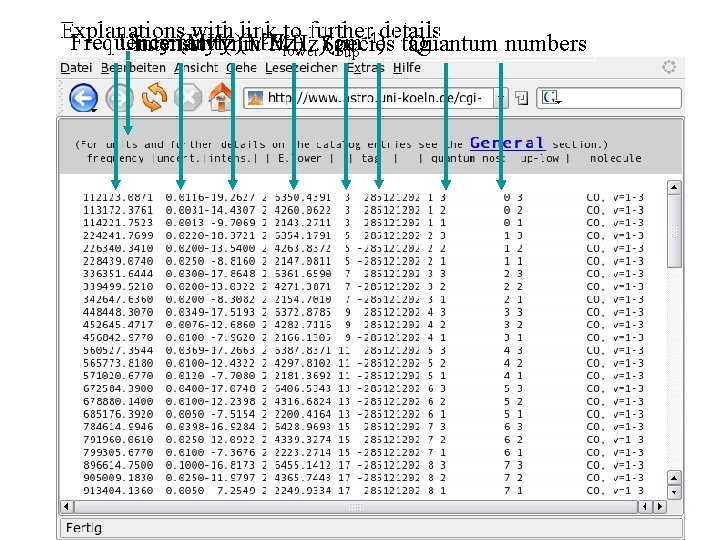
Explanations with (MHz) link to further – 1)details Frequency Uncertainty (MHz) (cm Intensity (nm 2 E MHz) Species g tag Quantum numbers lower up CO entry
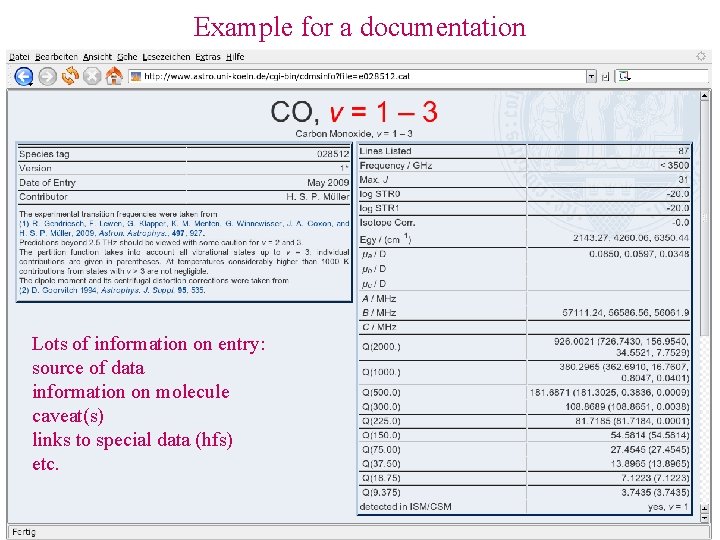
Example for a documentation Lots of information on entry: source of data information on molecule caveat(s) links to special data (hfs) etc.
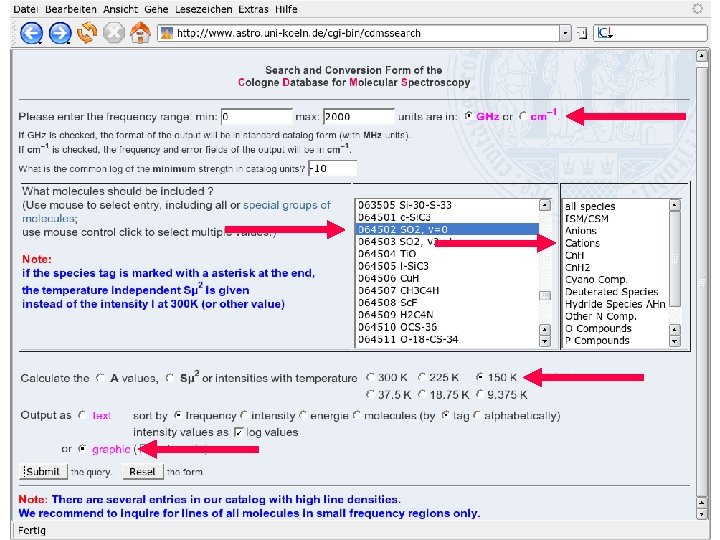
search (default)
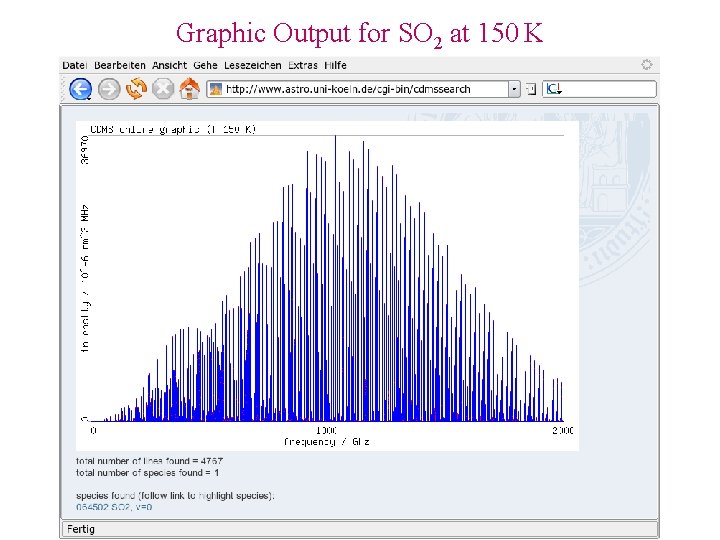
Graphic Output for SO 2 at 150 K
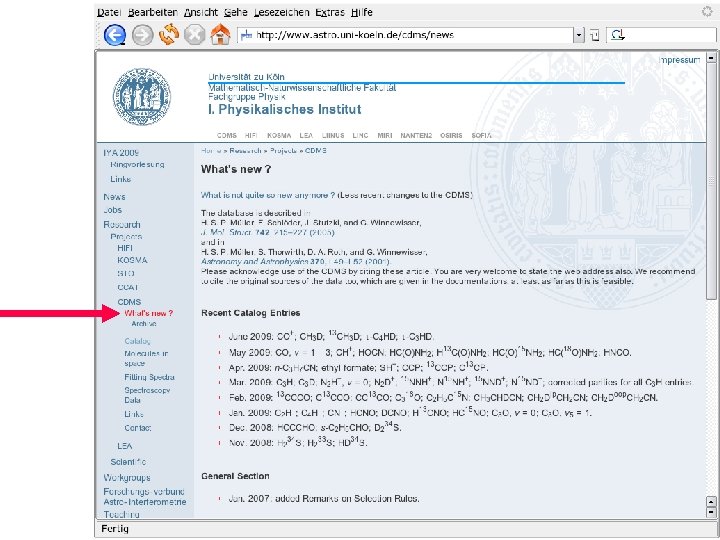
What’s New
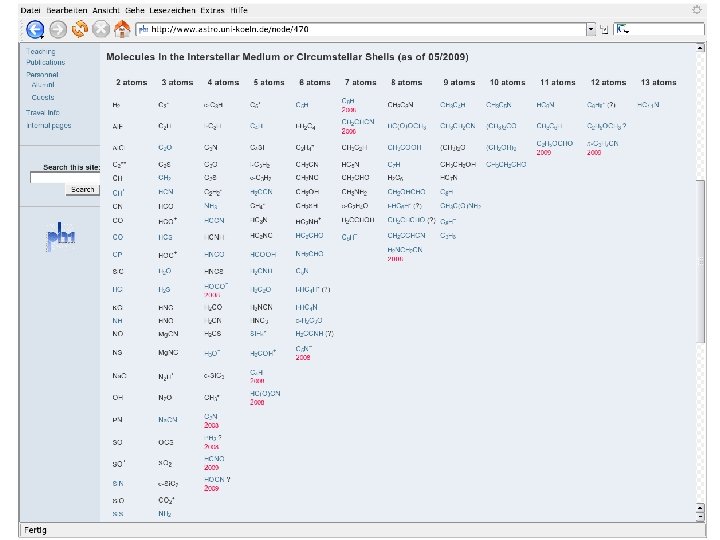
Molecules in Space
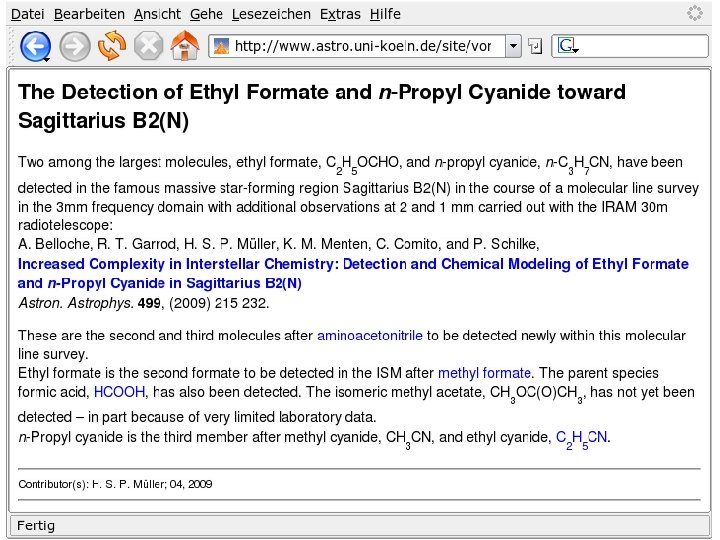
H 3+ in ISM
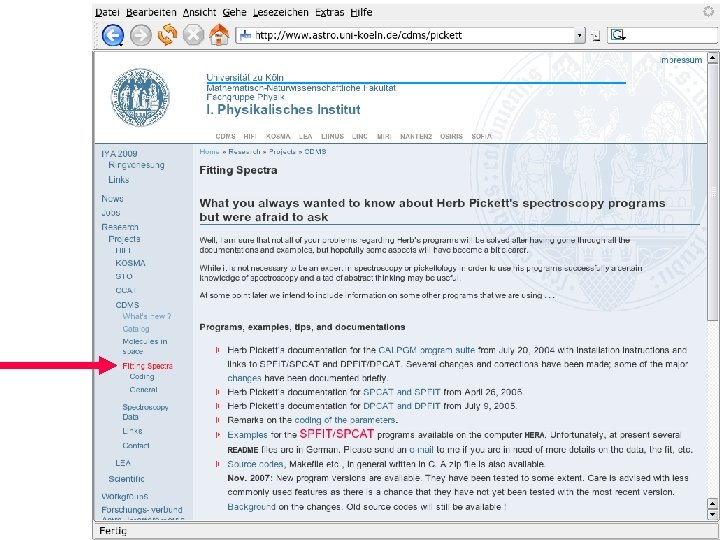
fitting spectra
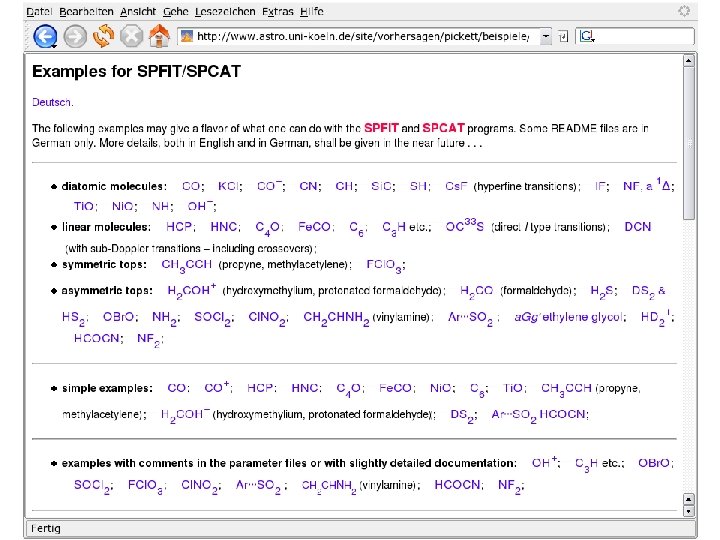
examples
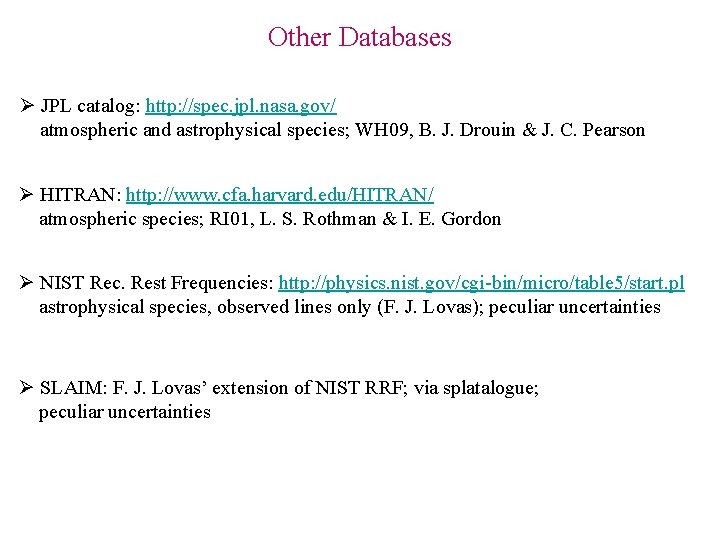
Other Databases Ø JPL catalog: http: //spec. jpl. nasa. gov/ atmospheric and astrophysical species; WH 09, B. J. Drouin & J. C. Pearson Ø HITRAN: http: //www. cfa. harvard. edu/HITRAN/ atmospheric species; RI 01, L. S. Rothman & I. E. Gordon Ø NIST Rec. Rest Frequencies: http: //physics. nist. gov/cgi-bin/micro/table 5/start. pl astrophysical species, observed lines only (F. J. Lovas); peculiar uncertainties Ø SLAIM: F. J. Lovas’ extension of NIST RRF; via splatalogue; peculiar uncertainties
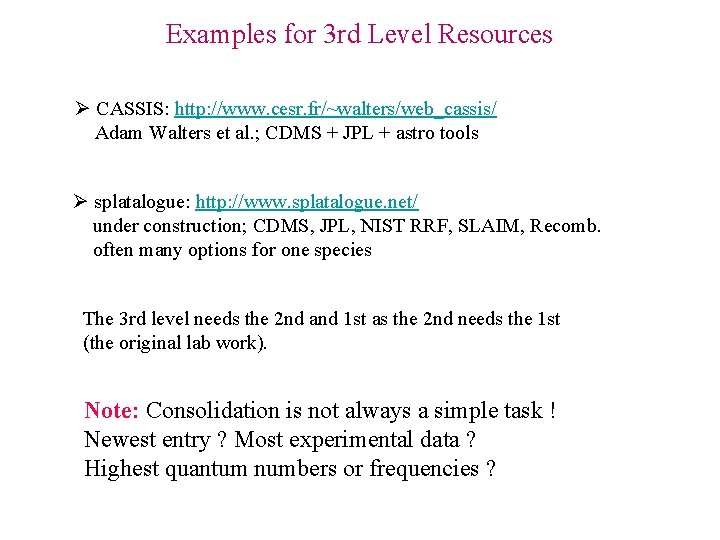
Examples for 3 rd Level Resources Ø CASSIS: http: //www. cesr. fr/~walters/web_cassis/ Adam Walters et al. ; CDMS + JPL + astro tools Ø splatalogue: http: //www. splatalogue. net/ under construction; CDMS, JPL, NIST RRF, SLAIM, Recomb. often many options for one species The 3 rd level needs the 2 nd and 1 st as the 2 nd needs the 1 st (the original lab work). Note: Consolidation is not always a simple task ! Newest entry ? Most experimental data ? Highest quantum numbers or frequencies ?
Considerations for Herschel and SOFIA
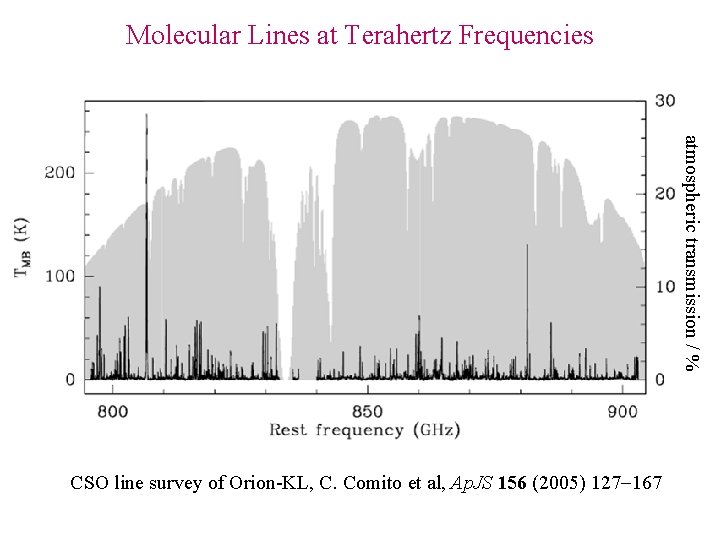
Molecular Lines at Terahertz Frequencies atmospheric transmission / % CSO line survey of Orion-KL, C. Comito et al, Ap. JS 156 (2005) 127 167
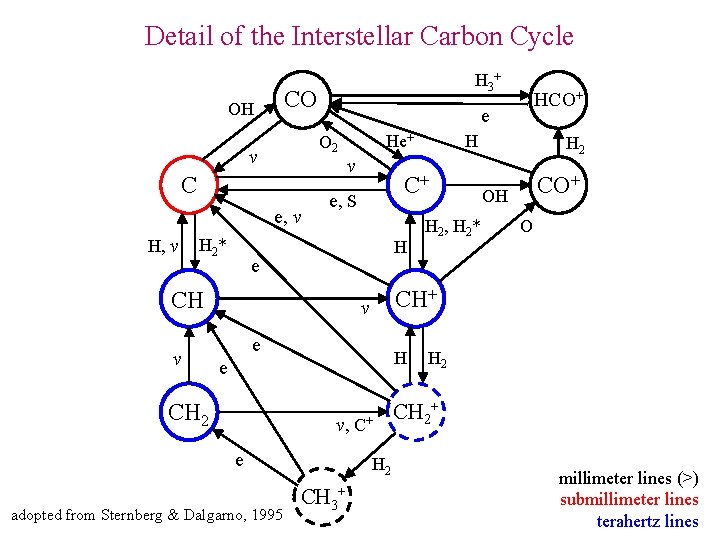
Detail of the Interstellar Carbon Cycle CO OH C e, ν H 2 * He+ ν H e e H e ν, e adopted from Sternberg & Dalgarno, 1995 C+ H 2 CH 3+ H 2 , H 2 * H 2 CO+ OH O CH+ ν CH 2 H C+ e, S CH ν HCO+ e O 2 ν H, ν H 3 + H 2 CH 2+ millimeter lines (>) submillimeter lines terahertz lines
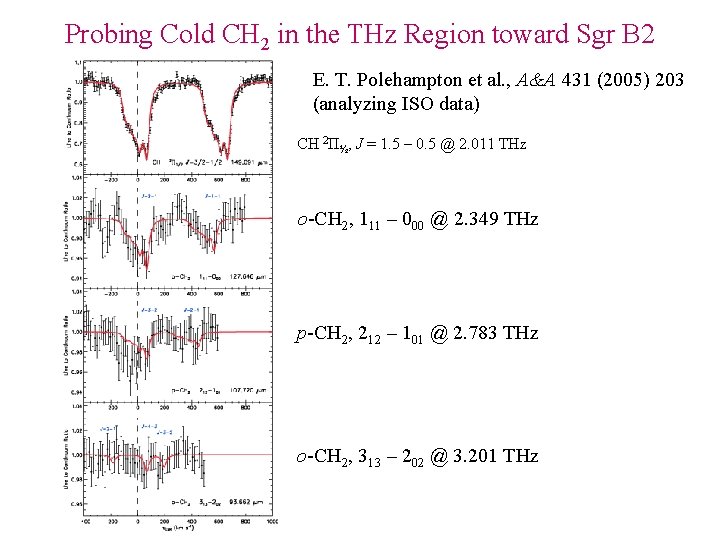
Probing Cold CH 2 in the THz Region toward Sgr B 2 E. T. Polehampton et al. , A&A 431 (2005) 203 (analyzing ISO data) CH 2Π½, J = 1. 5 – 0. 5 @ 2. 011 THz o-CH 2, 111 – 000 @ 2. 349 THz p-CH 2, 212 – 101 @ 2. 783 THz o-CH 2, 313 – 202 @ 3. 201 THz
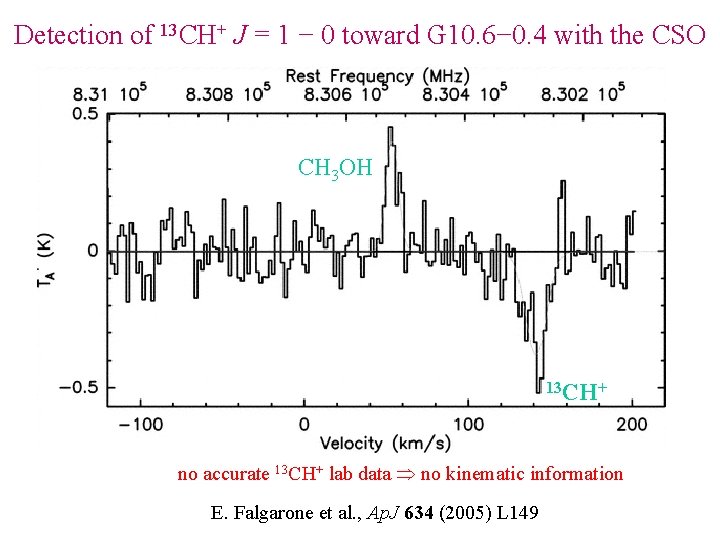
Detection of 13 CH+ J = 1 − 0 toward G 10. 6− 0. 4 with the CSO CH 3 OH 13 CH+ no accurate 13 CH+ lab data no kinematic information E. Falgarone et al. , Ap. J 634 (2005) L 149
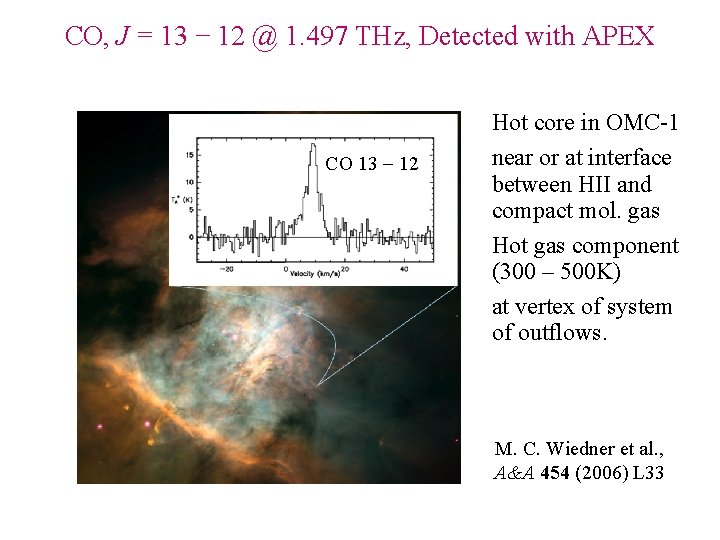
CO, J = 13 − 12 @ 1. 497 THz, Detected with APEX CO 13 12 Hot core in OMC-1 near or at interface between HII and compact mol. gas Hot gas component (300 – 500 K) at vertex of system of outflows. M. C. Wiedner et al. , A&A 454 (2006) L 33

Light Hydride Species AHn in the CDMS Catalog Ø H 2 D+, HD 2+, He. H+, Ne. H+, Ar. H+ Ø BH, CH+, CH 2 D+, CH 3 D, 13 CH 3 D Ø NH, ND, NH 2, NH 3, OH+, OH−, D 2 O, H 3 O+, H 2 DO+ Ø PH, PH 2, PH 3, SH−, SH+, H 2 S Ø Na. H, Mg. H, KH, Cu. H, Zn. H plus more to come detected in ISM/CSE; several isotopologs
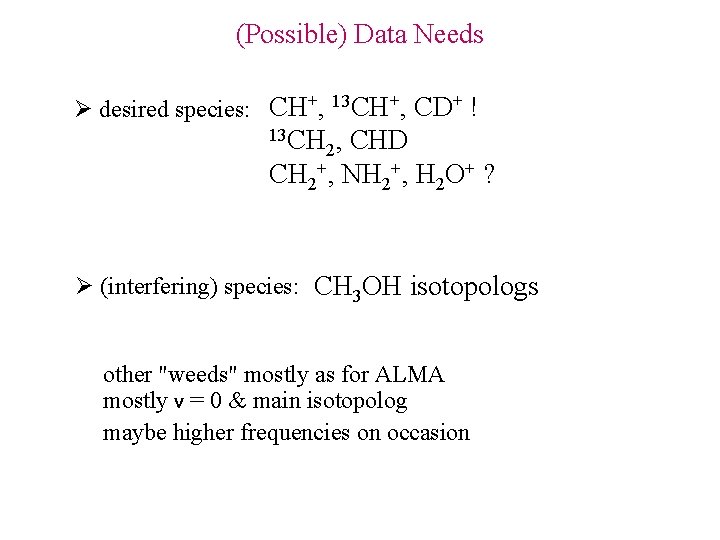
(Possible) Data Needs Ø desired species: CH+, 13 CH+, CD+ ! 13 CH 2, CHD CH 2+, NH 2+, H 2 O + ? Ø (interfering) species: CH 3 OH isotopologs other "weeds" mostly as for ALMA mostly v = 0 & main isotopolog maybe higher frequencies on occasion

Considerations for ALMA
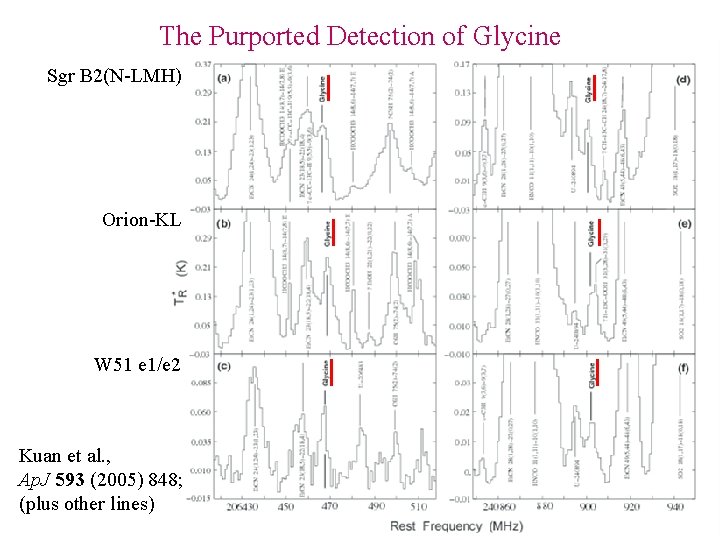
The Purported Detection of Glycine Sgr B 2(N-LMH) Orion-KL W 51 e 1/e 2 Kuan et al. , Ap. J 593 (2005) 848; (plus other lines)
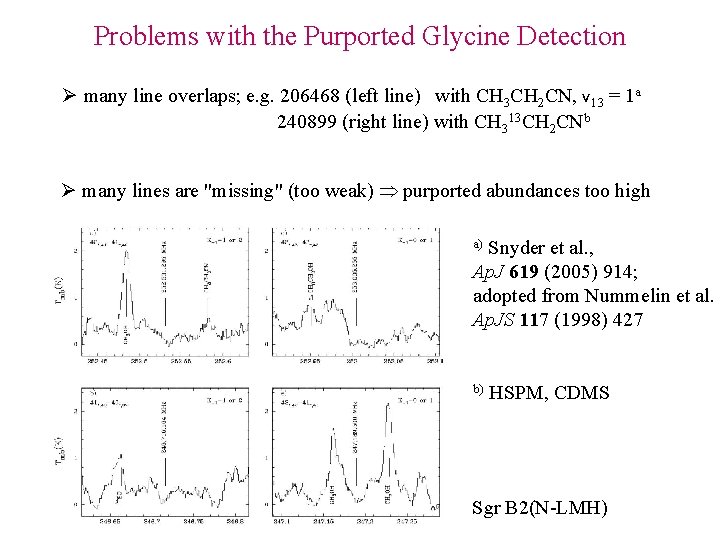
Problems with the Purported Glycine Detection Ø many line overlaps; e. g. 206468 (left line) with CH 3 CH 2 CN, v 13 = 1 a 240899 (right line) with CH 313 CH 2 CNb Ø many lines are "missing" (too weak) purported abundances too high Snyder et al. , Ap. J 619 (2005) 914; adopted from Nummelin et al. Ap. JS 117 (1998) 427 a) b) HSPM, CDMS Sgr B 2(N-LMH)
A Solution for Single Dish Radio Telescopes Unbiased Molecular Line Surveys in large frequency windows
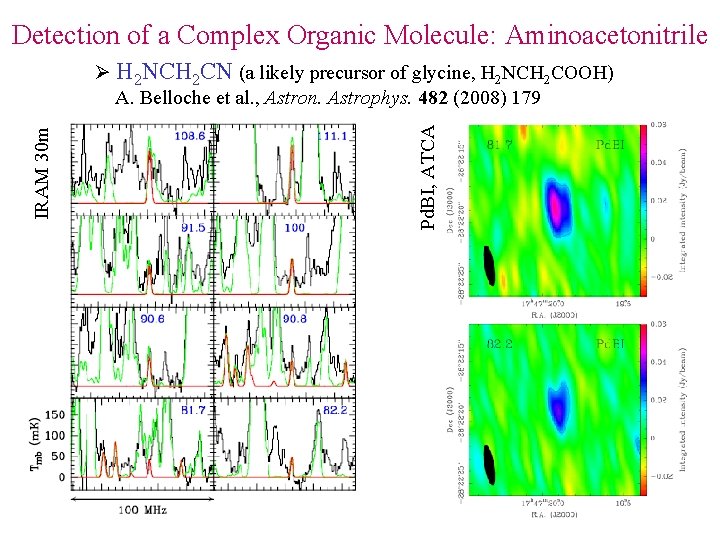
Detection of a Complex Organic Molecule: Aminoacetonitrile Pd. BI, ATCA IRAM 30 m Ø H 2 NCH 2 CN (a likely precursor of glycine, H 2 NCH 2 COOH) A. Belloche et al. , Astron. Astrophys. 482 (2008) 179

Detection of 13 C-Vinyl Cyanide Ø C 2 H 3 CN, v = 0, + 13 C, + 15 N H. S. P. Müller et al. , J. Mol. Spectrosc. 251 (2008) 319
HNCO in Sgr B 2(N) v = 0, v 5 = 1 (831 K), v 6 = 1 (944 K), v 4 = 1 (1117 K) previously in G 10. 47+0. 03: Wyrowski et al; A&A 381 (
The Blessing and the Curse of ALMA Ø very high sensitivity & very high spatial resolution much rarer species may be seen e. g. more complex molecules. . . but interfering species as well ! (Weeds; molecules with many lines in star-forming region. )

The Weeds Issue Ø Examples: CH 3 OH, CH 3 CN, C 2 H 5 CN, HC 3 N, CH 3 OCH 3, CH 3 C(O)CH 3, CH 3 OCHO, SO 2 − main isotopolog, v = 0 generally in good or fairly good shape − minor isotopologs, v = 0 good or reasonable for several species; more data to come − main isotopolog, excited states good or reasonable for some species; more data to come; tedious, but important: C 2 H 5 CN − minor isotopologs, exited states in good shape only rarely; data probably needed for some species, especially 13 C
Acknowledgments Ø DFG (Deutsche Forschungsgemeinschaft) → 2006 Ø BMBF (Bundesministerium für Bildung und Forschung) (for Herschel/HIFI) Ø Spectroscopists for measurements and providing data Ø Astronomers for suggestions and comments on the CDMS
- Slides: 40