
The Collective Behavior of MultiAgent Systems Jing HAN
The Collective Behavior of Multi-Agent Systems Jing HAN Complex Systems Research Center, http: //complex. amss. ac. cn/ Institute of System Sciences, Academy of Mathematics and Systems Science, CAS 2021/12/19
About me n Complex Systems Research Center, Academy of Mathematics and Systems Science, CAS n 2001 -Budapest CSSS, student 2004, 2005, 2006, 2007 CSSS, lecturer n Share my experience in doing interdisciplinary approach on Complex Systems
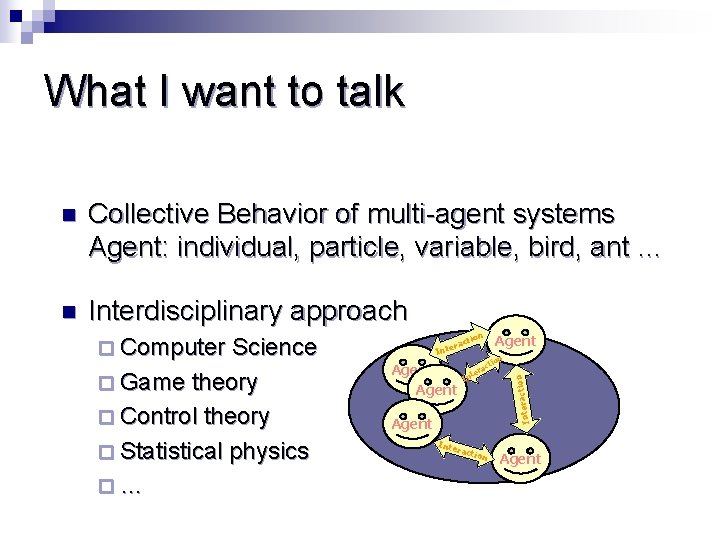
What I want to talk n Collective Behavior of multi-agent systems Agent: individual, particle, variable, bird, ant … n Interdisciplinary approach ¨ Control theory Agent ¨… tio ac r te In n tion ¨ Game theory Agent ¨ Statistical physics Agent Inte r Interac ¨ Computer Science ion ct era Int acti on Agent
What is Collective Behavior ?
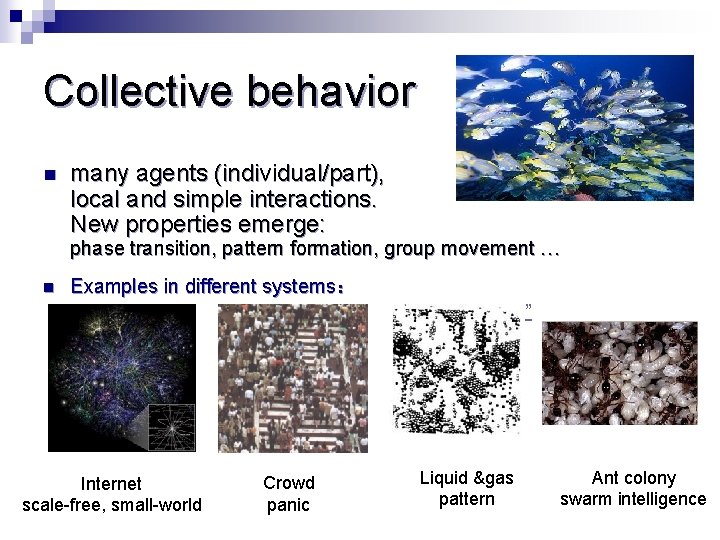
Collective behavior n many agents (individual/part), local and simple interactions. New properties emerge: phase transition, pattern formation, group movement … n Examples in different systems: ¨ ¨ ¨ Spins (avg. direction of neighbors) / “Magnetization” Ant - ant colony / swarm intelligence; Node - network / “small-world”, “scale-free”; Variables - combinatorial problems / solution state, phase transition; Bird/flocking Internet scale-free, small-world Crowd panic Liquid &gas pattern Ant colony swarm intelligence
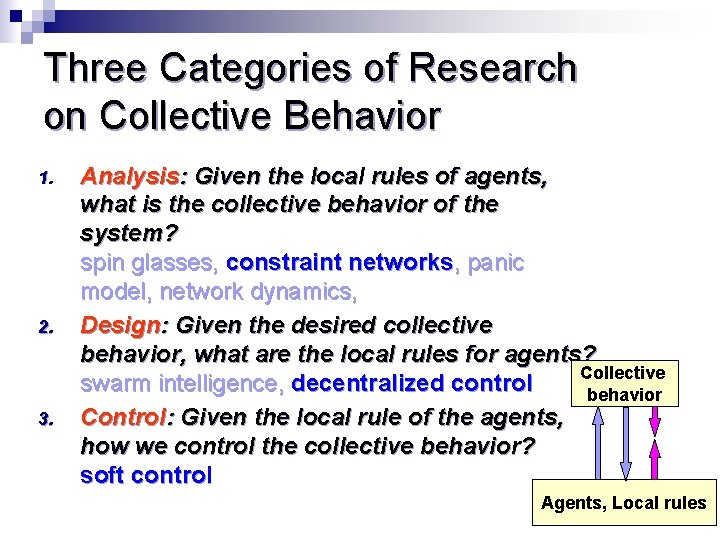
Three Categories of Research on Collective Behavior 1. 2. 3. Analysis: Given the local rules of agents, what is the collective behavior of the system? spin glasses, constraint networks, panic model, network dynamics, Design: Given the desired collective behavior, what are the local rules for agents? Collective swarm intelligence, decentralized control behavior Control: Given the local rule of the agents, how we control the collective behavior? soft control Agents, Local rules
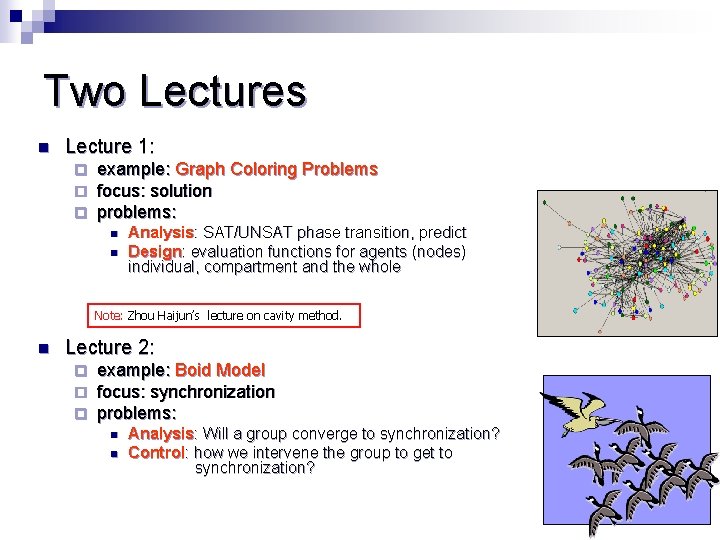
Two Lectures n Lecture 1: ¨ ¨ ¨ example: Graph Coloring Problems focus: solution problems: n n Analysis: SAT/UNSAT phase transition, predict Design: evaluation functions for agents (nodes) individual, compartment and the whole Note: Zhou Haijun’s lecture on cavity method. n Lecture 2: ¨ ¨ ¨ example: Boid Model focus: synchronization problems: n n Analysis: Will a group converge to synchronization? Control: how we intervene the group to get to synchronization?
- Slides: 7