
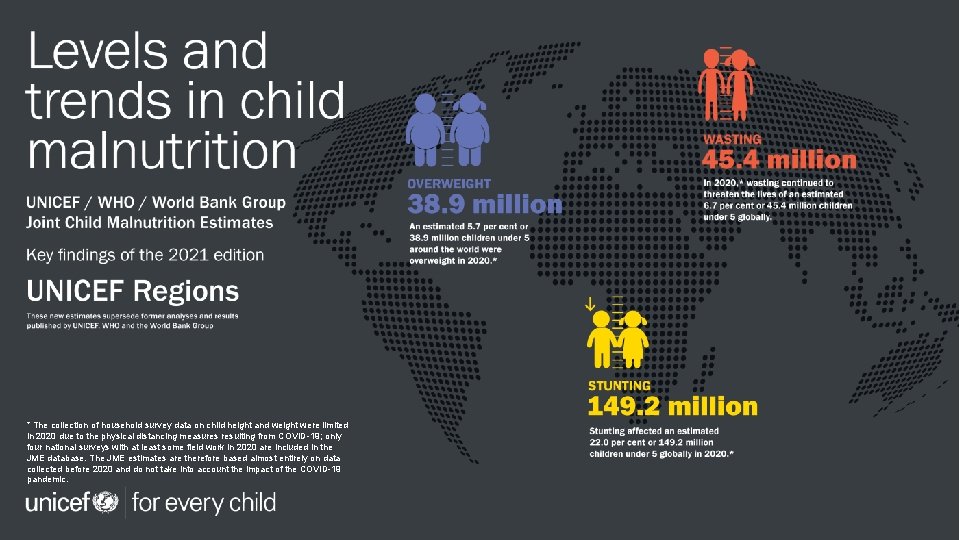
The collection of household survey data on child
- Slides: 36
* The collection of household survey data on child height and weight were limited in 2020 due to the physical distancing measures resulting from COVID-19; only four national surveys with at least some field work in 2020 are included in the JME database. The JME estimates are therefore based almost entirely on data collected before 2020 and do not take into account the impact of the COVID-19 pandemic. UNICEF, WHO, The World Bank. Levels and trends in child malnutrition: Key findings of the 2021 Edition of the Joint Child Malnutrition Estimates – UNICEF | for every child
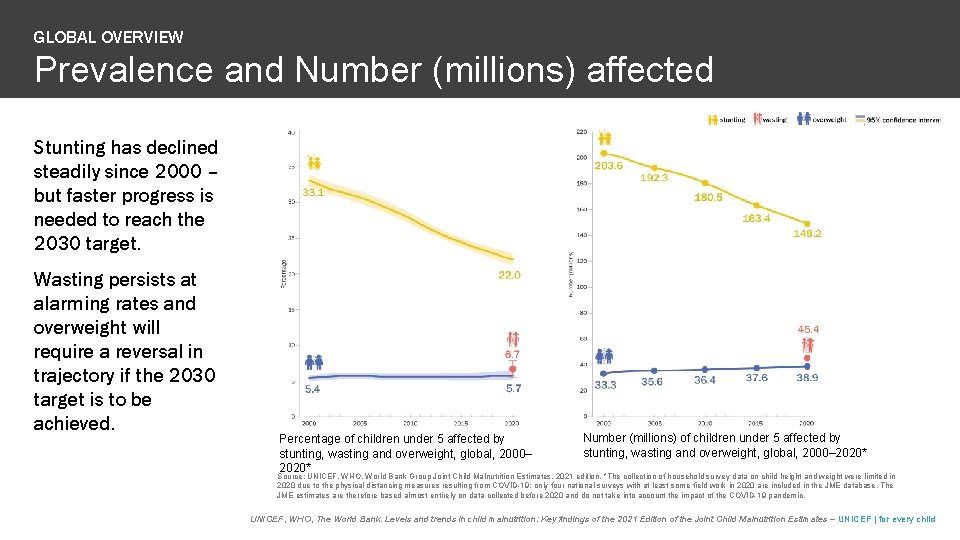
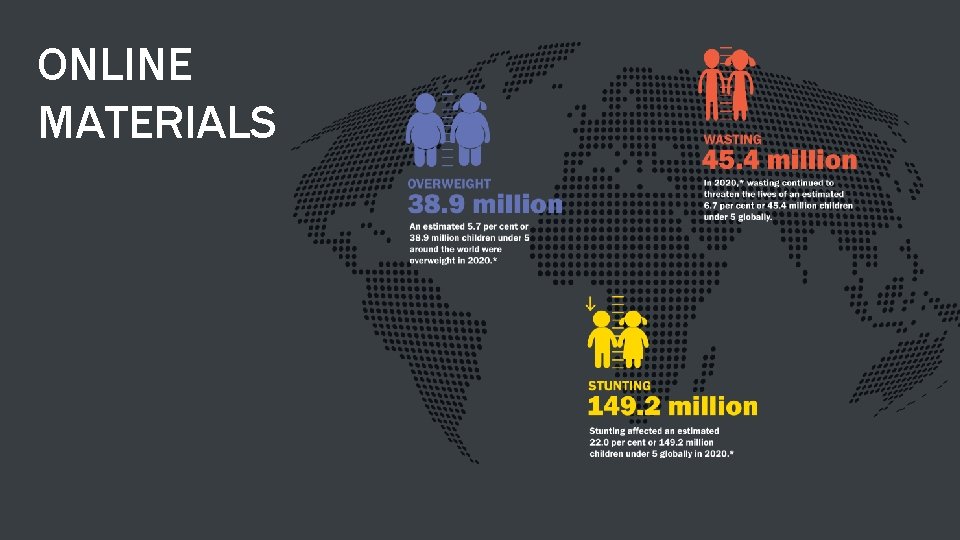
GLOBAL OVERVIEW Prevalence and Number (millions) affected Stunting has declined steadily since 2000 – but faster progress is needed to reach the 2030 target. Wasting persists at alarming rates and overweight will require a reversal in trajectory if the 2030 target is to be achieved. Percentage of children under 5 affected by stunting, wasting and overweight, global, 2000– 2020* Number (millions) of children under 5 affected by stunting, wasting and overweight, global, 2000– 2020* Source: UNICEF, WHO, World Bank Group Joint Child Malnutrition Estimates, 2021 edition. *The collection of household survey data on child height and weight were limited in 2020 due to the physical distancing measures resulting from COVID-19; only four national surveys with at least some field work in 2020 are included in the JME database. The JME estimates are therefore based almost entirely on data collected before 2020 and do not take into account the impact of the COVID-19 pandemic. UNICEF, WHO, The World Bank. Levels and trends in child malnutrition: Key findings of the 2021 Edition of the Joint Child Malnutrition Estimates – UNICEF | for every child
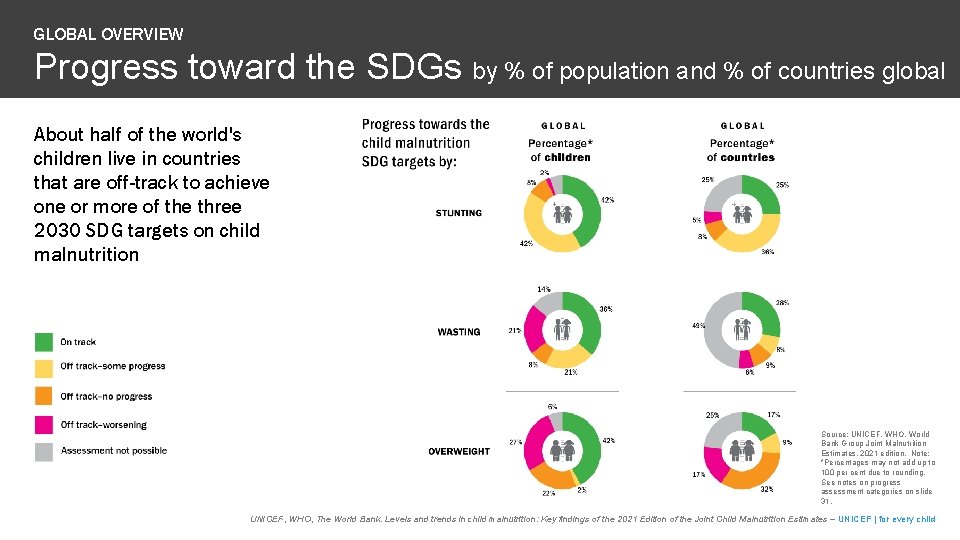
GLOBAL OVERVIEW Progress toward the SDGs by % of population and % of countries global About half of the world's children live in countries that are off-track to achieve one or more of the three 2030 SDG targets on child malnutrition Source: UNICEF, WHO, World Bank Group Joint Malnutrition Estimates, 2021 edition. Note: *Percentages may not add up to 100 per cent due to rounding. See notes on progress assessment categories on slide 31. UNICEF, WHO, The World Bank. Levels and trends in child malnutrition: Key findings of the 2021 Edition of the Joint Child Malnutrition Estimates – UNICEF | for every child
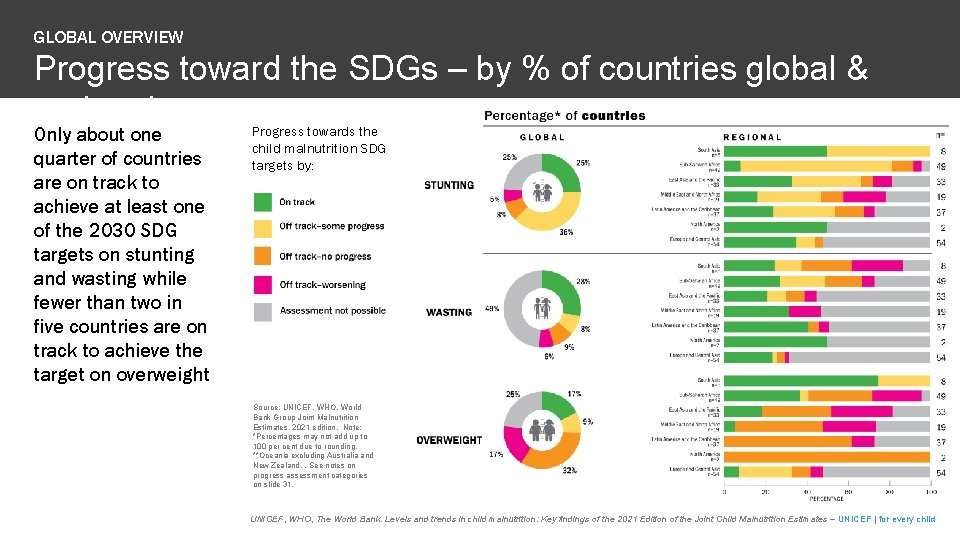
GLOBAL OVERVIEW Progress toward the SDGs – by % of countries global & regional Progress towards the Only about one quarter of countries are on track to achieve at least one of the 2030 SDG targets on stunting and wasting while fewer than two in five countries are on track to achieve the target on overweight child malnutrition SDG targets by: Source: UNICEF, WHO, World Bank Group Joint Malnutrition Estimates, 2021 edition. Note: *Percentages may not add up to 100 per cent due to rounding. **Oceania excluding Australia and New Zealand. . See notes on progress assessment categories on slide 31. UNICEF, WHO, The World Bank. Levels and trends in child malnutrition: Key findings of the 2021 Edition of the Joint Child Malnutrition Estimates – UNICEF | for every child
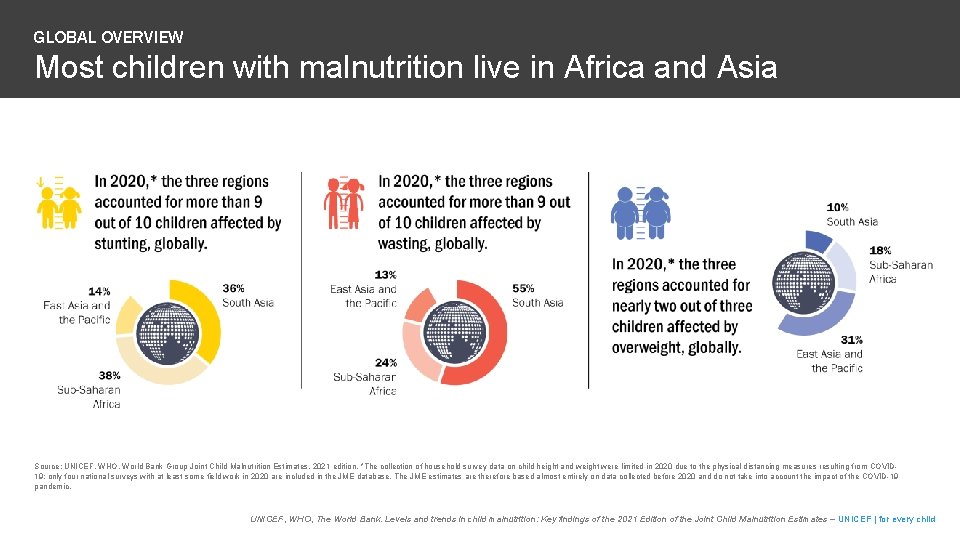
GLOBAL OVERVIEW Most children with malnutrition live in Africa and Asia Source: UNICEF, WHO, World Bank Group Joint Child Malnutrition Estimates, 2021 edition. *The collection of household survey data on child height and weight were limited in 2020 due to the physical distancing measures resulting from COVID 19; only four national surveys with at least some field work in 2020 are included in the JME database. The JME estimates are therefore based almost entirely on data collected before 2020 and do not take into account the impact of the COVID-19 pandemic. UNICEF, WHO, The World Bank. Levels and trends in child malnutrition: Key findings of the 2021 Edition of the Joint Child Malnutrition Estimates – UNICEF | for every child
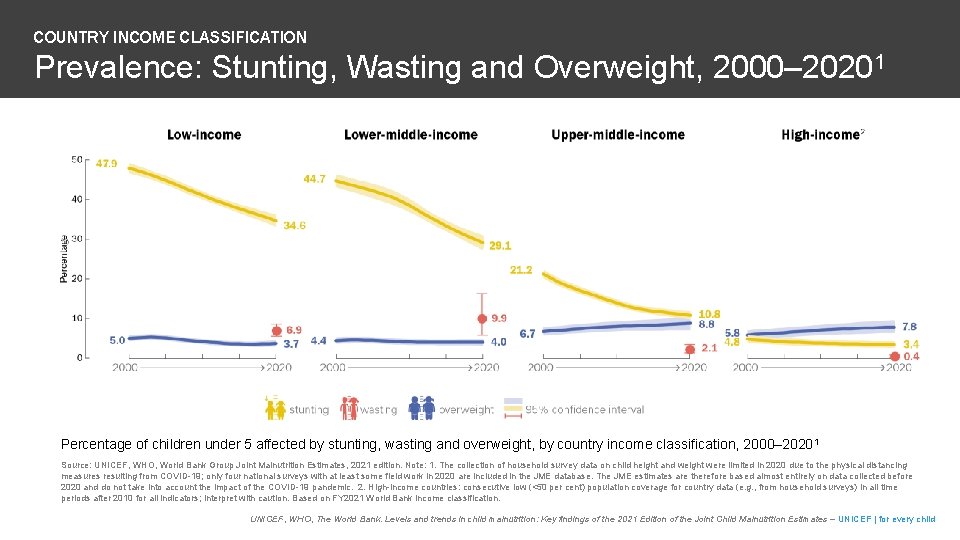
COUNTRY INCOME CLASSIFICATION Prevalence: Stunting, Wasting and Overweight, 2000– 20201 Percentage of children under 5 affected by stunting, wasting and overweight, by country income classification, 2000– 2020 1 Source: UNICEF, WHO, World Bank Group Joint Malnutrition Estimates, 2021 edition. Note: 1. The collection of household survey data on child height and weight were limited in 2020 due to the physical distancing measures resulting from COVID-19; only four national surveys with at least some field work in 2020 are included in the JME database. The JME estimates are therefore based almost entirely on data collected before 2020 and do not take into account the impact of the COVID-19 pandemic. 2. High-income countries: consecutive low (<50 per cent) population coverage for country data (e. g. , from household surveys) in all time periods after 2010 for all indicators; interpret with caution. Based on FY 2021 World Bank income classification. UNICEF, WHO, The World Bank. Levels and trends in child malnutrition: Key findings of the 2021 Edition of the Joint Child Malnutrition Estimates – UNICEF | for every child
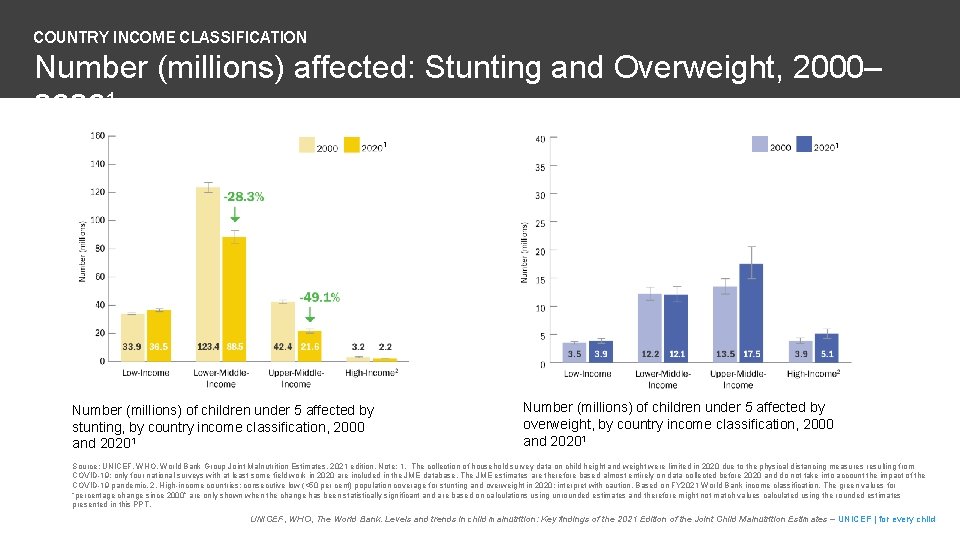
COUNTRY INCOME CLASSIFICATION Number (millions) affected: Stunting and Overweight, 2000– 20201 1 Number (millions) of children under 5 affected by stunting, by country income classification, 2000 and 20201 1 Number (millions) of children under 5 affected by overweight, by country income classification, 2000 and 20201 Source: UNICEF, WHO, World Bank Group Joint Malnutrition Estimates, 2021 edition. Note: 1. The collection of household survey data on child height and weight were limited in 2020 due to the physical distancing measures resulting from COVID-19; only four national surveys with at least some field work in 2020 are included in the JME database. The JME estimates are therefore based almost entirely on data collected before 2020 and do not take into account the impact of the COVID-19 pandemic. 2. High-income countries: consecutive low (<50 per cent) population coverage for stunting and overweight in 2020; interpret with caution. Based on FY 2021 World Bank income classification. The green values for “percentage change since 2000” are only shown when the change has been statistically significant and are based on calculations using unrounded estimates and therefore might not match values calculated using the rounded estimates presented in this PPT. UNICEF, WHO, The World Bank. Levels and trends in child malnutrition: Key findings of the 2021 Edition of the Joint Child Malnutrition Estimates – UNICEF | for every child
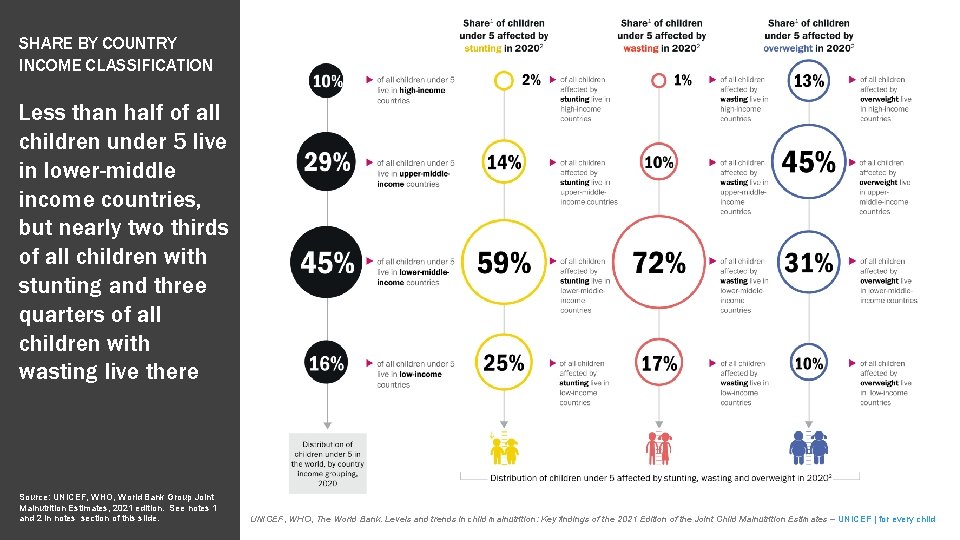
SHARE BY COUNTRY INCOME CLASSIFICATION Less than half of all children under 5 live in lower-middle income countries, but nearly two thirds of all children with stunting and three quarters of all children with wasting live there Source: UNICEF, WHO, World Bank Group Joint Malnutrition Estimates, 2021 edition. See notes 1 and 2 in notes section of this slide. UNICEF, WHO, The World Bank. Levels and trends in child malnutrition: Key findings of the 2021 Edition of the Joint Child Malnutrition Estimates – UNICEF | for every child
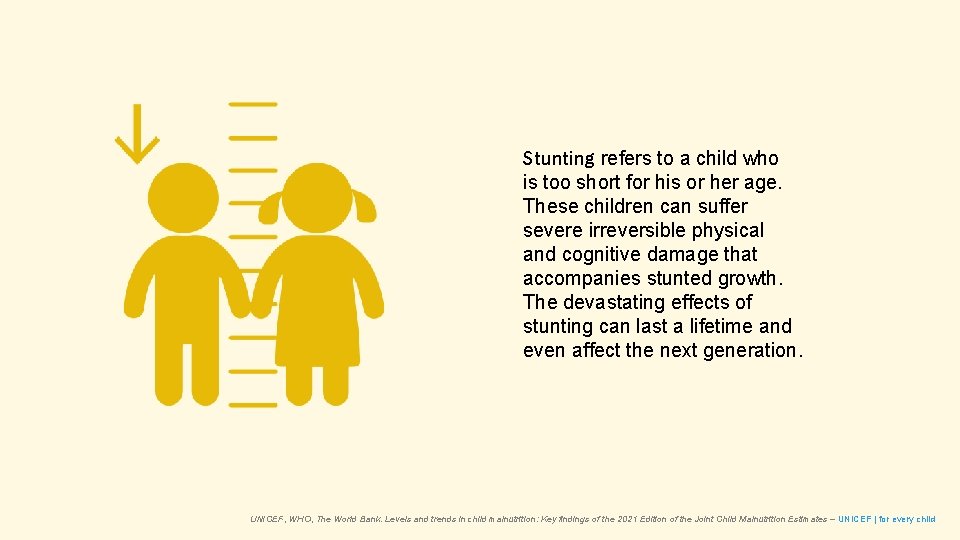
Stunting refers to a child who is too short for his or her age. These children can suffer severe irreversible physical and cognitive damage that accompanies stunted growth. The devastating effects of stunting can last a lifetime and even affect the next generation. UNICEF, WHO, The World Bank. Levels and trends in child malnutrition: Key findings of the 2021 Edition of the Joint Child Malnutrition Estimates – UNICEF | for every child
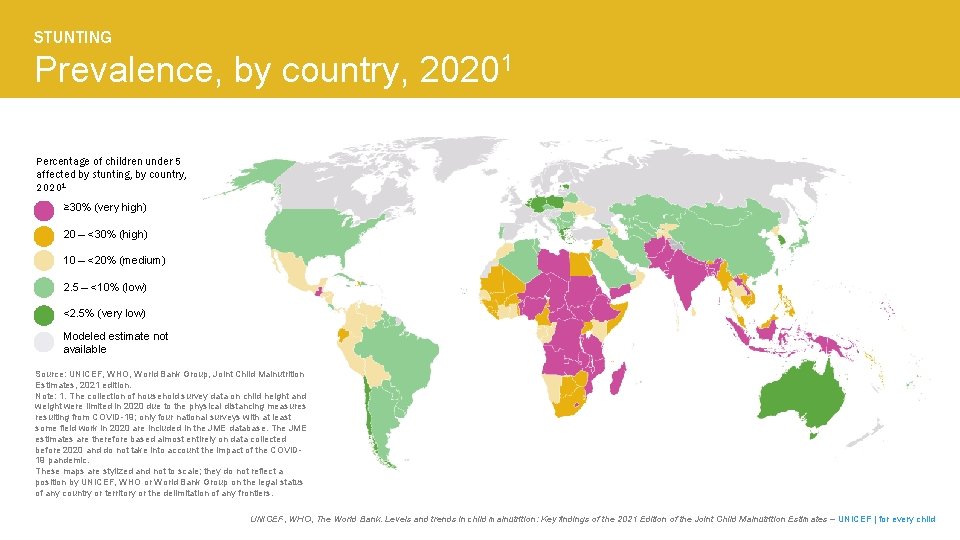
STUNTING Prevalence, by country, 20201 Percentage of children under 5 affected by stunting, by country, 20201 ≥ 30% (very high) 20 – <30% (high) 10 – <20% (medium) 2. 5 – <10% (low) <2. 5% (very low) Modeled estimate not available Source: UNICEF, WHO, World Bank Group, Joint Child Malnutrition Estimates, 2021 edition. Note: 1. The collection of household survey data on child height and weight were limited in 2020 due to the physical distancing measures resulting from COVID-19; only four national surveys with at least some field work in 2020 are included in the JME database. The JME estimates are therefore based almost entirely on data collected before 2020 and do not take into account the impact of the COVID 19 pandemic. These maps are stylized and not to scale; they do not reflect a position by UNICEF, WHO or World Bank Group on the legal status of any country or territory or the delimitation of any frontiers. UNICEF, WHO, The World Bank. Levels and trends in child malnutrition: Key findings of the 2021 Edition of the Joint Child Malnutrition Estimates – UNICEF | for every child
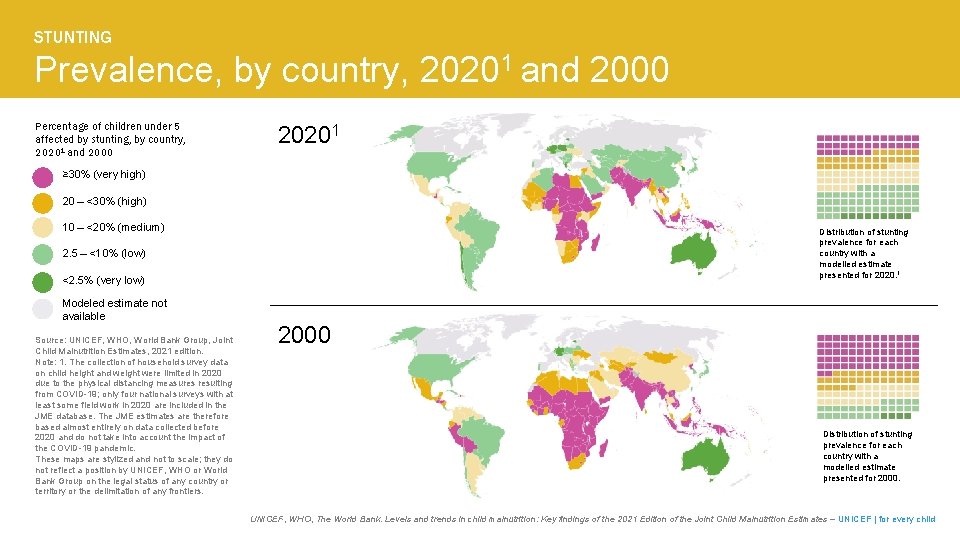
STUNTING Prevalence, by country, 20201 and 2000 Percentage of children under 5 affected by stunting, by country, 20201 and 2000 20201 ≥ 30% (very high) 20 – <30% (high) 10 – <20% (medium) Distribution of stunting prevalence for each country with a modelled estimate presented for 2020. 1 2. 5 – <10% (low) <2. 5% (very low) Modeled estimate not available Source: UNICEF, WHO, World Bank Group, Joint Child Malnutrition Estimates, 2021 edition. Note: 1. The collection of household survey data on child height and weight were limited in 2020 due to the physical distancing measures resulting from COVID-19; only four national surveys with at least some field work in 2020 are included in the JME database. The JME estimates are therefore based almost entirely on data collected before 2020 and do not take into account the impact of the COVID-19 pandemic. These maps are stylized and not to scale; they do not reflect a position by UNICEF, WHO or World Bank Group on the legal status of any country or territory or the delimitation of any frontiers. 2000 Distribution of stunting prevalence for each country with a modelled estimate presented for 2000. UNICEF, WHO, The World Bank. Levels and trends in child malnutrition: Key findings of the 2021 Edition of the Joint Child Malnutrition Estimates – UNICEF | for every child
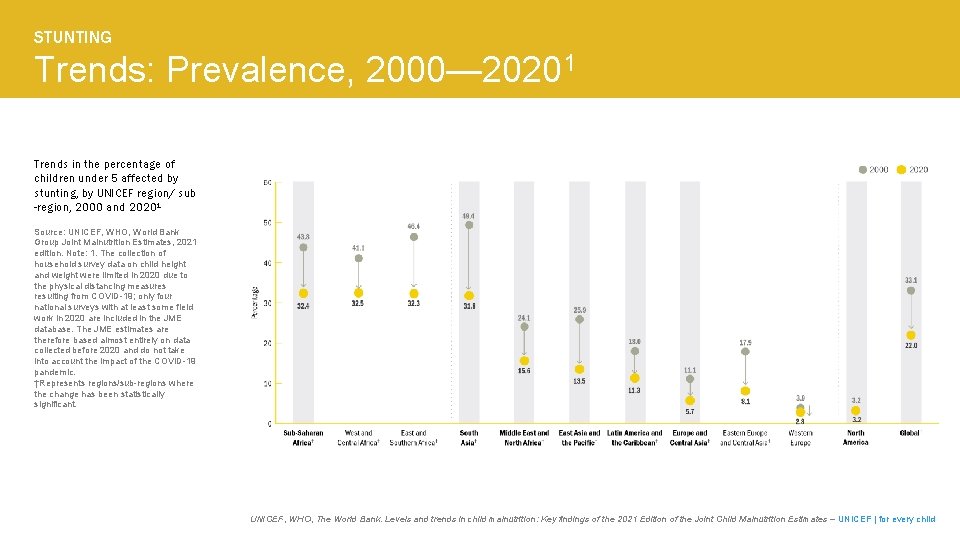
STUNTING Trends: Prevalence, 2000— 20201 Trends in the percentage of children under 5 affected by stunting, by UNICEF region/ sub -region, 2000 and 20201 Source: UNICEF, WHO, World Bank Group Joint Malnutrition Estimates, 2021 edition. Note: 1. The collection of household survey data on child height and weight were limited in 2020 due to the physical distancing measures resulting from COVID-19; only four national surveys with at least some field work in 2020 are included in the JME database. The JME estimates are therefore based almost entirely on data collected before 2020 and do not take into account the impact of the COVID-19 pandemic. †Represents regions/sub-regions where the change has been statistically significant. UNICEF, WHO, The World Bank. Levels and trends in child malnutrition: Key findings of the 2021 Edition of the Joint Child Malnutrition Estimates – UNICEF | for every child
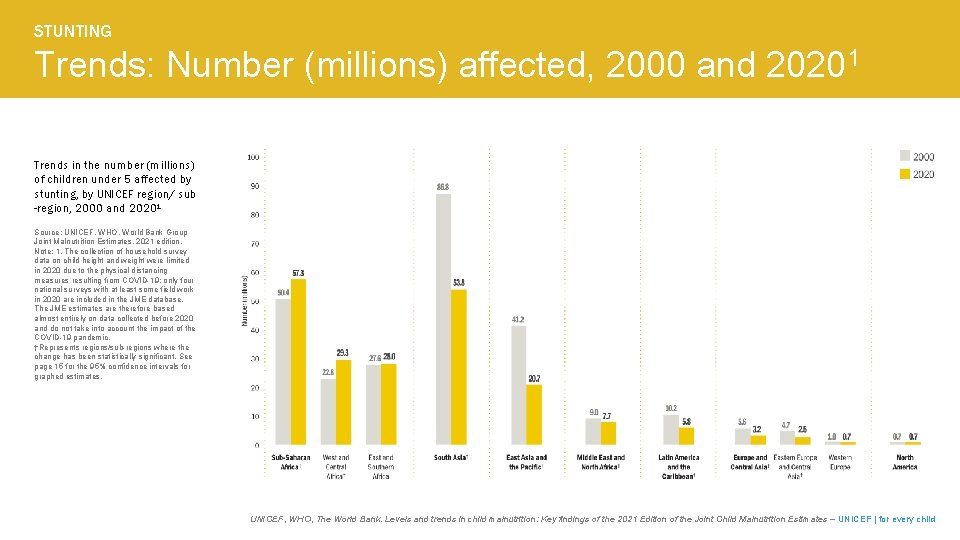
STUNTING Trends: Number (millions) affected, 2000 and 20201 Trends in the number (millions) of children under 5 affected by stunting, by UNICEF region/ sub -region, 2000 and 20201 Source: UNICEF, WHO, World Bank Group Joint Malnutrition Estimates, 2021 edition. Note: 1. The collection of household survey data on child height and weight were limited in 2020 due to the physical distancing measures resulting from COVID-19; only four national surveys with at least some field work in 2020 are included in the JME database. The JME estimates are therefore based almost entirely on data collected before 2020 and do not take into account the impact of the COVID-19 pandemic. †Represents regions/sub-regions where the change has been statistically significant. See page 15 for the 95% confidence intervals for graphed estimates. UNICEF, WHO, The World Bank. Levels and trends in child malnutrition: Key findings of the 2021 Edition of the Joint Child Malnutrition Estimates – UNICEF | for every child
Wasting refers to a child who is too thin for his or height. Wasting is the result of recent rapid weight loss or the failure to gain weight. A child who is moderately or severely wasted has an increased risk of death, but treatment is possible. UNICEF, WHO, The World Bank. Levels and trends in child malnutrition: Key findings of the 2021 Edition of the Joint Child Malnutrition Estimates – UNICEF | for every child
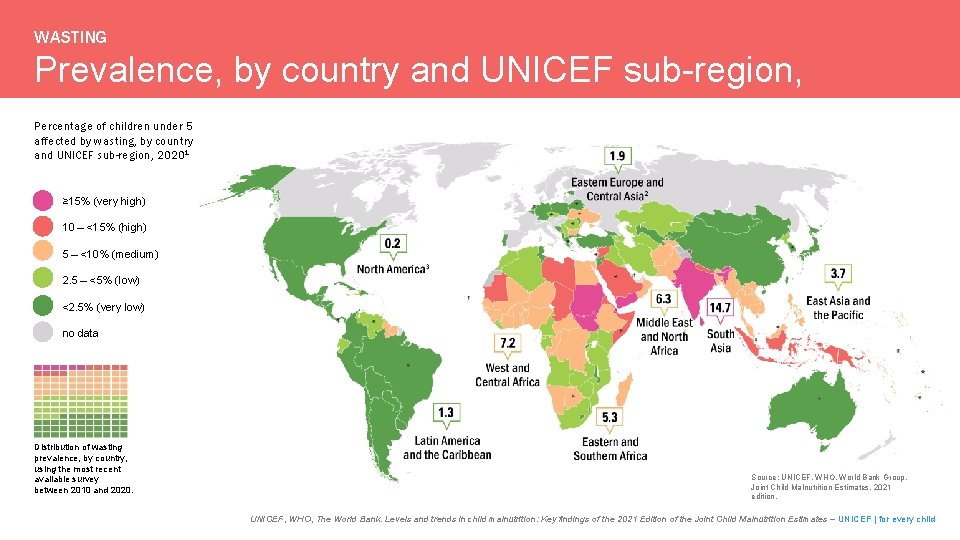
WASTING Prevalence, by country and UNICEF sub-region, 20201 Percentage of children under 5 affected by wasting, by country and UNICEF sub-region, 20201 ≥ 15% (very high) 10 – <15% (high) 5 – <10% (medium) 2. 5 – <5% (low) <2. 5% (very low) no data Distribution of wasting prevalence, by country, using the most recent available survey between 2010 and 2020. Source: UNICEF, WHO, World Bank Group, Joint Child Malnutrition Estimates, 2021 edition. UNICEF, WHO, The World Bank. Levels and trends in child malnutrition: Key findings of the 2021 Edition of the Joint Child Malnutrition Estimates – UNICEF | for every child
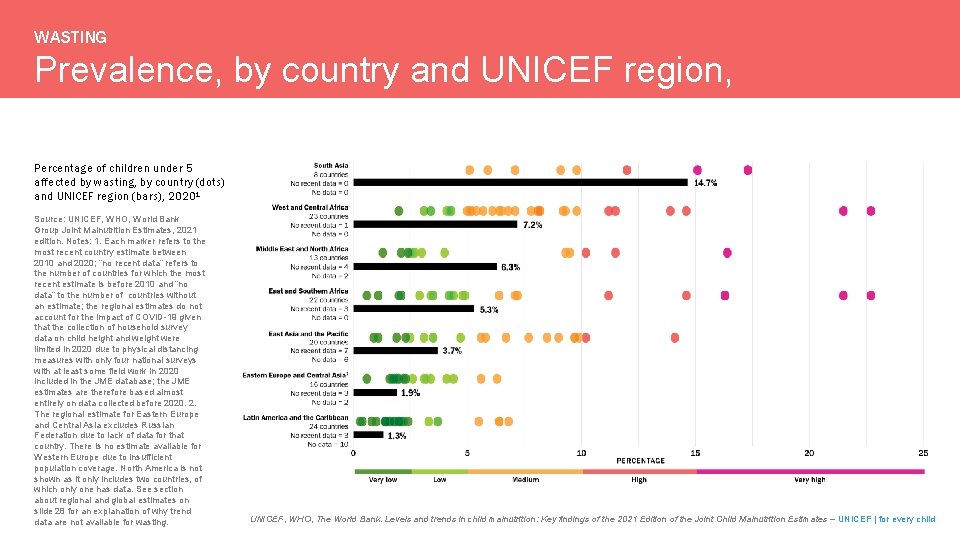
WASTING Prevalence, by country and UNICEF region, 20201 Percentage of children under 5 affected by wasting, by country (dots) and UNICEF region (bars), 20201 Source: UNICEF, WHO, World Bank Group Joint Malnutrition Estimates, 2021 edition. Notes: 1. Each marker refers to the most recent country estimate between 2010 and 2020; “no recent data” refers to the number of countries for which the most recent estimate is before 2010 and “no data” to the number of countries without an estimate; the regional estimates do not account for the impact of COVID-19 given that the collection of household survey data on child height and weight were limited in 2020 due to physical distancing measures with only four national surveys with at least some field work in 2020 included in the JME database; the JME estimates are therefore based almost entirely on data collected before 2020. 2. The regional estimate for Eastern Europe and Central Asia excludes Russian Federation due to lack of data for that country. There is no estimate available for Western Europe due to insufficient population coverage. North America is not shown as it only includes two countries, of which only one has data. See section about regional and global estimates on slide 28 for an explanation of why trend data are not available for wasting. UNICEF, WHO, The World Bank. Levels and trends in child malnutrition: Key findings of the 2021 Edition of the Joint Child Malnutrition Estimates – UNICEF | for every child
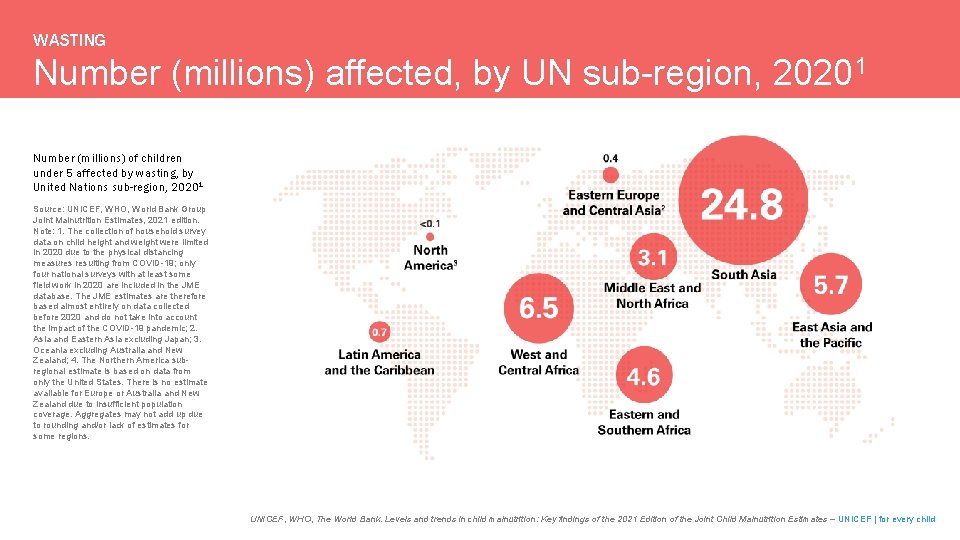
WASTING Number (millions) affected, by UN sub-region, 20201 Number (millions) of children under 5 affected by wasting, by United Nations sub-region, 20201 Source: UNICEF, WHO, World Bank Group Joint Malnutrition Estimates, 2021 edition. Note: 1. The collection of household survey data on child height and weight were limited in 2020 due to the physical distancing measures resulting from COVID-19; only four national surveys with at least some field work in 2020 are included in the JME database. The JME estimates are therefore based almost entirely on data collected before 2020 and do not take into account the impact of the COVID-19 pandemic; 2. Asia and Eastern Asia excluding Japan; 3. Oceania excluding Australia and New Zealand; 4. The Northern America subregional estimate is based on data from only the United States. There is no estimate available for Europe or Australia and New Zealand due to insufficient population coverage. Aggregates may not add up due to rounding and/or lack of estimates for some regions. UNICEF, WHO, The World Bank. Levels and trends in child malnutrition: Key findings of the 2021 Edition of the Joint Child Malnutrition Estimates – UNICEF | for every child
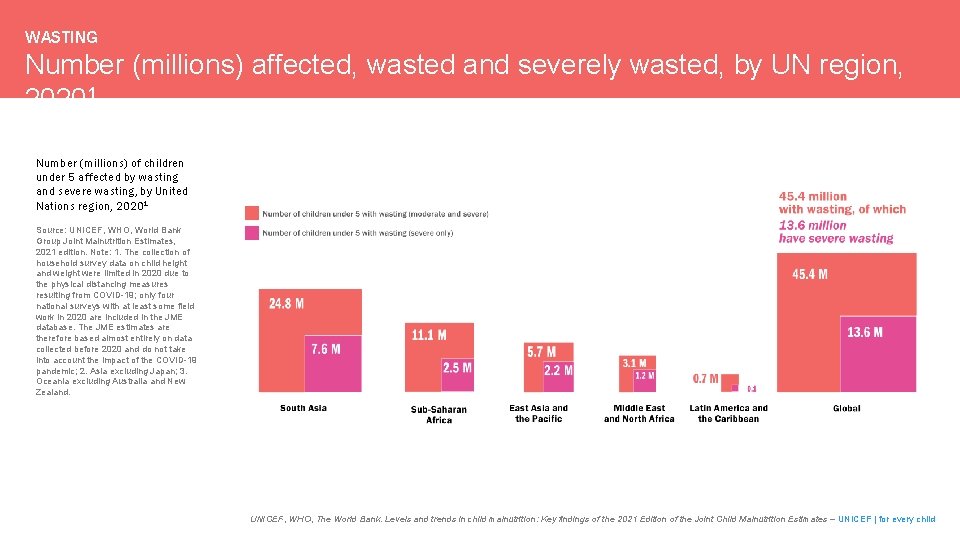
WASTING Number (millions) affected, wasted and severely wasted, by UN region, 20201 Number (millions) of children under 5 affected by wasting and severe wasting, by United Nations region, 20201 Source: UNICEF, WHO, World Bank Group Joint Malnutrition Estimates, 2021 edition. Note: 1. The collection of household survey data on child height and weight were limited in 2020 due to the physical distancing measures resulting from COVID-19; only four national surveys with at least some field work in 2020 are included in the JME database. The JME estimates are therefore based almost entirely on data collected before 2020 and do not take into account the impact of the COVID-19 pandemic; 2. Asia excluding Japan; 3. Oceania excluding Australia and New Zealand. UNICEF, WHO, The World Bank. Levels and trends in child malnutrition: Key findings of the 2021 Edition of the Joint Child Malnutrition Estimates – UNICEF | for every child
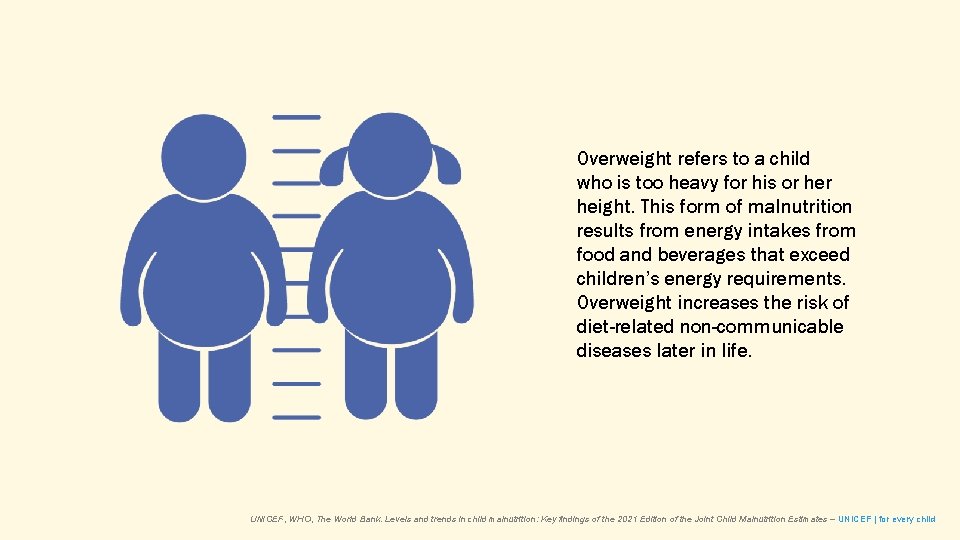
Overweight refers to a child who is too heavy for his or height. This form of malnutrition results from energy intakes from food and beverages that exceed children’s energy requirements. Overweight increases the risk of diet-related non-communicable diseases later in life. UNICEF, WHO, The World Bank. Levels and trends in child malnutrition: Key findings of the 2021 Edition of the Joint Child Malnutrition Estimates – UNICEF | for every child
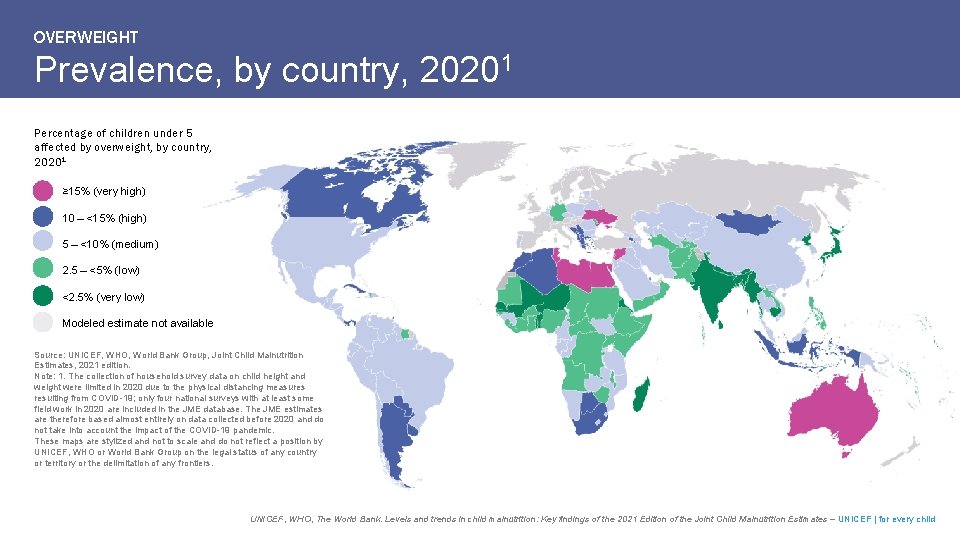
OVERWEIGHT Prevalence, by country, 20201 Percentage of children under 5 affected by overweight, by country, 20201 ≥ 15% (very high) 10 – <15% (high) 5 – <10% (medium) 2. 5 – <5% (low) <2. 5% (very low) Modeled estimate not available Source: UNICEF, WHO, World Bank Group, Joint Child Malnutrition Estimates, 2021 edition. Note: 1. The collection of household survey data on child height and weight were limited in 2020 due to the physical distancing measures resulting from COVID-19; only four national surveys with at least some field work in 2020 are included in the JME database. The JME estimates are therefore based almost entirely on data collected before 2020 and do not take into account the impact of the COVID-19 pandemic. These maps are stylized and not to scale and do not reflect a position by UNICEF, WHO or World Bank Group on the legal status of any country or territory or the delimitation of any frontiers. UNICEF, WHO, The World Bank. Levels and trends in child malnutrition: Key findings of the 2021 Edition of the Joint Child Malnutrition Estimates – UNICEF | for every child
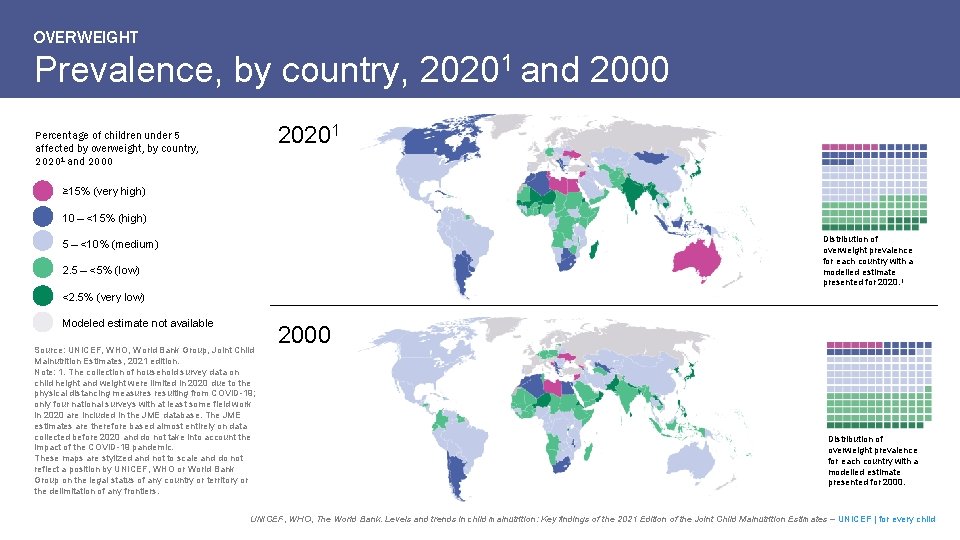
OVERWEIGHT Prevalence, by country, 20201 and 2000 20201 Percentage of children under 5 affected by overweight, by country, 20201 and 2000 ≥ 15% (very high) 10 – <15% (high) Distribution of overweight prevalence for each country with a modelled estimate presented for 2020. 1 5 – <10% (medium) 2. 5 – <5% (low) <2. 5% (very low) Modeled estimate not available Source: UNICEF, WHO, World Bank Group, Joint Child Malnutrition Estimates, 2021 edition. Note: 1. The collection of household survey data on child height and weight were limited in 2020 due to the physical distancing measures resulting from COVID-19; only four national surveys with at least some field work in 2020 are included in the JME database. The JME estimates are therefore based almost entirely on data collected before 2020 and do not take into account the impact of the COVID-19 pandemic. These maps are stylized and not to scale and do not reflect a position by UNICEF, WHO or World Bank Group on the legal status of any country or territory or the delimitation of any frontiers. 2000 Distribution of overweight prevalence for each country with a modelled estimate presented for 2000. UNICEF, WHO, The World Bank. Levels and trends in child malnutrition: Key findings of the 2021 Edition of the Joint Child Malnutrition Estimates – UNICEF | for every child
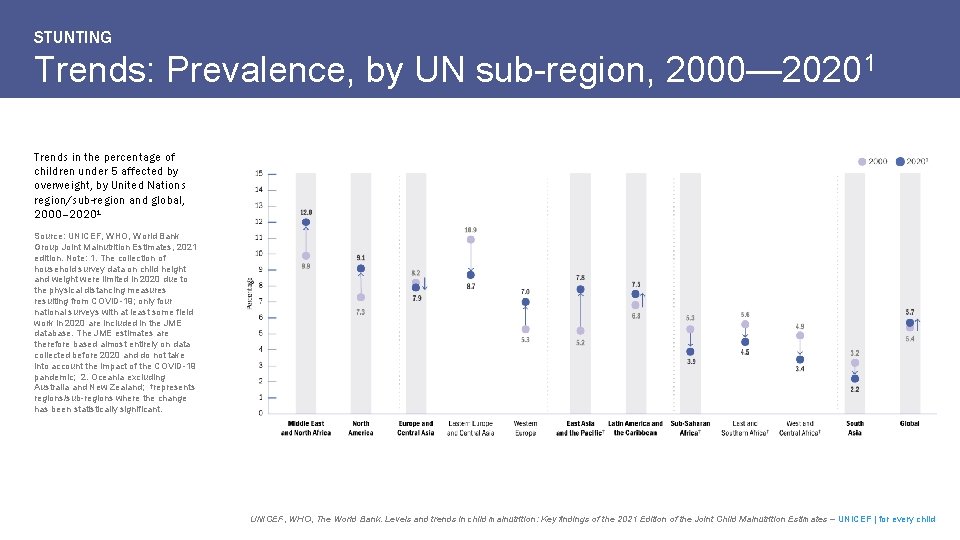
STUNTING Trends: Prevalence, by UN sub-region, 2000— 20201 Trends in the percentage of children under 5 affected by overweight, by United Nations region/sub-region and global, 2000– 20201 Source: UNICEF, WHO, World Bank Group Joint Malnutrition Estimates, 2021 edition. Note: 1. The collection of household survey data on child height and weight were limited in 2020 due to the physical distancing measures resulting from COVID-19; only four national surveys with at least some field work in 2020 are included in the JME database. The JME estimates are therefore based almost entirely on data collected before 2020 and do not take into account the impact of the COVID-19 pandemic; 2. Oceania excluding Australia and New Zealand; †represents regions/sub-regions where the change has been statistically significant. UNICEF, WHO, The World Bank. Levels and trends in child malnutrition: Key findings of the 2021 Edition of the Joint Child Malnutrition Estimates – UNICEF | for every child
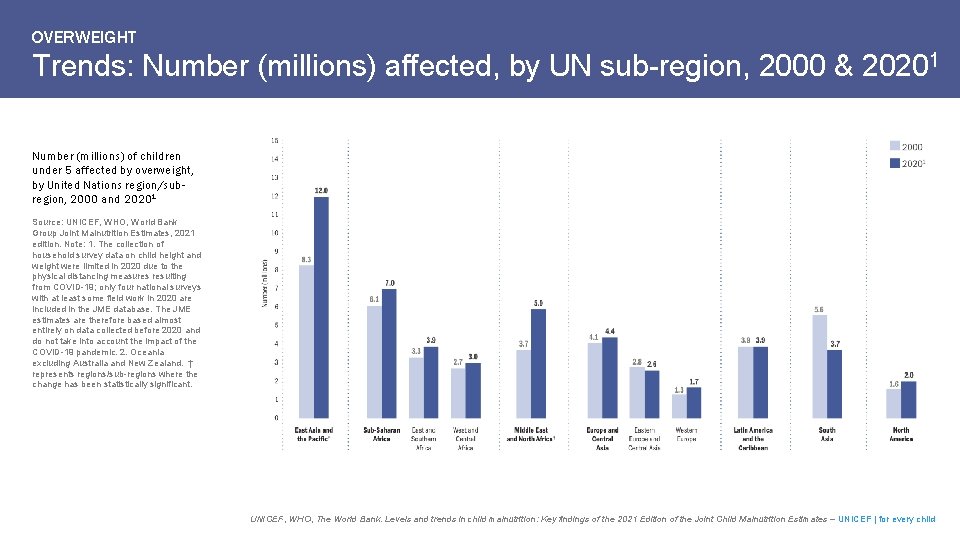
OVERWEIGHT Trends: Number (millions) affected, by UN sub-region, 2000 & 20201 Number (millions) of children under 5 affected by overweight, by United Nations region/subregion, 2000 and 20201 Source: UNICEF, WHO, World Bank Group Joint Malnutrition Estimates, 2021 edition. Note: 1. The collection of household survey data on child height and weight were limited in 2020 due to the physical distancing measures resulting from COVID-19; only four national surveys with at least some field work in 2020 are included in the JME database. The JME estimates are therefore based almost entirely on data collected before 2020 and do not take into account the impact of the COVID-19 pandemic. 2. Oceania excluding Australia and New Zealand. † represents regions/sub-regions where the change has been statistically significant. UNICEF, WHO, The World Bank. Levels and trends in child malnutrition: Key findings of the 2021 Edition of the Joint Child Malnutrition Estimates – UNICEF | for every child
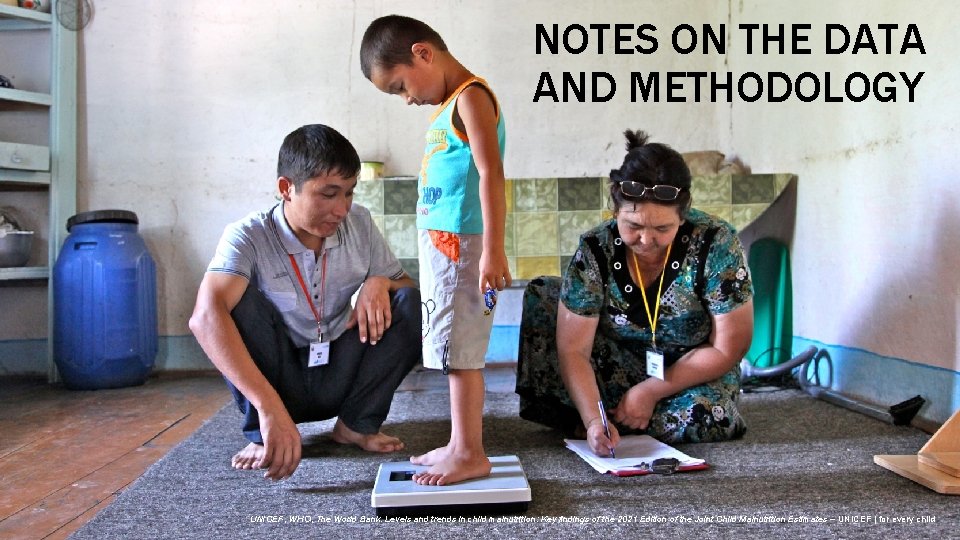
NOTES ON THE DATA AND METHODOLOGY UNICEF, WHO, The World Bank. Levels and trends in child malnutrition: Key findings of the 2021 Edition of the Joint Child Malnutrition Estimates – UNICEF | for every child
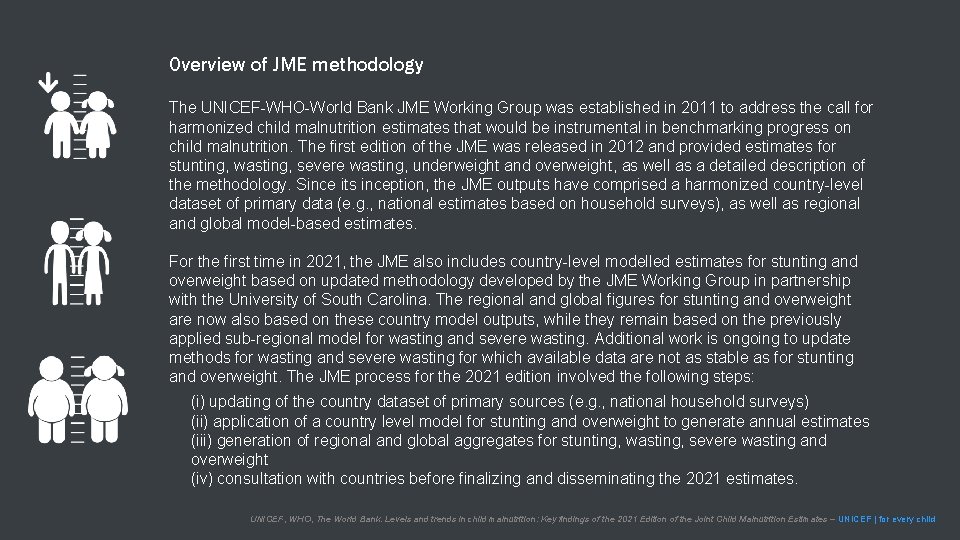
Overview of JME methodology The UNICEF-WHO-World Bank JME Working Group was established in 2011 to address the call for harmonized child malnutrition estimates that would be instrumental in benchmarking progress on child malnutrition. The first edition of the JME was released in 2012 and provided estimates for stunting, wasting, severe wasting, underweight and overweight, as well as a detailed description of the methodology. Since its inception, the JME outputs have comprised a harmonized country-level dataset of primary data (e. g. , national estimates based on household surveys), as well as regional and global model-based estimates. For the first time in 2021, the JME also includes country-level modelled estimates for stunting and overweight based on updated methodology developed by the JME Working Group in partnership with the University of South Carolina. The regional and global figures for stunting and overweight are now also based on these country model outputs, while they remain based on the previously applied sub-regional model for wasting and severe wasting. Additional work is ongoing to update methods for wasting and severe wasting for which available data are not as stable as for stunting and overweight. The JME process for the 2021 edition involved the following steps: (i) updating of the country dataset of primary sources (e. g. , national household surveys) (ii) application of a country level model for stunting and overweight to generate annual estimates (iii) generation of regional and global aggregates for stunting, wasting, severe wasting and overweight (iv) consultation with countries before finalizing and disseminating the 2021 estimates. UNICEF, WHO, The World Bank. Levels and trends in child malnutrition: Key findings of the 2021 Edition of the Joint Child Malnutrition Estimates – UNICEF | for every child
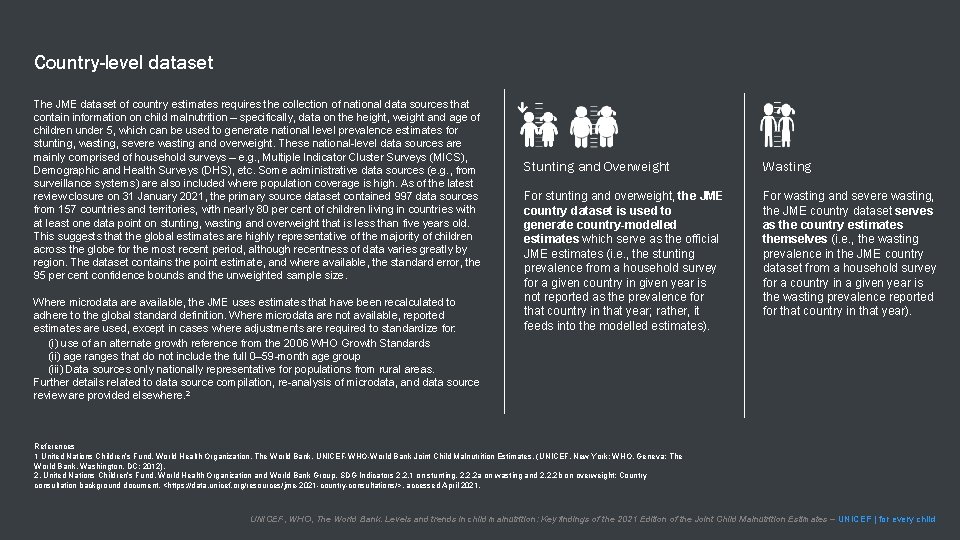
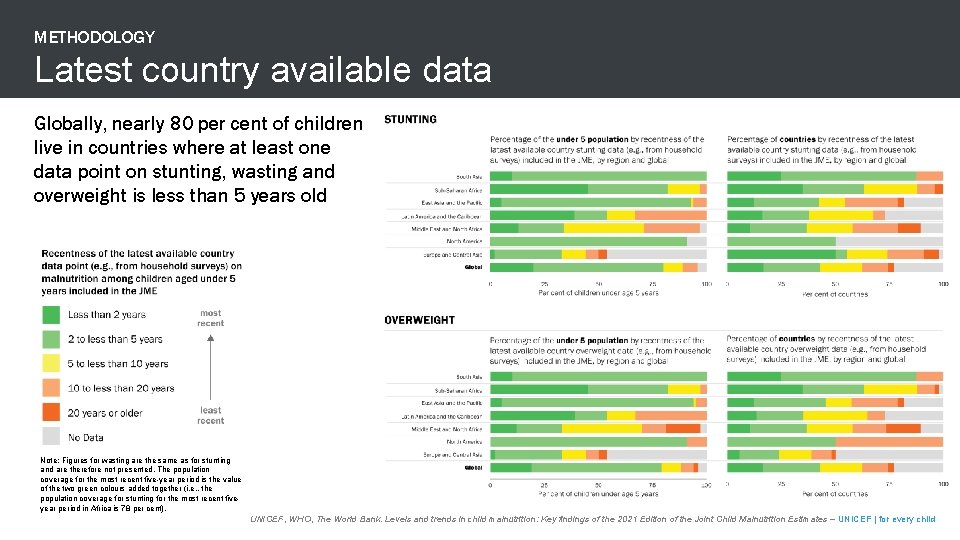
Country-level dataset The JME dataset of country estimates requires the collection of national data sources that contain information on child malnutrition – specifically, data on the height, weight and age of children under 5, which can be used to generate national level prevalence estimates for stunting, wasting, severe wasting and overweight. These national-level data sources are mainly comprised of household surveys – e. g. , Multiple Indicator Cluster Surveys (MICS), Demographic and Health Surveys (DHS), etc. Some administrative data sources (e. g. , from surveillance systems) are also included where population coverage is high. As of the latest review closure on 31 January 2021, the primary source dataset contained 997 data sources from 157 countries and territories, with nearly 80 per cent of children living in countries with at least one data point on stunting, wasting and overweight that is less than five years old. This suggests that the global estimates are highly representative of the majority of children across the globe for the most recent period, although recentness of data varies greatly by region. The dataset contains the point estimate, and where available, the standard error, the 95 per cent confidence bounds and the unweighted sample size. Where microdata are available, the JME uses estimates that have been recalculated to adhere to the global standard definition. Where microdata are not available, reported estimates are used, except in cases where adjustments are required to standardize for: (i) use of an alternate growth reference from the 2006 WHO Growth Standards (ii) age ranges that do not include the full 0– 59 -month age group (iii) Data sources only nationally representative for populations from rural areas. Further details related to data source compilation, re-analysis of microdata, and data source review are provided elsewhere. 2 Stunting and Overweight Wasting For stunting and overweight, the JME country dataset is used to generate country-modelled estimates which serve as the official JME estimates (i. e. , the stunting prevalence from a household survey for a given country in given year is not reported as the prevalence for that country in that year; rather, it feeds into the modelled estimates). For wasting and severe wasting, the JME country dataset serves as the country estimates themselves (i. e. , the wasting prevalence in the JME country dataset from a household survey for a country in a given year is the wasting prevalence reported for that country in that year). References 1 United Nations Children’s Fund, World Health Organization, The World Bank. UNICEF-WHO-World Bank Joint Child Malnutrition Estimates. (UNICEF, New York; WHO, Geneva; The World Bank, Washington, DC; 2012). 2. United Nations Children’s Fund, World Health Organization and World Bank Group, SDG Indicators 2. 2. 1 on stunting, 2. 2. 2 a on wasting and 2. 2. 2 b on overweight: Country consultation background document, <https: //data. unicef. org/resources/jme-2021 -country-consultations/>, accessed April 2021. UNICEF, WHO, The World Bank. Levels and trends in child malnutrition: Key findings of the 2021 Edition of the Joint Child Malnutrition Estimates – UNICEF | for every child
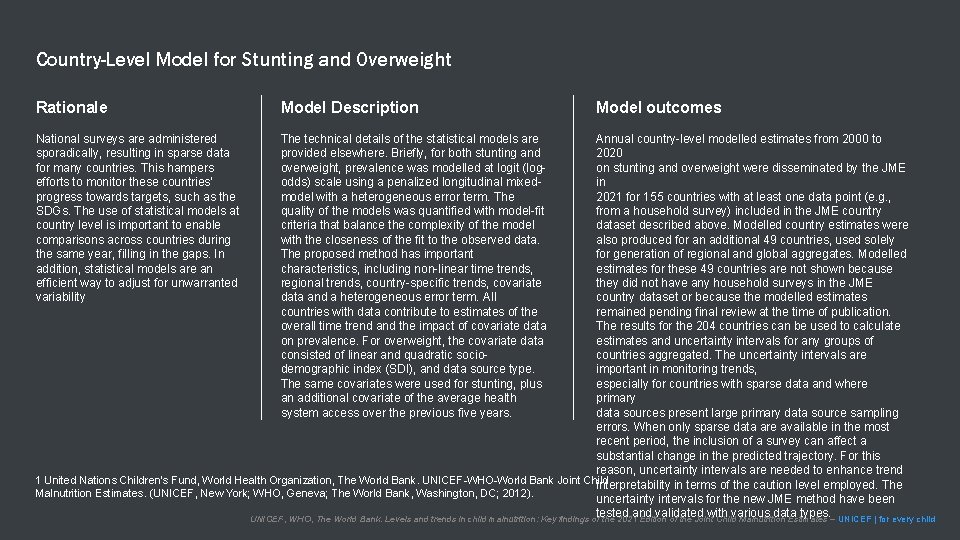
Country-Level Model for Stunting and Overweight Rationale Model Description National surveys are administered sporadically, resulting in sparse data for many countries. This hampers efforts to monitor these countries’ progress towards targets, such as the SDGs. The use of statistical models at country level is important to enable comparisons across countries during the same year, filling in the gaps. In addition, statistical models are an efficient way to adjust for unwarranted variability The technical details of the statistical models are provided elsewhere. Briefly, for both stunting and overweight, prevalence was modelled at logit (logodds) scale using a penalized longitudinal mixedmodel with a heterogeneous error term. The quality of the models was quantified with model-fit criteria that balance the complexity of the model with the closeness of the fit to the observed data. The proposed method has important characteristics, including non-linear time trends, regional trends, country-specific trends, covariate data and a heterogeneous error term. All countries with data contribute to estimates of the overall time trend and the impact of covariate data on prevalence. For overweight, the covariate data consisted of linear and quadratic sociodemographic index (SDI), and data source type. The same covariates were used for stunting, plus an additional covariate of the average health system access over the previous five years. Model outcomes Annual country-level modelled estimates from 2000 to 2020 on stunting and overweight were disseminated by the JME in 2021 for 155 countries with at least one data point (e. g. , from a household survey) included in the JME country dataset described above. Modelled country estimates were also produced for an additional 49 countries, used solely for generation of regional and global aggregates. Modelled estimates for these 49 countries are not shown because they did not have any household surveys in the JME country dataset or because the modelled estimates remained pending final review at the time of publication. The results for the 204 countries can be used to calculate estimates and uncertainty intervals for any groups of countries aggregated. The uncertainty intervals are important in monitoring trends, especially for countries with sparse data and where primary data sources present large primary data source sampling errors. When only sparse data are available in the most recent period, the inclusion of a survey can affect a substantial change in the predicted trajectory. For this reason, uncertainty intervals are needed to enhance trend 1 United Nations Children’s Fund, World Health Organization, The World Bank. UNICEF-WHO-World Bank Joint Child interpretability in terms of the caution level employed. The Malnutrition Estimates. (UNICEF, New York; WHO, Geneva; The World Bank, Washington, DC; 2012). uncertainty intervals for the new JME method have been and validated with various data types. – UNICEF | for every child UNICEF, WHO, The World Bank. Levels and trends in child malnutrition: Key findings oftested the 2021 Edition of the Joint Child Malnutrition Estimates
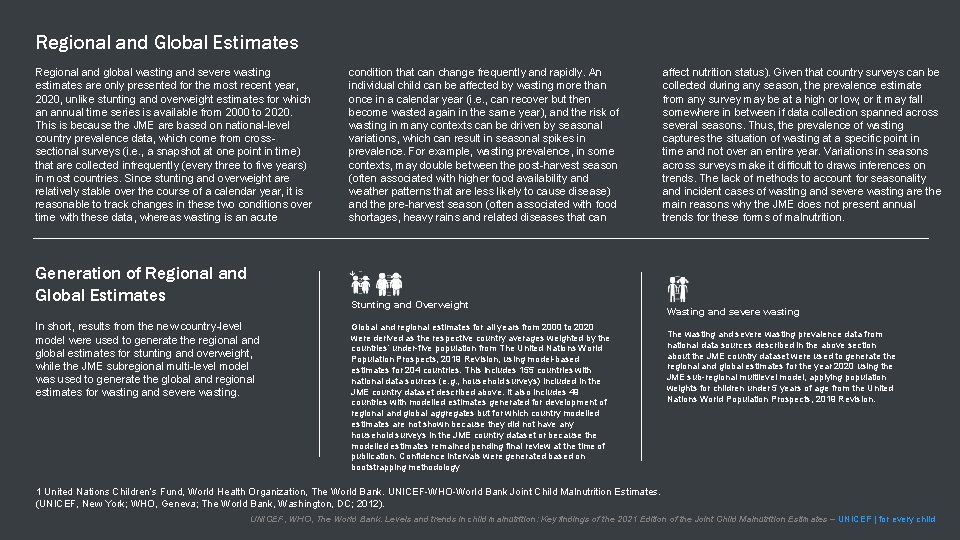
Regional and Global Estimates Regional and global wasting and severe wasting estimates are only presented for the most recent year, 2020, unlike stunting and overweight estimates for which an annual time series is available from 2000 to 2020. This is because the JME are based on national-level country prevalence data, which come from crosssectional surveys (i. e. , a snapshot at one point in time) that are collected infrequently (every three to five years) in most countries. Since stunting and overweight are relatively stable over the course of a calendar year, it is reasonable to track changes in these two conditions over time with these data, whereas wasting is an acute Generation of Regional and Global Estimates condition that can change frequently and rapidly. An individual child can be affected by wasting more than once in a calendar year (i. e. , can recover but then become wasted again in the same year), and the risk of wasting in many contexts can be driven by seasonal variations, which can result in seasonal spikes in prevalence. For example, wasting prevalence, in some contexts, may double between the post-harvest season (often associated with higher food availability and weather patterns that are less likely to cause disease) and the pre-harvest season (often associated with food shortages, heavy rains and related diseases that can Stunting and Overweight In short, results from the new country-level model were used to generate the regional and global estimates for stunting and overweight, while the JME subregional multi-level model was used to generate the global and regional estimates for wasting and severe wasting. Global and regional estimates for all years from 2000 to 2020 were derived as the respective country averages weighted by the countries’ under-five population from The United Nations World Population Prospects, 2019 Revision, using model-based estimates for 204 countries. This includes 155 countries with national data sources (e. g. , household surveys) included in the JME country dataset described above. It also includes 49 countries with modelled estimates generated for development of regional and global aggregates but for which country modelled estimates are not shown because they did not have any household surveys in the JME country dataset or because the modelled estimates remained pending final review at the time of publication. Confidence intervals were generated based on bootstrapping methodology affect nutrition status). Given that country surveys can be collected during any season, the prevalence estimate from any survey may be at a high or low; or it may fall somewhere in between if data collection spanned across several seasons. Thus, the prevalence of wasting captures the situation of wasting at a specific point in time and not over an entire year. Variations in seasons across surveys make it difficult to draws inferences on trends. The lack of methods to account for seasonality and incident cases of wasting and severe wasting are the main reasons why the JME does not present annual trends for these forms of malnutrition. Wasting and severe wasting The wasting and severe wasting prevalence data from national data sources described in the above section about the JME country dataset were used to generate the regional and global estimates for the year 2020 using the JME sub-regional multilevel model, applying population weights for children under 5 years of age from the United Nations World Population Prospects, 2019 Revision. 1 United Nations Children’s Fund, World Health Organization, The World Bank. UNICEF-WHO-World Bank Joint Child Malnutrition Estimates. (UNICEF, New York; WHO, Geneva; The World Bank, Washington, DC; 2012). UNICEF, WHO, The World Bank. Levels and trends in child malnutrition: Key findings of the 2021 Edition of the Joint Child Malnutrition Estimates – UNICEF | for every child
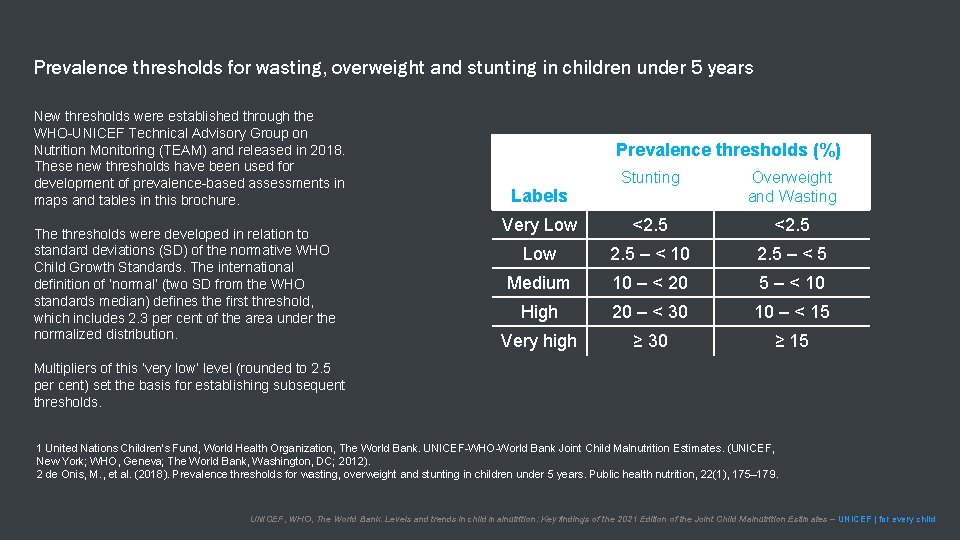
Prevalence thresholds for wasting, overweight and stunting in children under 5 years New thresholds were established through the WHO-UNICEF Technical Advisory Group on Nutrition Monitoring (TEAM) and released in 2018. These new thresholds have been used for development of prevalence-based assessments in maps and tables in this brochure. The thresholds were developed in relation to standard deviations (SD) of the normative WHO Child Growth Standards. The international definition of ‘normal’ (two SD from the WHO standards median) defines the first threshold, which includes 2. 3 per cent of the area under the normalized distribution. Prevalence thresholds (%) Stunting Overweight and Wasting Very Low <2. 5 Low 2. 5 – < 10 2. 5 – < 5 Medium 10 – < 20 5 – < 10 High 20 – < 30 10 – < 15 Very high ≥ 30 ≥ 15 Labels Multipliers of this ‘very low’ level (rounded to 2. 5 per cent) set the basis for establishing subsequent thresholds. 1 United Nations Children’s Fund, World Health Organization, The World Bank. UNICEF-WHO-World Bank Joint Child Malnutrition Estimates. (UNICEF, New York; WHO, Geneva; The World Bank, Washington, DC; 2012). 2 de Onis, M. , et al. (2018). Prevalence thresholds for wasting, overweight and stunting in children under 5 years. Public health nutrition, 22(1), 175– 179. UNICEF, WHO, The World Bank. Levels and trends in child malnutrition: Key findings of the 2021 Edition of the Joint Child Malnutrition Estimates – UNICEF | for every child
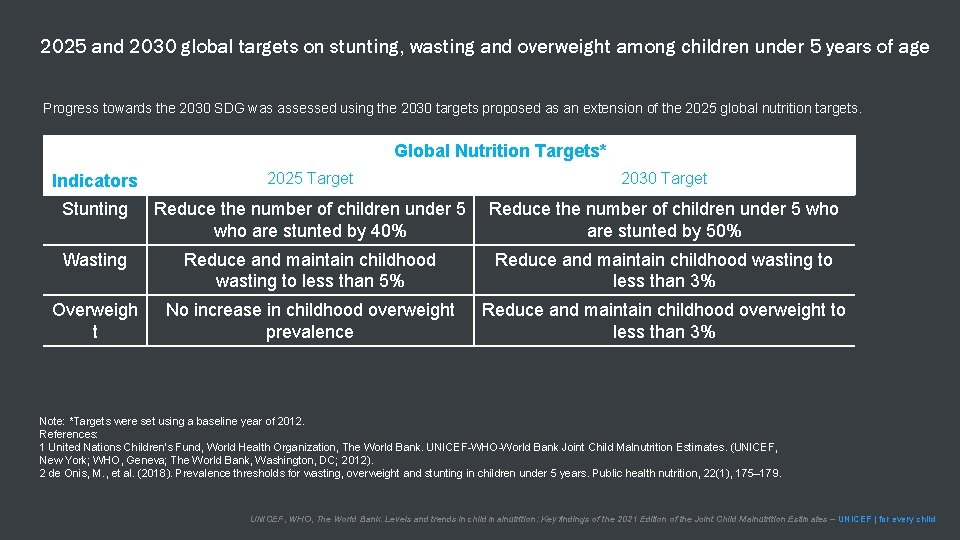
2025 and 2030 global targets on stunting, wasting and overweight among children under 5 years of age Progress towards the 2030 SDG was assessed using the 2030 targets proposed as an extension of the 2025 global nutrition targets. Global Nutrition Targets* Indicators 2025 Target 2030 Target Stunting Reduce the number of children under 5 who are stunted by 40% Reduce the number of children under 5 who are stunted by 50% Wasting Reduce and maintain childhood wasting to less than 5% Reduce and maintain childhood wasting to less than 3% Overweigh t No increase in childhood overweight prevalence Reduce and maintain childhood overweight to less than 3% Note: *Targets were set using a baseline year of 2012. References: 1 United Nations Children’s Fund, World Health Organization, The World Bank. UNICEF-WHO-World Bank Joint Child Malnutrition Estimates. (UNICEF, New York; WHO, Geneva; The World Bank, Washington, DC; 2012). 2 de Onis, M. , et al. (2018). Prevalence thresholds for wasting, overweight and stunting in children under 5 years. Public health nutrition, 22(1), 175– 179. UNICEF, WHO, The World Bank. Levels and trends in child malnutrition: Key findings of the 2021 Edition of the Joint Child Malnutrition Estimates – UNICEF | for every child
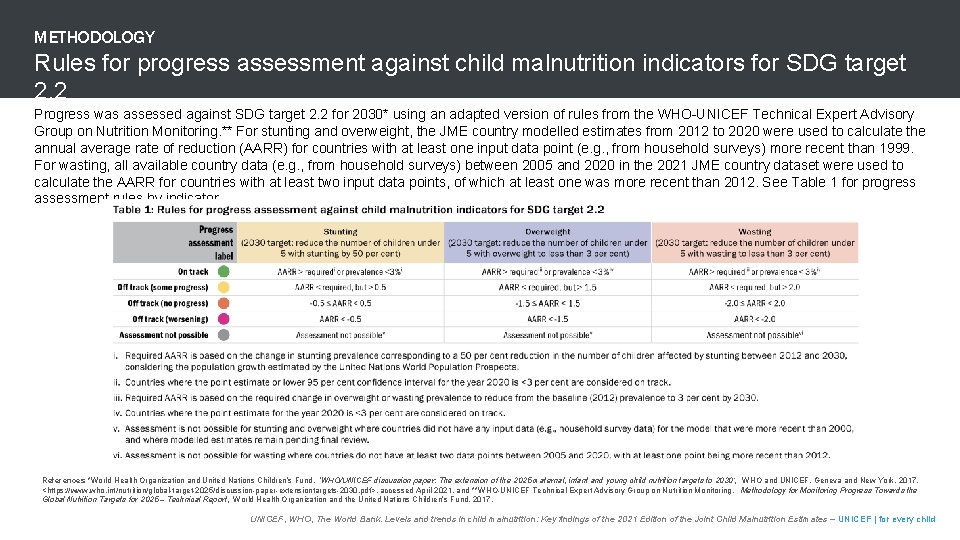
METHODOLOGY Rules for progress assessment against child malnutrition indicators for SDG target 2. 2 Progress was assessed against SDG target 2. 2 for 2030* using an adapted version of rules from the WHO-UNICEF Technical Expert Advisory Group on Nutrition Monitoring. ** For stunting and overweight, the JME country modelled estimates from 2012 to 2020 were used to calculate the annual average rate of reduction (AARR) for countries with at least one input data point (e. g. , from household surveys) more recent than 1999. For wasting, all available country data (e. g. , from household surveys) between 2005 and 2020 in the 2021 JME country dataset were used to calculate the AARR for countries with at least two input data points, of which at least one was more recent than 2012. See Table 1 for progress assessment rules by indicator. References *World Health Organization and United Nations Children’s Fund. ‘WHO/UNICEF discussion paper: The extension of the 2025 maternal, infant and young child nutrition targets to 2030’, WHO and UNICEF, Geneva and New York, 2017, <https: //www. who. int/nutrition/global-target-2025/discussion-paper-extensiontargets-2030. pdf>, accessed April 2021. and **WHO-UNICEF Technical Expert Advisory Group on Nutrition Monitoring, Methodology for Monitoring Progress Towards the Global Nutrition Targets for 2025 – Technical Report, World Health Organization and the United Nations Children’s Fund, 2017. UNICEF, WHO, The World Bank. Levels and trends in child malnutrition: Key findings of the 2021 Edition of the Joint Child Malnutrition Estimates – UNICEF | for every child
METHODOLOGY Latest country available data Globally, nearly 80 per cent of children live in countries where at least one data point on stunting, wasting and overweight is less than 5 years old Note: Figures for wasting are the same as for stunting and are therefore not presented. The population coverage for the most recent five-year period is the value of the two green colours added together (i. e. , the population coverage for stunting for the most recent fiveyear period in Africa is 78 per cent). UNICEF, WHO, The World Bank. Levels and trends in child malnutrition: Key findings of the 2021 Edition of the Joint Child Malnutrition Estimates – UNICEF | for every child
ONLINE MATERIALS UNICEF, WHO, The World Bank. Levels and trends in child malnutrition: Key findings of the 2021 Edition of the Joint Child Malnutrition Estimates – UNICEF | for every child
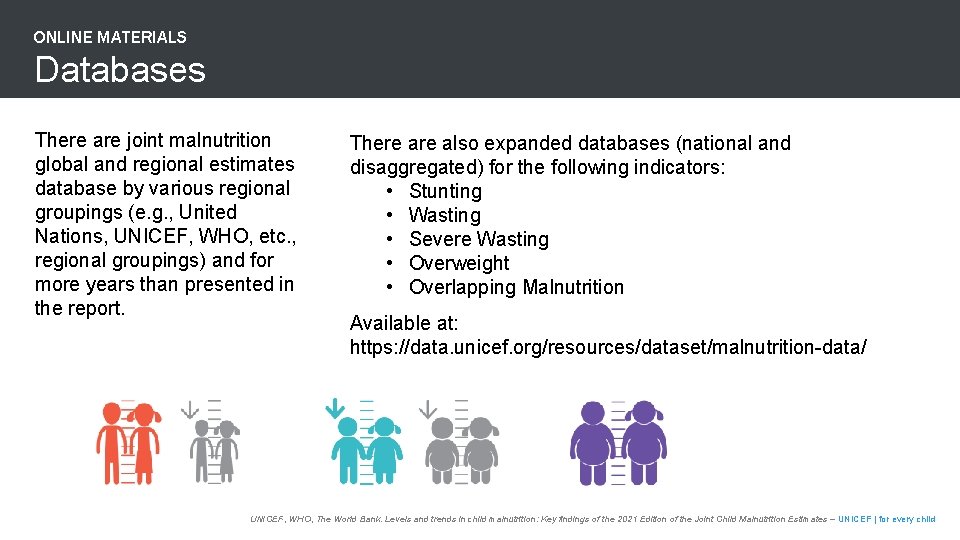
ONLINE MATERIALS Databases There are joint malnutrition global and regional estimates database by various regional groupings (e. g. , United Nations, UNICEF, WHO, etc. , regional groupings) and for more years than presented in the report. There also expanded databases (national and disaggregated) for the following indicators: • Stunting • Wasting • Severe Wasting • Overweight • Overlapping Malnutrition Available at: https: //data. unicef. org/resources/dataset/malnutrition-data/ UNICEF, WHO, The World Bank. Levels and trends in child malnutrition: Key findings of the 2021 Edition of the Joint Child Malnutrition Estimates – UNICEF | for every child
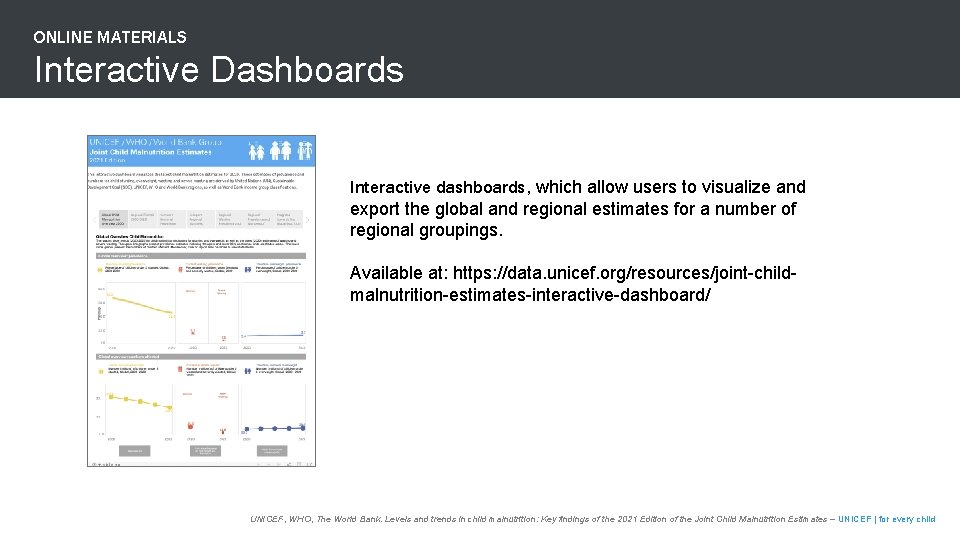
ONLINE MATERIALS Interactive Dashboards Interactive dashboards, which allow users to visualize and export the global and regional estimates for a number of regional groupings. Available at: https: //data. unicef. org/resources/joint-childmalnutrition-estimates-interactive-dashboard/ UNICEF, WHO, The World Bank. Levels and trends in child malnutrition: Key findings of the 2021 Edition of the Joint Child Malnutrition Estimates – UNICEF | for every child
Prepared by: Data and Analytics Section Division of Data, Analytics, Planning & Monitoring UNICEF Headquarters 3 UN Plaza, New York, NY, 10017 data. unicef. org For more information contact: data@unicef. org UNICEF, WHO, The World Bank. Levels and trends in child malnutrition: Key findings of the 2021 Edition of the Joint Child Malnutrition Estimates – UNICEF | for every child