
The Cold War What is a Cold War









- Slides: 54
The Cold War
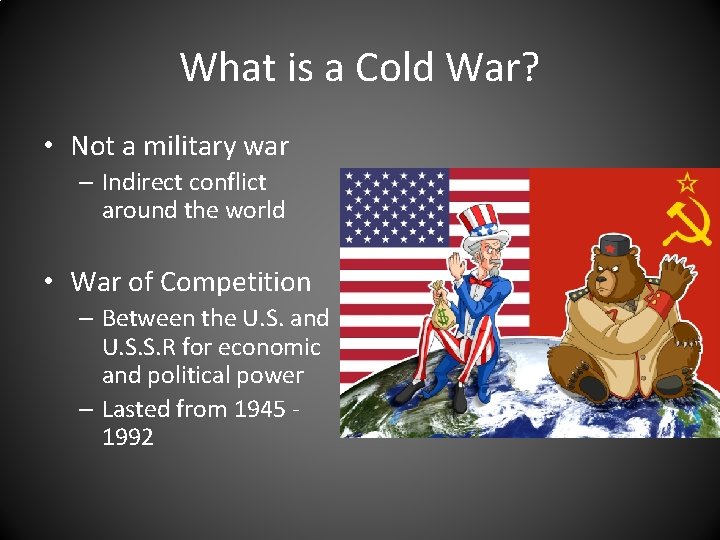
What is a Cold War? • Not a military war – Indirect conflict around the world • War of Competition – Between the U. S. and U. S. S. R for economic and political power – Lasted from 1945 1992
Philosophy of the USA • Believed in democratic forms of government • Believed economic stability would keep peace in the word • Believed the free enterprise system was necessary for economic growth
Philosophy of the Soviet Union • Believed in a communist forms of government • Believed in workers revolting (striking) against business owners and taking control of government • Wanted to control countries between Russia and Germany
Relations between US and USSR • Very Unstable due to differences in ideology – 1917 -1933 US had no relations – Allies during WW 2, enemies immediately after • Both were afraid of the other taking over the world
Post WW 2 Goals • US, Great Britain, France – Democracy in Eastern Europe – Restore French control of SE Asia (Vietnam) • Soviet Union (USSR) – Spread Communism to Eastern Europe – Create a buffer zone of friendly communist countries (satellite countries)
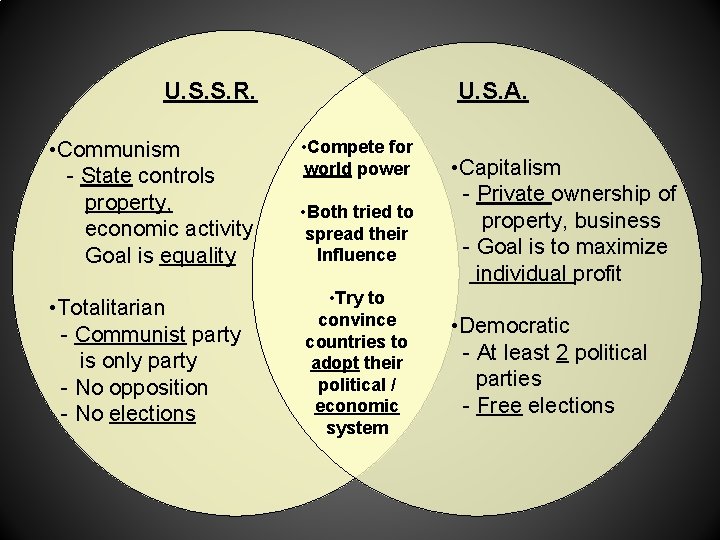
U. S. S. R. • Communism - State controls property, economic activity Goal is equality • Totalitarian - Communist party is only party - No opposition - No elections U. S. A. • Compete for world power • Both tried to spread their Influence • Try to convince countries to adopt their political / economic system • Capitalism - Private ownership of property, business - Goal is to maximize individual profit • Democratic - At least 2 political parties - Free elections
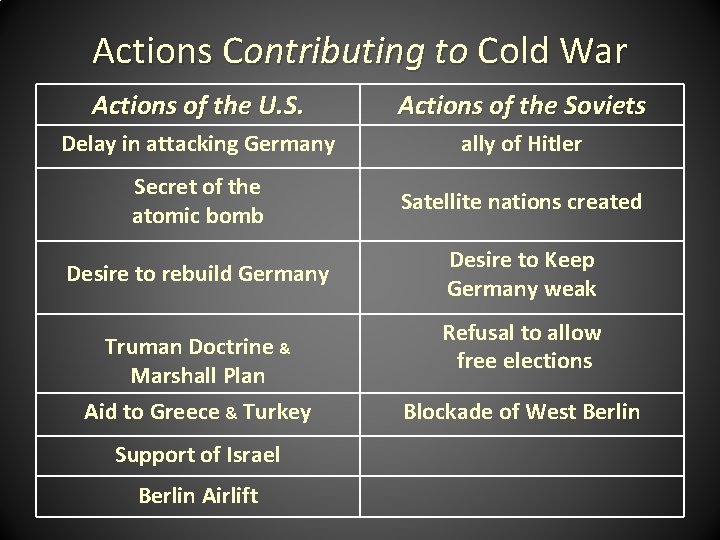
Actions Contributing to Cold War Actions of the U. S. Actions of the Soviets Delay in attacking Germany ally of Hitler Secret of the atomic bomb Satellite nations created Desire to rebuild Germany Desire to Keep Germany weak Truman Doctrine & Marshall Plan Aid to Greece & Turkey Support of Israel Berlin Airlift Refusal to allow free elections Blockade of West Berlin
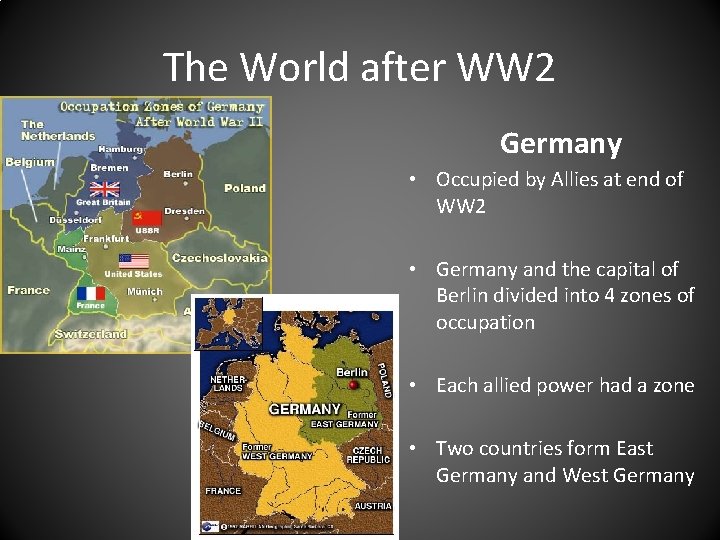
The World after WW 2 Germany • Occupied by Allies at end of WW 2 • Germany and the capital of Berlin divided into 4 zones of occupation • Each allied power had a zone • Two countries form East Germany and West Germany
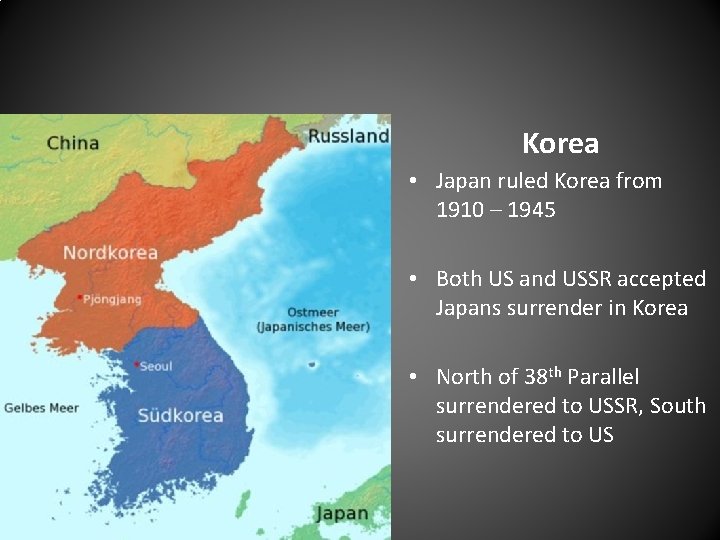
Korea • Japan ruled Korea from 1910 – 1945 • Both US and USSR accepted Japans surrender in Korea • North of 38 th Parallel surrendered to USSR, South surrendered to US
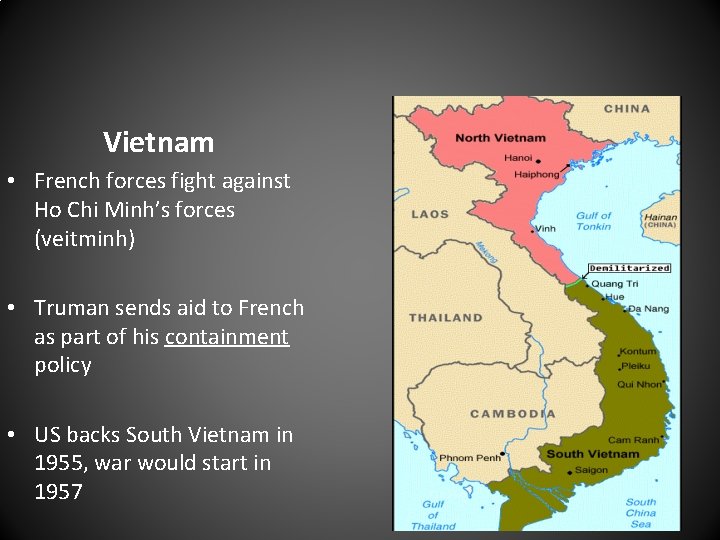
Vietnam • French forces fight against Ho Chi Minh’s forces (veitminh) • Truman sends aid to French as part of his containment policy • US backs South Vietnam in 1955, war would start in 1957
An Iron Curtain Forms • The Soviet Union forces nations it liberated during WW 2 to become communist. • These countries would be directly influenced by the USSR and are known as satellite nations.
NATO vs Warsaw Pact • NATO – North Atlantic Treaty Organization – 1949, 10 European Countries, the US and Canada – Defensive military alliance against the USSR • Warsaw Pact – 1955, 7 Communist Countries in Europe, and USSR – Soviet response to NATO
Berlin Air Lift • USSR attempts to take over Berlin by surrounding it and taking the city hostage • US and GB use air power to provide supplies – 327 days, planes landed every few minutes
The Korean War • June 1950 – North Korea invades South Korea • UN and US forces pledge to help South – There was no formal declaration of war by the US • War turns into a stalemate when China supports North Korea
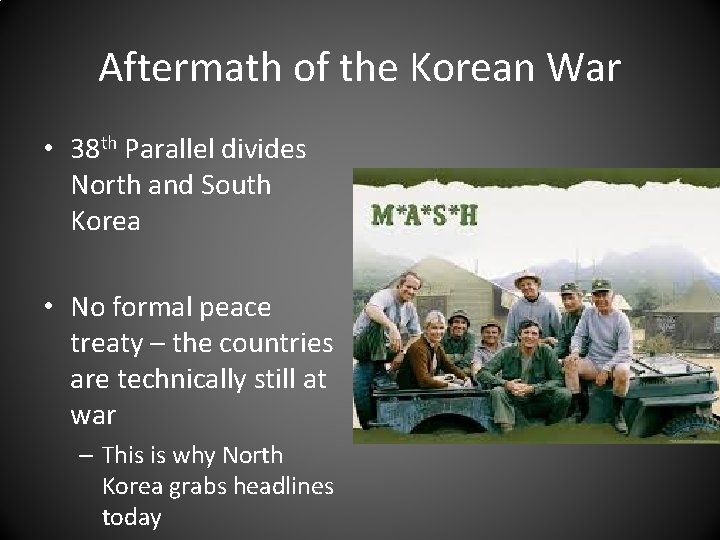
Aftermath of the Korean War • 38 th Parallel divides North and South Korea • No formal peace treaty – the countries are technically still at war – This is why North Korea grabs headlines today
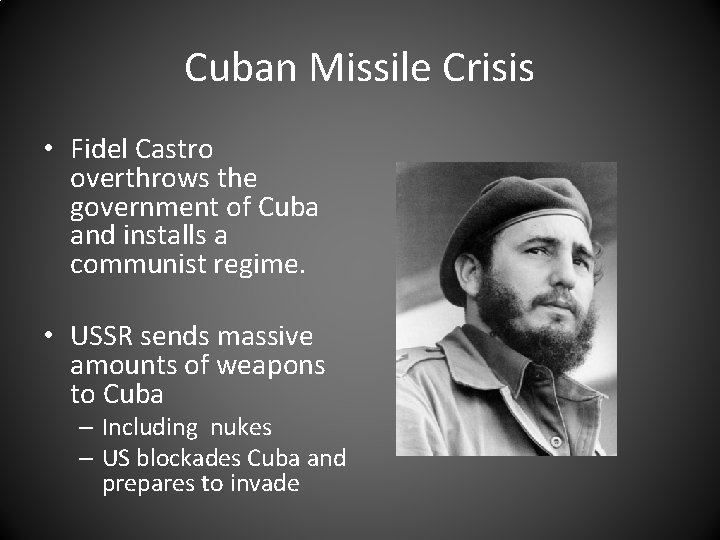
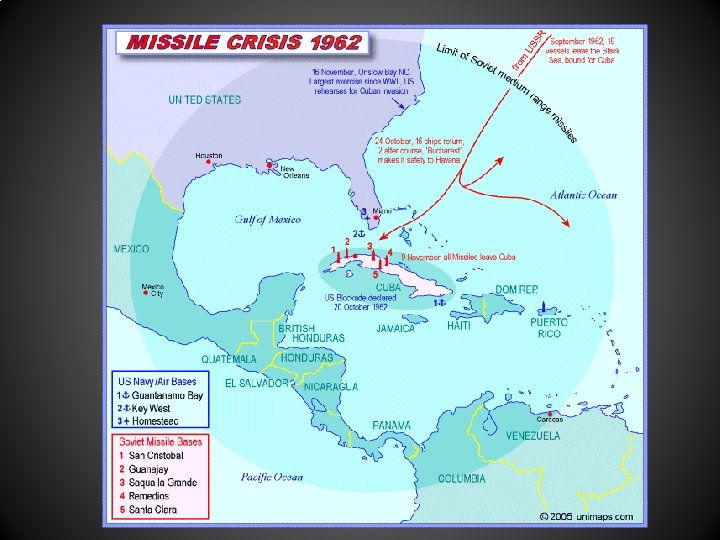
Cuban Missile Crisis • Fidel Castro overthrows the government of Cuba and installs a communist regime. • USSR sends massive amounts of weapons to Cuba – Including nukes – US blockades Cuba and prepares to invade
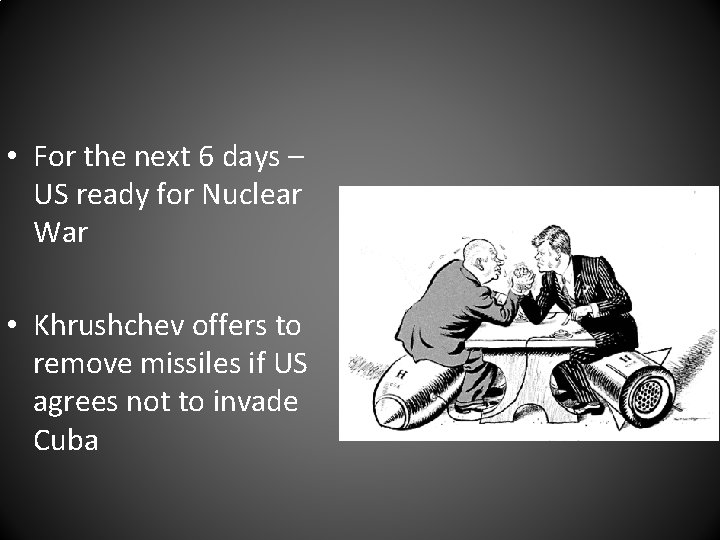
• For the next 6 days – US ready for Nuclear War • Khrushchev offers to remove missiles if US agrees not to invade Cuba
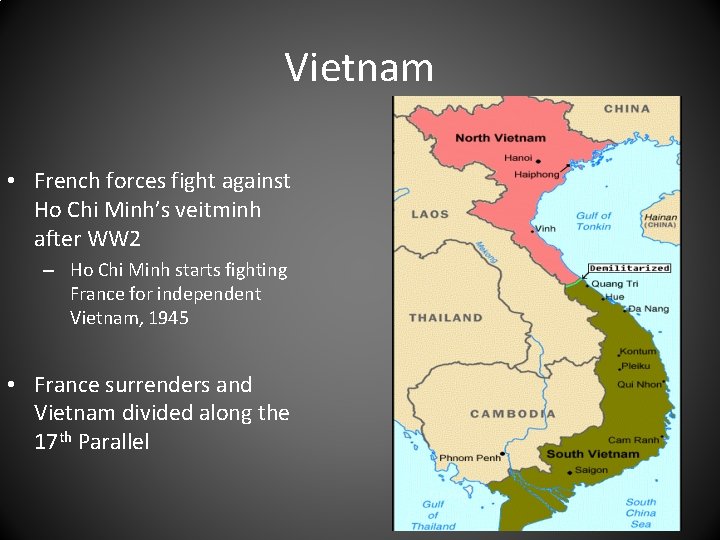
Vietnam • French forces fight against Ho Chi Minh’s veitminh after WW 2 – Ho Chi Minh starts fighting France for independent Vietnam, 1945 • France surrenders and Vietnam divided along the 17 th Parallel
Vietnam Divided North Vietnam • Led by Ho Chi Minh’s communist forces • Supported by the USSR and China South Vietnam • Led by an anti-Communist government under the rule of Ngo Dinh Diem • Supported by the U. S. and France.
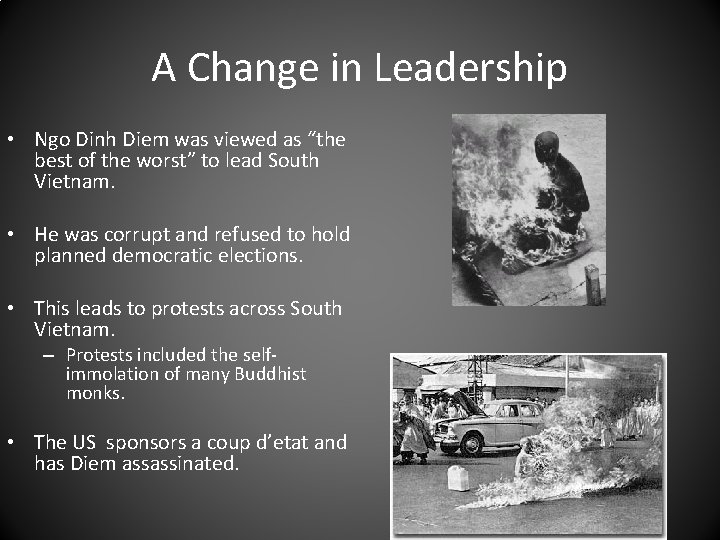
A Change in Leadership • Ngo Dinh Diem was viewed as “the best of the worst” to lead South Vietnam. • He was corrupt and refused to hold planned democratic elections. • This leads to protests across South Vietnam. – Protests included the selfimmolation of many Buddhist monks. • The US sponsors a coup d’etat and has Diem assassinated.
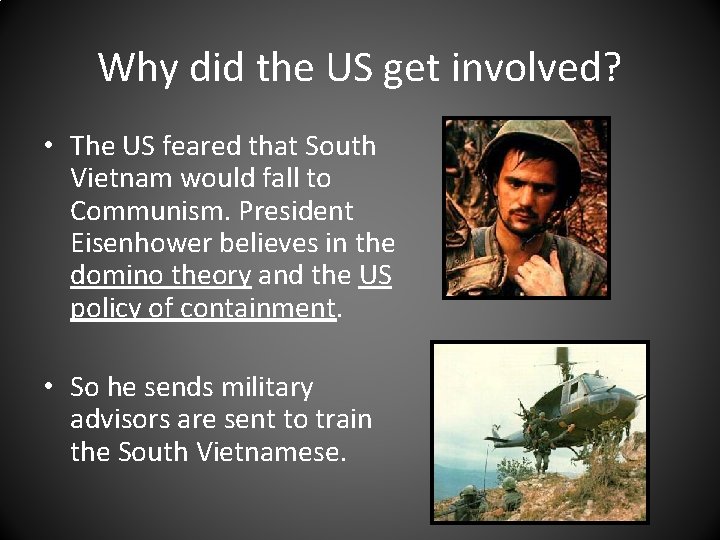
Why did the US get involved? • The US feared that South Vietnam would fall to Communism. President Eisenhower believes in the domino theory and the US policy of containment. • So he sends military advisors are sent to train the South Vietnamese.
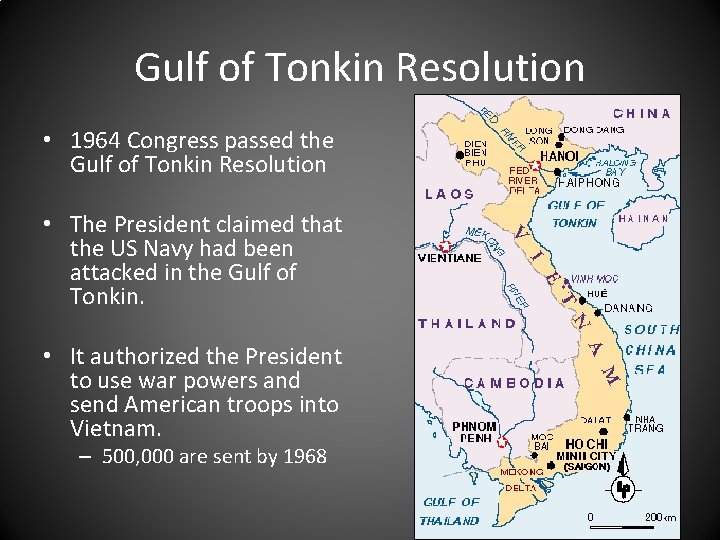
Gulf of Tonkin Resolution • 1964 Congress passed the Gulf of Tonkin Resolution • The President claimed that the US Navy had been attacked in the Gulf of Tonkin. • It authorized the President to use war powers and send American troops into Vietnam. – 500, 000 are sent by 1968
The Tet Offensive • The war was largely a stalemate until 1968 as neither the US or North Vietnamese could gain the upper hand. • The North Vietnamese launched a surprise attack on most of the major cities in South Vietnam and major US bases. • The attack occurred on the Vietnamese new year of Tet.
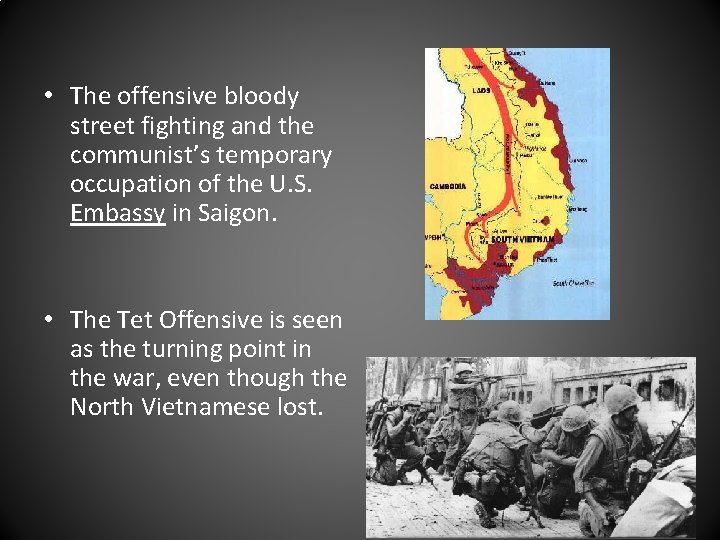
• The offensive bloody street fighting and the communist’s temporary occupation of the U. S. Embassy in Saigon. • The Tet Offensive is seen as the turning point in the war, even though the North Vietnamese lost.
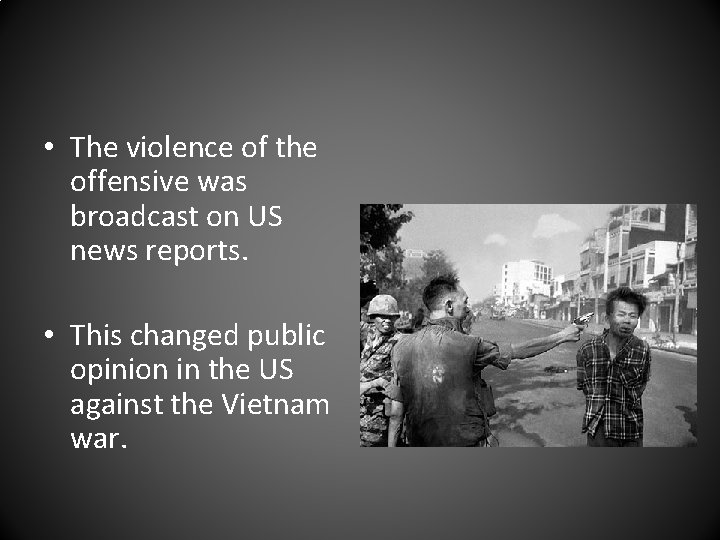
• The violence of the offensive was broadcast on US news reports. • This changed public opinion in the US against the Vietnam war.
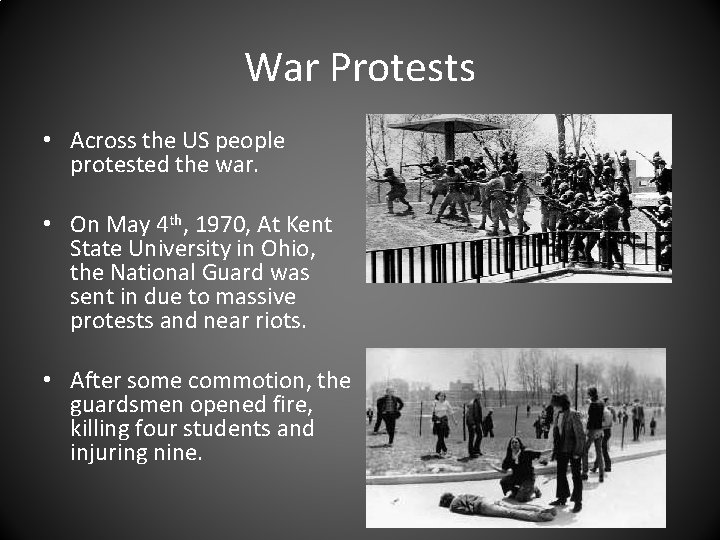
War Protests • Across the US people protested the war. • On May 4 th, 1970, At Kent State University in Ohio, the National Guard was sent in due to massive protests and near riots. • After some commotion, the guardsmen opened fire, killing four students and injuring nine.
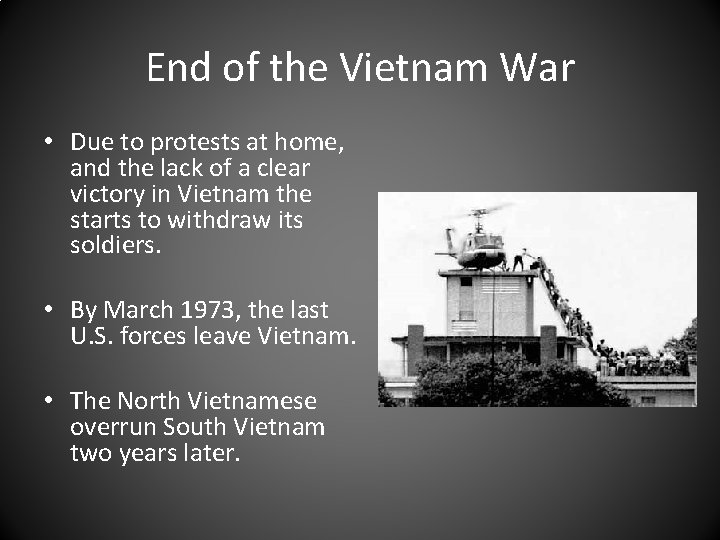
End of the Vietnam War • Due to protests at home, and the lack of a clear victory in Vietnam the starts to withdraw its soldiers. • By March 1973, the last U. S. forces leave Vietnam. • The North Vietnamese overrun South Vietnam two years later.
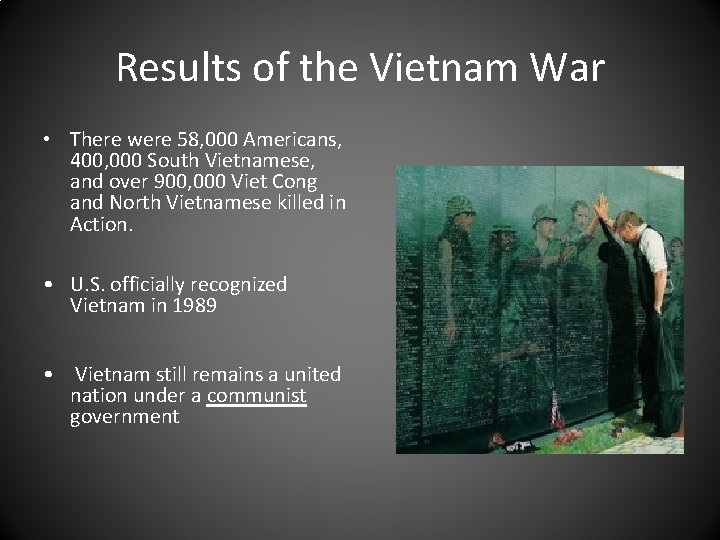
Results of the Vietnam War • There were 58, 000 Americans, 400, 000 South Vietnamese, and over 900, 000 Viet Cong and North Vietnamese killed in Action. • U. S. officially recognized Vietnam in 1989 • Vietnam still remains a united nation under a communist government
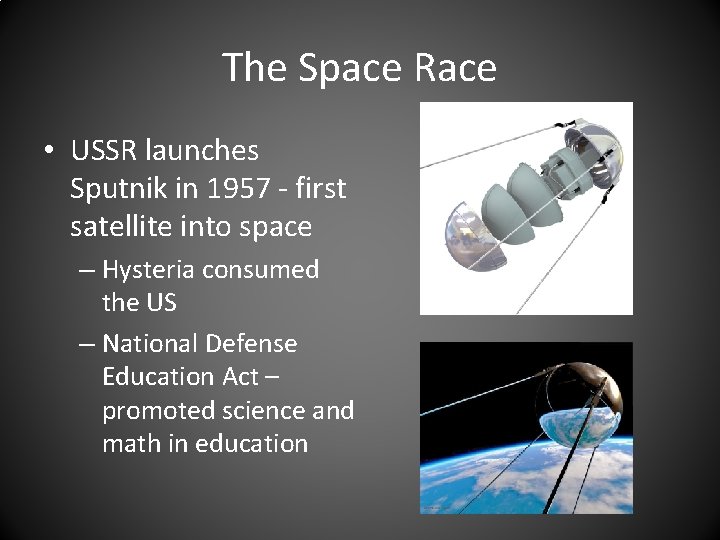
The Space Race • USSR launches Sputnik in 1957 - first satellite into space – Hysteria consumed the US – National Defense Education Act – promoted science and math in education
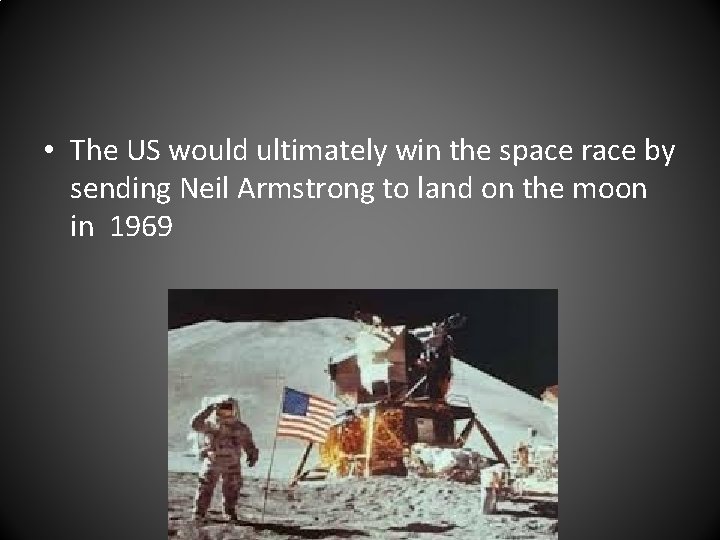
• The US would ultimately win the space race by sending Neil Armstrong to land on the moon in 1969
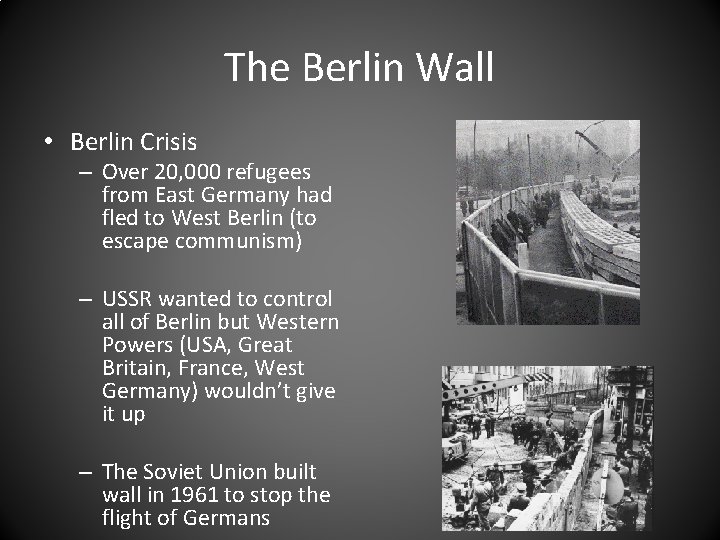
The Berlin Wall • Berlin Crisis – Over 20, 000 refugees from East Germany had fled to West Berlin (to escape communism) – USSR wanted to control all of Berlin but Western Powers (USA, Great Britain, France, West Germany) wouldn’t give it up – The Soviet Union built wall in 1961 to stop the flight of Germans
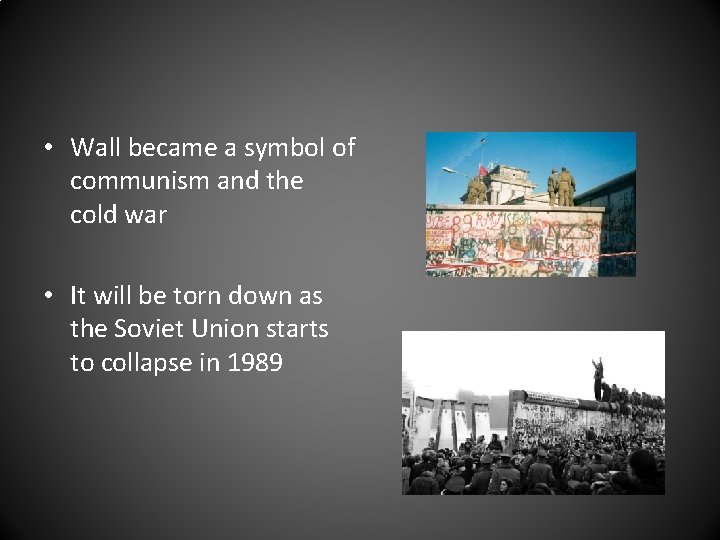
• Wall became a symbol of communism and the cold war • It will be torn down as the Soviet Union starts to collapse in 1989
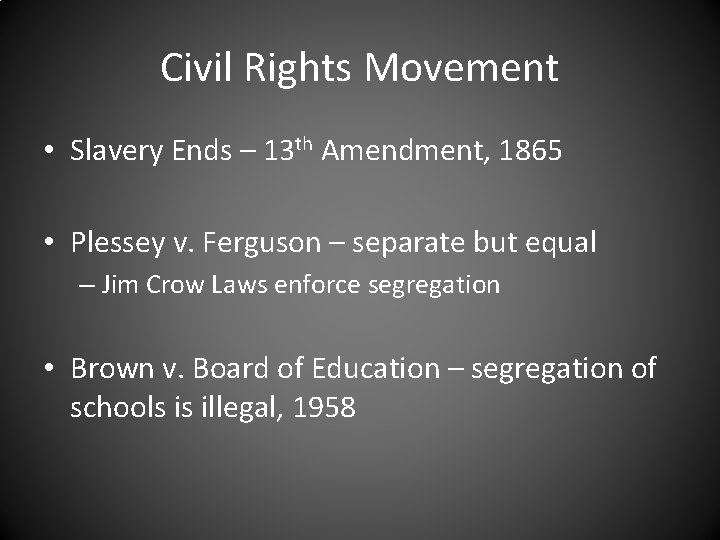
Civil Rights Movement • Slavery Ends – 13 th Amendment, 1865 • Plessey v. Ferguson – separate but equal – Jim Crow Laws enforce segregation • Brown v. Board of Education – segregation of schools is illegal, 1958
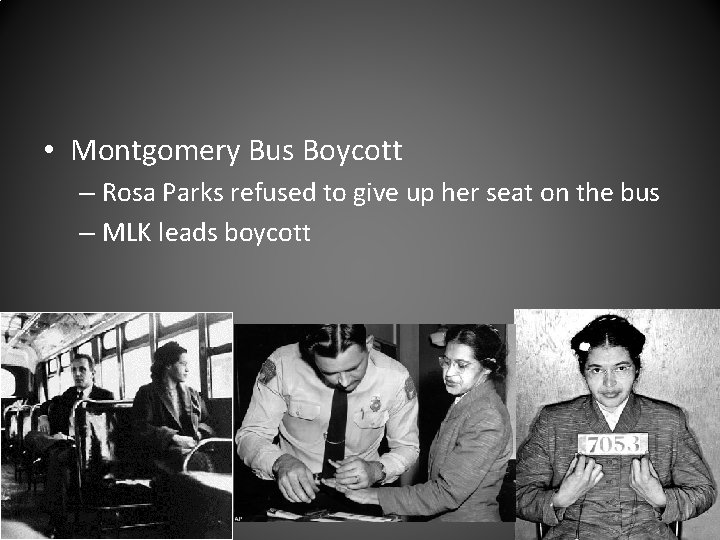
• Montgomery Bus Boycott – Rosa Parks refused to give up her seat on the bus – MLK leads boycott
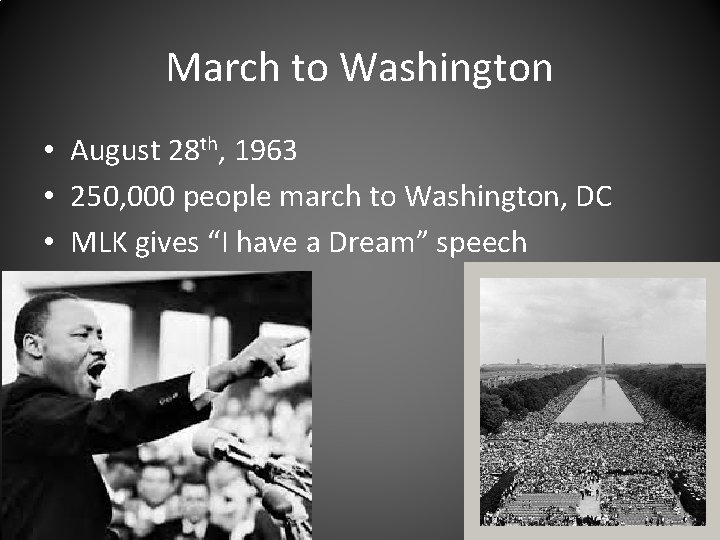
March to Washington • August 28 th, 1963 • 250, 000 people march to Washington, DC • MLK gives “I have a Dream” speech
The Home Front during the Cold War • Red Scare – fear of communism spreading in the US – 80, 000 US citizens were registered as communist part members out of a population of 152, 271, 417 (less than 1% of the US) • Mc. Carthyism – Senator Joseph Mc. Carthy – Accused 205 members of US Government of being communist, but listed no names – Unfairly accused people of disloyalty
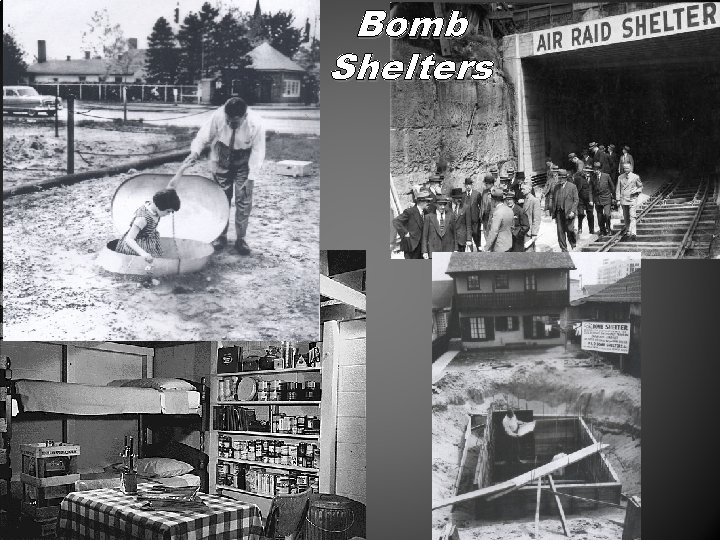
Bomb Shelters
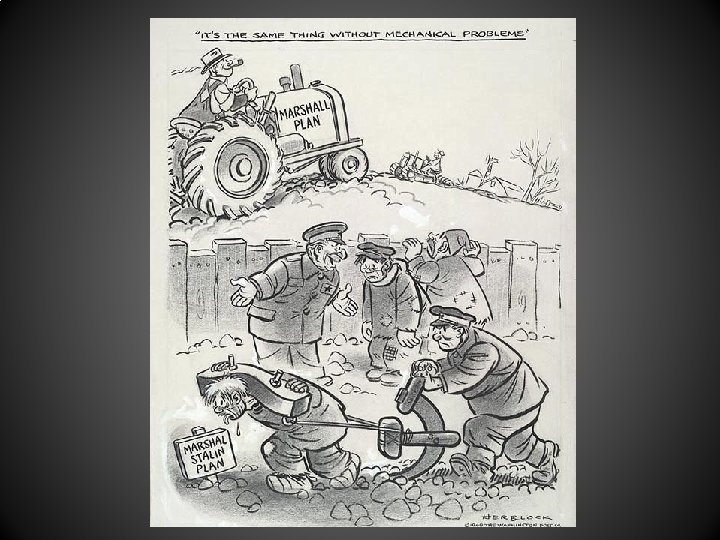
Truman Administration • Containment Policy – Goal contain the spread of Communism – Aid weak European countries against communism – Was a response to USSR’s building of satellite nations • Truman Doctrine – Sent money to Turkey and Greece to fend off communism – Both nations had totalitarian dictators • Marshall Plan – Provide aid to rebuild Europe after WW 2 – By 1952, communism had lost favor in Western Europe
Eisenhower Administration • Continues US involvement in Vietnam War (supports French forces, US not officially in war yet) • U-2 incident – US Spy plane shot down over USSR, pilot was captured – Embarrassment for the US • Federal Highway Act 1956 – US builds interstate highway system
JFK Administration • Sent more troops (advisors) and supplies to Vietnam • The Bay of Pigs – JFK approves a CIA mission to use Cuban refugees to overthrow Fidel Castro – Cuba was Communist – Invasion did not get full US military support and failed
LBJ’s Administration • Vietnam War – Sent first US ground troops • 6 Days War – Israel vs. Syria and Egypt – USSR backs Arabs, US backs Israel – Israel wins • The Great Society – Goal to end inequality and poverty – Medicare and Medicaid founded
The Nixon Administration • Vietnam War - Vietnamization the gradual withdrawal of troops • Policy of détente - realpolitik ”realistic politics” - easing of Cold War tension from late 60’s to 1980 - more flexible less hostile approach to dealing with communism
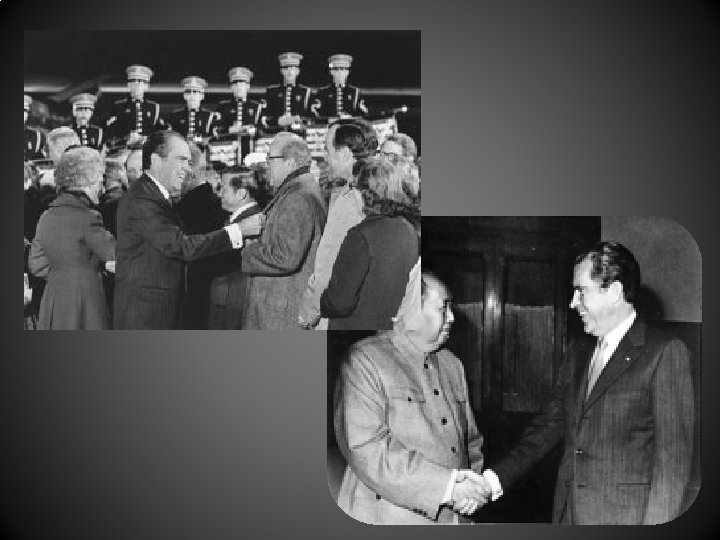
Nixon’s Administration • Rapprochement with China - attempt to drive a wedge between USSR & China - Nixon’s attempt to divide communist block - isolate North Vietnam • Visit to Moscow - SALT Treaty I (Strategic Arms Limitation Talks) - negotiation limiting # and type of nuclear arms b/t US and USSR
Ford’s Administration • Continued negotiations with China & USSR • Ford pardons Nixon so country could move on and focus on international issues • OPEC (Organization of Petroleum Exporting Countries) 1973 - used oil as a means to control international politics - mostly Arabs countries opposed Israel - embargoed oil shipments to U. S.
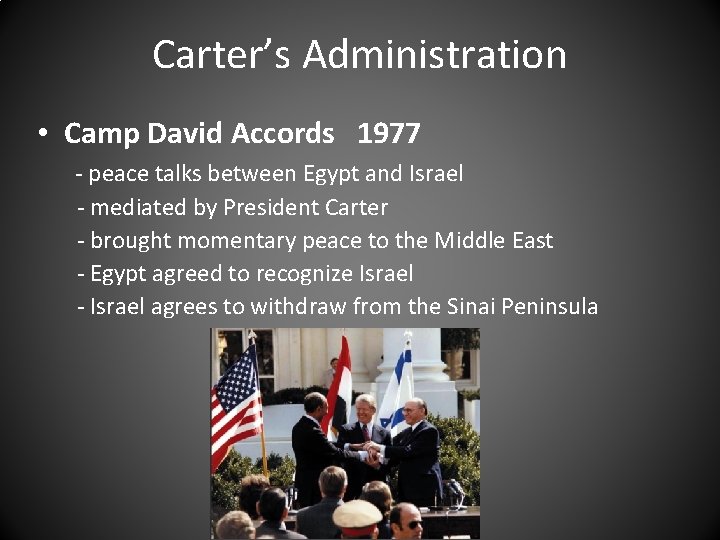
Carter’s Administration • Camp David Accords 1977 - peace talks between Egypt and Israel - mediated by President Carter - brought momentary peace to the Middle East - Egypt agreed to recognize Israel - Israel agrees to withdraw from the Sinai Peninsula
Carter’s Administration 1950‘s U. S. helped bring Shah of Iran to power Shah supported U. S. interest in Middle East Religious fundamentalism challenged Shah Called for return to Islam and ending cooperation with the U. S • Shah was overthrown and dictatorship established • Iran Hostage Crisis 1979 • • - U. S. embassy invaded - taken over by Islamist students - 53 Americans taken hostage by Iran - held hostage for 444 days
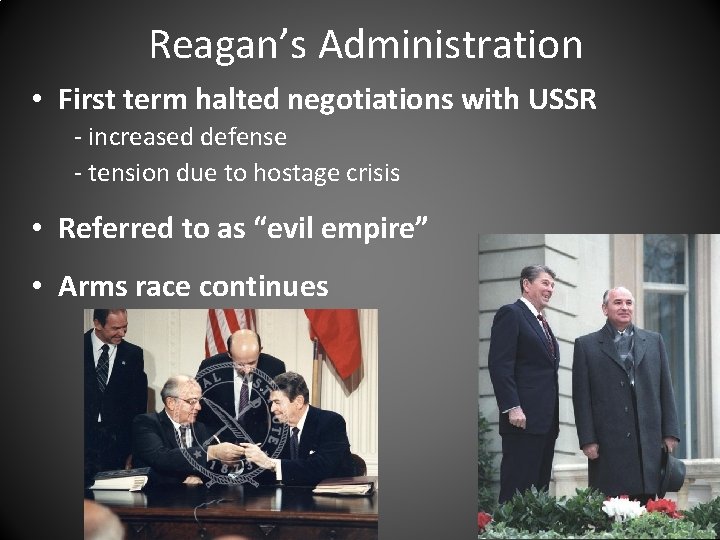
Reagan’s Administration • First term halted negotiations with USSR - increased defense - tension due to hostage crisis • Referred to as “evil empire” • Arms race continues
Reagan’s Administration • Gorbachev new Soviet leader (in 1985) – Glasnost – Perestroika • Reagan soften position - signed INF in 1987 - Intermediate-Range Nuclear Forces Treaty • Berlin Wall falls - Nov. 9, 1989 is brought down
The Cold War Ends • 1989 – The Berlin Wall Falls, Germany unifies in 1990 • 1991 – Soviet Unions economy starts to collapse as a result of the ongoing Arms/Space Race with the US – Democratic reforms are put into place in the Soviet Union – 14 non-Russian republics declare independence from the Soviet Union • 1992 – Formal statement between the US and the new nation of Russia formally ends the cold war.