
THE COLD WAR Superpowers o After WWII there
- Slides: 42
THE COLD WAR
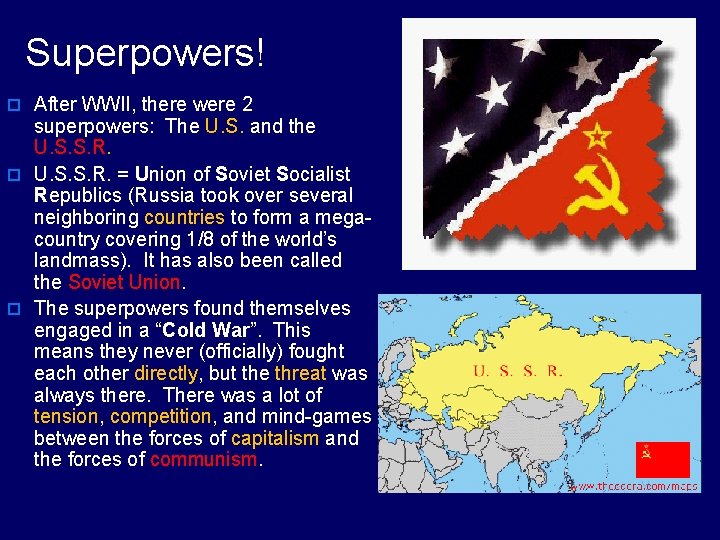
Superpowers! o After WWII, there were 2 superpowers: The U. S. and the U. S. S. R. o U. S. S. R. = Union of Soviet Socialist Republics (Russia took over several neighboring countries to form a megacountry covering 1/8 of the world’s landmass). It has also been called the Soviet Union. o The superpowers found themselves engaged in a “Cold War”. This means they never (officially) fought each other directly, but the threat was always there. There was a lot of tension, competition, and mind-games between the forces of capitalism and the forces of communism.
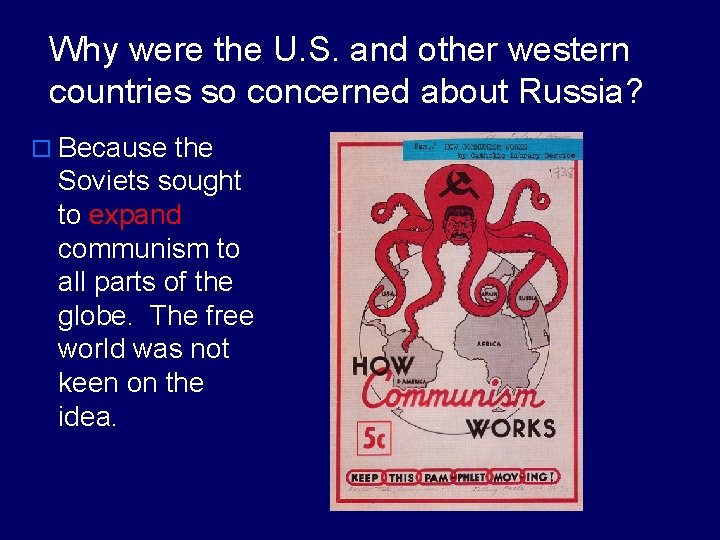
Why were the U. S. and other western countries so concerned about Russia? o Because the Soviets sought to expand communism to all parts of the globe. The free world was not keen on the idea.
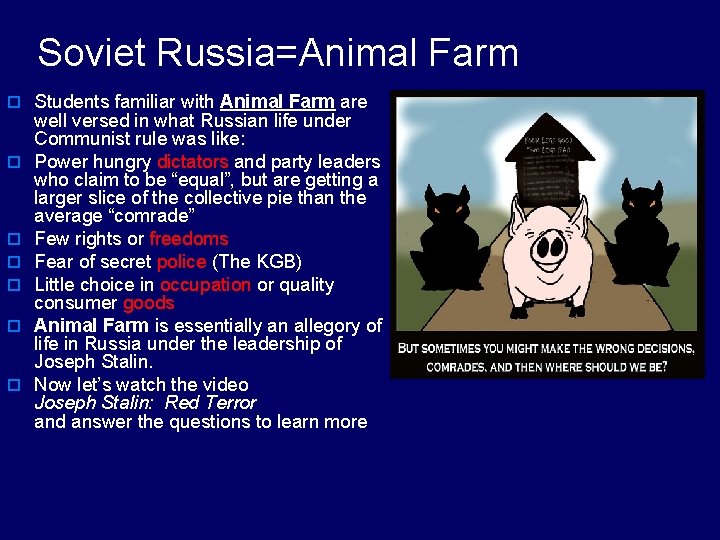
Soviet Russia=Animal Farm o Students familiar with Animal Farm are o o o well versed in what Russian life under Communist rule was like: Power hungry dictators and party leaders who claim to be “equal”, but are getting a larger slice of the collective pie than the average “comrade” Few rights or freedoms Fear of secret police (The KGB) Little choice in occupation or quality consumer goods Animal Farm is essentially an allegory of life in Russia under the leadership of Joseph Stalin. Now let’s watch the video Joseph Stalin: Red Terror and answer the questions to learn more
Recap o Having watched the video, see if you can identify the following: o Collectivizationo Purgeso Gulagso KGB-
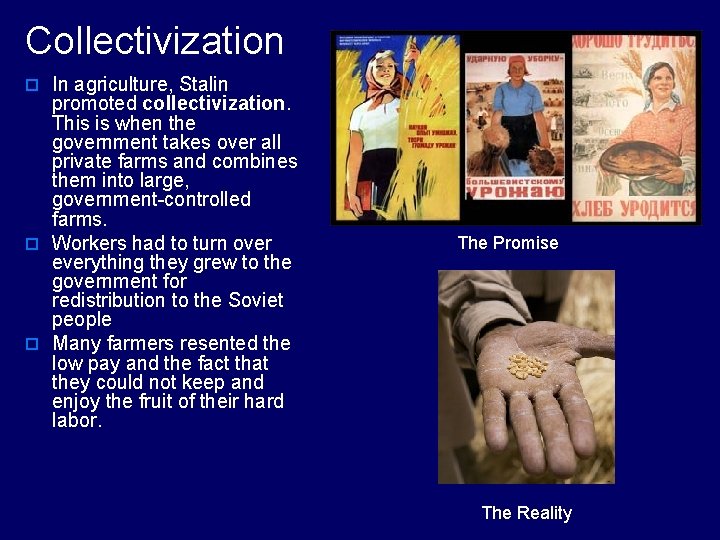
Collectivization o In agriculture, Stalin promoted collectivization. This is when the government takes over all private farms and combines them into large, government-controlled farms. o Workers had to turn over everything they grew to the government for redistribution to the Soviet people o Many farmers resented the low pay and the fact that they could not keep and enjoy the fruit of their hard labor. The Promise The Reality
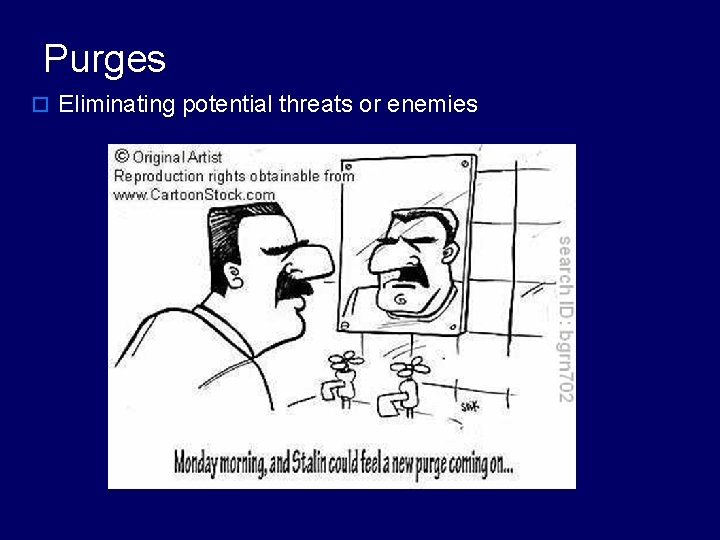
Purges o Eliminating potential threats or enemies
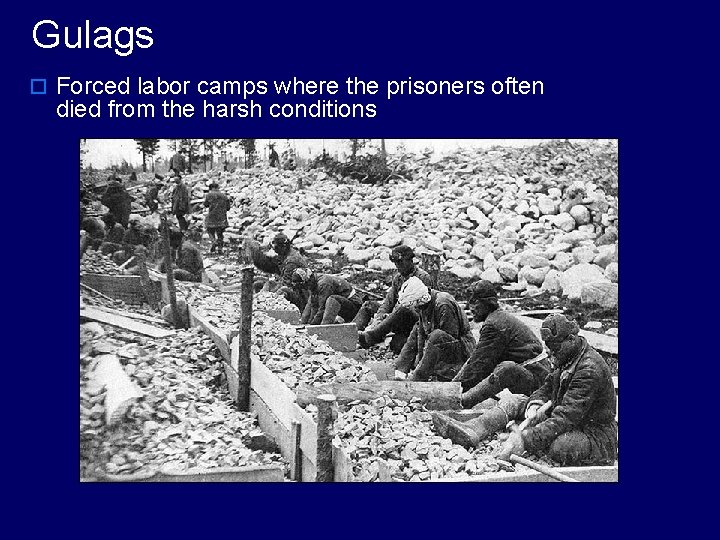
Gulags o Forced labor camps where the prisoners often died from the harsh conditions
KGB o Soviet secret police
Stalin Quiz 1. Stalin became the leader of the USSR after whose death? 2. Name Stalin’s biggest political rival (who he eventually had killed in Mexico) 3. Where did Stalin send people into exile? 4. 5. 6. 7. 8. 9. 10. Collectivization had to do with the government taking control of all of Russia’s _______ How many Ukrainians starved to death for resisting Stalin’s changes? What were gulags? What were purges? Why couldn’t Russia’s military deal with the German invasion very well initially during WWII? The name “Stalin” actually means “Man of ______” Who did Stalin think was out to poison him?
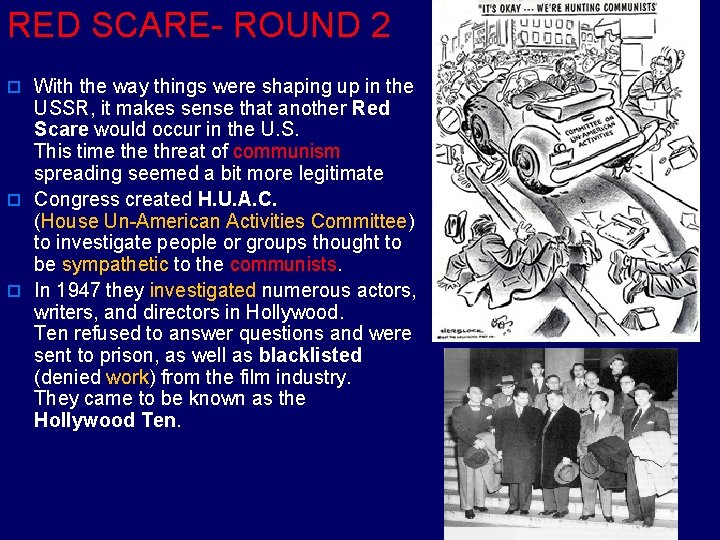
RED SCARE- ROUND 2 o With the way things were shaping up in the USSR, it makes sense that another Red Scare would occur in the U. S. This time threat of communism spreading seemed a bit more legitimate o Congress created H. U. A. C. (House Un-American Activities Committee) to investigate people or groups thought to be sympathetic to the communists. o In 1947 they investigated numerous actors, writers, and directors in Hollywood. Ten refused to answer questions and were sent to prison, as well as blacklisted (denied work) from the film industry. They came to be known as the Hollywood Ten.
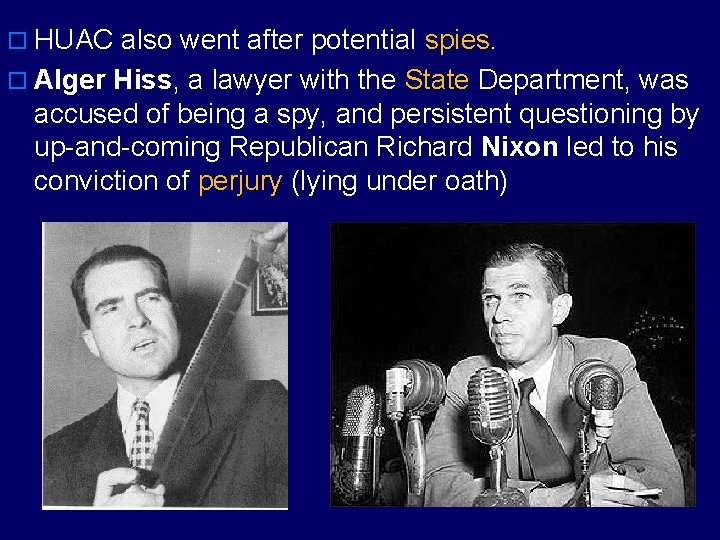
o HUAC also went after potential spies. o Alger Hiss, a lawyer with the State Department, was accused of being a spy, and persistent questioning by up-and-coming Republican Richard Nixon led to his conviction of perjury (lying under oath)
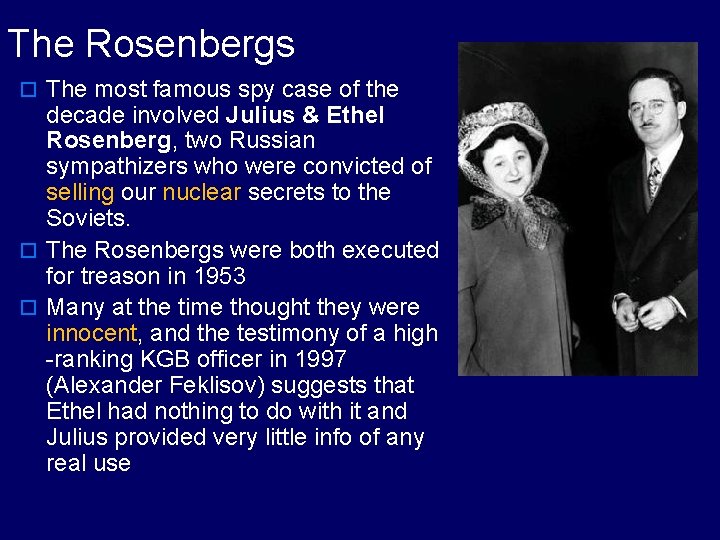
The Rosenbergs o The most famous spy case of the decade involved Julius & Ethel Rosenberg, two Russian sympathizers who were convicted of selling our nuclear secrets to the Soviets. o The Rosenbergs were both executed for treason in 1953 o Many at the time thought they were innocent, and the testimony of a high -ranking KGB officer in 1997 (Alexander Feklisov) suggests that Ethel had nothing to do with it and Julius provided very little info of any real use
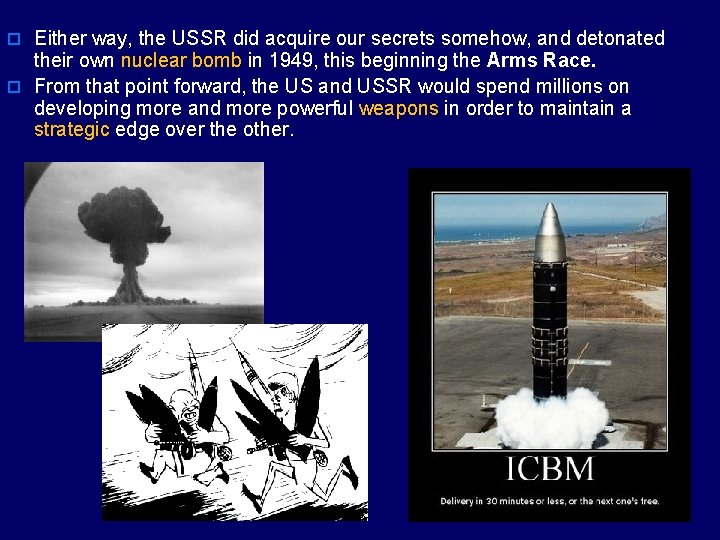
o Either way, the USSR did acquire our secrets somehow, and detonated their own nuclear bomb in 1949, this beginning the Arms Race. o From that point forward, the US and USSR would spend millions on developing more and more powerful weapons in order to maintain a strategic edge over the other.
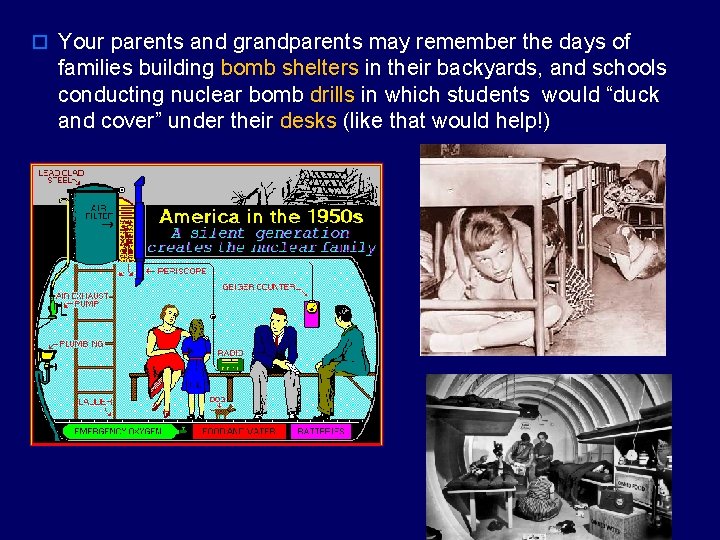
o Your parents and grandparents may remember the days of families building bomb shelters in their backyards, and schools conducting nuclear bomb drills in which students would “duck and cover” under their desks (like that would help!)
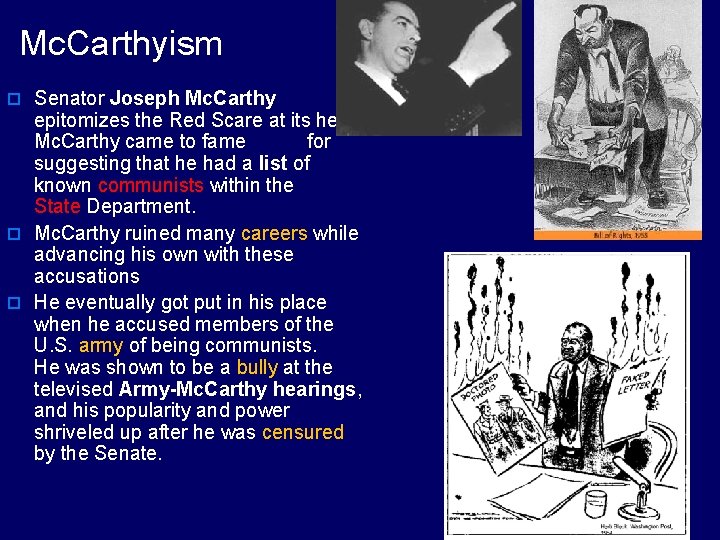
Mc. Carthyism o Senator Joseph Mc. Carthy epitomizes the Red Scare at its height. Mc. Carthy came to fame for suggesting that he had a list of known communists within the State Department. o Mc. Carthy ruined many careers while advancing his own with these accusations o He eventually got put in his place when he accused members of the U. S. army of being communists. He was shown to be a bully at the televised Army-Mc. Carthy hearings, and his popularity and power shriveled up after he was censured by the Senate.
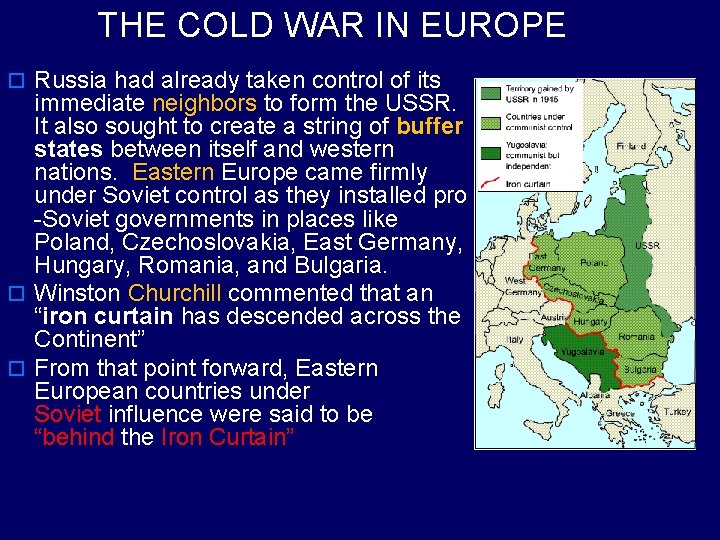
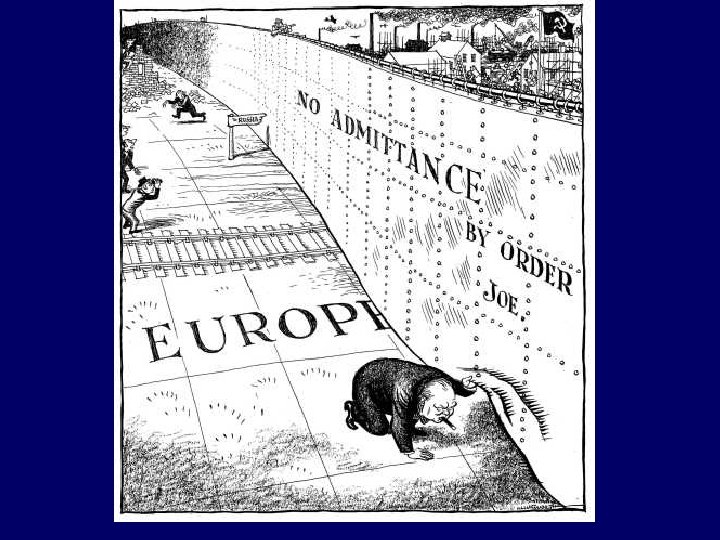
THE COLD WAR IN EUROPE o Russia had already taken control of its immediate neighbors to form the USSR. It also sought to create a string of buffer states between itself and western nations. Eastern Europe came firmly under Soviet control as they installed pro -Soviet governments in places like Poland, Czechoslovakia, East Germany, Hungary, Romania, and Bulgaria. o Winston Churchill commented that an “iron curtain has descended across the Continent” o From that point forward, Eastern European countries under Soviet influence were said to be “behind the Iron Curtain”
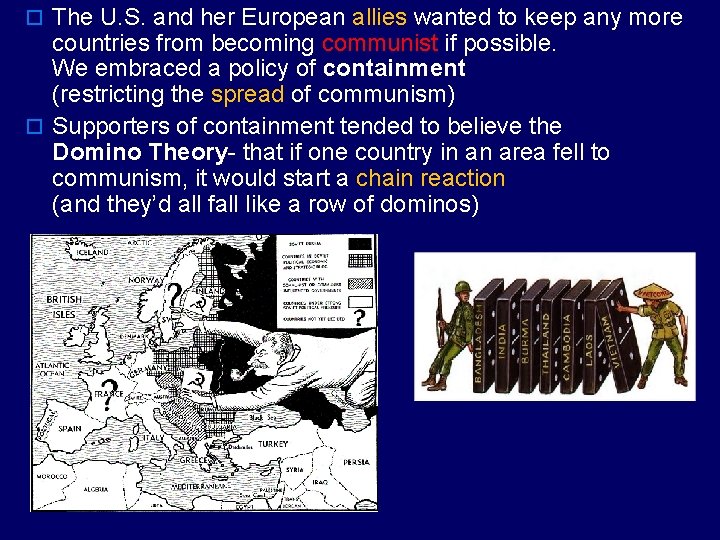
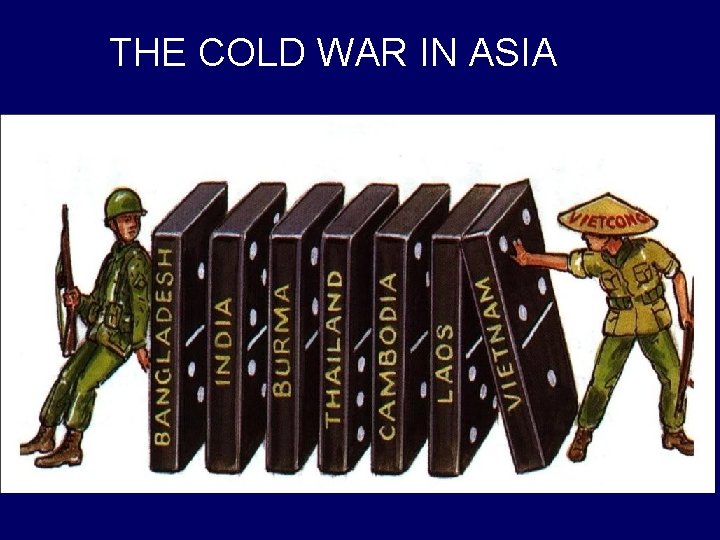
o The U. S. and her European allies wanted to keep any more countries from becoming communist if possible. We embraced a policy of containment (restricting the spread of communism) o Supporters of containment tended to believe the Domino Theory- that if one country in an area fell to communism, it would start a chain reaction (and they’d all fall like a row of dominos)
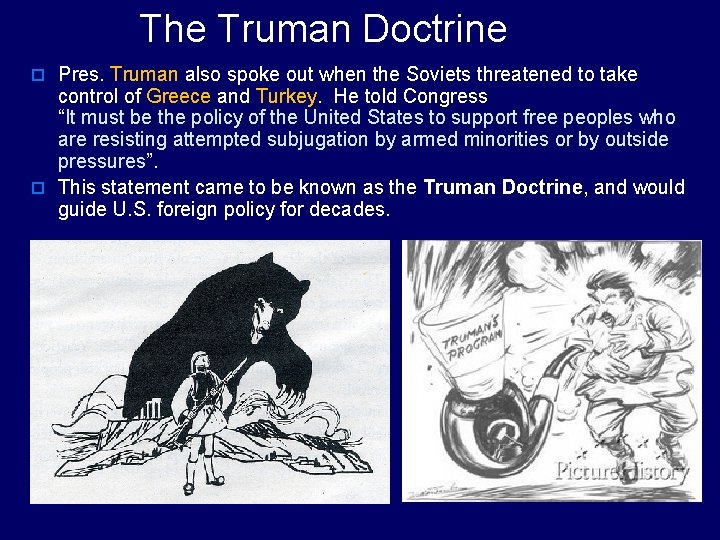
The Truman Doctrine o Pres. Truman also spoke out when the Soviets threatened to take control of Greece and Turkey. He told Congress “It must be the policy of the United States to support free peoples who are resisting attempted subjugation by armed minorities or by outside pressures”. o This statement came to be known as the Truman Doctrine, and would guide U. S. foreign policy for decades.
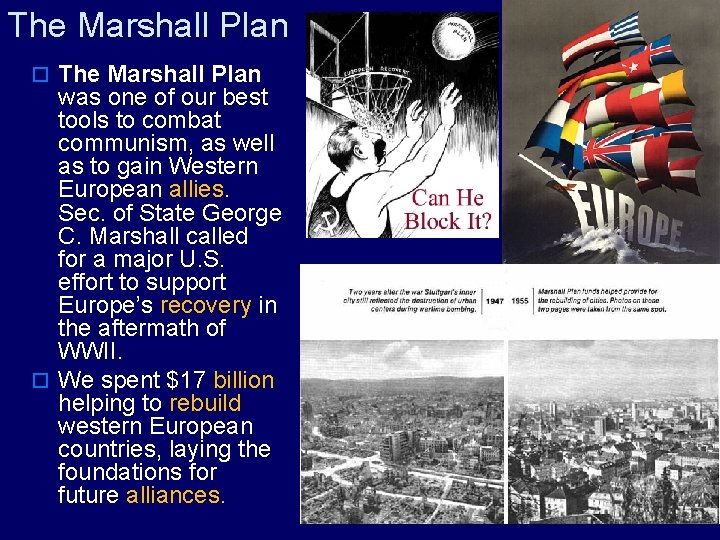
The Marshall Plan o The Marshall Plan was one of our best tools to combat communism, as well as to gain Western European allies. Sec. of State George C. Marshall called for a major U. S. effort to support Europe’s recovery in the aftermath of WWII. o We spent $17 billion helping to rebuild western European countries, laying the foundations for future alliances.
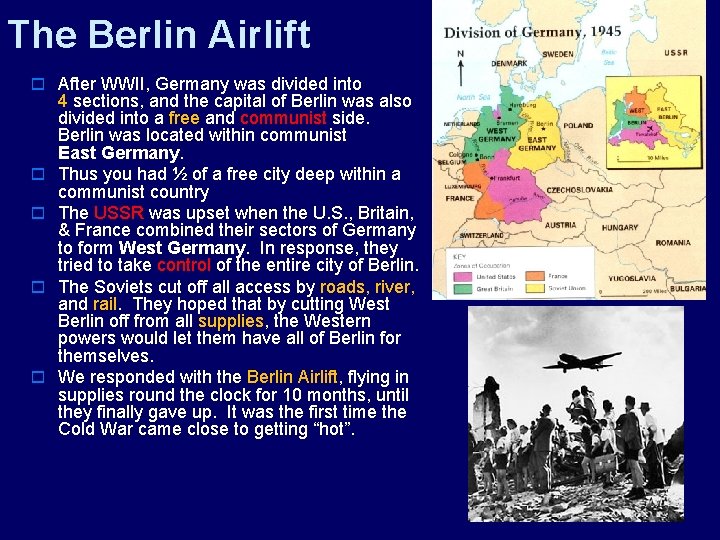
The Berlin Airlift o After WWII, Germany was divided into o o 4 sections, and the capital of Berlin was also divided into a free and communist side. Berlin was located within communist East Germany. Thus you had ½ of a free city deep within a communist country The USSR was upset when the U. S. , Britain, & France combined their sectors of Germany to form West Germany. In response, they tried to take control of the entire city of Berlin. The Soviets cut off all access by roads, river, and rail. They hoped that by cutting West Berlin off from all supplies, the Western powers would let them have all of Berlin for themselves. We responded with the Berlin Airlift, flying in supplies round the clock for 10 months, until they finally gave up. It was the first time the Cold War came close to getting “hot”.
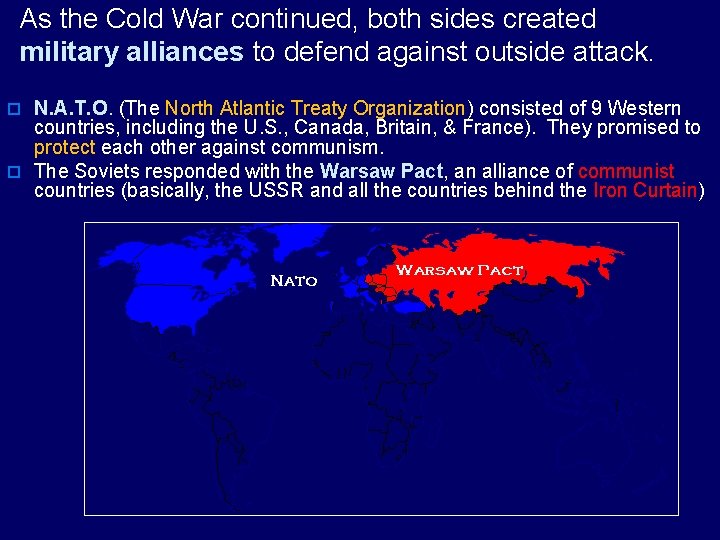
As the Cold War continued, both sides created military alliances to defend against outside attack. o N. A. T. O. (The North Atlantic Treaty Organization) consisted of 9 Western countries, including the U. S. , Canada, Britain, & France). They promised to protect each other against communism. o The Soviets responded with the Warsaw Pact, an alliance of communist countries (basically, the USSR and all the countries behind the Iron Curtain)
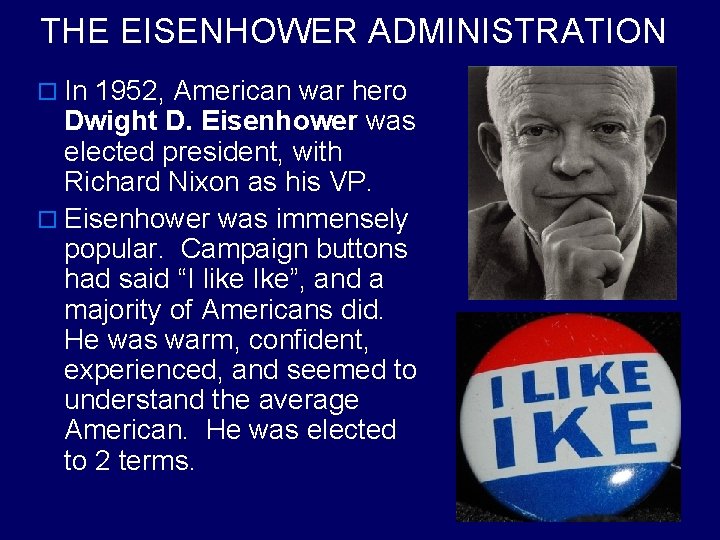
THE EISENHOWER ADMINISTRATION o In 1952, American war hero Dwight D. Eisenhower was elected president, with Richard Nixon as his VP. o Eisenhower was immensely popular. Campaign buttons had said “I like Ike”, and a majority of Americans did. He was warm, confident, experienced, and seemed to understand the average American. He was elected to 2 terms.
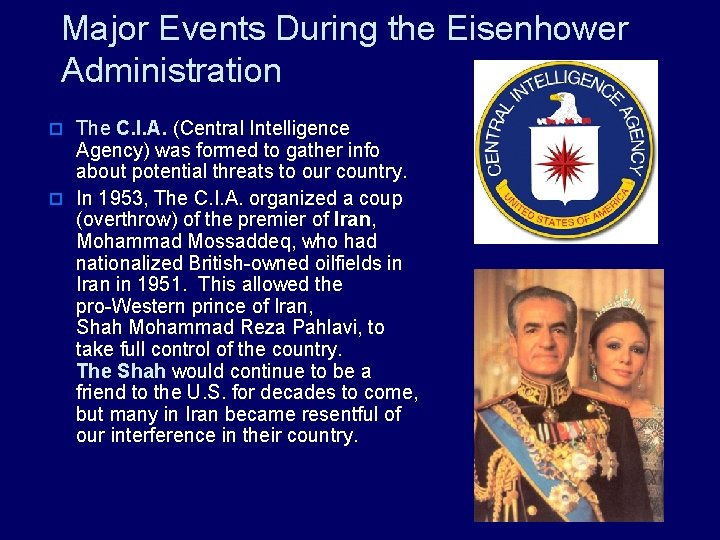
Major Events During the Eisenhower Administration o The C. I. A. (Central Intelligence Agency) was formed to gather info about potential threats to our country. o In 1953, The C. I. A. organized a coup (overthrow) of the premier of Iran, Mohammad Mossaddeq, who had nationalized British-owned oilfields in Iran in 1951. This allowed the pro-Western prince of Iran, Shah Mohammad Reza Pahlavi, to take full control of the country. The Shah would continue to be a friend to the U. S. for decades to come, but many in Iran became resentful of our interference in their country.
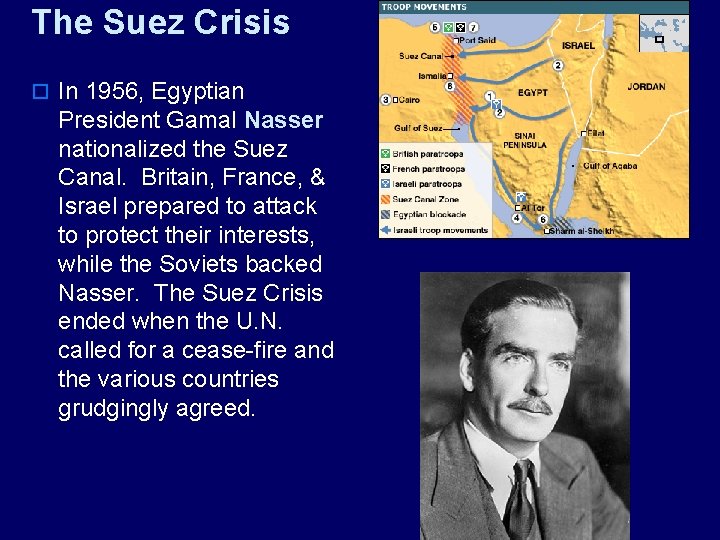
The Suez Crisis o In 1956, Egyptian President Gamal Nasser nationalized the Suez Canal. Britain, France, & Israel prepared to attack to protect their interests, while the Soviets backed Nasser. The Suez Crisis ended when the U. N. called for a cease-fire and the various countries grudgingly agreed.
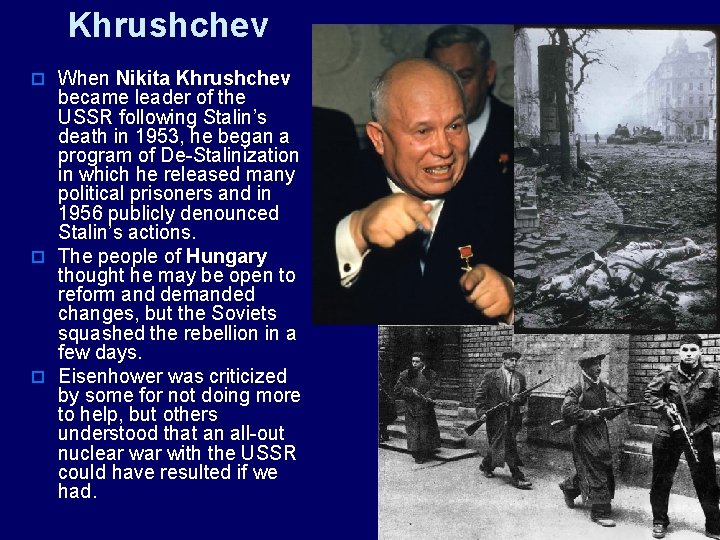
Khrushchev o When Nikita Khrushchev became leader of the USSR following Stalin’s death in 1953, he began a program of De-Stalinization in which he released many political prisoners and in 1956 publicly denounced Stalin’s actions. o The people of Hungary thought he may be open to reform and demanded changes, but the Soviets squashed the rebellion in a few days. o Eisenhower was criticized by some for not doing more to help, but others understood that an all-out nuclear with the USSR could have resulted if we had.
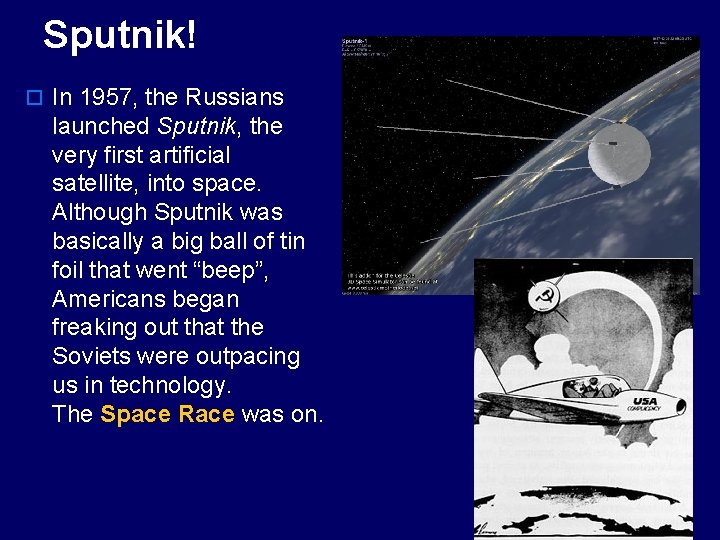
Sputnik! o In 1957, the Russians launched Sputnik, the very first artificial satellite, into space. Although Sputnik was basically a big ball of tin foil that went “beep”, Americans began freaking out that the Soviets were outpacing us in technology. The Space Race was on.
o In response, we created N. A. S. A. (The National Aeronautics & Space Administration) and began spending a lot more money to promote math & science in our schools.
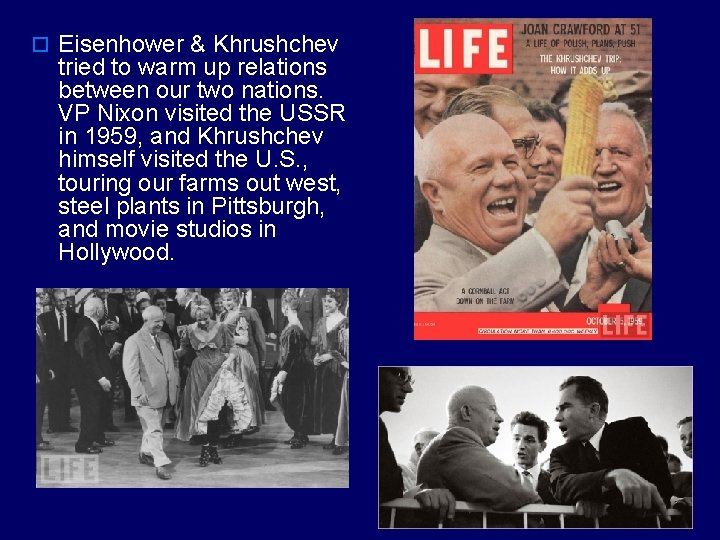
o Eisenhower & Khrushchev tried to warm up relations between our two nations. VP Nixon visited the USSR in 1959, and Khrushchev himself visited the U. S. , touring our farms out west, steel plants in Pittsburgh, and movie studios in Hollywood.
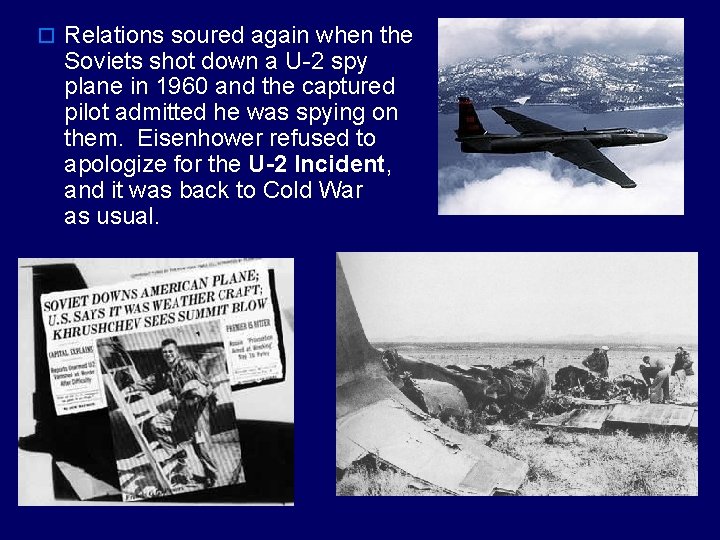
o Relations soured again when the Soviets shot down a U-2 spy plane in 1960 and the captured pilot admitted he was spying on them. Eisenhower refused to apologize for the U-2 Incident, and it was back to Cold War as usual.
THE COLD WAR IN ASIA
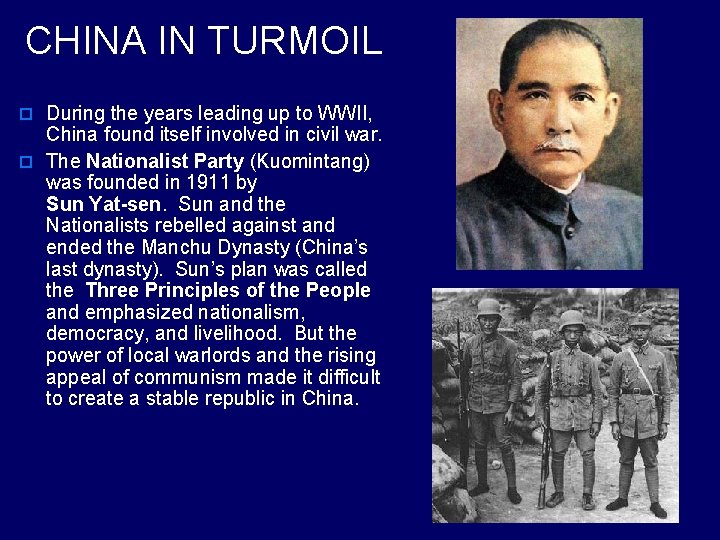
CHINA IN TURMOIL o During the years leading up to WWII, China found itself involved in civil war. o The Nationalist Party (Kuomintang) was founded in 1911 by Sun Yat-sen. Sun and the Nationalists rebelled against and ended the Manchu Dynasty (China’s last dynasty). Sun’s plan was called the Three Principles of the People and emphasized nationalism, democracy, and livelihood. But the power of local warlords and the rising appeal of communism made it difficult to create a stable republic in China.
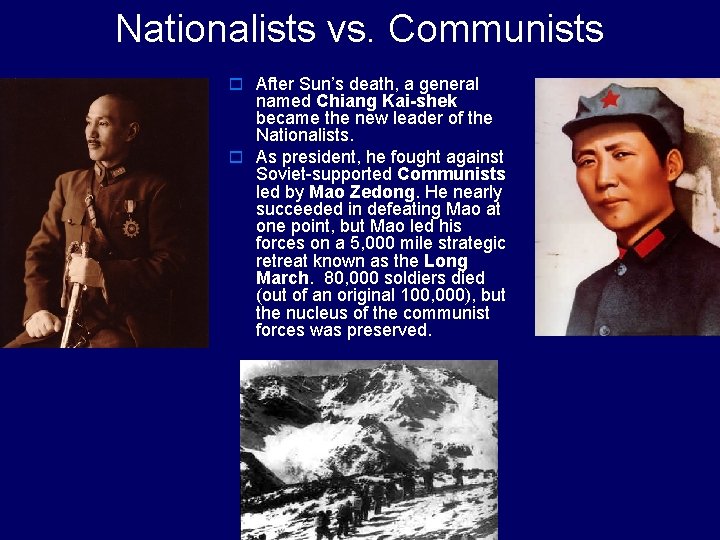
Nationalists vs. Communists o After Sun’s death, a general named Chiang Kai-shek became the new leader of the Nationalists. o As president, he fought against Soviet-supported Communists led by Mao Zedong. He nearly succeeded in defeating Mao at one point, but Mao led his forces on a 5, 000 mile strategic retreat known as the Long March. 80, 000 soldiers died (out of an original 100, 000), but the nucleus of the communist forces was preserved.
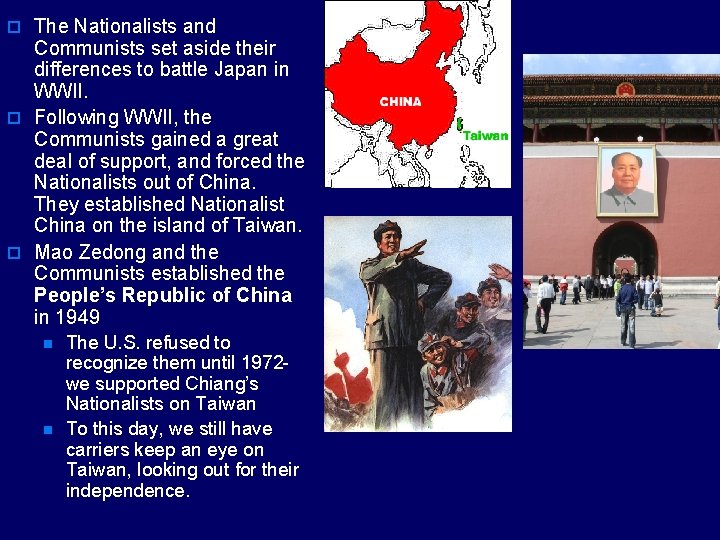
o The Nationalists and Communists set aside their differences to battle Japan in WWII. o Following WWII, the Communists gained a great deal of support, and forced the Nationalists out of China. They established Nationalist China on the island of Taiwan. o Mao Zedong and the Communists established the People’s Republic of China in 1949 n n The U. S. refused to recognize them until 1972 we supported Chiang’s Nationalists on Taiwan To this day, we still have carriers keep an eye on Taiwan, looking out for their independence.
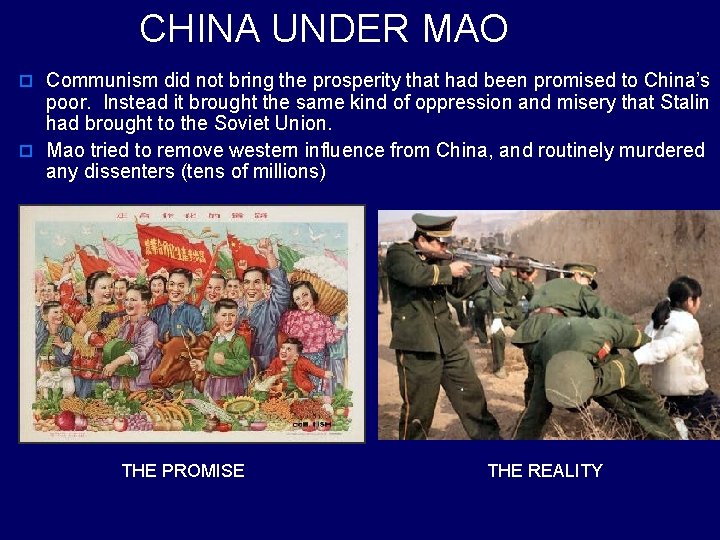
CHINA UNDER MAO o Communism did not bring the prosperity that had been promised to China’s poor. Instead it brought the same kind of oppression and misery that Stalin had brought to the Soviet Union. o Mao tried to remove western influence from China, and routinely murdered any dissenters (tens of millions) THE PROMISE THE REALITY
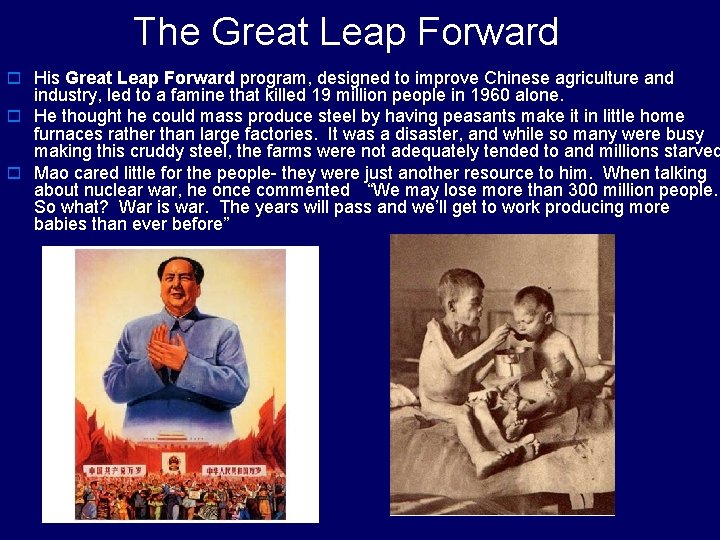
The Great Leap Forward o His Great Leap Forward program, designed to improve Chinese agriculture and industry, led to a famine that killed 19 million people in 1960 alone. o He thought he could mass produce steel by having peasants make it in little home furnaces rather than large factories. It was a disaster, and while so many were busy making this cruddy steel, the farms were not adequately tended to and millions starved o Mao cared little for the people- they were just another resource to him. When talking about nuclear war, he once commented “We may lose more than 300 million people. So what? War is war. The years will pass and we’ll get to work producing more babies than ever before”
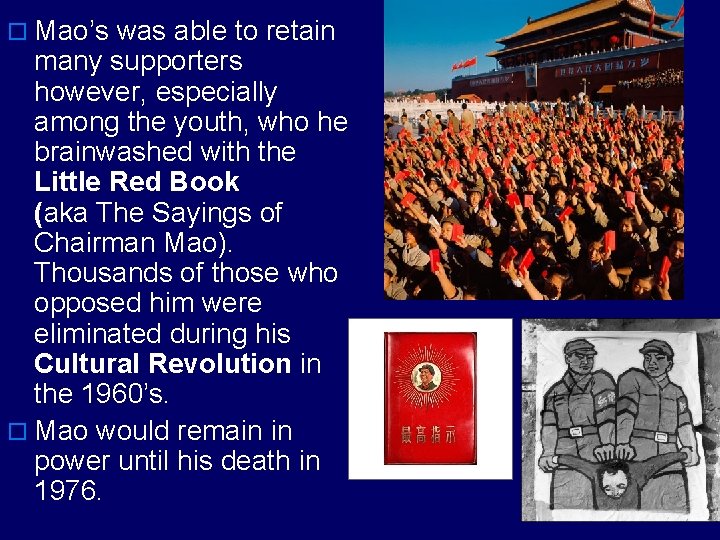
o Mao’s was able to retain many supporters however, especially among the youth, who he brainwashed with the Little Red Book (aka The Sayings of Chairman Mao). Thousands of those who opposed him were eliminated during his Cultural Revolution in the 1960’s. o Mao would remain in power until his death in 1976.
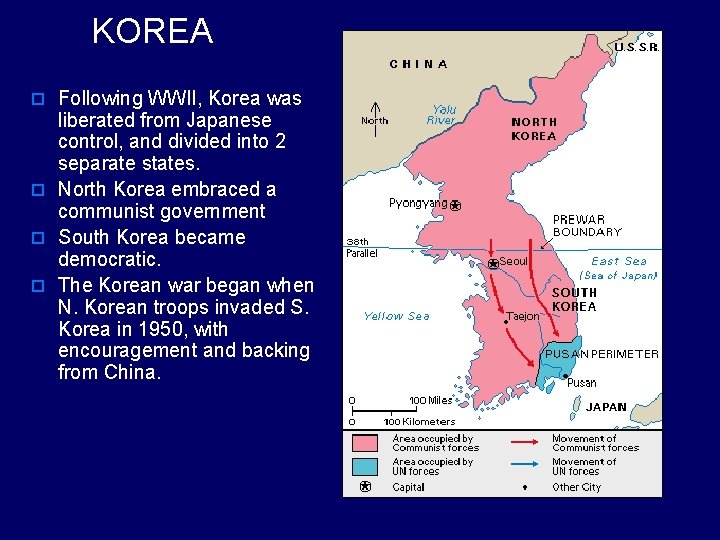
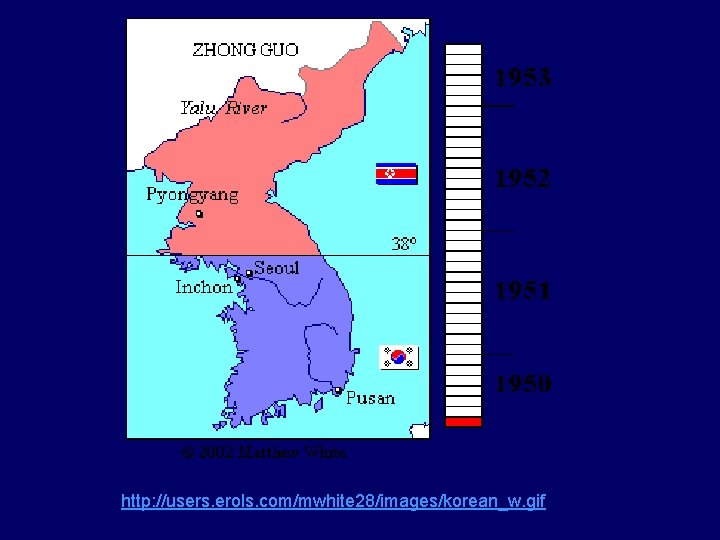
KOREA o Following WWII, Korea was liberated from Japanese control, and divided into 2 separate states. o North Korea embraced a communist government o South Korea became democratic. o The Korean war began when N. Korean troops invaded S. Korea in 1950, with encouragement and backing from China.
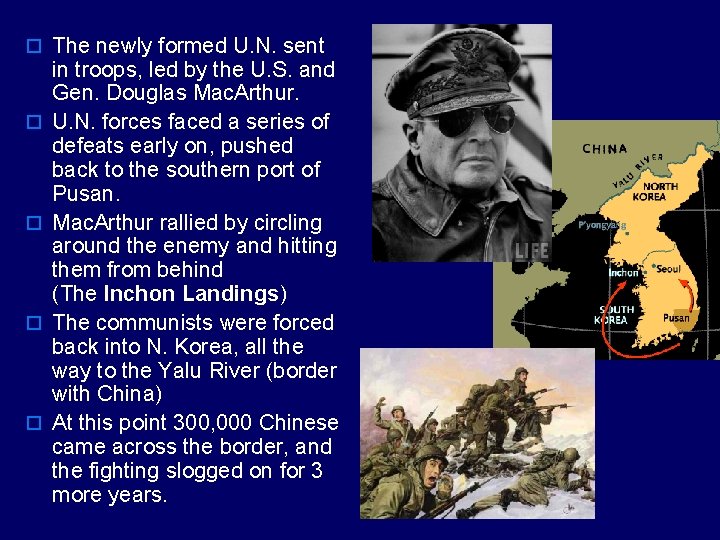
o The newly formed U. N. sent o o in troops, led by the U. S. and Gen. Douglas Mac. Arthur. U. N. forces faced a series of defeats early on, pushed back to the southern port of Pusan. Mac. Arthur rallied by circling around the enemy and hitting them from behind (The Inchon Landings) The communists were forced back into N. Korea, all the way to the Yalu River (border with China) At this point 300, 000 Chinese came across the border, and the fighting slogged on for 3 more years.
http: //users. erols. com/mwhite 28/images/korean_w. gif
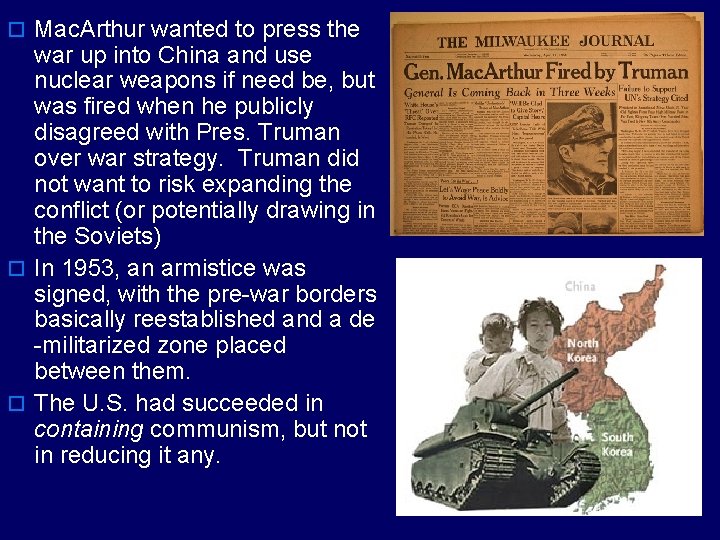
o Mac. Arthur wanted to press the war up into China and use nuclear weapons if need be, but was fired when he publicly disagreed with Pres. Truman over war strategy. Truman did not want to risk expanding the conflict (or potentially drawing in the Soviets) o In 1953, an armistice was signed, with the pre-war borders basically reestablished and a de -militarized zone placed between them. o The U. S. had succeeded in containing communism, but not in reducing it any.