
THE COLD WAR POST WWII WORLD RELATIONS The
- Slides: 37
THE COLD WAR & POST WWII WORLD RELATIONS The Onset from 1945 -1950
II. Two Major Meetings to decide the Postwar Setup of the World Yalta & Potsdam
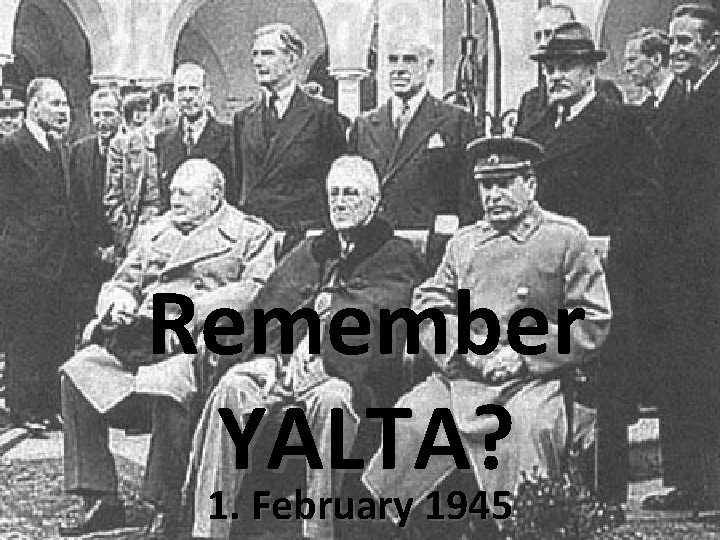
Remember YALTA? 1. February 1945
***The Yalta Conference was seen as the beginning of the Cold War. • FDR (US), Churchill (GB), and Stalin (Russia) meet on the Crimean southern border of the Black Sea Feb. 4 -11, 1945. ***At this time, Stalin now has control of the largest army in Europe (12 million soldiers)
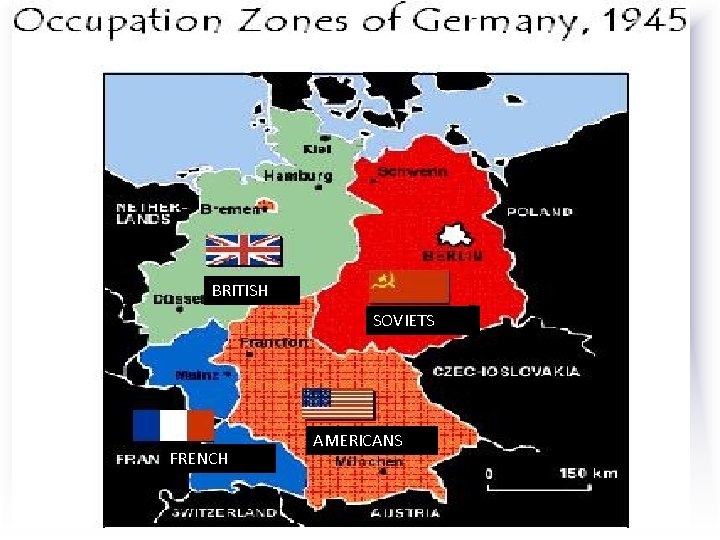
MAJOR POINTS of YALTA a. Germany would be divided into U. S. , British, French, and Soviet occupation zones b. Berlin, although in the quadrant controlled by the Soviets, would also be divided among the four. c. Discussion of how to reorganize Poland came up, but US and GB let the Soviet occupation continue in the hopes of retaining Soviet alliance(more appeasement!!). He did however, promise to be fair with elections in Poland.
BRITISH SOVIETS FRENCH AMERICANS
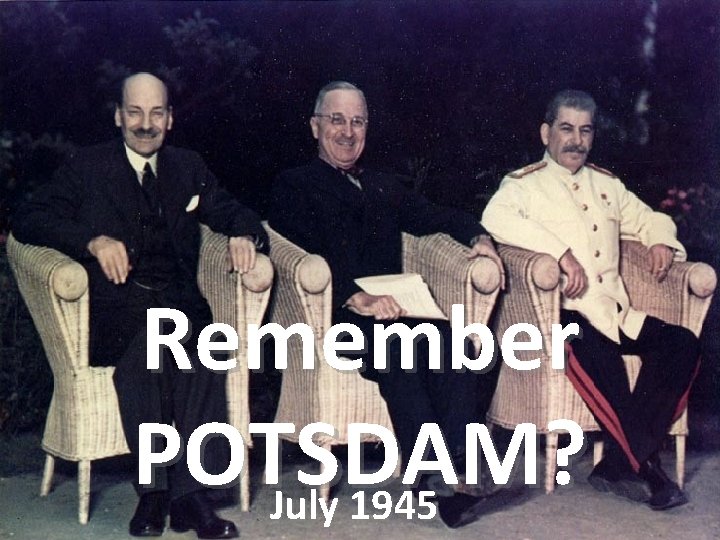
Remember POTSDAM? July 1945
2. July 16 - August 2, 1945 3. Stalin, Truman, and Churchill (who was replaced during the conference by new PM of GB Clement Atlee) meet in Berlin. 4. The “Big Three” finalize the divisions of Germany and Berlin- establish the borders and occupation zones. 5. It also offered an ultimatum to Japansurrender or be annihilated.
(9)THE UNITED NATIONS A Postwar International Peacekeeping Organization 1. August 1945
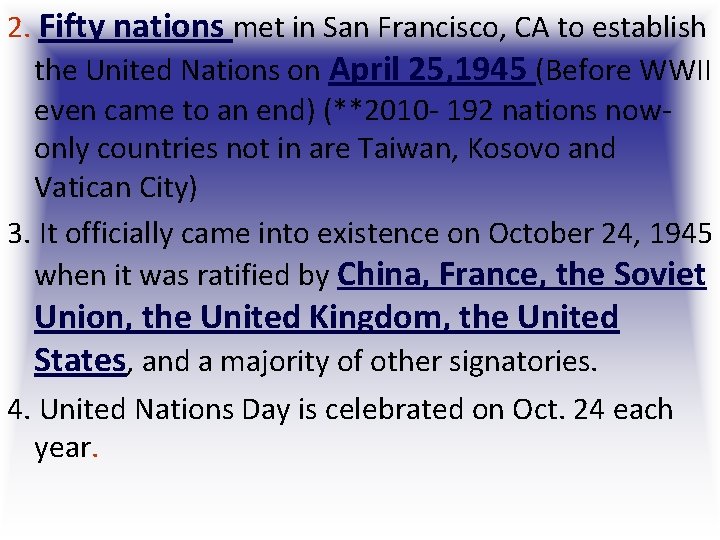
2. Fifty nations met in San Francisco, CA to establish the United Nations on April 25, 1945 (Before WWII even came to an end) (**2010 - 192 nations nowonly countries not in are Taiwan, Kosovo and Vatican City) 3. It officially came into existence on October 24, 1945 when it was ratified by China, France, the Soviet Union, the United Kingdom, the United States, and a majority of other signatories. 4. United Nations Day is celebrated on Oct. 24 each year.
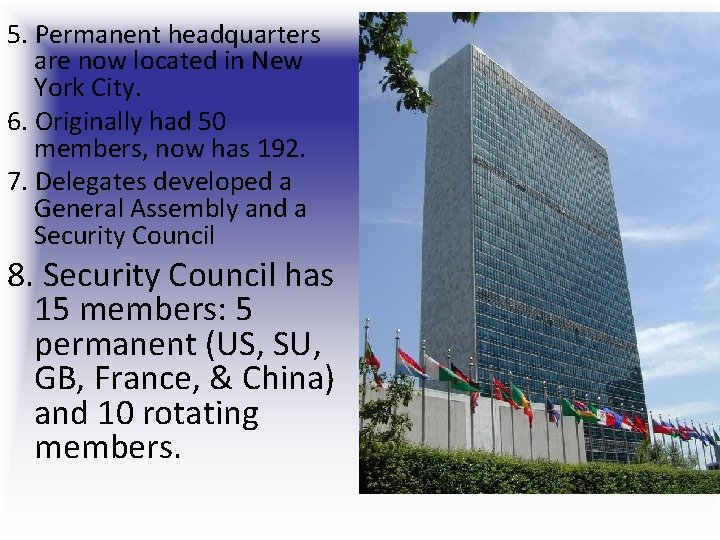
5. Permanent headquarters are now located in New York City. 6. Originally had 50 members, now has 192. 7. Delegates developed a General Assembly and a Security Council 8. Security Council has 15 members: 5 permanent (US, SU, GB, France, & China) and 10 rotating members.
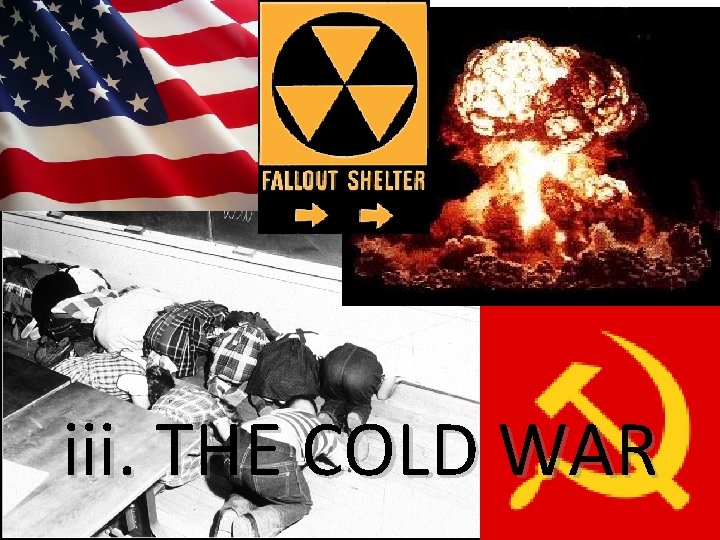
iii. THE COLD WAR
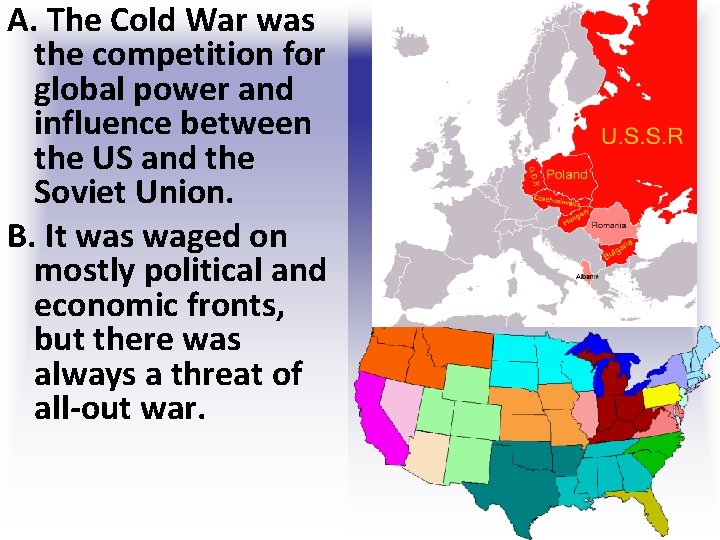
A. The Cold War was the competition for global power and influence between the US and the Soviet Union. B. It was waged on mostly political and economic fronts, but there was always a threat of all-out war.
RELATIONS AFTER WWII 1. US and GB aligned themselves with the Soviet Union during WWII, because of strategic placement to ward of Japan. Although the US and GB had many concerns of the type of rule in the Soviet Union, their lack of economic wealth, military power, and national unity made them a non-threatening ally. 2 However, after WWII, old dissentions over governmental ideals arose and now Soviet Union has military and occupational strength that was not prominent before.
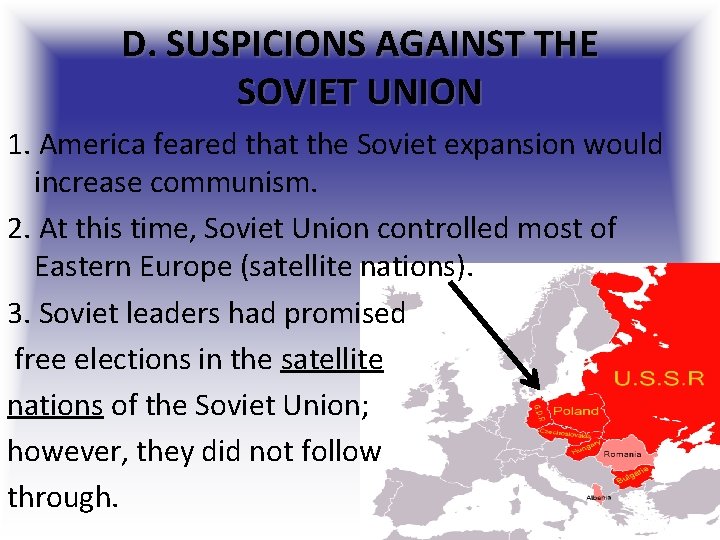
D. SUSPICIONS AGAINST THE SOVIET UNION 1. America feared that the Soviet expansion would increase communism. 2. At this time, Soviet Union controlled most of Eastern Europe (satellite nations). 3. Soviet leaders had promised free elections in the satellite nations of the Soviet Union; however, they did not follow through.
E. STALIN’S SUPPRESSIONS 1. Stalin suppressed elections and held supervised elections in order to receive communist votes. 2. The Soviet Union crushed all opposition in Eastern Europe after 1945. 3. The Communists gained control by promising to abolish poverty, privilege, and private property.
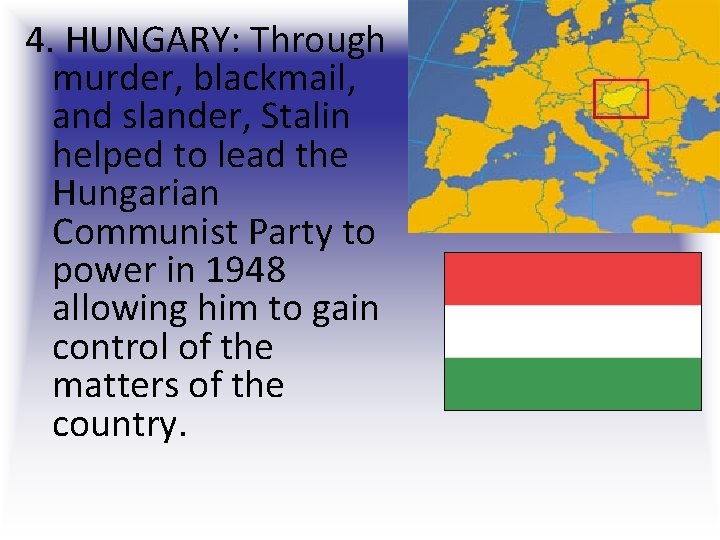
4. HUNGARY: Through murder, blackmail, and slander, Stalin helped to lead the Hungarian Communist Party to power in 1948 allowing him to gain control of the matters of the country.
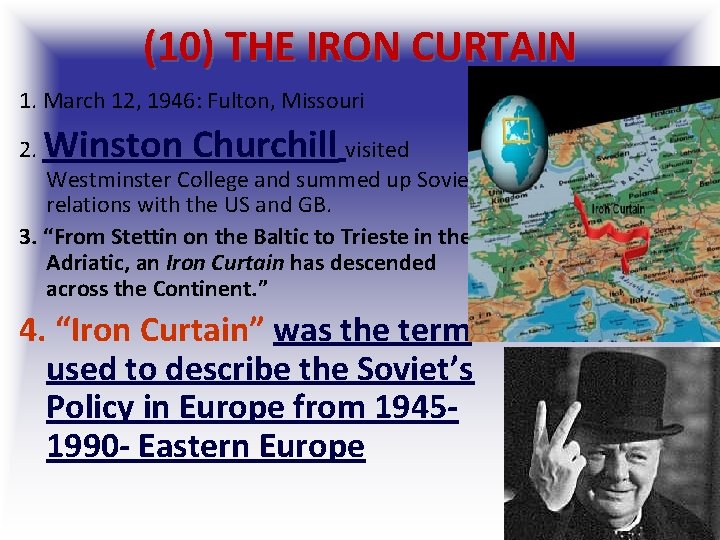
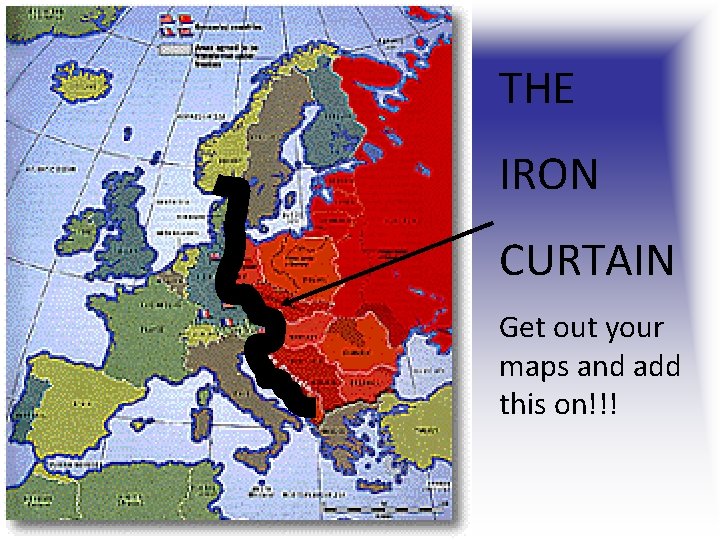
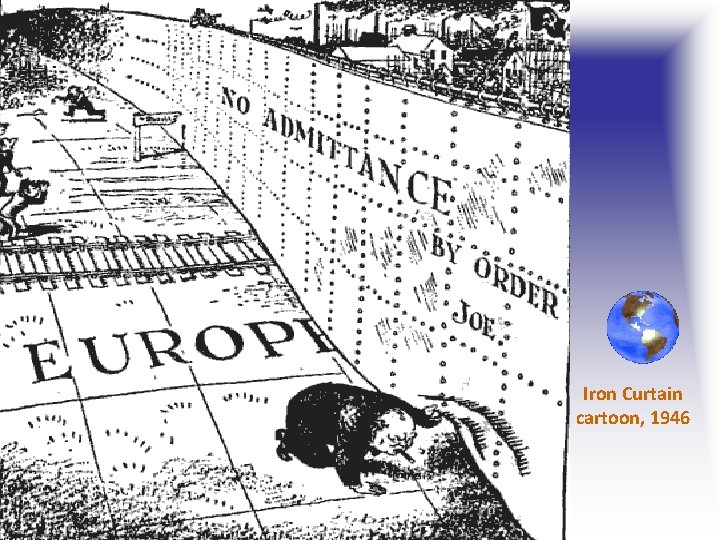
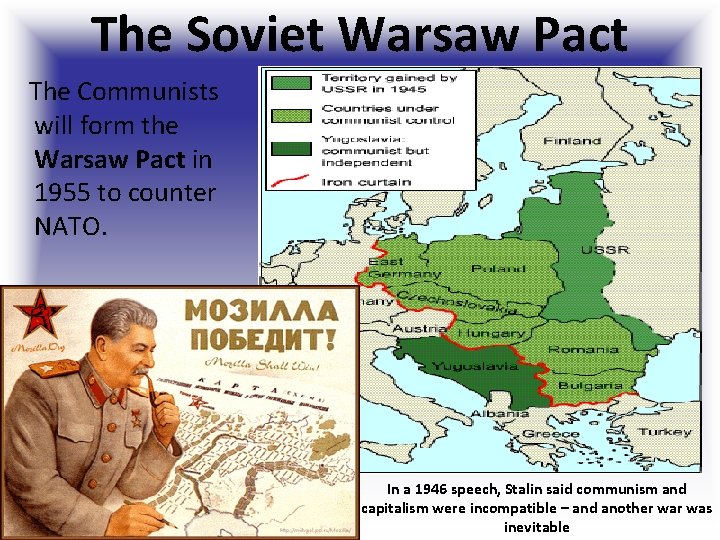
(10) THE IRON CURTAIN 1. March 12, 1946: Fulton, Missouri 2. Winston Churchill visited Westminster College and summed up Soviet relations with the US and GB. 3. “From Stettin on the Baltic to Trieste in the Adriatic, an Iron Curtain has descended across the Continent. ” 4. “Iron Curtain” was the term used to describe the Soviet’s Policy in Europe from 19451990 - Eastern Europe
THE IRON CURTAIN Get out your maps and add this on!!!
Iron Curtain cartoon, 1946
(11) CONTAINMENT • George Keenan- State Department official and Soviet expert- suggested the U. S. and Great Britain instill a policy of CONTAINMENT: CONTAINMENT restricting the expansion of Soviet communism. Examples of Containment: >The Marshall Plan > The Korean War >The Berlin Airlift >The Truman Doctrine >The Eisenhower Doctrine
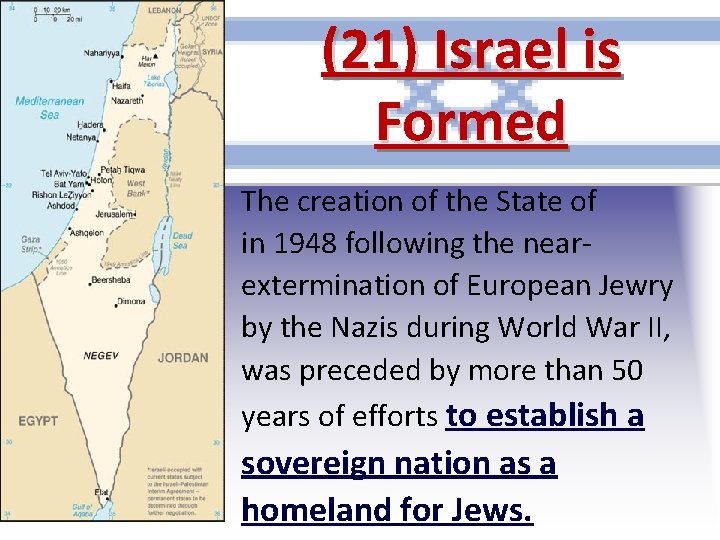
(21) Israel is Formed The creation of the State of in 1948 following the nearextermination of European Jewry by the Nazis during World War II, was preceded by more than 50 years of efforts to establish a sovereign nation as a homeland for Jews.
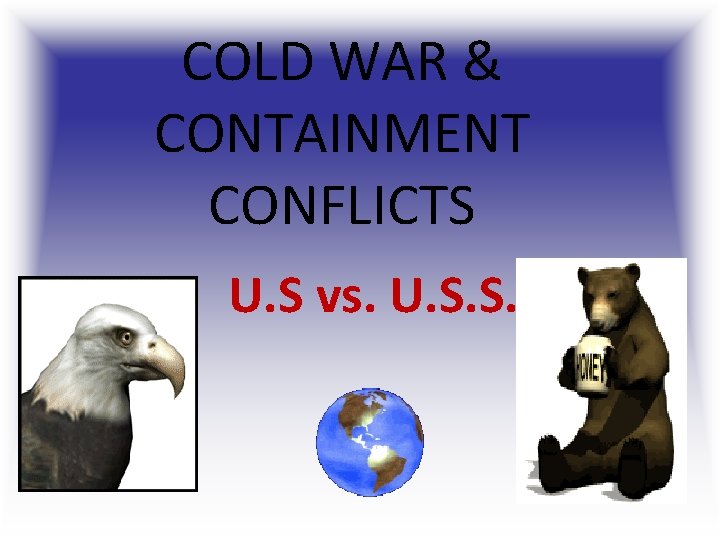
COLD WAR & CONTAINMENT CONFLICTS U. S vs. U. S. S. R.
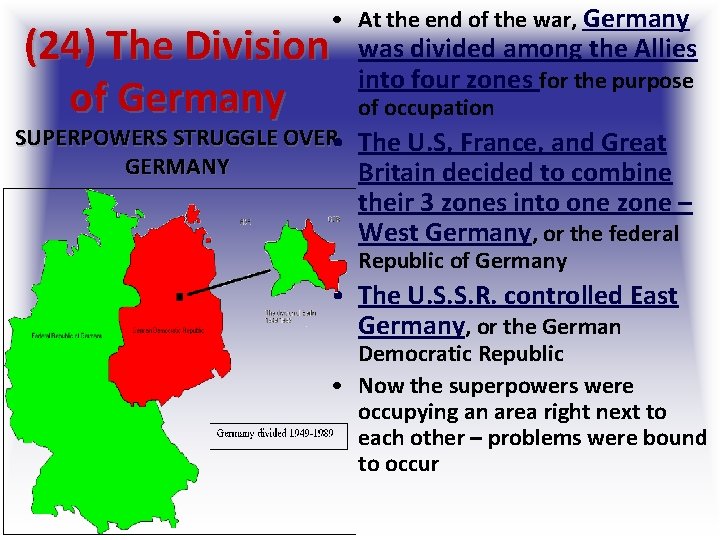
(24) The Division of Germany • At the end of the war, Germany was divided among the Allies into four zones for the purpose of occupation SUPERPOWERS STRUGGLE OVER • The U. S, France, and Great GERMANY Britain decided to combine their 3 zones into one zone – West Germany, or the federal Republic of Germany • The U. S. S. R. controlled East Germany, or the German Democratic Republic • Now the superpowers were occupying an area right next to each other – problems were bound to occur
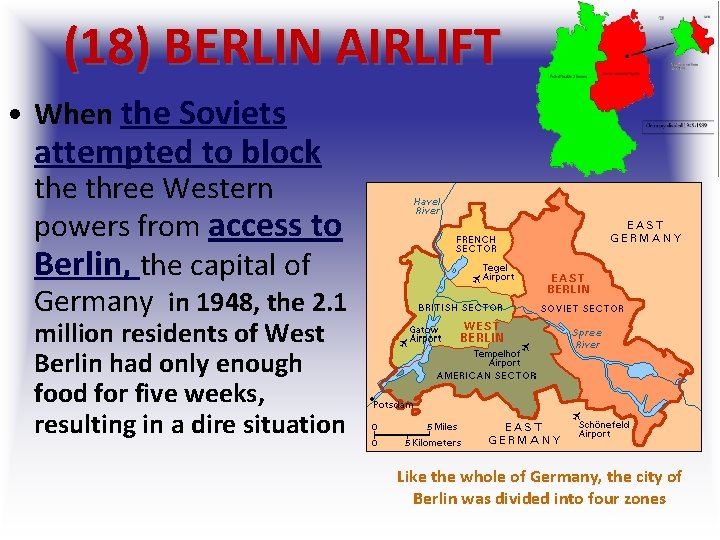
(18) BERLIN AIRLIFT • When the Soviets attempted to block the three Western powers from access to Berlin, the capital of Germany in 1948, the 2. 1 million residents of West Berlin had only enough food for five weeks, resulting in a dire situation Like the whole of Germany, the city of Berlin was divided into four zones
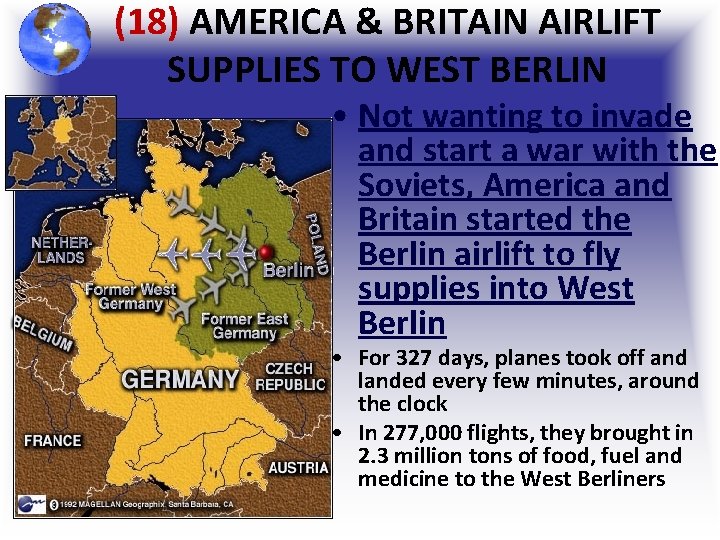
(18) AMERICA & BRITAIN AIRLIFT SUPPLIES TO WEST BERLIN • Not wanting to invade and start a war with the Soviets, America and Britain started the Berlin airlift to fly supplies into West Berlin • For 327 days, planes took off and landed every few minutes, around the clock • In 277, 000 flights, they brought in 2. 3 million tons of food, fuel and medicine to the West Berliners
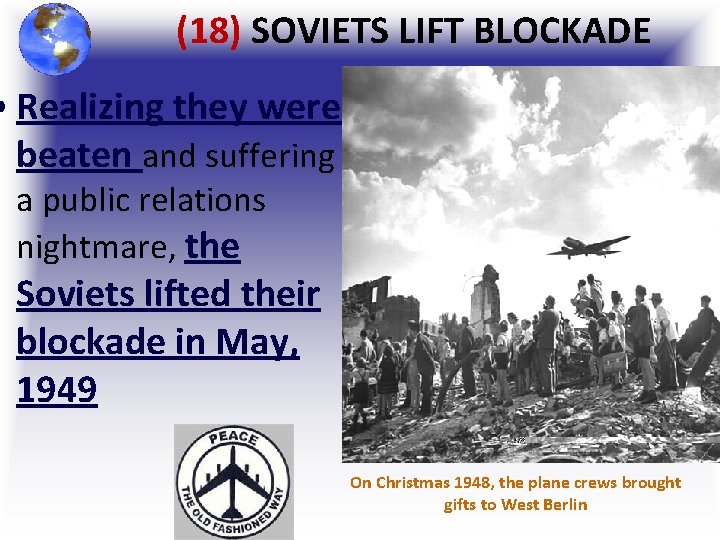
(18) SOVIETS LIFT BLOCKADE • Realizing they were beaten and suffering a public relations nightmare, the Soviets lifted their blockade in May, 1949 On Christmas 1948, the plane crews brought gifts to West Berlin
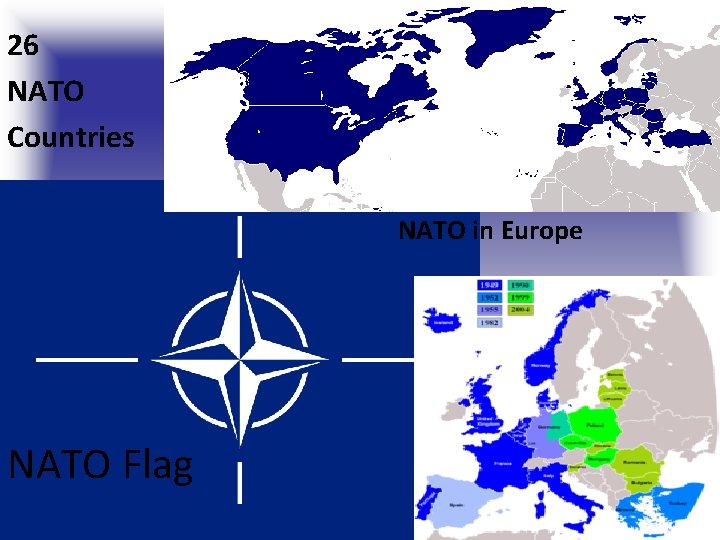
26 NATO Countries NATO in Europe NATO Flag
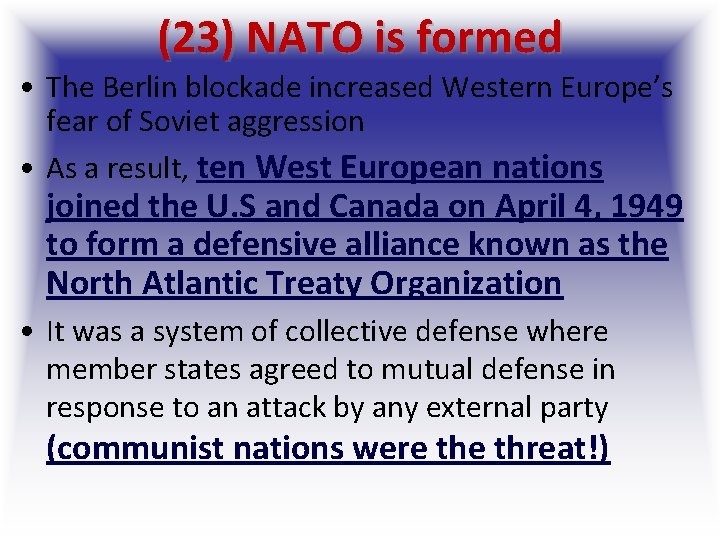
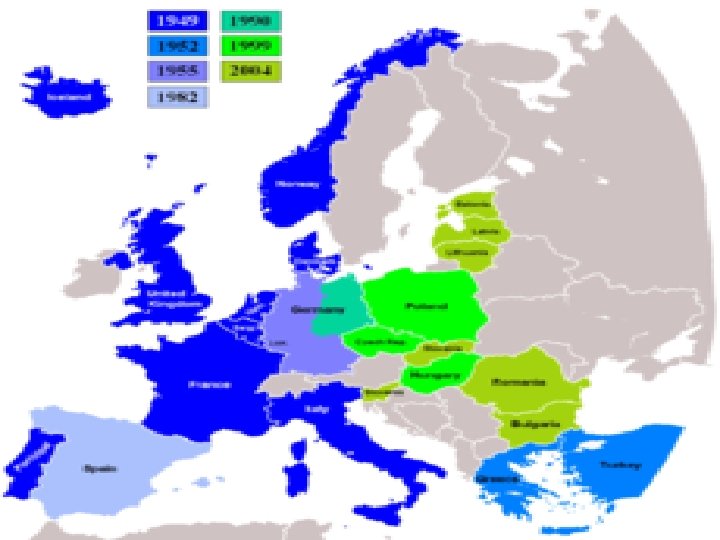
(23) NATO is formed • The Berlin blockade increased Western Europe’s fear of Soviet aggression • As a result, ten West European nations joined the U. S and Canada on April 4, 1949 to form a defensive alliance known as the North Atlantic Treaty Organization • It was a system of collective defense where member states agreed to mutual defense in response to an attack by any external party (communist nations were threat!)
The Soviet Warsaw Pact The Communists will form the Warsaw Pact in 1955 to counter NATO. In a 1946 speech, Stalin said communism and capitalism were incompatible – and another was inevitable
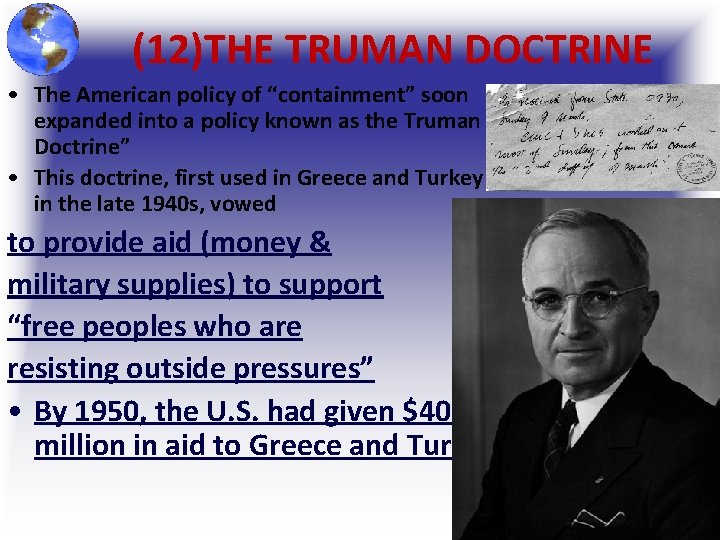
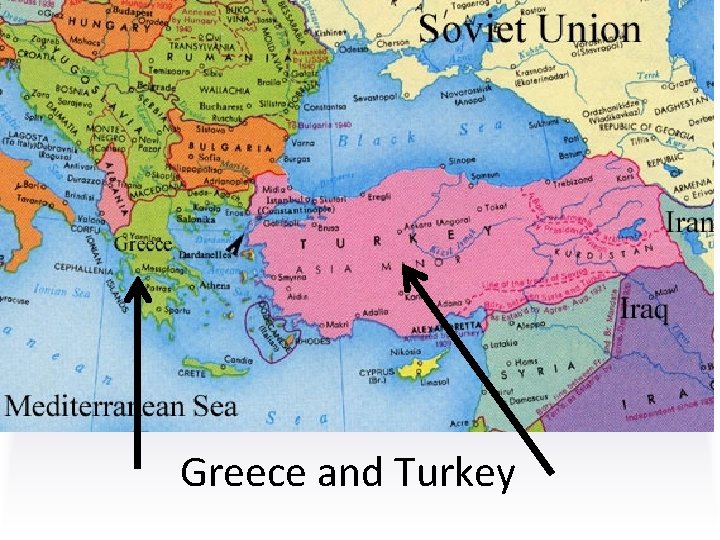
(12)THE TRUMAN DOCTRINE • The American policy of “containment” soon expanded into a policy known as the Truman Doctrine” • This doctrine, first used in Greece and Turkey in the late 1940 s, vowed to provide aid (money & military supplies) to support “free peoples who are resisting outside pressures” • By 1950, the U. S. had given $400 million in aid to Greece and Turkey
Greece and Turkey
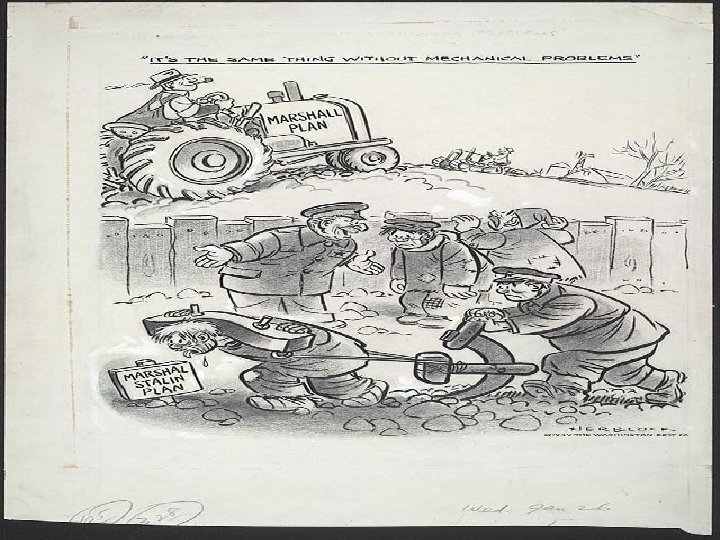
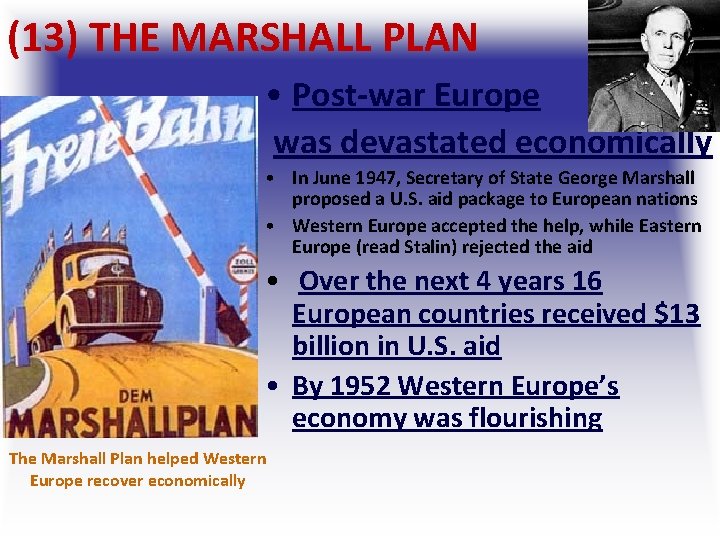
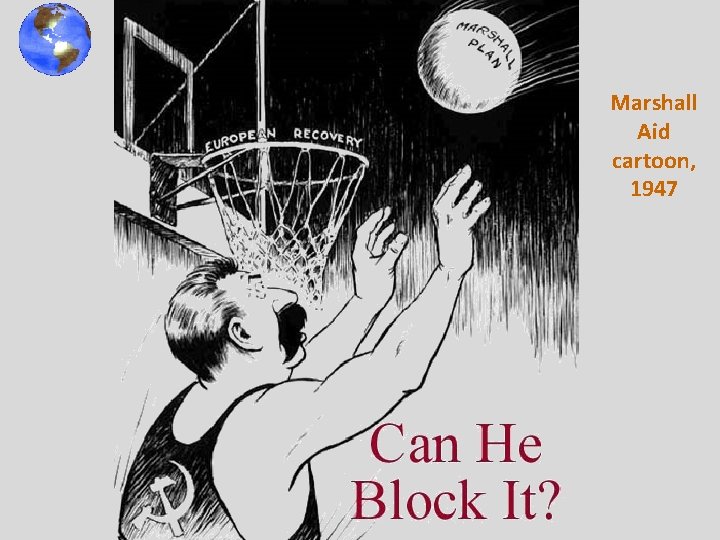
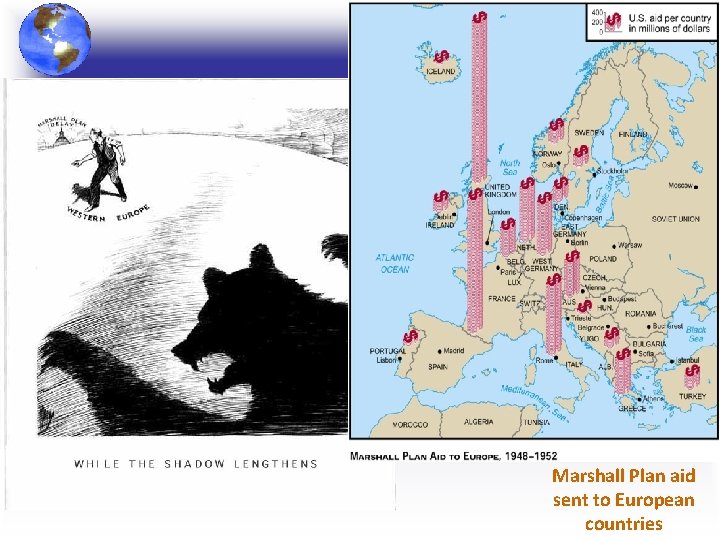
(13) THE MARSHALL PLAN • Post-war Europe was devastated economically • In June 1947, Secretary of State George Marshall proposed a U. S. aid package to European nations • Western Europe accepted the help, while Eastern Europe (read Stalin) rejected the aid • Over the next 4 years 16 European countries received $13 billion in U. S. aid • By 1952 Western Europe’s economy was flourishing The Marshall Plan helped Western Europe recover economically
Marshall Aid cartoon, 1947
Marshall Plan aid sent to European countries