
The Cold War Origins of the Cold War
- Slides: 40
The Cold War
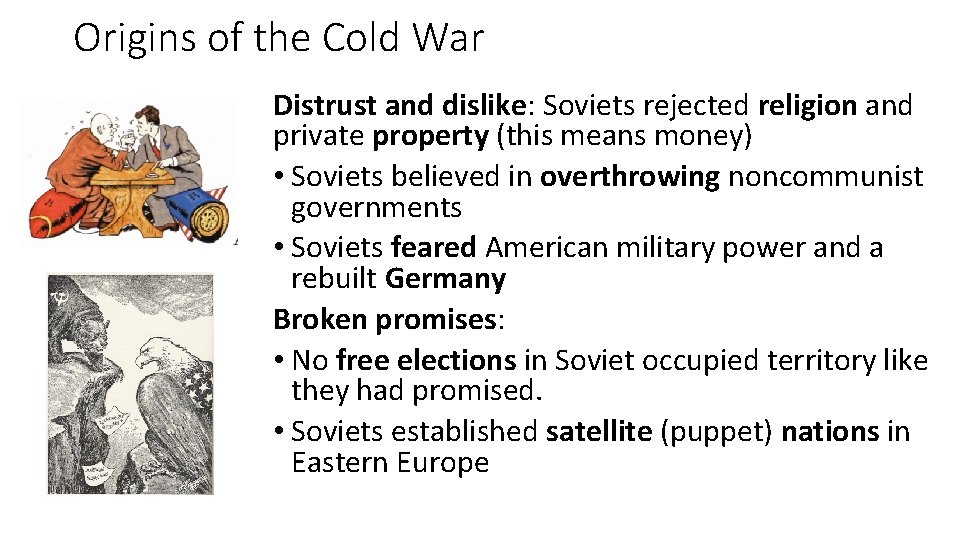
Origins of the Cold War Distrust and dislike: Soviets rejected religion and private property (this means money) • Soviets believed in overthrowing noncommunist governments • Soviets feared American military power and a rebuilt Germany Broken promises: • No free elections in Soviet occupied territory like they had promised. • Soviets established satellite (puppet) nations in Eastern Europe
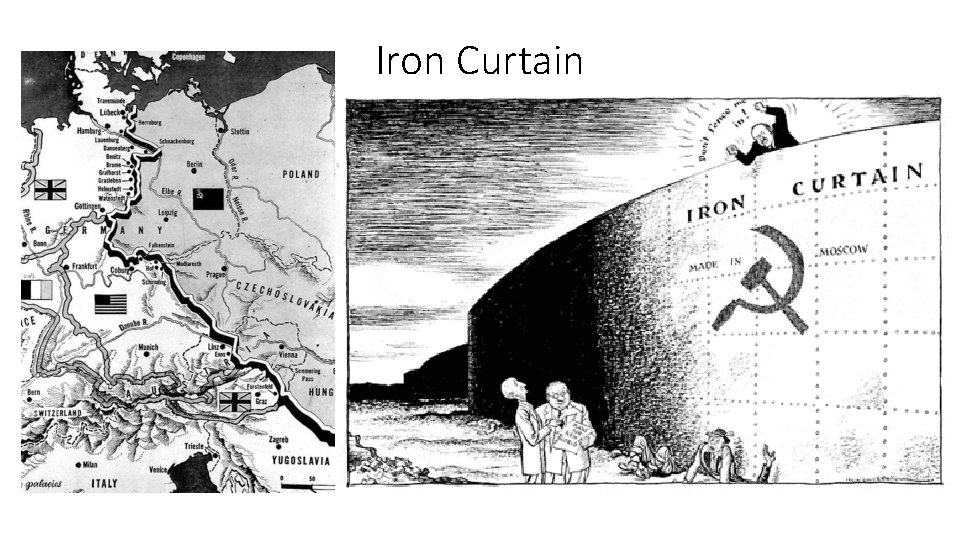
Iron Curtain
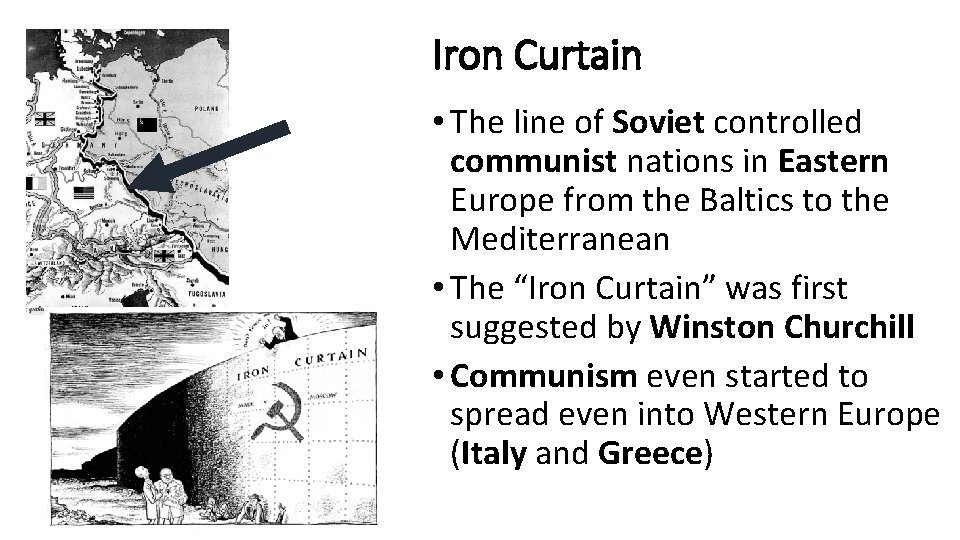
Iron Curtain • The line of Soviet controlled communist nations in Eastern Europe from the Baltics to the Mediterranean • The “Iron Curtain” was first suggested by Winston Churchill • Communism even started to spread even into Western Europe (Italy and Greece)
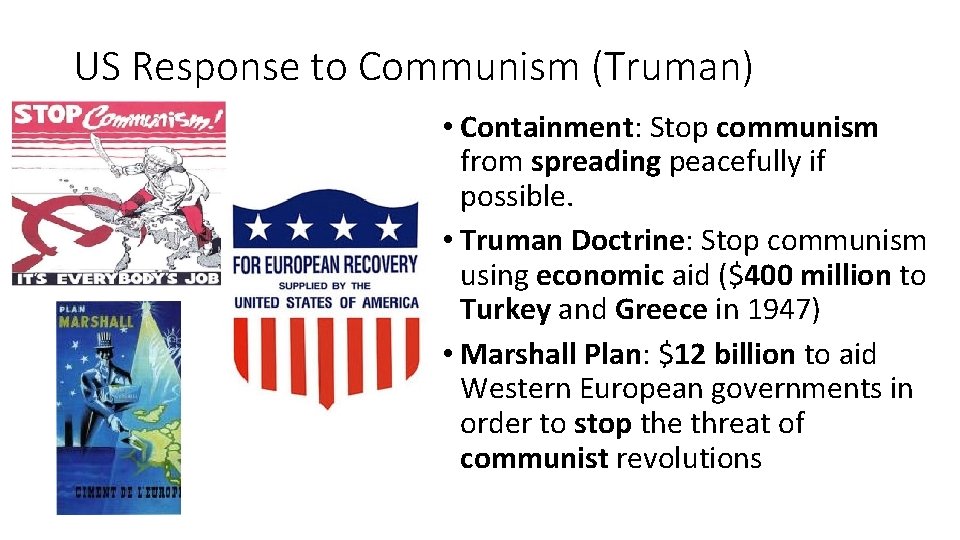
US Response to Communism (Truman) • Containment: Stop communism from spreading peacefully if possible. • Truman Doctrine: Stop communism using economic aid ($400 million to Turkey and Greece in 1947) • Marshall Plan: $12 billion to aid Western European governments in order to stop the threat of communist revolutions
Berlin Crisis • Read and find out: What was the crisis in Berlin? • Figure out: How was it solved?
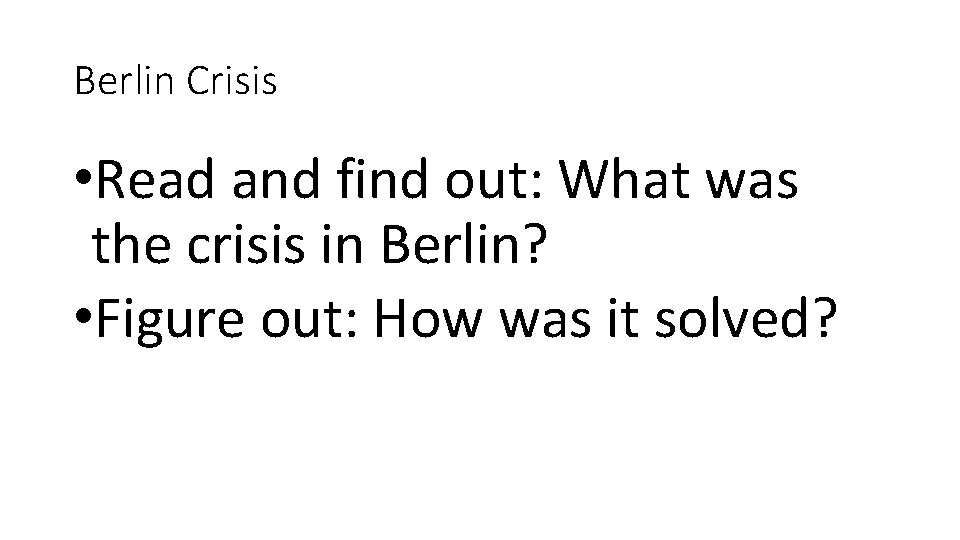
Crisis over Berlin • After the war Germany and the city of Berlin were divided into 4 sections (British, American, French and Soviets) • Berlin was surrounded by communist East Germany (controlled by the Soviets) • The US, Britain and France wanted to reunite Germany • Stalin (Soviet leader) feared this. In 1948 he blockaded Berlin by closing roads, railways and rivers.
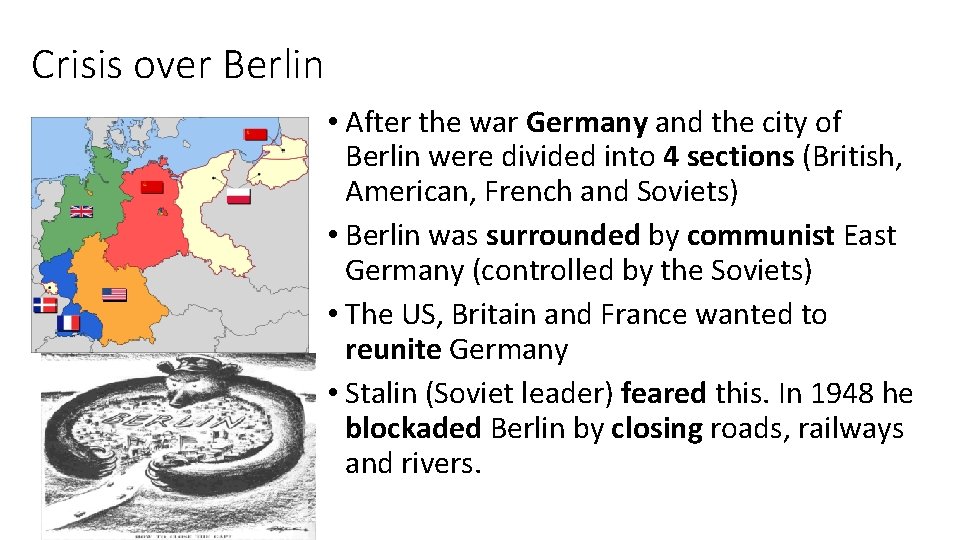
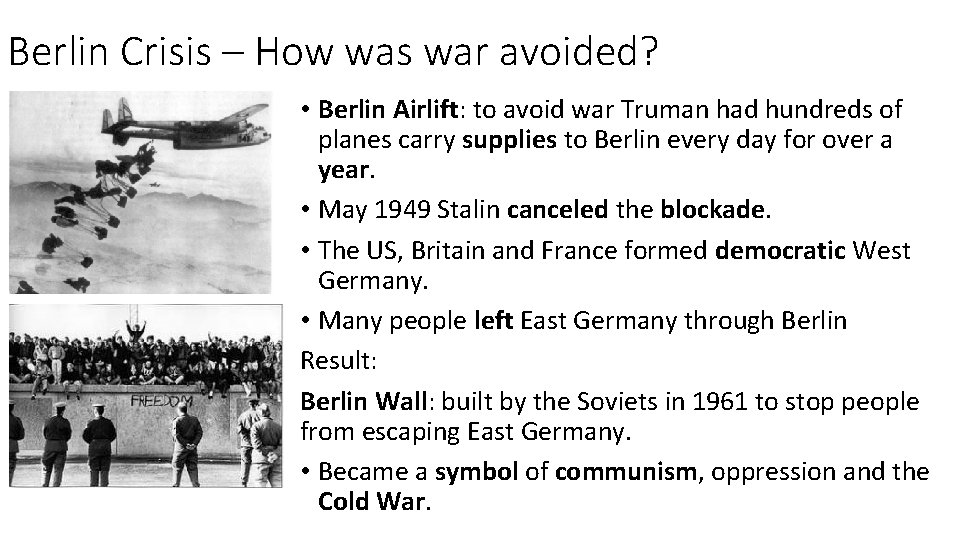
Berlin Crisis – How was war avoided? • Berlin Airlift: to avoid war Truman had hundreds of planes carry supplies to Berlin every day for over a year. • May 1949 Stalin canceled the blockade. • The US, Britain and France formed democratic West Germany. • Many people left East Germany through Berlin Result: Berlin Wall: built by the Soviets in 1961 to stop people from escaping East Germany. • Became a symbol of communism, oppression and the Cold War.
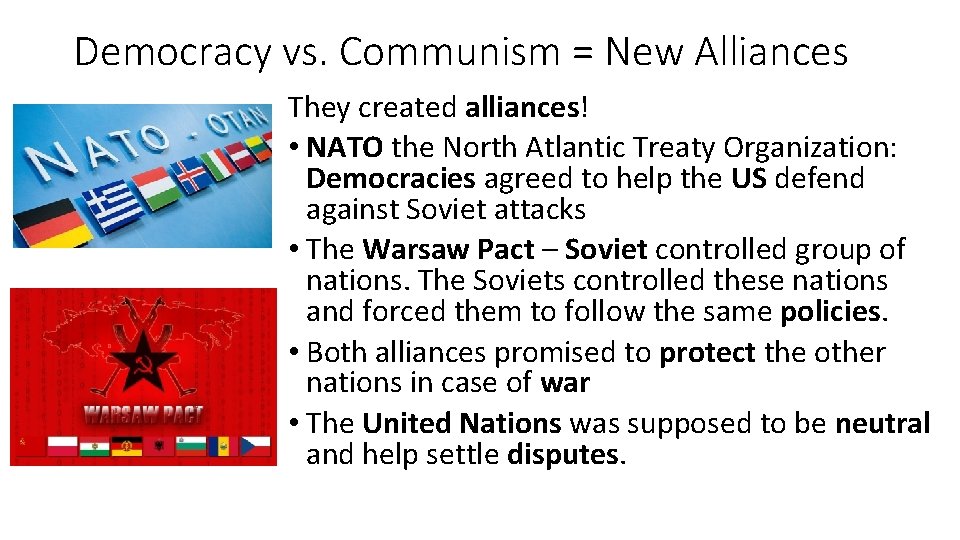
Democracy vs. Communism = New Alliances They created alliances! • NATO the North Atlantic Treaty Organization: Democracies agreed to help the US defend against Soviet attacks • The Warsaw Pact – Soviet controlled group of nations. The Soviets controlled these nations and forced them to follow the same policies. • Both alliances promised to protect the other nations in case of war • The United Nations was supposed to be neutral and help settle disputes.
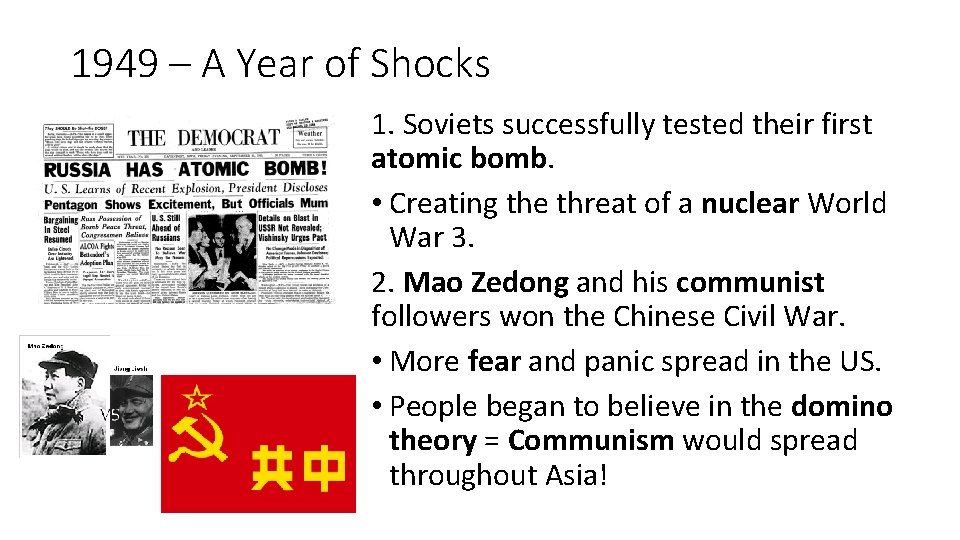
1949 – A Year of Shocks 1. Soviets successfully tested their first atomic bomb. • Creating the threat of a nuclear World War 3. 2. Mao Zedong and his communist followers won the Chinese Civil War. • More fear and panic spread in the US. • People began to believe in the domino theory = Communism would spread throughout Asia!
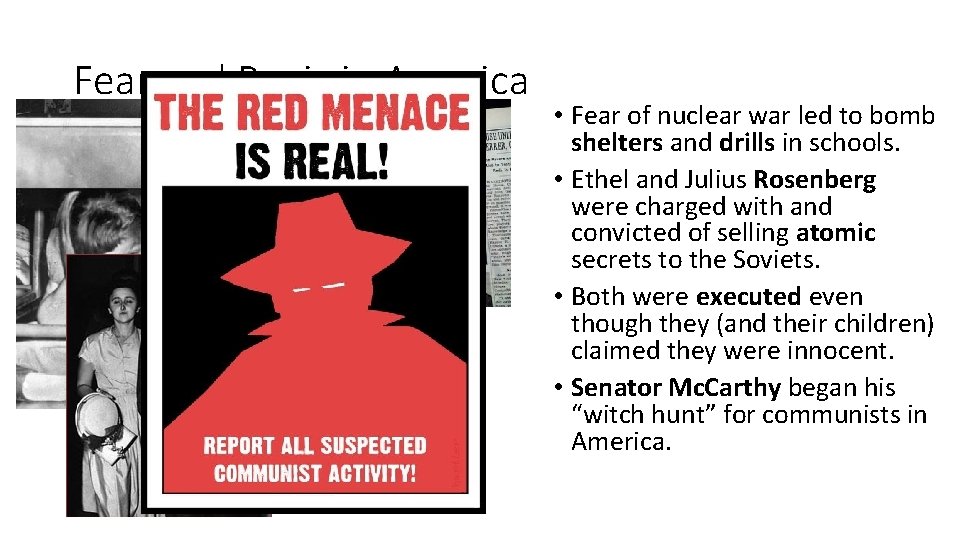
Fear and Panic in America • Fear of nuclear war led to bomb shelters and drills in schools. • Ethel and Julius Rosenberg were charged with and convicted of selling atomic secrets to the Soviets. • Both were executed even though they (and their children) claimed they were innocent. • Senator Mc. Carthy began his “witch hunt” for communists in America.
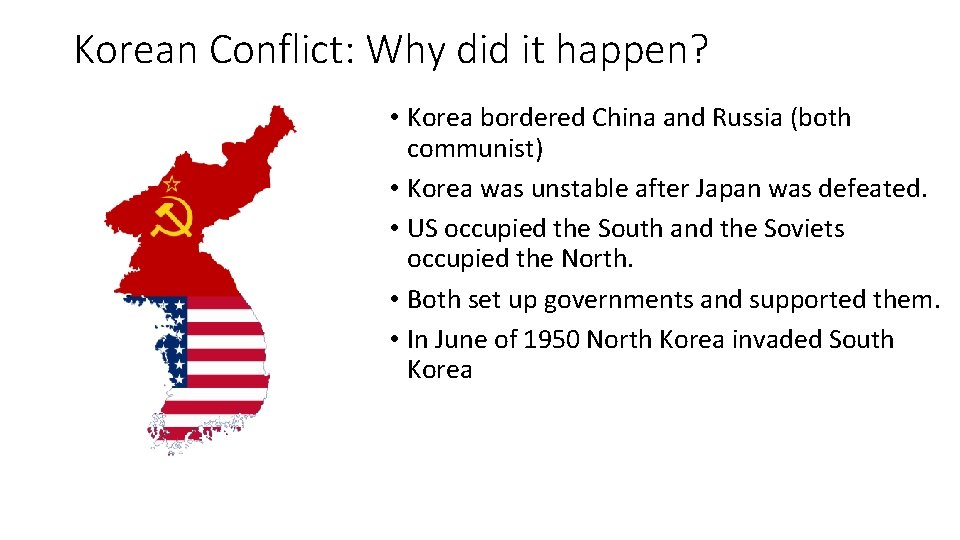
Korean Conflict: Why did it happen? • Korea bordered China and Russia (both communist) • Korea was unstable after Japan was defeated. • US occupied the South and the Soviets occupied the North. • Both set up governments and supported them. • In June of 1950 North Korea invaded South Korea
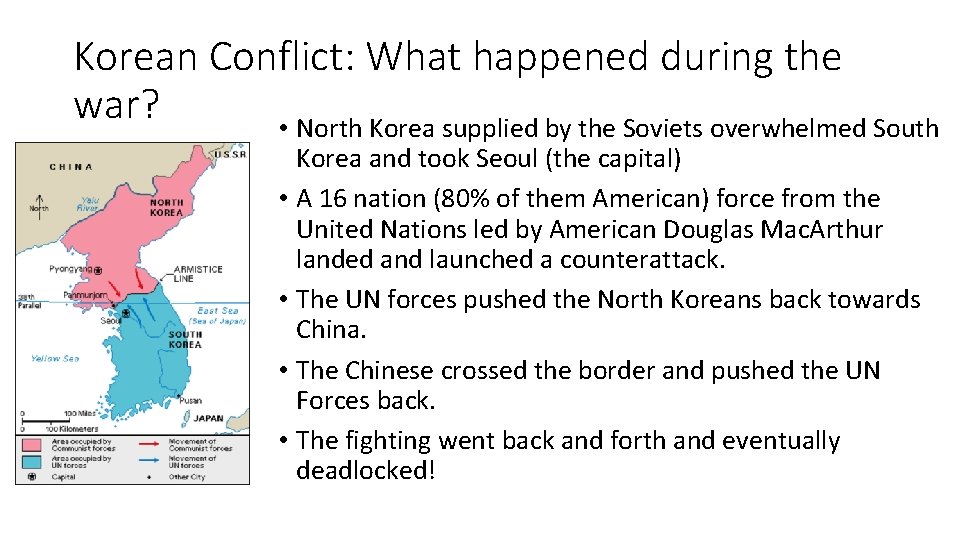
Korean Conflict: What happened during the war? • North Korea supplied by the Soviets overwhelmed South Korea and took Seoul (the capital) • A 16 nation (80% of them American) force from the United Nations led by American Douglas Mac. Arthur landed and launched a counterattack. • The UN forces pushed the North Koreans back towards China. • The Chinese crossed the border and pushed the UN Forces back. • The fighting went back and forth and eventually deadlocked!
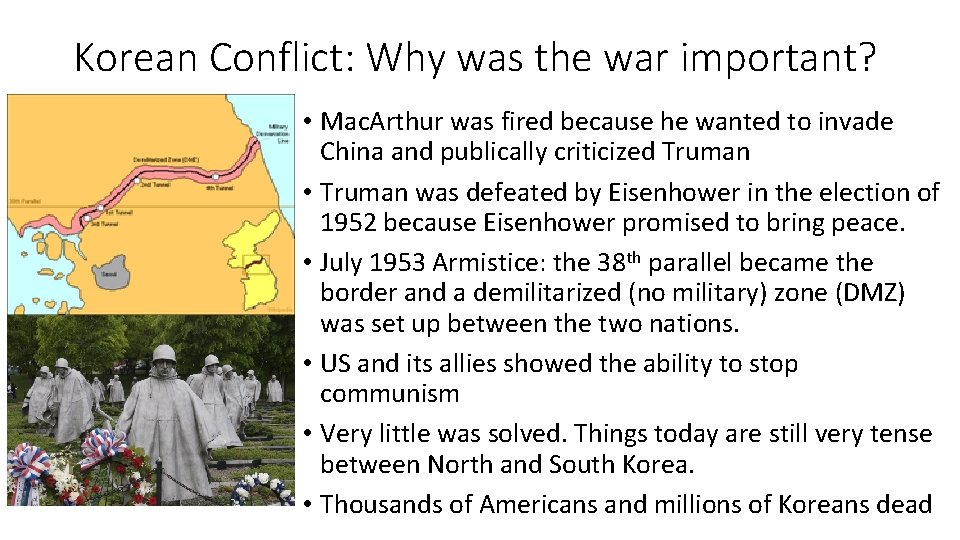
Korean Conflict: Why was the war important? • Mac. Arthur was fired because he wanted to invade China and publically criticized Truman • Truman was defeated by Eisenhower in the election of 1952 because Eisenhower promised to bring peace. • July 1953 Armistice: the 38 th parallel became the border and a demilitarized (no military) zone (DMZ) was set up between the two nations. • US and its allies showed the ability to stop communism • Very little was solved. Things today are still very tense between North and South Korea. • Thousands of Americans and millions of Koreans dead
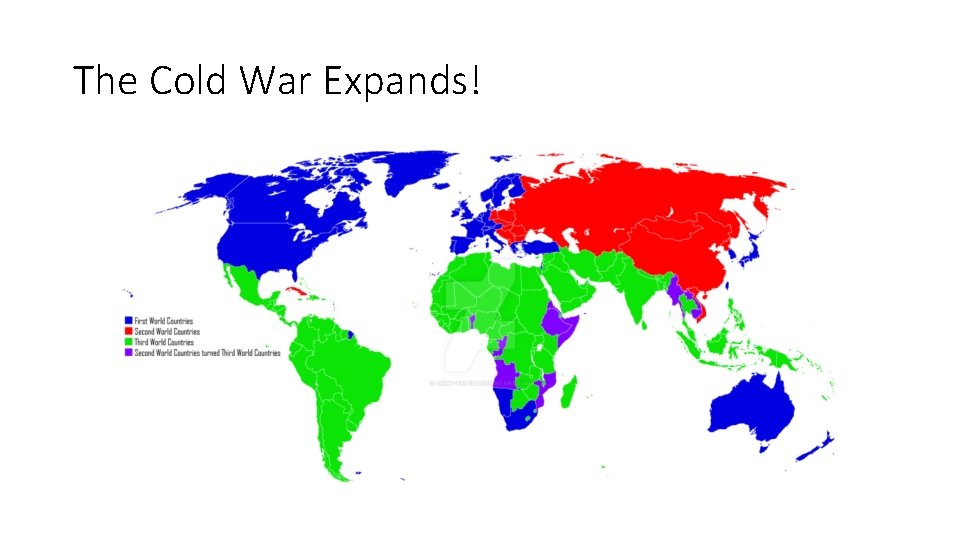
The Cold War Expands!
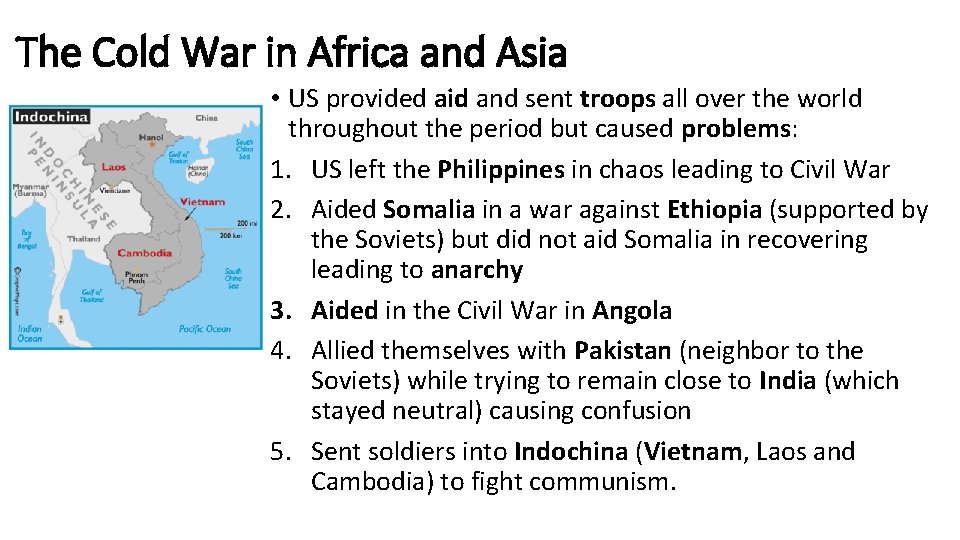
The Cold War in Africa and Asia • US provided aid and sent troops all over the world throughout the period but caused problems: 1. US left the Philippines in chaos leading to Civil War 2. Aided Somalia in a war against Ethiopia (supported by the Soviets) but did not aid Somalia in recovering leading to anarchy 3. Aided in the Civil War in Angola 4. Allied themselves with Pakistan (neighbor to the Soviets) while trying to remain close to India (which stayed neutral) causing confusion 5. Sent soldiers into Indochina (Vietnam, Laos and Cambodia) to fight communism.
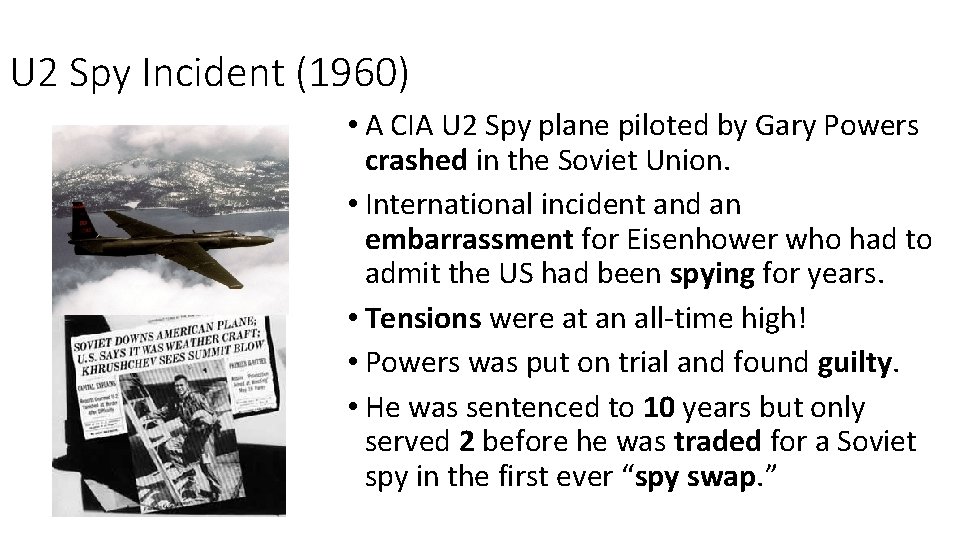
U 2 Spy Incident (1960) • A CIA U 2 Spy plane piloted by Gary Powers crashed in the Soviet Union. • International incident and an embarrassment for Eisenhower who had to admit the US had been spying for years. • Tensions were at an all-time high! • Powers was put on trial and found guilty. • He was sentenced to 10 years but only served 2 before he was traded for a Soviet spy in the first ever “spy swap. ”
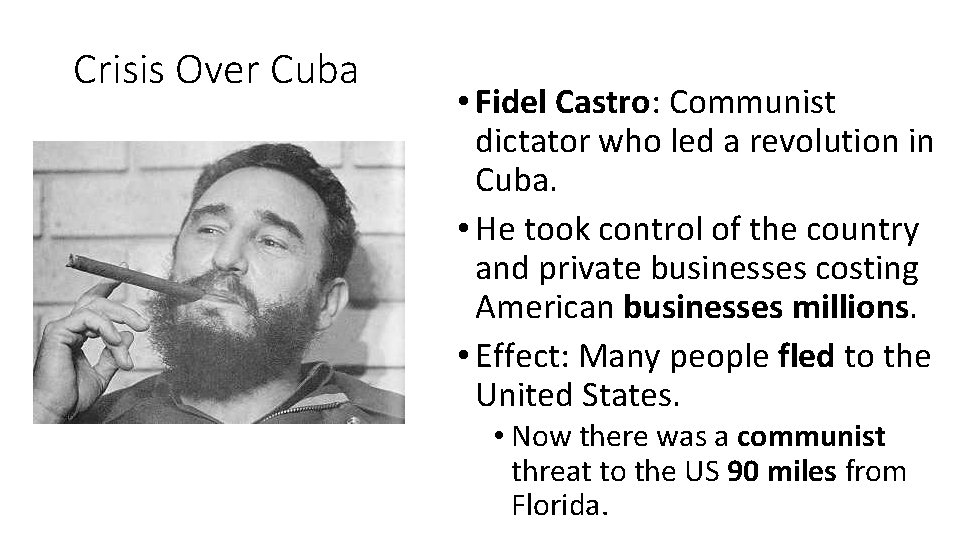
Crisis Over Cuba • Fidel Castro: Communist dictator who led a revolution in Cuba. • He took control of the country and private businesses costing American businesses millions. • Effect: Many people fled to the United States. • Now there was a communist threat to the US 90 miles from Florida.
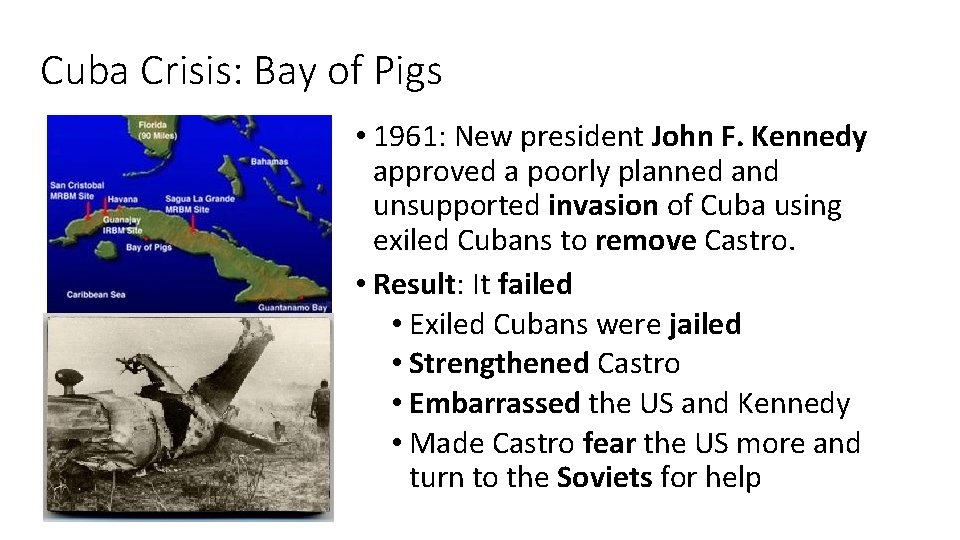
Cuba Crisis: Bay of Pigs • 1961: New president John F. Kennedy approved a poorly planned and unsupported invasion of Cuba using exiled Cubans to remove Castro. • Result: It failed • Exiled Cubans were jailed • Strengthened Castro • Embarrassed the US and Kennedy • Made Castro fear the US more and turn to the Soviets for help
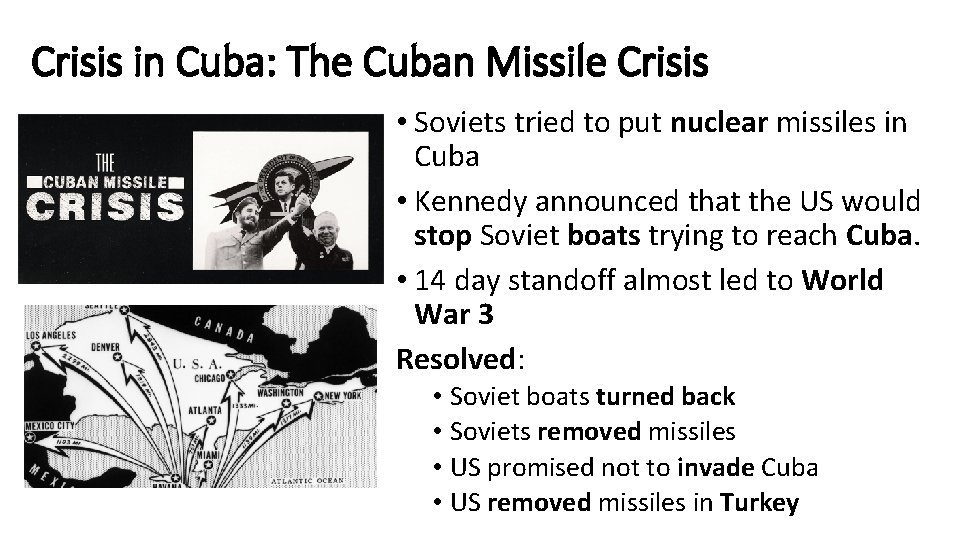
Crisis in Cuba: The Cuban Missile Crisis • Soviets tried to put nuclear missiles in Cuba • Kennedy announced that the US would stop Soviet boats trying to reach Cuba. • 14 day standoff almost led to World War 3 Resolved: • Soviet boats turned back • Soviets removed missiles • US promised not to invade Cuba • US removed missiles in Turkey
Latin America: How to stop the next Cuba • Three types: Social and economic aid and Intervention 1. Social – Kennedy developed the Alliance for Progress and the Peace Corps. Helped build schools, hospitals, etc 2. Economic – Organization of American States promoted economic progress and investment 3. Intervention (1950 -90): Guatemala, Dominican Republican, Panama, Grenada. Sent soldiers in to stop communism. • Supported anti-communist governments in Guatemala and El Salvador • Ronald Regan supported the “contras” in Nicaragua against a law passed by Congress
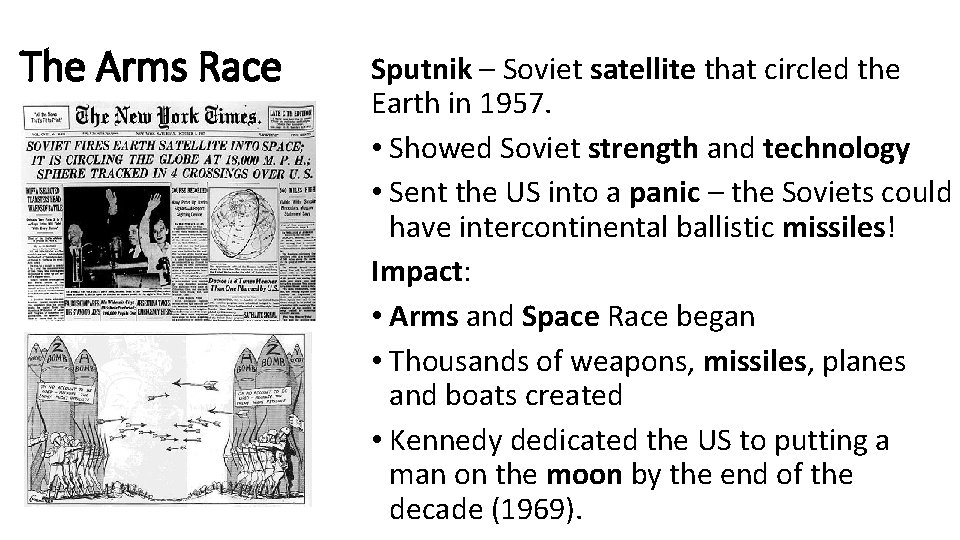
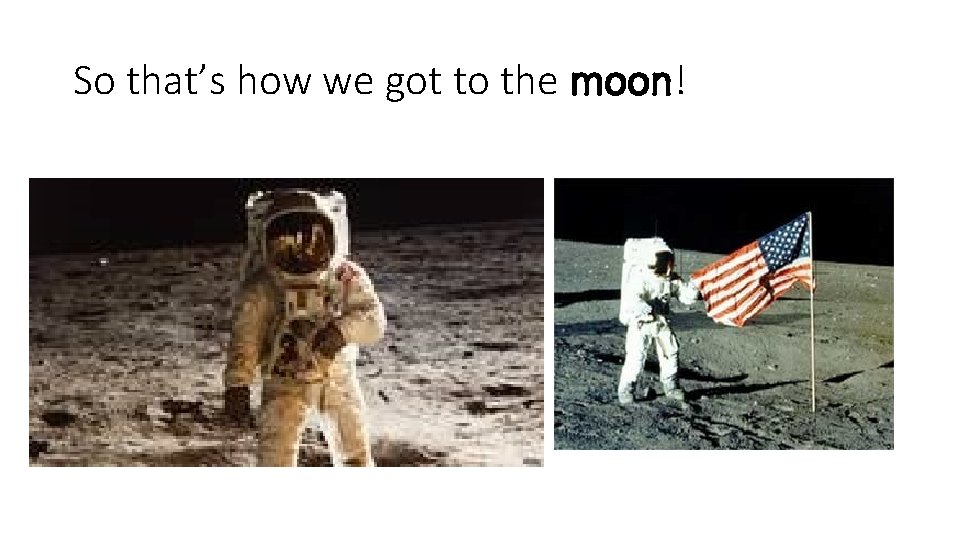
The Arms Race Sputnik – Soviet satellite that circled the Earth in 1957. • Showed Soviet strength and technology • Sent the US into a panic – the Soviets could have intercontinental ballistic missiles! Impact: • Arms and Space Race began • Thousands of weapons, missiles, planes and boats created • Kennedy dedicated the US to putting a man on the moon by the end of the decade (1969).
So that’s how we got to the moon!
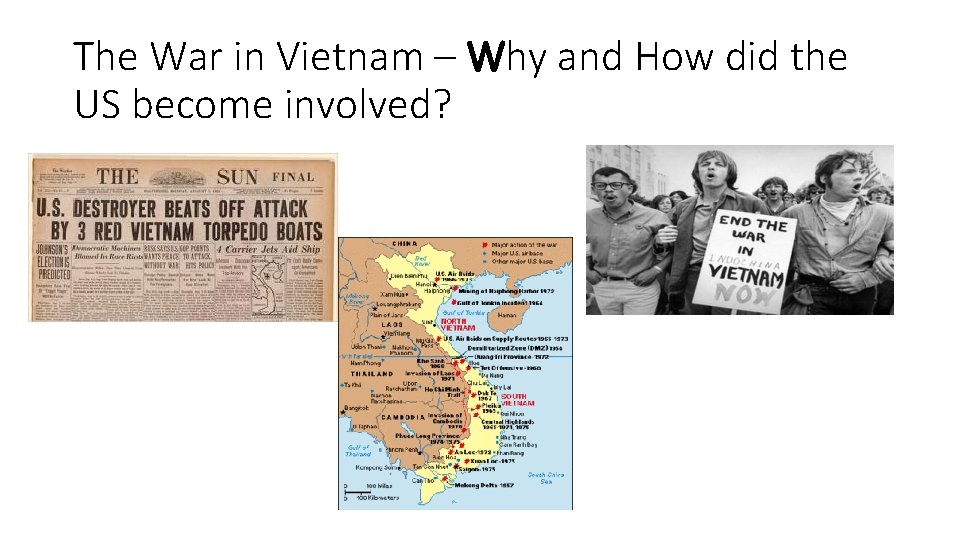
The War in Vietnam – Why and How did the US become involved?
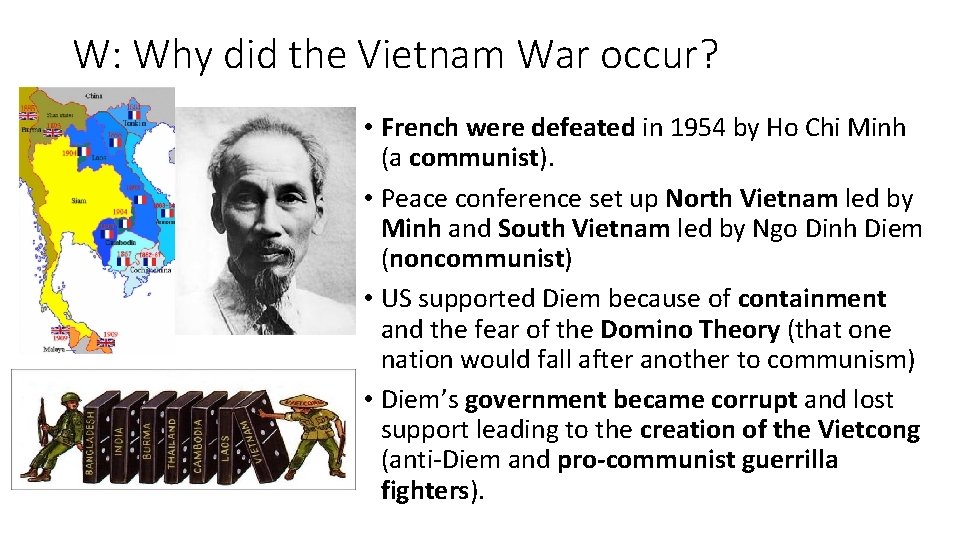
W: Why did the Vietnam War occur? • French were defeated in 1954 by Ho Chi Minh (a communist). • Peace conference set up North Vietnam led by Minh and South Vietnam led by Ngo Dinh Diem (noncommunist) • US supported Diem because of containment and the fear of the Domino Theory (that one nation would fall after another to communism) • Diem’s government became corrupt and lost support leading to the creation of the Vietcong (anti-Diem and pro-communist guerrilla fighters).
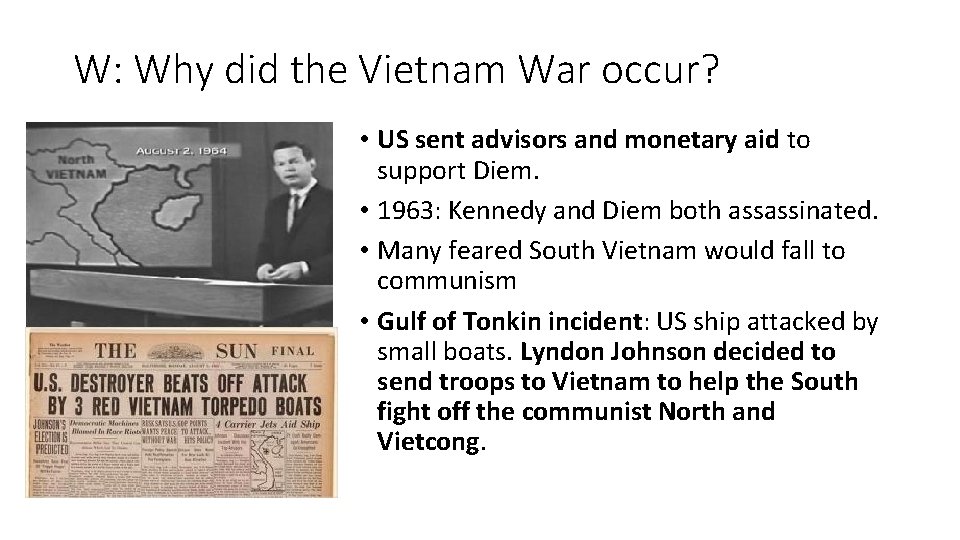
W: Why did the Vietnam War occur? • US sent advisors and monetary aid to support Diem. • 1963: Kennedy and Diem both assassinated. • Many feared South Vietnam would fall to communism • Gulf of Tonkin incident: US ship attacked by small boats. Lyndon Johnson decided to send troops to Vietnam to help the South fight off the communist North and Vietcong.
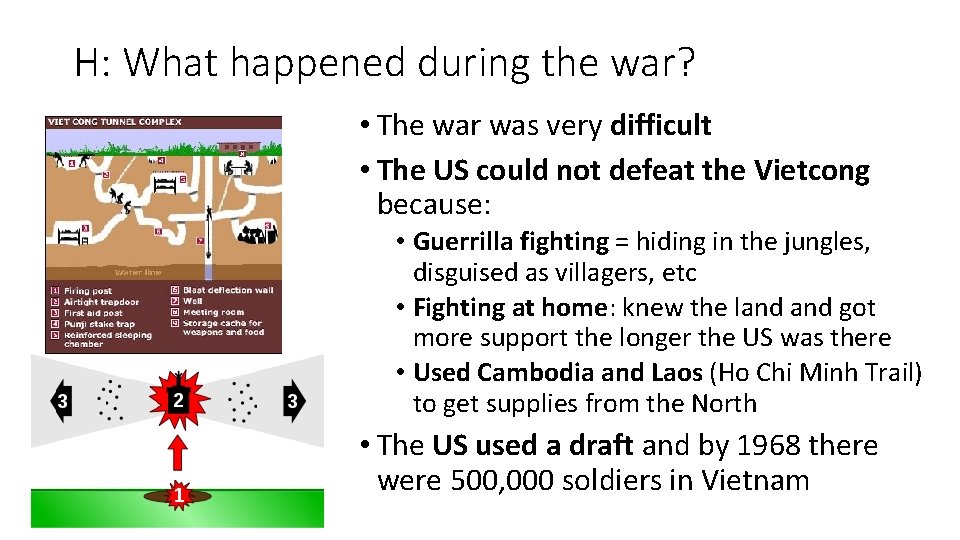
H: What happened during the war? • The war was very difficult • The US could not defeat the Vietcong because: • Guerrilla fighting = hiding in the jungles, disguised as villagers, etc • Fighting at home: knew the land got more support the longer the US was there • Used Cambodia and Laos (Ho Chi Minh Trail) to get supplies from the North • The US used a draft and by 1968 there were 500, 000 soldiers in Vietnam
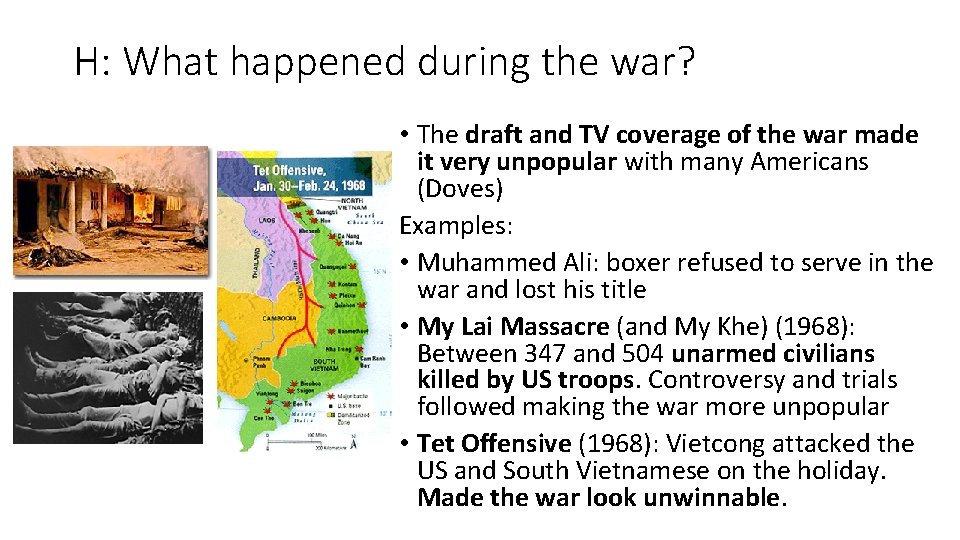
H: What happened during the war? • The draft and TV coverage of the war made it very unpopular with many Americans (Doves) Examples: • Muhammed Ali: boxer refused to serve in the war and lost his title • My Lai Massacre (and My Khe) (1968): Between 347 and 504 unarmed civilians killed by US troops. Controversy and trials followed making the war more unpopular • Tet Offensive (1968): Vietcong attacked the US and South Vietnamese on the holiday. Made the war look unwinnable.
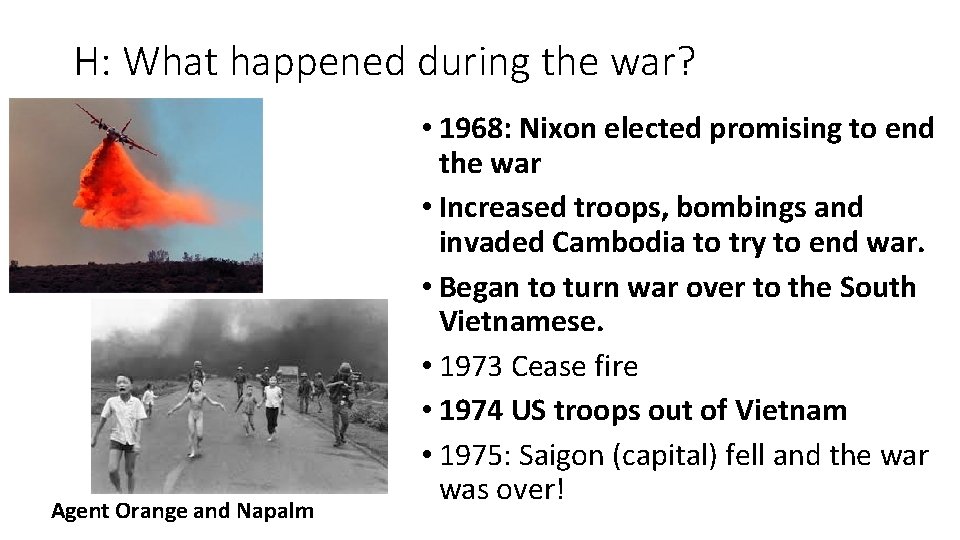
H: What happened during the war? Agent Orange and Napalm • 1968: Nixon elected promising to end the war • Increased troops, bombings and invaded Cambodia to try to end war. • Began to turn war over to the South Vietnamese. • 1973 Cease fire • 1974 US troops out of Vietnam • 1975: Saigon (capital) fell and the war was over!
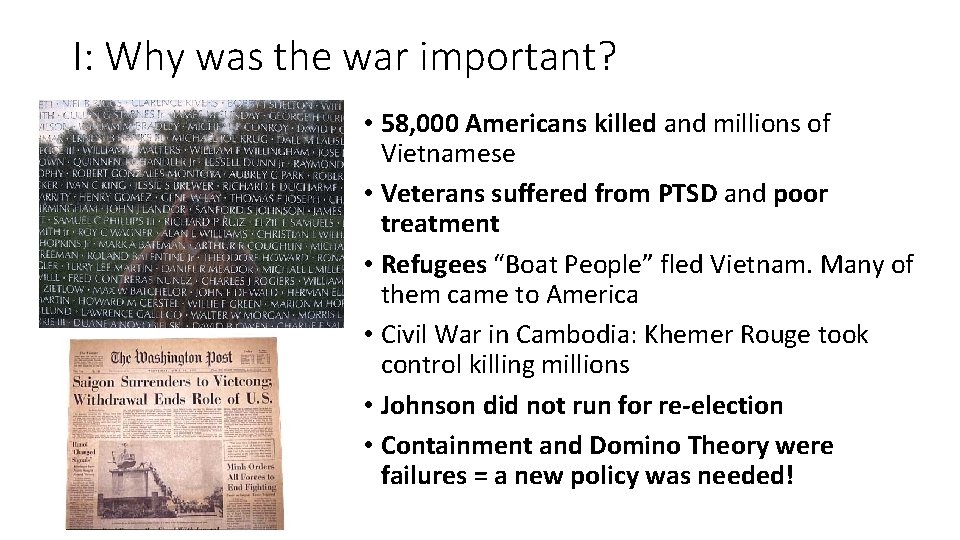
I: Why was the war important? • 58, 000 Americans killed and millions of Vietnamese • Veterans suffered from PTSD and poor treatment • Refugees “Boat People” fled Vietnam. Many of them came to America • Civil War in Cambodia: Khemer Rouge took control killing millions • Johnson did not run for re-election • Containment and Domino Theory were failures = a new policy was needed!
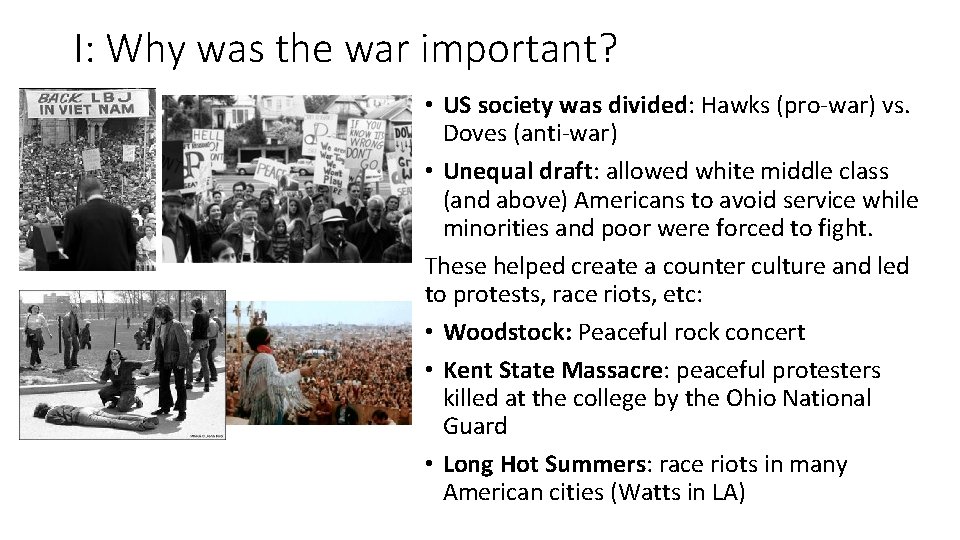
I: Why was the war important? • US society was divided: Hawks (pro-war) vs. Doves (anti-war) • Unequal draft: allowed white middle class (and above) Americans to avoid service while minorities and poor were forced to fight. These helped create a counter culture and led to protests, race riots, etc: • Woodstock: Peaceful rock concert • Kent State Massacre: peaceful protesters killed at the college by the Ohio National Guard • Long Hot Summers: race riots in many American cities (Watts in LA)
The Cold War Ends! How did it happen?
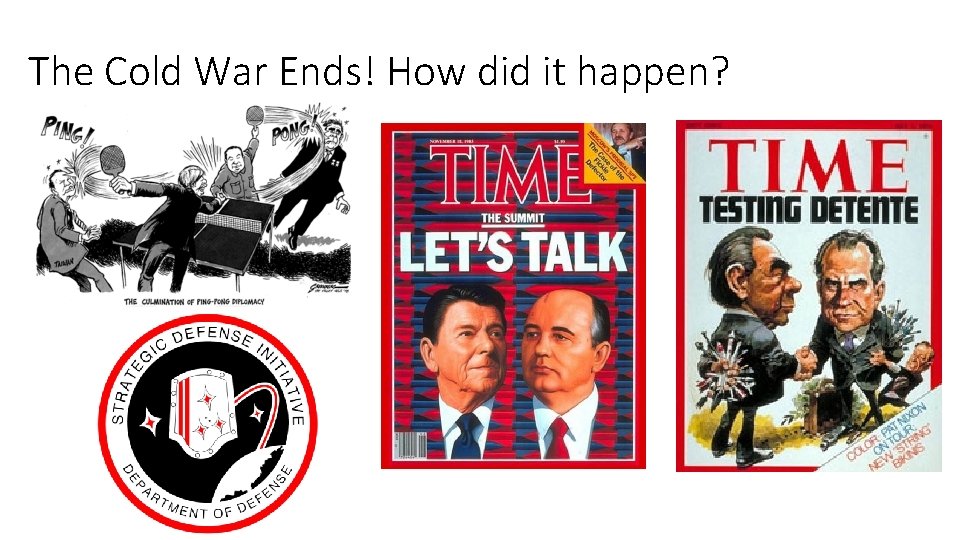
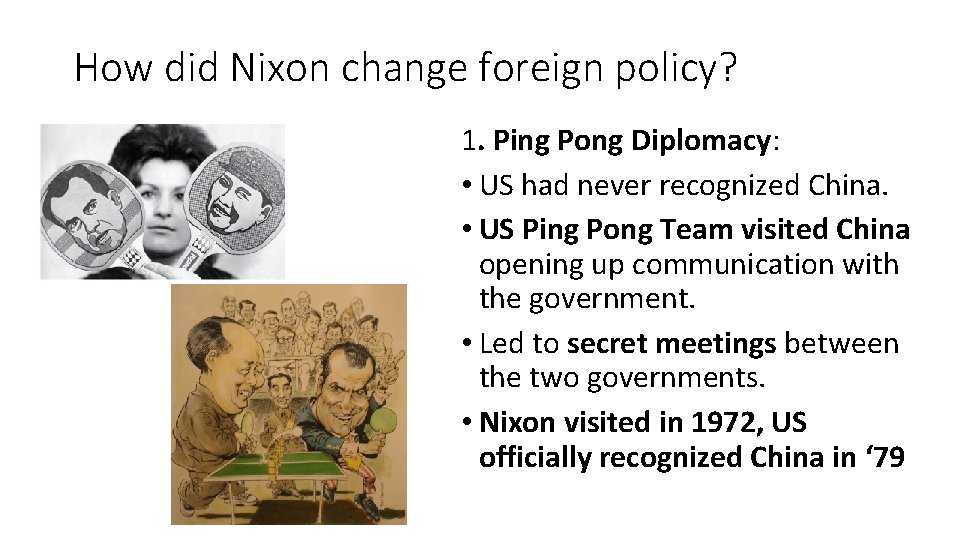
How did Nixon change foreign policy? 1. Ping Pong Diplomacy: • US had never recognized China. • US Ping Pong Team visited China opening up communication with the government. • Led to secret meetings between the two governments. • Nixon visited in 1972, US officially recognized China in ‘ 79
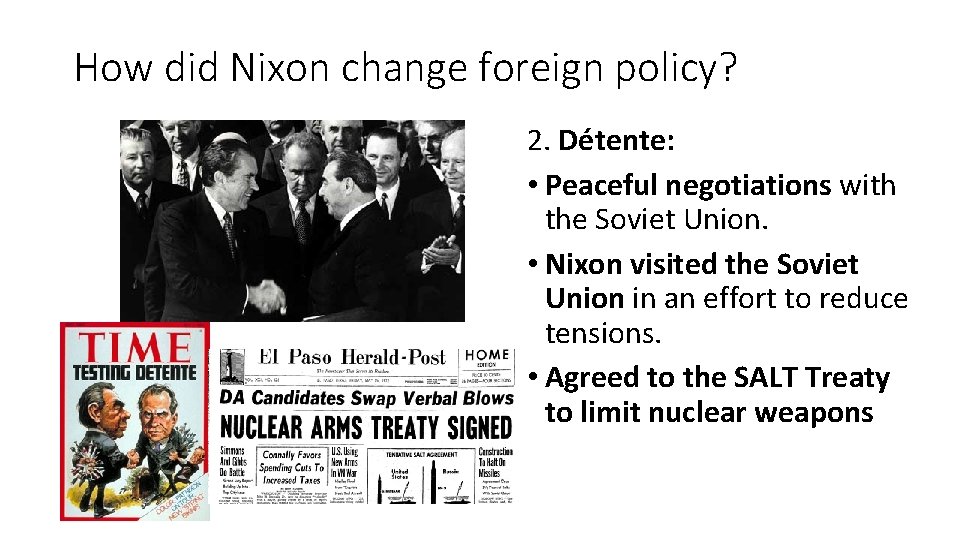
How did Nixon change foreign policy? 2. Détente: • Peaceful negotiations with the Soviet Union. • Nixon visited the Soviet Union in an effort to reduce tensions. • Agreed to the SALT Treaty to limit nuclear weapons
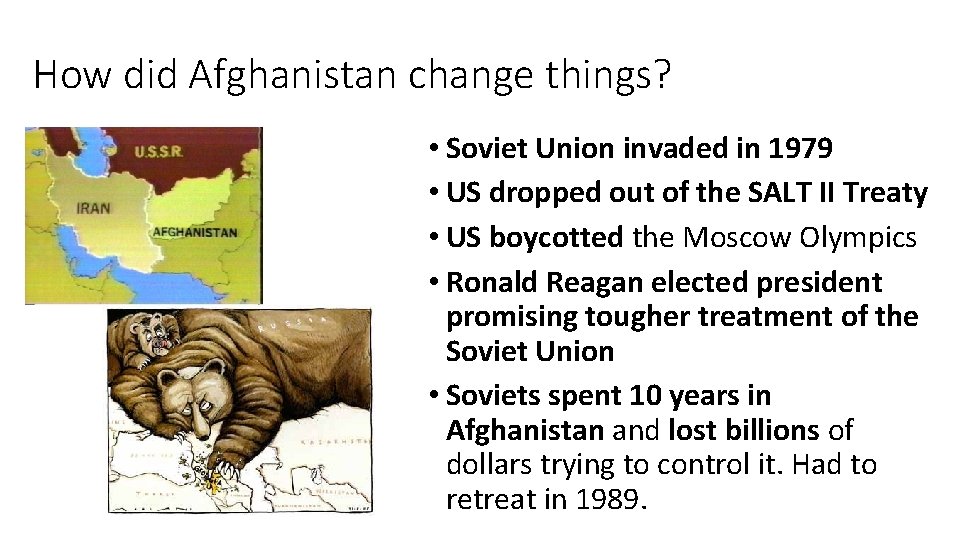
How did Afghanistan change things? • Soviet Union invaded in 1979 • US dropped out of the SALT II Treaty • US boycotted the Moscow Olympics • Ronald Reagan elected president promising tougher treatment of the Soviet Union • Soviets spent 10 years in Afghanistan and lost billions of dollars trying to control it. Had to retreat in 1989.
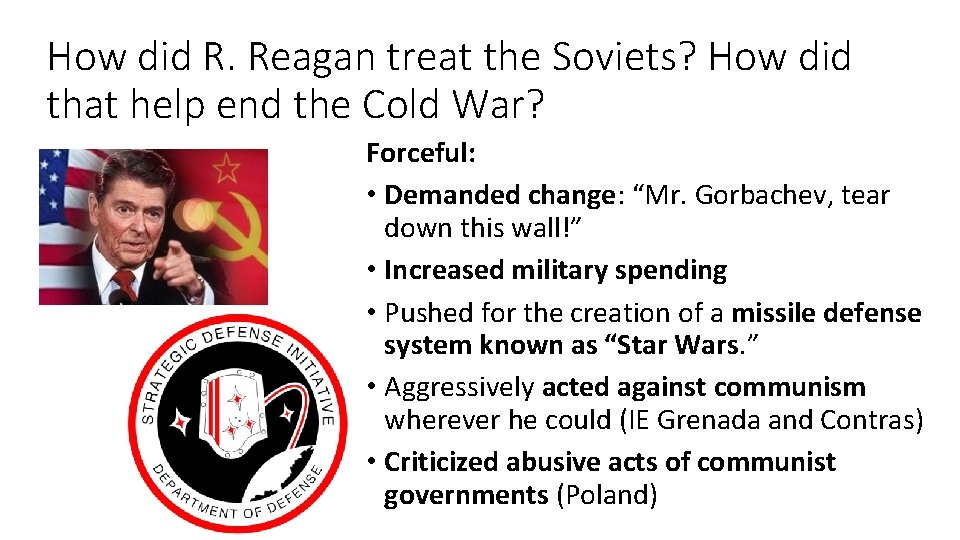
How did R. Reagan treat the Soviets? How did that help end the Cold War? Forceful: • Demanded change: “Mr. Gorbachev, tear down this wall!” • Increased military spending • Pushed for the creation of a missile defense system known as “Star Wars. ” • Aggressively acted against communism wherever he could (IE Grenada and Contras) • Criticized abusive acts of communist governments (Poland)
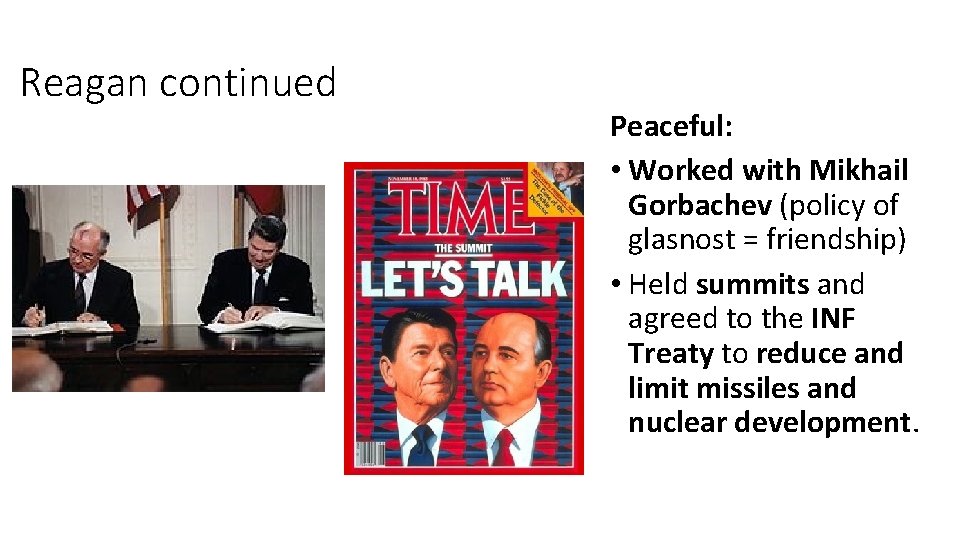
Reagan continued Peaceful: • Worked with Mikhail Gorbachev (policy of glasnost = friendship) • Held summits and agreed to the INF Treaty to reduce and limit missiles and nuclear development.
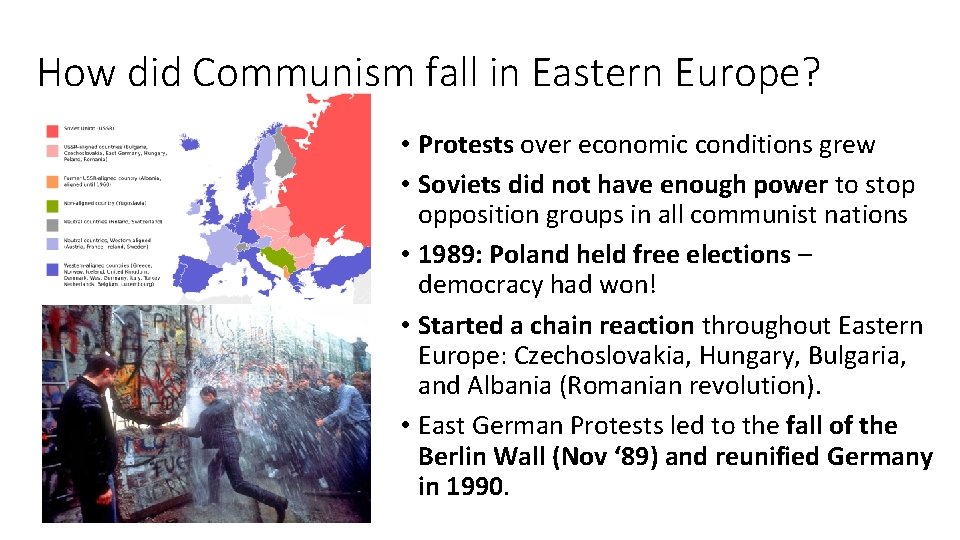
How did Communism fall in Eastern Europe? • Protests over economic conditions grew • Soviets did not have enough power to stop opposition groups in all communist nations • 1989: Poland held free elections – democracy had won! • Started a chain reaction throughout Eastern Europe: Czechoslovakia, Hungary, Bulgaria, and Albania (Romanian revolution). • East German Protests led to the fall of the Berlin Wall (Nov ‘ 89) and reunified Germany in 1990.
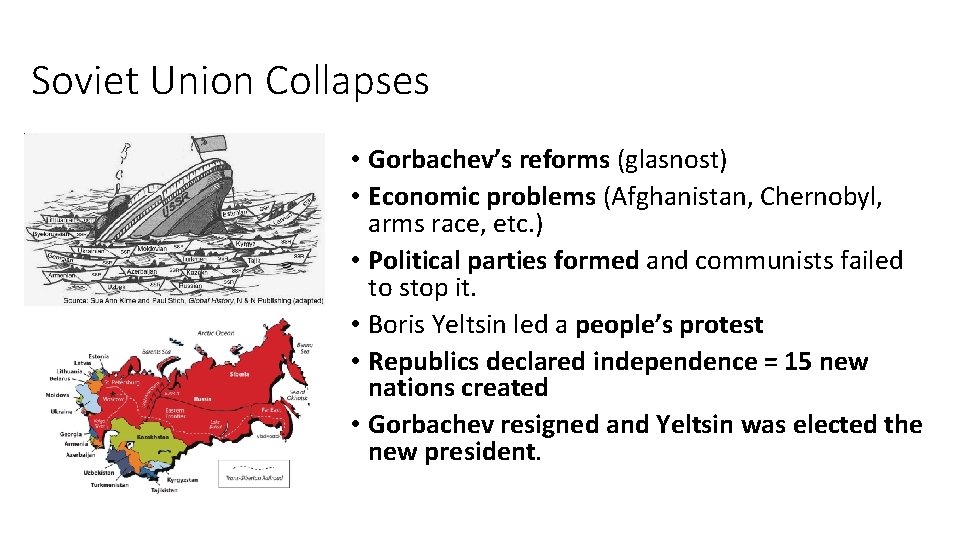
Soviet Union Collapses • Gorbachev’s reforms (glasnost) • Economic problems (Afghanistan, Chernobyl, arms race, etc. ) • Political parties formed and communists failed to stop it. • Boris Yeltsin led a people’s protest • Republics declared independence = 15 new nations created • Gorbachev resigned and Yeltsin was elected the new president.
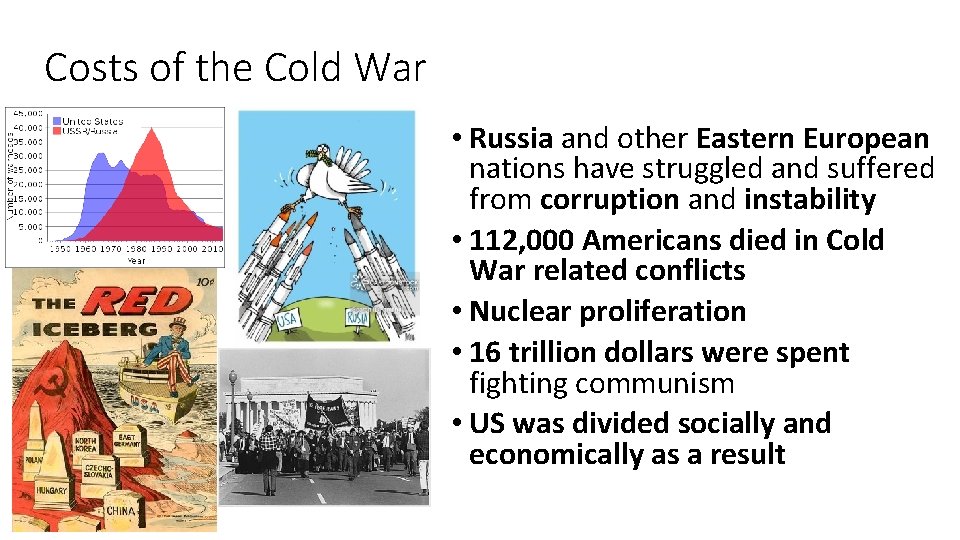
Costs of the Cold War • Russia and other Eastern European nations have struggled and suffered from corruption and instability • 112, 000 Americans died in Cold War related conflicts • Nuclear proliferation • 16 trillion dollars were spent fighting communism • US was divided socially and economically as a result