
The Cold War Imperial Russia The Romanov Dynasty
- Slides: 44
The Cold War
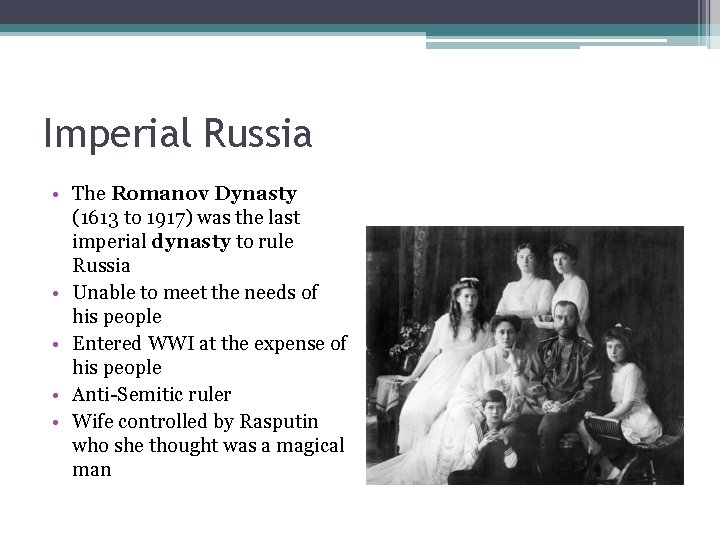
Imperial Russia • The Romanov Dynasty (1613 to 1917) was the last imperial dynasty to rule Russia • Unable to meet the needs of his people • Entered WWI at the expense of his people • Anti-Semitic ruler • Wife controlled by Rasputin who she thought was a magical man
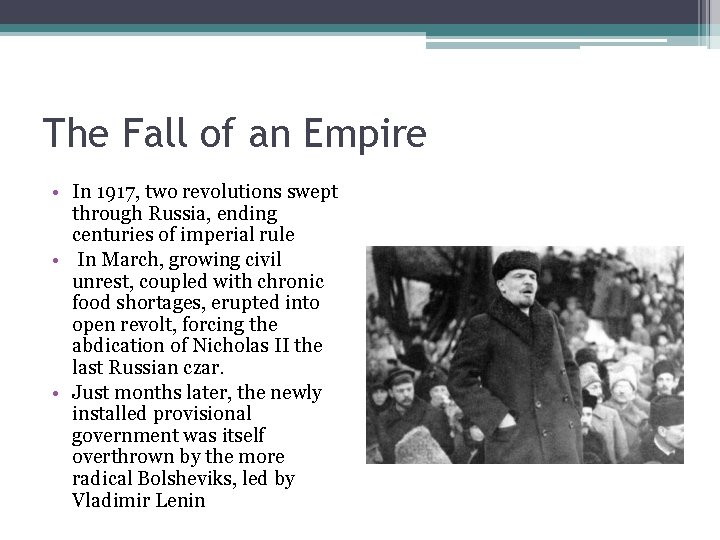
The Fall of an Empire • In 1917, two revolutions swept through Russia, ending centuries of imperial rule • In March, growing civil unrest, coupled with chronic food shortages, erupted into open revolt, forcing the abdication of Nicholas II the last Russian czar. • Just months later, the newly installed provisional government was itself overthrown by the more radical Bolsheviks, led by Vladimir Lenin
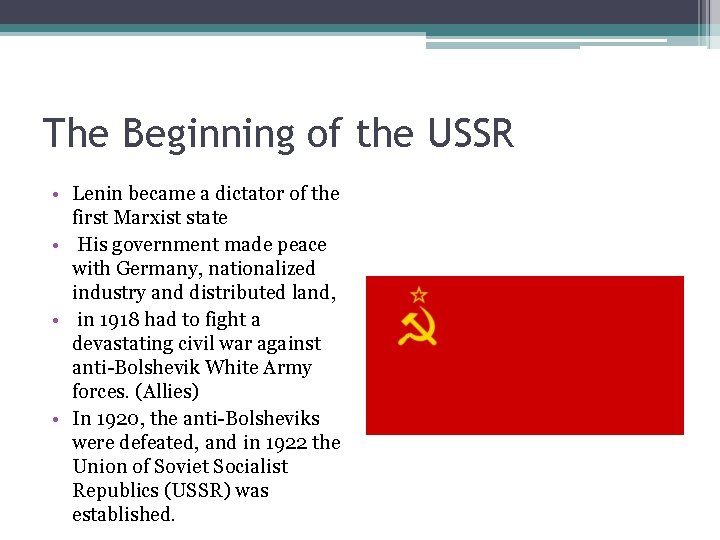
The Beginning of the USSR • Lenin became a dictator of the first Marxist state • His government made peace with Germany, nationalized industry and distributed land, • in 1918 had to fight a devastating civil war against anti-Bolshevik White Army forces. (Allies) • In 1920, the anti-Bolsheviks were defeated, and in 1922 the Union of Soviet Socialist Republics (USSR) was established.
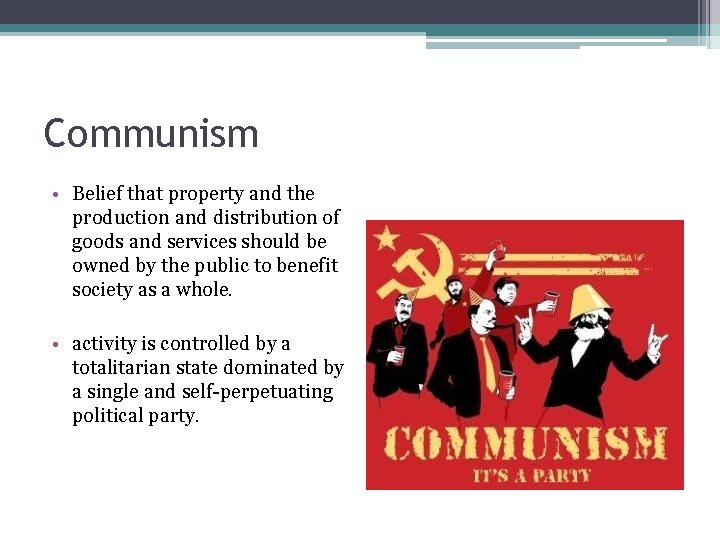
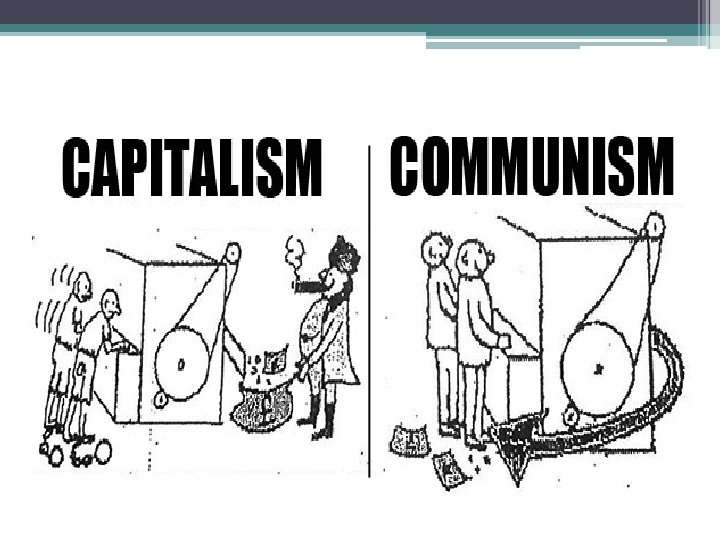
Communism • Belief that property and the production and distribution of goods and services should be owned by the public to benefit society as a whole. • activity is controlled by a totalitarian state dominated by a single and self-perpetuating political party.
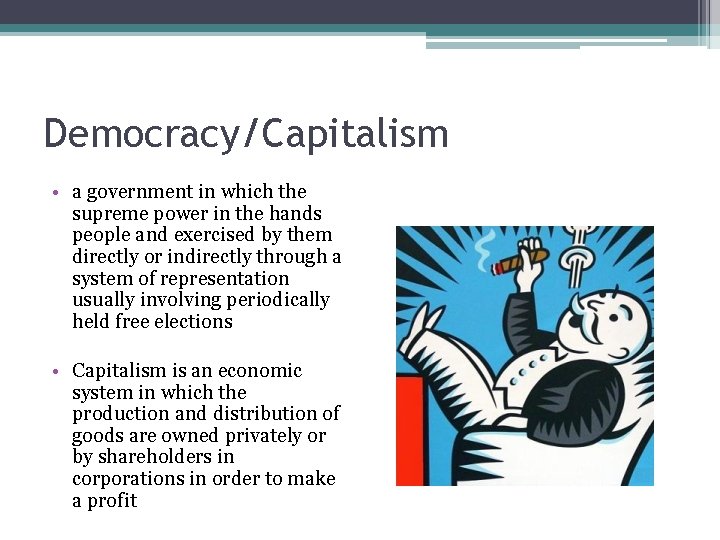
Democracy/Capitalism • a government in which the supreme power in the hands people and exercised by them directly or indirectly through a system of representation usually involving periodically held free elections • Capitalism is an economic system in which the production and distribution of goods are owned privately or by shareholders in corporations in order to make a profit
Why did they fear each other Soviet Union Fears the West The West fears the USSR • The USSR feared that the western nations would invade Soviet territory and impose capitalism in order to take power away from the proletariat • Western countries feared that communists planned to over throw the western societies in a world revolution • Already tried during the 1918 White revolution • Communist theory argued that the proletariat will inherit the means of production through a world wide revolution
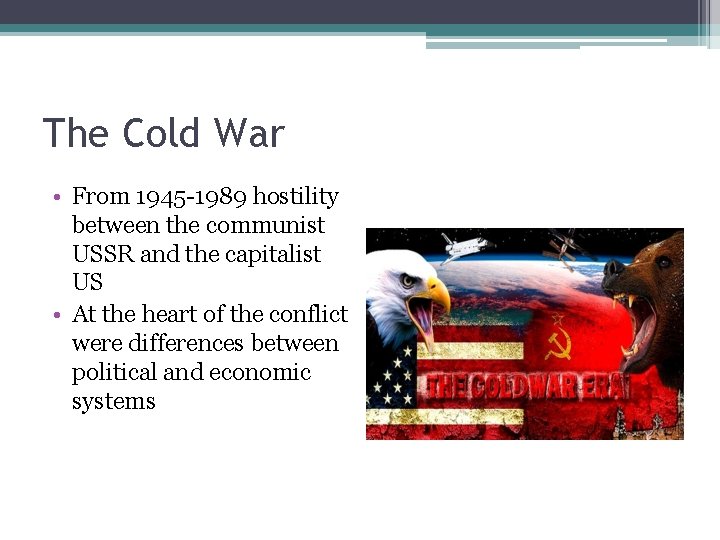
The Cold War • From 1945 -1989 hostility between the communist USSR and the capitalist US • At the heart of the conflict were differences between political and economic systems
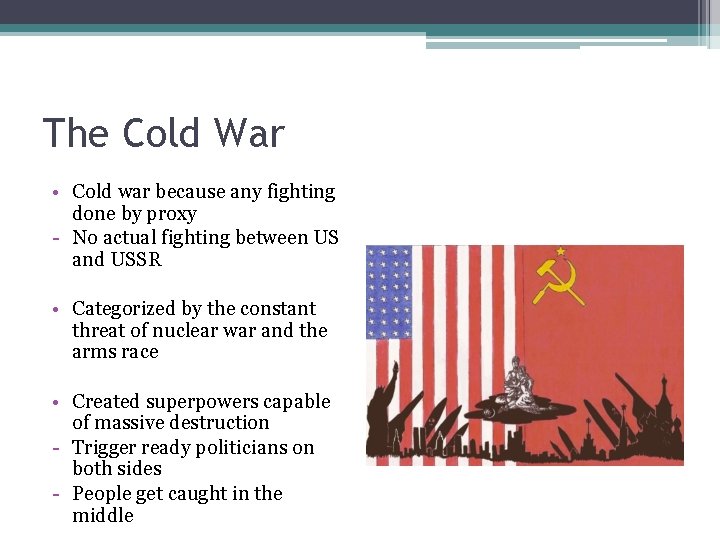
The Cold War • Cold war because any fighting done by proxy - No actual fighting between US and USSR • Categorized by the constant threat of nuclear war and the arms race • Created superpowers capable of massive destruction - Trigger ready politicians on both sides - People get caught in the middle
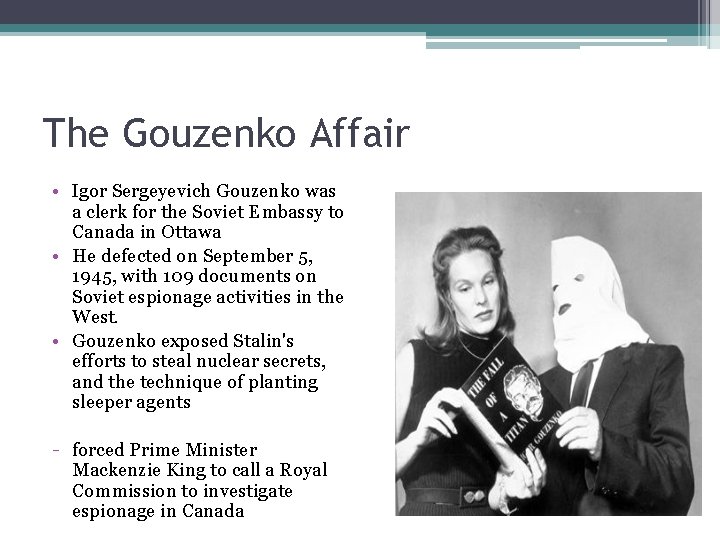
The Gouzenko Affair • Igor Sergeyevich Gouzenko was a clerk for the Soviet Embassy to Canada in Ottawa • He defected on September 5, 1945, with 109 documents on Soviet espionage activities in the West. • Gouzenko exposed Stalin's efforts to steal nuclear secrets, and the technique of planting sleeper agents - forced Prime Minister Mackenzie King to call a Royal Commission to investigate espionage in Canada
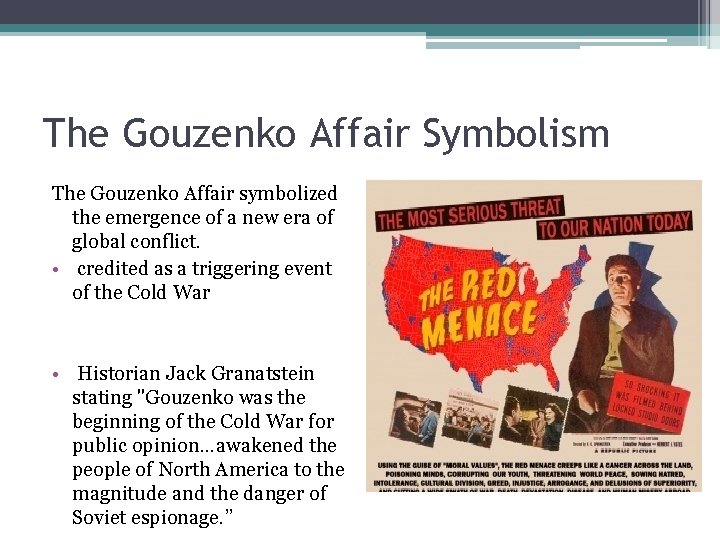
The Gouzenko Affair Symbolism The Gouzenko Affair symbolized the emergence of a new era of global conflict. • credited as a triggering event of the Cold War • Historian Jack Granatstein stating "Gouzenko was the beginning of the Cold War for public opinion…awakened the people of North America to the magnitude and the danger of Soviet espionage. ”
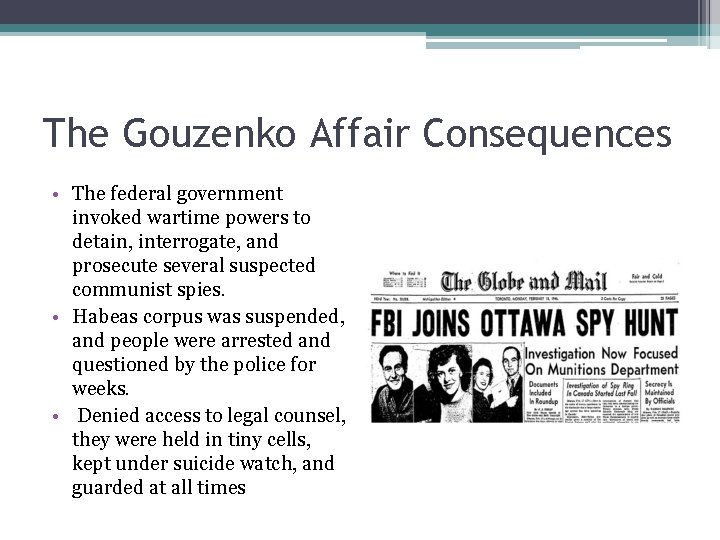
The Gouzenko Affair Consequences • The federal government invoked wartime powers to detain, interrogate, and prosecute several suspected communist spies. • Habeas corpus was suspended, and people were arrested and questioned by the police for weeks. • Denied access to legal counsel, they were held in tiny cells, kept under suicide watch, and guarded at all times
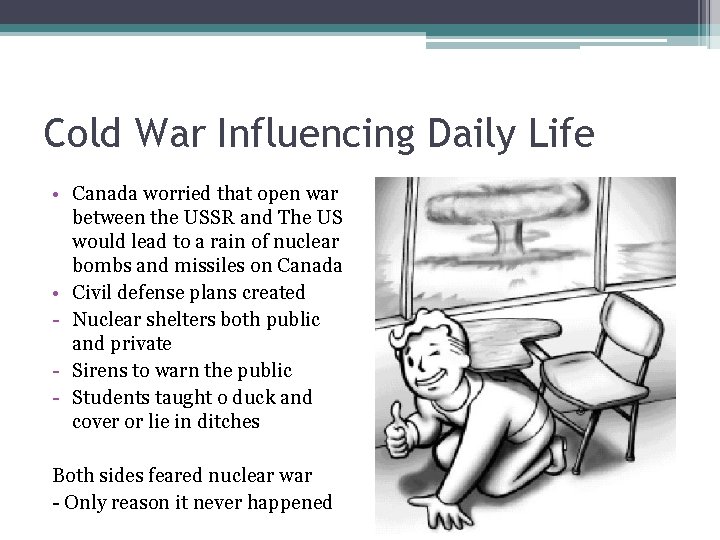
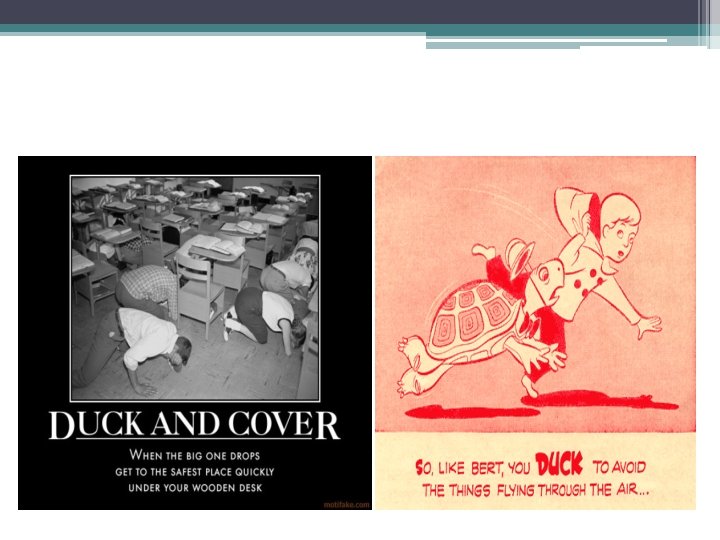
Cold War Influencing Daily Life • Canada worried that open war between the USSR and The US would lead to a rain of nuclear bombs and missiles on Canada • Civil defense plans created - Nuclear shelters both public and private - Sirens to warn the public - Students taught o duck and cover or lie in ditches Both sides feared nuclear war - Only reason it never happened
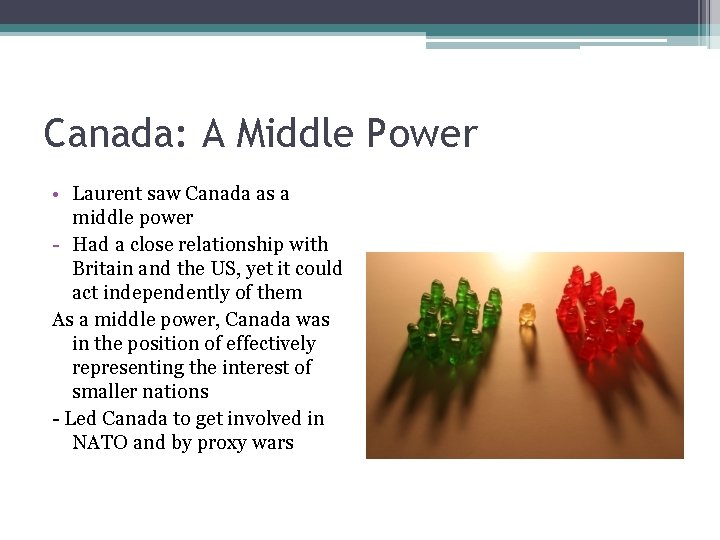
Canada: A Middle Power • Laurent saw Canada as a middle power - Had a close relationship with Britain and the US, yet it could act independently of them As a middle power, Canada was in the position of effectively representing the interest of smaller nations - Led Canada to get involved in NATO and by proxy wars
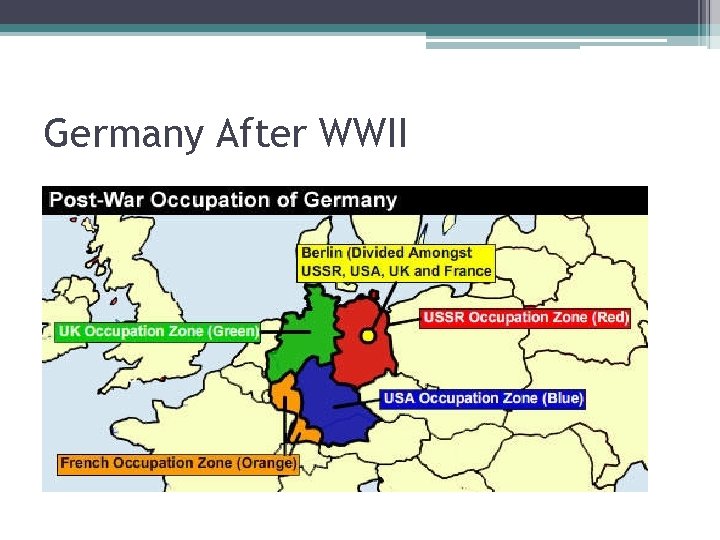
Germany After WWII
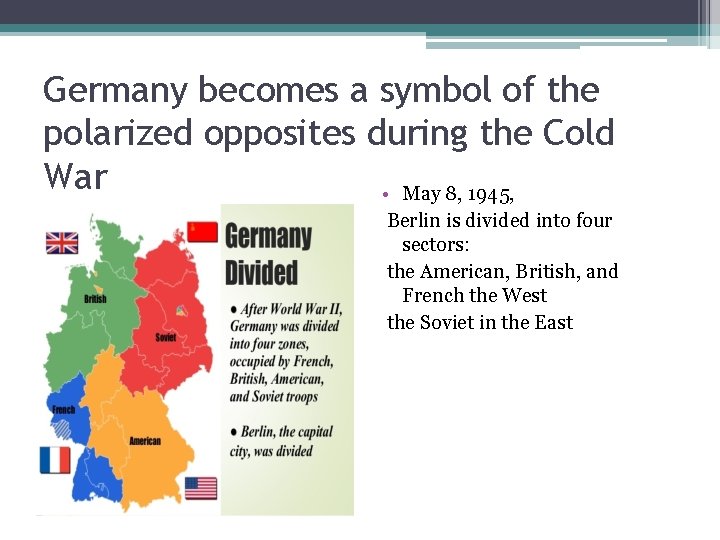
Germany becomes a symbol of the polarized opposites during the Cold War • May 8, 1945, Berlin is divided into four sectors: the American, British, and French the West the Soviet in the East
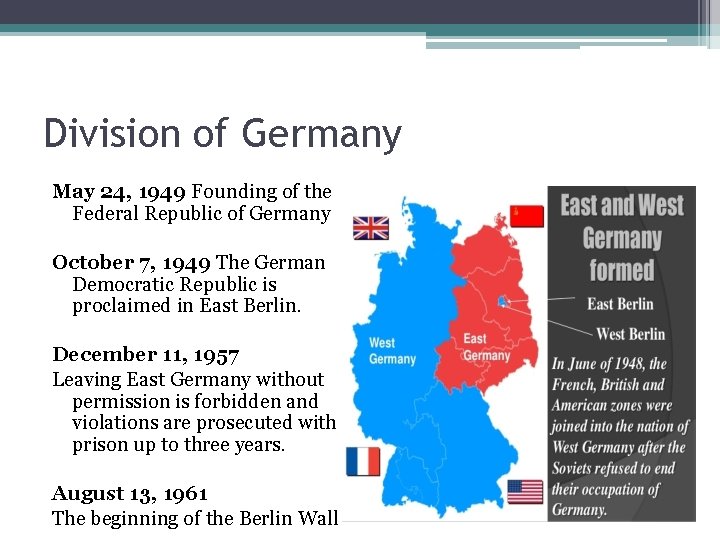
Division of Germany May 24, 1949 Founding of the Federal Republic of Germany October 7, 1949 The German Democratic Republic is proclaimed in East Berlin. December 11, 1957 Leaving East Germany without permission is forbidden and violations are prosecuted with prison up to three years. August 13, 1961 The beginning of the Berlin Wall
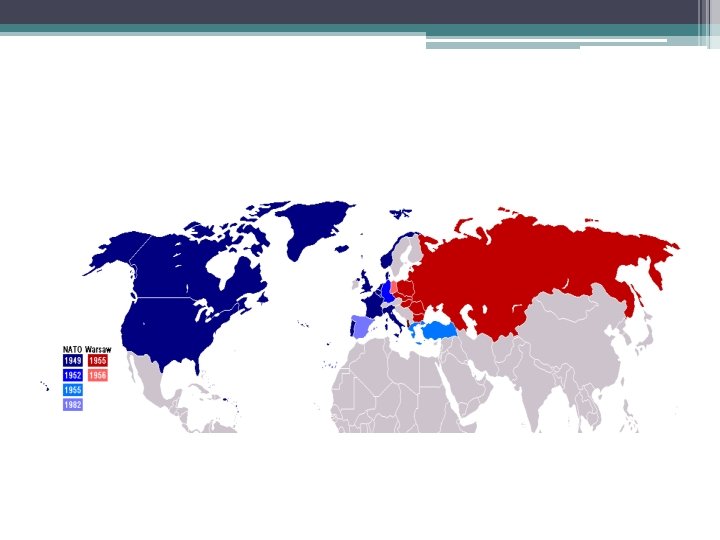
North Atlantic Treaty Organization 1949 Mutual defense organization set up to protect several Western European countries, Canada, and the US from possible aggression from the USSR - An attack on one NATO member would be considered as an attack on all - Willing to use short range nuclear weapons, or wage total nuclear war
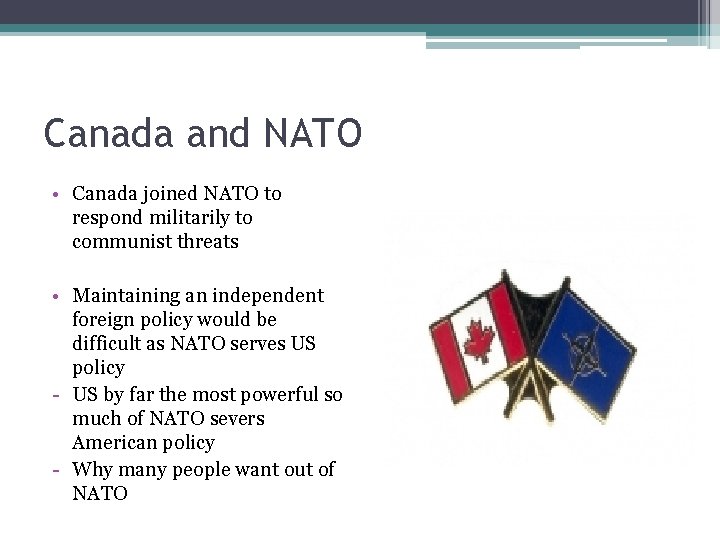
Canada and NATO • Canada joined NATO to respond militarily to communist threats • Maintaining an independent foreign policy would be difficult as NATO serves US policy - US by far the most powerful so much of NATO severs American policy - Why many people want out of NATO
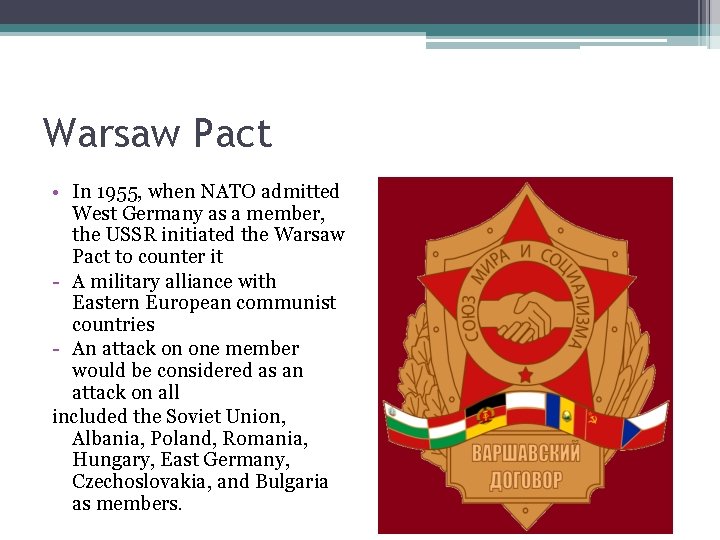
Warsaw Pact • In 1955, when NATO admitted West Germany as a member, the USSR initiated the Warsaw Pact to counter it - A military alliance with Eastern European communist countries - An attack on one member would be considered as an attack on all included the Soviet Union, Albania, Poland, Romania, Hungary, East Germany, Czechoslovakia, and Bulgaria as members.
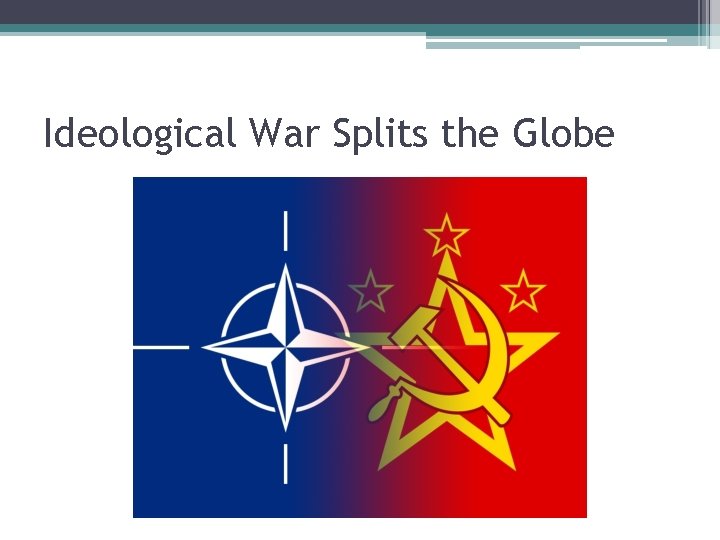
Ideological War Splits the Globe
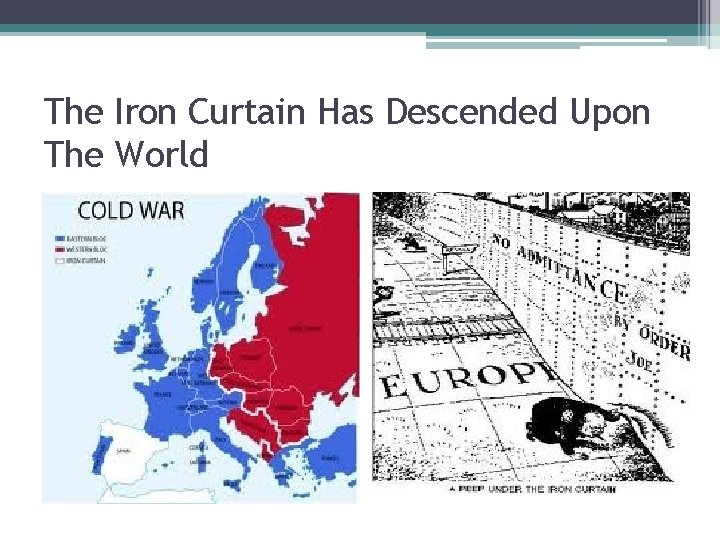
Global Impact of NATO and Warsaw • The creation of NATO and the Warsaw Pact effectively divided the Northern Hemisphere into 2 hostile camps - Armies constantly practiced for war Local population taught to fear the other camp Spies attempting to infiltrate gov secrets Assassinations Provoking revolution and counter-revolutions
The Iron Curtain Has Descended Upon The World
North American Aerospace Defense Command • Diefenbaker committed Canada to NORAD 1958 This meant that Canada and the US had become part of a joint coordinated continental air defense against the threat of attack from the Soviet Union - Missile bases - Air bombers armed with nuclear weapons - Air defense radar systems to detect missile attacks
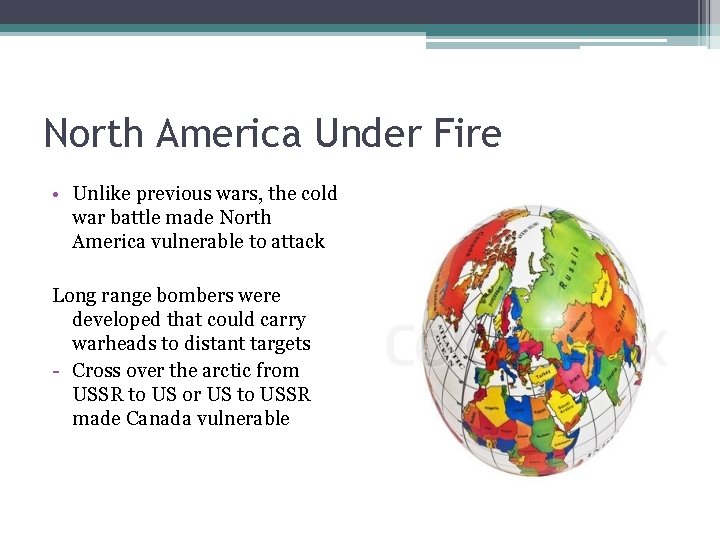
North America Under Fire • Unlike previous wars, the cold war battle made North America vulnerable to attack Long range bombers were developed that could carry warheads to distant targets - Cross over the arctic from USSR to US or US to USSR made Canada vulnerable
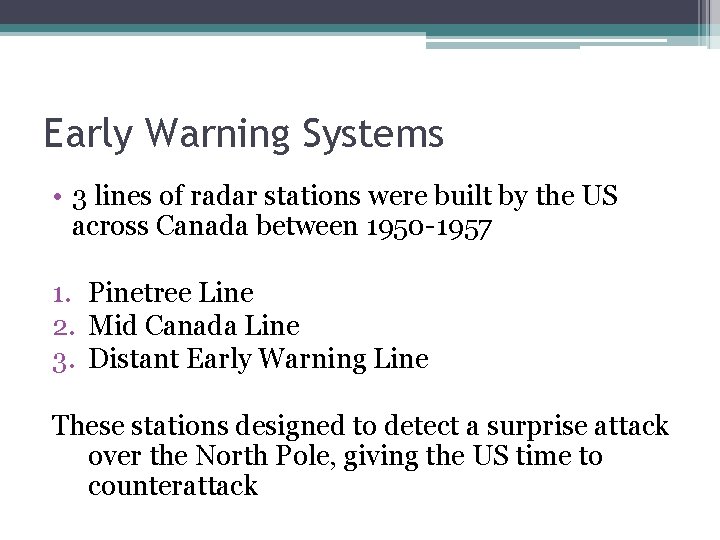
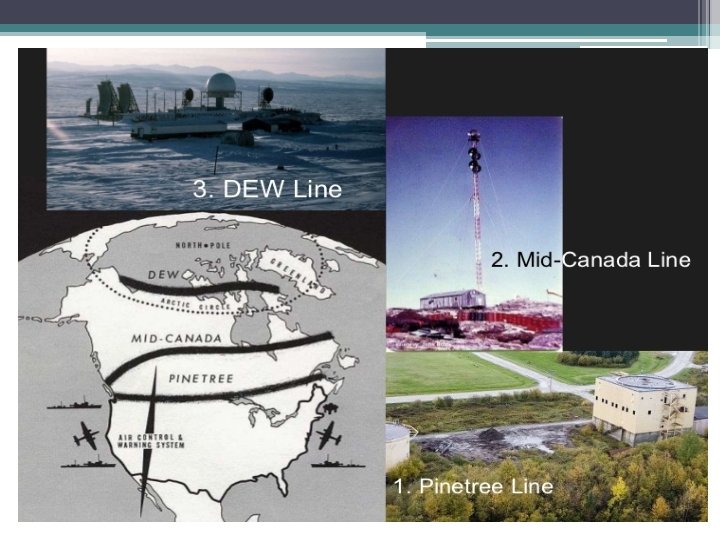
Early Warning Systems • 3 lines of radar stations were built by the US across Canada between 1950 -1957 1. Pinetree Line 2. Mid Canada Line 3. Distant Early Warning Line These stations designed to detect a surprise attack over the North Pole, giving the US time to counterattack
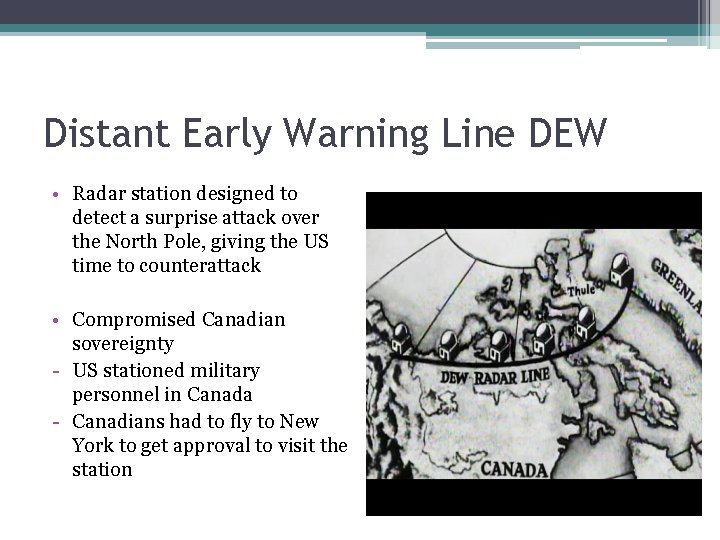
Distant Early Warning Line DEW • Radar station designed to detect a surprise attack over the North Pole, giving the US time to counterattack • Compromised Canadian sovereignty - US stationed military personnel in Canada - Canadians had to fly to New York to get approval to visit the station
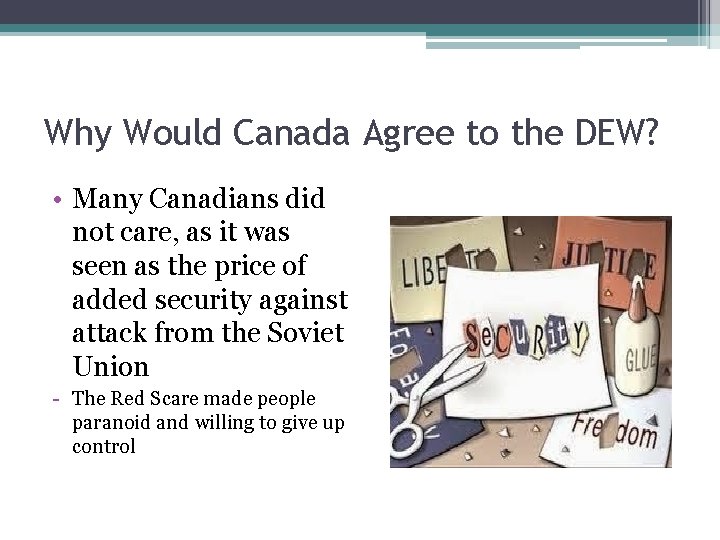
Why Would Canada Agree to the DEW? • Many Canadians did not care, as it was seen as the price of added security against attack from the Soviet Union - The Red Scare made people paranoid and willing to give up control
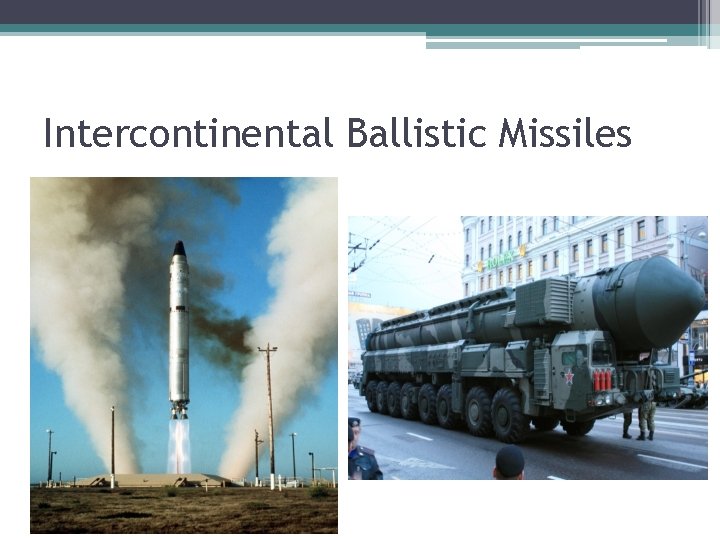
Intercontinental Ballistic Missiles • IBM’s made the DEW line obsolete - Armed with nuclear warheads - They could travel from the USSR to North America in 30 minutes - Made radar stations ineffective as there is no response time
Intercontinental Ballistic Missiles
Canada and the United Nations • The UN is an organization established to maintain global peace and order Canada has been a strong supporter of UN policies - aid refugees Work on development projects collective security Peacekeeping missions
The Power of the VETO • The use of the VETO in the security Council has often prevented the UN from taking action • By 1955, as the cold war escalated, the veto was used 78 times - 75 by the USSR - UN is unable to reduce tensions
Canada's Major Contribution to the UN • Canadian peacekeepers have been involved in every UN operation since 1956 - Suez Canal Crisis was the first time Canadian Peacekeepers units implemented
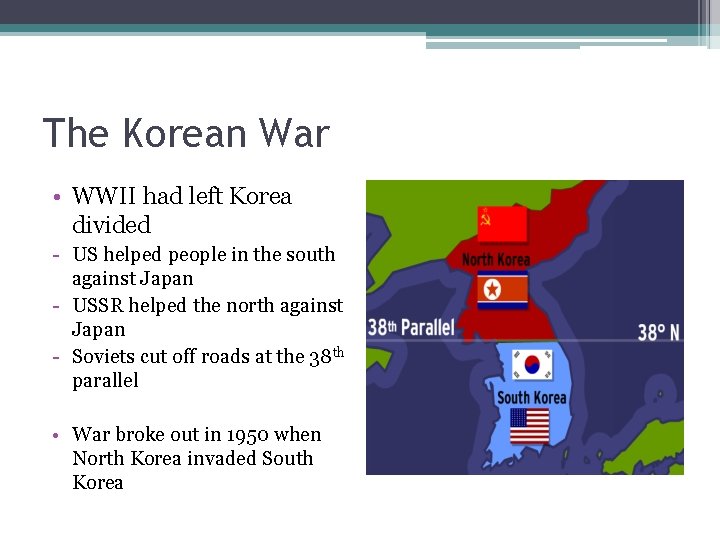
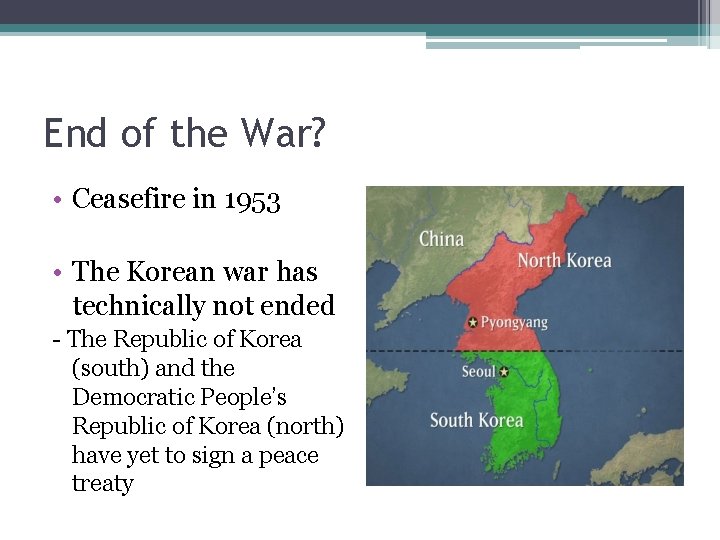
The Korean War • WWII had left Korea divided - US helped people in the south against Japan - USSR helped the north against Japan - Soviets cut off roads at the 38 th parallel • War broke out in 1950 when North Korea invaded South Korea
The Korean War North Korea South Korea • USSR and communist China supported the North Korea as it was a communist state • Could not use the VETO in the UN as it was boycotting the UN for not allowing communist China to join • The US supported South Korea which had a fragile democracy • UN called on members to support South Korea
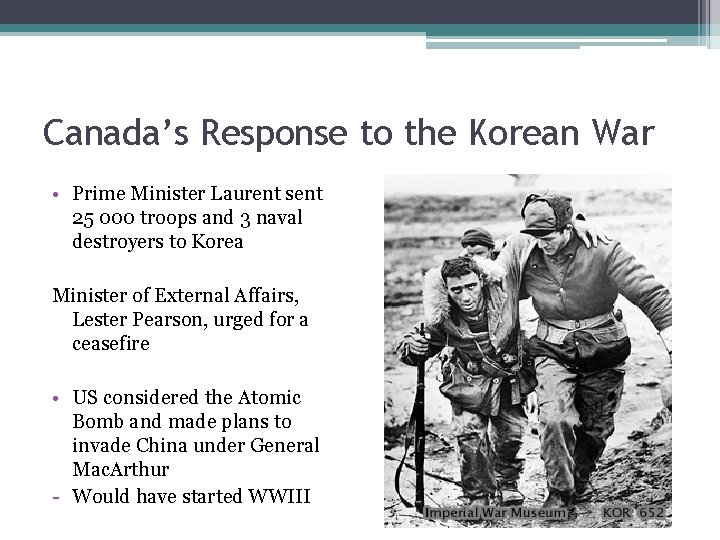
Canada’s Response to the Korean War • Prime Minister Laurent sent 25 000 troops and 3 naval destroyers to Korea Minister of External Affairs, Lester Pearson, urged for a ceasefire • US considered the Atomic Bomb and made plans to invade China under General Mac. Arthur - Would have started WWIII
End of the War? • Ceasefire in 1953 • The Korean war has technically not ended - The Republic of Korea (south) and the Democratic People’s Republic of Korea (north) have yet to sign a peace treaty
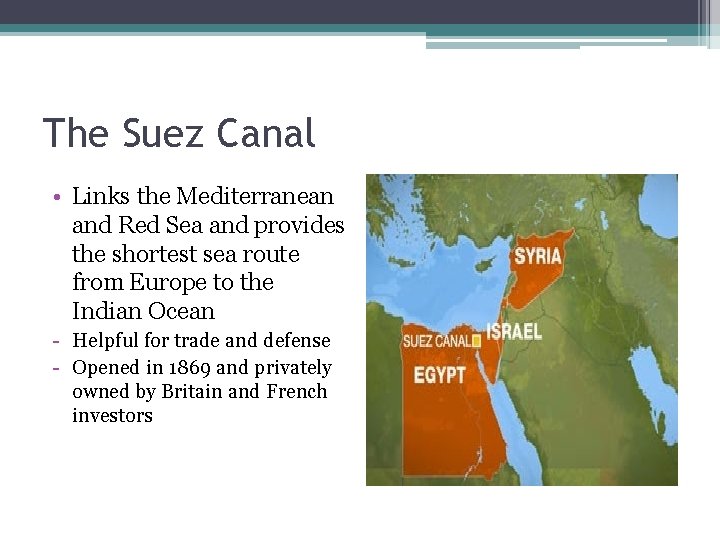
The Suez Canal • Links the Mediterranean and Red Sea and provides the shortest sea route from Europe to the Indian Ocean - Helpful for trade and defense - Opened in 1869 and privately owned by Britain and French investors
The Suez Canal • Britain, France, and Israel upset when President Nassar took over the canal in 1956 because he banned ships traveling to and from Israel • Britain, France, and Israel implemented “Operation Musketeer” in which they landed troops in the canal zone - Did not consult US and ignored UN call for ceasing hostilities - USSR immediately gave military support to Egypt
Canada and the Suez Canal Crisis Leaster Pearson Minister of External Affairs went to the UN and proposed a multinational peacekeeping force be created and installed in the war zone to maintain ceasefires and oversea the withdrawal of troops - The United Nations Emergency Force created to help bring hostilities to a peaceful end - Canada gained the reputation as an impartial and peacekeeping force - Pearson got the Nobel Peace Prize in 1957