
The Cold War Heats Up China Becomes a
The Cold War Heats Up
China Becomes a Communist Country - The U. S. begins sending aid (3 billion) to the Chinese Nationalist government led by Chiang Kai-shek - The U. S. government saw the government corrupt and inefficient - U. S citizens admired the nationalists for resisting Japan during the war - Soon a new Communist party led by Mao Zedong began to gain support in China - Supported by peasants because the Communist were providing them with food and education
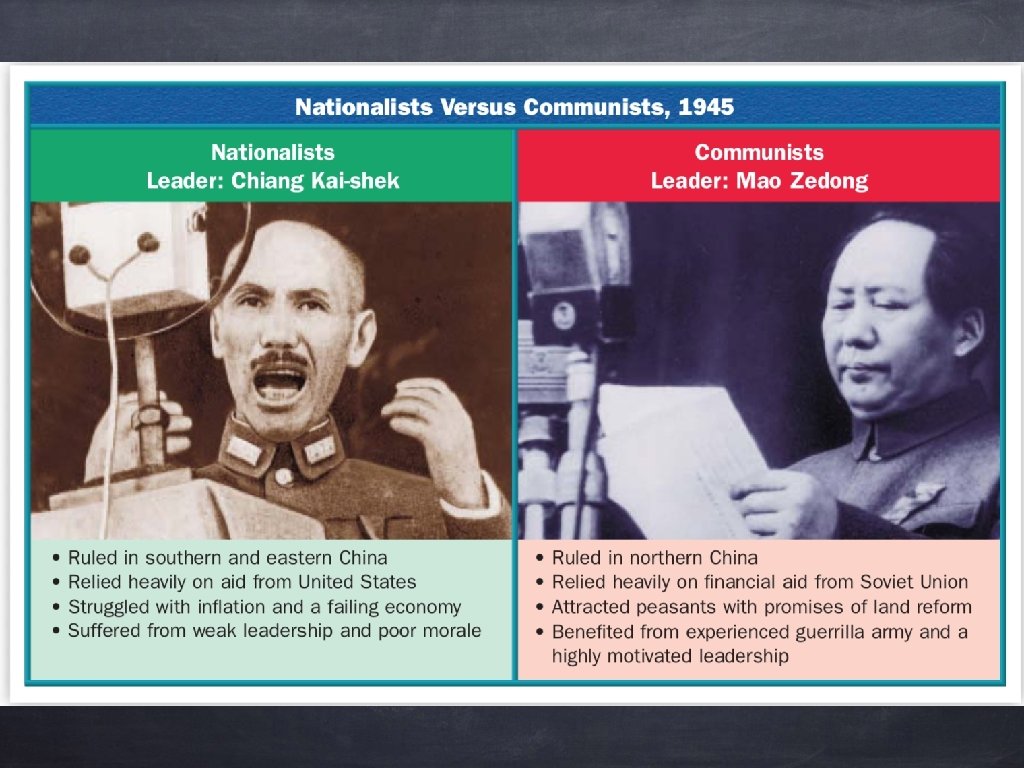
Renewed Civil War - Communist versus Nationalists - Between 1944 and 47 the U. S. continued to send military and monetary (2 billion) aid to Nationalists to oppose communism - The U. S failed to negate decease even though they were playing peacemakers - In 1949, Chinese Nationalists flee to island of Taiwan - Communists establish People’s Republic of China in mainland - With the support of the Red Army (U. S. S. R)
- Due to their disagreement with Communist ideals the U. S. does not formally recognize the newly established Communist Chinese government - The United States public was stunned and out of fear many began blaming Truman for not opposing troops enough aid - State Departments blames the rise of communism in China on internal forces - Some believed that this was simply an excuse and that the government is filled with Communist - U. S. felt that their policy of containment failed - Lead to an increased fear of communism spreading abroad and throughout the country
The Korean War - Japan had annexed and ruled Korea from 1910 -1945 - Post WWII-Korea was Deeply Divided- In the North, Communist forces controlled the region (after Japan had surrendered to the Soviets at the end of WWII) while the U. S. supported the efforts of the south Koreans - Similar to Germany
- In 1950, North Korea attacked South Korea - This was after America had withdrawn most of their troops, so the Soviet Union pushed North Korea to attack by preparing them with tanks, airplanes, and money - Following this attack South Korea asks for help from the United Nations and United States - Sixteen other nations join in but the U. S. ultimately provides ninety percent of the troops (520, 000 troops total) - Under the leadership of Macarthur and the might of U. S. forces North Korea was finally pushed back into their own territory - This saved his army from almost certain defeat - Seemed as if Korea would be a single country again
- Then the Chinese aided the North Koreans, and pushed back to 38 th parallel (38º N latitude) - Chinese felt threatened by the American fleet near their coast - The Korean War had escalated into a war where the main opponents were Chinese Communist versus Americans - In 1951, Mac. Arthur suggests attacking Chinan with nuclear weapons but Truman disagrees saying that attacking China would bring Russia into the conflict and potentially start WWIII - Mac. Arthur calls Truman “weak” and tries to go behind his back, but gets removed from his post - Wrote to newspapers, magazines and to Republican leaders - U. S people were upset by the removal of Mac. Arthur
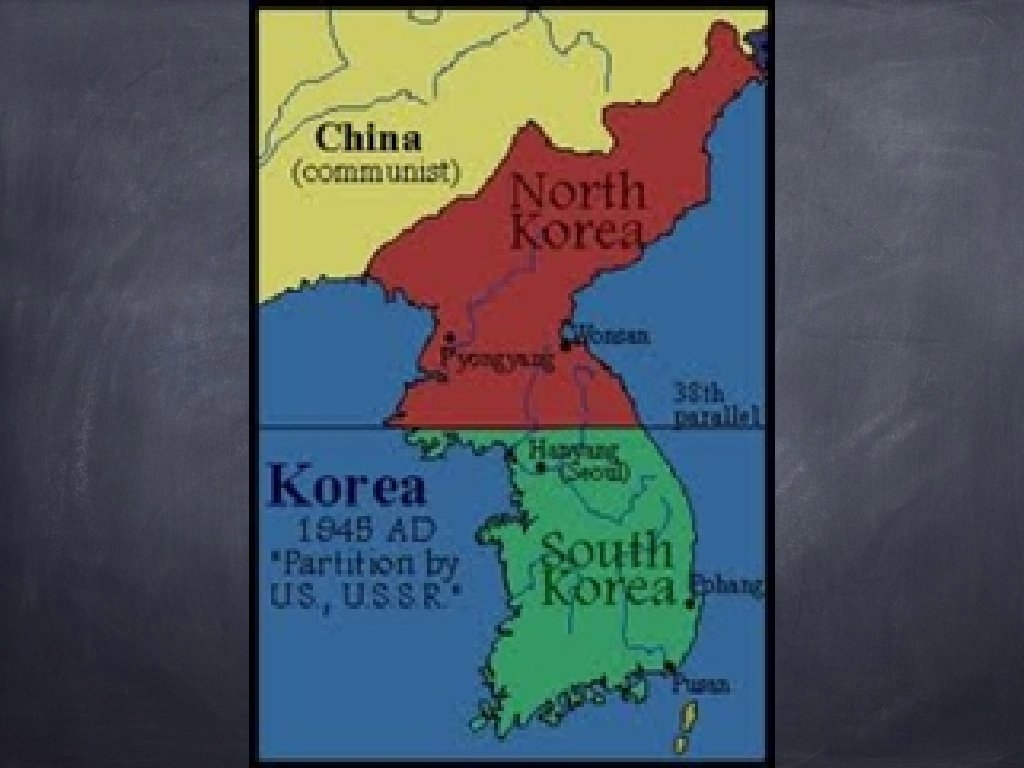
- In 1951 the Soviets suggest peace talks that could end the war - Two points for peace are agreed upon: - 38 th parallel (38º N latitude) becomes the dividing line in Korea - The U. S. S. R. controls the area north of 38 th parallel and the United States will help guide the area south of the 38 th parallel - Republic of Korea (South), Democratic People’s Republic of Korea (North) were founded - A demilitarized zone (known as the DMZ) is created along this dividing line in hopes of preventing future conflicts - This was finalized in July 1953
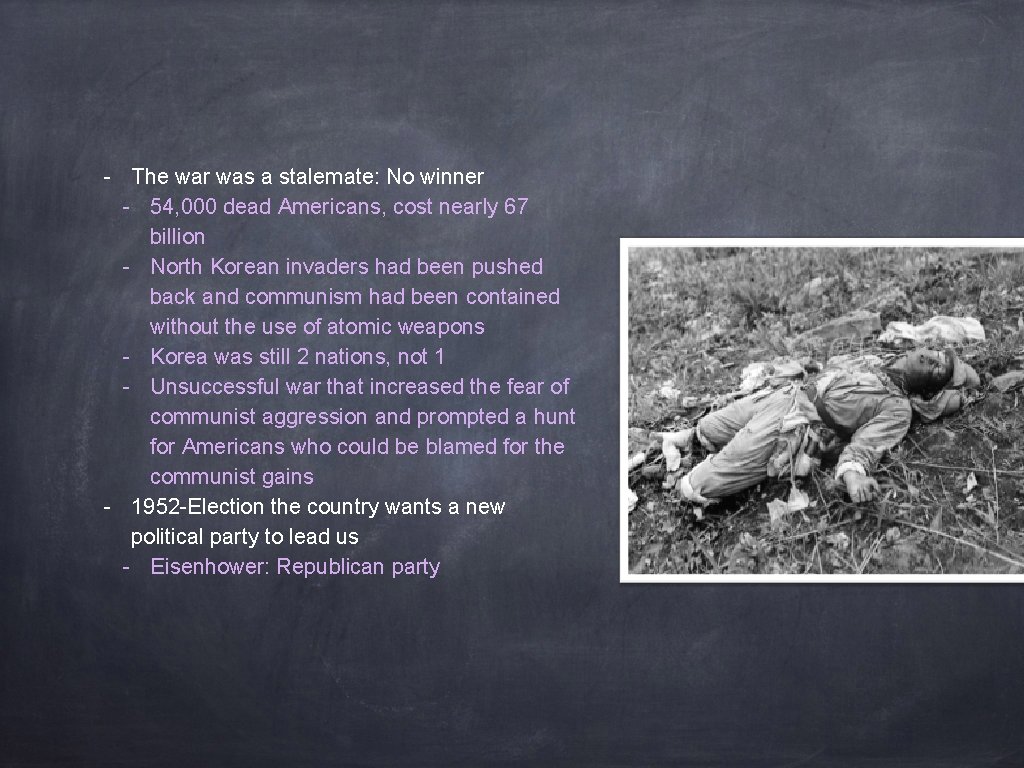
- The war was a stalemate: No winner - 54, 000 dead Americans, cost nearly 67 billion - North Korean invaders had been pushed back and communism had been contained without the use of atomic weapons - Korea was still 2 nations, not 1 - Unsuccessful war that increased the fear of communist aggression and prompted a hunt for Americans who could be blamed for the communist gains - 1952 -Election the country wants a new political party to lead us - Eisenhower: Republican party
- Slides: 11