
The Cold War Central and South America Guatemala
- Slides: 24
The Cold War – Central and South America
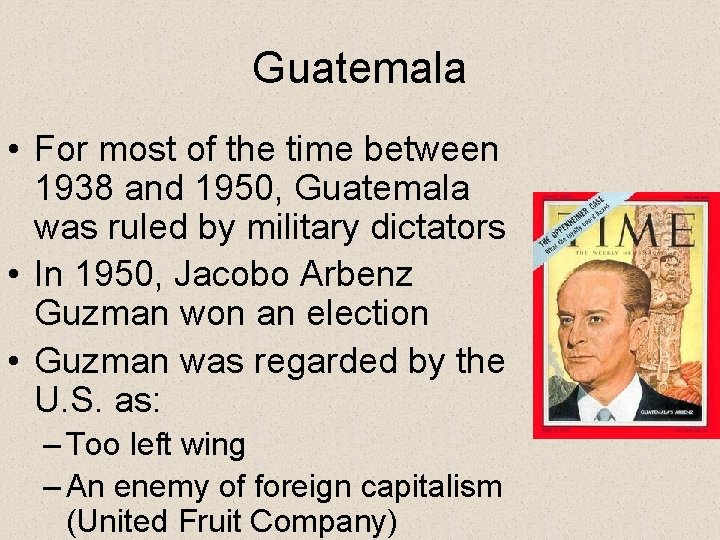
Guatemala • For most of the time between 1938 and 1950, Guatemala was ruled by military dictators • In 1950, Jacobo Arbenz Guzman won an election • Guzman was regarded by the U. S. as: – Too left wing – An enemy of foreign capitalism (United Fruit Company)
Guatemala • President Guzman: – Distributed lands to the peasants – Supported strikers against foreign companies – Legalized the Communist Party – Introduced a minimum wage – Built new schools and hospitals
Guatemala • U. S. Secretary of State John Foster Dulles tried to persuade others countries to condemn Guzman’s government • When they didn’t: – All U. S. aid was stopped – Guerillas were armed by Washington – U. S. pressured other states not to sell arms to Guatemala
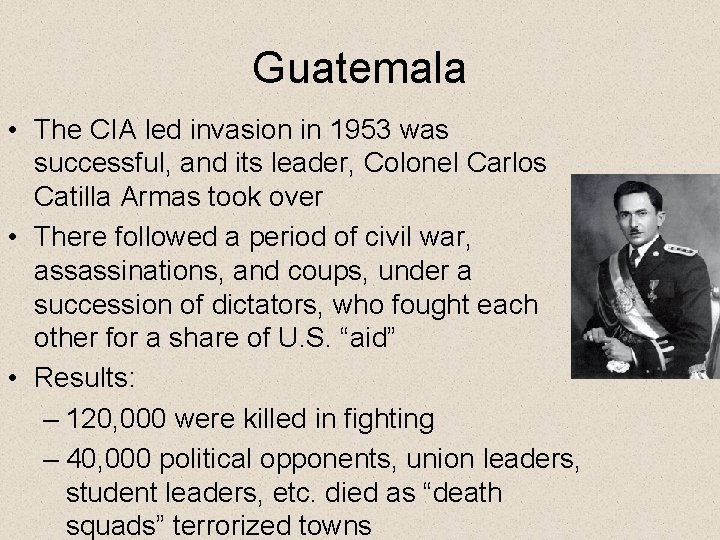
Guatemala • The CIA led invasion in 1953 was successful, and its leader, Colonel Carlos Catilla Armas took over • There followed a period of civil war, assassinations, and coups, under a succession of dictators, who fought each other for a share of U. S. “aid” • Results: – 120, 000 were killed in fighting – 40, 000 political opponents, union leaders, student leaders, etc. died as “death squads” terrorized towns
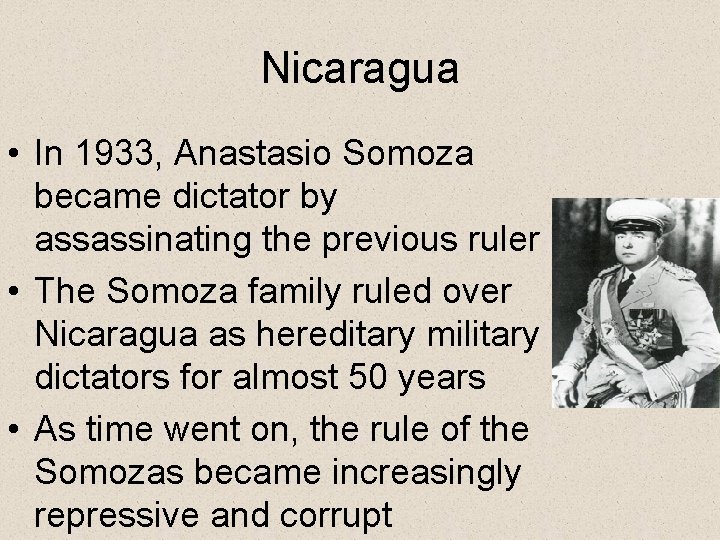
Nicaragua • In 1933, Anastasio Somoza became dictator by assassinating the previous ruler • The Somoza family ruled over Nicaragua as hereditary military dictators for almost 50 years • As time went on, the rule of the Somozas became increasingly repressive and corrupt
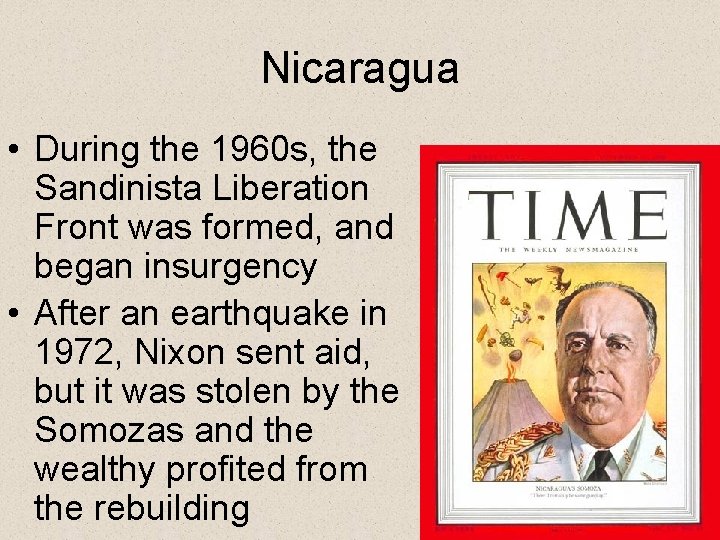
Nicaragua • During the 1960 s, the Sandinista Liberation Front was formed, and began insurgency • After an earthquake in 1972, Nixon sent aid, but it was stolen by the Somozas and the wealthy profited from the rebuilding
Nicaragua • In 1979, the Somozas were finally driven out, and the country was governed by a collective leadership by the Marxists • They: – Nationalized foreign owned enterprises – Redistributed land to the poor – Conducted a literacy campaign – Conducted a public health campaign
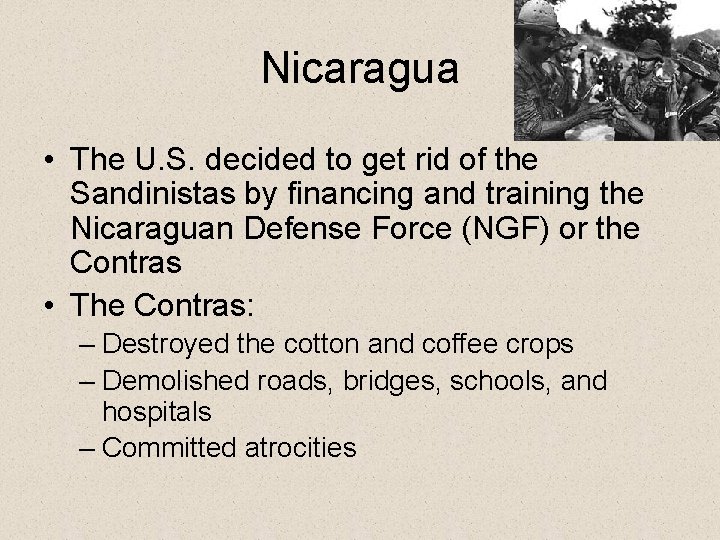
Nicaragua • The U. S. decided to get rid of the Sandinistas by financing and training the Nicaraguan Defense Force (NGF) or the Contras • The Contras: – Destroyed the cotton and coffee crops – Demolished roads, bridges, schools, and hospitals – Committed atrocities
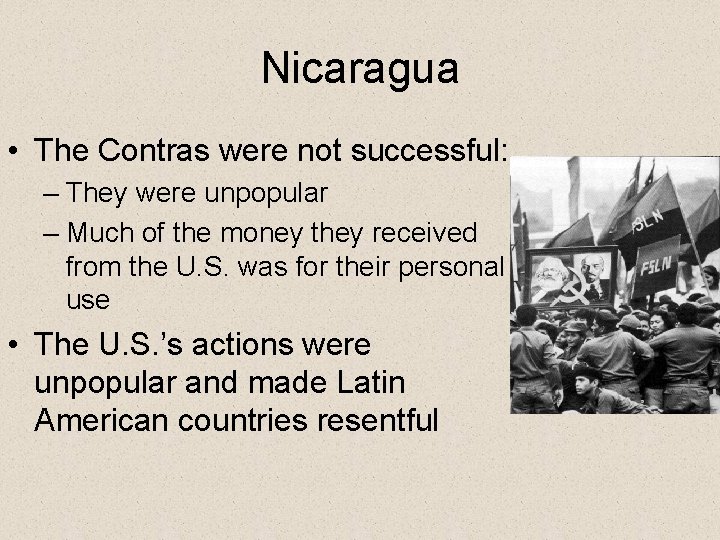
Nicaragua • The Contras were not successful: – They were unpopular – Much of the money they received from the U. S. was for their personal use • The U. S. ’s actions were unpopular and made Latin American countries resentful
Nicaragua • In 1986, Irangate or the Iran Contra Affair broke out • President Reagan had secretly sold arms to the Iranians in order to secure the release of the hostages in the U. S. embassy in Teheran • The profits had been used, illegally, to finance the contras • Most of those responsible, including President Reagan, who said that he did not ‘remember’ authorizing the deal, escaped punishment
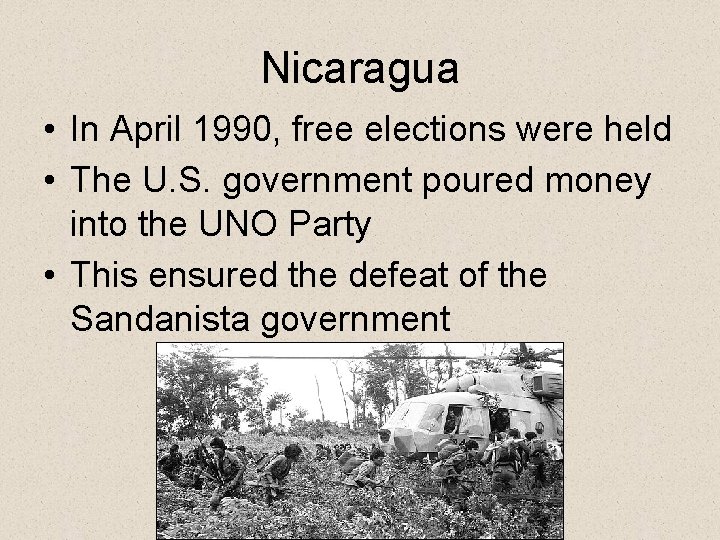
Nicaragua • In April 1990, free elections were held • The U. S. government poured money into the UNO Party • This ensured the defeat of the Sandanista government
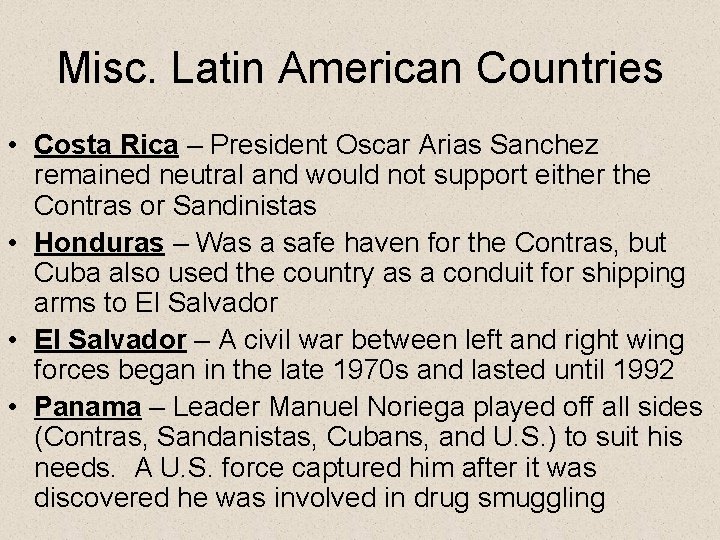
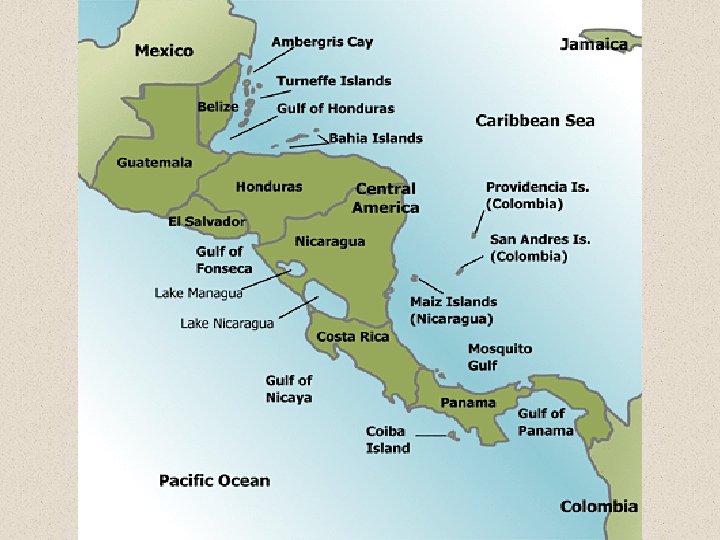
Misc. Latin American Countries • Costa Rica – President Oscar Arias Sanchez remained neutral and would not support either the Contras or Sandinistas • Honduras – Was a safe haven for the Contras, but Cuba also used the country as a conduit for shipping arms to El Salvador • El Salvador – A civil war between left and right wing forces began in the late 1970 s and lasted until 1992 • Panama – Leader Manuel Noriega played off all sides (Contras, Sandanistas, Cubans, and U. S. ) to suit his needs. A U. S. force captured him after it was discovered he was involved in drug smuggling
Peru • In 1968, Peru's reformist president was ousted by a leftist military coup • The new junta instituted social reforms and seized some American-owned businesses, while importing Soviet weapons and advisers • In 1974, Peru expelled some U. S. Embassy and Peace Corps personnel, accusing them of spying for the CIA • A democratic system of government resumed in 1980 • Two insurgent communist groups still threaten the government: – The Senderos terrorized both rural and urban areas – The Tupac Amaru took hostages at Christmas Party at the Japanese ambassador’s residence in 1996
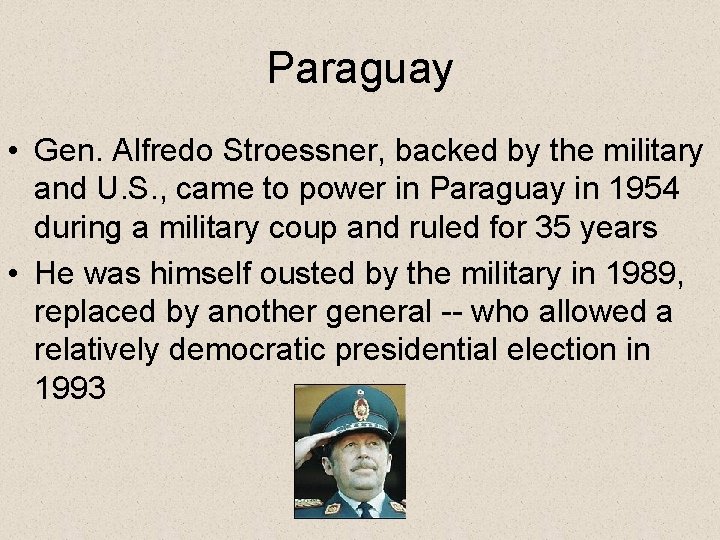
Paraguay • Gen. Alfredo Stroessner, backed by the military and U. S. , came to power in Paraguay in 1954 during a military coup and ruled for 35 years • He was himself ousted by the military in 1989, replaced by another general -- who allowed a relatively democratic presidential election in 1993
Uruguay • Beginning in the 1960 s, the Tupamaros, a Marxist guerrilla group, began making headlines with their attacks against government targets • The Tupamaros attacks, coupled with growing economic and political unrest, led to the establishment of a repressive military government in 1973 • Uruguay's ruling junta worked toward a transition to democracy, which led to presidential elections in 1984
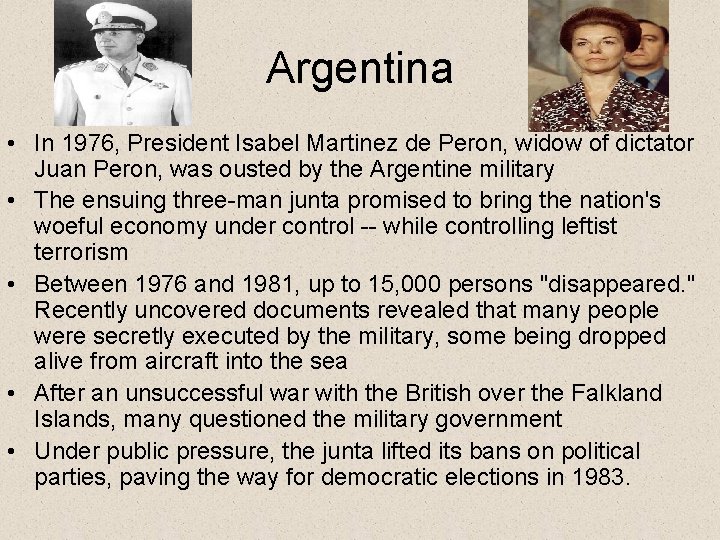
Argentina • In 1976, President Isabel Martinez de Peron, widow of dictator Juan Peron, was ousted by the Argentine military • The ensuing three-man junta promised to bring the nation's woeful economy under control -- while controlling leftist terrorism • Between 1976 and 1981, up to 15, 000 persons "disappeared. " Recently uncovered documents revealed that many people were secretly executed by the military, some being dropped alive from aircraft into the sea • After an unsuccessful war with the British over the Falkland Islands, many questioned the military government • Under public pressure, the junta lifted its bans on political parties, paving the way for democratic elections in 1983.
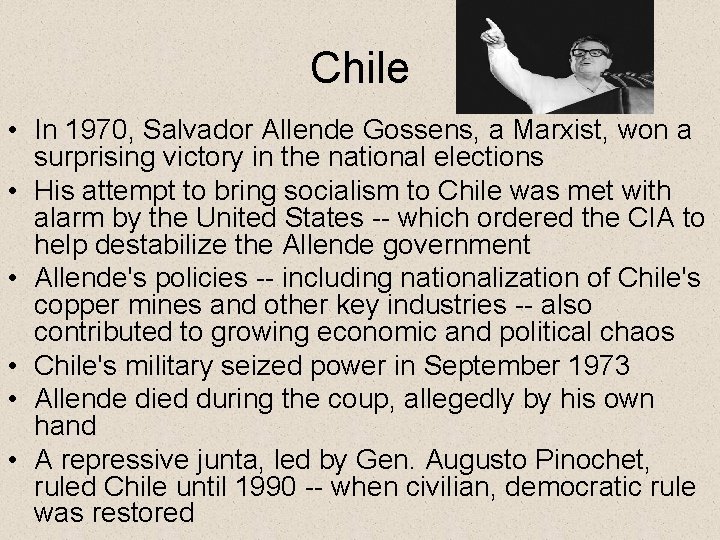
Chile • In 1970, Salvador Allende Gossens, a Marxist, won a surprising victory in the national elections • His attempt to bring socialism to Chile was met with alarm by the United States -- which ordered the CIA to help destabilize the Allende government • Allende's policies -- including nationalization of Chile's copper mines and other key industries -- also contributed to growing economic and political chaos • Chile's military seized power in September 1973 • Allende died during the coup, allegedly by his own hand • A repressive junta, led by Gen. Augusto Pinochet, ruled Chile until 1990 -- when civilian, democratic rule was restored
Brazil • The nation's armed forces ousted President Joao Goulart in 1964, replacing him with a military government • The regime came under international condemnation several years later for its alleged human rights abuses • In turn, Brazil's military charged that its most outspoken critic, the Catholic Church, was involved in communist-oriented work with the poor
Brazil • In the mid-1970 s, Brazil's continued economic decline brought about a pragmatic decision by the military government: It became the first nation in Central and South America -- besides Cuba -- to recognize the leftist MPLA in Angola's civil war • The decision apparently centered on Brazil's need, at the time, to import Angolan coffee and oil • Brazil returned to an elected, civilian government in 1985
Columbia • Leftist insurgencies began in Colombia in the 1970 s and have continued into the 1990 s • Most communist guerrilla groups ended their rebellions in the early 1990 s following the collapse of the Soviet Union • Two Marxist groups, the ELN and FARC, are still in operation and control about 40 percent of Colombian territory • Recent attempts at peace talks between the government and the rebels have failed
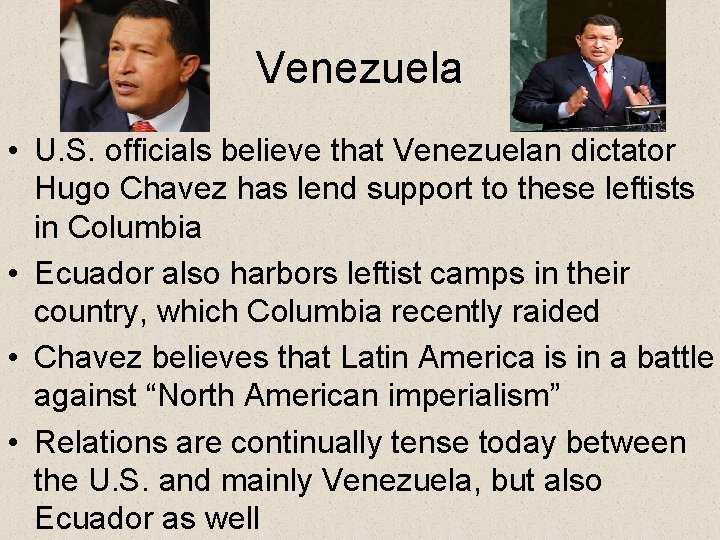
Venezuela • U. S. officials believe that Venezuelan dictator Hugo Chavez has lend support to these leftists in Columbia • Ecuador also harbors leftist camps in their country, which Columbia recently raided • Chavez believes that Latin America is in a battle against “North American imperialism” • Relations are continually tense today between the U. S. and mainly Venezuela, but also Ecuador as well