
The Cold War Balance of Power 1945 1991
The Cold War Balance of Power 1945 -1991 S
Discussion Question S What is the Cold War? S What were the two superpowers that emerged at the end of WWII?
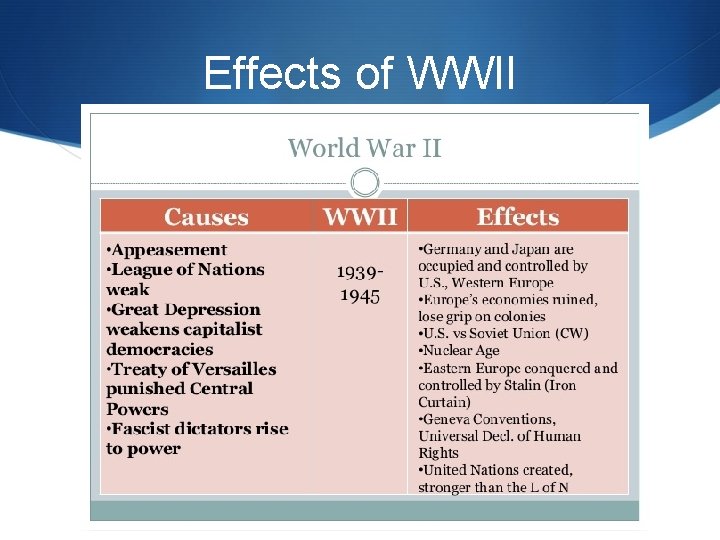
Effects of WWII
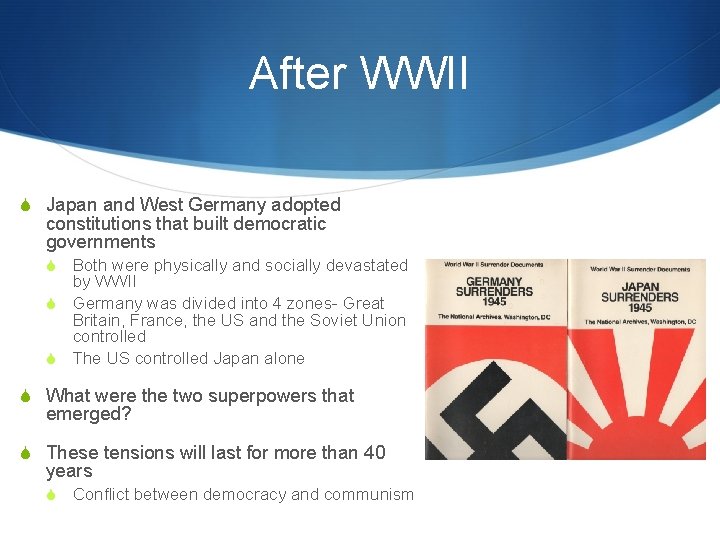
After WWII S Japan and West Germany adopted constitutions that built democratic governments Both were physically and socially devastated by WWII S Germany was divided into 4 zones- Great Britain, France, the US and the Soviet Union controlled S The US controlled Japan alone S S What were the two superpowers that emerged? S These tensions will last for more than 40 years S Conflict between democracy and communism
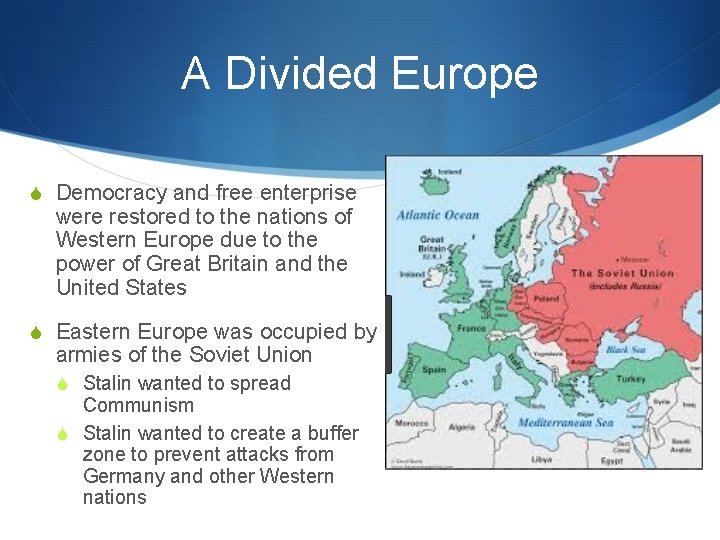
A Divided Europe S Democracy and free enterprise were restored to the nations of Western Europe due to the power of Great Britain and the United States S Eastern Europe was occupied by armies of the Soviet Union S Stalin wanted to spread Communism S Stalin wanted to create a buffer zone to prevent attacks from Germany and other Western nations
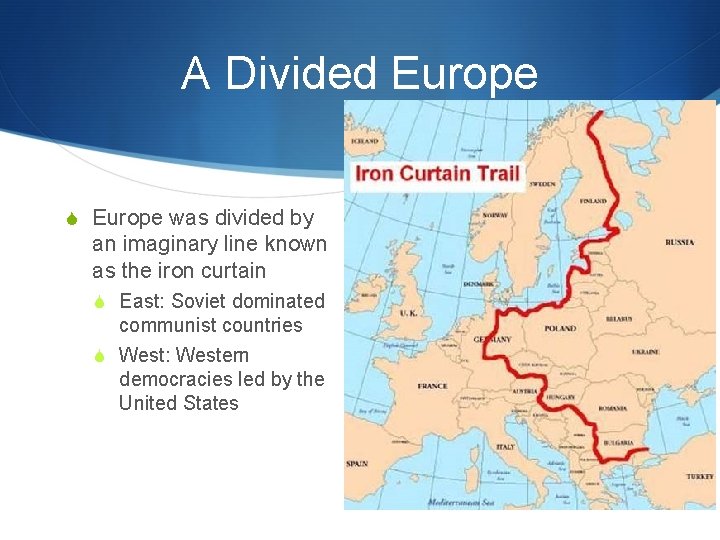
A Divided Europe S Europe was divided by an imaginary line known as the iron curtain S East: Soviet dominated communist countries S West: Western democracies led by the United States
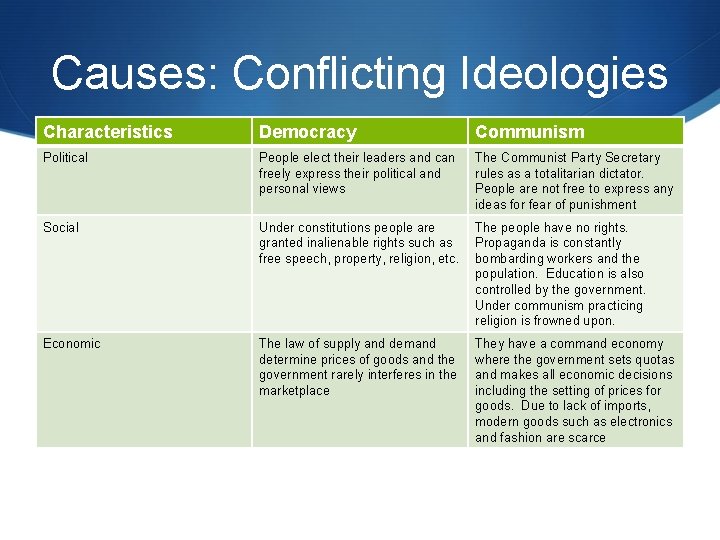
Causes: Conflicting Ideologies Characteristics Democracy Communism Political People elect their leaders and can freely express their political and personal views The Communist Party Secretary rules as a totalitarian dictator. People are not free to express any ideas for fear of punishment Social Under constitutions people are granted inalienable rights such as free speech, property, religion, etc. The people have no rights. Propaganda is constantly bombarding workers and the population. Education is also controlled by the government. Under communism practicing religion is frowned upon. Economic The law of supply and demand determine prices of goods and the government rarely interferes in the marketplace They have a command economy where the government sets quotas and makes all economic decisions including the setting of prices for goods. Due to lack of imports, modern goods such as electronics and fashion are scarce
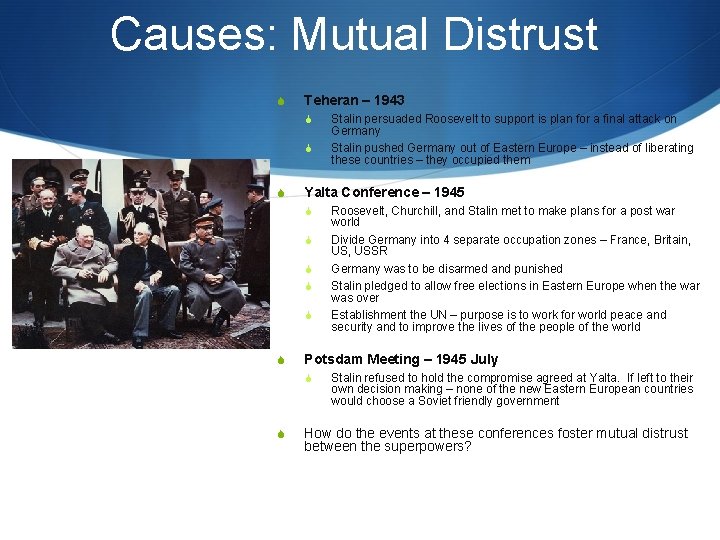
Causes: Mutual Distrust S Teheran – 1943 S S S Yalta Conference – 1945 S S S Roosevelt, Churchill, and Stalin met to make plans for a post war world Divide Germany into 4 separate occupation zones – France, Britain, USSR Germany was to be disarmed and punished Stalin pledged to allow free elections in Eastern Europe when the war was over Establishment the UN – purpose is to work for world peace and security and to improve the lives of the people of the world Potsdam Meeting – 1945 July S S Stalin persuaded Roosevelt to support is plan for a final attack on Germany Stalin pushed Germany out of Eastern Europe – instead of liberating these countries – they occupied them Stalin refused to hold the compromise agreed at Yalta. If left to their own decision making – none of the new Eastern European countries would choose a Soviet friendly government How do the events at these conferences foster mutual distrust between the superpowers?
Democracy in West Germany S Germany’s armed forces were disbanded, Nazi party outlawed S Nazi war criminals were tried in the Nuremberg trials S Western Germany- Allies helped set up political parties S New constitution set up a democratic government and approved in 1949 S Constitution included an article that guaranteed political asylum for people who were persecuted for political reason S Asylum- protection from arrest or from the possibility of being returned to a dangerous situation
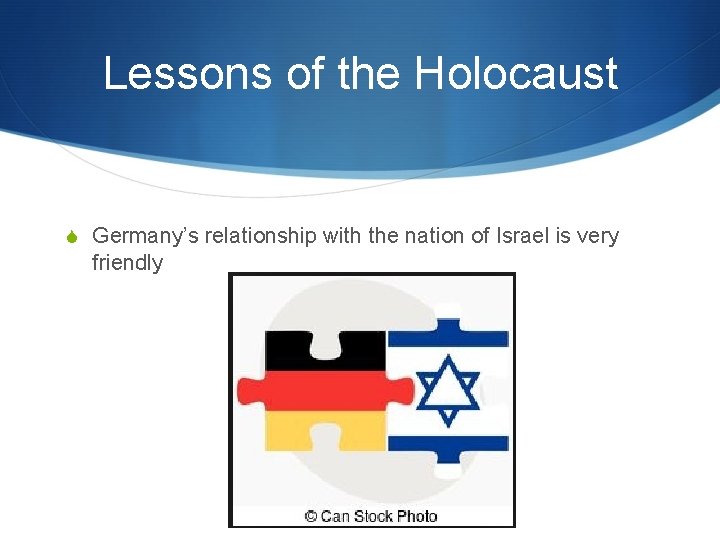
Lessons of the Holocaust S Germany’s relationship with the nation of Israel is very friendly
Democracy in Japan S America occupied Japan S Japan armed forces were disbanded S Trials were held to punish people were responsible for wartime atrocities S Japan gained a new constitution S S S Created a constitutional monarchy that limited the power of the emperor Promised that Japan would not use war as a political weapon Set up a democratic government Women gained the right to vote Basic rights were granted 1952 - Allied occupation ended in Japan
The Cold War Begins S Superpowers-rivalries that came to dominate global politics in the period after WWII S Due to differences in political and economic thinking S Stalin forced countries that were procommunist like Poland Czechoslovakia to be satellites
Truman Doctrine S March 1947 - President Harry S. Truman established the Truman Doctrine S Economic and military program designed to help other nations resist Soviet aggression S Based on theory of containment- limiting communism to already Soviet control S US pledged to resist Soviet expansion elsewhere S Truman sent military and economic aid to Greece and Turkey so they could resist communism
The Marshall Plan S Proposed in 1947 - massive economic package designed to strengthen democratic government and lessen the appeal of communism S Helped countries to recover from WWII S US offered aid to Eastern Europe- Stalin forbade these countries from accepting it
Crisis in Germany S Great Britain, France, and the US combined their democratically ruled zones in Germany S Tension grew between East and West S Berlin was located in East Germany
Berlin Airlift S 1948 - Stalin tried to keep Allied forces out of Berlin by closing all land routes S Western powers did an airlift S Food and supplies were flown into West Berlin S Created the Federal Republic of Germany (West Germany) in 1949 S 1961 - East German government built a wall
Opposing Military Alliances S NATO (North Atlantic Treaty Organization) military alliance of Western European countries; members promised to support if any of the members were attacked S Warsaw Pact- Military alliance of the Soviet Union and 7 satellites
Repression in Eastern Europe S Eastern Germany- revolt was put down with Soviet Tanks S Poland was repressed
The Hungarian Revolt S 1956 - revolution began in Hungary S Led by Imre Nagy- Hungarian nationalist and communist S Nagy wanted to end one party rule, got rid of Soviet troops, ad withdrew Hungary from the Warsaw Pact S Response: Soviet Union sent in troops and tanks S Thousands of Hungarians died
Invasion of Czechoslovakia S Spring 1968 S Alexander Dubcek called for liberal reforms and easing of Communist controls S Czechoslovakia’s government eased censorship and began to plan for a new constitution S Response- Soviet Union sent troops to overturn the government and restore communist dictatorship
Space and Arms Race S 1949: Soviets explode their first atomic bomb S 1952: US tested hydrogen bomb; 1953 the Soviets tested theirs S Geneva Summit 1955 S First attempt between USSR and the West to disarm, no agreements made S Sputnik S USSR sent the first satellite into space S US response: NASA S U-2 Incident S American U-2 Spy place was shot down by the Soviets S Soviets demand apology- US does not apologize S US lands on the moon in 1969
USSR and the Eastern Bloc From Stalin to Khruschev S De-Stalinization- Khrushchev condemned certain acts of terror experienced under Stalin and allowed for a more open environment S Gosplan- Economic shift from heavy industry to the production of consumer goods
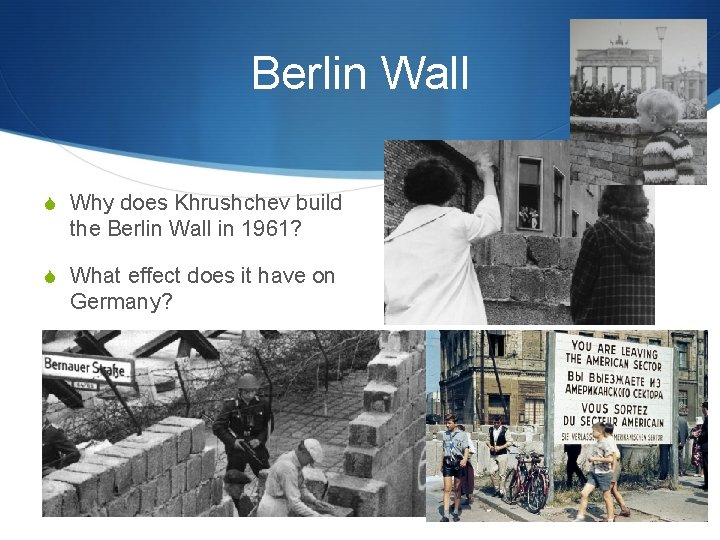
Berlin Wall S Why does Khrushchev build the Berlin Wall in 1961? S What effect does it have on Germany?
Cold War in East Asia S Korean War (1950 -1953) S S S After WWII- Korea was divided between north and south North Korea: Soviet forces (Communist) South Korea: American forces UN forces commanded by General Douglas Mac. Arthur drove North Koreans back Chinese entered the war- pushed UN forces into the south 1953: armistice was signed S S Demilitarized zone between 2 countries Vietnam War S 1954 - Vietnam was temporarily divided between northern half ruled by communist leader Ho Chi Minh and southern half headed by non-communist Ngo Dinh Diem S S S US was sent to Vietnam to prevent Ho Chi Minh from uniting Vietnam under communism 1973 - President Nxion ordered a cease fire 1975 - North Vietnamese captured Sargon- reuniting Vietnam
Cold War in the Middle East S Arab States and Israel S 1950 s- Gamal Abdel Nasser emerged as a leader in the Arab state of Egypt S S S Wanted to end Western power in Egypt 1956 - Nationalization of the Suez Canal and used Soviet money to build Aswan High Dam Egypt went against Israel twice Soviet Union supported Egypt; America supported Israel Iran and Iraq S S US and Soviet Union became interested in Iran after oil field were discovered Iranian nationalist leader who had communist support tried to nationalize the oil industry US supported the repressive anticommunist Shah of Iran with weapons and advisers Soviet Union supported Iraq- became a socialist dictatorship in the 1960 s and had oil reserves S Soviets also supported governments in Syria and Libya
Cold War in Africa S Congo S Belgian colony in Africa became independent in 1960 S S New government needed aid in resisting revolt S Soviet Union came to support S Strong anti-communist dictator Mobutu Sese Seko named the country Zaire and gained support from the west Angola S Portuguese colony and gained independence in 1975 S Rebel group MPLA was supported by the Soviet Union and Cuba S Soviet Union sent advisors and equipment; Cuba sent troops S MPLA had a communist dictatorship in Angola S Confrontation continued until 1991
Cold War in Latin America S Cuba S S S Cuba gained independence from Spain in 1898 60 years- Cuba was influenced by US 1952 - Fulgencio Batista seized power- repressive and corrupt S Fidel Castro organized gureilla army against Baptista S Established a communist dictatorship in Cuba S Castro turned to Soviet Union for support S Cuba became a rivalry between the US and Soviet Union S 1961 - Bay of Pigs invasion S Castro allowed Soviets to build nuclear missile sites in Cuba- 90 miles from Florida S President Kennedy demanded the removal of the missiles and ordered the blockade of Cuba S Cuban Missile Crisis- ended with Nikita Khruschev (Soviet Union) agreed to remove the milliles in exchange for a pledge from Kennedy that the US would not invade Cuba S US established trade embargo and diplomatic isolation on Cuba S Obama and Raul Castro restored diplomatic relations
Nonaligned Nations S Nations that chose not to ally with either side in the Cold War S India, Yugoslavia, and many African nations S Goal- make economic progress and avoid being involved in the Cold War
The Role of the United Nations S During the Cold War- UN provided a forum for superpowers to air their differences peacefully S Tended to vote in “blocs”- countries who sided with the US or the Soviet Union S Cold War ended in 1991 S UN expanded its roles since then
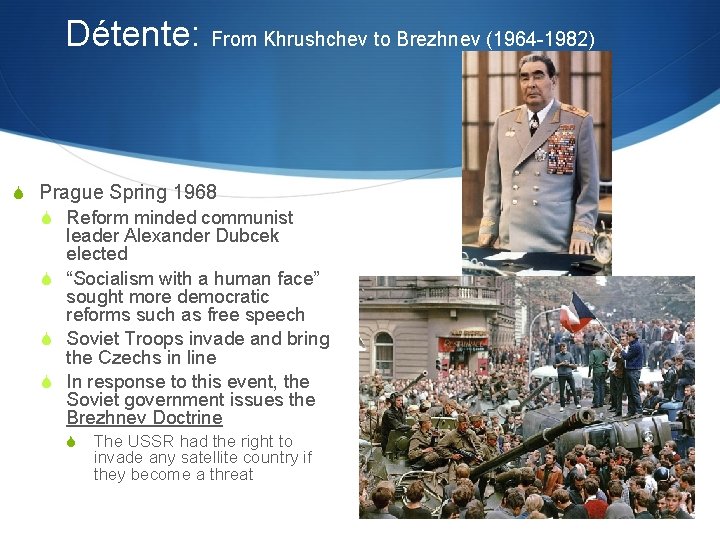
Détente: From Khrushchev to Brezhnev (1964 -1982) S Prague Spring 1968 S Reform minded communist leader Alexander Dubcek elected S “Socialism with a human face” sought more democratic reforms such as free speech S Soviet Troops invade and bring the Czechs in line S In response to this event, the Soviet government issues the Brezhnev Doctrine S The USSR had the right to invade any satellite country if they become a threat
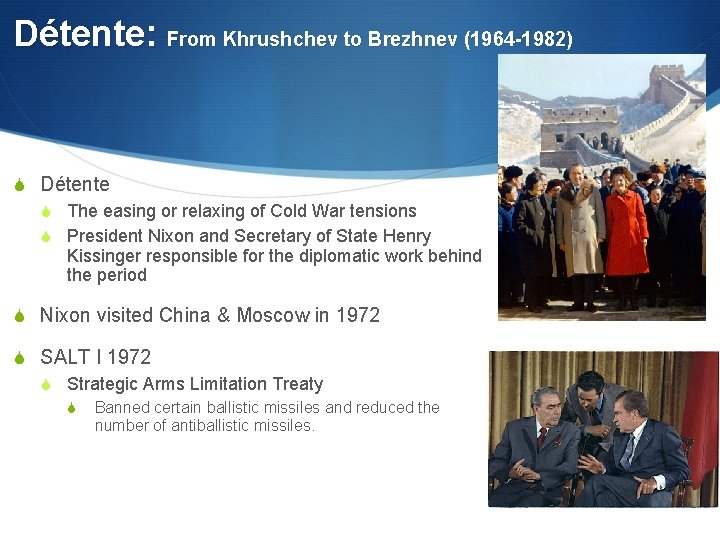
Détente: From Khrushchev to Brezhnev (1964 -1982) S Détente S The easing or relaxing of Cold War tensions S President Nixon and Secretary of State Henry Kissinger responsible for the diplomatic work behind the period S Nixon visited China & Moscow in 1972 S SALT I 1972 S Strategic Arms Limitation Treaty S Banned certain ballistic missiles and reduced the number of antiballistic missiles.
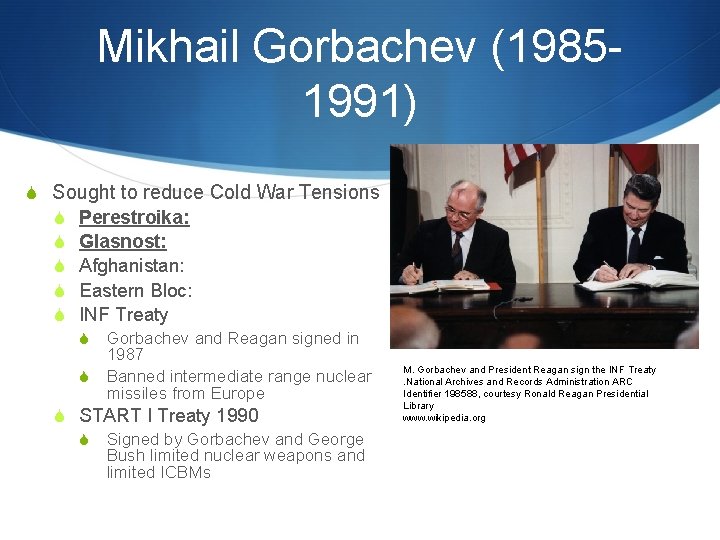
Mikhail Gorbachev (19851991) S Sought to reduce Cold War Tensions S Perestroika: S Glasnost: S Afghanistan: S Eastern Bloc: S INF Treaty S S Gorbachev and Reagan signed in 1987 Banned intermediate range nuclear missiles from Europe S START I Treaty 1990 S Signed by Gorbachev and George Bush limited nuclear weapons and limited ICBMs M. Gorbachev and President Reagan sign the INF Treaty. National Archives and Records Administration ARC Identifier 198588, courtesy Ronald Reagan Presidential Library www. wikipedia. org
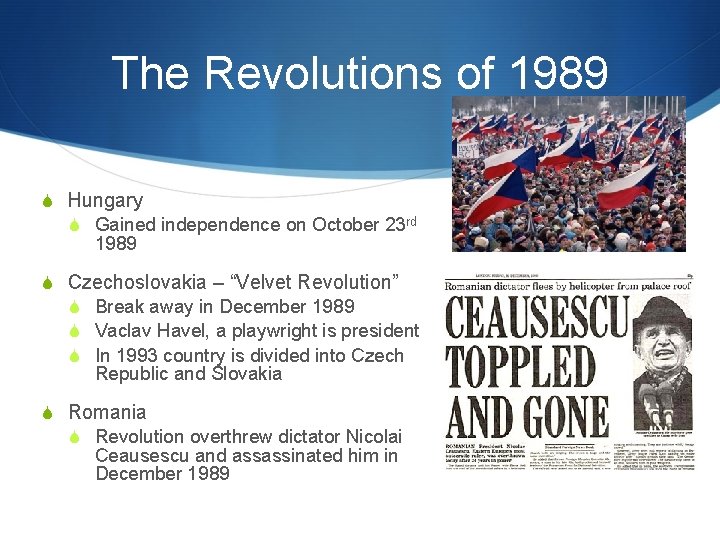
The Revolutions of 1989 S Hungary S Gained independence on October 23 rd 1989 S Czechoslovakia – “Velvet Revolution” S Break away in December 1989 S Vaclav Havel, a playwright is president S In 1993 country is divided into Czech Republic and Slovakia S Romania S Revolution overthrew dictator Nicolai Ceausescu and assassinated him in December 1989
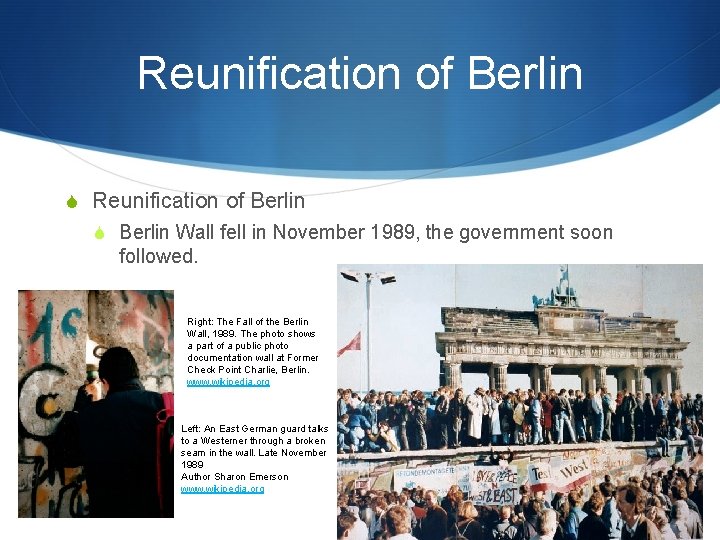
Reunification of Berlin S Berlin Wall fell in November 1989, the government soon followed. Right: The Fall of the Berlin Wall, 1989. The photo shows a part of a public photo documentation wall at Former Check Point Charlie, Berlin. www. wikipedia. org Left: An East German guard talks to a Westerner through a broken seam in the wall. Late November 1989 Author Sharon Emerson www. wikipedia. org
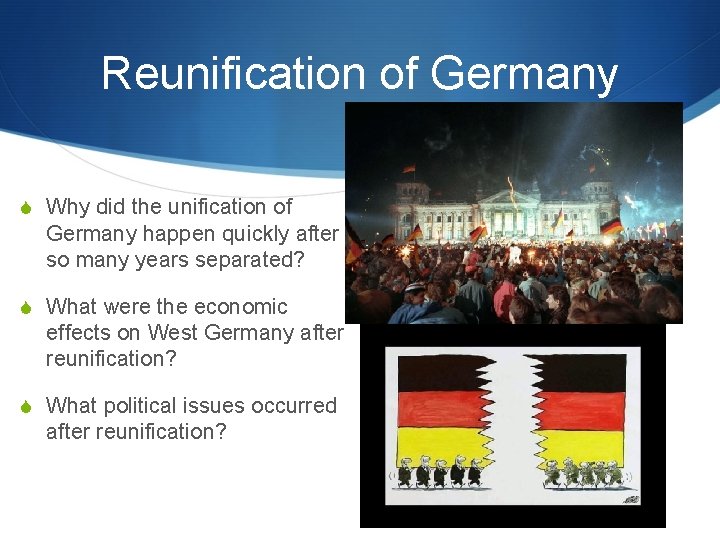
Reunification of Germany S Why did the unification of Germany happen quickly after so many years separated? S What were the economic effects on West Germany after reunification? S What political issues occurred after reunification?
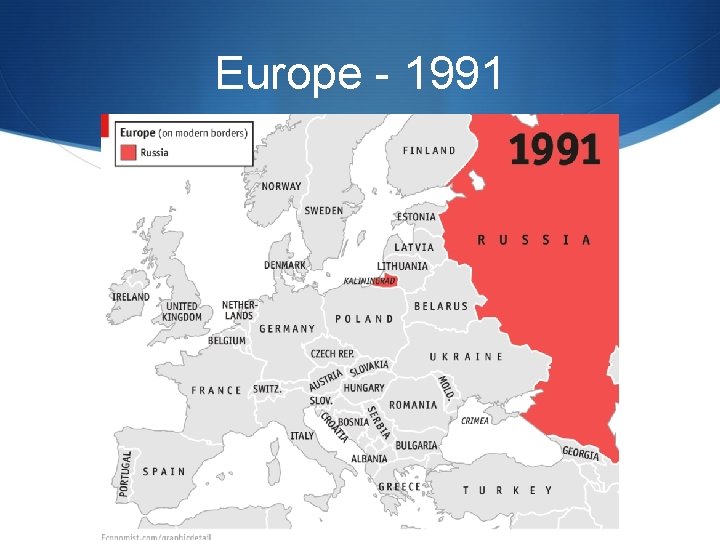
Europe - 1991
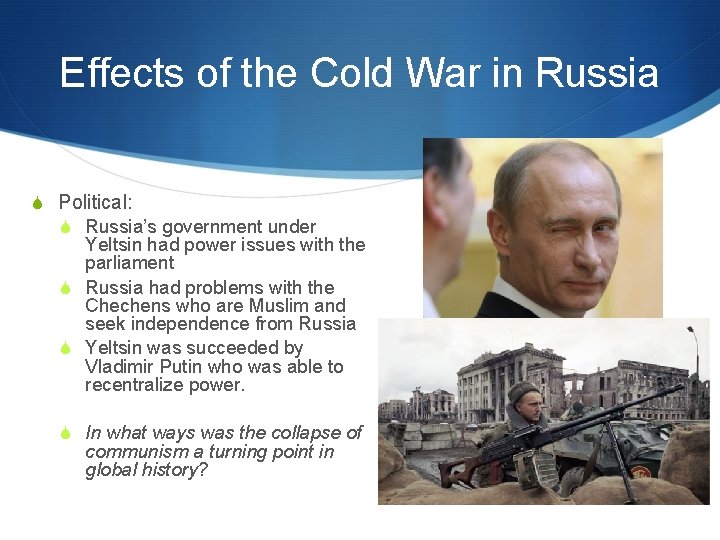
Effects of the Cold War in Russia S Political: S Russia’s government under Yeltsin had power issues with the parliament S Russia had problems with the Chechens who are Muslim and seek independence from Russia S Yeltsin was succeeded by Vladimir Putin who was able to recentralize power. S In what ways was the collapse of communism a turning point in global history?
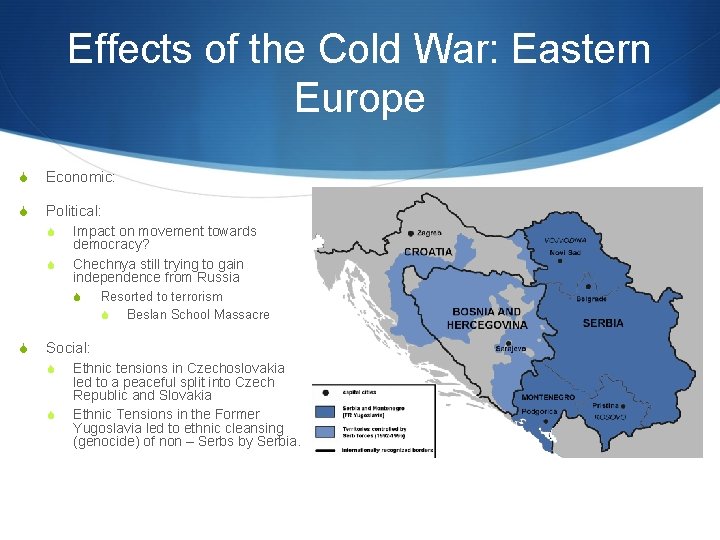
Effects of the Cold War: Eastern Europe S Economic: S Political: S S Impact on movement towards democracy? Chechnya still trying to gain independence from Russia S S Resorted to terrorism S Beslan School Massacre Social: S S Ethnic tensions in Czechoslovakia led to a peaceful split into Czech Republic and Slovakia Ethnic Tensions in the Former Yugoslavia led to ethnic cleansing (genocide) of non – Serbs by Serbia.
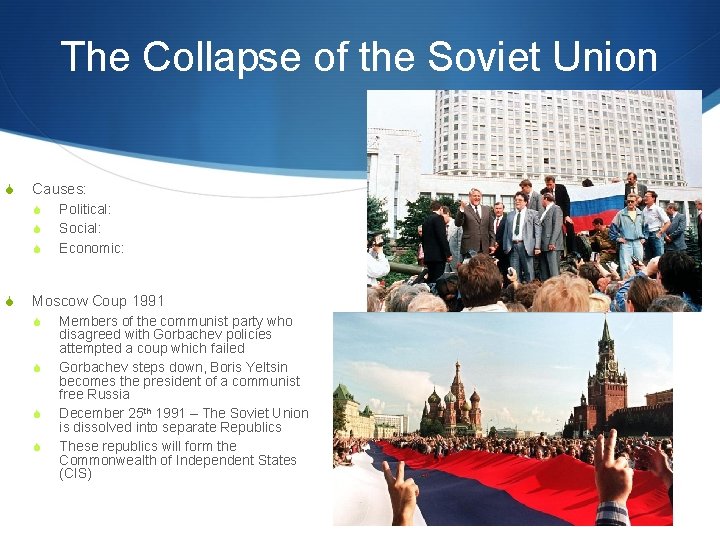
The Collapse of the Soviet Union S Causes: S S Political: Social: Economic: Moscow Coup 1991 S S Members of the communist party who disagreed with Gorbachev policies attempted a coup which failed Gorbachev steps down, Boris Yeltsin becomes the president of a communist free Russia December 25 th 1991 – The Soviet Union is dissolved into separate Republics These republics will form the Commonwealth of Independent States (CIS)
- Slides: 39