
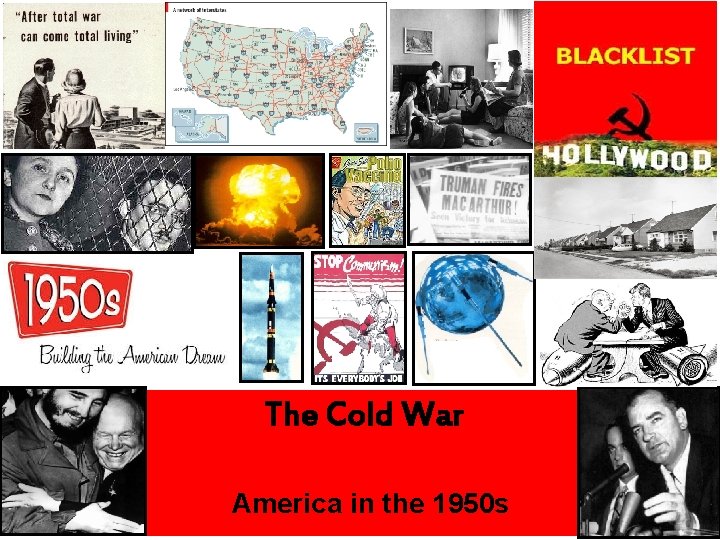
The Cold War America in the 1950 s






- Slides: 27
The Cold War America in the 1950 s
1957 The year was 1957. Sputnik? What’s that some kind of vegetable? I was two years old and not in the least concerned with the Cold War. …and then the Russians launched Sputnik. Wonder what’s for dinner ?
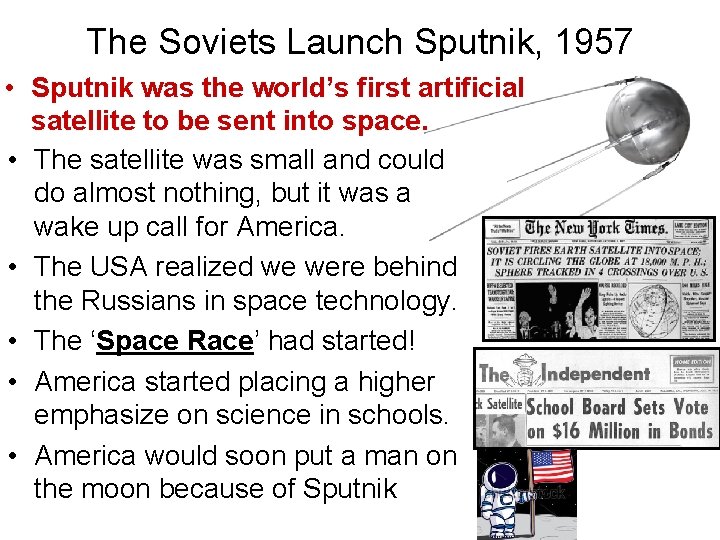
The Soviets Launch Sputnik, 1957 • Sputnik was the world’s first artificial satellite to be sent into space. • The satellite was small and could do almost nothing, but it was a wake up call for America. • The USA realized we were behind the Russians in space technology. • The ‘Space Race’ had started! • America started placing a higher emphasize on science in schools. • America would soon put a man on the moon because of Sputnik
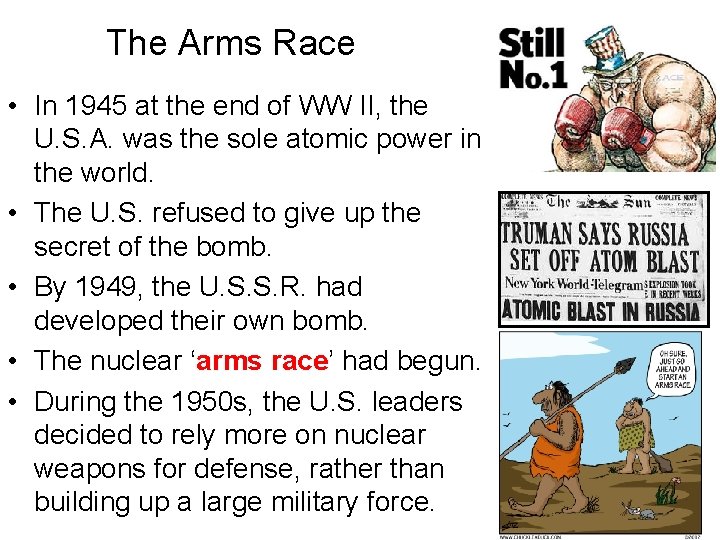
The Arms Race • In 1945 at the end of WW II, the U. S. A. was the sole atomic power in the world. • The U. S. refused to give up the secret of the bomb. • By 1949, the U. S. S. R. had developed their own bomb. • The nuclear ‘arms race’ had begun. • During the 1950 s, the U. S. leaders decided to rely more on nuclear weapons for defense, rather than building up a large military force.
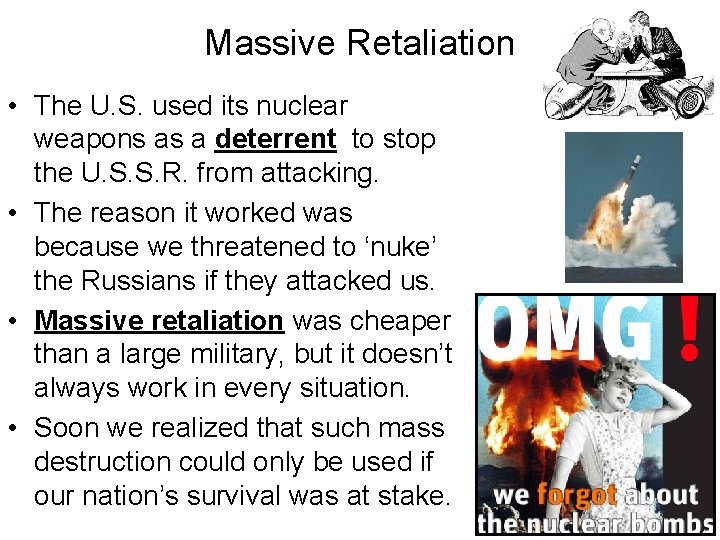
Massive Retaliation • The U. S. used its nuclear weapons as a deterrent to stop the U. S. S. R. from attacking. • The reason it worked was because we threatened to ‘nuke’ the Russians if they attacked us. • Massive retaliation was cheaper than a large military, but it doesn’t always work in every situation. • Soon we realized that such mass destruction could only be used if our nation’s survival was at stake.
Government Response to the Threat of Nuclear War
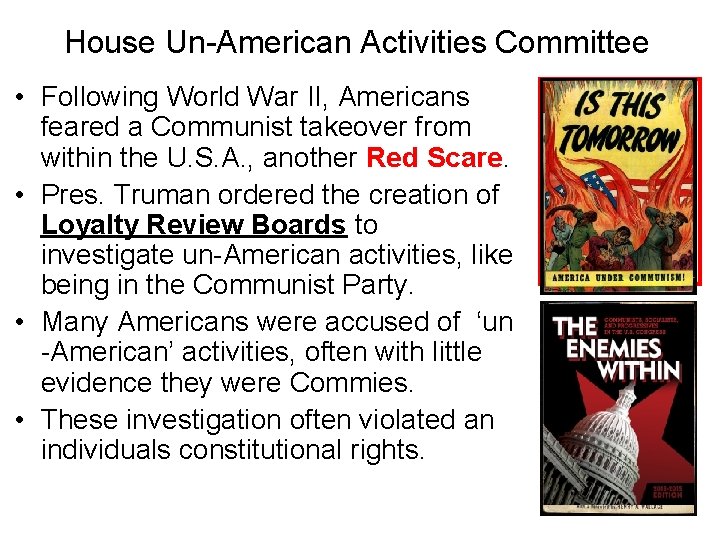
House Un-American Activities Committee • Following World War II, Americans feared a Communist takeover from within the U. S. A. , another Red Scare. • Pres. Truman ordered the creation of Loyalty Review Boards to investigate un-American activities, like being in the Communist Party. • Many Americans were accused of ‘un -American’ activities, often with little evidence they were Commies. • These investigation often violated an individuals constitutional rights.
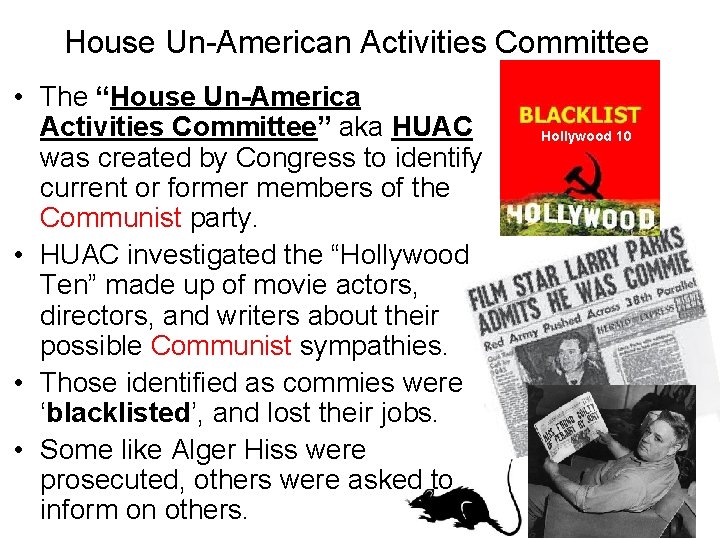
House Un-American Activities Committee • The “House Un-America Activities Committee” aka HUAC was created by Congress to identify current or former members of the Communist party. • HUAC investigated the “Hollywood Ten” made up of movie actors, directors, and writers about their possible Communist sympathies. • Those identified as commies were ‘blacklisted’, and lost their jobs. • Some like Alger Hiss were prosecuted, others were asked to inform on others. Hollywood 10
HUAC House Un-American Activities Committee
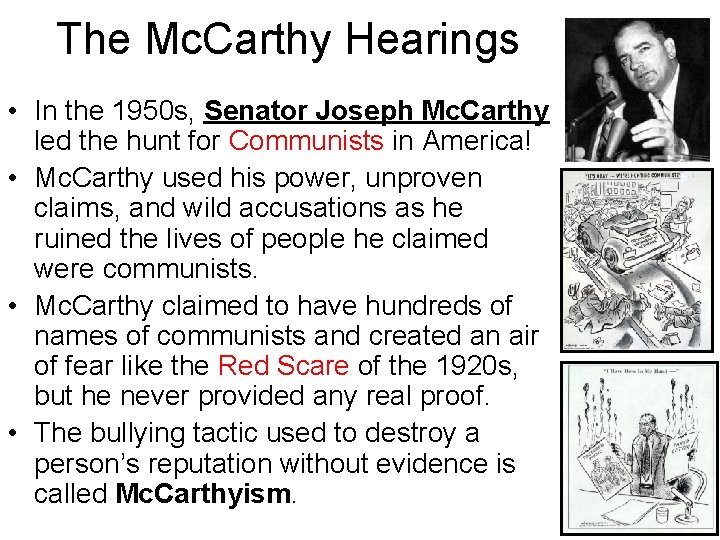
The Mc. Carthy Hearings • In the 1950 s, Senator Joseph Mc. Carthy led the hunt for Communists in America! • Mc. Carthy used his power, unproven claims, and wild accusations as he ruined the lives of people he claimed were communists. • Mc. Carthy claimed to have hundreds of names of communists and created an air of fear like the Red Scare of the 1920 s, but he never provided any real proof. • The bullying tactic used to destroy a person’s reputation without evidence is called Mc. Carthyism.
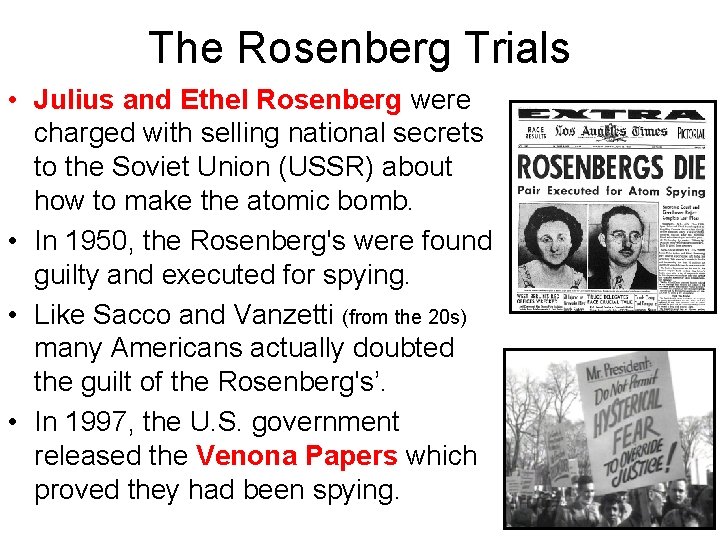
The Rosenberg Trials • Julius and Ethel Rosenberg were charged with selling national secrets to the Soviet Union (USSR) about how to make the atomic bomb. • In 1950, the Rosenberg's were found guilty and executed for spying. • Like Sacco and Vanzetti (from the 20 s) many Americans actually doubted the guilt of the Rosenberg's’. • In 1997, the U. S. government released the Venona Papers which proved they had been spying.
The Rosenberg's
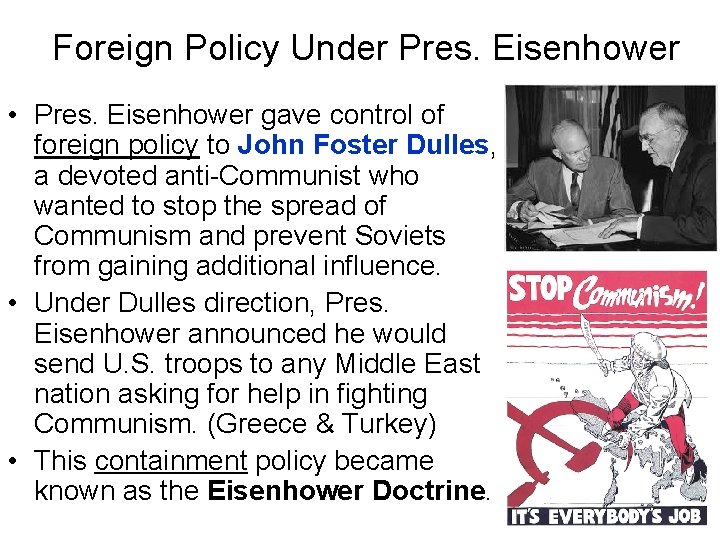
Foreign Policy Under Pres. Eisenhower • Pres. Eisenhower gave control of foreign policy to John Foster Dulles, a devoted anti-Communist who wanted to stop the spread of Communism and prevent Soviets from gaining additional influence. • Under Dulles direction, Pres. Eisenhower announced he would send U. S. troops to any Middle East nation asking for help in fighting Communism. (Greece & Turkey) • This containment policy became known as the Eisenhower Doctrine.
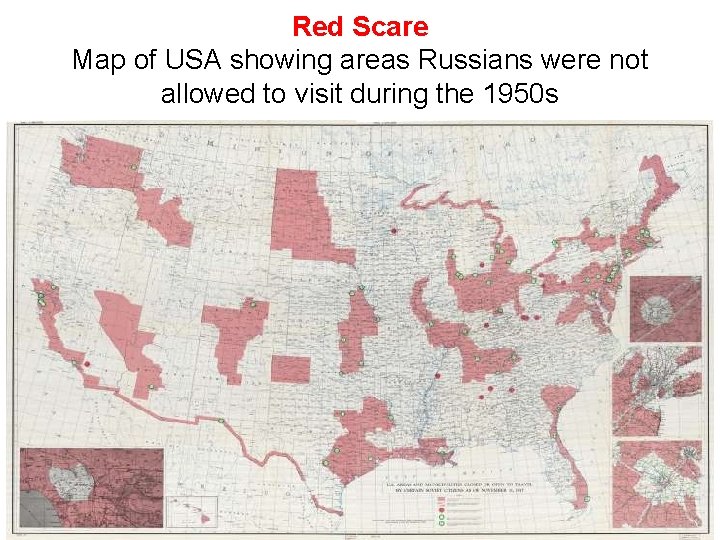
Red Scare Map of USA showing areas Russians were not allowed to visit during the 1950 s
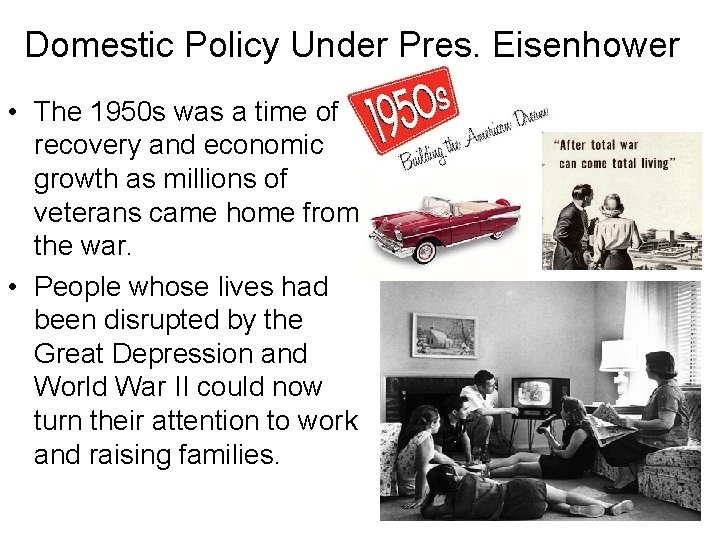
Domestic Policy Under Pres. Eisenhower • The 1950 s was a time of recovery and economic growth as millions of veterans came home from the war. • People whose lives had been disrupted by the Great Depression and World War II could now turn their attention to work and raising families.
America in the 1950 s
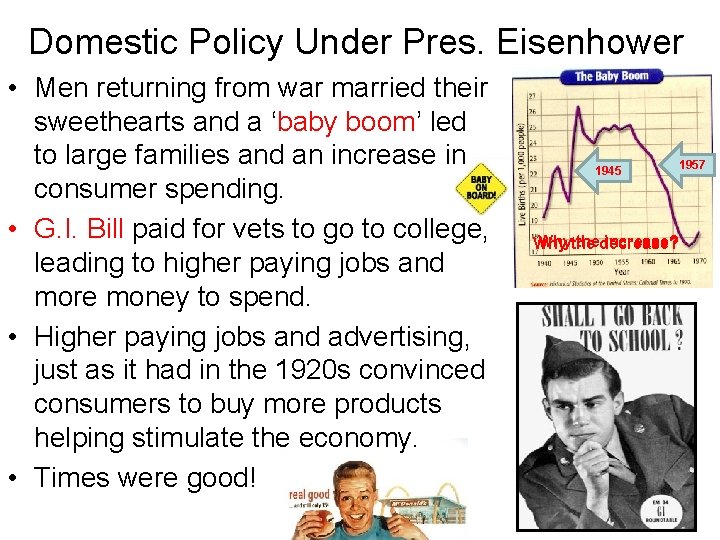
Domestic Policy Under Pres. Eisenhower • Men returning from war married their sweethearts and a ‘baby boom’ led to large families and an increase in consumer spending. • G. I. Bill paid for vets to go to college, leading to higher paying jobs and more money to spend. • Higher paying jobs and advertising, just as it had in the 1920 s convinced consumers to buy more products helping stimulate the economy. • Times were good! 1945 Whythe thedecrease? increase? Why 1957
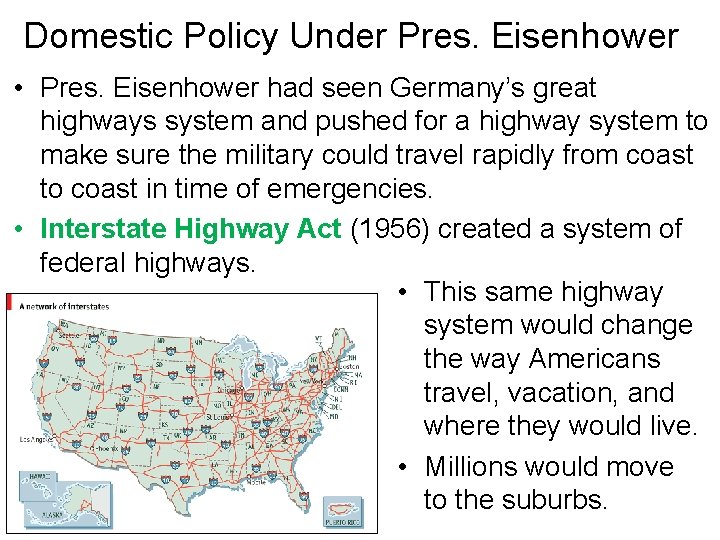
Domestic Policy Under Pres. Eisenhower • Pres. Eisenhower had seen Germany’s great highways system and pushed for a highway system to make sure the military could travel rapidly from coast to coast in time of emergencies. • Interstate Highway Act (1956) created a system of federal highways. • This same highway system would change the way Americans travel, vacation, and where they would live. • Millions would move to the suburbs.
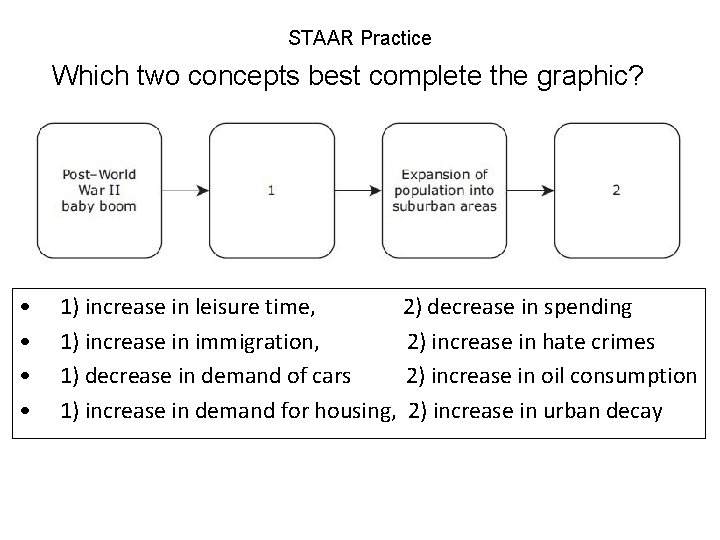
Domestic Policy Under Pres. Eisenhower • Veterans benefitted from special programs helping them readjust to civilian life. • Low Interest housing loans to Vets created a ‘housing boom’. • Home ownership jumped by 50% as developers built cheap, mass-produced sub-divisions, like Levittown. • People started moving to the ‘suburbs’ causing ‘inner’ city decay and creating ghettos.
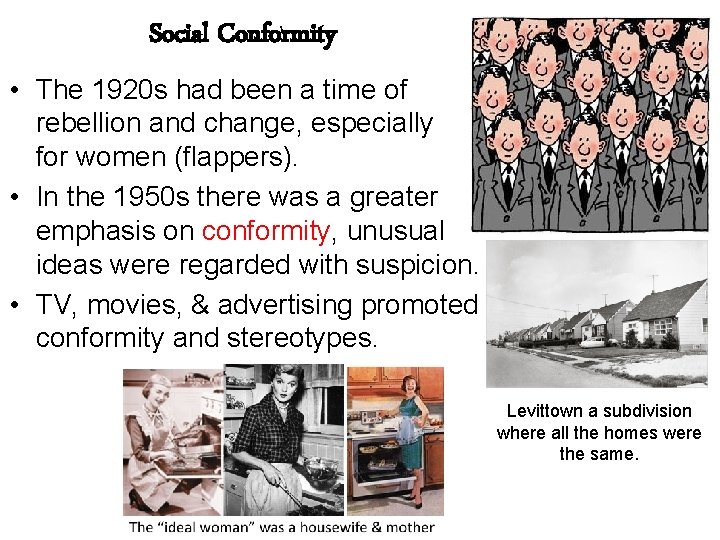
Social Conformity • The 1920 s had been a time of rebellion and change, especially for women (flappers). • In the 1950 s there was a greater emphasis on conformity, unusual ideas were regarded with suspicion. • TV, movies, & advertising promoted conformity and stereotypes. Levittown a subdivision where all the homes were the same.
Leave it to Beaver
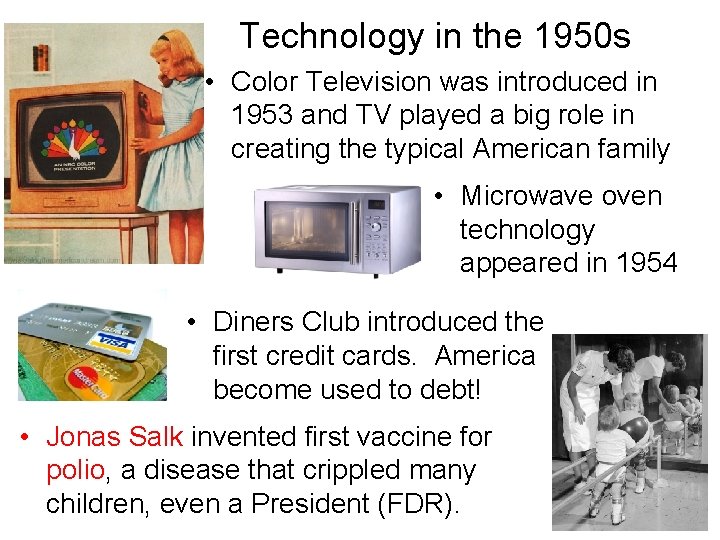
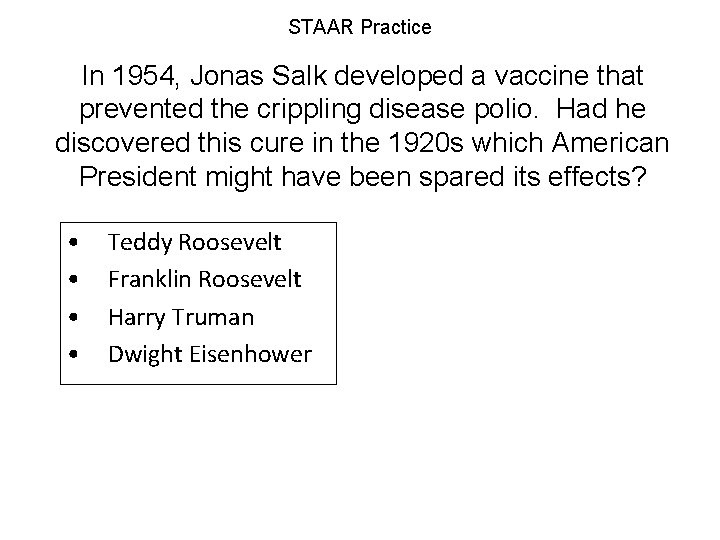
Technology in the 1950 s • Color Television was introduced in 1953 and TV played a big role in creating the typical American family • Microwave oven technology appeared in 1954 • Diners Club introduced the first credit cards. America become used to debt! • Jonas Salk invented first vaccine for polio, a disease that crippled many children, even a President (FDR).
STAAR Practice In 1954, Jonas Salk developed a vaccine that prevented the crippling disease polio. Had he discovered this cure in the 1920 s which American President might have been spared its effects? • • Teddy Roosevelt Franklin Roosevelt Harry Truman Dwight Eisenhower
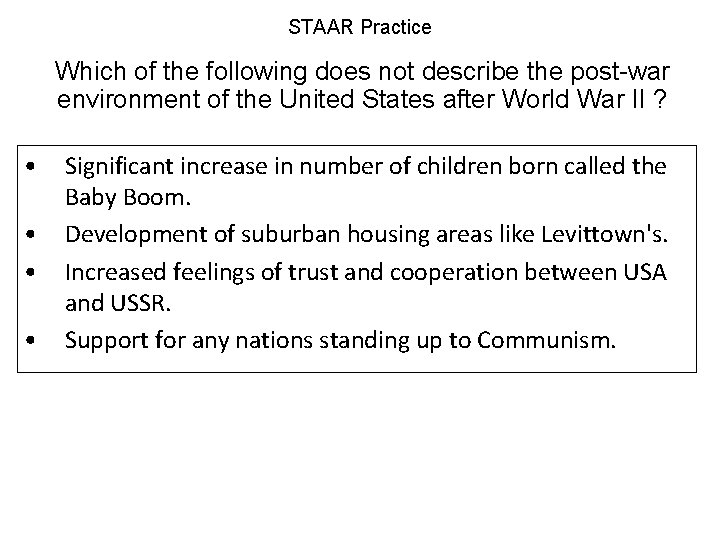
STAAR Practice Which of the following does not describe the post-war environment of the United States after World War II ? • • Significant increase in number of children born called the Baby Boom. Development of suburban housing areas like Levittown's. Increased feelings of trust and cooperation between USA and USSR. Support for any nations standing up to Communism.
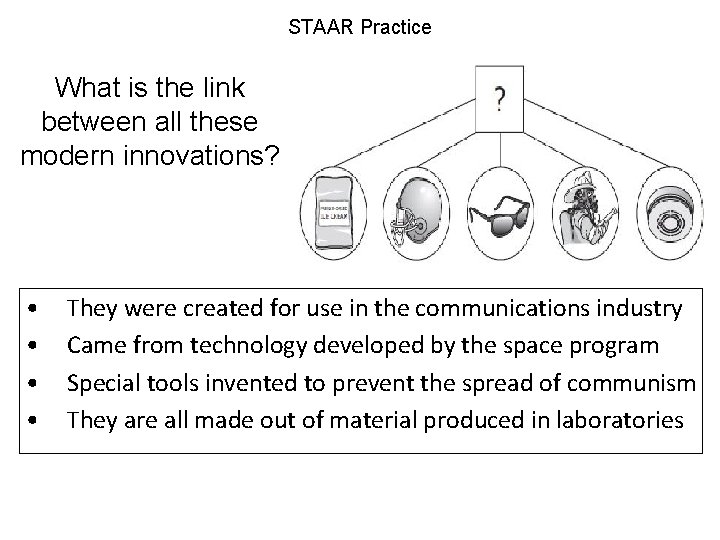
STAAR Practice What is the link between all these modern innovations? • • They were created for use in the communications industry Came from technology developed by the space program Special tools invented to prevent the spread of communism They are all made out of material produced in laboratories
STAAR Practice Which two concepts best complete the graphic? • • 1) increase in leisure time, 2) decrease in spending 1) increase in immigration, 2) increase in hate crimes 1) decrease in demand of cars 2) increase in oil consumption 1) increase in demand for housing, 2) increase in urban decay
TEKS • • • US. 2 (D) explain the significance of the following years as turning points: 1898 (Spanish-American War), 1914 -1918 (World War I), 1929 (the Great Depression begins), 1939 -1945 (World War II), 1957 (Sputnik launch ignites U. S. -Soviet space race), 1968 -1969 (Martin Luther King Jr. assassination and U. S. lands on the moon), 1991 (Cold War ends), 2001 (terrorist attacks on World Trade Center and the Pentagon), and 2008 (election of first black president, Barack Obama). US. 8 (B) describe how Cold War tensions were intensified by the arms race, the space race, Mc. Carthyism, and the House Un-American Activities Committee (HUAC), the findings of which were confirmed by the Venona Papers; US. 8 (C) explain reasons and outcomes for U. S. involvement in the Korean War and its relationship to the containment policy; US. 17 (B) identify the causes of prosperity in the 1950 s, including the Baby Boom and the impact of the GI Bill (Servicemen's Readjustment Act of 1944), and the effects of prosperity in the 1950 s such as increased consumption and the growth of agriculture and business; US. 17 (C) describe the economic impact of defense spending on the business cycle and education priorities from 1945 to the 1990 s; US. 27 (A) explain the effects of scientific discoveries and technological innovations such as electric power, telephone and satellite communications, petroleum-based products, steel production, and computers on the economic development of the United States;