
The Cold War 1949 1991 Origins Born out
The Cold War 1949 -1991
Origins Born out of the decisions made after World War II – Early tensions Russia’s non-aggression treaty with the Germans Allies failure to take pressure off the Russians by invading Europe sooner Fate of Poland – Yalta Conference Division of conquered Germany into military zones – American, British, and French zones (West Germany) – Soviet zone (East Germany) Creation of The United Nations – New International peace-keeping organization – Replace the largely ineffective League of Nations formed after World War I United States, Great Britain were strongly anti-communist, while the Soviets are trying to spread communism all over Europe and Asia
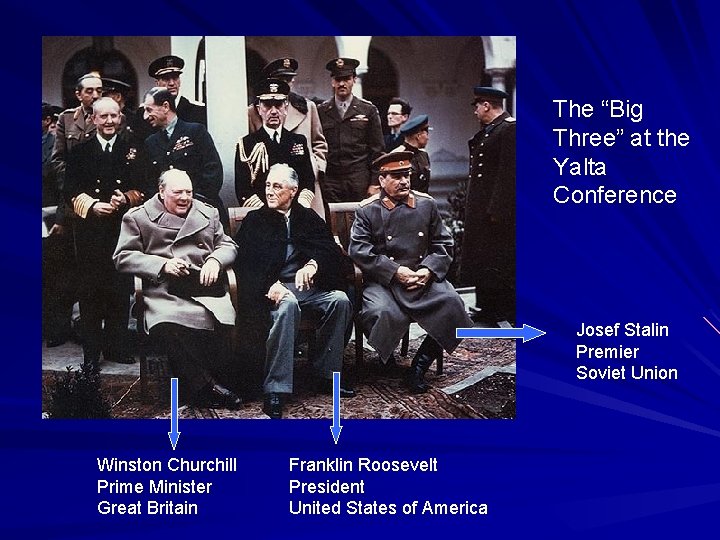
The “Big Three” at the Yalta Conference Josef Stalin Premier Soviet Union Winston Churchill Prime Minister Great Britain Franklin Roosevelt President United States of America

Truman takes over Franklin Roosevelt died in Georgia in 1945 – Harry S. Truman, his inexperienced Vice. President, takes command – Truman is a hard-nosed, temperamental man noted for his honesty and patriotism While initially interested in compromise with the Soviets, he soon comes to understand them, and his attitude towards them hardens
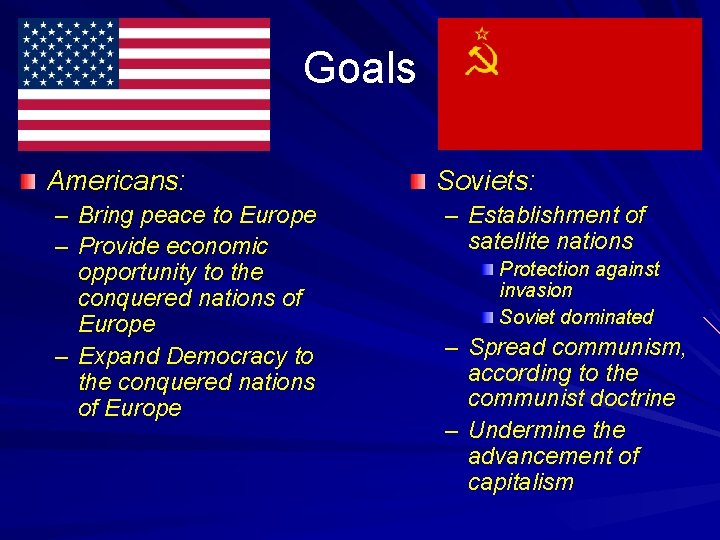
Goals Americans: – Bring peace to Europe – Provide economic opportunity to the conquered nations of Europe – Expand Democracy to the conquered nations of Europe Soviets: – Establishment of satellite nations Protection against invasion Soviet dominated – Spread communism, according to the communist doctrine – Undermine the advancement of capitalism
Soviets Conquered all nations that they liberated form the Nazis in World War II – Installed a puppet regime in Poland, where they had promised to support free elections – Conquered Czechoslovakia, Bulgaria, Albania, Hungary, Romania – These nations became known as The Eastern Bloc A tangible divide between eastern and Western Europe
“…an Iron Curtain has descended across the Continent. ” In 1946, Stalin gave a speech in which he predicted the triumph of communism over capitalism, and vowed to help coordinated pro communist efforts around the world Winston Churchill, in a speech in Missouri, coined the phrase “Iron Curtain” to describe the divide between eastern and Western Europe, and urged Americans to halt the spread of communism These two opposing speeches mark the beginning of the Cold War.
Iron Curtain Speech https: //www. youtube. com/watch? v=jvax 5 V Uvj. WQ
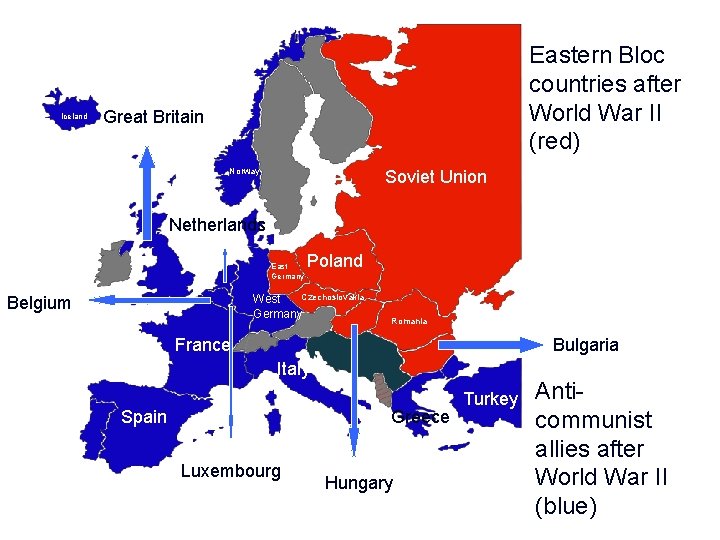
Iceland Eastern Bloc countries after World War II (red) Great Britain Norway Soviet Union Netherlands East Germany Poland Czechoslovakia West Germany Belgium Romania France Bulgaria Italy Spain Greece Luxembourg Hungary Turkey Anticommunist allies after World War II (blue)
The Cold War Competition that developed between the United States and the Soviet Union for power an influence around the globe Characterized by political and economic conflict and military tensions Stopped just short of an actual war between the United States and the Soviet Union
Containment Using political, economic, and military strategies to stop the spread of communism around the world – Not to defeat it where it exists – A middle ground policy Led to the adoption of the Truman Doctrine Led to the Marshall Plan, a plan to deliver economic aid to European nations rebuilding after World War II Led to the North Atlantic Treaty Organization (NATO), a mutual defense pact – The Soviets responded with the Creation of The Warsaw Pact, and mutual defense treaty among the Eastern Bloc Countries
The Truman Doctrine President Truman’s policies on dealing with the spread of communism became known as The Truman Doctrine – Pledged to "support free peoples who are resisting attempted subjugation by armed minorities or by outside pressures. ” – Pointed out a clash between “totalitarian regimes” and “free peoples” Warned of a domino effect in the spread of communism, and vowed to fight it
Cold War related Conflicts Berlin Blockade Korean Conflict – Led to the division of Korea at the 49 th parallel Berlin Conflict of 1961 – Led to the creation of the Berlin Wall Bay of Pigs Invasion Cuban Missile Crisis Viet Nam War Soviet War in Afghanistan
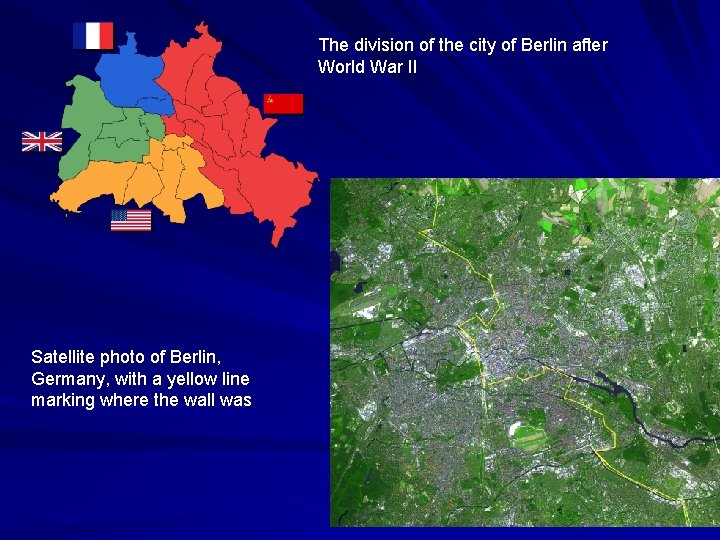
The division of the city of Berlin after World War II Satellite photo of Berlin, Germany, with a yellow line marking where the wall was
Impact The Cold War had an impact on the United States for decades – Anti-communist movements in the United States House Committee on Un-American Activities – Congressional committee formed to seek out and expose American citizens suspected of communists affiliations The Blacklist – A group of Hollywood actors and writers who were deemed “unhireable” because thy had suspected ties to communism – – Mc. Carthy Hearings Foreign Policy The Arms race The Space Relationship with the Chinese
End of the Cold War Collapse of the Soviet Union – – Severe economic stagnation in the 1980 s More pressure placed on the Soviets in the 1980 s Movements toward independence by Soviet bloc countries Premier Mikhail Gorbachev moving the country toward cooperation with the United States – August Coup The Soviet Union, no longer a viable entity, was officially dissolved on December 26, 1991 The United States was left as the only worldwide superpower, until the rise of China in the late 1990 s
- Slides: 16