
THE COLD WAR 1947 1991 World War II




- Slides: 33
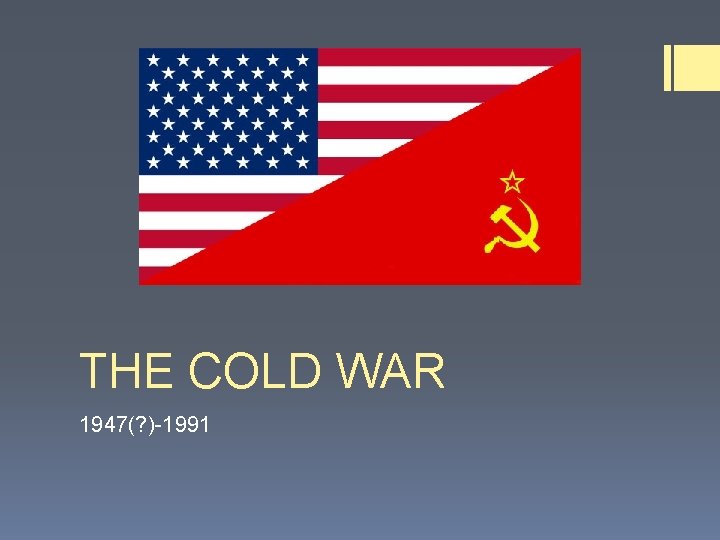
THE COLD WAR 1947(? )-1991
World War II is over…. . § The United States and the Soviet Union had fought together during WWII to help defeat Adolf Hitler and the Nazis § Within 2 years, the wartime alliance between the two sides is completely gone § The Cold War became a back-and-forth battle for global influence between the United States and the Soviets.
The Spread of Communism § The United State’s worst fears were confirmed in 1946 and 1947, when the Soviets helped establish Communist governments in Romania, Hungary, Bulgaria, and Poland
PRIMARY DOCUMENT: THE TRUMAN DOCTRINE § BACKGROUND: § President Truman gives speech before joint session of Congress on March 12, 1947 § Given in response to the recent Soviet threat in Greece and Turkey § http: //avalon. law. yale. edu/20 th_century/trudoc. asp
THE TRUMAN DOCTRINE Questions to answer: 1. How is Truman able to convince Congress that the United States must intervene with the crisis in Greece and Turkey? Give specific examples from the document. 2. Truman says that all people must choose between two “alternative ways of life”. What two ways is he talking about? How do you know? 3. What does President Truman ask of Congress? Give specific examples from the document. 4. What does Truman say will happen if the U. S. fails to act? 5. Throughout the speech, Truman only uses the word “Communist” once. Why do think this is?
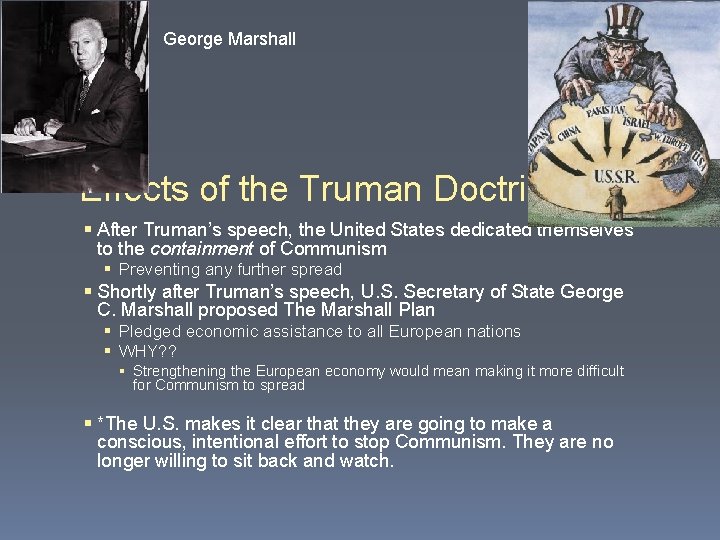
George Marshall Effects of the Truman Doctrine… § After Truman’s speech, the United States dedicated themselves to the containment of Communism § Preventing any further spread § Shortly after Truman’s speech, U. S. Secretary of State George C. Marshall proposed The Marshall Plan § Pledged economic assistance to all European nations § WHY? ? § Strengthening the European economy would mean making it more difficult for Communism to spread § *The U. S. makes it clear that they are going to make a conscious, intentional effort to stop Communism. They are no longer willing to sit back and watch.
The Soviets Respond § The Berlin Blockade § Stalin orders a blockade of West Germany from June 24, 1948 May 12, 1949 § Prevented food, materials, and supplies from arriving § The Berlin Airlift § https: //www. youtube. com/watch? v=6 d. N 6 IM 5 Pq. Yo
END OF DAY 1
Let’s pause, and ask some questions… § From what we have learned so far, what is the basic problem, or conflict, that exists between the United States and the Soviet Union? § What are some possible solutions to this conflict? § Why do you think the Cold War continued for another forty years?
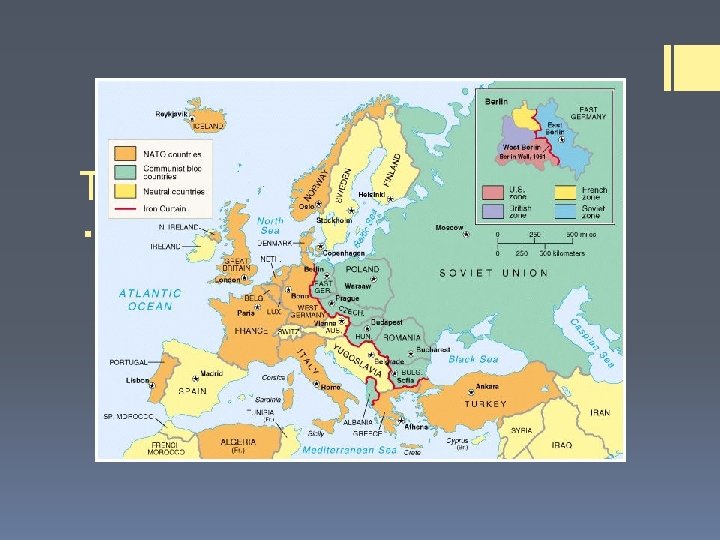
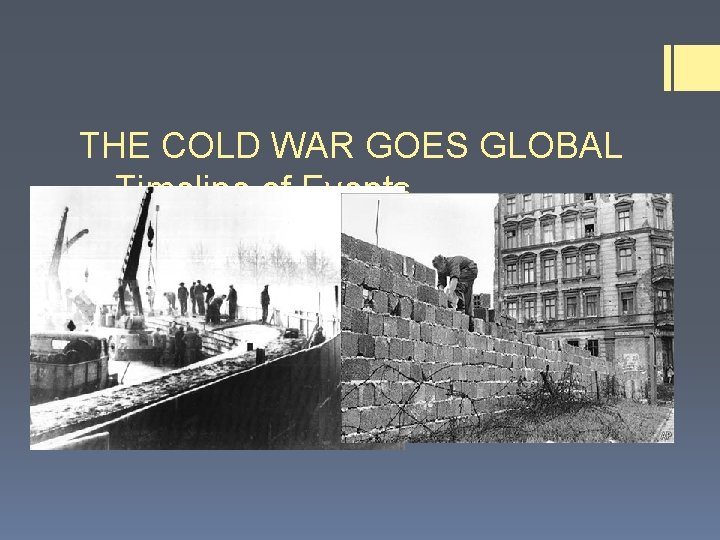
THE COLD WAR GOES GLOBAL —Timeline of Events § 1949—North Atlantic Treaty Organization (NATO) § Military alliance between U. S. , Belgium, Canada, France, Britain, Italy, Luxembourg, Norway, Portugal, the Netherlands, & Iceland § 1955—Warsaw Pact § United seven communist European nations § 1961—Construction of Berlin Wall
THE COLD WAR GOES GLOBALTimeline of Events § Mao Zedong brings communism to China in 1949 and immediately forms alliance with Soviets § In 1950, North Korea invades South Korea § Invasion backed by Stalin § Start of the Korean Conflict
Change of Leadership § After Stalin’s death in 1953, Nikita Khrushchev became Soviet leader § In 1953, Dwight D. Eisenhower elected U. S. President § Khrushchev denounced Stalin’s form of communism, but vowed to continue it in his own, reformed manner
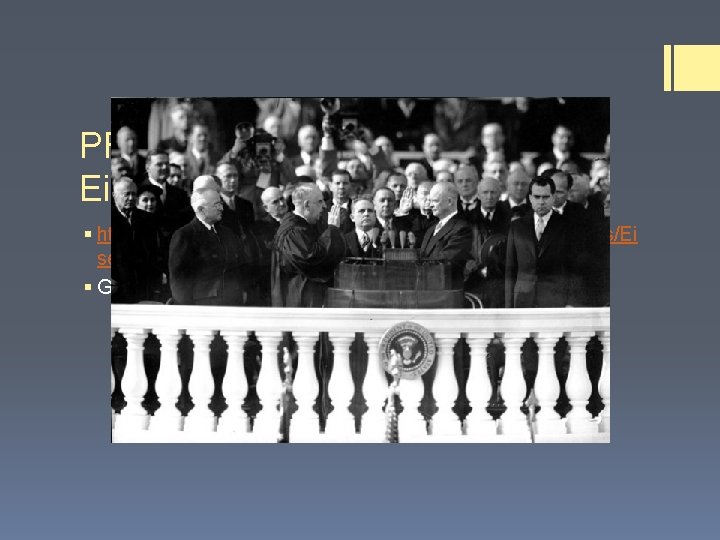
PRIMARY DOCUMENT— Eisenhower Inaugural Address § http: //legacy. wilsoncenter. org/coldwarfiles/Documents/Ei senhower. Inaugural. Address. pdf § Given on January 20 th 1953
Eisenhower Inaugural Address 1. In what ways did Eisenhower gain the trust of the American people through his Inaugural address? Give specific examples from the document. 2. What similarities are there between the language that Eisenhower uses and the language that Truman used in the Truman Doctrine six years earlier? 3. During the speech, Eisenhower says, “Honoring the identity and the special heritage of each nation in the world, we shall never use our strength to try to impress upon another people our own cherished political and economic institutions. ” Do you think this statement in itself is contradictory to the current position the United States was in? Why or why not?
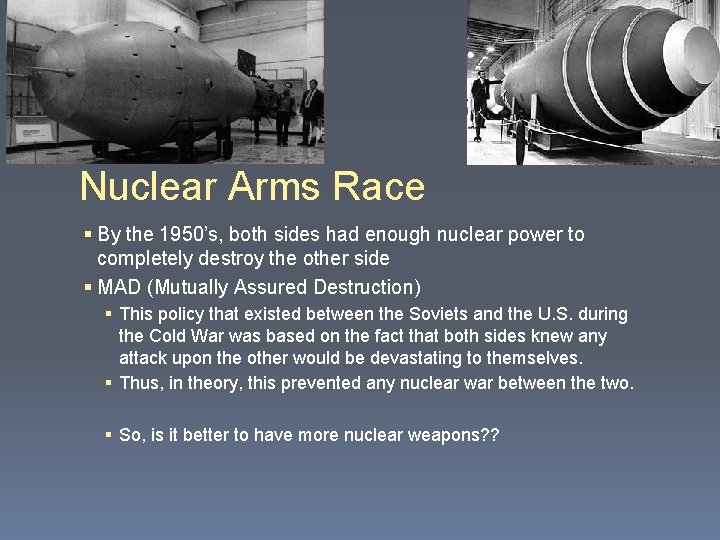
Nuclear Arms Race § In 1949, the Soviet Union had tested its own atomic bomb § Khrushchev was dedicated to keeping up with the United States in terms of nuclear power and military superiority § As a result, the United States beefed up their nuclear arsenal as well. § The result? ? ?
Nuclear Arms Race § By the 1950’s, both sides had enough nuclear power to completely destroy the other side § MAD (Mutually Assured Destruction) § This policy that existed between the Soviets and the U. S. during the Cold War was based on the fact that both sides knew any attack upon the other would be devastating to themselves. § Thus, in theory, this prevented any nuclear war between the two. § So, is it better to have more nuclear weapons? ?
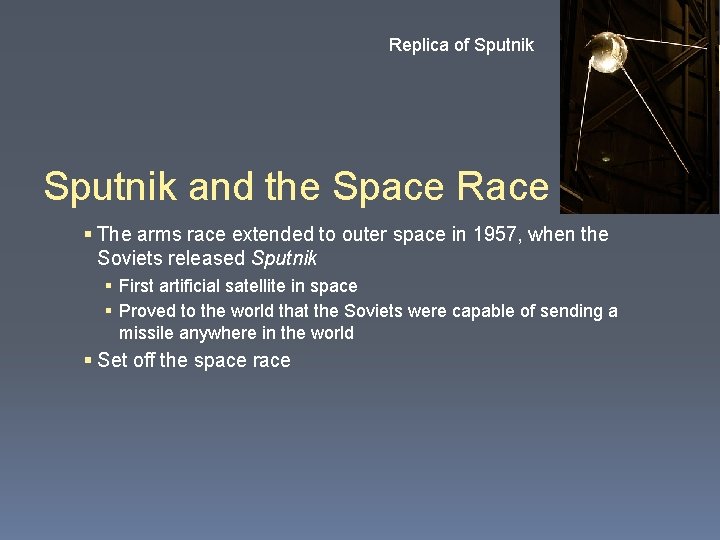
Replica of Sputnik and the Space Race § The arms race extended to outer space in 1957, when the Soviets released Sputnik § First artificial satellite in space § Proved to the world that the Soviets were capable of sending a missile anywhere in the world § Set off the space race
END OF DAY 2
The Cuban Missile Crisis
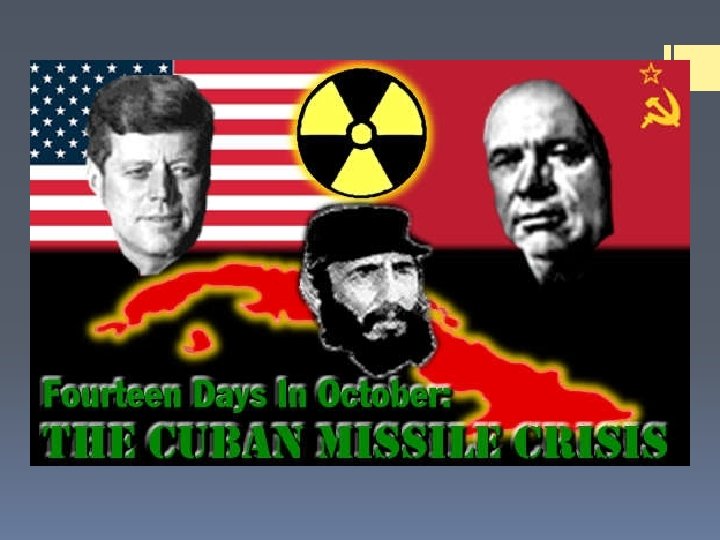
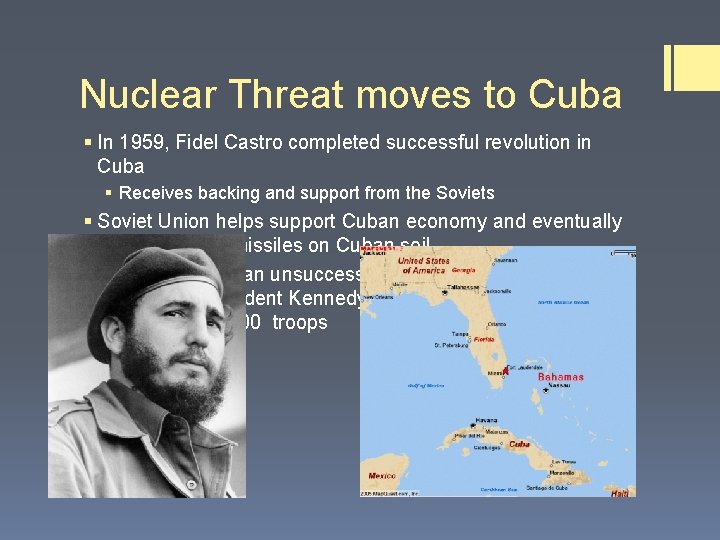
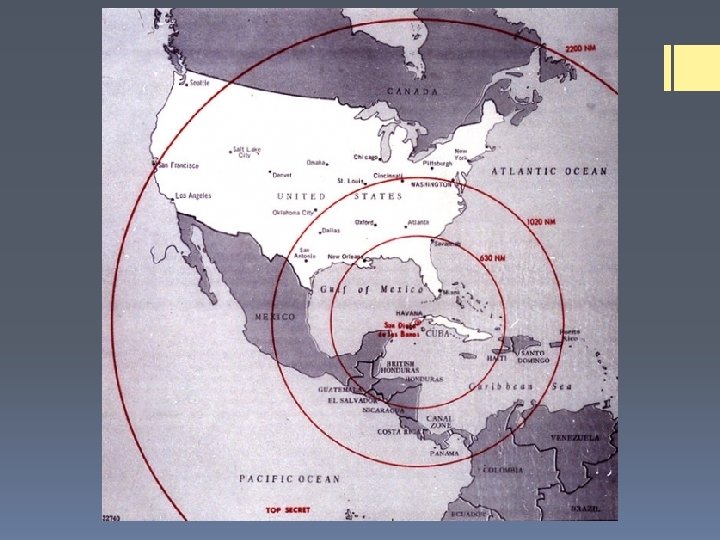
Nuclear Threat moves to Cuba § In 1959, Fidel Castro completed successful revolution in Cuba § Receives backing and support from the Soviets § Soviet Union helps support Cuban economy and eventually places nuclear missiles on Cuban soil § In April of 1961, an unsuccessful invasion at the Bay of Pigs, ordered by President Kennedy, ended with the killing or capture of all 1500 troops
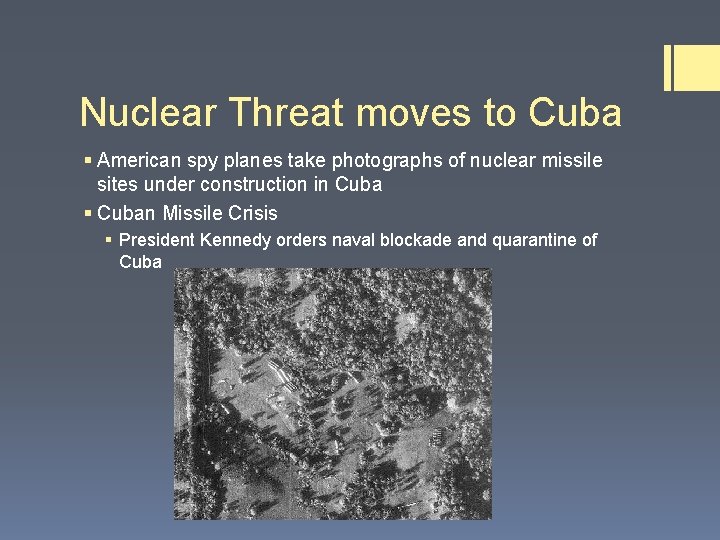
Nuclear Threat moves to Cuba § American spy planes take photographs of nuclear missile sites under construction in Cuba § Cuban Missile Crisis § President Kennedy orders naval blockade and quarantine of Cuba
PRIMARY DOCUMENT— KENNEDY’S DECLARATION OF NAVAL BLOCKADE & QUARANTINE http: //www. rferl. org/media/video/24745070. html October 22, 1962 1. What influences may the use of television had for an announcement as important and critical as this one? 2. Why did you think Kennedy elected to go with a naval blockade of Cuba instead of an all-out invasion? 3. Many people believe the Cuban Missile Crisis was the closest the world has ever been to nuclear conflict. Do you think Kennedy’s blockade made the situation better or do you think it made it worse? Why or why not?
Cuban Missile Crisis § Kennedy orders Soviets to withdraw all missiles from Cuba if they want blockade to end § Tensions became so high that for the only time in U. S. history, their B-52 bombers were on continuous air alert, and their B-47 bombers were sent to civilian and military airfields, ready to take off
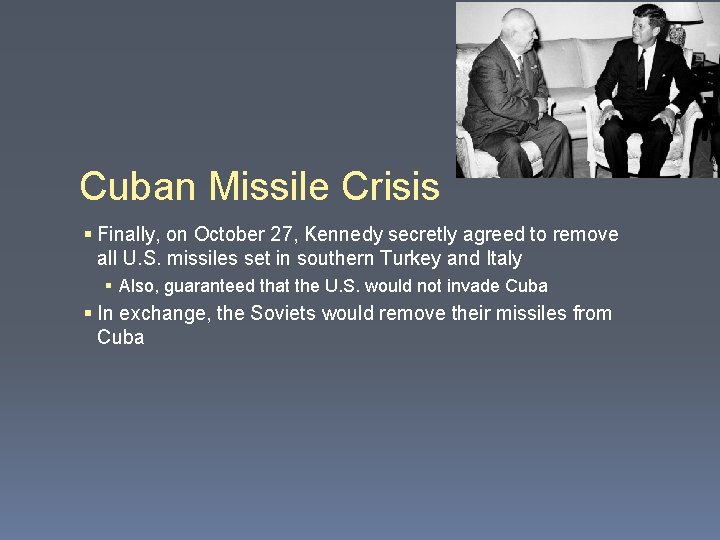
Cuban Missile Crisis § Finally, on October 27, Kennedy secretly agreed to remove all U. S. missiles set in southern Turkey and Italy § Also, guaranteed that the U. S. would not invade Cuba § In exchange, the Soviets would remove their missiles from Cuba
END OF DAY 3
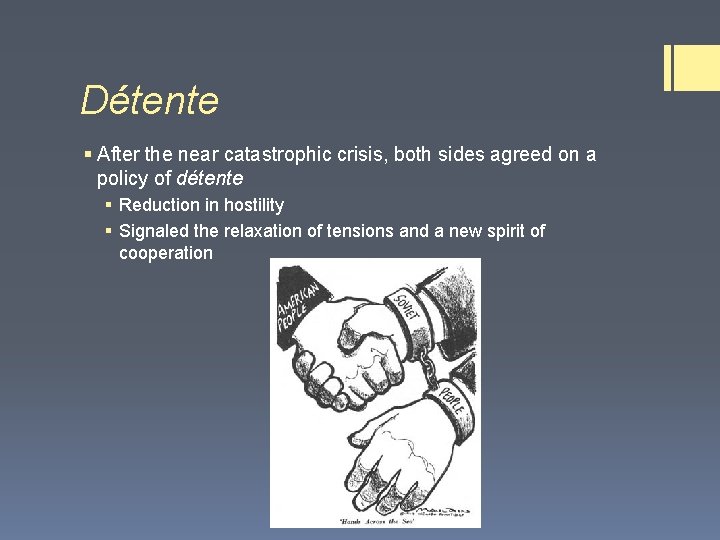
Détente § After the near catastrophic crisis, both sides agreed on a policy of détente § Reduction in hostility § Signaled the relaxation of tensions and a new spirit of cooperation
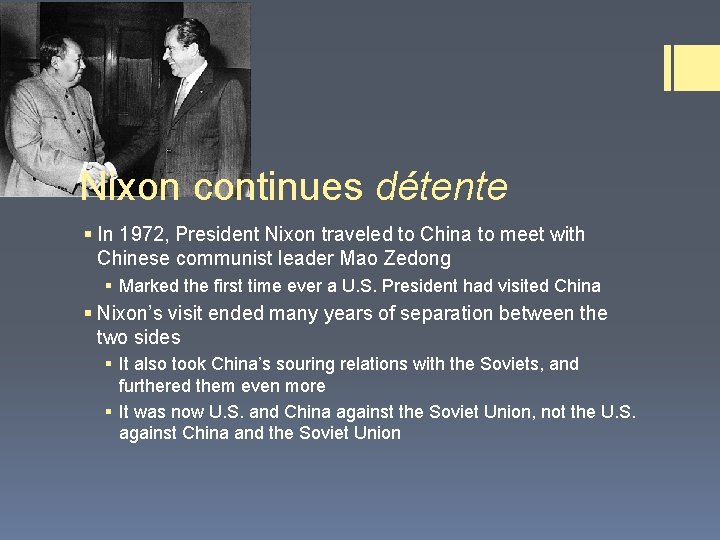
Nixon continues détente § In 1972, President Nixon traveled to China to meet with Chinese communist leader Mao Zedong § Marked the first time ever a U. S. President had visited China § Nixon’s visit ended many years of separation between the two sides § It also took China’s souring relations with the Soviets, and furthered them even more § It was now U. S. and China against the Soviet Union, not the U. S. against China and the Soviet Union
Nixon continues détente § Nixon also visited Soviet Union, and was able to start negotiating talks that continued throughout the decade § SALT I— 1971—froze the number of ballistic missile launchers between the two sides § Anti-Ballistic Missile Treaty— 1972 § SALT II— signed in 1979—Under President Carter, it banned new missile programs, limited strategic launchers
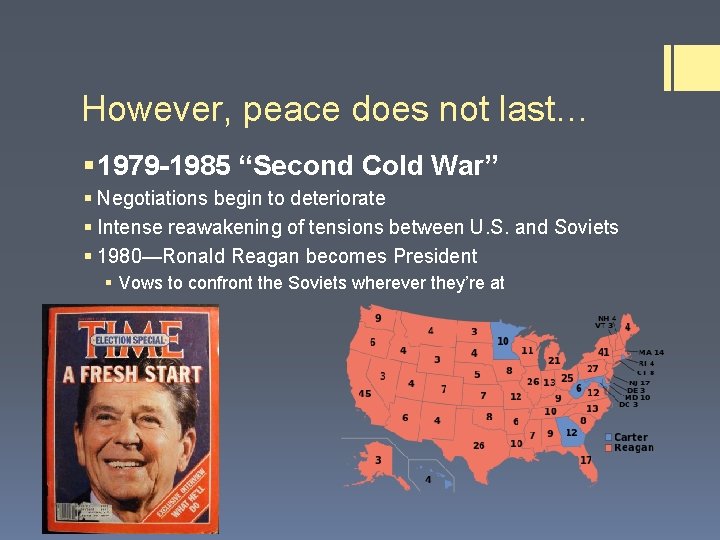
However, peace does not last… § 1979 -1985 “Second Cold War” § Negotiations begin to deteriorate § Intense reawakening of tensions between U. S. and Soviets § 1980—Ronald Reagan becomes President § Vows to confront the Soviets wherever they’re at
PRIMARY DOCUMENT— REAGAN’S INAUGURAL ADDRESS 1981 § http: //www. presidency. ucsb. edu/ws/? pid=43130 1. Reagan seems to address the current economic situation in America more so than the situation with the Soviet Union? Why do you think this is? 2. What similarities are there between Regan’s inaugural address and Eisenhower’s address in 1953? What differences are there? 3. Eisenhower said during his address, “Honoring the identity and the special heritage of each nation in the world, we shall never use our strength to try to impress upon another people our own cherished political and economic institutions. ” Give three specific examples from Reagan’s address that you think either agree with this statement, or are contradictory to this statement.
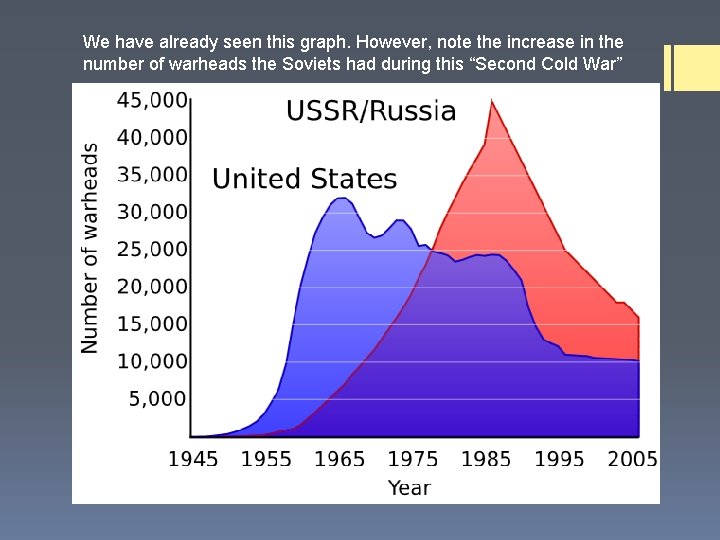
We have already seen this graph. However, note the increase in the number of warheads the Soviets had during this “Second Cold War”
END OF DAY 4 § (The start of day 5 includes the last two slides from day 4. I was recording myself talking for the flipped classroom so I could not delete them).