
The COherent Muon to Electron Transition COMET Experiment
- Slides: 19
The COherent Muon to Electron Transition (COMET) Experiment Ajit Kurup Nuclear and Particle Physics Divisional Conference of the Institute of Physics 6 th April 2011
The COherent Muon to Electron Transition (COMET) experiment Introduction • Brief introduction to muon to electron conversion and the aims of COMET Experiment. • Experimental overview. • Some R&D projects. • PRISM – going beyond the sensitivity of COMET. • Summary and future plans. Ajit Kurup IOP Nuclear and Particle Physics Divisional Conference 6 th April 2011 Page 2
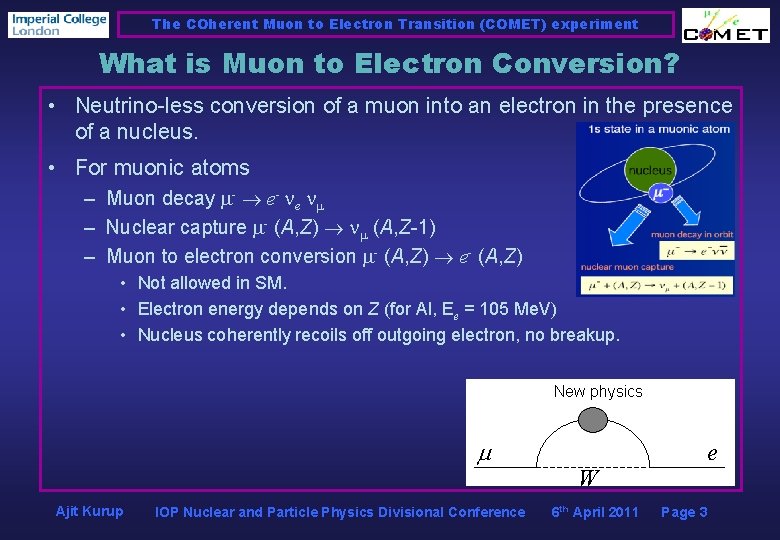
The COherent Muon to Electron Transition (COMET) experiment What is Muon to Electron Conversion? • Neutrino-less conversion of a muon into an electron in the presence of a nucleus. • For muonic atoms – Muon decay - e- e – Nuclear capture - (A, Z) (A, Z-1) – Muon to electron conversion - (A, Z) e- (A, Z) • Not allowed in SM. • Electron energy depends on Z (for Al, Ee = 105 Me. V) • Nucleus coherently recoils off outgoing electron, no breakup. New physics Ajit Kurup IOP Nuclear and Particle Physics Divisional Conference W 6 th April 2011 e Page 3
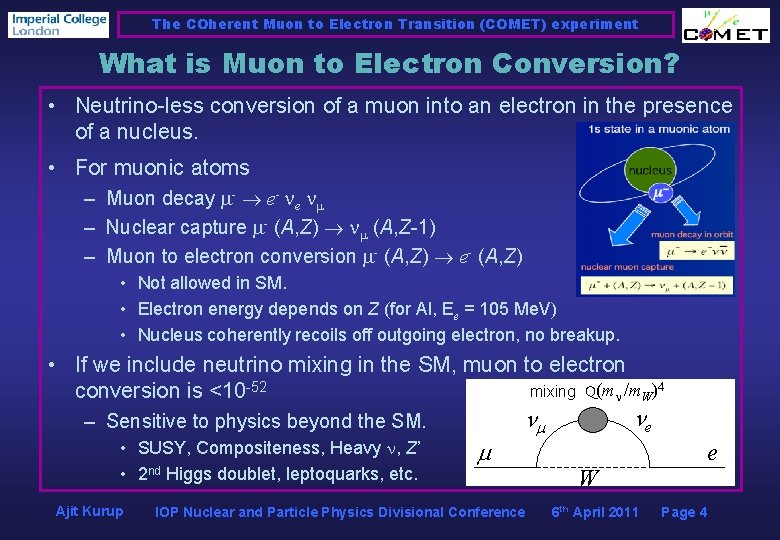
The COherent Muon to Electron Transition (COMET) experiment What is Muon to Electron Conversion? • Neutrino-less conversion of a muon into an electron in the presence of a nucleus. • For muonic atoms – Muon decay - e- e – Nuclear capture - (A, Z) (A, Z-1) – Muon to electron conversion - (A, Z) e- (A, Z) • Not allowed in SM. • Electron energy depends on Z (for Al, Ee = 105 Me. V) • Nucleus coherently recoils off outgoing electron, no breakup. • If we include neutrino mixing in the SM, muon to electron mixing Q(m /m. W)4 conversion is <10 -52 – Sensitive to physics beyond the SM. • SUSY, Compositeness, Heavy , Z’ • 2 nd Higgs doublet, leptoquarks, etc. Ajit Kurup e IOP Nuclear and Particle Physics Divisional Conference W 6 th April 2011 e Page 4
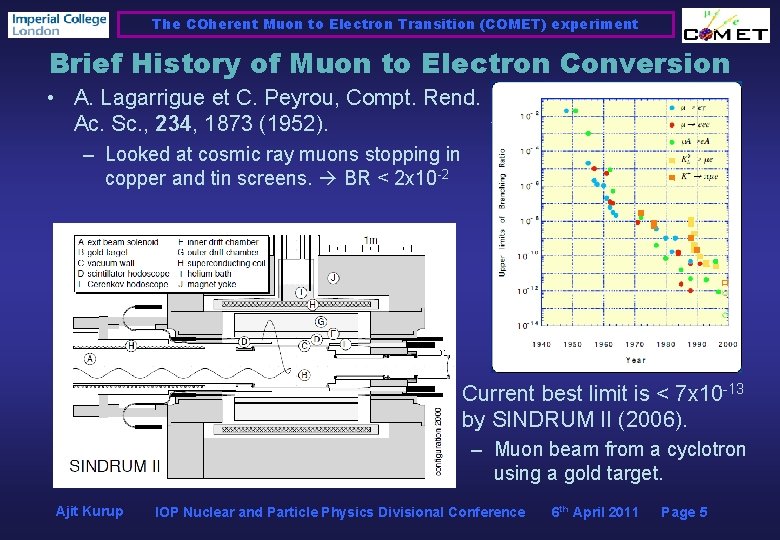
The COherent Muon to Electron Transition (COMET) experiment Brief History of Muon to Electron Conversion • A. Lagarrigue et C. Peyrou, Compt. Rend. Ac. Sc. , 234, 1873 (1952). – Looked at cosmic ray muons stopping in copper and tin screens. BR < 2 x 10 -2 • Current best limit is < 7 x 10 -13 by SINDRUM II (2006). – Muon beam from a cyclotron using a gold target. Ajit Kurup IOP Nuclear and Particle Physics Divisional Conference 6 th April 2011 Page 5
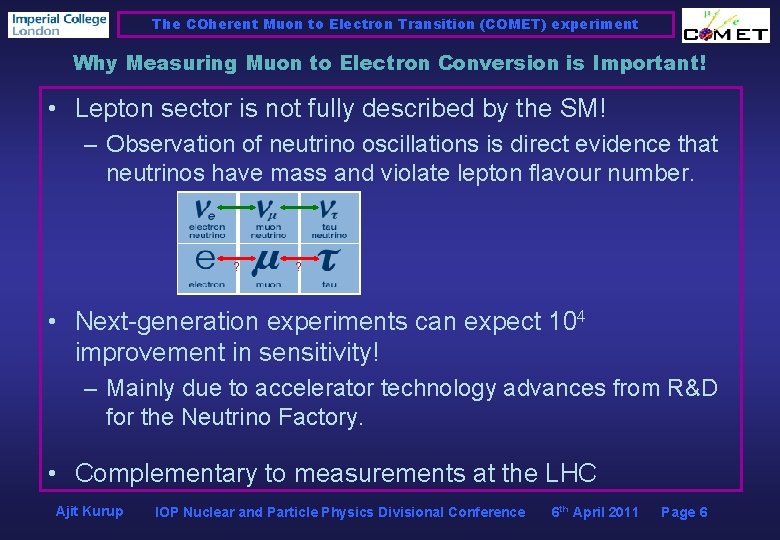
The COherent Muon to Electron Transition (COMET) experiment Why Measuring Muon to Electron Conversion is Important! • Lepton sector is not fully described by the SM! – Observation of neutrino oscillations is direct evidence that neutrinos have mass and violate lepton flavour number. ? ? • Next-generation experiments can expect 104 improvement in sensitivity! – Mainly due to accelerator technology advances from R&D for the Neutrino Factory. • Complementary to measurements at the LHC Ajit Kurup IOP Nuclear and Particle Physics Divisional Conference 6 th April 2011 Page 6
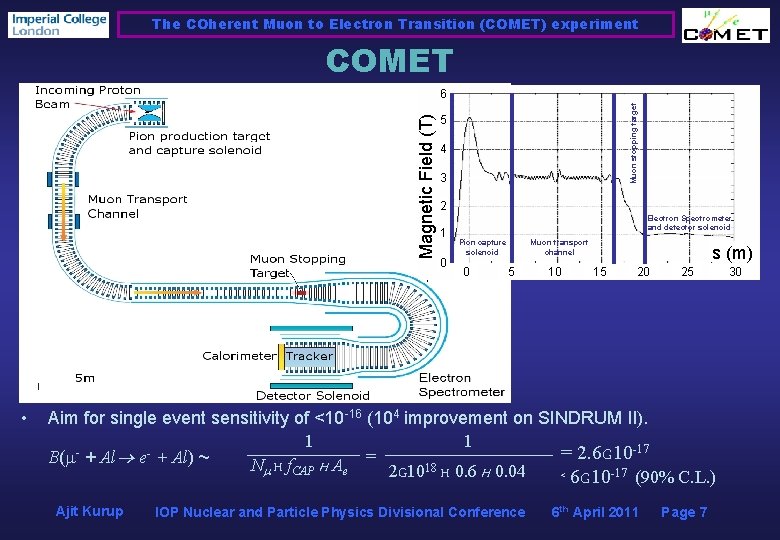
The COherent Muon to Electron Transition (COMET) experiment COMET • Muon stopping target Magnetic Field (T) 6 5 4 3 2 1 0 Electron Spectrometer and detector solenoid Muon transport channel Pion capture solenoid 0 5 10 s (m) 15 20 25 Aim for single event sensitivity of <10 -16 (104 improvement on SINDRUM II). 1 1 = 2. 6 G 10 -17 = B( + Al e + Al) ~ N H f. CAP H Ae < 6 G 10 -17 (90% C. L. ) 2 G 1018 H 0. 6 H 0. 04 Ajit Kurup IOP Nuclear and Particle Physics Divisional Conference 6 th April 2011 Page 7 30
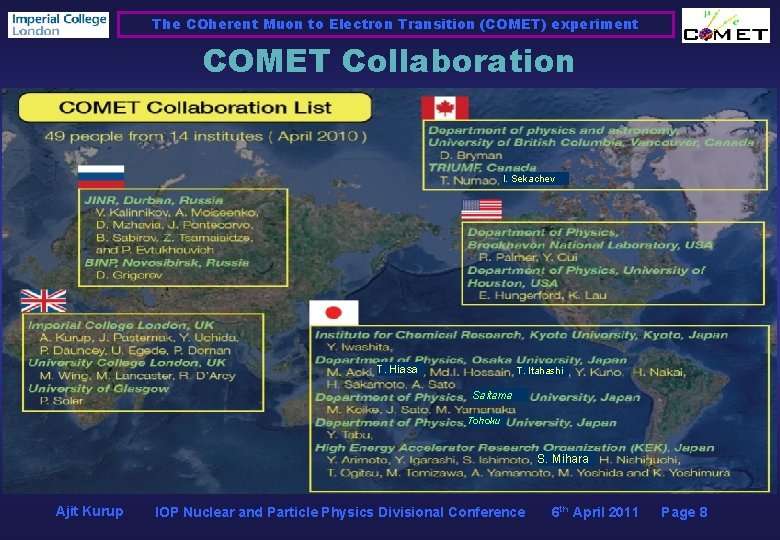
The COherent Muon to Electron Transition (COMET) experiment COMET Collaboration I. Sekachev T. Hiasa T. Itahashi Saitama Tohoku S. Mihara Ajit Kurup IOP Nuclear and Particle Physics Divisional Conference 6 th April 2011 Page 8
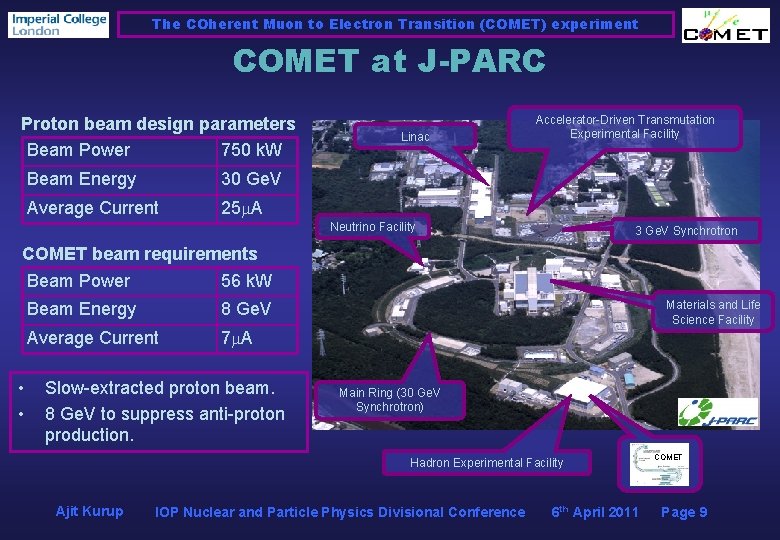
The COherent Muon to Electron Transition (COMET) experiment COMET at J-PARC Proton beam design parameters Beam Power 750 k. W Beam Energy 30 Ge. V Average Current 25 A Linac Accelerator-Driven Transmutation Experimental Facility Neutrino Facility 3 Ge. V Synchrotron COMET beam requirements Beam Power 56 k. W • • Beam Energy 8 Ge. V Average Current 7 A Slow-extracted proton beam. 8 Ge. V to suppress anti-proton production. Materials and Life Science Facility Main Ring (30 Ge. V Synchrotron) Hadron Experimental Facility Ajit Kurup IOP Nuclear and Particle Physics Divisional Conference 6 th April 2011 COMET Page 9
The COherent Muon to Electron Transition (COMET) experiment Challenges for COMET • Need for high intensity muon beam Many challenges from an accelerator physics perspective. – Intense proton beams. – Very cleanly pulsed proton beam (extinction <10 -9). • Need extinction device? – Superconducting solenoid in high radiation environment. – Transportation and momentum selection of large emittance pion/muon beams. • Detector systems. – Extinction measurement device. – 0. 4% momentum resolution for ~105 Me. V/c electrons. – Fast, highly-segmented calorimeter. Ajit Kurup IOP Nuclear and Particle Physics Divisional Conference 6 th April 2011 Page 10
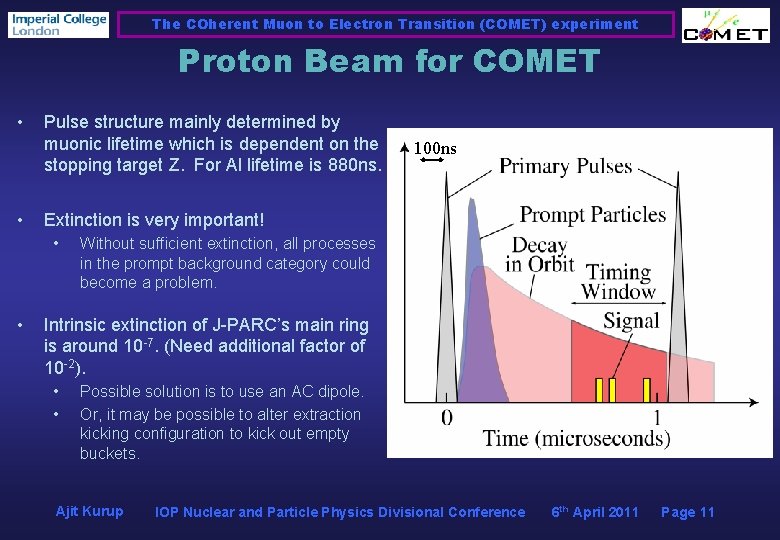
The COherent Muon to Electron Transition (COMET) experiment Proton Beam for COMET • • Pulse structure mainly determined by muonic lifetime which is dependent on the stopping target Z. For Al lifetime is 880 ns. Extinction is very important! • • 100 ns Without sufficient extinction, all processes in the prompt background category could become a problem. Intrinsic extinction of J-PARC’s main ring is around 10 -7. (Need additional factor of 10 -2). • • Possible solution is to use an AC dipole. Or, it may be possible to alter extraction kicking configuration to kick out empty buckets. Ajit Kurup IOP Nuclear and Particle Physics Divisional Conference 6 th April 2011 Page 11
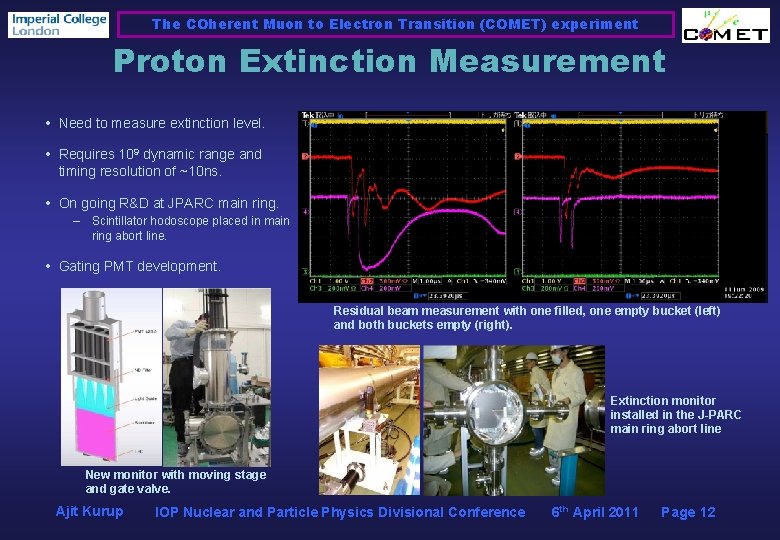
The COherent Muon to Electron Transition (COMET) experiment Proton Extinction Measurement • Need to measure extinction level. • Requires 109 dynamic range and timing resolution of ~10 ns. • On going R&D at JPARC main ring. – Scintillator hodoscope placed in main ring abort line. • Gating PMT development. Residual beam measurement with one filled, one empty bucket (left) and both buckets empty (right). Extinction monitor installed in the J-PARC main ring abort line New monitor with moving stage and gate valve. Ajit Kurup IOP Nuclear and Particle Physics Divisional Conference 6 th April 2011 Page 12
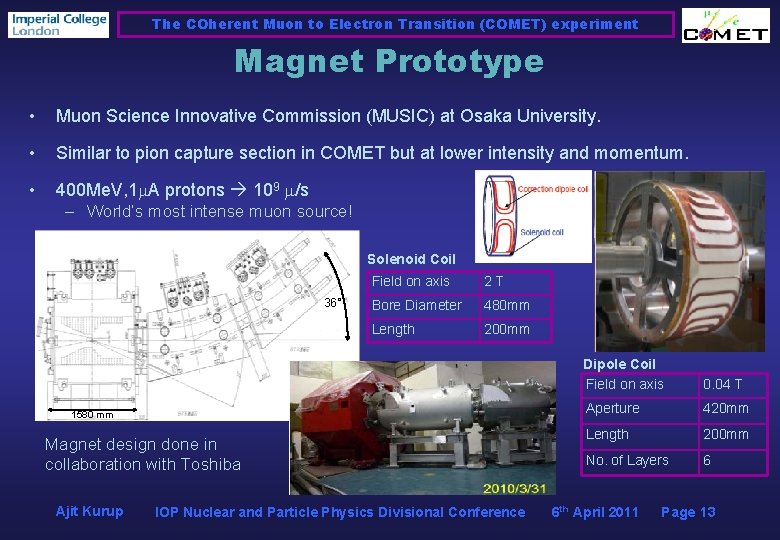
The COherent Muon to Electron Transition (COMET) experiment Magnet Prototype • Muon Science Innovative Commission (MUSIC) at Osaka University. • Similar to pion capture section in COMET but at lower intensity and momentum. • 400 Me. V, 1 A protons 109 /s – World’s most intense muon source! Solenoid Coil 36° Field on axis 2 T Bore Diameter 480 mm Length 200 mm 1580 mm Magnet design done in collaboration with Toshiba Ajit Kurup IOP Nuclear and Particle Physics Divisional Conference Dipole Coil Field on axis 0. 04 T Aperture 420 mm Length 200 mm No. of Layers 6 6 th April 2011 Page 13
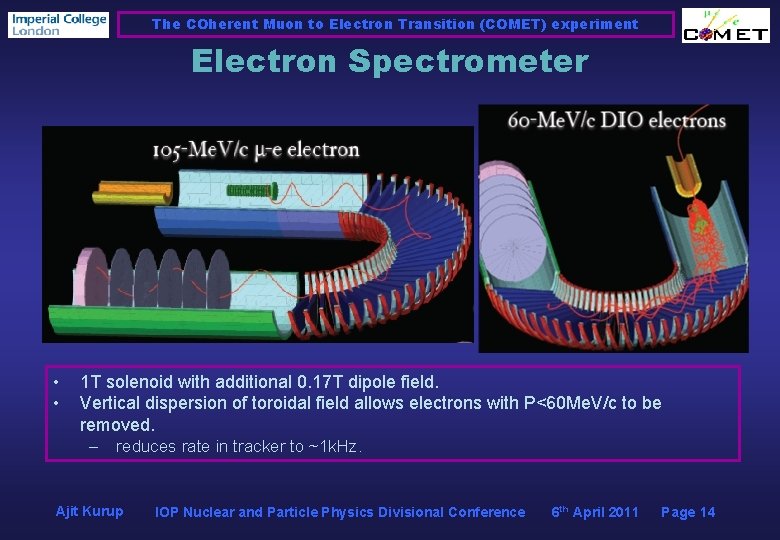
The COherent Muon to Electron Transition (COMET) experiment Electron Spectrometer • • 1 T solenoid with additional 0. 17 T dipole field. Vertical dispersion of toroidal field allows electrons with P<60 Me. V/c to be removed. – reduces rate in tracker to ~1 k. Hz. Ajit Kurup IOP Nuclear and Particle Physics Divisional Conference 6 th April 2011 Page 14
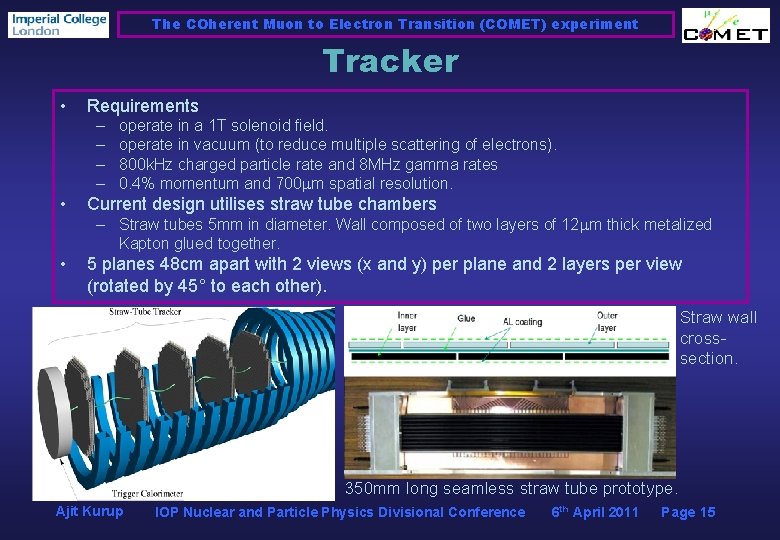
The COherent Muon to Electron Transition (COMET) experiment Tracker • Requirements – – • operate in a 1 T solenoid field. operate in vacuum (to reduce multiple scattering of electrons). 800 k. Hz charged particle rate and 8 MHz gamma rates 0. 4% momentum and 700 m spatial resolution. Current design utilises straw tube chambers – Straw tubes 5 mm in diameter. Wall composed of two layers of 12 m thick metalized Kapton glued together. • 5 planes 48 cm apart with 2 views (x and y) per plane and 2 layers per view (rotated by 45° to each other). Straw wall crosssection. 350 mm long seamless straw tube prototype. Ajit Kurup IOP Nuclear and Particle Physics Divisional Conference 6 th April 2011 Page 15
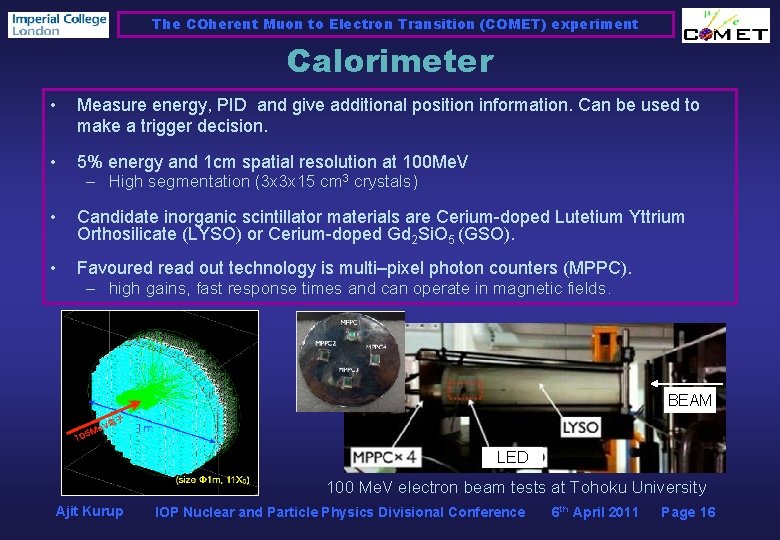
The COherent Muon to Electron Transition (COMET) experiment Calorimeter • Measure energy, PID and give additional position information. Can be used to make a trigger decision. • 5% energy and 1 cm spatial resolution at 100 Me. V – High segmentation (3 x 3 x 15 cm 3 crystals) • Candidate inorganic scintillator materials are Cerium-doped Lutetium Yttrium Orthosilicate (LYSO) or Cerium-doped Gd 2 Si. O 5 (GSO). • Favoured read out technology is multi–pixel photon counters (MPPC). – high gains, fast response times and can operate in magnetic fields. BEAM LED 100 Me. V electron beam tests at Tohoku University Ajit Kurup IOP Nuclear and Particle Physics Divisional Conference 6 th April 2011 Page 16
The COherent Muon to Electron Transition (COMET) experiment Other Detectors • Cosmic ray veto counters. – Needs to cover a large area. – Efficiency 99. 99%. • Muon intensity monitor. – X-rays from stopped muons. • Calibration system for electron momentum. – Use pions? – Electron linac? • Late-arriving particle tagger in muon beamline. – – Only active after main beam pulse. Momentum? PID? Silicon pixels or diamond pixels? Design being done in the UK. Ajit Kurup IOP Nuclear and Particle Physics Divisional Conference 6 th April 2011 Page 17
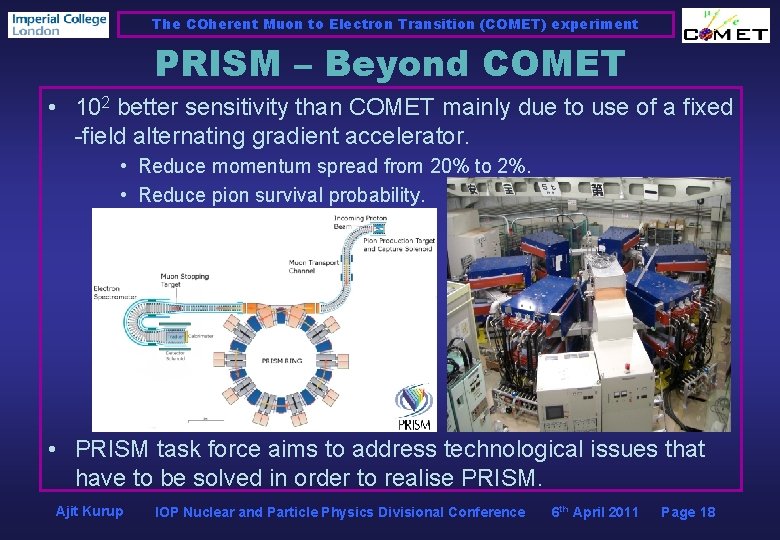
The COherent Muon to Electron Transition (COMET) experiment PRISM – Beyond COMET • 102 better sensitivity than COMET mainly due to use of a fixed -field alternating gradient accelerator. • Reduce momentum spread from 20% to 2%. • Reduce pion survival probability. • PRISM task force aims to address technological issues that have to be solved in order to realise PRISM. Ajit Kurup IOP Nuclear and Particle Physics Divisional Conference 6 th April 2011 Page 18
The COherent Muon to Electron Transition (COMET) experiment Summary and Future Plans • COMET is an exciting project to work on! – Promises factor 104 improvement on current best limit. – Accelerator is intimately linked to the detector systems. • To achieve sensitivity requires the development of accelerator and detector technology. – – Intense, cleanly pulsed, proton beams. Superconducting solenoid technology. Transport channels for large emittance beams. Tracker technology, cost-effective calorimeter technology, late-arriving particle tagger. • COMET has Stage-1 approval from J-PARC and the Technical Design Report is planned to be submitted in 2011. • PRISM could be an even better muon to electron conversion experiment. – Requires pushing the boundaries of accelerator technology. Ajit Kurup IOP Nuclear and Particle Physics Divisional Conference 6 th April 2011 Page 19