
The Coevolution of Life Ocean and Atmospheric Chemistry



- Slides: 62
The Co-evolution of Life, Ocean and Atmospheric Chemistry, and Sedimentary Rocks 12. 842 Lecture #3 Ed Boyle 9/18/06
The Origin of Life
Theories of the origin of life “We still have little idea how, when or where life began…. The evidence is circumstantial and can be compared with delving into such records as there are in Massachusetts of the Mayflower, to discern the origins of the English language. ” Nisbet & Sleep (2001) “The habitat and nature of early life” Nature Vol. 409: 1083 -1091.
Some Milestones in Origin-of-Life Science-1 • 1664: Archbishop Usher announced that his literal reading of the Bible indicates that God created humans & higher organisms on Oct. 26, 4004 BC. • < mid 1800’s: Creationism + insects, frogs & other small creatures arise spontaneously from mud & rot. • mid 1800’s: • (1) Pasteur demonstrated bacteria & other microorganisms arise from parents resembling themselves. Spontaneous generation is dead. • (2) Darwin proposes natural selection, theory that environmental pressure results in the perpetuation of certain adaptations. Evolution of complex organisms therefore possible, & all current life forms could have evolved from a single (last) common ancestor. • Darwin (privately) suggested life could have arisen from chemistry: “in some warm little pond, with all sorts of ammonia and phosphoric salts, light, heat, electricity, etc. , present. ” Adapted from Orgel (1994) Sci. Am. , Oct. 1994, 77 -83.
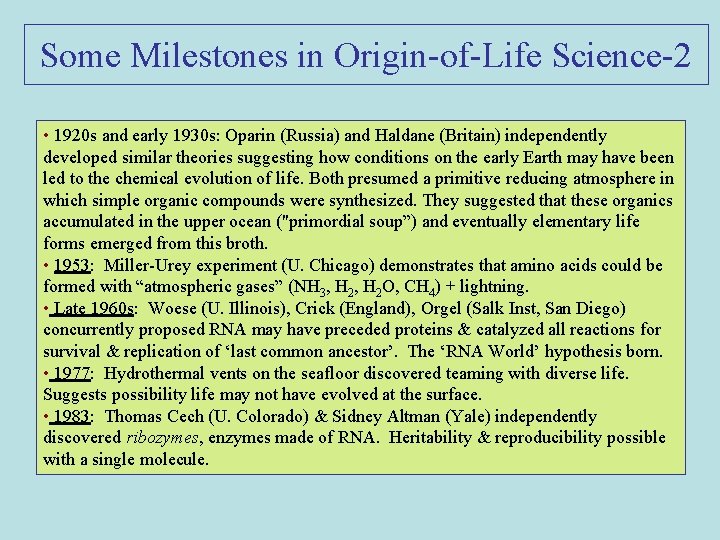
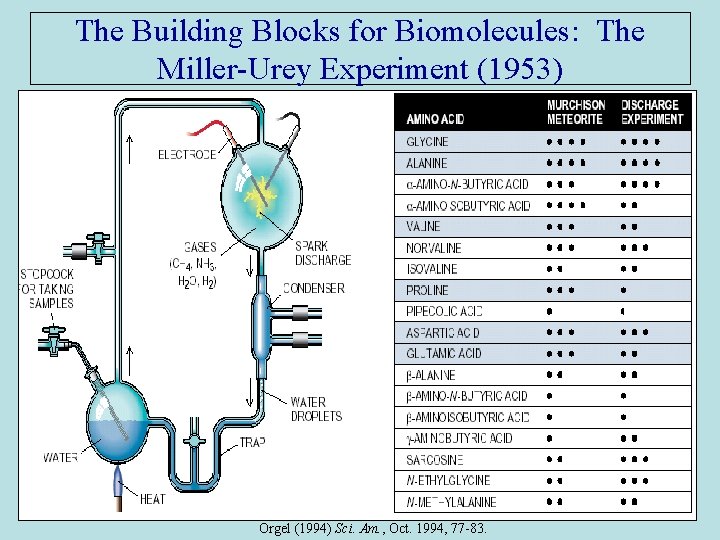
Some Milestones in Origin-of-Life Science-2 • 1920 s and early 1930 s: Oparin (Russia) and Haldane (Britain) independently developed similar theories suggesting how conditions on the early Earth may have been led to the chemical evolution of life. Both presumed a primitive reducing atmosphere in which simple organic compounds were synthesized. They suggested that these organics accumulated in the upper ocean ("primordial soup”) and eventually elementary life forms emerged from this broth. • 1953: Miller-Urey experiment (U. Chicago) demonstrates that amino acids could be formed with “atmospheric gases” (NH 3, H 2 O, CH 4) + lightning. • Late 1960 s: Woese (U. Illinois), Crick (England), Orgel (Salk Inst, San Diego) concurrently proposed RNA may have preceded proteins & catalyzed all reactions for survival & replication of ‘last common ancestor’. The ‘RNA World’ hypothesis born. • 1977: Hydrothermal vents on the seafloor discovered teaming with diverse life. Suggests possibility life may not have evolved at the surface. • 1983: Thomas Cech (U. Colorado) & Sidney Altman (Yale) independently discovered ribozymes, enzymes made of RNA. Heritability & reproducibility possible with a single molecule.
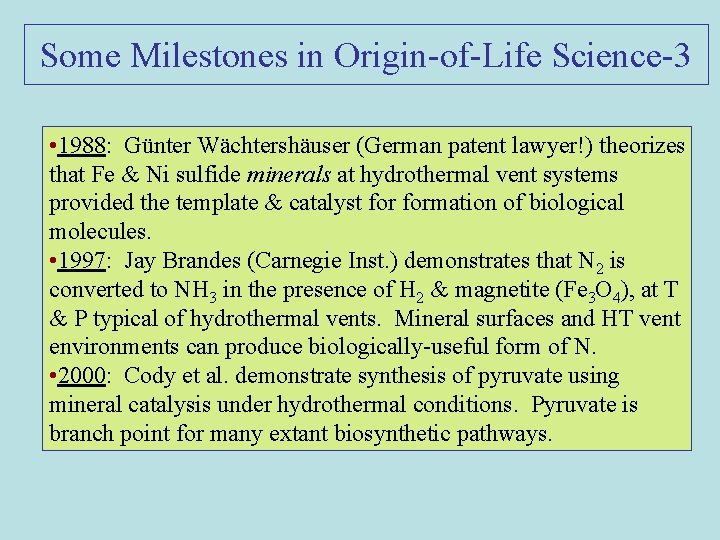
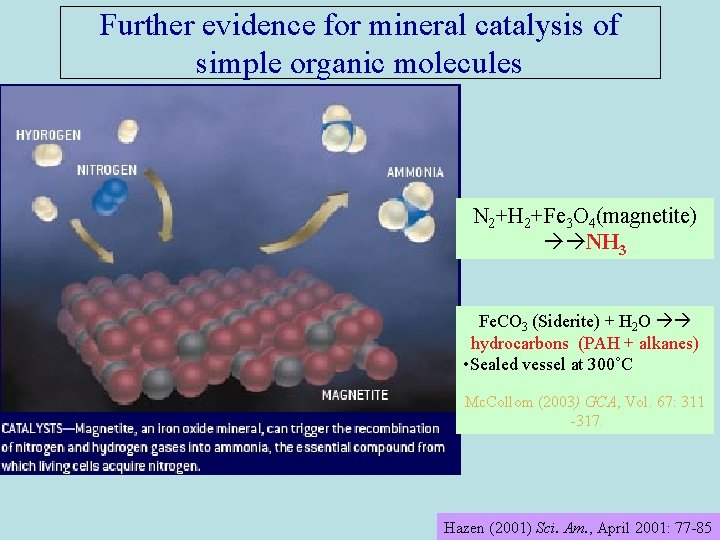
Some Milestones in Origin-of-Life Science-3 • 1988: Günter Wächtershäuser (German patent lawyer!) theorizes that Fe & Ni sulfide minerals at hydrothermal vent systems provided the template & catalyst formation of biological molecules. • 1997: Jay Brandes (Carnegie Inst. ) demonstrates that N 2 is converted to NH 3 in the presence of H 2 & magnetite (Fe 3 O 4), at T & P typical of hydrothermal vents. Mineral surfaces and HT vent environments can produce biologically-useful form of N. • 2000: Cody et al. demonstrate synthesis of pyruvate using mineral catalysis under hydrothermal conditions. Pyruvate is branch point for many extant biosynthetic pathways.
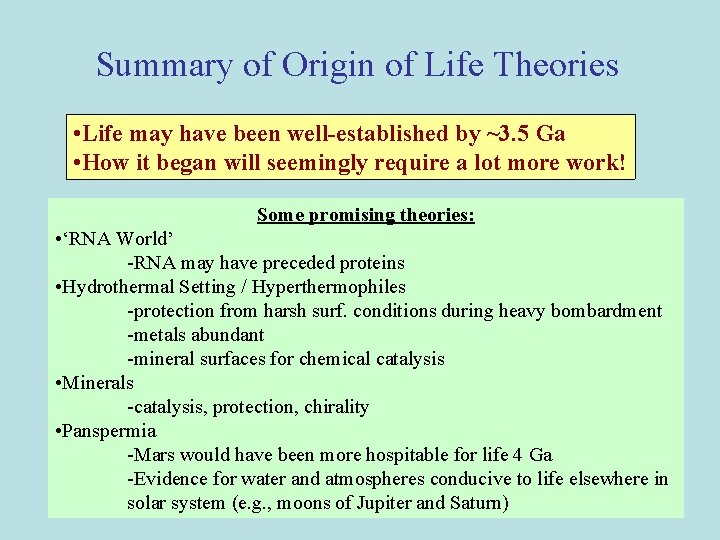
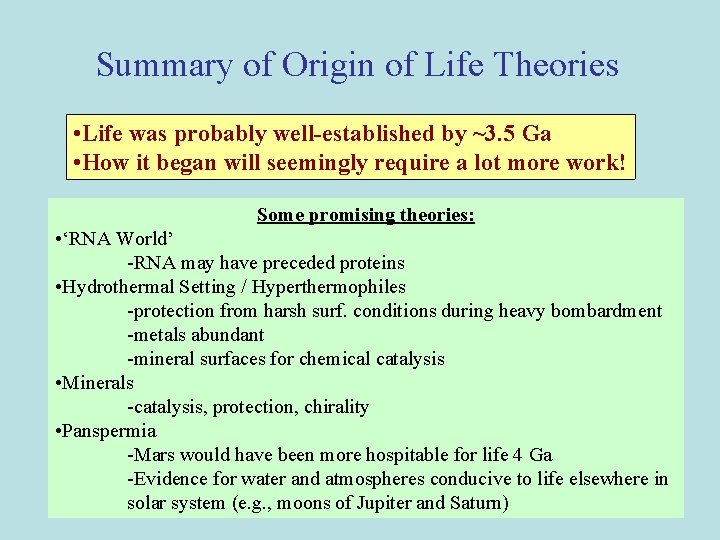
Summary of Origin of Life Theories • Life may have been well-established by ~3. 5 Ga • How it began will seemingly require a lot more work! Some promising theories: • ‘RNA World’ -RNA may have preceded proteins • Hydrothermal Setting / Hyperthermophiles -protection from harsh surf. conditions during heavy bombardment -metals abundant -mineral surfaces for chemical catalysis • Minerals -catalysis, protection, chirality • Panspermia -Mars would have been more hospitable for life 4 Ga -Evidence for water and atmospheres conducive to life elsewhere in solar system (e. g. , moons of Jupiter and Saturn)
The Building Blocks for Biomolecules: The Miller-Urey Experiment (1953) Orgel (1994) Sci. Am. , Oct. 1994, 77 -83.
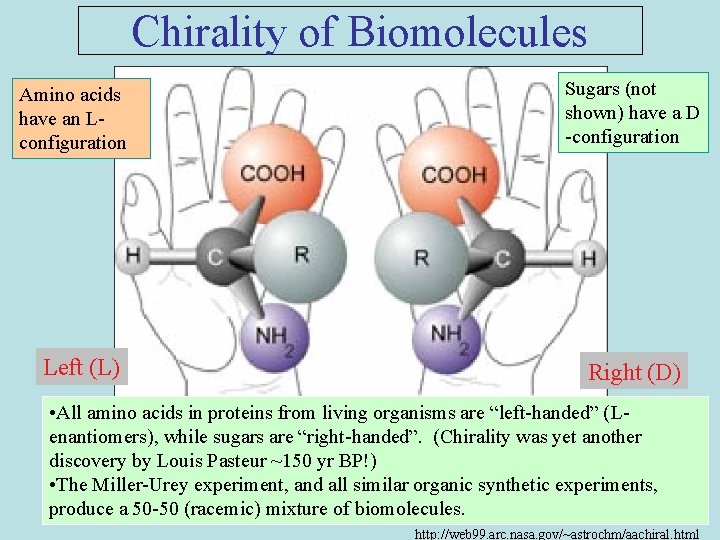
Chirality of Biomolecules Amino acids have an Lconfiguration Left (L) Sugars (not shown) have a D -configuration Right (D) • All amino acids in proteins from living organisms are “left-handed” (Lenantiomers), while sugars are “right-handed”. (Chirality was yet another discovery by Louis Pasteur ~150 yr BP!) • The Miller-Urey experiment, and all similar organic synthetic experiments, produce a 50 -50 (racemic) mixture of biomolecules. http: //web 99. arc. nasa. gov/~astrochm/aachiral. html
How did chirality of biomolecules arise? • • It may have occurred in the solar nebula during the formation of the solar system. Amino acids with a slight L-enantiomeric excess is observed in the Murchison & Murray meteorites (Although beware of contamination, since all Earthly aa’s begin with L configuration. But note: during natural decomposition processes, protein aa’s revert to a 50 -50 (racemic) mixture over time. ) Crystal faces have surface structures that are mirror-images. Experiments show that crystal faces can selct L or D amino acids quite efficiently (40% excess) (Hazen, 2001). While this mechanism can explain the propagation of the L or D configuration, it cannot explain the origin of that preference.
A Hyperthermophilic Beginning for Life? • Given the inhospitable surface environment on Earth < 3. 8 Ga, when the intense bombardment likely melted the crust & vaporized the ocean, perhaps repeatedly, it is frequently proposed that life began in a sub-surface environment, perhaps a hydrothermal system where hot water, CO 2 & a variety of metals are readily available. • The recognition that many of the essential enzymes for life require metals common in hydrothermal settings (Fe, Ni, Mo, Cu, Co, Zn) supports this supposition. c. f. , Nisbet & Sleep (2001) Nature, Vol. 409: 1083 -1091.
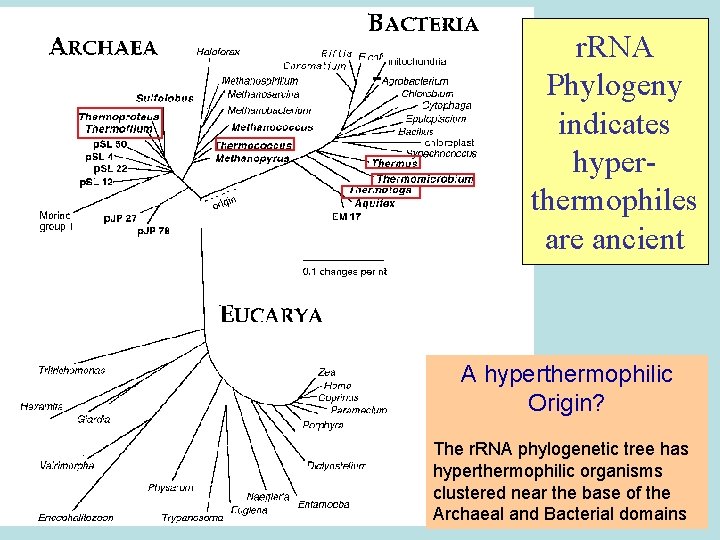
r. RNA Phylogeny indicates hyperthermophiles are ancient A hyperthermophilic Origin? The r. RNA phylogenetic tree has hyperthermophilic organisms clustered near the base of the Archaeal and Bacterial domains
Further evidence for mineral catalysis of simple organic molecules N 2+H 2+Fe 3 O 4(magnetite) NH 3 Fe. CO 3 (Siderite) + H 2 O hydrocarbons (PAH + alkanes) • Sealed vessel at 300˚C Mc. Collom (2003) GCA, Vol. 67: 311 -317. Hazen (2001) Sci. Am. , April 2001: 77 -85
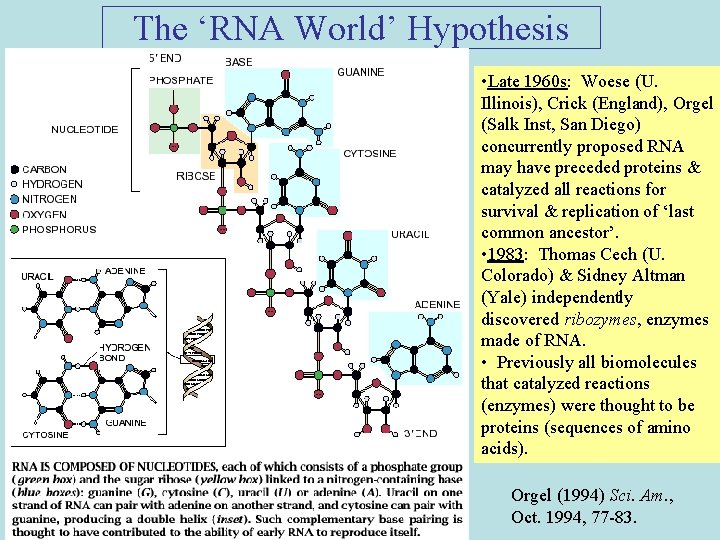
The ‘RNA World’ Hypothesis • Late 1960 s: Woese (U. Illinois), Crick (England), Orgel (Salk Inst, San Diego) concurrently proposed RNA may have preceded proteins & catalyzed all reactions for survival & replication of ‘last common ancestor’. • 1983: Thomas Cech (U. Colorado) & Sidney Altman (Yale) independently discovered ribozymes, enzymes made of RNA. • Previously all biomolecules that catalyzed reactions (enzymes) were thought to be proteins (sequences of amino acids). Orgel (1994) Sci. Am. , Oct. 1994, 77 -83.
Summary of Origin of Life Theories • Life was probably well-established by ~3. 5 Ga • How it began will seemingly require a lot more work! Some promising theories: • ‘RNA World’ -RNA may have preceded proteins • Hydrothermal Setting / Hyperthermophiles -protection from harsh surf. conditions during heavy bombardment -metals abundant -mineral surfaces for chemical catalysis • Minerals -catalysis, protection, chirality • Panspermia -Mars would have been more hospitable for life 4 Ga -Evidence for water and atmospheres conducive to life elsewhere in solar system (e. g. , moons of Jupiter and Saturn)
The Rise of Atmospheric Oxygen
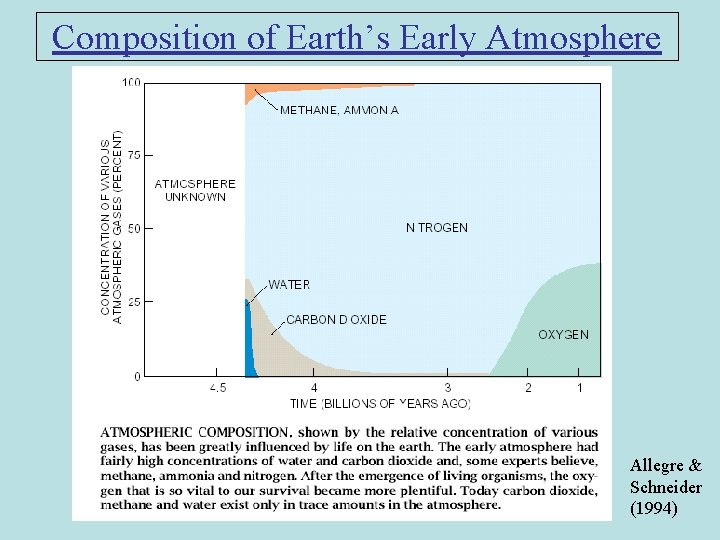
Composition of Earth’s Early Atmosphere Allegre & Schneider (1994)
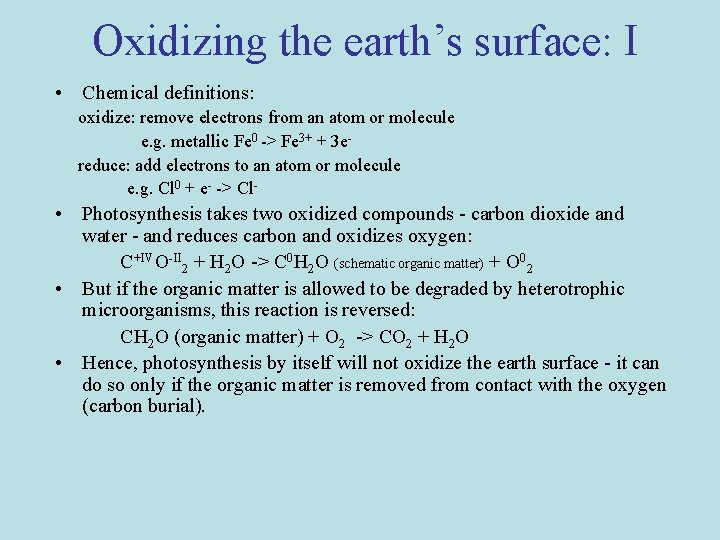
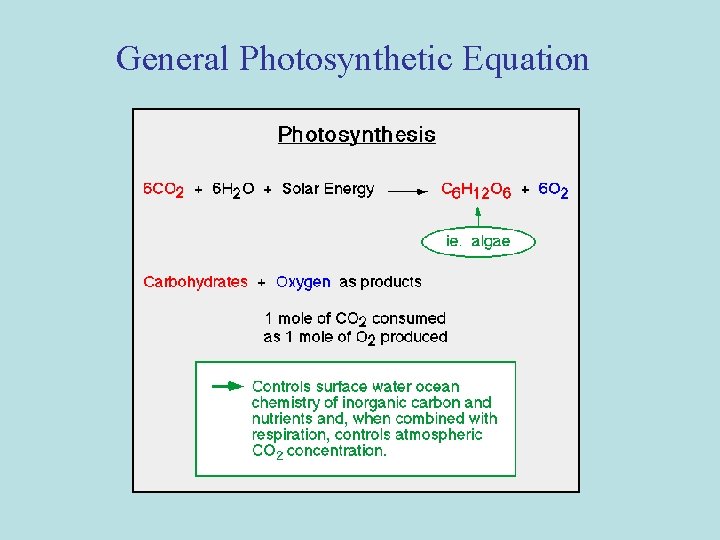
Oxidizing the earth’s surface: I • Chemical definitions: oxidize: remove electrons from an atom or molecule e. g. metallic Fe 0 -> Fe 3+ + 3 ereduce: add electrons to an atom or molecule e. g. Cl 0 + e- -> Cl- • Photosynthesis takes two oxidized compounds - carbon dioxide and water - and reduces carbon and oxidizes oxygen: C+IVO-II 2 + H 2 O -> C 0 H 2 O (schematic organic matter) + O 02 • But if the organic matter is allowed to be degraded by heterotrophic microorganisms, this reaction is reversed: CH 2 O (organic matter) + O 2 -> CO 2 + H 2 O • Hence, photosynthesis by itself will not oxidize the earth surface - it can do so only if the organic matter is removed from contact with the oxygen (carbon burial).
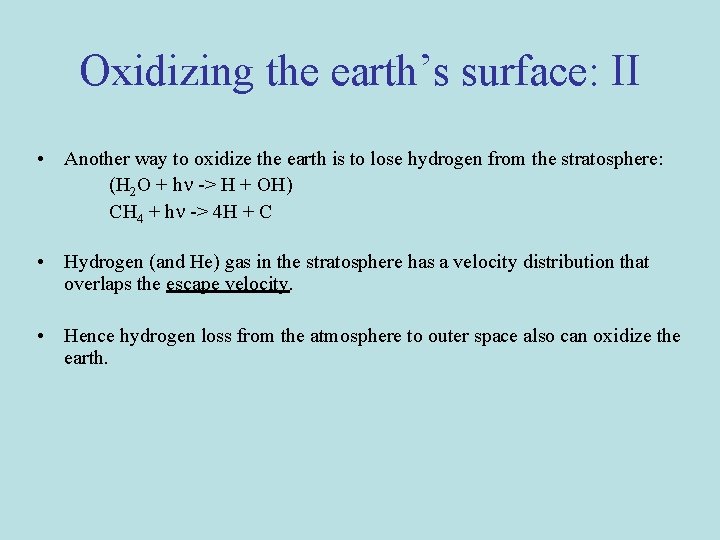
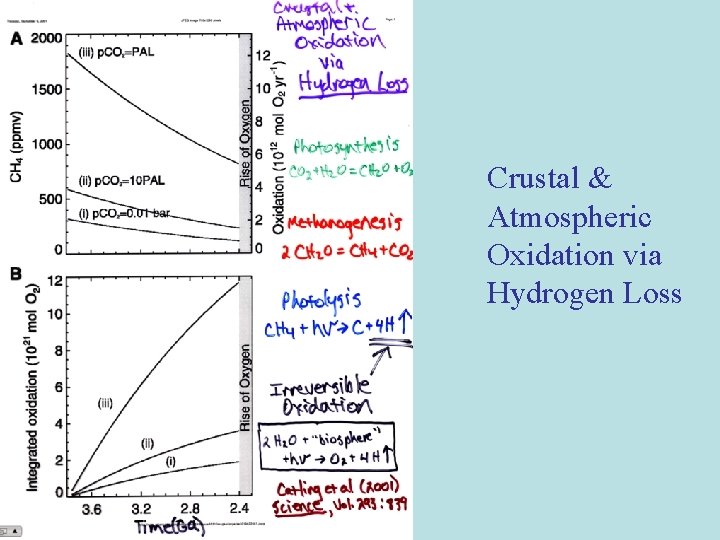
Oxidizing the earth’s surface: II • Another way to oxidize the earth is to lose hydrogen from the stratosphere: (H 2 O + h -> H + OH) CH 4 + h -> 4 H + C • Hydrogen (and He) gas in the stratosphere has a velocity distribution that overlaps the escape velocity. • Hence hydrogen loss from the atmosphere to outer space also can oxidize the earth.
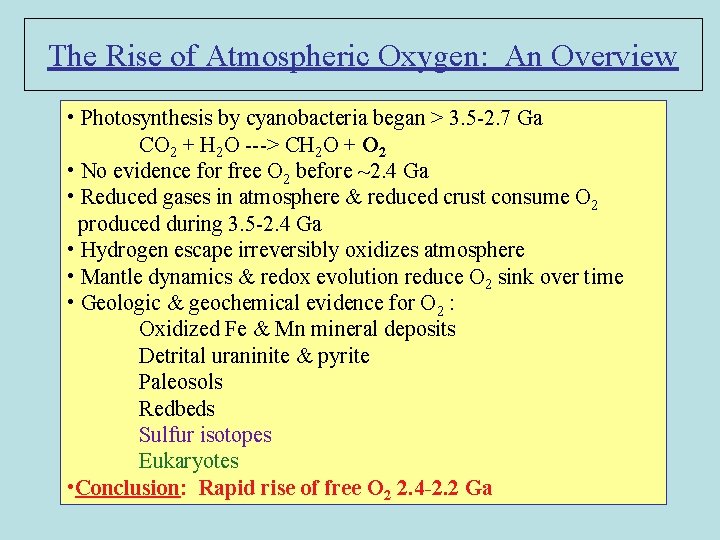
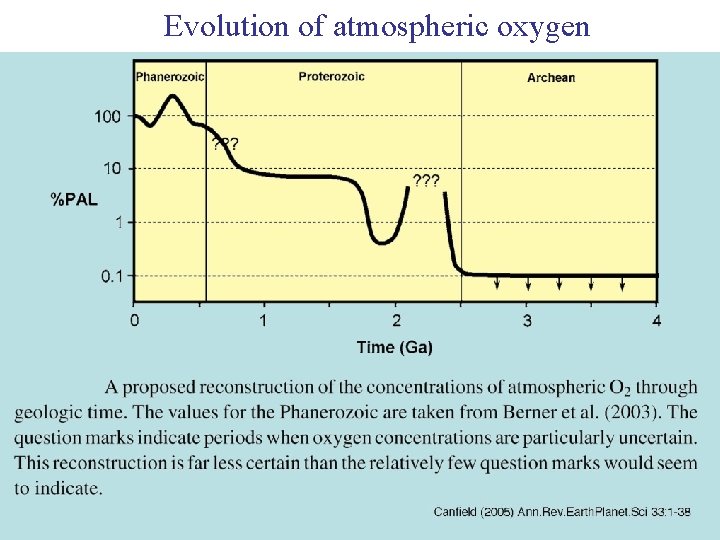
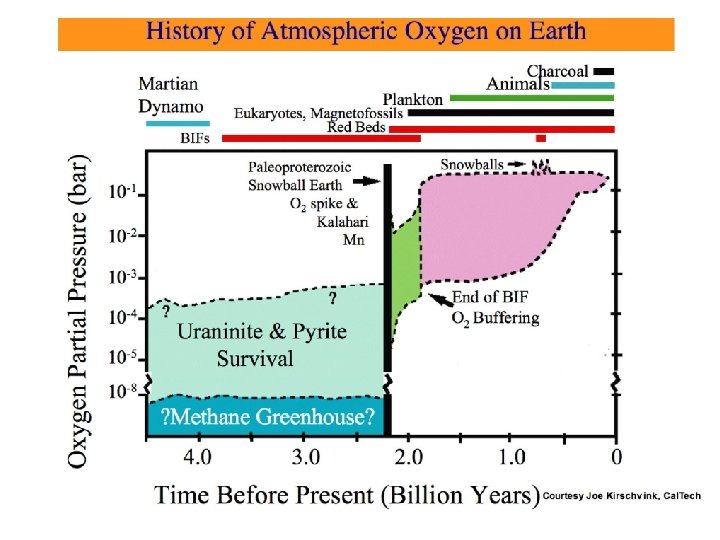
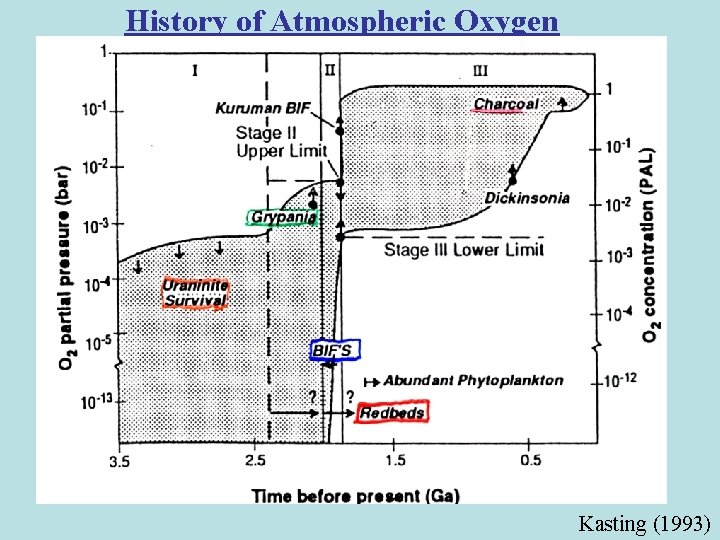
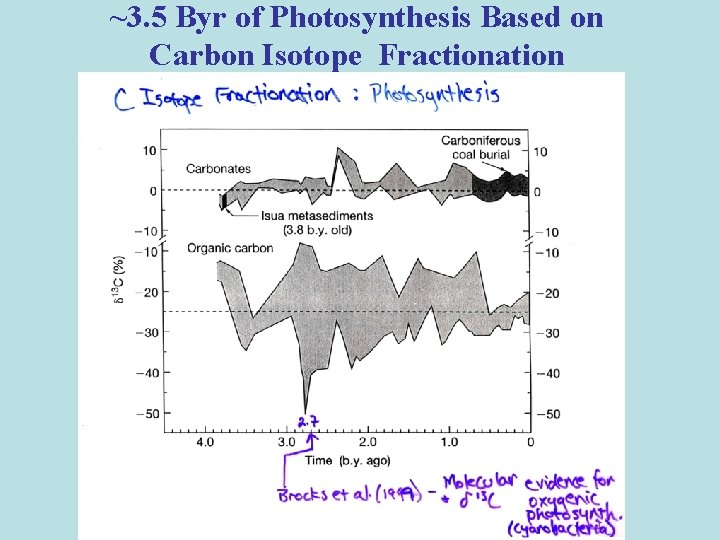
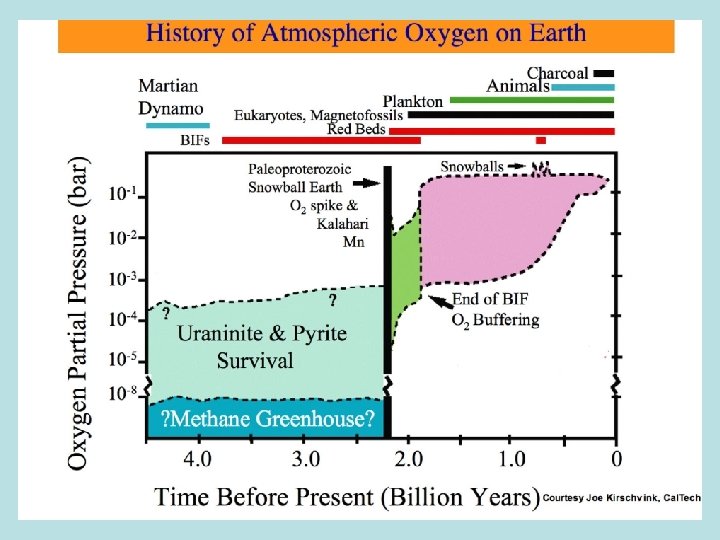
The Rise of Atmospheric Oxygen: An Overview • Photosynthesis by cyanobacteria began > 3. 5 -2. 7 Ga CO 2 + H 2 O ---> CH 2 O + O 2 • No evidence for free O 2 before ~2. 4 Ga • Reduced gases in atmosphere & reduced crust consume O 2 produced during 3. 5 -2. 4 Ga • Hydrogen escape irreversibly oxidizes atmosphere • Mantle dynamics & redox evolution reduce O 2 sink over time • Geologic & geochemical evidence for O 2 : Oxidized Fe & Mn mineral deposits Detrital uraninite & pyrite Paleosols Redbeds Sulfur isotopes Eukaryotes • Conclusion: Rapid rise of free O 2 2. 4 -2. 2 Ga
Geologic Evidence for Atmospheric Oxygen
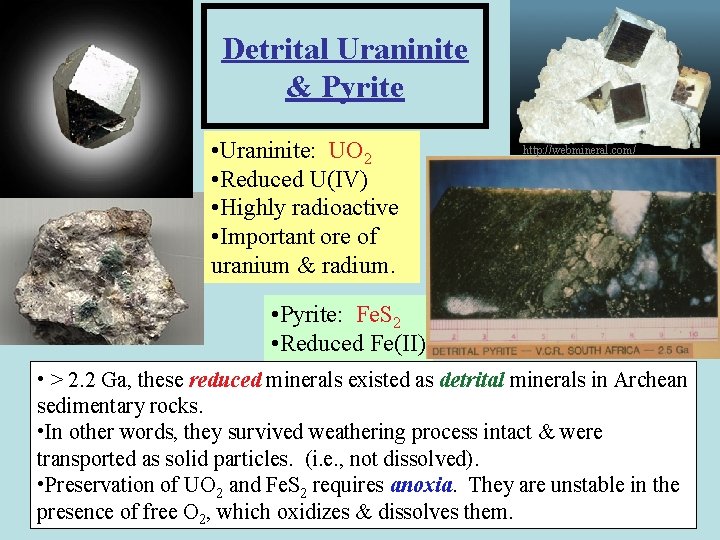
Detrital Uraninite & Pyrite • Uraninite: UO 2 • Reduced U(IV) • Highly radioactive • Important ore of uranium & radium. http: //webmineral. com/ • Pyrite: Fe. S 2 • Reduced Fe(II) • > 2. 2 Ga, these reduced minerals existed as detrital minerals in Archean sedimentary rocks. • In other words, they survived weathering process intact & were transported as solid particles. (i. e. , not dissolved). • Preservation of UO 2 and Fe. S 2 requires anoxia. They are unstable in the presence of free O 2, which oxidizes & dissolves them.
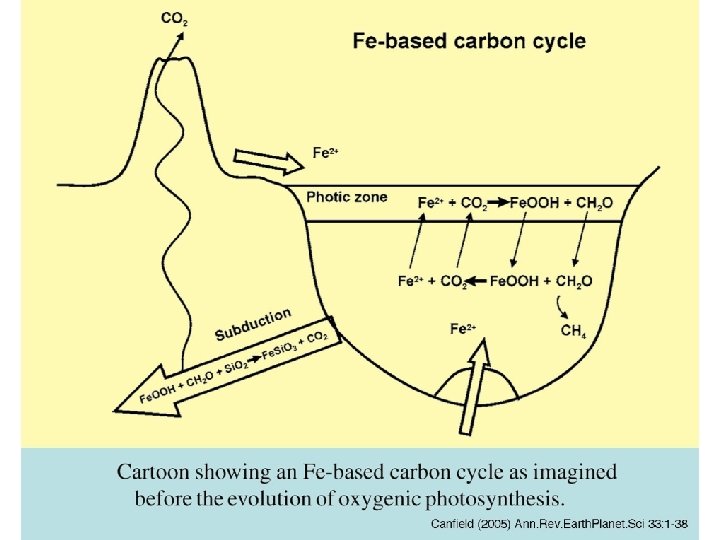
Fe-based carbon cycle cartoon
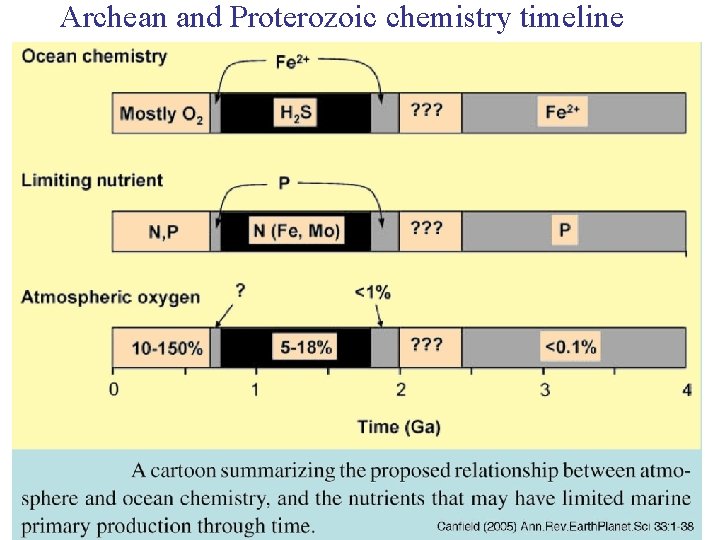
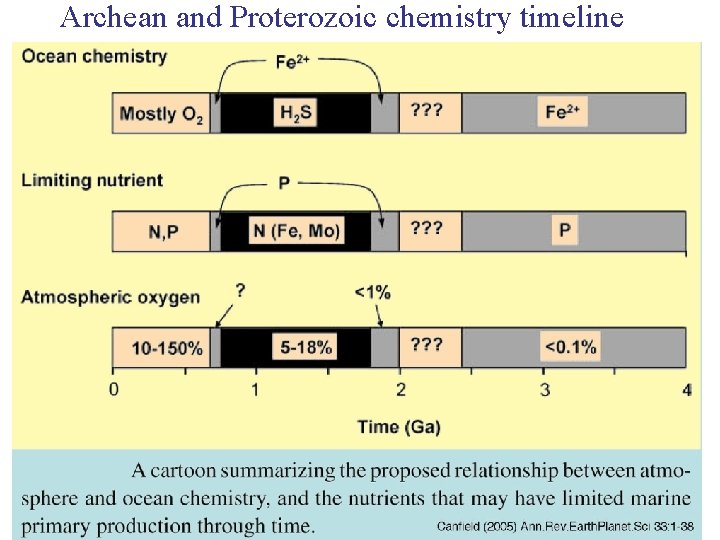
Archean and Proterozoic chemistry timeline
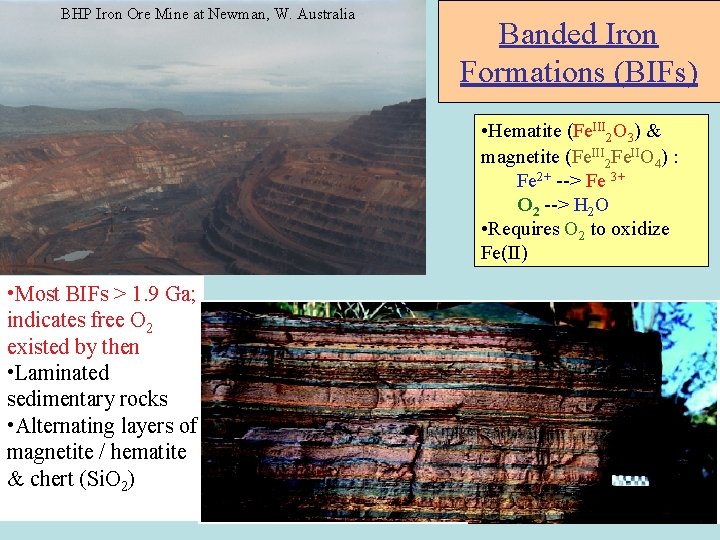
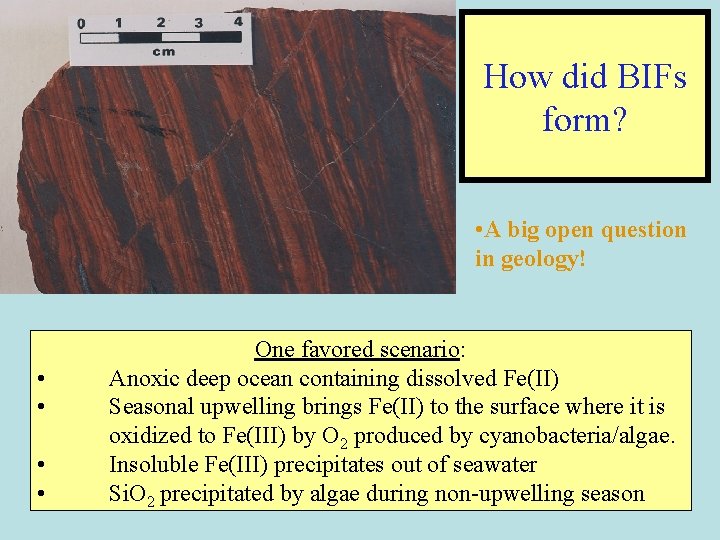
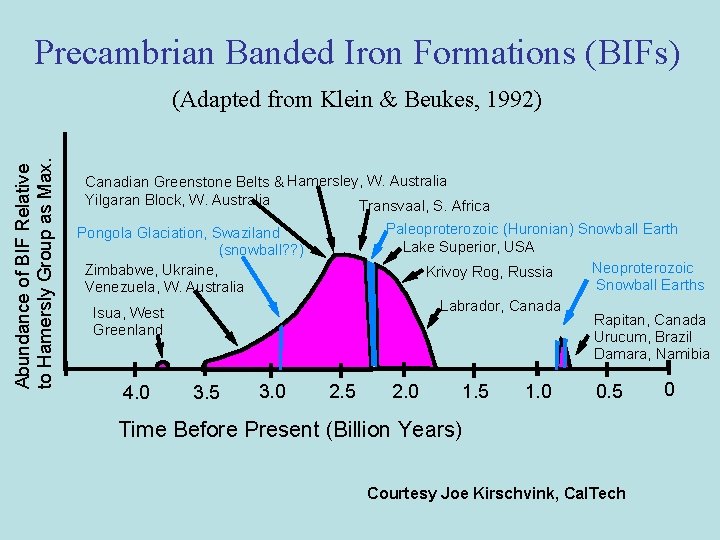
BHP Iron Ore Mine at Newman, W. Australia Banded Iron Formations (BIFs) • Hematite (Fe. III 2 O 3) & magnetite (Fe. III 2 Fe. IIO 4) : Fe 2+ --> Fe 3+ O 2 --> H 2 O • Requires O 2 to oxidize Fe(II) • Most BIFs > 1. 9 Ga; indicates free O 2 existed by then • Laminated sedimentary rocks • Alternating layers of magnetite / hematite & chert (Si. O 2)
How did BIFs form? • A big open question in geology! • • One favored scenario: Anoxic deep ocean containing dissolved Fe(II) Seasonal upwelling brings Fe(II) to the surface where it is oxidized to Fe(III) by O 2 produced by cyanobacteria/algae. Insoluble Fe(III) precipitates out of seawater Si. O 2 precipitated by algae during non-upwelling season
Precambrian Banded Iron Formations (BIFs) Abundance of BIF Relative to Hamersly Group as Max. (Adapted from Klein & Beukes, 1992) Canadian Greenstone Belts & Hamersley, W. Australia Yilgaran Block, W. Australia Transvaal, S. Africa Paleoproterozoic (Huronian) Snowball Earth Lake Superior, USA Neoproterozoic Krivoy Rog, Russia Snowball Earths Labrador, Canada Rapitan, Canada Urucum, Brazil Damara, Namibia Pongola Glaciation, Swaziland (snowball? ? ) Zimbabwe, Ukraine, Venezuela, W. Australia Isua, West Greenland 4. 0 3. 5 3. 0 2. 5 2. 0 1. 5 1. 0 0. 5 Time Before Present (Billion Years) Courtesy Joe Kirschvink, Cal. Tech 0
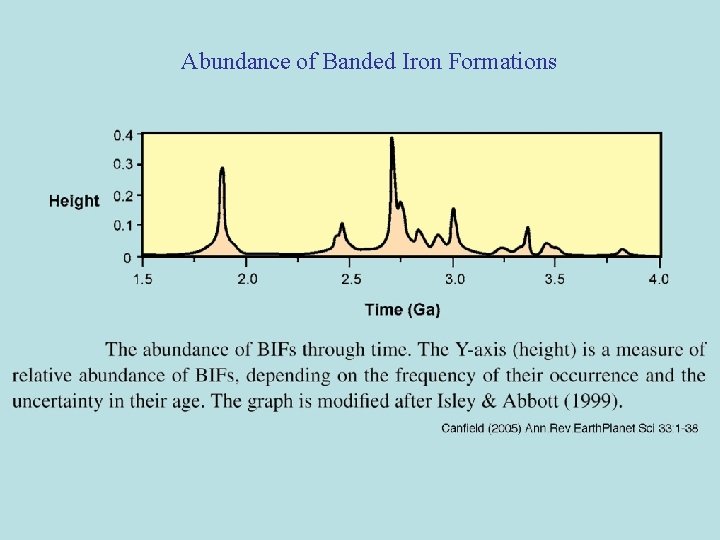
Banded iron formations, 1. 5 -4. 0 billion years after formation of earth Abundance of Banded Iron Formations
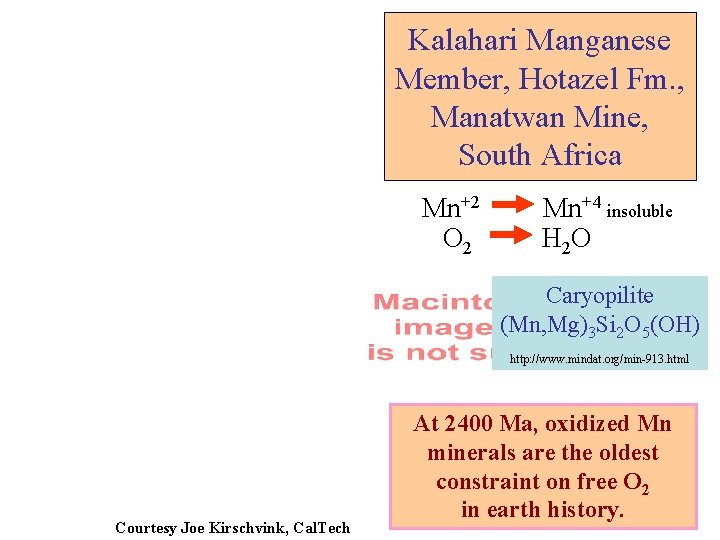
Kalahari Manganese Member, Hotazel Fm. , Manatwan Mine, South Africa Mn+2 O 2 Mn+4 insoluble H 2 O Caryopilite (Mn, Mg)3 Si 2 O 5(OH) http: //www. mindat. org/min-913. html Courtesy Joe Kirschvink, Cal. Tech At 2400 Ma, oxidized Mn minerals are the oldest constraint on free O 2 in earth history.
Likely Mechanism of Mn & Fe Deposit Formation Courtesy Joe Kirschvink, Cal. Tech • Cyanobacterial Bloom Yields an Electrochemical Stratification in the Oceans, Depositing Manganese in Upwelling Areas on Continental Shelves.
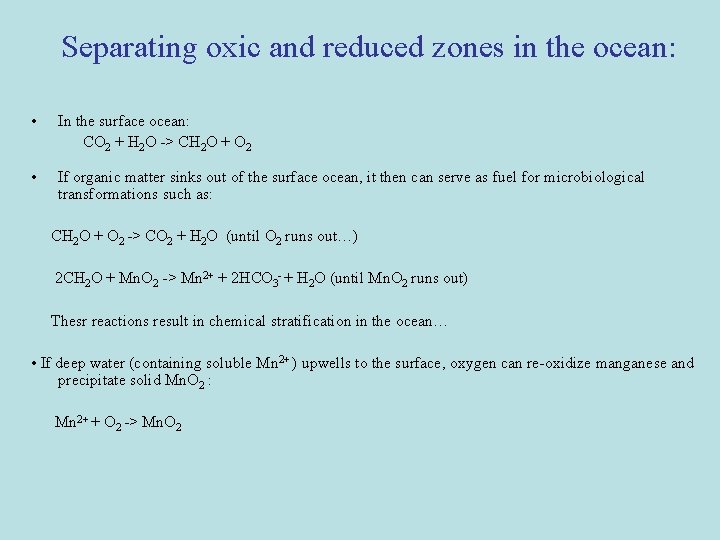
Separating oxic and reduced zones in the ocean: • In the surface ocean: CO 2 + H 2 O -> CH 2 O + O 2 • If organic matter sinks out of the surface ocean, it then can serve as fuel for microbiological transformations such as: CH 2 O + O 2 -> CO 2 + H 2 O (until O 2 runs out…) 2 CH 2 O + Mn. O 2 -> Mn 2+ + 2 HCO 3 - + H 2 O (until Mn. O 2 runs out) Thesr reactions result in chemical stratification in the ocean… • If deep water (containing soluble Mn 2+ ) upwells to the surface, oxygen can re-oxidize manganese and precipitate solid Mn. O 2 : Mn 2+ + O 2 -> Mn. O 2
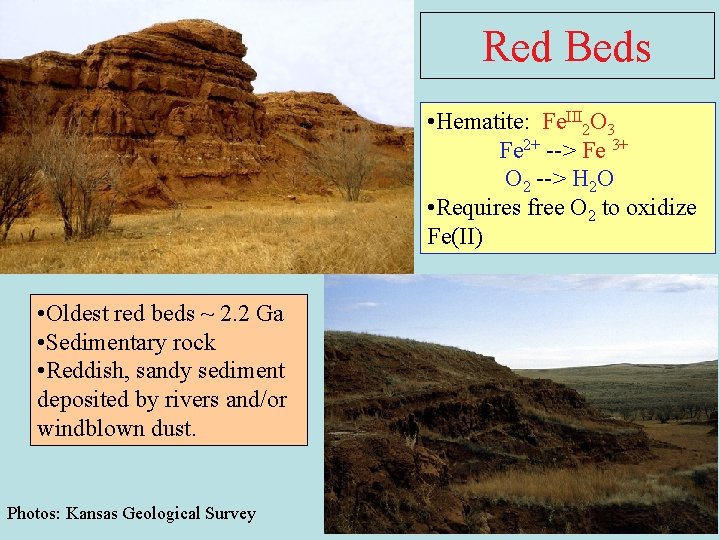
Red Beds • Hematite: Fe. III 2 O 3 Fe 2+ --> Fe 3+ O 2 --> H 2 O • Requires free O 2 to oxidize Fe(II) • Oldest red beds ~ 2. 2 Ga • Sedimentary rock • Reddish, sandy sediment deposited by rivers and/or windblown dust. Photos: Kansas Geological Survey
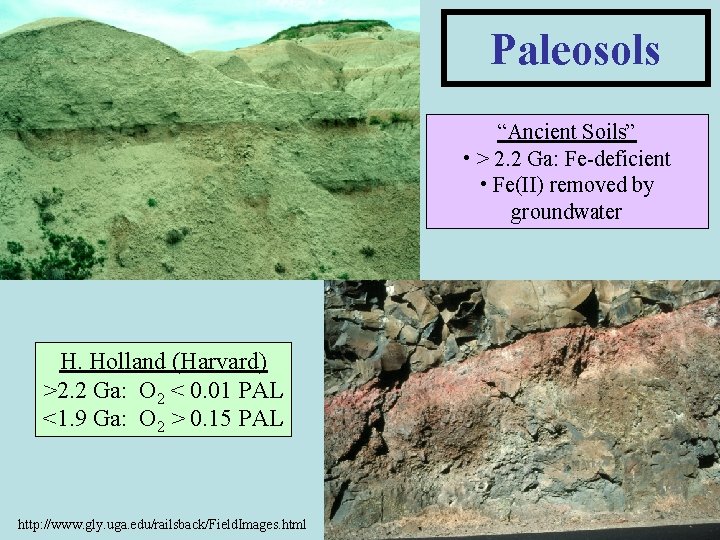
Paleosols “Ancient Soils” • > 2. 2 Ga: Fe-deficient • Fe(II) removed by groundwater H. Holland (Harvard) >2. 2 Ga: O 2 < 0. 01 PAL <1. 9 Ga: O 2 > 0. 15 PAL http: //www. gly. uga. edu/railsback/Field. Images. html
Biotic Evidence for Atmospheric Oxygen
Archean and Proterozoic chemistry timeline
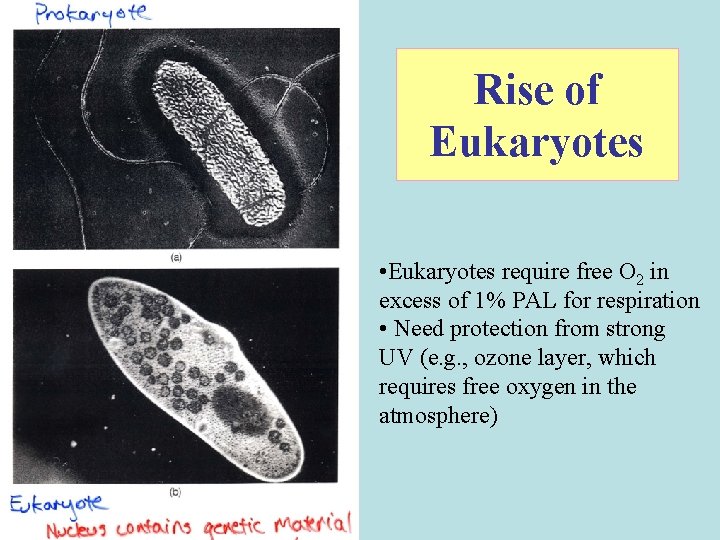
Rise of Eukaryotes • Eukaryotes require free O 2 in excess of 1% PAL for respiration • Need protection from strong UV (e. g. , ozone layer, which requires free oxygen in the atmosphere)
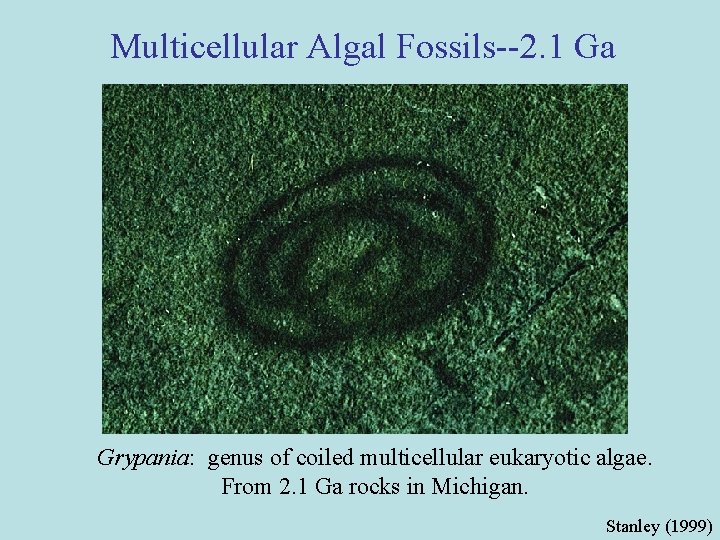
Multicellular Algal Fossils--2. 1 Ga Grypania: genus of coiled multicellular eukaryotic algae. From 2. 1 Ga rocks in Michigan. Stanley (1999)
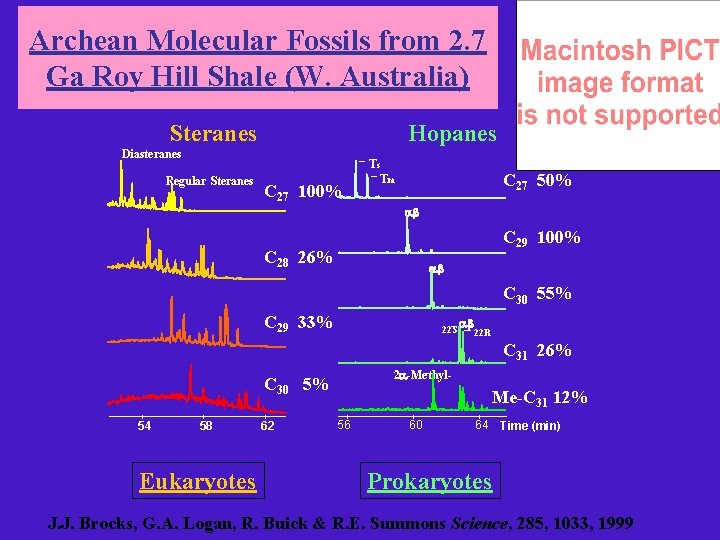
Archean Molecular Fossils from 2. 7 Ga Roy Hill Shale (W. Australia) Steranes Hopanes Diasteranes Regular Steranes C 27 100% Ts Tm C 27 50% ab C 29 100% C 28 26% ab C 30 55% C 29 33% 22 S ab 22 R C 31 26% 2 a-Methyl- C 30 5% 54 58 Eukaryotes 62 Me-C 31 12% 56 60 64 Time (min) Prokaryotes J. J. Brocks, G. A. Logan, R. Buick & R. E. Summons Science, 285, 1033, 1999
Evolution of atmospheric oxygen
History of Atmospheric Oxygen Kasting (1993)
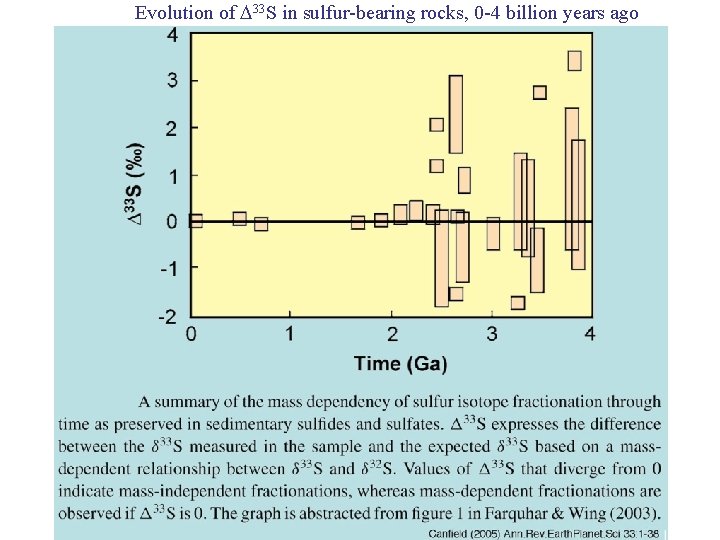
Evolution of 33 S in sulfur-bearing rocks, 0 -4 billion years ago
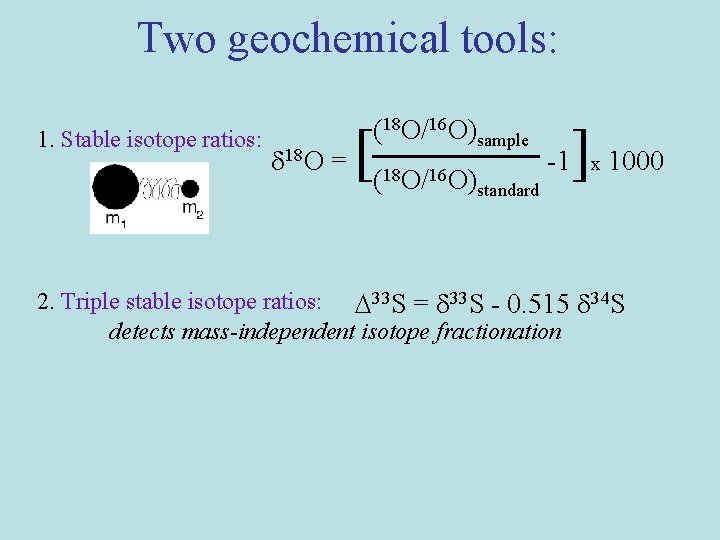
Two geochemical tools: 1. Stable isotope ratios: 18 O = (18 O/16 O)sample [( 18 O/16 O) standard -1 ] 1000 x 2. Triple stable isotope ratios: 33 S = 33 S - 0. 515 34 S detects mass-independent isotope fractionation
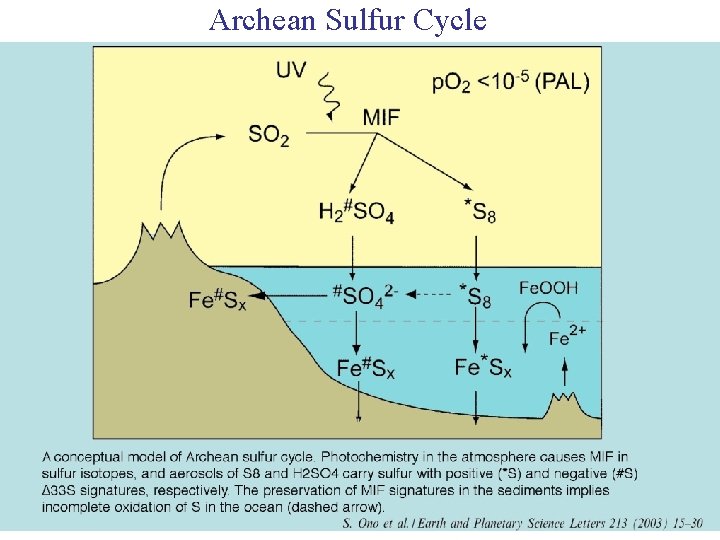
Archean Sulfur Cycle
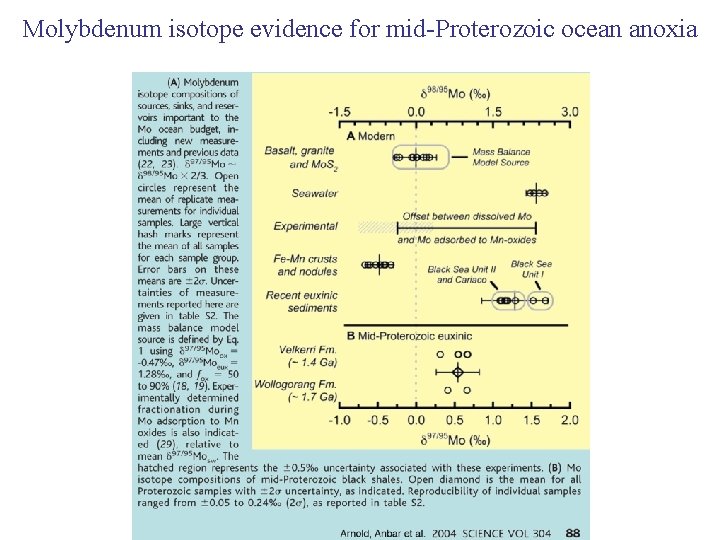
Molybdenum isotope evidence for mid-Proterozoic ocean anoxia
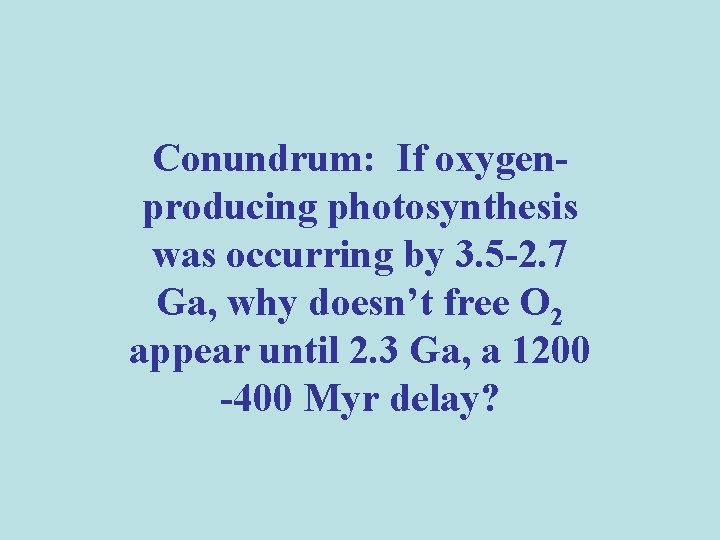
Conundrum: If oxygenproducing photosynthesis was occurring by 3. 5 -2. 7 Ga, why doesn’t free O 2 appear until 2. 3 Ga, a 1200 -400 Myr delay?
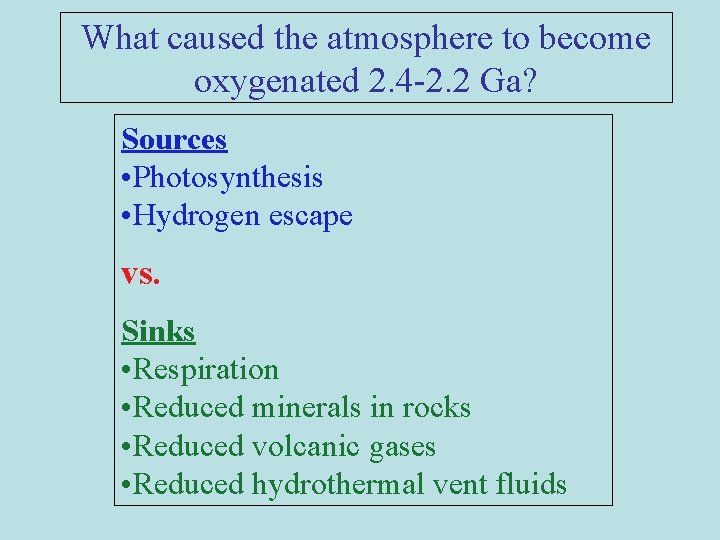
What caused the atmosphere to become oxygenated 2. 4 -2. 2 Ga? Sources • Photosynthesis • Hydrogen escape vs. Sinks • Respiration • Reduced minerals in rocks • Reduced volcanic gases • Reduced hydrothermal vent fluids
Sources of Oxygen to the Atmosphere
General Photosynthetic Equation
~3. 5 Byr of Photosynthesis Based on Carbon Isotope Fractionation
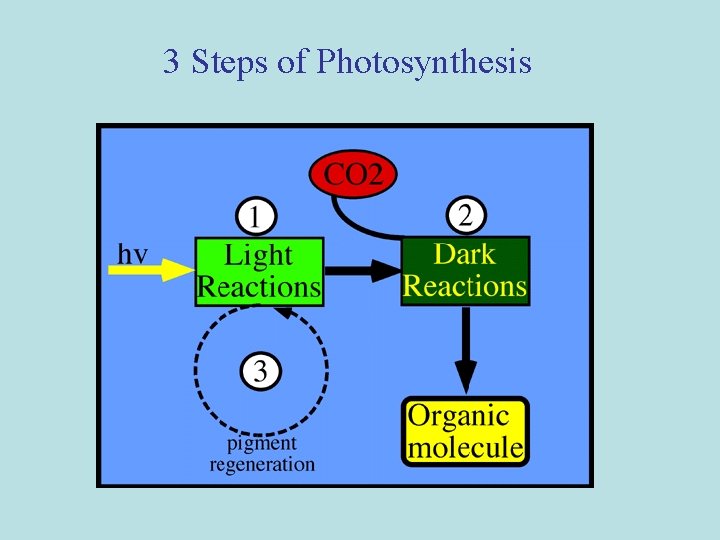
3 Steps of Photosynthesis
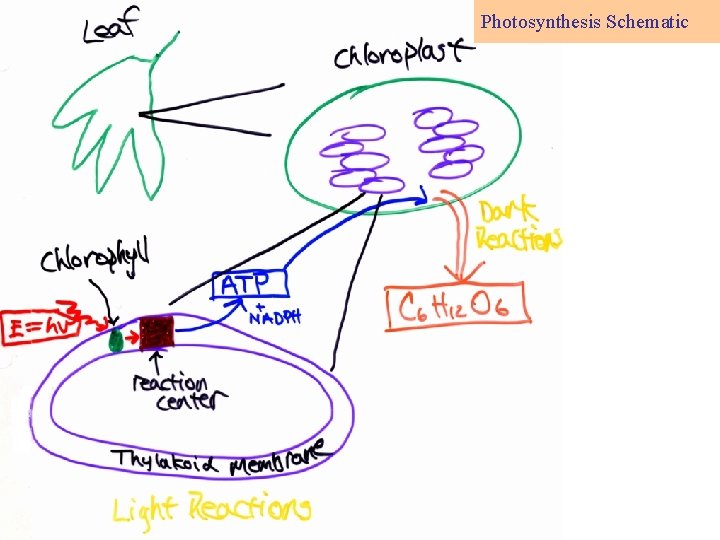
Photosynthesis Schematic
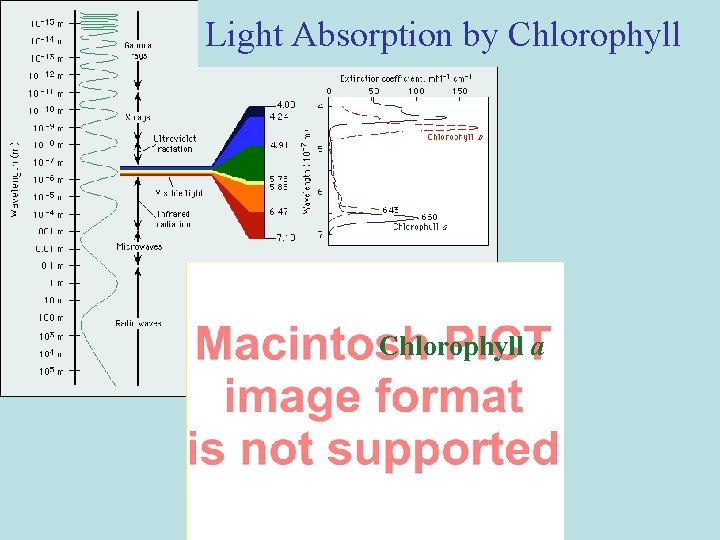
Light Absorption by Chlorophyll a
Crustal & Atmospheric Oxidation via Hydrogen Loss
Sinks for Atmospheric Oxygen
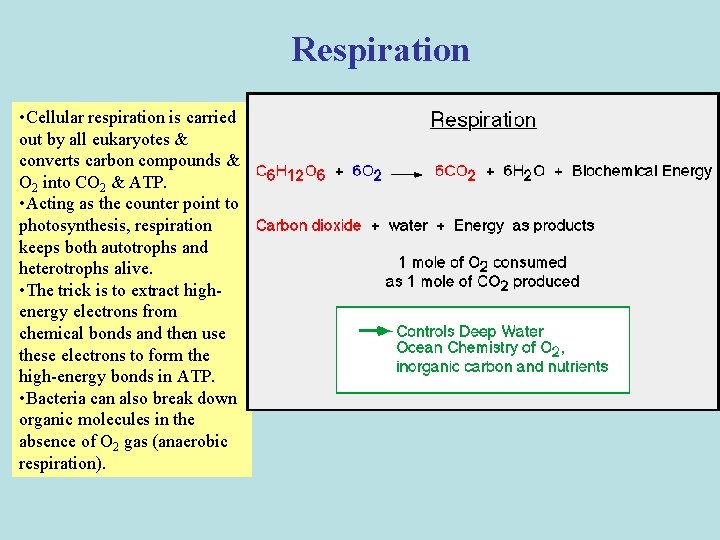
Respiration • Cellular respiration is carried out by all eukaryotes & converts carbon compounds & O 2 into CO 2 & ATP. • Acting as the counter point to photosynthesis, respiration keeps both autotrophs and heterotrophs alive. • The trick is to extract highenergy electrons from chemical bonds and then use these electrons to form the high-energy bonds in ATP. • Bacteria can also break down organic molecules in the absence of O 2 gas (anaerobic respiration).
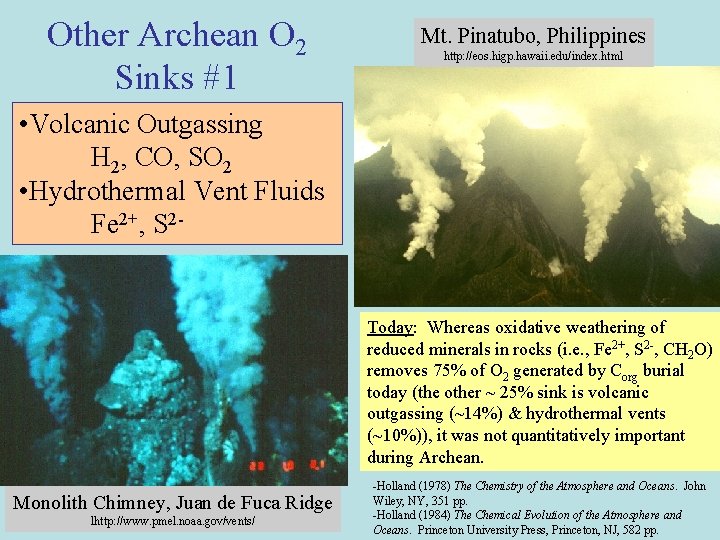
Other Archean O 2 Sinks #1 Mt. Pinatubo, Philippines http: //eos. higp. hawaii. edu/index. html • Volcanic Outgassing H 2, CO, SO 2 • Hydrothermal Vent Fluids Fe 2+, S 2 - Today: Whereas oxidative weathering of reduced minerals in rocks (i. e. , Fe 2+, S 2 -, CH 2 O) removes 75% of O 2 generated by Corg burial today (the other ~ 25% sink is volcanic outgassing (~14%) & hydrothermal vents (~10%)), it was not quantitatively important during Archean. Monolith Chimney, Juan de Fuca Ridge lhttp: //www. pmel. noaa. gov/vents/ -Holland (1978) The Chemistry of the Atmosphere and Oceans. John Wiley, NY, 351 pp. -Holland (1984) The Chemical Evolution of the Atmosphere and Oceans. Princeton University Press, Princeton, NJ, 582 pp.
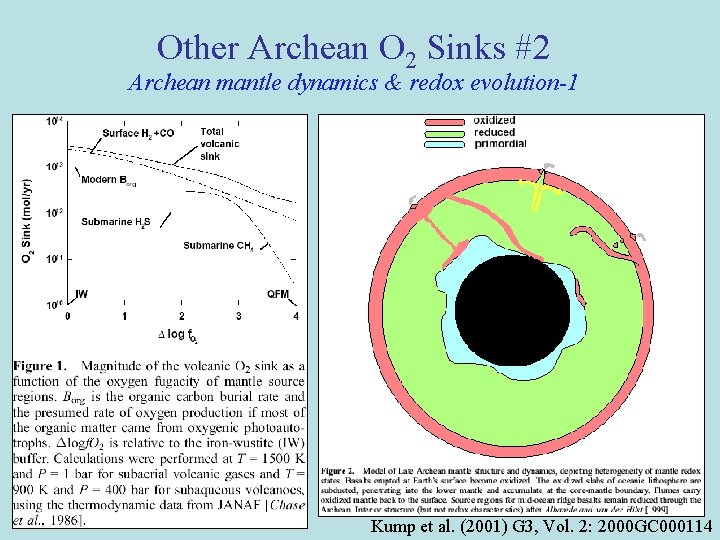
Other Archean O 2 Sinks #2 Archean mantle dynamics & redox evolution-1 Kump et al. (2001) G 3, Vol. 2: 2000 GC 000114
Atmospheric oxygen and the ozone layer • No oxygen in atmosphere = no ozone layer! • No ozone layer => intense UV bombardment • Most life would not be adapted to withstand this UV unless it had some sort of shielding - depth of water, etc.
Co-evolution of life and the earth’s surface • The first organisms evolved when oxygen was scarce and reductants were abundant. Micro-organisms made use of the chemical properties that were available at the time. For example, Fe 2+ was abundant in the ocean, so life did not hesitate to make use of its chemical properties. • As reductants were exhausted and the chemical balance of the ocean evolved, new organisms evolved from the pathways initiated by early life. Some enzymes etc. were so essential that they were retained despite less favorable conditions. Organisms that were adapted to highly reducing conditions took refuge in isolated environments. New organisms evolved to survive in the less reducing environments.
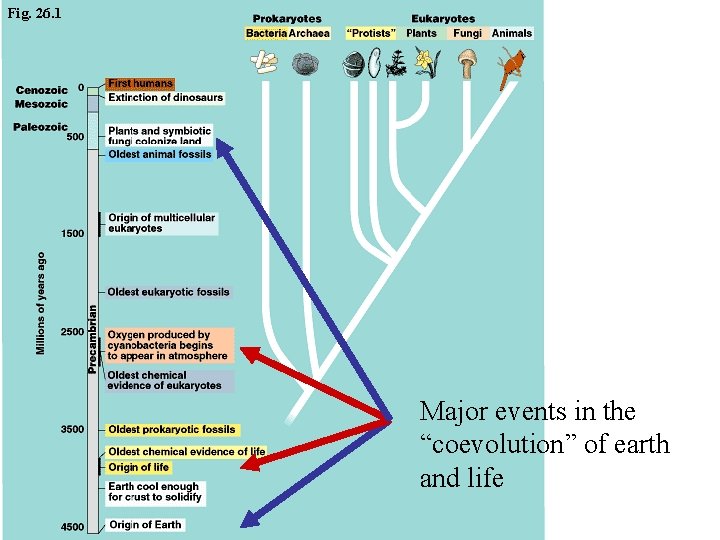
Fig. 26. 1 Major events in the “coevolution” of earth and life Copyright © 2002 Pearson Education, Inc. , publishing as Benjamin Cummings