
The cod in Barents Sea and Icelandic Waters
The cod in Barents Sea and Icelandic Waters - experience and ways forward Symposium on optimizing sustainable fishing yields - ecosystem and management perspectives, Copenhagen 10 -11 October 2018

Barents Sea (BS) and Icelandic cod (Gadus morhua) • Currently the two largest cod stocks in the world • Biology, ecology and physical environment of both stocks are quite similar, but some notable differences • Both stocks used to be overexploited • Following introduction of harvest control rules (ICE: 1996, BS: 2003) fishing pressure has been reduced and cod stocks and catches have increased in both areas • Some challenges have been encountered along the way and some lessons learned • Time to sum up experiences and look ahead
Biology of the two cod stocks • Both are long-lived, slow growing and late maturers (age 6 -7 at first spawning) compared to cod found in warmer waters • Icelandic cod grow and mature slightly faster than BS cod (about half a year difference at age 6 -7) • The most important commercial fish species and also the main predatory fish in both areas • Both have capelin as their main prey

Management of the two cod stocks • Managed by one or two countries (Norway/Russia in Barents Sea, Iceland in Icelandic waters) • Annual assessments and advice by ICES, quotas (TACs) set annually • Fished both by trawl and conventional gears • Minimum size and closed areas: • Barents Sea: 44 cm, max 15% undersized fish by numbers allowed • Icelandic waters: 55 cm, max 25 % undersized fish by numbers allowed • Both areas: Some mixed fisheries, in particular with haddock
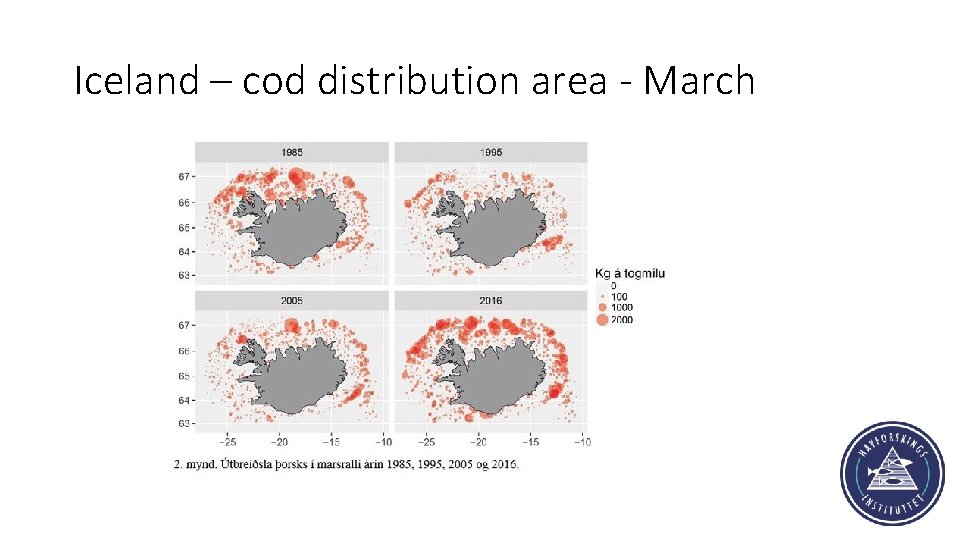
Iceland – cod distribution area - March
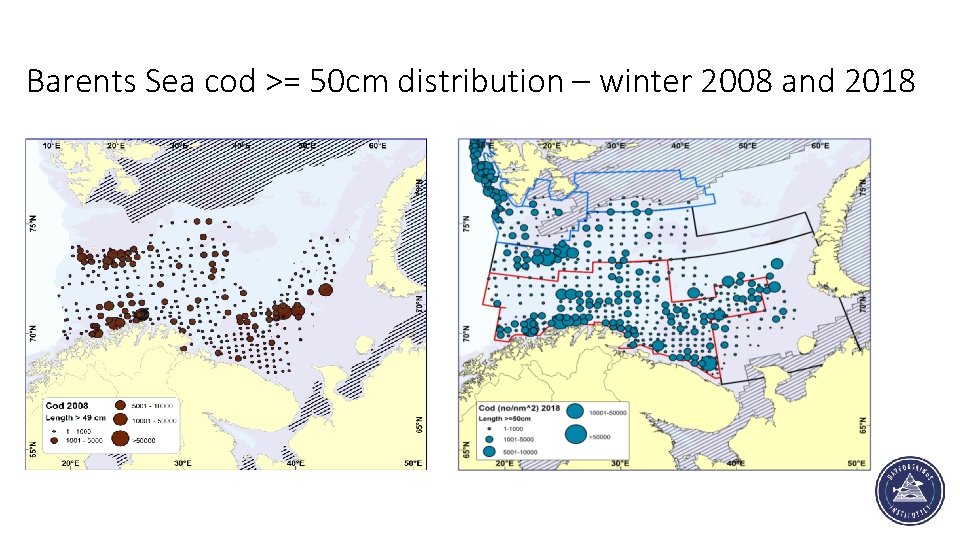
Barents Sea cod >= 50 cm distribution – winter 2008 and 2018
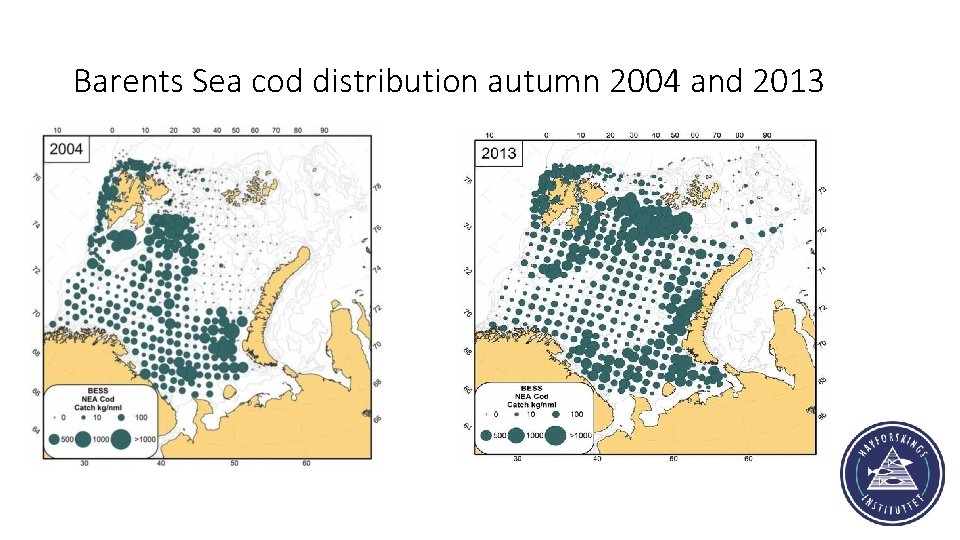
Barents Sea cod distribution autumn 2004 and 2013
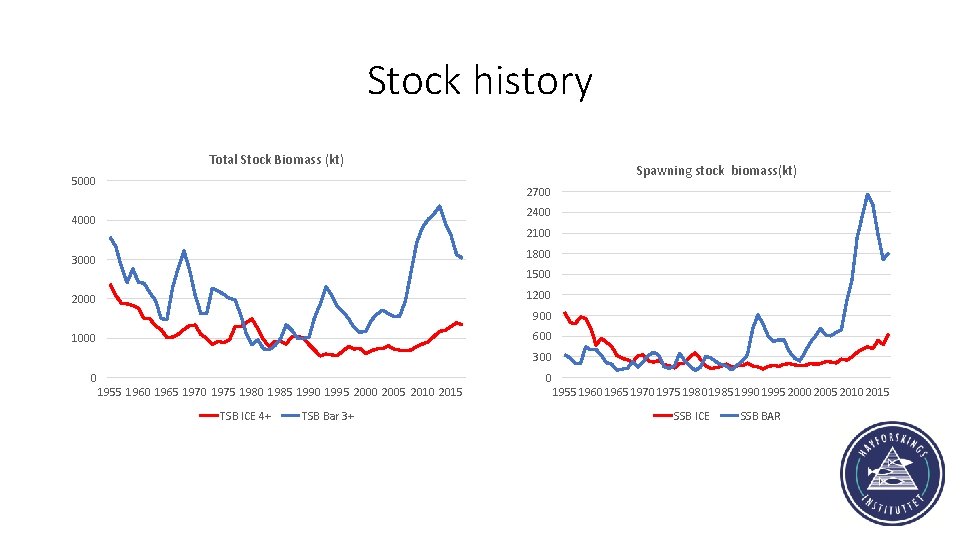
Stock history Total Stock Biomass (kt) 5000 Spawning stock biomass(kt) 2700 2400 4000 2100 1800 3000 1500 1200 2000 900 600 1000 300 0 0 1955 1960 1965 1970 1975 1980 1985 1990 1995 2000 2005 2010 2015 TSB ICE 4+ TSB Bar 3+ 1955 1960 1965 1970 1975 1980 1985 1990 1995 2000 2005 2010 2015 SSB ICE SSB BAR
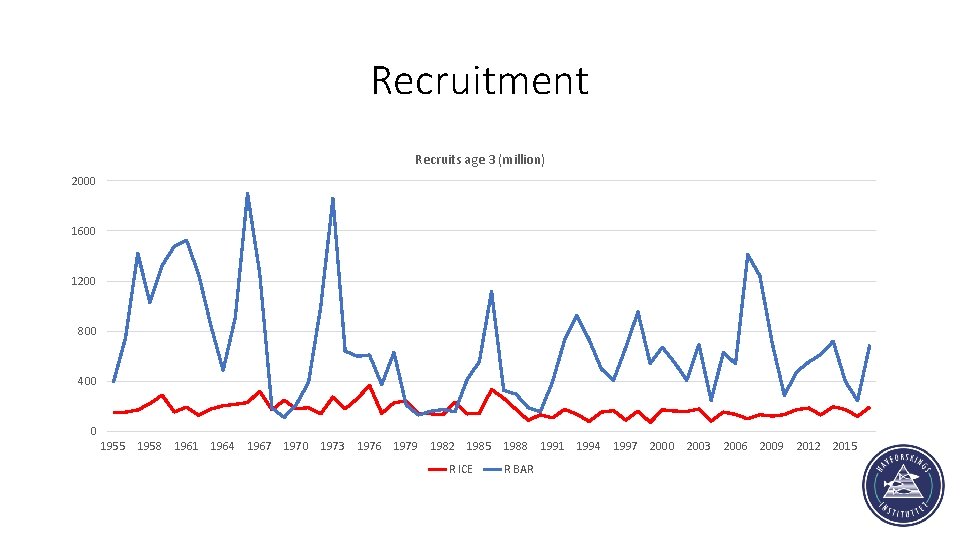
Recruitment Recruits age 3 (million) 2000 1600 1200 800 400 0 1955 1958 1961 1964 1967 1970 1973 1976 1979 1982 1985 R ICE 1988 R BAR 1991 1994 1997 2000 2003 2006 2009 2012 2015
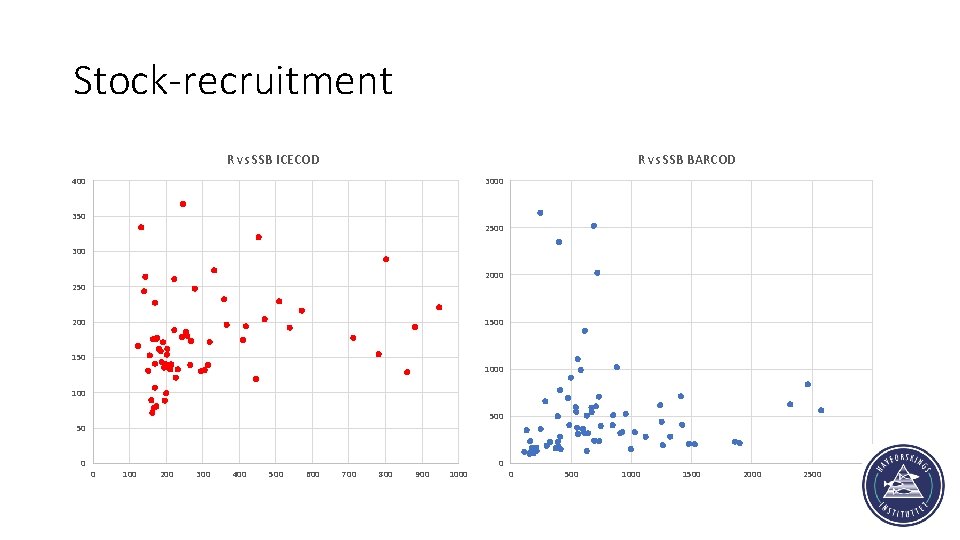
Stock-recruitment R vs SSB ICECOD R vs SSB BARCOD 400 3000 350 2500 300 2000 250 1500 200 150 100 500 50 0 0 100 200 300 400 500 600 700 800 900 1000 0 0 500 1000 1500 2000 2500 3000
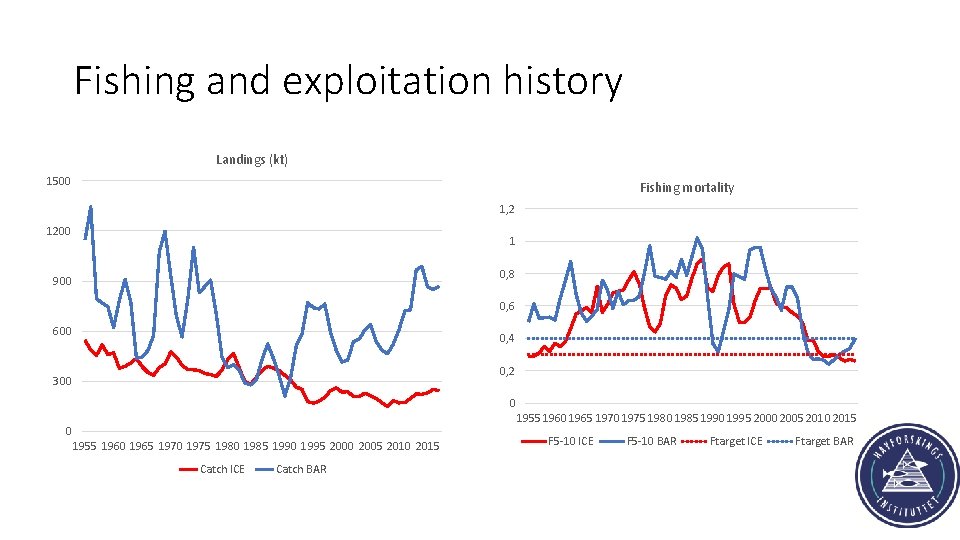
Fishing and exploitation history Landings (kt) 1500 Fishing mortality 1, 2 1200 1 0, 8 900 0, 6 600 0, 4 0, 2 300 0 1955 1960 1965 1970 1975 1980 1985 1990 1995 2000 2005 2010 2015 Catch ICE Catch BAR F 5 -10 ICE F 5 -10 BAR Ftarget ICE Ftarget BAR
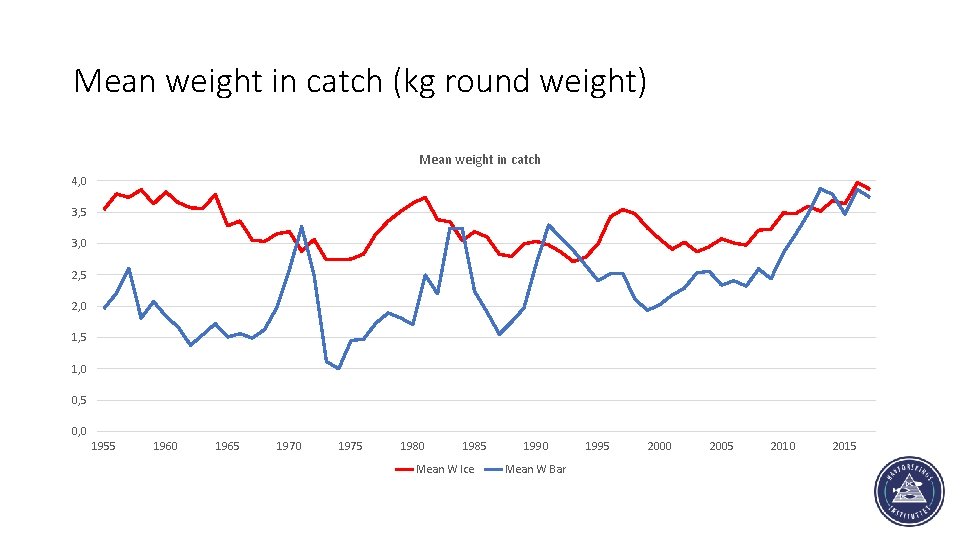
Mean weight in catch (kg round weight) Mean weight in catch 4, 0 3, 5 3, 0 2, 5 2, 0 1, 5 1, 0 0, 5 0, 0 1955 1960 1965 1970 1975 1980 1985 Mean W Ice 1990 Mean W Bar 1995 2000 2005 2010 2015
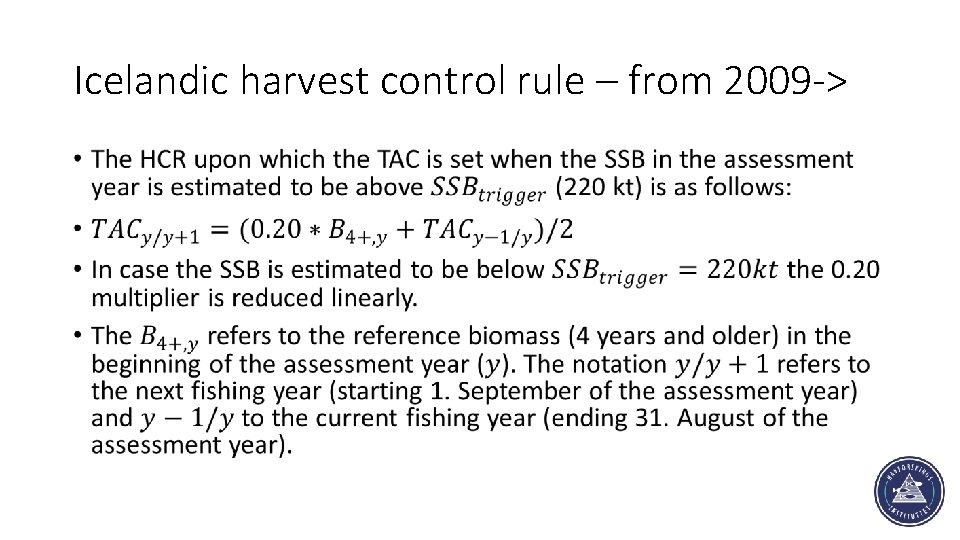
Icelandic harvest control rule – from 2009 -> •
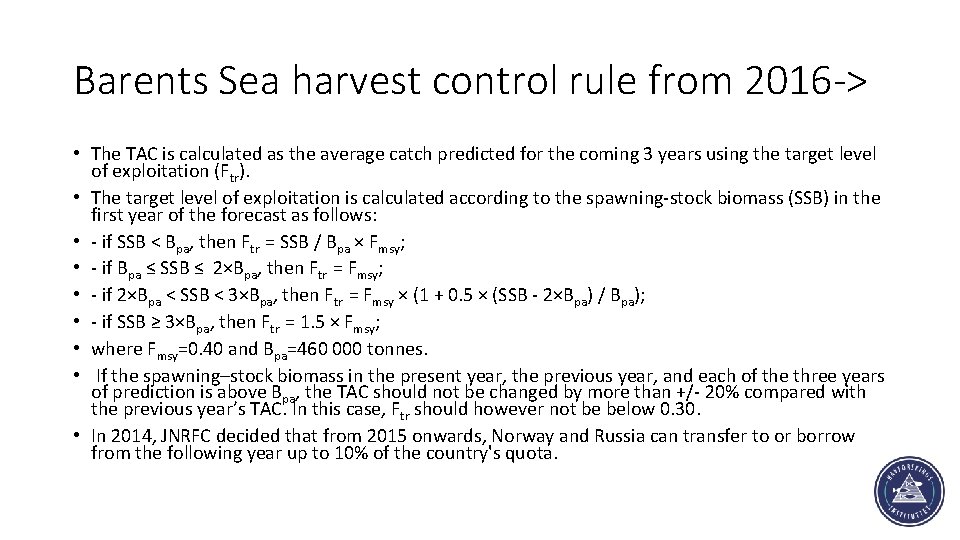
Barents Sea harvest control rule from 2016 -> • The TAC is calculated as the average catch predicted for the coming 3 years using the target level of exploitation (Ftr). • The target level of exploitation is calculated according to the spawning-stock biomass (SSB) in the first year of the forecast as follows: • - if SSB < Bpa, then Ftr = SSB / Bpa × Fmsy; • - if Bpa ≤ SSB ≤ 2×Bpa, then Ftr = Fmsy; • - if 2×Bpa < SSB < 3×Bpa, then Ftr = Fmsy × (1 + 0. 5 × (SSB - 2×Bpa) / Bpa); • - if SSB ≥ 3×Bpa, then Ftr = 1. 5 × Fmsy; • where Fmsy=0. 40 and Bpa=460 000 tonnes. • If the spawning–stock biomass in the present year, the previous year, and each of the three years of prediction is above Bpa, the TAC should not be changed by more than +/- 20% compared with the previous year’s TAC. In this case, Ftr should however not be below 0. 30. • In 2014, JNRFC decided that from 2015 onwards, Norway and Russia can transfer to or borrow from the following year up to 10% of the country's quota.
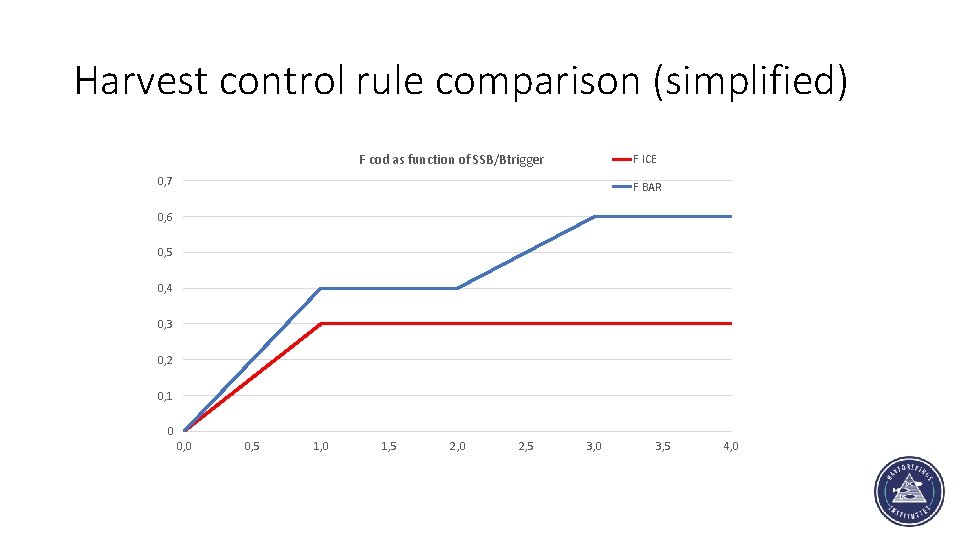
Harvest control rule comparison (simplified) F cod as function of SSB/Btrigger F ICE 0, 7 F BAR 0, 6 0, 5 0, 4 0, 3 0, 2 0, 1 0 0, 5 1, 0 1, 5 2, 0 2, 5 3, 0 3, 5 4, 0
Harvest control rule development • Iceland: • Started in 1995/96 • Multiplier reduced from 0. 25 to 0. 20 over time • Barents Sea: • Started in 2003 • Lower limit of F (0. 30) introduced in 2009 • Increased F at high SSB added in 2016, also limit on annual change of TAC increased from 10 to 20%

Testing of harvest control rules • Develop operating model • Within which range of stock size and exploitation can this model be considered realistic? • Long-term stochastic simulations where stock/recruitment has a stchastic element and assessment error is taken into account (minimum complexity) • Possibly also account for density-dependent effects, implementation error, biases etc. • Tabulate yield, risk (e. g. SSB< Blim) and variability in catches
Challenges with implementation TAC set above advice Catches above TAC Errors in stock assessment In the first years with a HCR for Icelandic cod, stock size was overestimated and catches were also somewhat above agreed TAC. Works well now • For Barents Sea cod, IUU catches were high in first years after introduction of HCR. Then after such catches were eliminated, stock size was underestimated for some years and thus fishing mortality became lower than originally intended. Works better now but difficult to make managers follow advised reductions in TAC • •
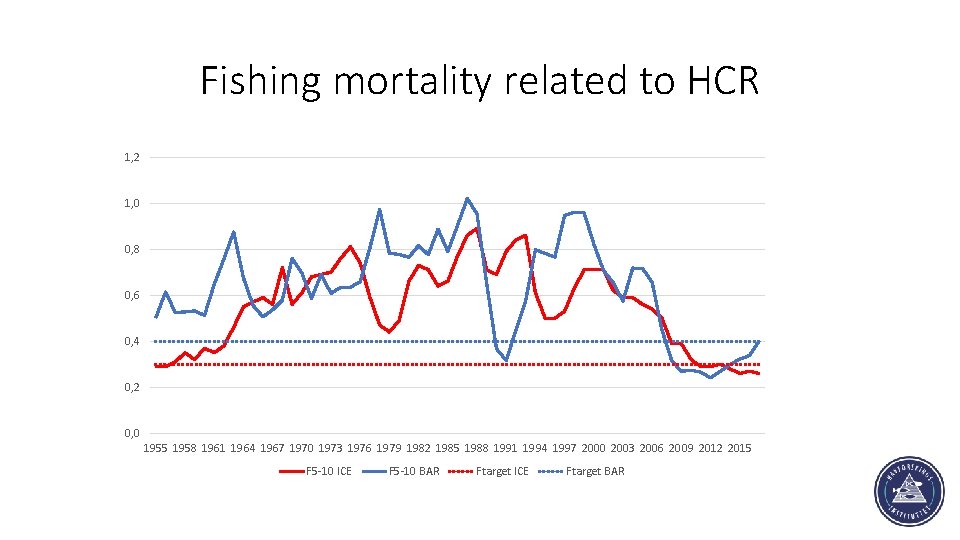
Fishing mortality related to HCR 1, 2 1, 0 0, 8 0, 6 0, 4 0, 2 0, 0 1955 1958 1961 1964 1967 1970 1973 1976 1979 1982 1985 1988 1991 1994 1997 2000 2003 2006 2009 2012 2015 F 5 -10 ICE F 5 -10 BAR Ftarget ICE Ftarget BAR
Density-dependent factors • Recruitment • Growth • Cannibalism • Density-dependent factors are more important in Barents Sea and density-dependent growth and cannibalism acocunted for in evaluation of HCRs there • Density-dependence in growth also accounted for in first simulations for Icelandic cod
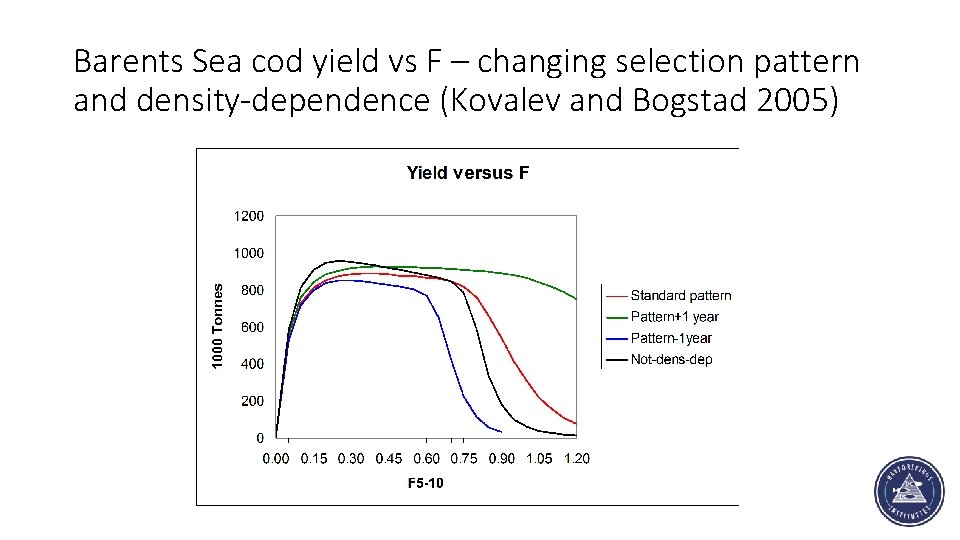
Barents Sea cod yield vs F – changing selection pattern and density-dependence (Kovalev and Bogstad 2005)
Going into the unknown when reducing F considerably? • In previous periods with high stock size there may not have been surveys and other data may also be scarce – particularly a problem for older fish • Also physical environment and ecology may have changed since then • Expanding stocks – expansion of survey area lagging, also observations of large amounts of older fish which are outliers in time series may cause assessment problems – experience from Barents Sea • Large catches and large fish in catches also may cause some ’luxury problems’ for the fishery and industry (too large fish, too large individual catches, lower prices… )
Some final points • HCR implementation took some time for both cod stocks but must be considered as fairly successful now • Need some adjustments of models and HCRs along the way • A HCR is not better than its biological basis and implementation • Take care to extrapolate model results outside range of observations. In previous periods with high stock size there were quite likely no surveys and other data may also be scarce • Dialogue with managers and industry very important but not going into that here
Acknowledgements • FMSY project • ICES AFWG and NWWG • Guðmundur Þordarson and Höskuldur Björnsson, MRI, Iceland
- Slides: 24