
The CloudAerosol Transport System CATS A New Earth
- Slides: 22
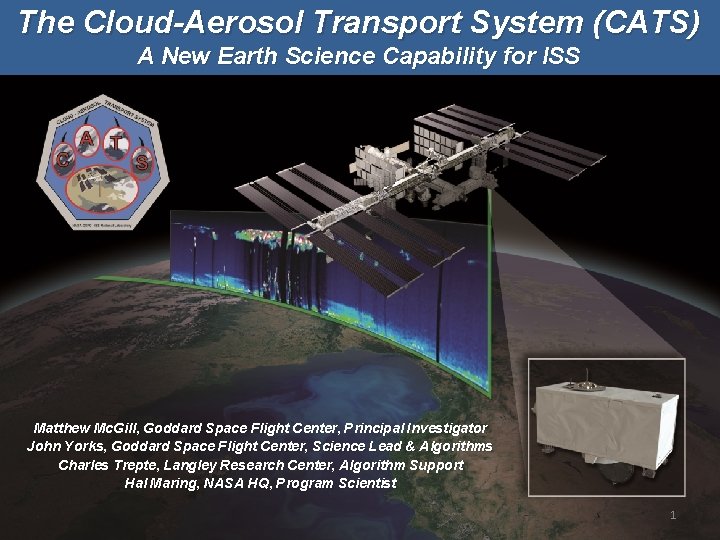
The Cloud-Aerosol Transport System (CATS) A New Earth Science Capability for ISS Matthew Mc. Gill, Goddard Space Flight Center, Principal Investigator John Yorks, Goddard Space Flight Center, Science Lead & Algorithms Charles Trepte, Langley Research Center, Algorithm Support Hal Maring, NASA HQ, Program Scientist 1
CATS Overview • ISS | Earth Science The Cloud-Aerosol Transport System (CATS) is a lidar remote sensing instrument built for use on the International Space Station. CATS is a directed opportunity funded by the ISS Program. • Payload Developer is NASA-Goddard Space Flight Center • “customer” is the ISS Program (HEOMD) SMD is assisting with funding algorithm/processing development (which is a joint effort with La. RC/CALIPSO team) CATS was designed to provide vertical profiles of cloud and aerosol properties at up to 3 wavelengths (355, 532, 1064 nm) • • • CATS is based on existing instrumentation built and operated on the high-altitude NASA ER -2 aircraft • The CATS project has three simultaneous goals: • Provide long-term (6 months to 3 years) science from ISS • Prove that low-cost, streamlined project approach can work • Provide tech demo on-orbit (target ACE mission) – high rep rate laser – photon-counting detection – UV (355 nm) laser operation in space – HSRL receiver concept 2
Why ISS and Why CATS? ISS | Earth Science Why the ISS makes sense for Earth Science: • Use what we already have (i. e. , the ISS) to achieve rapid results within an affordable budget – essential in our cost-constrained environment • • ISS payloads can easily trade mass for cost – the impact on cost can be huge • Incrementally enhance the ISS Earth observing capability, and grow it to become a vital part of the Earth Science system • Build international partnerships for collaborative climate monitoring and exploration • ISS orbit covers significant portion of the Earth’s surface, land area, and populated areas Embrace strict build-to-cost/build-to-schedule mentality to minimize development cycle and cost – multiple lower-cost Class D instruments can accomplish more than one giant Class B instrument With that rationale, CATS was funded to be a forcing function for Earth Science from ISS and to be a pathfinder for NASA-developed ISS payloads. 3
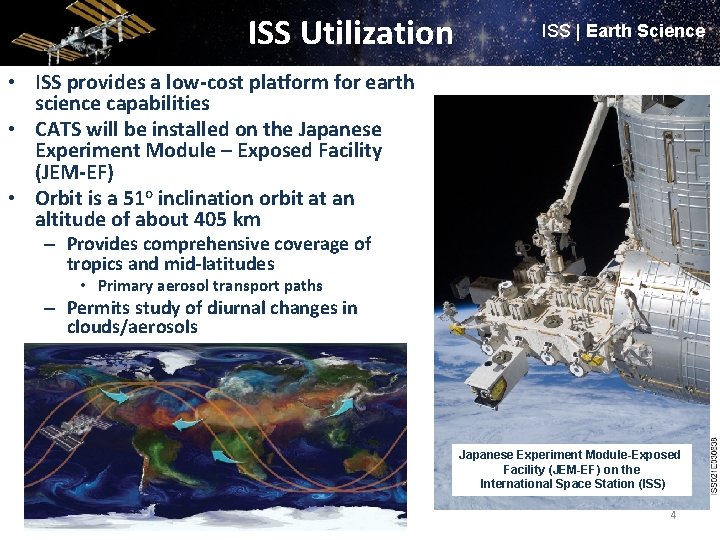
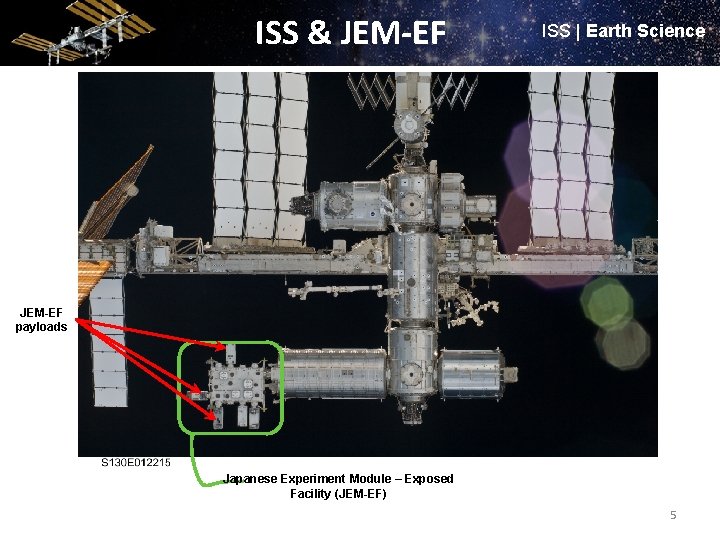
ISS Utilization ISS | Earth Science • ISS provides a low-cost platform for earth science capabilities • CATS will be installed on the Japanese Experiment Module – Exposed Facility (JEM-EF) • Orbit is a 51 o inclination orbit at an altitude of about 405 km – Provides comprehensive coverage of tropics and mid-latitudes • Primary aerosol transport paths – Permits study of diurnal changes in clouds/aerosols Japanese Experiment Module-Exposed Facility (JEM-EF) on the International Space Station (ISS) 4
ISS & JEM-EF ISS | Earth Science JEM-EF payloads Japanese Experiment Module – Exposed Facility (JEM-EF) 5
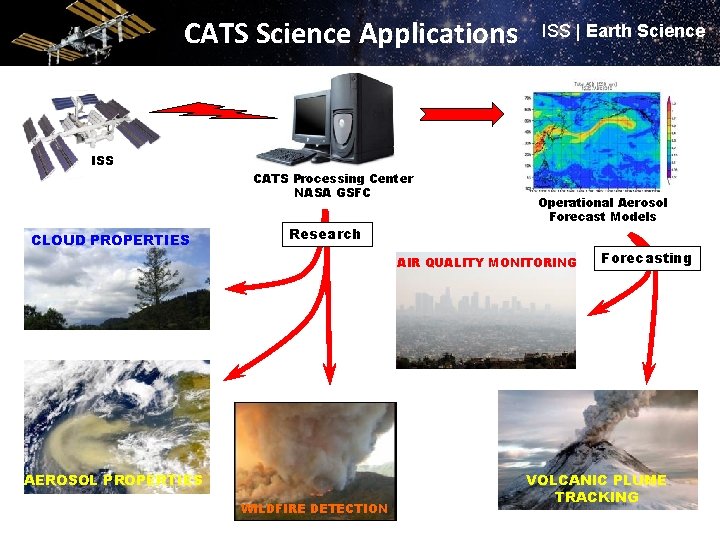
CATS Science Applications ISS | Earth Science ISS CATS Processing Center NASA GSFC CLOUD PROPERTIES Research Operational Aerosol Forecast Models AIR QUALITY MONITORING AEROSOL PROPERTIES WILDFIRE DETECTION Forecasting VOLCANIC PLUME TRACKING
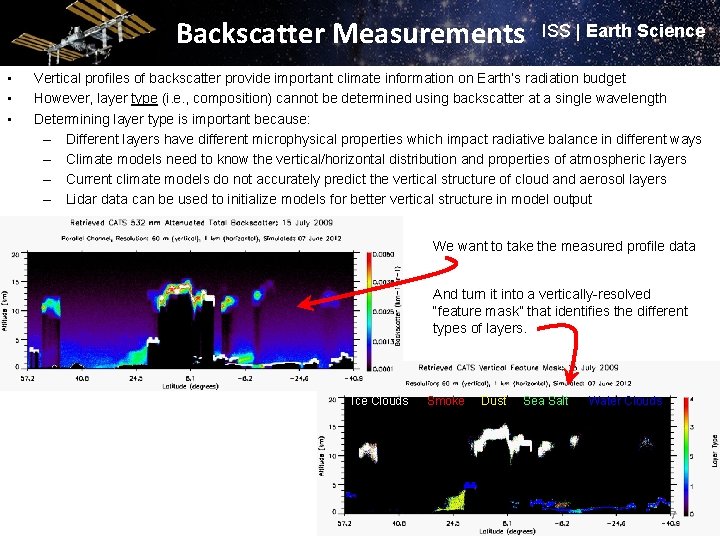
Backscatter Measurements • • • ISS | Earth Science Vertical profiles of backscatter provide important climate information on Earth’s radiation budget However, layer type (i. e. , composition) cannot be determined using backscatter at a single wavelength Determining layer type is important because: – Different layers have different microphysical properties which impact radiative balance in different ways – Climate models need to know the vertical/horizontal distribution and properties of atmospheric layers – Current climate models do not accurately predict the vertical structure of cloud and aerosol layers – Lidar data can be used to initialize models for better vertical structure in model output We want to take the measured profile data And turn it into a vertically-resolved “feature mask” that identifies the different types of layers. Ice Clouds Smoke Dust Sea Salt Water Clouds 7
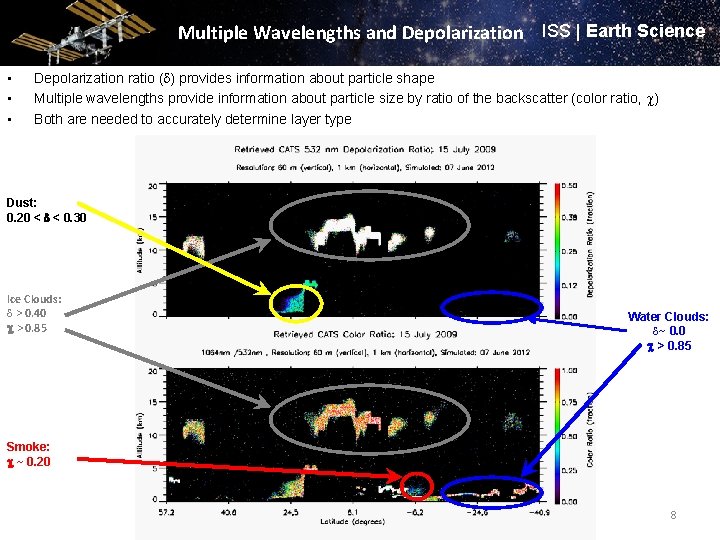
Multiple Wavelengths and Depolarization ISS | Earth Science • • • Depolarization ratio (d) provides information about particle shape Multiple wavelengths provide information about particle size by ratio of the backscatter (color ratio, c) Both are needed to accurately determine layer type Dust: 0. 20 < d < 0. 30 Ice Clouds: d > 0. 40 c > 0. 85 Water Clouds: d~ 0. 0 c > 0. 85 Smoke: c ~ 0. 20 8
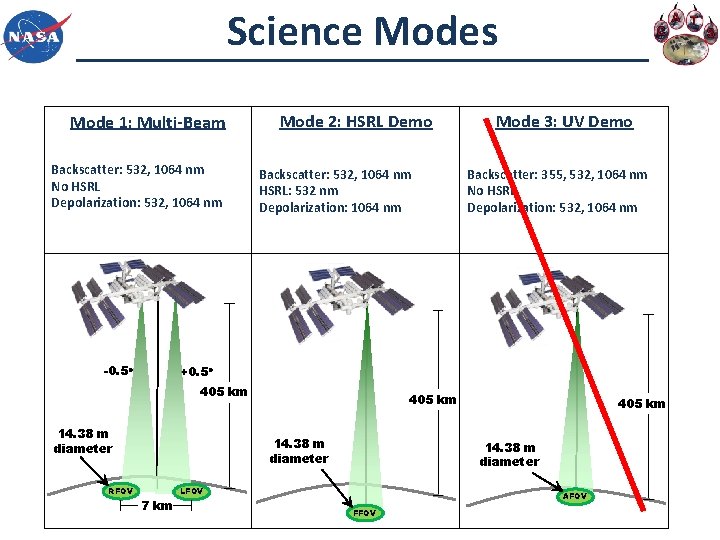
Science Modes Mode 1: Multi-Beam Backscatter: 532, 1064 nm No HSRL Depolarization: 532, 1064 nm -0. 5 o Mode 2: HSRL Demo Backscatter: 532, 1064 nm HSRL: 532 nm Depolarization: 1064 nm Mode 3: UV Demo Backscatter: 355, 532, 1064 nm No HSRL Depolarization: 532, 1064 nm +0. 5 o 405 km 14. 38 m diameter RFOV 7 km 405 km 14. 38 m diameter LFOV AFOV FFOV
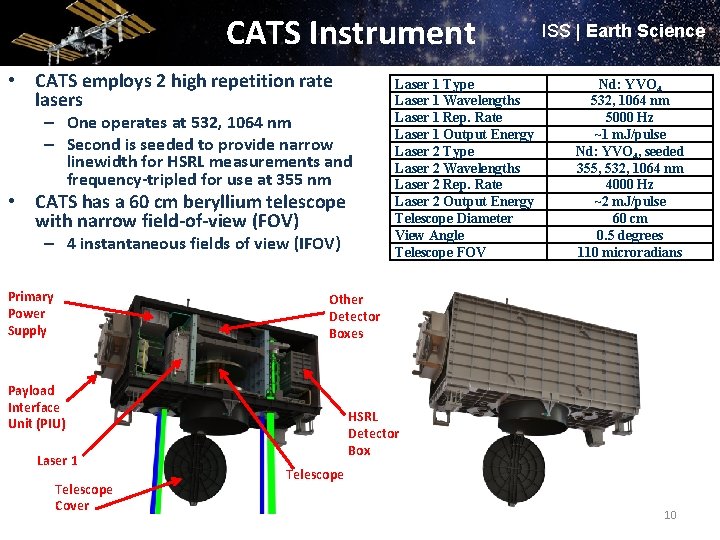
CATS Instrument • CATS employs 2 high repetition rate lasers – One operates at 532, 1064 nm – Second is seeded to provide narrow linewidth for HSRL measurements and frequency-tripled for use at 355 nm • CATS has a 60 cm beryllium telescope with narrow field-of-view (FOV) – 4 instantaneous fields of view (IFOV) Primary Power Supply Laser 1 Type Laser 1 Wavelengths Laser 1 Rep. Rate Laser 1 Output Energy Laser 2 Type Laser 2 Wavelengths Laser 2 Rep. Rate Laser 2 Output Energy Telescope Diameter View Angle Telescope FOV ISS | Earth Science Nd: YVO 4 532, 1064 nm 5000 Hz ~1 m. J/pulse Nd: YVO 4, seeded 355, 532, 1064 nm 4000 Hz ~2 m. J/pulse 60 cm 0. 5 degrees 110 microradians Other Detector Boxes Payload Interface Unit (PIU) Laser 1 Telescope Cover HSRL Detector Box Telescope 10
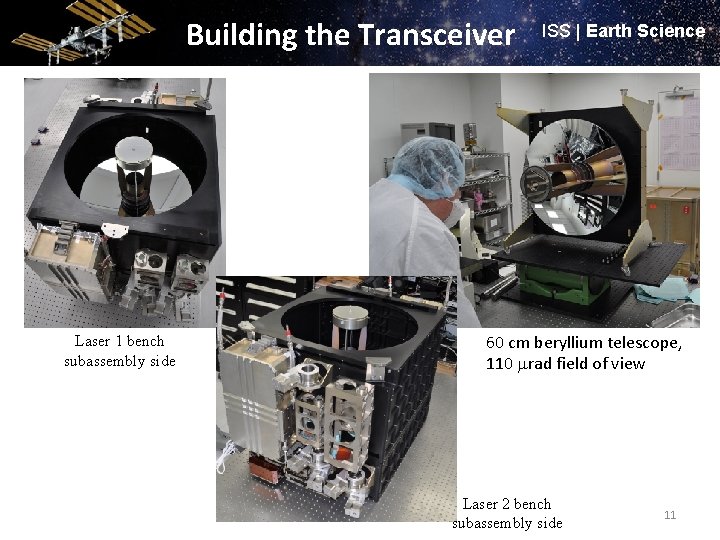
Building the Transceiver Laser 1 bench subassembly side ISS | Earth Science 60 cm beryllium telescope, 110 mrad field of view Laser 2 bench subassembly side 11
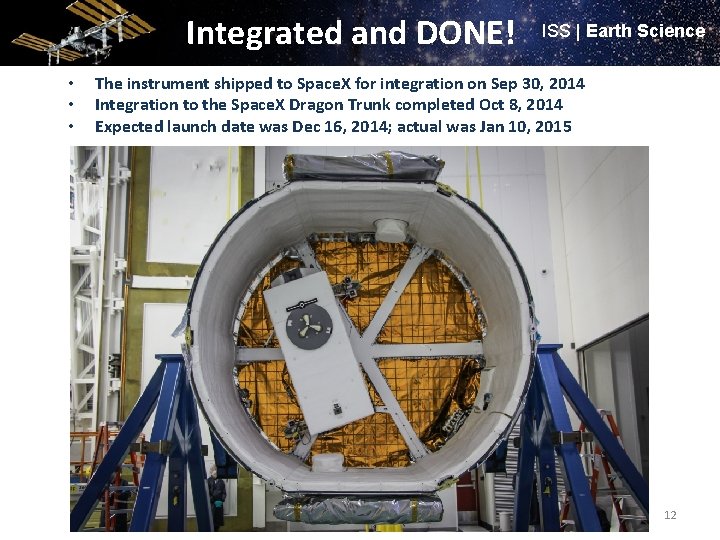
Integrated and DONE! • • • ISS | Earth Science The instrument shipped to Space. X for integration on Sep 30, 2014 Integration to the Space. X Dragon Trunk completed Oct 8, 2014 Expected launch date was Dec 16, 2014; actual was Jan 10, 2015 12
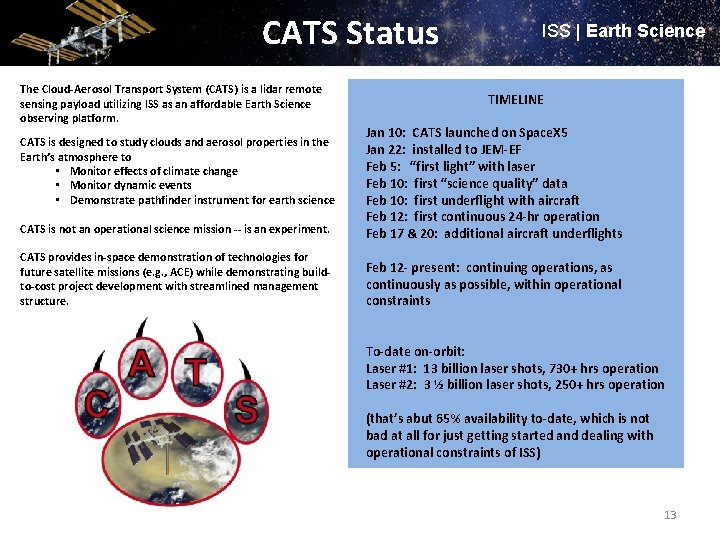
CATS Status The Cloud-Aerosol Transport System (CATS) is a lidar remote sensing payload utilizing ISS as an affordable Earth Science observing platform. CATS is designed to study clouds and aerosol properties in the Earth’s atmosphere to • Monitor effects of climate change • Monitor dynamic events • Demonstrate pathfinder instrument for earth science CATS is not an operational science mission -- is an experiment. CATS provides in-space demonstration of technologies for future satellite missions (e. g. , ACE) while demonstrating buildto-cost project development with streamlined management structure. ISS | Earth Science TIMELINE Jan 10: CATS launched on Space. X 5 Jan 22: installed to JEM-EF Feb 5: “first light” with laser Feb 10: first “science quality” data Feb 10: first underflight with aircraft Feb 12: first continuous 24 -hr operation Feb 17 & 20: additional aircraft underflights Feb 12 - present: continuing operations, as continuously as possible, within operational constraints To-date on-orbit: Laser #1: 13 billion laser shots, 730+ hrs operation Laser #2: 3 ½ billion laser shots, 250+ hrs operation (that’s abut 65% availability to-date, which is not bad at all for just getting started and dealing with operational constraints of ISS) 13
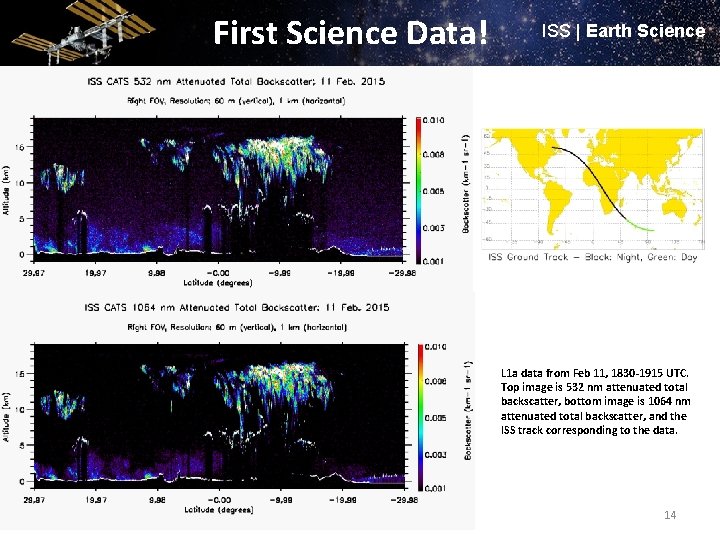
First Science Data! ISS | Earth Science L 1 a data from Feb 11, 1830 -1915 UTC. Top image is 532 nm attenuated total backscatter, bottom image is 1064 nm attenuated total backscatter, and the ISS track corresponding to the data. 14
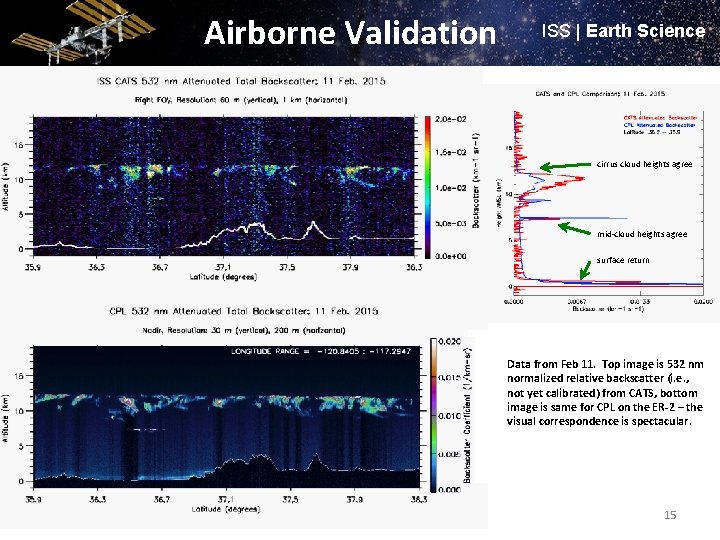
Airborne Validation ISS | Earth Science cirrus cloud heights agree mid-cloud heights agree surface return Data from Feb 11. Top image is 532 nm normalized relative backscatter (i. e. , not yet calibrated) from CATS, bottom image is same for CPL on the ER-2 – the visual correspondence is spectacular. 15
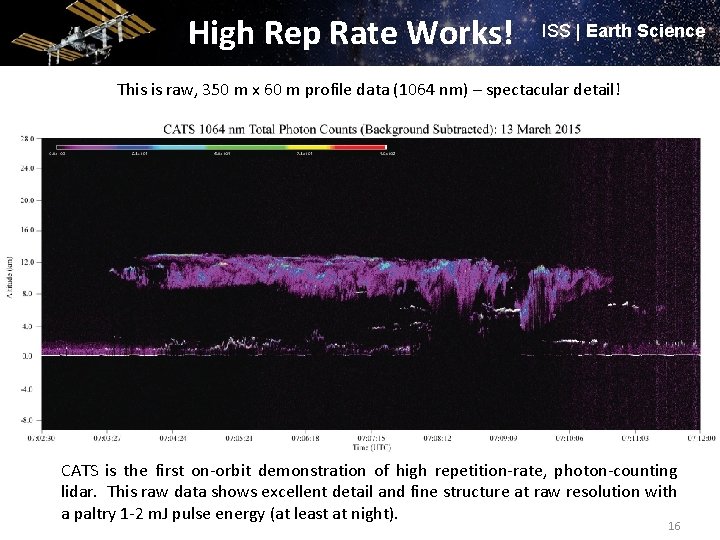
High Rep Rate Works! ISS | Earth Science This is raw, 350 m x 60 m profile data (1064 nm) – spectacular detail! CATS is the first on-orbit demonstration of high repetition-rate, photon-counting lidar. This rawis data detaildata and(1064 fine structure at raw resolution This raw, shows 350 m excellent x 60 m profile nm) – spectacular detail! with a paltry 1 -2 m. J pulse energy (at least at night). 16
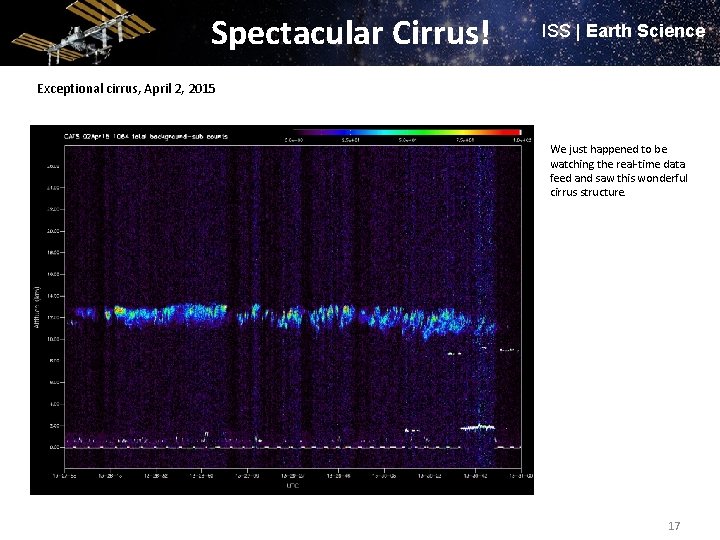
Spectacular Cirrus! ISS | Earth Science Exceptional cirrus, April 2, 2015 We just happened to be watching the real-time data feed and saw this wonderful cirrus structure. This is raw, 350 m x 60 m profile data (1064 nm) – spectacular detail! 17
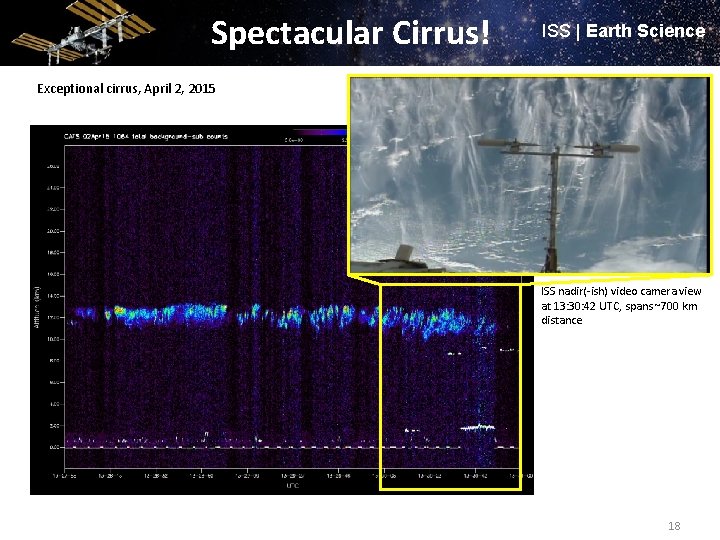
Spectacular Cirrus! ISS | Earth Science Exceptional cirrus, April 2, 2015 ISS nadir(-ish) video camera view at 13: 30: 42 UTC, spans ~700 km distance This is raw, 350 m x 60 m profile data (1064 nm) – spectacular detail! 18
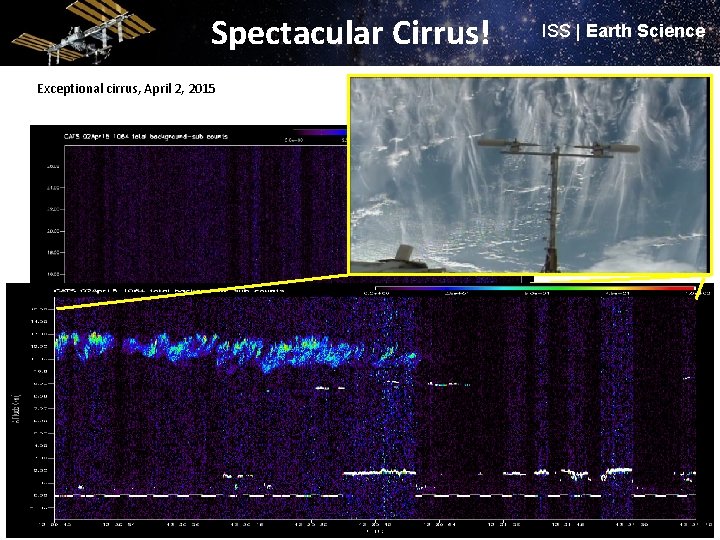
Spectacular Cirrus! ISS | Earth Science Exceptional cirrus, April 2, 2015 ISS nadir(-ish) video camera view at 13: 30: 42 UTC, spans ~700 km distance This is raw, 350 m x 60 m profile data (1064 nm) – spectacular detail! 19
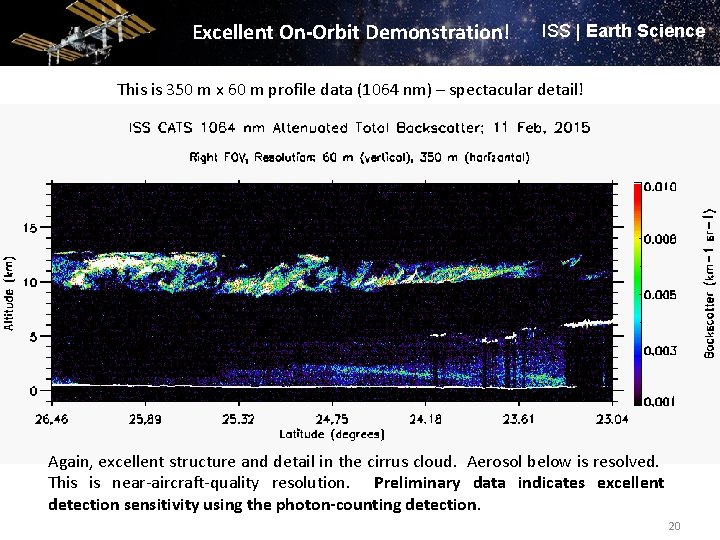
Excellent On-Orbit Demonstration! ISS | Earth Science This is 350 m x 60 m profile data (1064 nm) – spectacular detail! Again, excellent structure and detail in the cirrus cloud. Aerosol below is resolved. This is near-aircraft-quality resolution. Preliminary data indicates excellent detection sensitivity using the photon-counting detection. 20
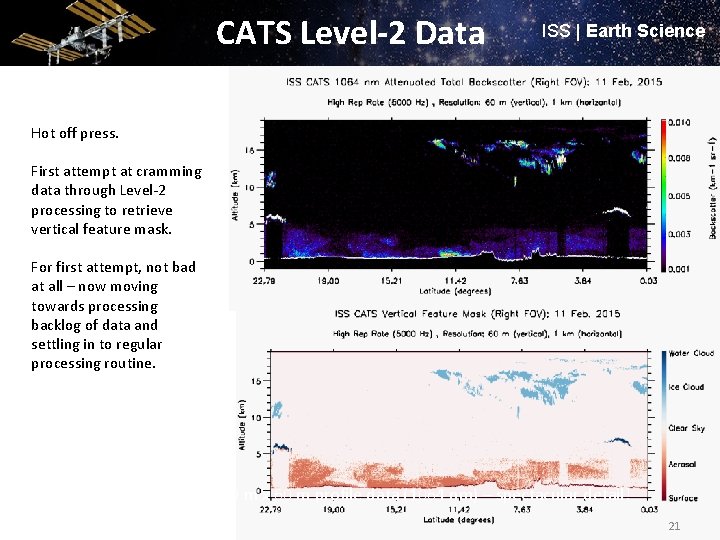
CATS Level-2 Data ISS | Earth Science Hot off press. First attempt at cramming data through Level-2 processing to retrieve vertical feature mask. For first attempt, not bad at all – now moving towards processing backlog of data and settling in to regular processing routine. This is raw, 350 m x 60 m profile data (1064 nm) – spectacular detail! 21
Summary ISS | Earth Science • CATS is a spectacular opportunity, and the latitude given by the ISS Program to apply sound engineering and management judgment in the pursuit of generating good science has been demonstrated to work. • ISS Program trusted the Payload Developer to derive our own science requirements instead of subjecting the project to externally-derived requirements and oversight • Instrument design and requirements are consistent with the [self-generated] science requirements. • CATS team has proven that a large attached payload can be built for ~$15 M and ~2 years development time. • On-time/on-cost completion • Succesfully launched and operating • The CATS experience and approach is directly applicable to Earth Venture Instrument (EVi) and Earth Venture Mission (EVm) competitive opportunities. • The GSFC Class D Constitution has been an important outcome of the CATS effort. http: //cats. gsfc. nasa. gov 22