
The CLOUD experiment Cosmics Leaving Outdoor Droplets Studies
- Slides: 38
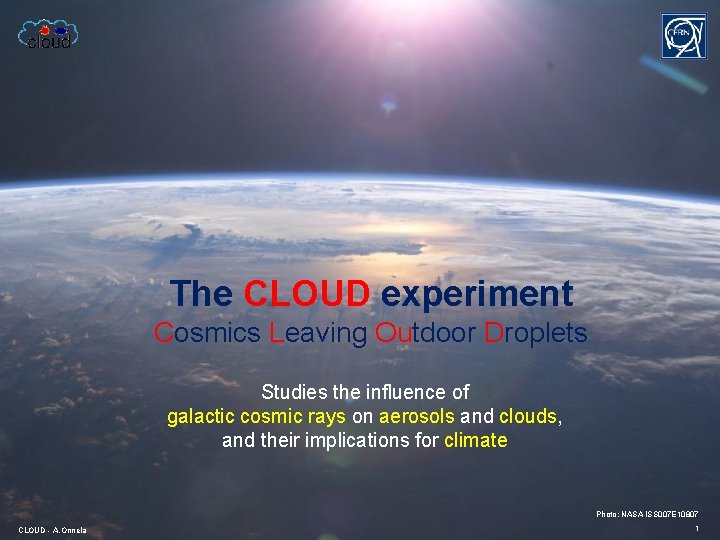
The CLOUD experiment Cosmics Leaving Outdoor Droplets Studies the influence of galactic cosmic rays on aerosols and clouds, and their implications for climate Photo: NASA ISS 007 E 10807 CLOUD - A. Onnela 1
Agenda • Background: Earth’s climate, cosmic rays, aerosols and clouds • CLOUD Experiment: Concept, methods, results • Visits to CLOUD unfortunately not possible in 2019 -2020 due on-going renovation of the building where CLOUD is located. CLOUD - A. Onnela 2
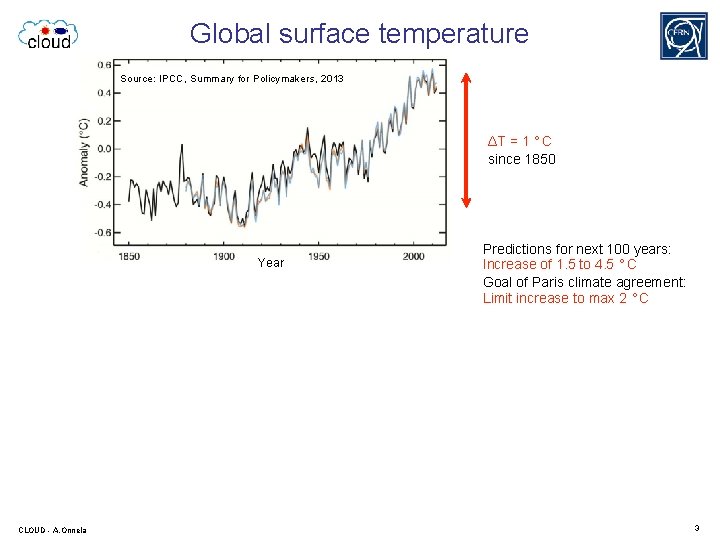
Global surface temperature Source: IPCC, Summary for Policymakers, 2013 ΔT = 1 °C since 1850 Year CLOUD - A. Onnela Predictions for next 100 years: Increase of 1. 5 to 4. 5 °C Goal of Paris climate agreement: Limit increase to max 2 °C 3
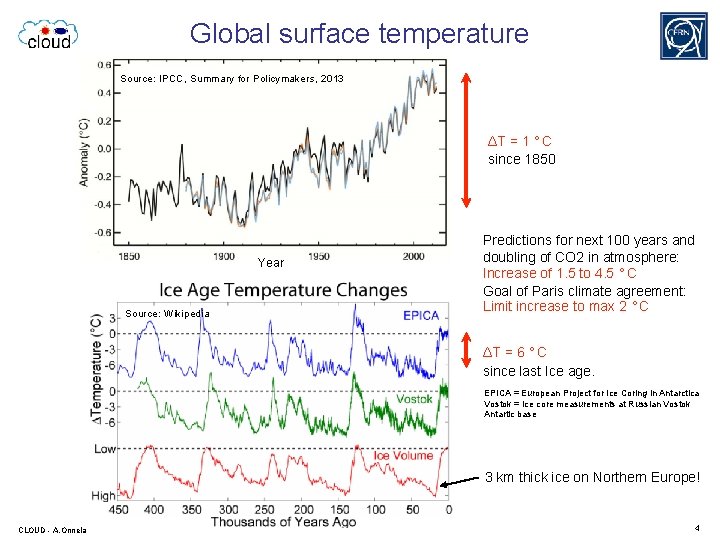
Global surface temperature Source: IPCC, Summary for Policymakers, 2013 ΔT = 1 °C since 1850 Year Source: Wikipedia Predictions for next 100 years and doubling of CO 2 in atmosphere: Increase of 1. 5 to 4. 5 °C Goal of Paris climate agreement: Limit increase to max 2 °C ΔT = 6 °C since last Ice age. EPICA = European Project for Ice Coring in Antarctica Vostok = Ice core measurements at Russian Vostok Antartic base 3 km thick ice on Northern Europe! CLOUD - A. Onnela 4
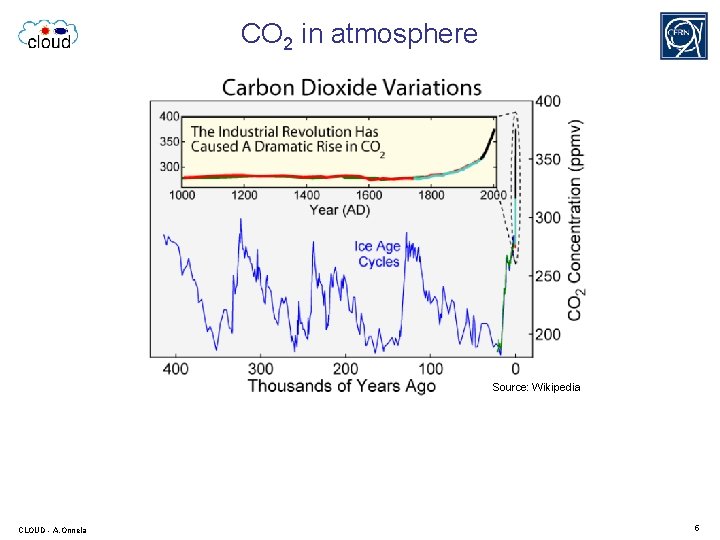
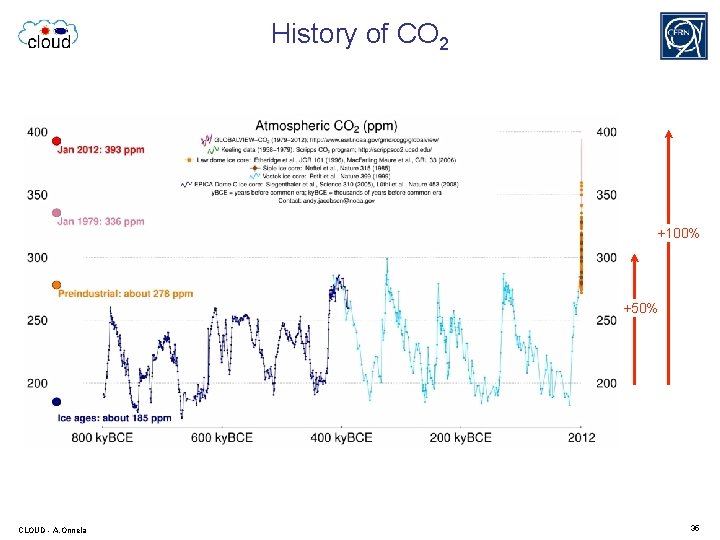
CO 2 in atmosphere Source: Wikipedia CLOUD - A. Onnela 5
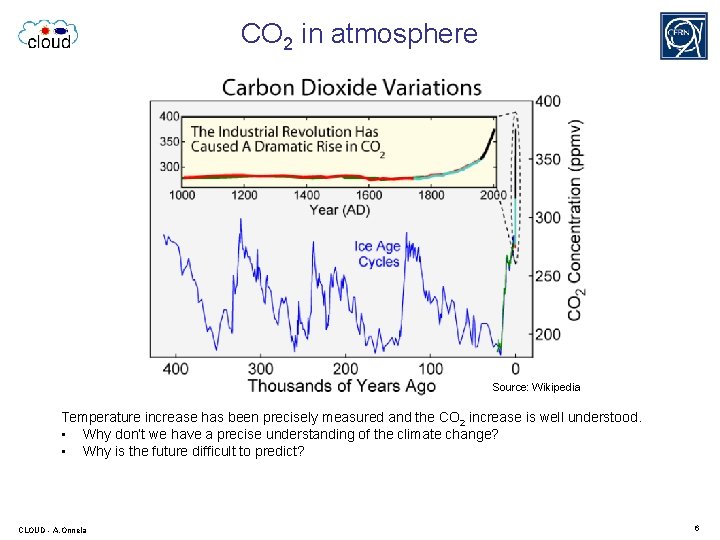
CO 2 in atmosphere Source: Wikipedia Temperature increase has been precisely measured and the CO 2 increase is well understood. • Why don’t we have a precise understanding of the climate change? • Why is the future difficult to predict? CLOUD - A. Onnela 6
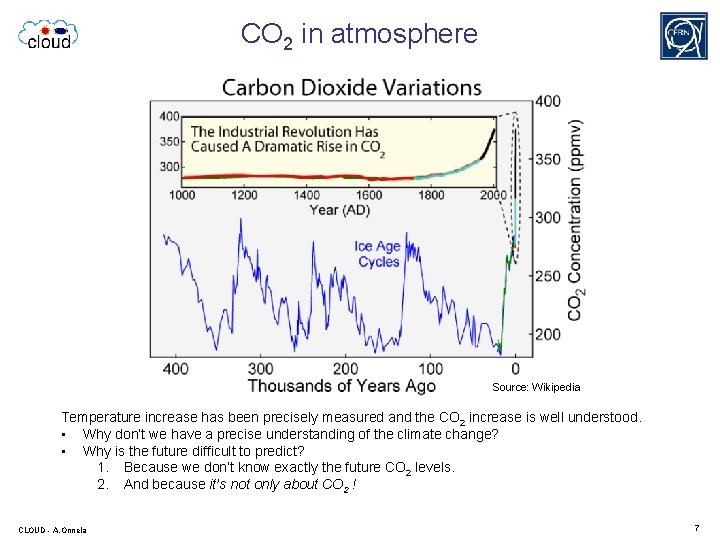
CO 2 in atmosphere Source: Wikipedia Temperature increase has been precisely measured and the CO 2 increase is well understood. • Why don’t we have a precise understanding of the climate change? • Why is the future difficult to predict? 1. Because we don’t know exactly the future CO 2 levels. 2. And because it’s not only about CO 2 ! CLOUD - A. Onnela 7
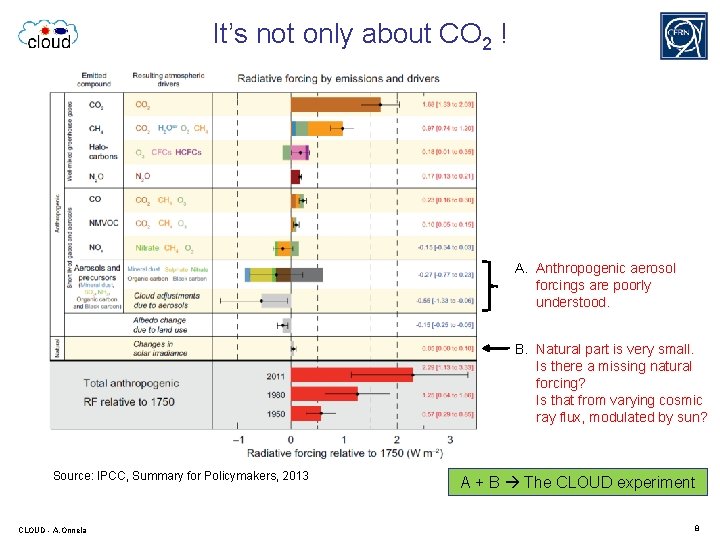
It’s not only about CO 2 ! A. Anthropogenic aerosol forcings are poorly understood. B. Natural part is very small. Is there a missing natural forcing? Is that from varying cosmic ray flux, modulated by sun? Source: IPCC, Summary for Policymakers, 2013 CLOUD - A. Onnela A + B The CLOUD experiment 8
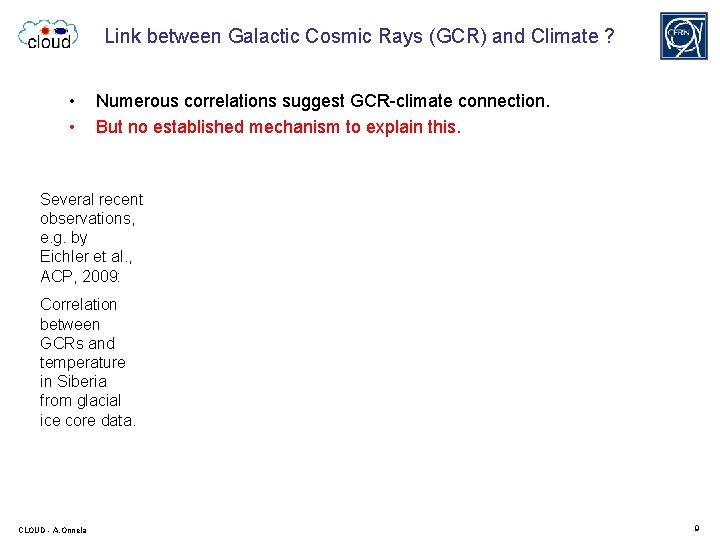
Link between Galactic Cosmic Rays (GCR) and Climate ? • • Numerous correlations suggest GCR-climate connection. But no established mechanism to explain this. Several recent observations, e. g. by Eichler et al. , ACP, 2009: Correlation between GCRs and temperature in Siberia from glacial ice core data. CLOUD - A. Onnela 9
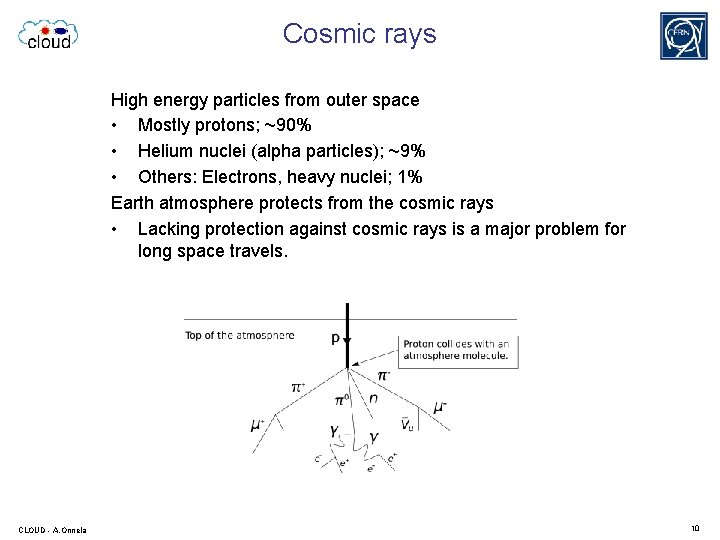
Cosmic rays High energy particles from outer space • Mostly protons; ~90% • Helium nuclei (alpha particles); ~9% • Others: Electrons, heavy nuclei; 1% Earth atmosphere protects from the cosmic rays • Lacking protection against cosmic rays is a major problem for long space travels. CLOUD - A. Onnela 10
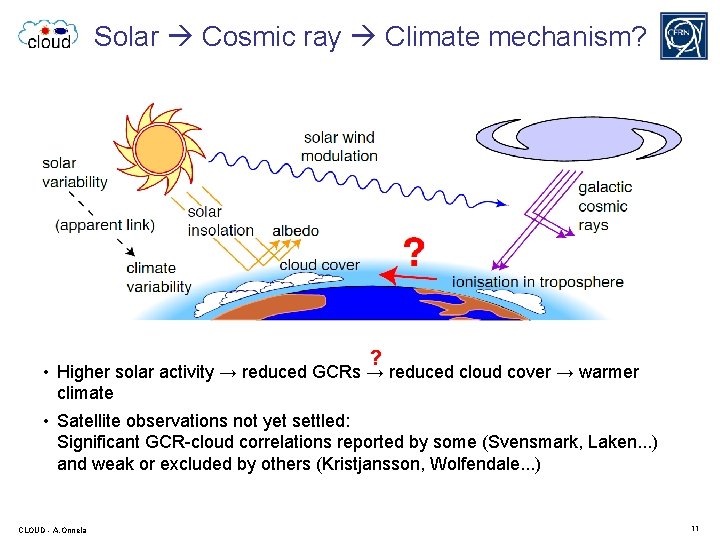
Solar Cosmic ray Climate mechanism? ? • Higher solar activity → reduced GCRs → reduced cloud cover → warmer climate • Satellite observations not yet settled: Significant GCR-cloud correlations reported by some (Svensmark, Laken. . . ) and weak or excluded by others (Kristjansson, Wolfendale. . . ) CLOUD - A. Onnela 11
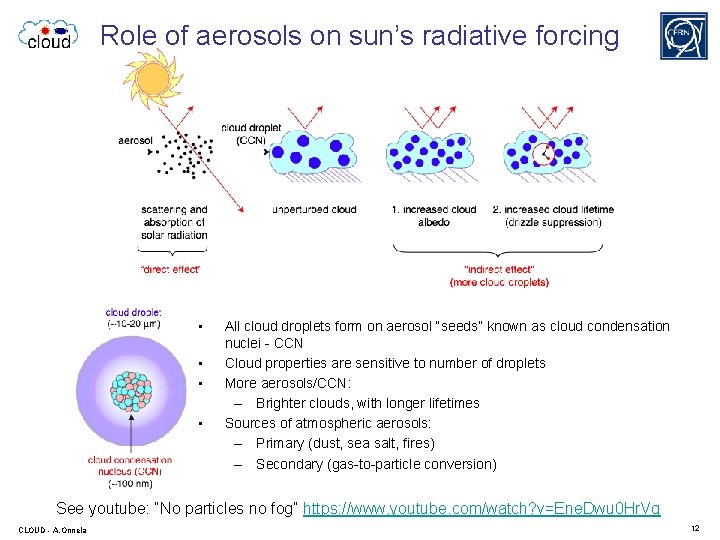
Role of aerosols on sun’s radiative forcing • • All cloud droplets form on aerosol “seeds” known as cloud condensation nuclei - CCN Cloud properties are sensitive to number of droplets More aerosols/CCN: – Brighter clouds, with longer lifetimes Sources of atmospheric aerosols: – Primary (dust, sea salt, fires) – Secondary (gas-to-particle conversion) See youtube: “No particles no fog” https: //www. youtube. com/watch? v=Ene. Dwu 0 Hr. Vg CLOUD - A. Onnela 12
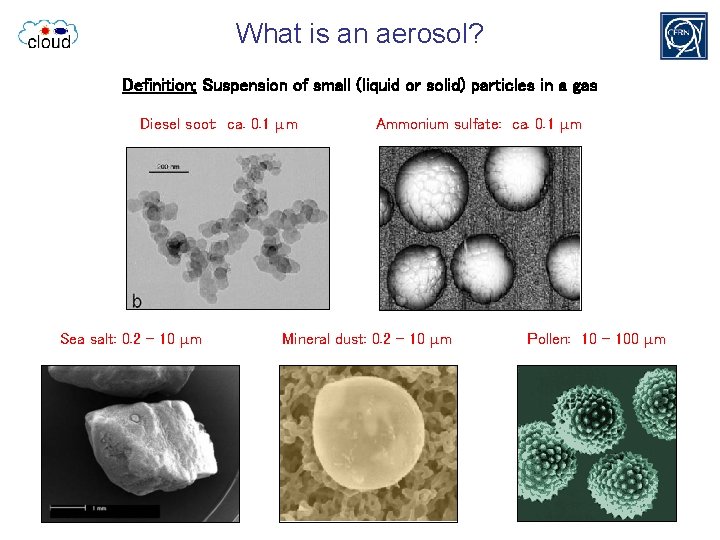
What is an aerosol? Definition: Suspension of small (liquid or solid) particles in a gas Diesel soot: ca. 0. 1 μm Sea salt: 0. 2 - 10 μm Ammonium sulfate: ca. 0. 1 μm Mineral dust: 0. 2 - 10 μm Pollen: 10 - 100 μm
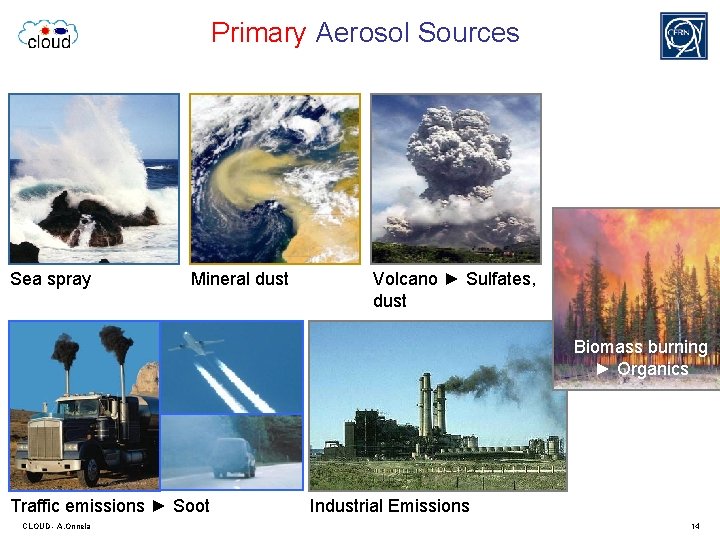
Primary Aerosol Sources Sea spray Mineral dust Volcano ► Sulfates, dust Biomass burning ► Organics Traffic emissions ► Soot CLOUD - A. Onnela Industrial Emissions 14
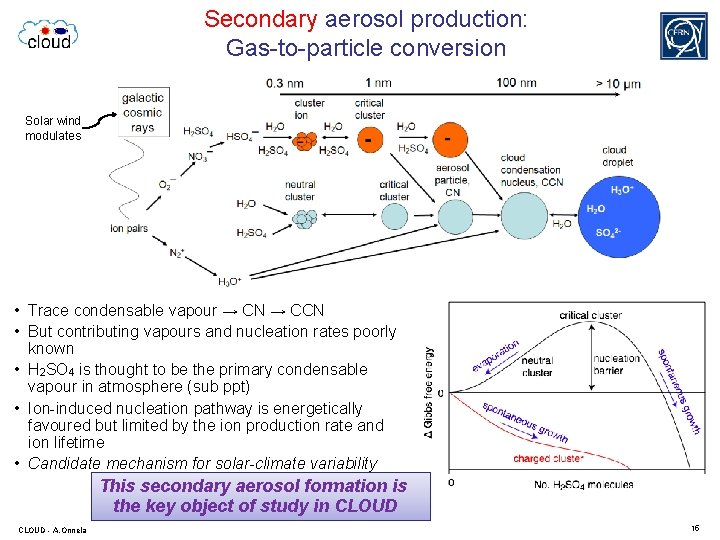
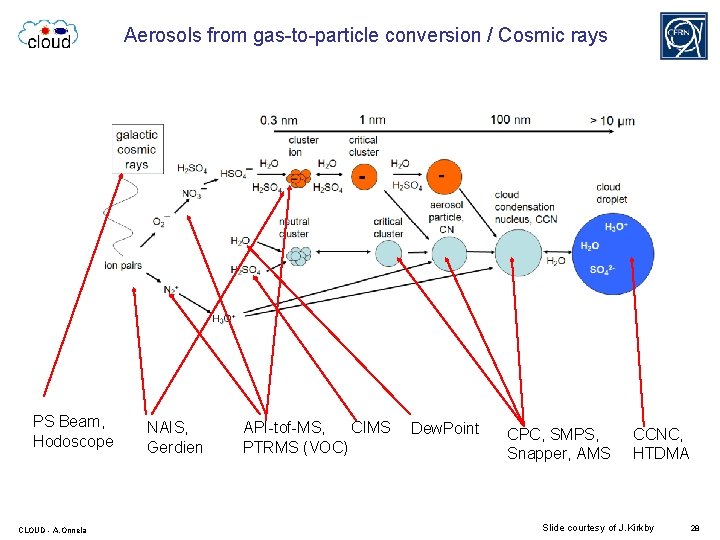
Secondary aerosol production: Gas-to-particle conversion Solar wind modulates • Trace condensable vapour → CN → CCN • But contributing vapours and nucleation rates poorly known • H 2 SO 4 is thought to be the primary condensable vapour in atmosphere (sub ppt) • Ion-induced nucleation pathway is energetically favoured but limited by the ion production rate and ion lifetime • Candidate mechanism for solar-climate variability This secondary aerosol formation is the key object of study in CLOUD - A. Onnela 15
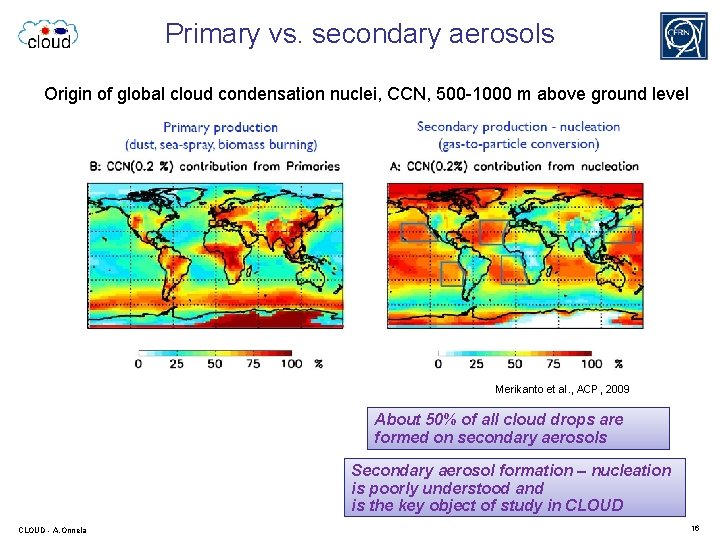
Primary vs. secondary aerosols Origin of global cloud condensation nuclei, CCN, 500 -1000 m above ground level Merikanto et al. , ACP, 2009 About 50% of all cloud drops are formed on secondary aerosols Secondary aerosol formation – nucleation is poorly understood and is the key object of study in CLOUD - A. Onnela 16
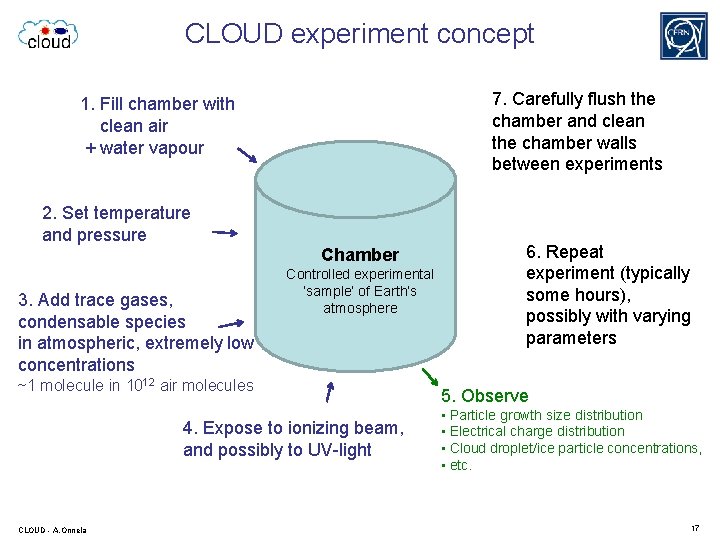
CLOUD experiment concept 7. Carefully flush the chamber and clean the chamber walls between experiments 1. Fill chamber with clean air + water vapour 2. Set temperature and pressure Chamber 3. Add trace gases, condensable species in atmospheric, extremely low concentrations Controlled experimental ‘sample’ of Earth’s atmosphere ~1 molecule in 1012 air molecules 4. Expose to ionizing beam, and possibly to UV-light CLOUD - A. Onnela 6. Repeat experiment (typically some hours), possibly with varying parameters 5. Observe • Particle growth size distribution • Electrical charge distribution • Cloud droplet/ice particle concentrations, • etc. 17
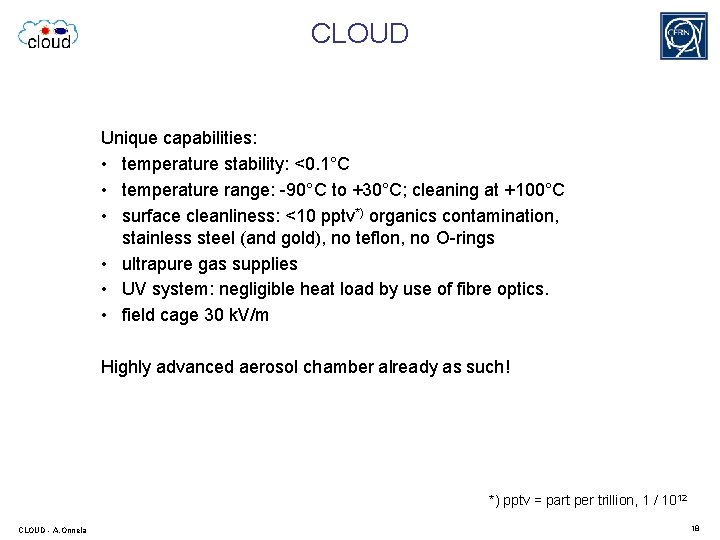
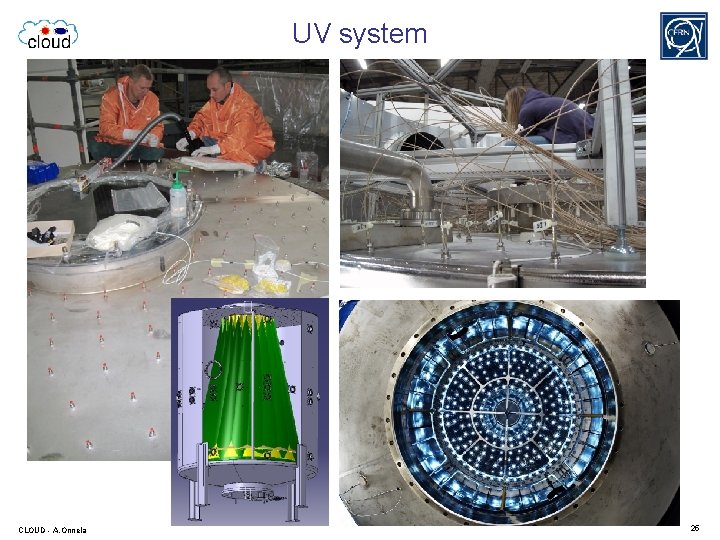
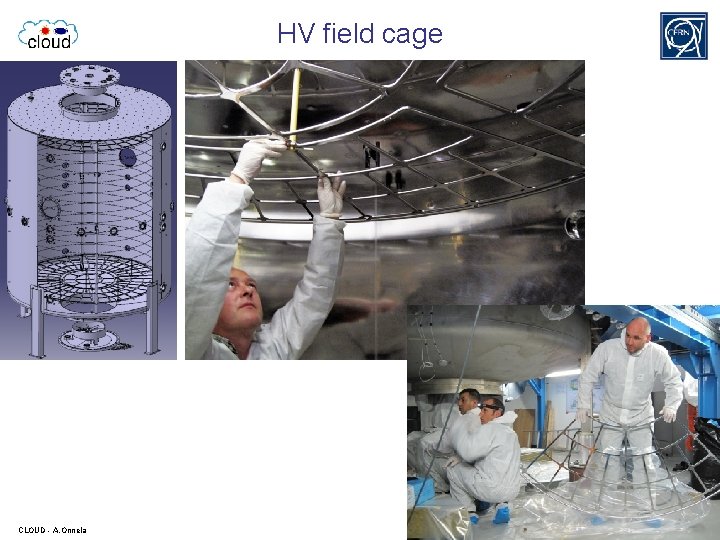
CLOUD Unique capabilities: • temperature stability: <0. 1°C • temperature range: -90°C to +30°C; cleaning at +100°C • surface cleanliness: <10 pptv*) organics contamination, stainless steel (and gold), no teflon, no O-rings • ultrapure gas supplies • UV system: negligible heat load by use of fibre optics. • field cage 30 k. V/m Highly advanced aerosol chamber already as such! *) pptv = part per trillion, 1 / 1012 CLOUD - A. Onnela 18
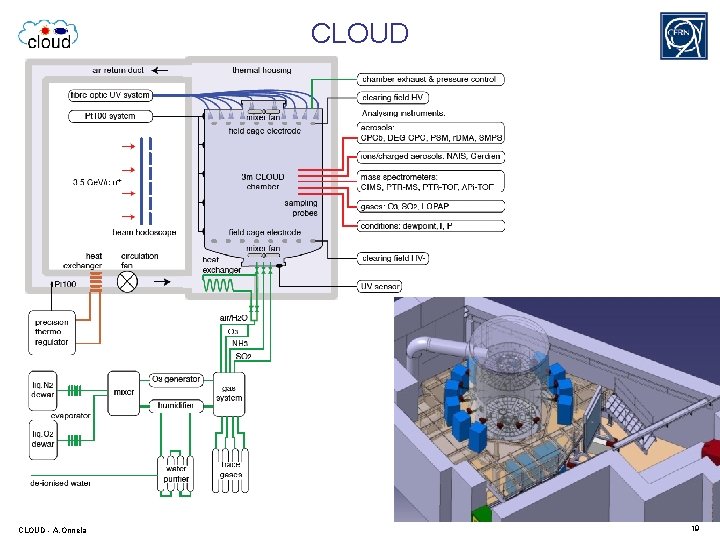
CLOUD - A. Onnela 19
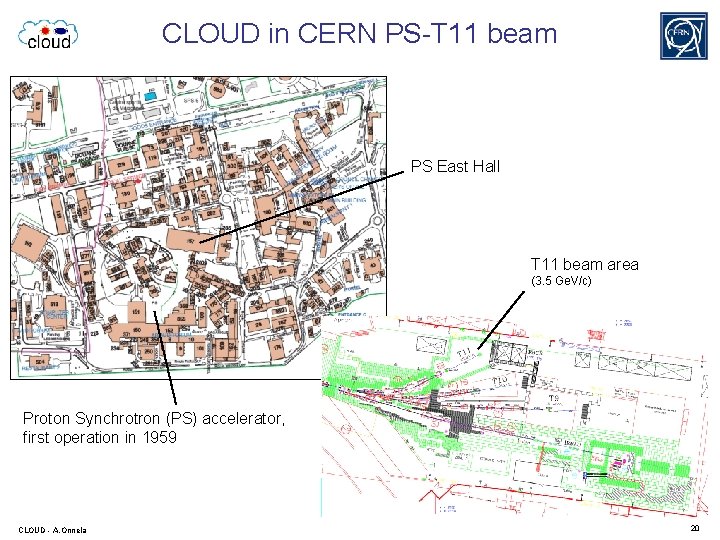
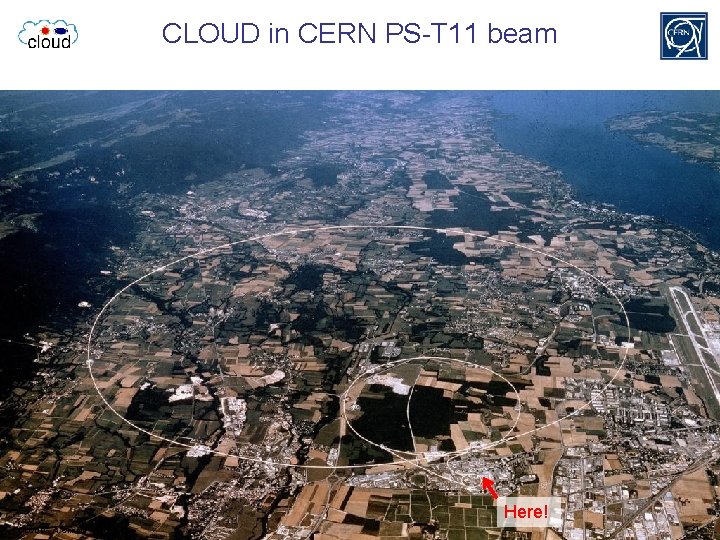
CLOUD in CERN PS-T 11 beam PS East Hall T 11 beam area (3. 5 Ge. V/c) Proton Synchrotron (PS) accelerator, first operation in 1959 CLOUD - A. Onnela 20
CLOUD in CERN PS-T 11 beam Here! CLOUD - A. Onnela 21
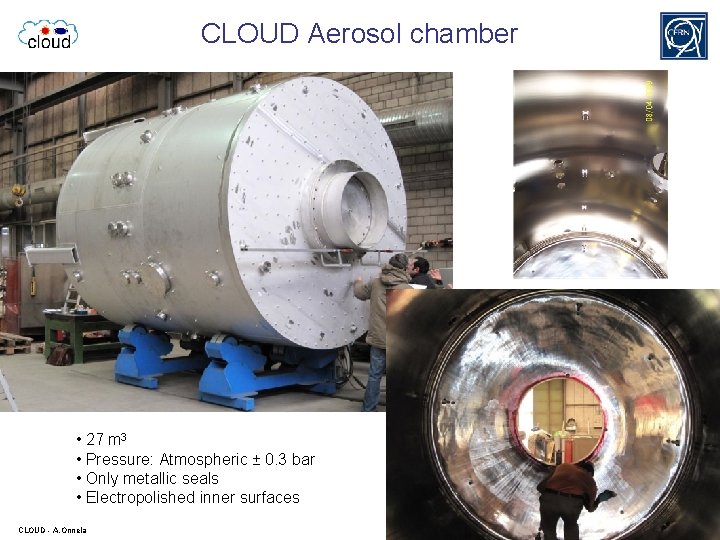
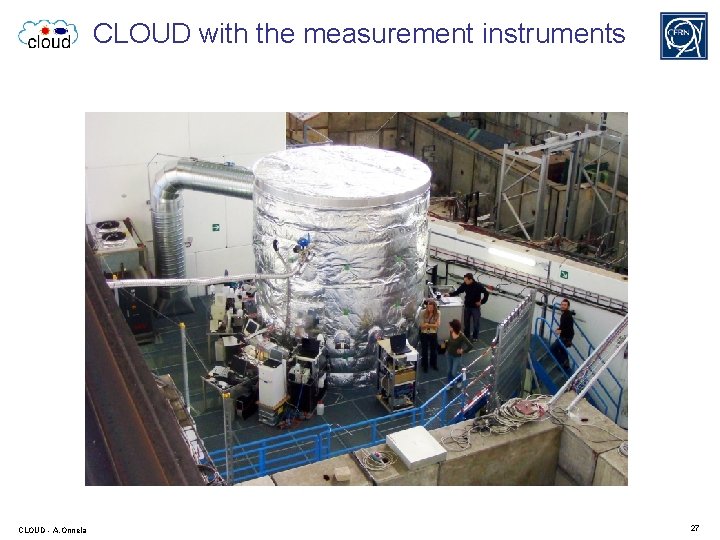
CLOUD Aerosol chamber • 27 m 3 • Pressure: Atmospheric ± 0. 3 bar • Only metallic seals • Electropolished inner surfaces CLOUD - A. Onnela 22
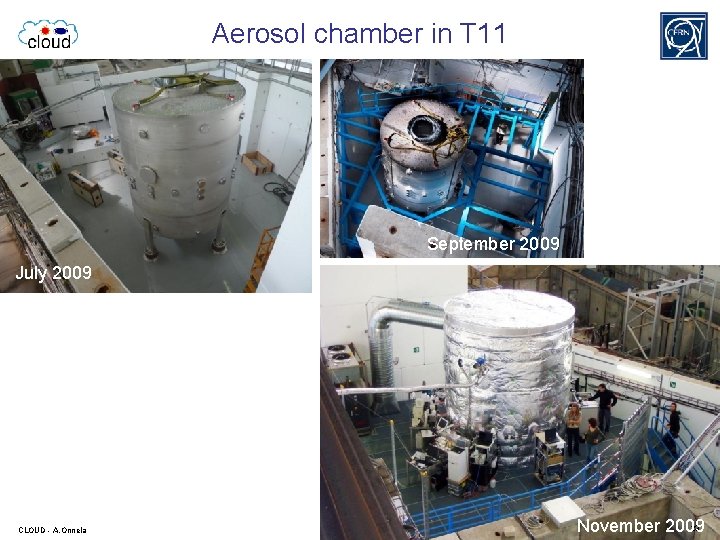
Aerosol chamber in T 11 September 2009 July 2009 CLOUD - A. Onnela 23 November 2009
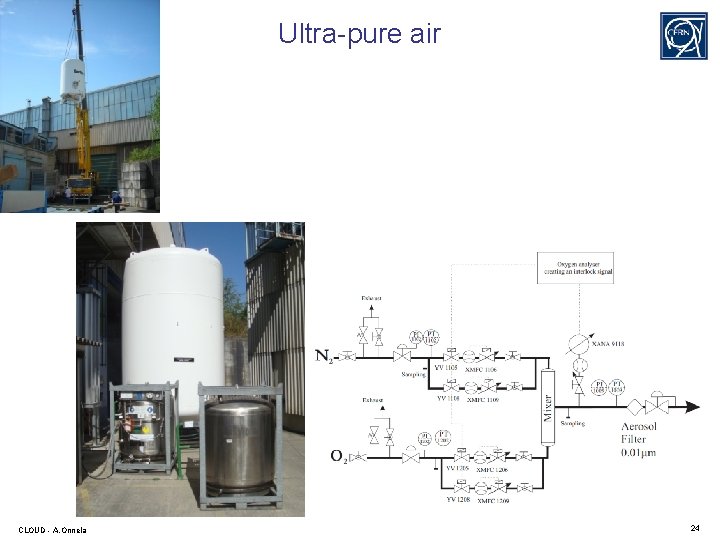
Ultra-pure air CLOUD - A. Onnela 24
UV system CLOUD - A. Onnela 25
HV field cage CLOUD - A. Onnela 26
CLOUD with the measurement instruments CLOUD - A. Onnela 27
Aerosols from gas-to-particle conversion / Cosmic rays PS Beam, Hodoscope CLOUD - A. Onnela NAIS, Gerdien CIMS API-tof-MS, PTRMS (VOC) Dew. Point CPC, SMPS, Snapper, AMS CCNC, HTDMA Slide courtesy of J. Kirkby 28
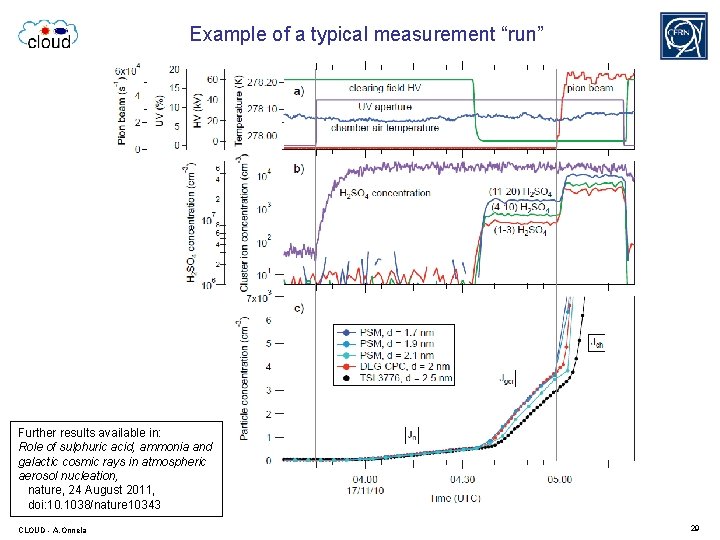
Example of a typical measurement “run” Further results available in: Role of sulphuric acid, ammonia and galactic cosmic rays in atmospheric aerosol nucleation, nature, 24 August 2011, doi: 10. 1038/nature 10343 CLOUD - A. Onnela 29
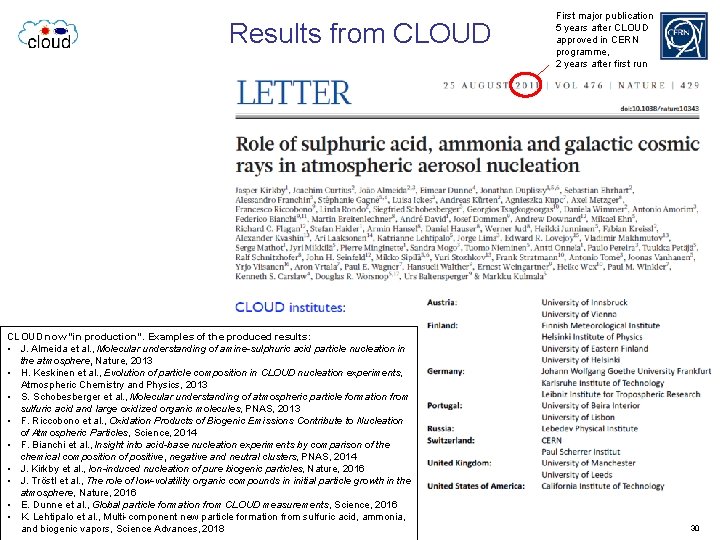
Results from CLOUD now “in production”. Examples of the produced results: • J. Almeida et al. , Molecular understanding of amine-sulphuric acid particle nucleation in the atmosphere, Nature, 2013 • H. Keskinen et al. , Evolution of particle composition in CLOUD nucleation experiments, Atmospheric Chemistry and Physics, 2013 • S. Schobesberger et al. , Molecular understanding of atmospheric particle formation from sulfuric acid and large oxidized organic molecules, PNAS, 2013 • F. Riccobono et al. , Oxidation Products of Biogenic Emissions Contribute to Nucleation of Atmospheric Particles, Science, 2014 • F. Bianchi et al. , Insight into acid-base nucleation experiments by comparison of the chemical composition of positive, negative and neutral clusters, PNAS, 2014 • J. Kirkby et al. , Ion-induced nucleation of pure biogenic particles, Nature, 2016 • J. Tröstl et al. , The role of low-volatility organic compounds in initial particle growth in the atmosphere, Nature, 2016 • E. Dunne et al. , Global particle formation from CLOUD measurements, Science, 2016 • K. Lehtipalo et al. , Multi-component new particle formation from sulfuric acid, ammonia, and biogenic vapors, Science Advances, 2018 CLOUD - A. Onnela First major publication 5 years after CLOUD approved in CERN programme, 2 years after first run 30
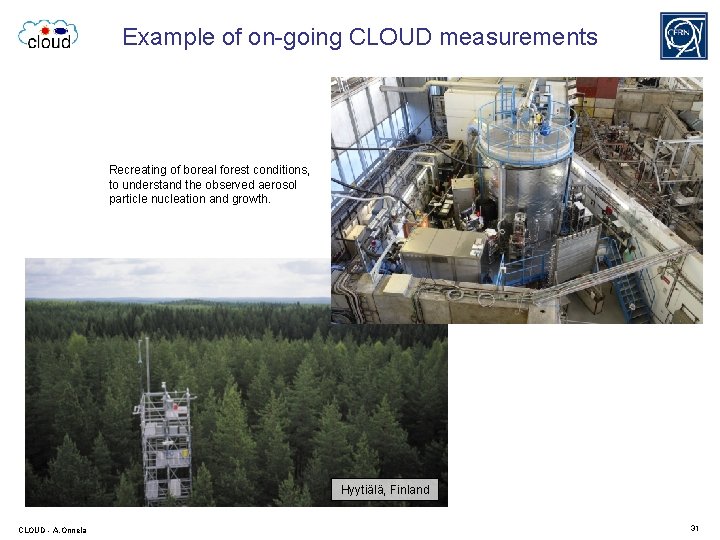
Example of on-going CLOUD measurements Recreating of boreal forest conditions, to understand the observed aerosol particle nucleation and growth. Hyytiälä, Finland CLOUD - A. Onnela 31
Summary • CLOUD is the only facility in the world for accurate quantifying of ion -induced aerosol nucleation. It has become possible by the combination of ü highly sophisticated aerosol chamber and its auxiliary systems made in CERN standards (‘no compromises’), ü availability of the beam allowing to simulate the atmosphere up to the top of the troposphere, ü collaboration of the leading groups in aerosol nucleation, ü and availability of new instrumentation. • With this combination CLOUD provides the tools for many further studies and discoveries – There is still a lot to be learned! CLOUD - A. Onnela 32
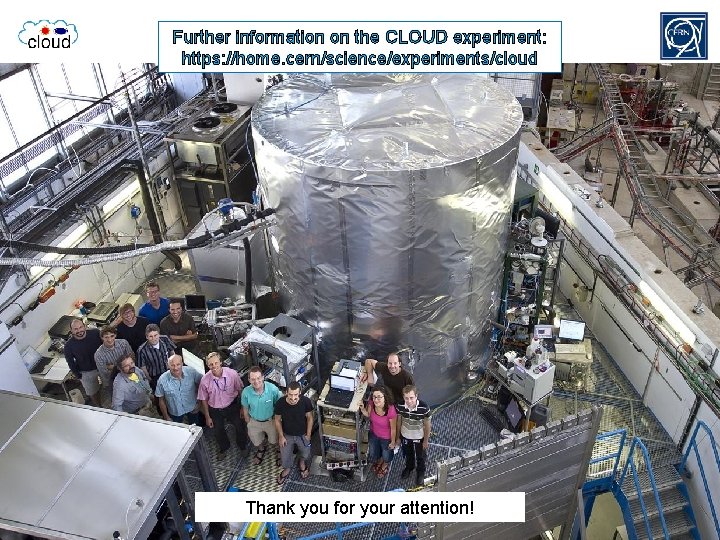
Further information on the CLOUD experiment: https: //home. cern/science/experiments/cloud Thank you for your attention! CLOUD - A. Onnela 33
Back-up slides CLOUD - A. Onnela 34
History of CO 2 +100% +50% CLOUD - A. Onnela 35
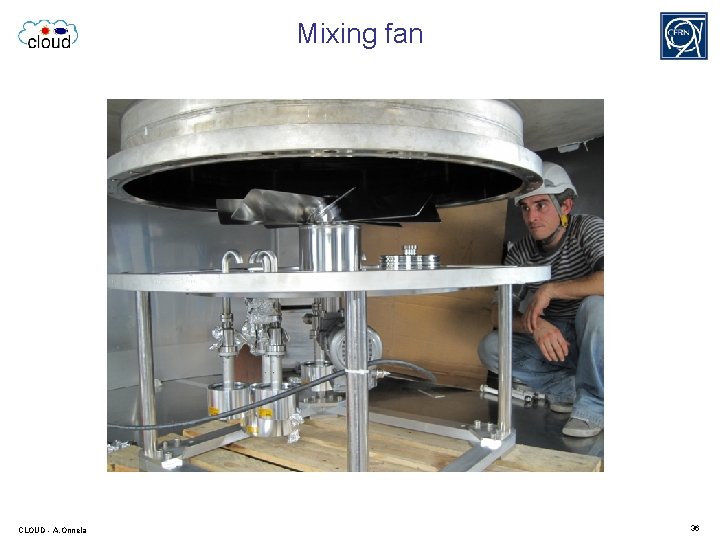
Mixing fan CLOUD - A. Onnela 36
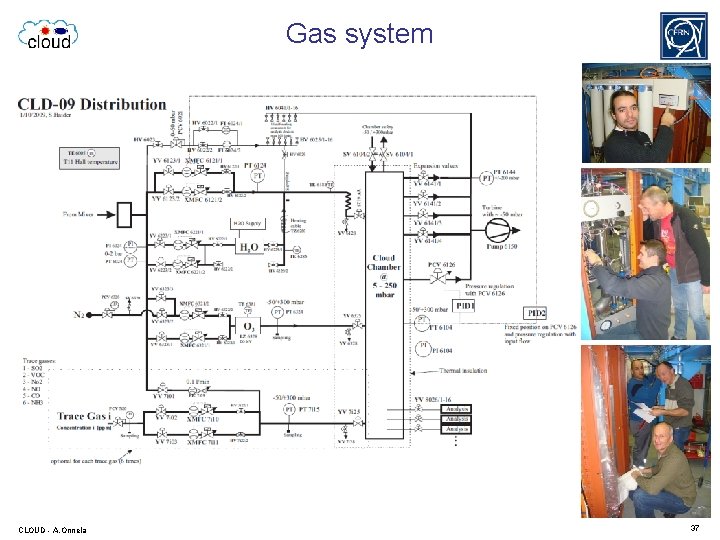
Gas system CLOUD - A. Onnela 37
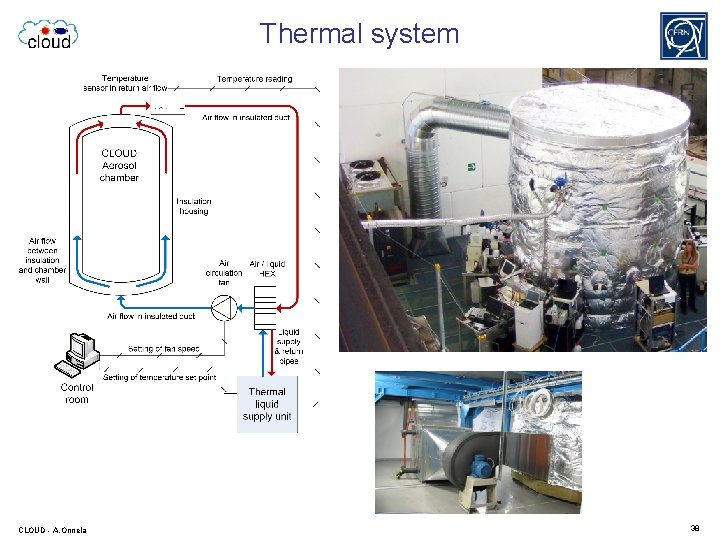
Thermal system CLOUD - A. Onnela 38