
The Clinical Competency Committee Dean Seehusen MD MPH

- Slides: 7
The Clinical Competency Committee Dean Seehusen, MD, MPH Associate Dean for Graduate Medical Education Professor of Family Medicine
Assessing Milestones • Assigning one or more members to review certain residents, or certain data, before the meeting will save time • The ACGME discourages simple use of statistical data or use of a single data point to assign make determinations • If during a given period, not enough data on a milestone has been gathered, hold the prior milestone rating • The goal is consensus; the ACGME discourages voting • The CCC only advises; the PD has final authority for assessment, promotion and graduation ACGME. Clinical Competency Committees 2 nd Edition. Available at: https: //www. acgme. org/Portals/0/ACGMEClinical. Competency. Committee. Guidebook. pdf
Additional CCC Duties • Determine baseline milestones for fellows accepted into to a program that do not meet the standard eligibility requirements within 6 weeks of matriculation • May help create and monitor remediation plans for residents in difficulty • Identify potential improvements in the program’s evaluation process ACGME. Clinical Competency Committees 2 nd Edition. Available at: https: //www. acgme. org/Portals/0/ACGMEClinical. Competency. Committee. Guidebook. pdf
Running the Meeting • Have enough time • Use the same approach for every resident • Have a method to ensure all voices are heard – Consider starting with the junior person – The Chair should speak last – The PD should speak the least or not at all • Consider designating a “Devil’s Advocate” • Have a solid documentation plan • Have a solid communication plan ACGME. Clinical Competency Committees 2 nd Edition. Available at: https: //www. acgme. org/Portals/0/ACGMEClinical. Competency. Committee. Guidebook. pdf
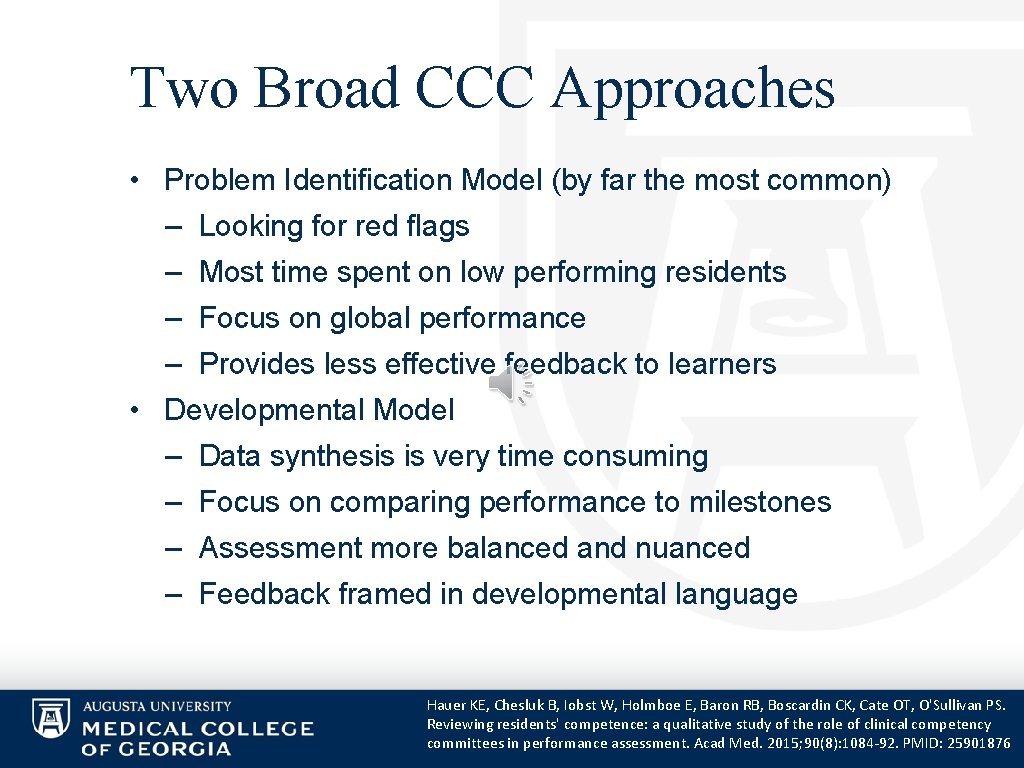
Two Broad CCC Approaches • Problem Identification Model (by far the most common) – Looking for red flags – Most time spent on low performing residents – Focus on global performance – Provides less effective feedback to learners • Developmental Model – Data synthesis is very time consuming – Focus on comparing performance to milestones – Assessment more balanced and nuanced – Feedback framed in developmental language Hauer KE, Chesluk B, Iobst W, Holmboe E, Baron RB, Boscardin CK, Cate OT, O'Sullivan PS. Reviewing residents' competence: a qualitative study of the role of clinical competency committees in performance assessment. Acad Med. 2015; 90(8): 1084 -92. PMID: 25901876
CCC Food for Thought
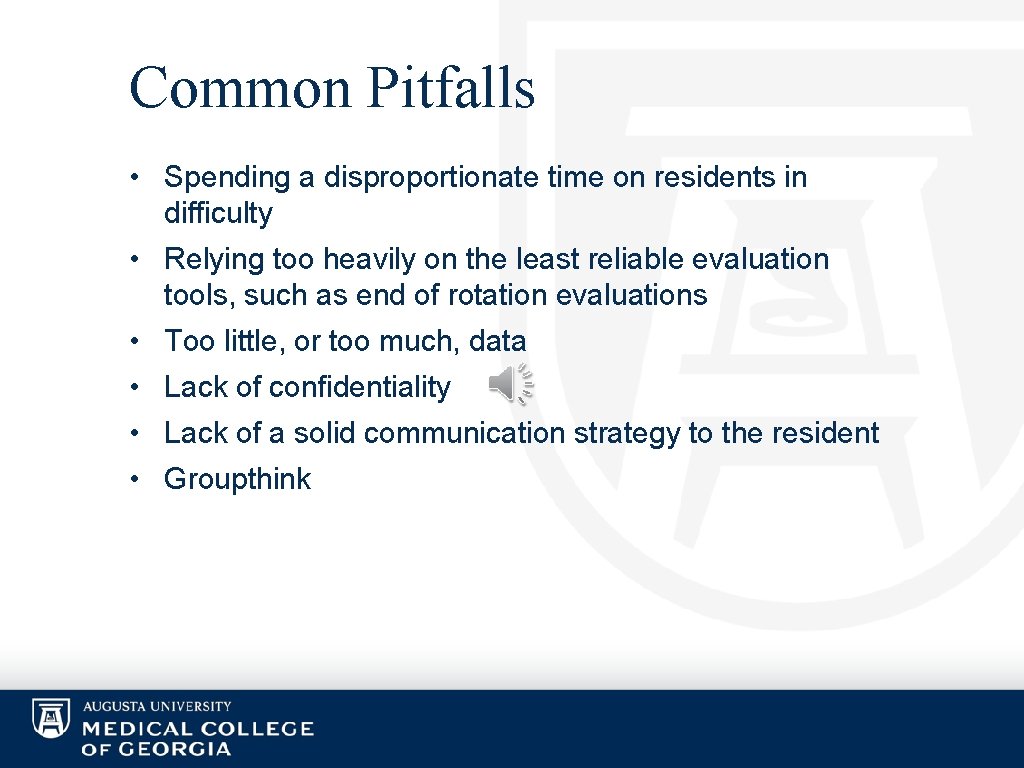
Common Pitfalls • Spending a disproportionate time on residents in difficulty • Relying too heavily on the least reliable evaluation tools, such as end of rotation evaluations • Too little, or too much, data • Lack of confidentiality • Lack of a solid communication strategy to the resident • Groupthink