
The Clausius Inequality Expressions of inequalityequality relating to


- Slides: 13
The Clausius Inequality • Expressions of inequality/equality relating to heat flow at a fixed temperature. • The expression is required for the derivation of an equation for entropy – which is our next main topic. • Derived from a “thought experiment” using Carnot engines acting in a series.
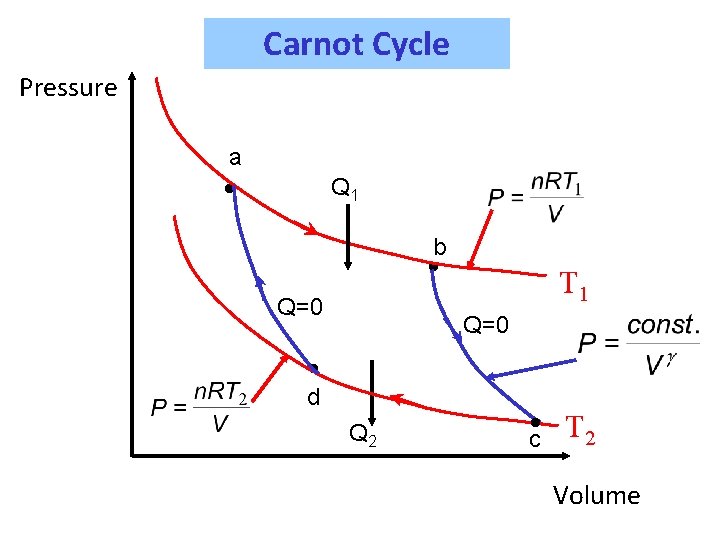
Carnot Cycle Pressure a • Q 1 b • Q=0 T 1 Q=0 • d Q 2 • c T 2 Volume
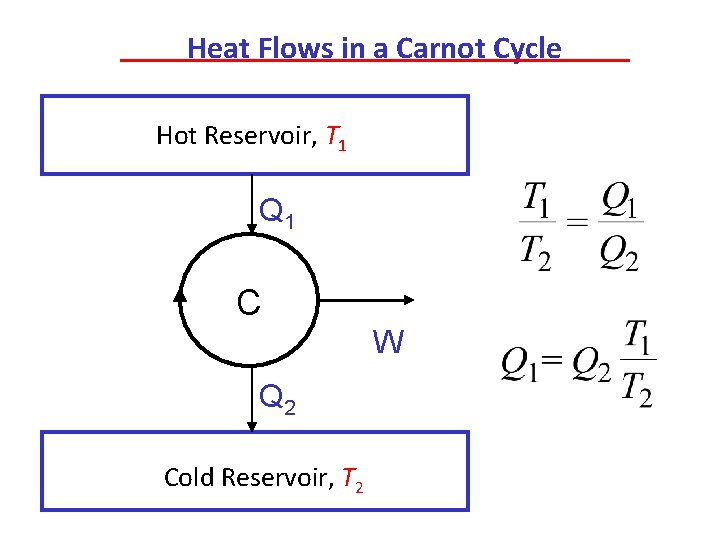
Heat Flows in a Carnot Cycle Hot Reservoir, T 1 Q 1 C W Q 2 Cold Reservoir, T 2
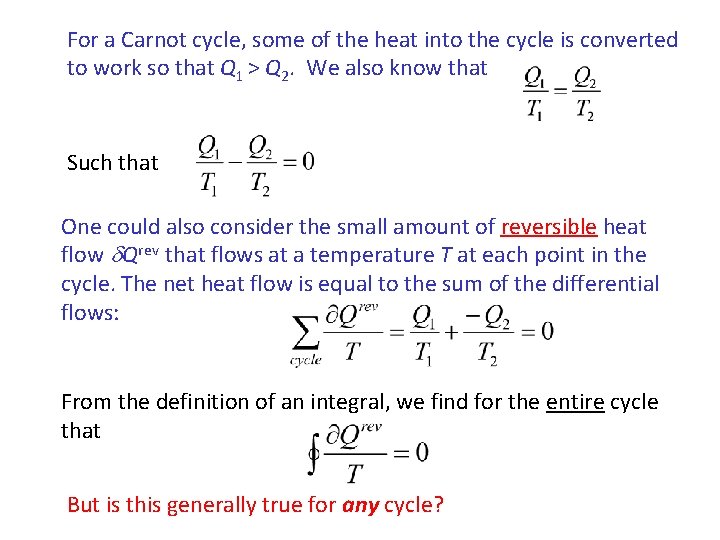
For a Carnot cycle, some of the heat into the cycle is converted to work so that Q 1 > Q 2. We also know that Such that One could also consider the small amount of reversible heat flow d. Qrev that flows at a temperature T at each point in the cycle. The net heat flow is equal to the sum of the differential flows: From the definition of an integral, we find for the entire cycle that But is this generally true for any cycle?
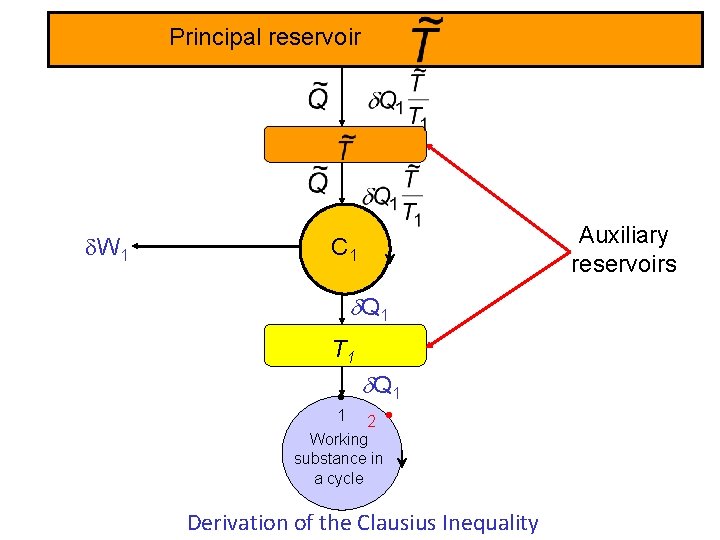
Principal reservoir d. W 1 C 1 d. Q 1 T 1 • d. Q 1 1 2 • Working substance in a cycle Derivation of the Clausius Inequality Auxiliary reservoirs
Principal reservoir d. W 1 C 2 C 1 d. Q 2 d. Q 1 T 1 d. Q 1 Composite System T 2 • d. Q 2 1 2 • Working 3 • Add N Carnot engines in total substance in a cycle Derivation of the Clausius Inequality d. W 2
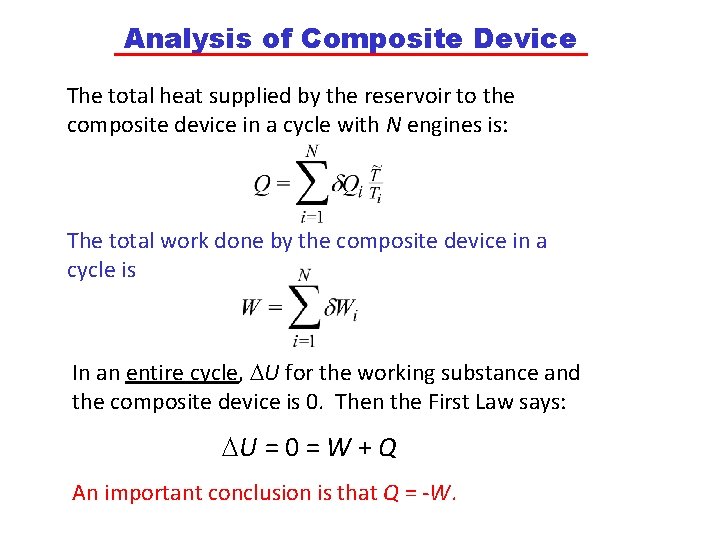
Analysis of Composite Device The total heat supplied by the reservoir to the composite device in a cycle with N engines is: The total work done by the composite device in a cycle is In an entire cycle, DU for the working substance and the composite device is 0. Then the First Law says: DU = 0 = W + Q An important conclusion is that Q = -W.
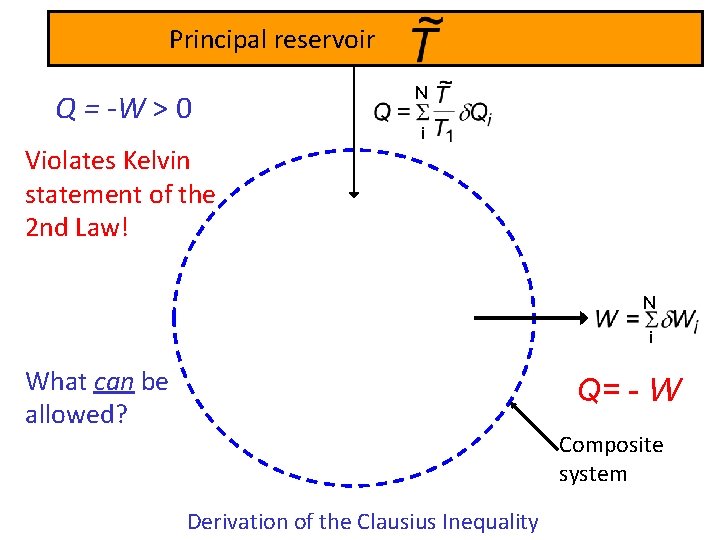
Principal reservoir Q = -W > 0 Violates Kelvin statement of the 2 nd Law! N i What can be allowed? Q= - W Composite system Derivation of the Clausius Inequality
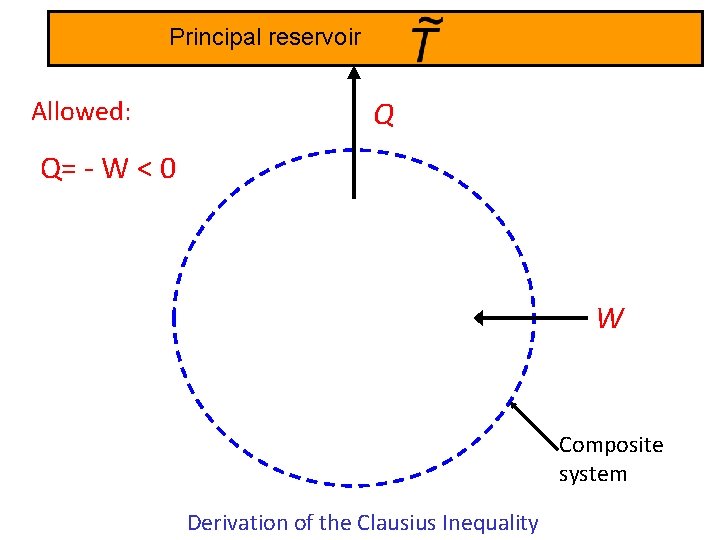
Principal reservoir Allowed: Q Q= - W < 0 W Composite system Derivation of the Clausius Inequality
Principal reservoir Q Allowed: Q=-W =0 (Sum of +ve and –ve d. Q and d. W) W Composite system Derivation of the Clausius Inequality
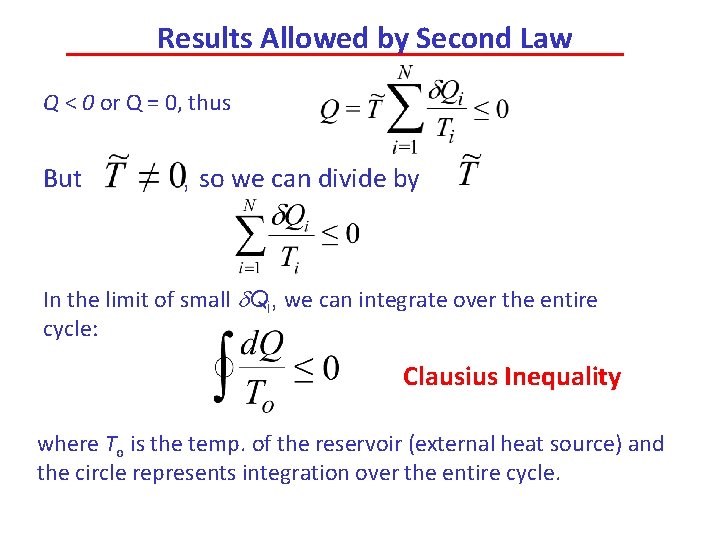
Results Allowed by Second Law Q < 0 or Q = 0, thus But , so we can divide by In the limit of small d. Qi, we can integrate over the entire cycle: Clausius Inequality where To is the temp. of the reservoir (external heat source) and the circle represents integration over the entire cycle.
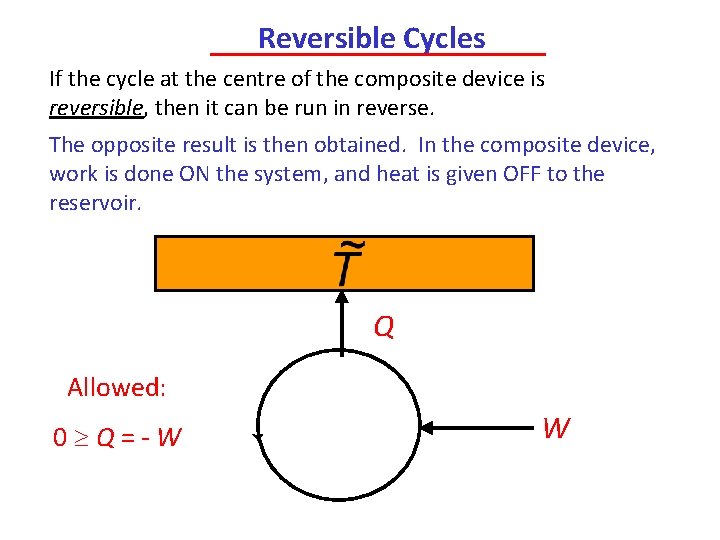
Reversible Cycles If the cycle at the centre of the composite device is reversible, then it can be run in reverse. The opposite result is then obtained. In the composite device, work is done ON the system, and heat is given OFF to the reservoir. Q Allowed: 0 Q=-W W
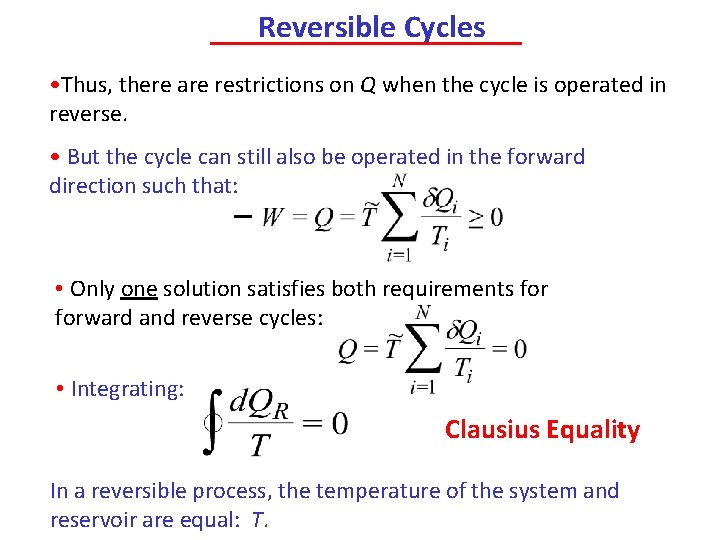
Reversible Cycles • Thus, there are restrictions on Q when the cycle is operated in reverse. • But the cycle can still also be operated in the forward direction such that: • Only one solution satisfies both requirements forward and reverse cycles: • Integrating: Clausius Equality In a reversible process, the temperature of the system and reservoir are equal: T.