
The Classical Period 1000 BCE 600 CE Transition
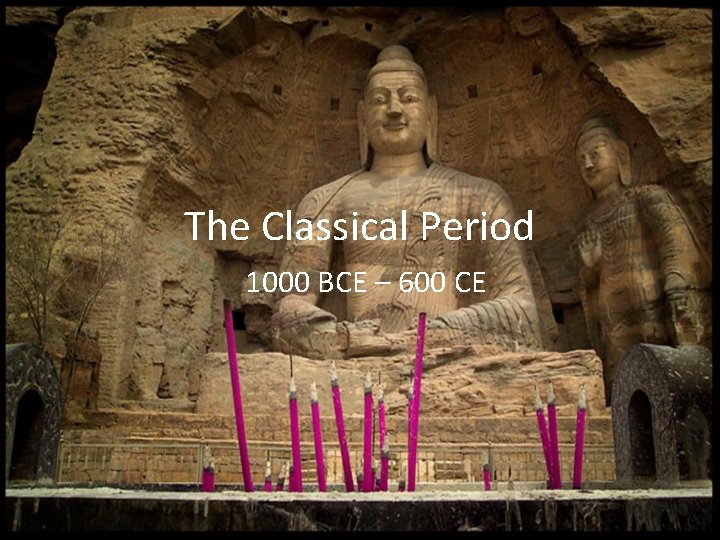
The Classical Period 1000 BCE – 600 CE
Transition from River Valley Civilizations to Classical Civilizations • River Valley Civilizations had huge impact on human society and history – Development of writing systems – Experimentation in religion, government, math, science, astronomy, etc. – Development of social stratification systems – Complex trade networks started • Although not as large in size, other groups made notable contributions – Phoenecians- simplified alphabet became model for Greek and Latin – Lydians- first coined money – Jews- monotheism; later influences Christianity and Islam
Classical Period • During the Classical Period (1000 BCE- 600 CE), societies built upon the past and expanded into vast empires • Large regional civilizations grew in: – China – India – Mediterranean – Middle East
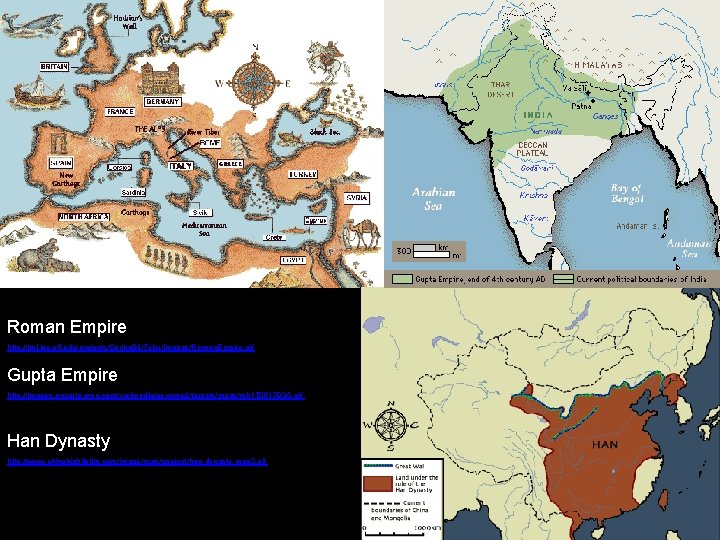
Roman Empire http: //iml. jou. ufl. edu/projects/Spring 04/Tyler/Images/Roman. Empire. gif Gupta Empire http: //images. encarta. msn. com/xrefmedia/aencmed/targets/maps/mhi/T 051793 A. gif Han Dynasty http: //www. chinahighlights. com/image/map/ancient/han-dynasty-map 2. gif
Continuities from the Past • During the Classical Period, some things remained relatively the same as they had in the past – Peasant labor retained dominant role in most economies – Systems of transportation continued – Patriarchy continued – Populations continue to increase
Changes during the Classical Period • Although some things continued, the Classical Period was characterized by: – Empire building, military conquest – Use of iron tools and metal coinage – New trade links – Development of new religions – Increase in literacy, elaborate art, literature
Classical India
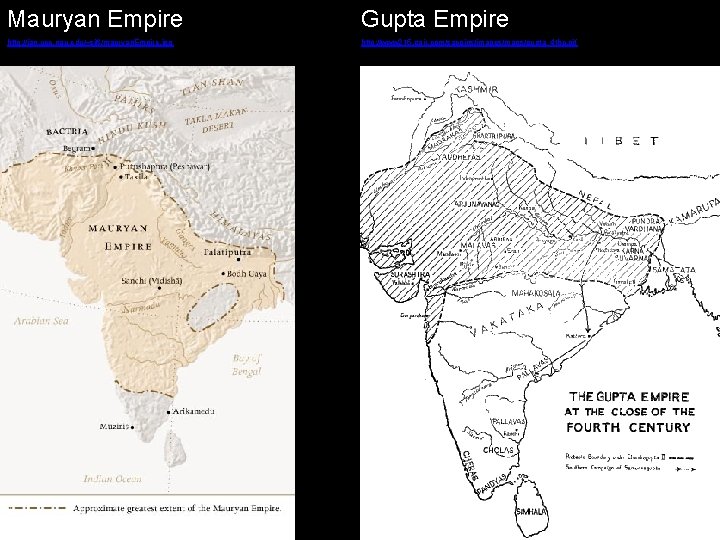
Mauryan Empire Gupta Empire http: //jan. ucc. nau. edu/~sj 6/mauryan. Empire. jpg http: //www 215. pair. com/sacoins/images/maps/gupta_4 thc. gif
Geography • Indian Subcontinent • Mountains to north (Himalayas, etc) • Monsoon: seasonal wind that brings moisture to subcontinent – How can this be a good thing and/or bad thing for the people of India? ? ?
Fall Of Indus River Valley Society • Decline of Indus River Valley civilization – Natural disaster and invasion • 1500 BCE Aryans assume control of the subcontinent • Began to alter culture
Vedic Period • 1500 -1000 BCE known as Vedic Period – Named after the Vedas (books of “knowledge”) • Under Aryans: – Sanskrit- most common language – Villages took on more organization and regulation – Families became more patriarchal – Caste system begins – Beginnings of Hinduism
Classical India: Government • Unlike China, India often did not develop and maintain a strong centralized government • Regional kingdoms, decentralized • 327 BCE: Alexander the Great invaded India to expand his empire – In reaction, an Indian soldier began to create a powerbase to oppose the invasion • Chandragupta Maurya united India in its first dynasty – Known as the Mauryan Dynasty
Mauryan Empire • Chandragupta relied upon military for power – Created an empire throughout most of the subcontinent • Chandragupta’s grandson was a better known ruler of the empire
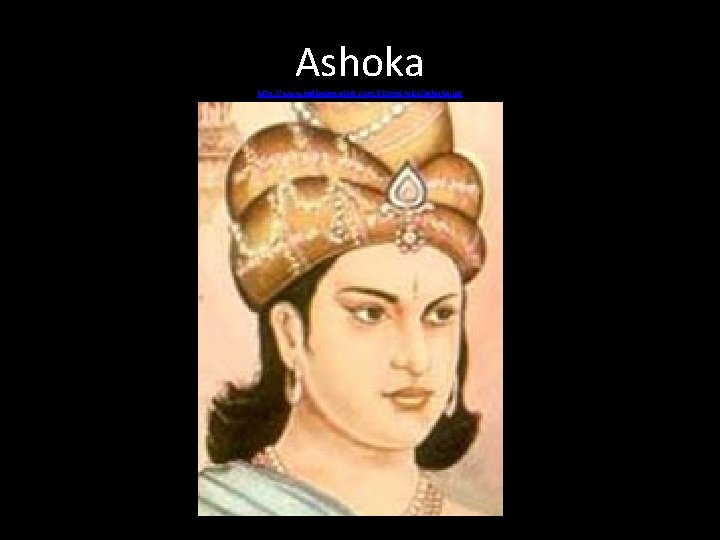
Ashoka http: //www. indiaparenting. com/stories/pics/ashoka. jpg
Ashoka • Ashoka continued to expand the empire – Use of brutal military campaigns • Later, Ashoka converted to Buddhism and promoted nonviolence – Helped popularize Buddhism by sponsoring shrines and statues to the Buddha • Ordered construction projects throughout empire – Roads with wells and rest stops for travelers
Fall of Mauryan Empire • Mauryan Empire fell apart soon after the death of Ashoka (232 BCE) • Invaders from Northwest established a temporary state (Kushan) • Early 4 th Century CE a new empire emerged – Gupta Empire
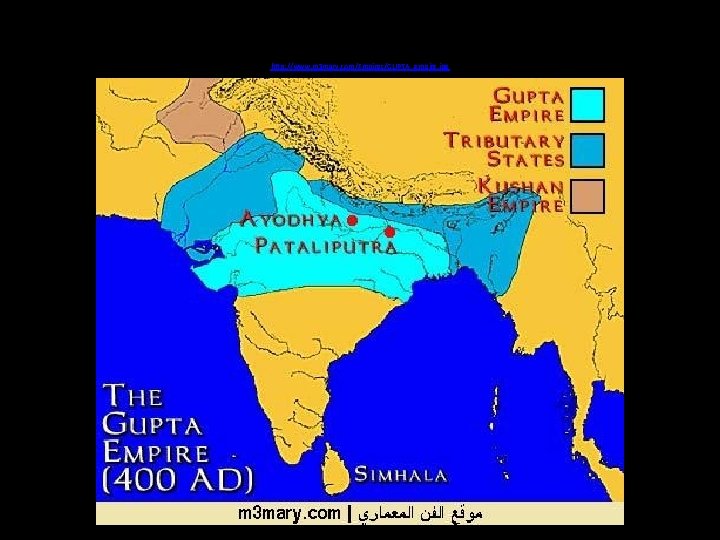
http: //www. m 3 mary. com/Empires/GUPTA_empire. jpg
Gupta Empire • 320 -550 CE • Gupta rulers modeled their rule after the Mauryan Empire – Taxation, construction projects, emphasis on military – Empire was not as large or as bureaucratic as the Mauryan • India’s Golden Age – Advances in math, science, art, literature, etc.
Classical India: Government and Politics • Regional governments dominated – Less emphasis on politics than in China • Empires were typically short-lived and less bureaucratic than the other classical civilizations • Religion and the caste system assumed role of maintaining order • Caste system became more complex in the classical era • Dictated proper behavior for members of society
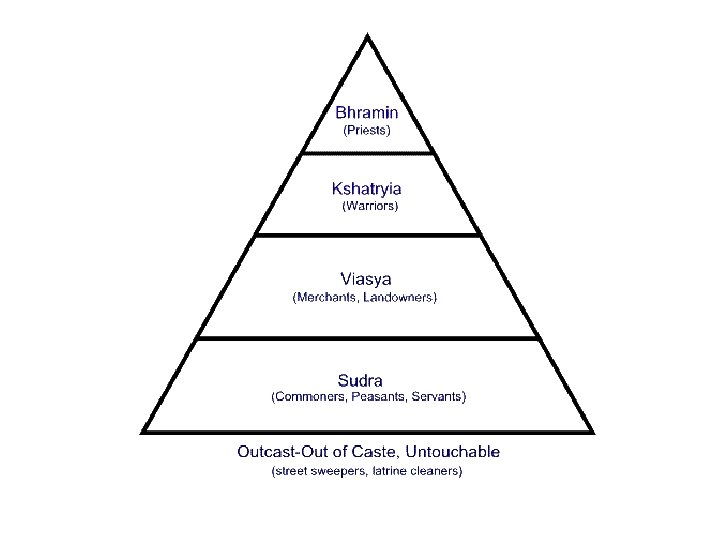
Caste System • Society broken up into castes or Varnas (literally means color) – Warrior/governing class – Priests (Brahmans) eventually move to top of social ladder – Traders/farmers – Common Laborers – Untouchables (so named b/c of their work)
Religion and Culture • Hinduism played largest role in shaping Indian society • Buddhism rose in popularity during the reign of Ashoka • Much of the culture of India is directly tied to religion
Literature in Classical India • Epic stories – Ramayana and Mahabarata • Love, romance and adventure major themes • Lively storylines – Often involving military exploits and romance • Even today, love and adventure are popular themes in Indian entertainment
Science and Math in Classical India • Guptas sponsored one of the world’s first Universities – Over 100 lecture halls and 3 libraries, astronomical observatory – Studied religion, philosophy, medicine, and architecture – Value placed on education
Advances in Astronomy • Scholars calculated circumference of the Earth with remarkable accuracy • Calculated daily rotation of Earth on axis • Predicted and explained eclipses • Developed a theory of gravity • Able to identify 7 planets
Advances in medicine • Indians became proficient in – Bone setting – Experimenting with plastic surgery – Inoculations against smallpox – Cleanliness and sterilization of wounds
Advances in Math • • • Invented the concept of a zero Developed a decimal system Negative numbers Calculation of square roots Calculated value of pi
Art in Classical India • Statues and shrines devoted to the Buddha – Stupa • Colorful, elaborate art – Shows an appreciation of nature – Reveals India’s interest in spontaneity and imagination • Elaborate carvings on buildings, temples, and shrines
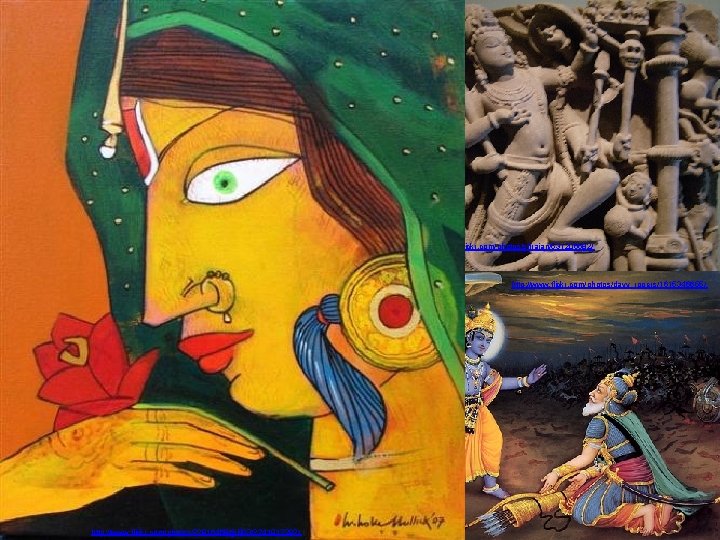
http: //www. flickr. com/photos/sftrajan/531206682/ http: //www. flickr. com/photos/davy_rogers/1615346655/ http: //www. flickr. com/photos/magic_eye/138583970/ http: //www. flickr. com/photos/22816468@N 03/2241912292/
Family Structure • Patriarchy – Men dominated family life – Women had few rights, but were valued for their beauty and cleverness – Arranged marriages • Love and sexuality valued • Children were often pampered and indulged
Economy • Indians were experts at iron making • Proficient in textiles: cotton, cashmere • Merchants enjoyed high social status b/c India was involved in extensive trade – Silk, dyes, textiles, gold, ivory – Traded with: Mediterranean, Malaysia, Indonesia, China • Ag based economy – Subsistence farming for many
- Slides: 31