
The Classical Hall effect Reminder The Lorentz Force
![Reminder: The Lorentz Force F = q[E + (v B)]](https://slidetodoc.com/presentation_image_h2/ccc4ae95a3e2d4953db9887be4d08f82/image-2.jpg "Reminder: The Lorentz Force F = q[E + (v B)]")
![Charge Density in the Drude Model rm [kg/m 3]: mass density A [kg]: atomic](https://slidetodoc.com/presentation_image_h2/ccc4ae95a3e2d4953db9887be4d08f82/image-11.jpg "Charge Density in the Drude Model rm [kg/m 3]: mass density A [kg]: atomic")
- Slides: 23
The Classical Hall effect
Reminder: The Lorentz Force F = q[E + (v B)]
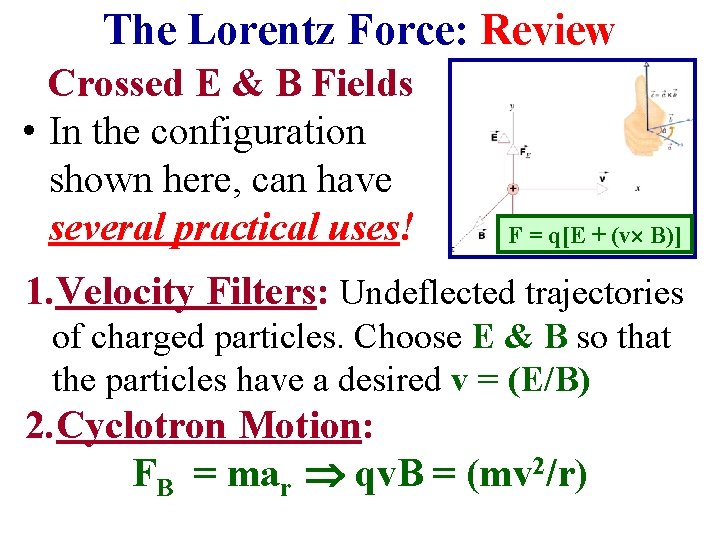
The Lorentz Force: Review Crossed E & B Fields • In the configuration shown here, can have several practical uses! F = q[E + (v B)] 1. Velocity Filters: Undeflected trajectories of charged particles. Choose E & B so that the particles have a desired v = (E/B) 2. Cyclotron Motion: FB = mar qv. B = (mv 2/r)
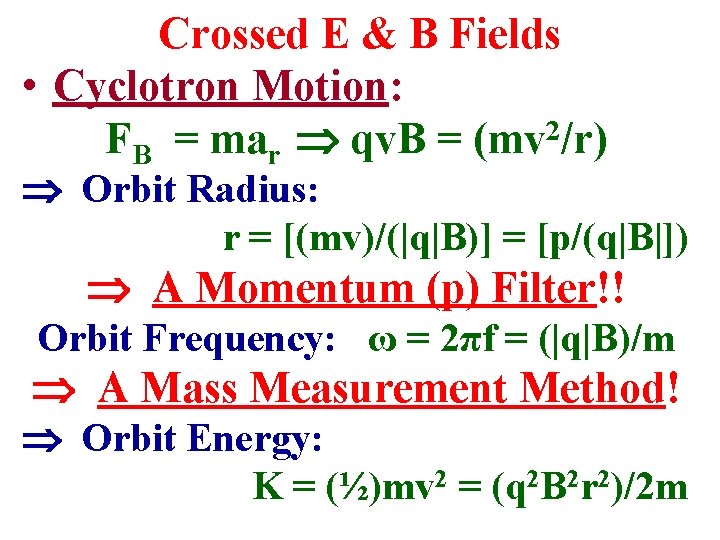
Crossed E & B Fields • Cyclotron Motion: 2 FB = mar qv. B = (mv /r) Orbit Radius: r = [(mv)/(|q|B)] = [p/(q|B|]) A Momentum (p) Filter!! Orbit Frequency: ω = 2πf = (|q|B)/m A Mass Measurement Method! Orbit Energy: K = (½)mv 2 = (q 2 B 2 r 2)/2 m
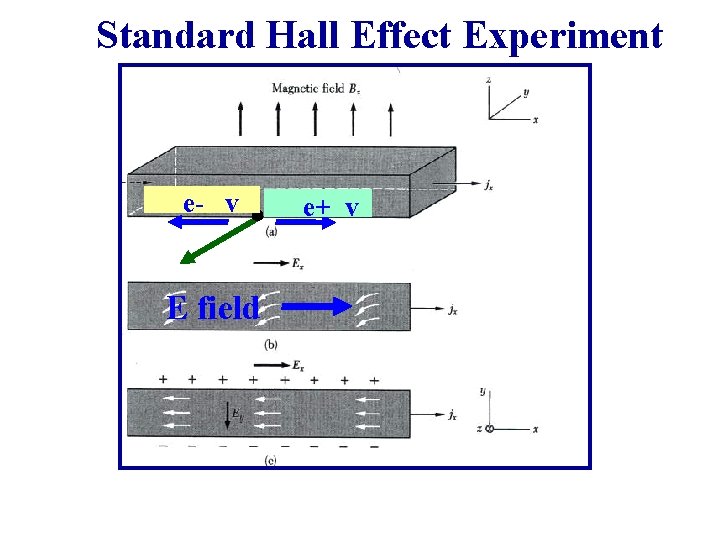
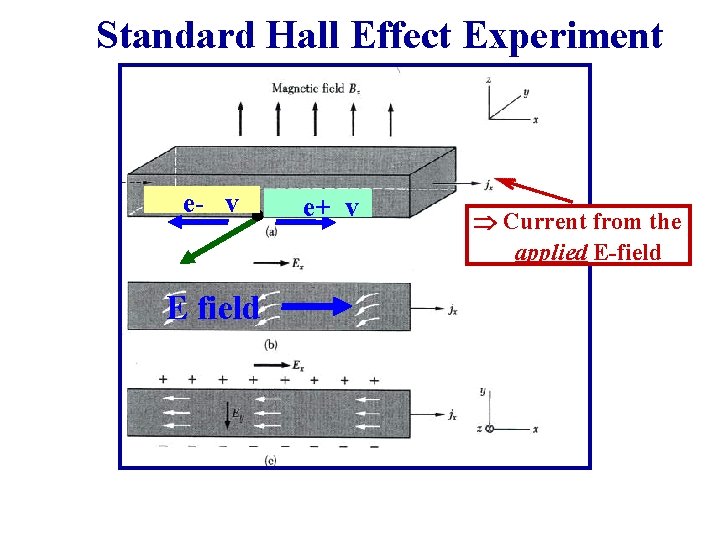
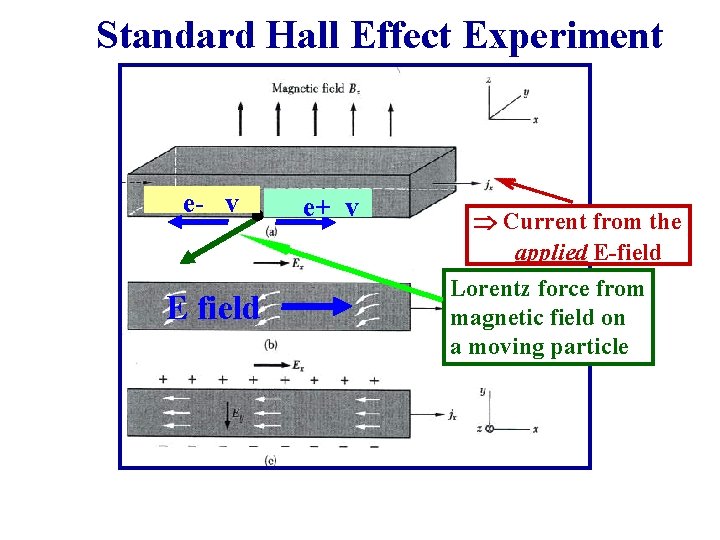
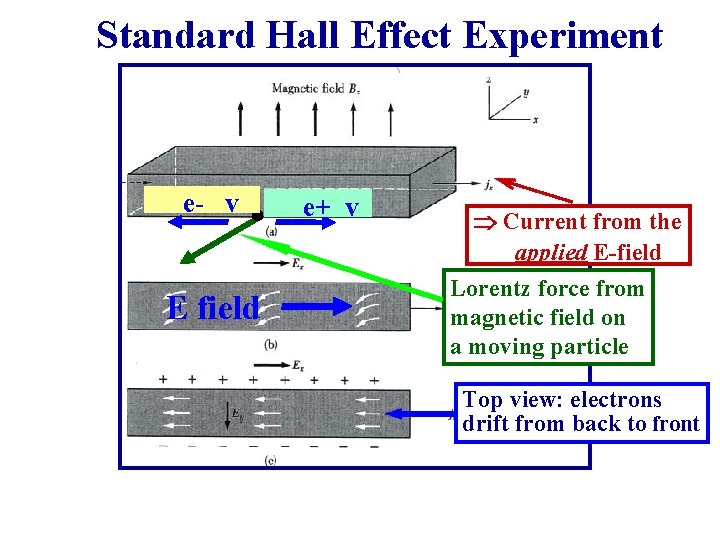
Standard Hall Effect Experiment e- v E field e+ v
Standard Hall Effect Experiment e- v E field e+ v Current from the applied E-field
Standard Hall Effect Experiment e- v E field e+ v Current from the applied E-field Lorentz force from magnetic field on a moving particle
Standard Hall Effect Experiment e- v E field e+ v Current from the applied E-field Lorentz force from magnetic field on a moving particle Top view: electrons drift from back to front
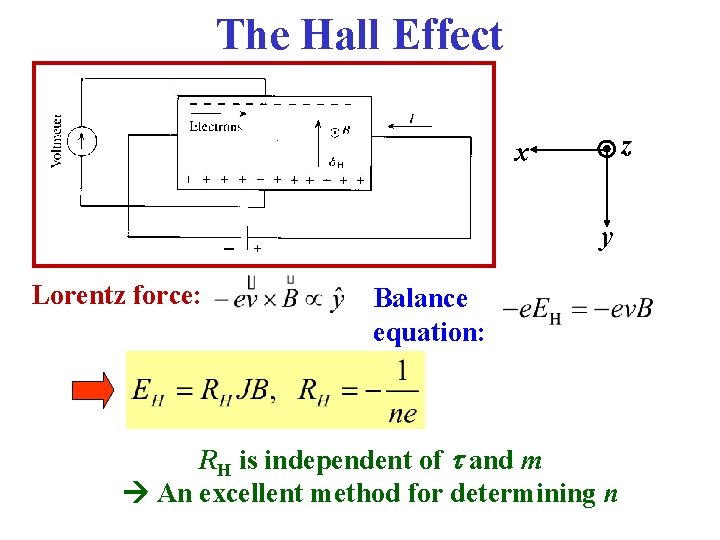
The Hall Effect z x y Lorentz force: Balance equation: RH is independent of t and m An excellent method for determining n
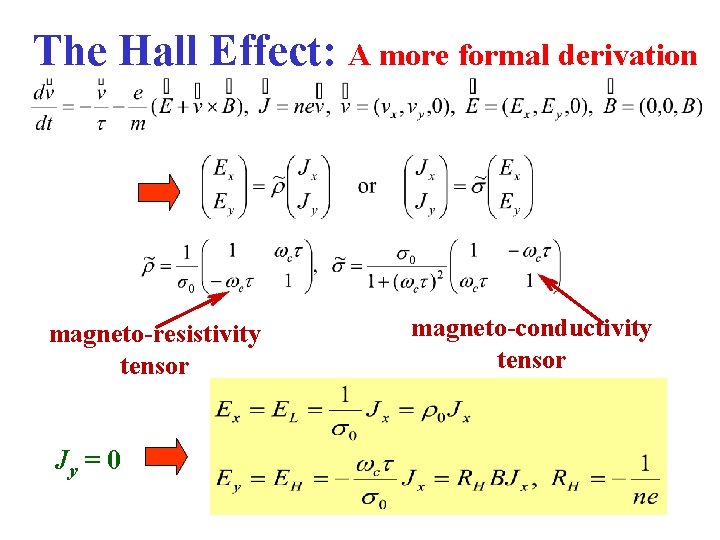
The Hall Effect: A more formal derivation magneto-resistivity tensor Jy = 0 magneto-conductivity tensor
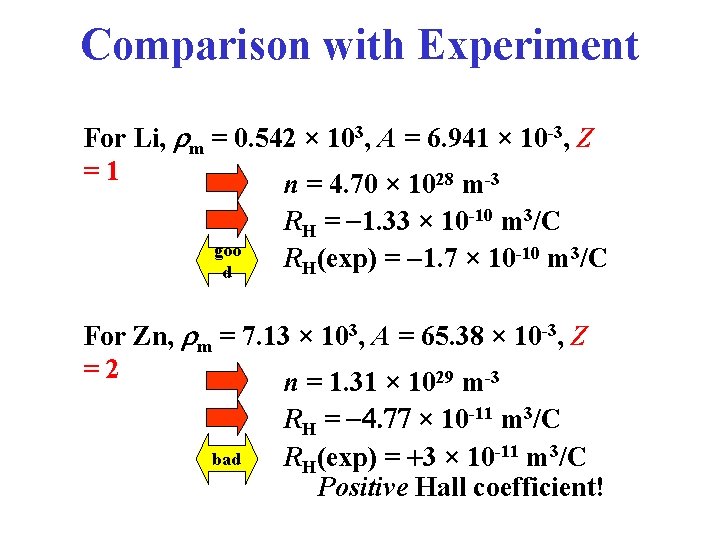
Charge Density in the Drude Model rm [kg/m 3]: mass density A [kg]: atomic mass (mass of one mole) rm/A moles atoms per m 3 NArm/A atoms per m 3, NA = 6. 02 × 1023 n = NArm. Z/A electrons per m 3, Z: # of valence electrons For Li, rm = 0. 542 × 103, A = 6. 941 × 10 -3, Z = 1 n = 4. 70 × 1028 m-3
Comparison with Experiment For Li, rm = 0. 542 × 103, A = 6. 941 × 10 -3, Z =1 n = 4. 70 × 1028 m-3 goo d RH = 1. 33 × 10 -10 m 3/C RH(exp) = 1. 7 × 10 -10 m 3/C For Zn, rm = 7. 13 × 103, A = 65. 38 × 10 -3, Z =2 n = 1. 31 × 1029 m-3 bad RH = 4. 77 × 10 -11 m 3/C RH(exp) = +3 × 10 -11 m 3/C Positive Hall coefficient!
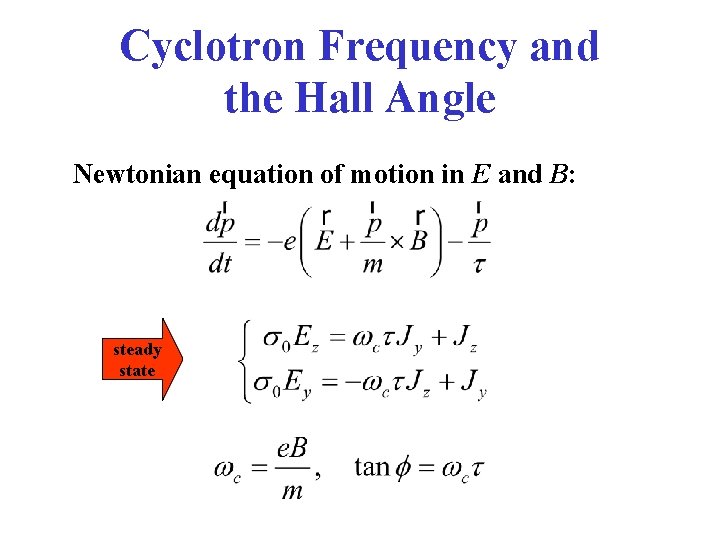
Cyclotron Frequency and the Hall Angle Newtonian equation of motion in E and B: steady state
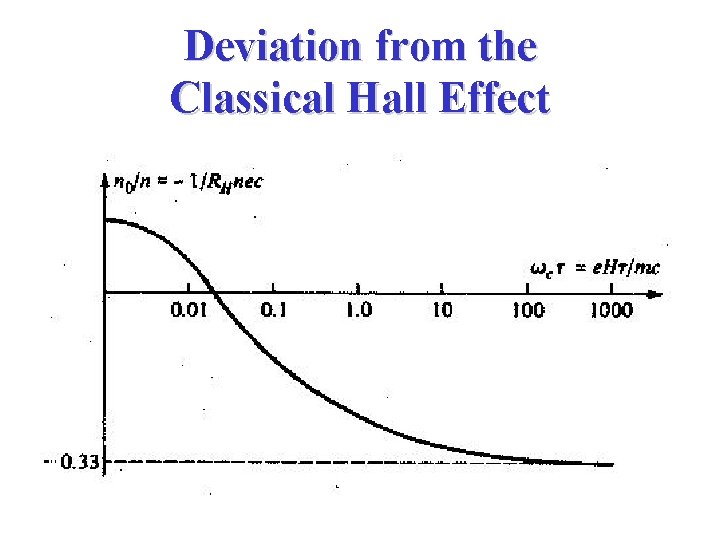
Deviation from the Classical Hall Effect
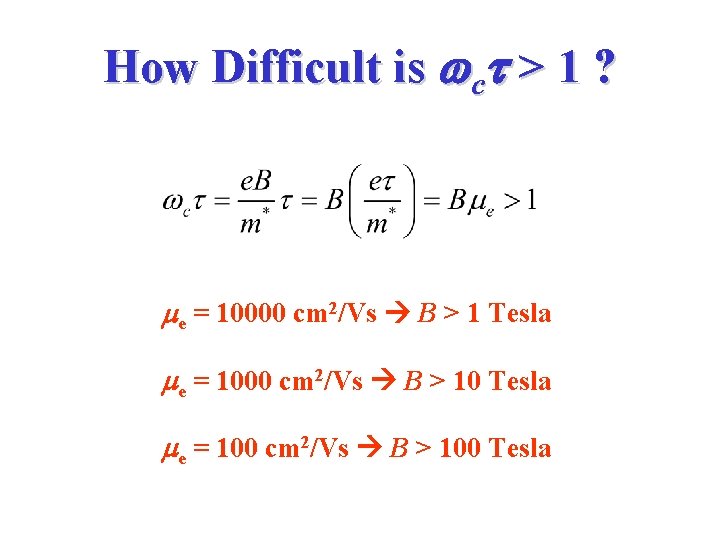
How Difficult is wct > 1 ? me = 10000 cm 2/Vs B > 1 Tesla me = 1000 cm 2/Vs B > 10 Tesla me = 100 cm 2/Vs B > 100 Tesla
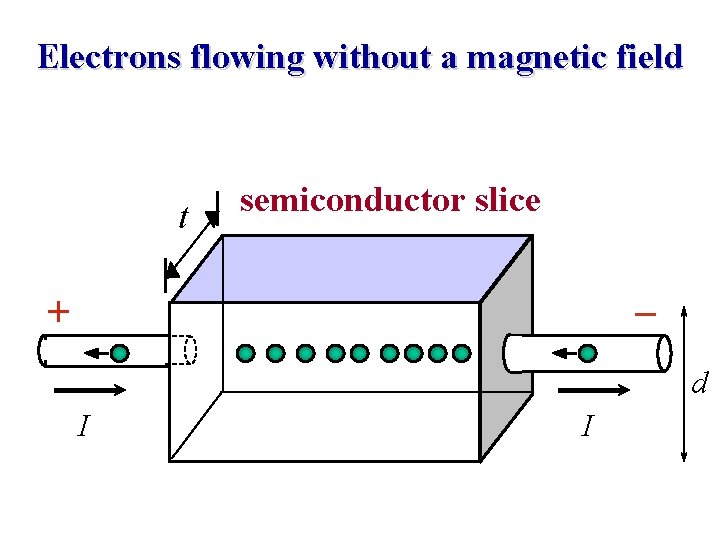
Electrons flowing without a magnetic field t semiconductor slice _ + d I I
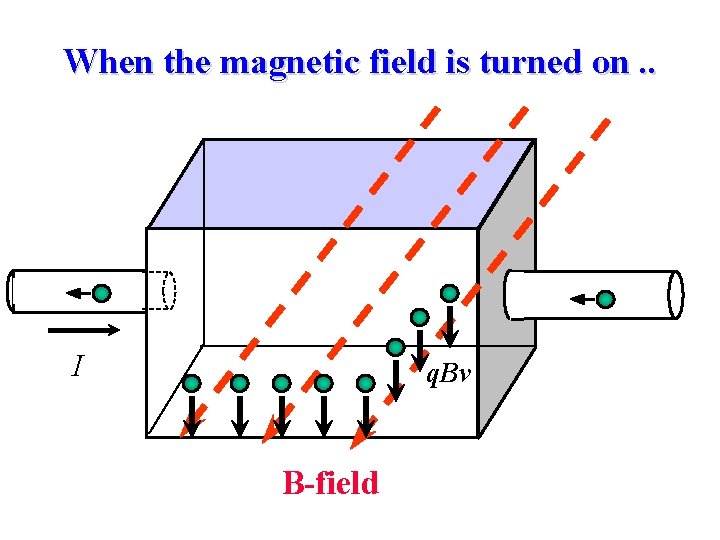
When the magnetic field is turned on. . I q. Bv B-field
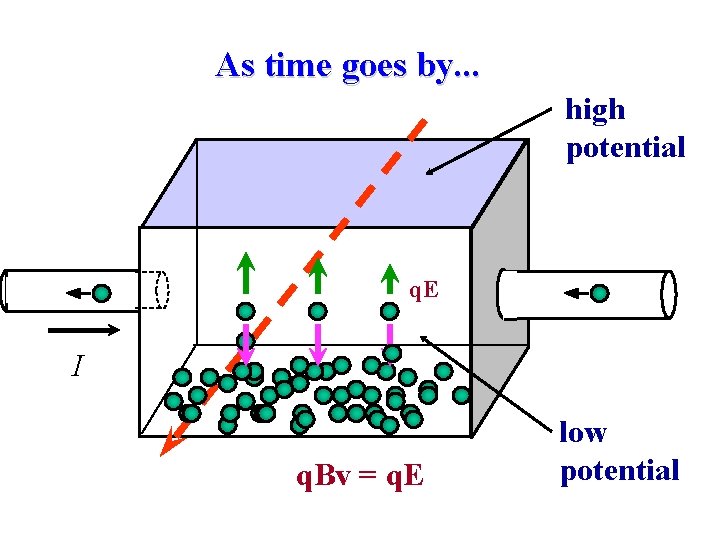
As time goes by. . . high potential q. E I q. Bv = q. E low potential
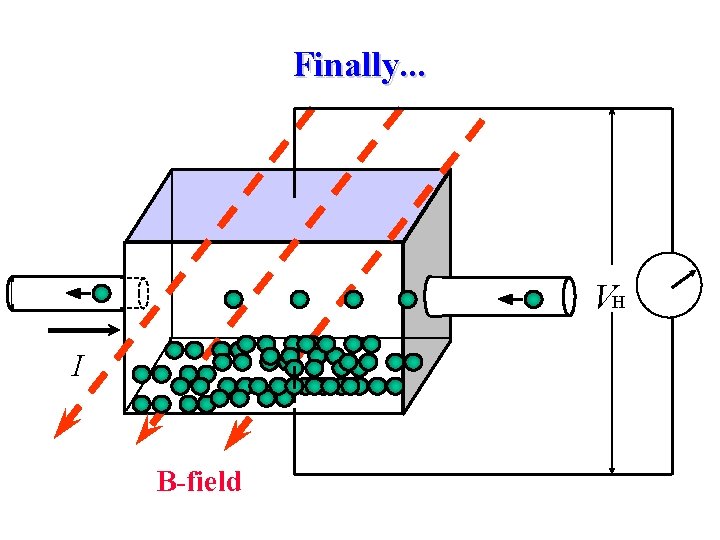
Finally. . . VH I B-field
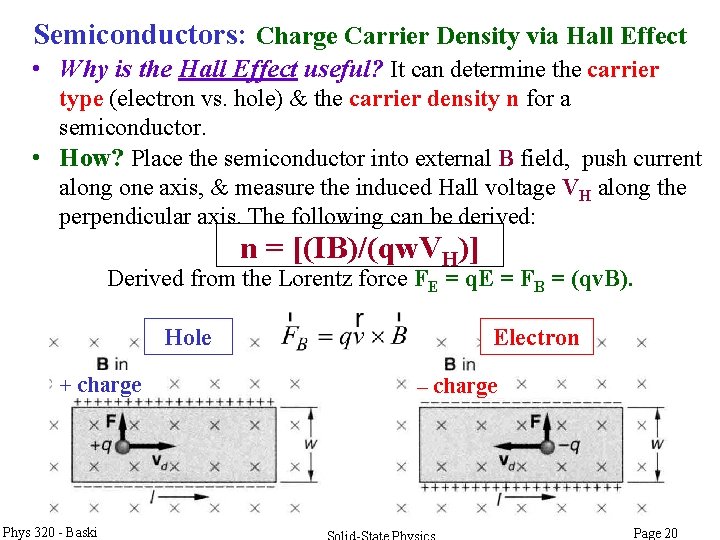
Semiconductors: Charge Carrier Density via Hall Effect • Why is the Hall Effect useful? It can determine the carrier type (electron vs. hole) & the carrier density n for a semiconductor. • How? Place the semiconductor into external B field, push current along one axis, & measure the induced Hall voltage VH along the perpendicular axis. The following can be derived: n = [(IB)/(qw. VH)] Derived from the Lorentz force FE = q. E = FB = (qv. B). Hole + charge Phys 320 - Baski Electron – charge Page 20
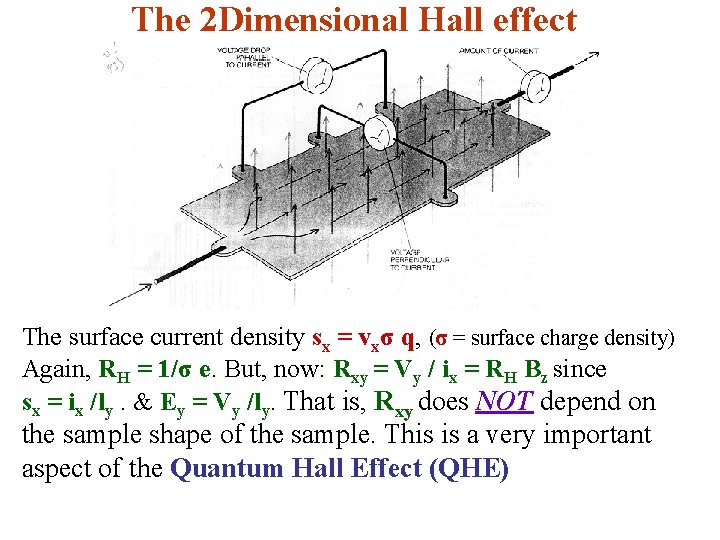
The 2 Dimensional Hall effect The surface current density sx = vxσ q, (σ = surface charge density) Again, RH = 1/σ e. But, now: Rxy = Vy / ix = RH Bz since sx = ix /ly. & Ey = Vy /ly. That is, Rxy does NOT depend on the sample shape of the sample. This is a very important aspect of the Quantum Hall Effect (QHE)
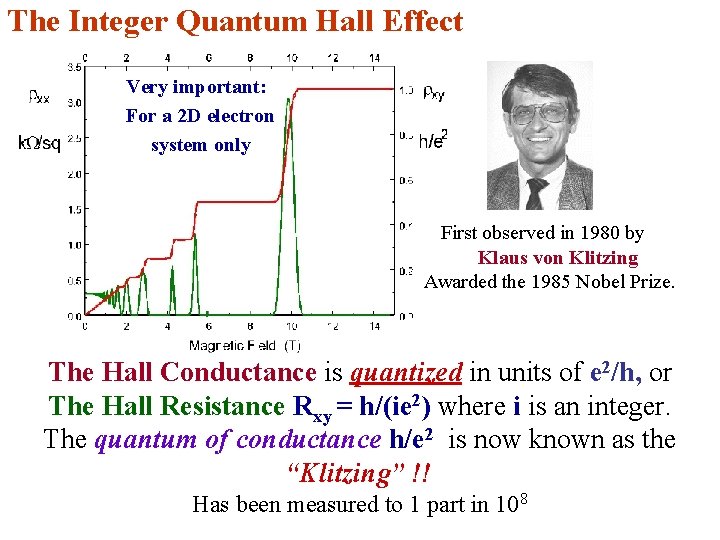
The Integer Quantum Hall Effect Very important: For a 2 D electron system only First observed in 1980 by Klaus von Klitzing Awarded the 1985 Nobel Prize. The Hall Conductance is quantized in units of e 2/h, or The Hall Resistance Rxy = h/(ie 2) where i is an integer. The quantum of conductance h/e 2 is now known as the “Klitzing” !! Has been measured to 1 part in 108
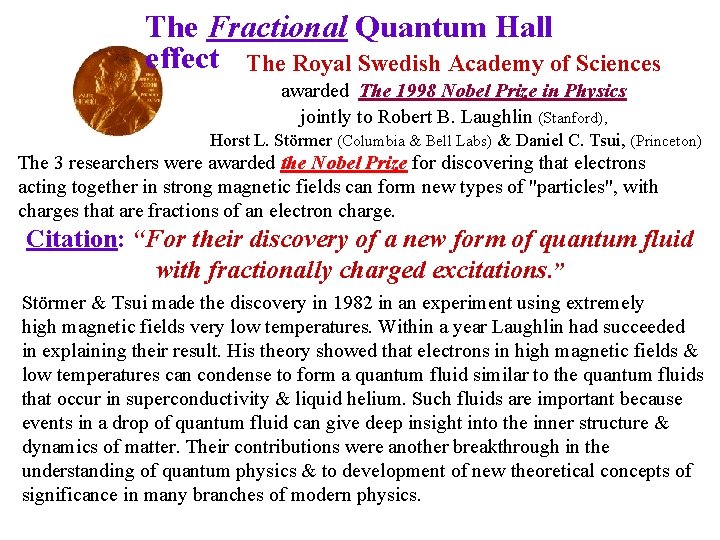
The Fractional Quantum Hall effect The Royal Swedish Academy of Sciences awarded The 1998 Nobel Prize in Physics jointly to Robert B. Laughlin (Stanford), Horst L. Störmer (Columbia & Bell Labs) & Daniel C. Tsui, (Princeton) The 3 researchers were awarded the Nobel Prize for discovering that electrons acting together in strong magnetic fields can form new types of "particles", with charges that are fractions of an electron charge. Citation: “For their discovery of a new form of quantum fluid with fractionally charged excitations. ” Störmer & Tsui made the discovery in 1982 in an experiment using extremely high magnetic fields very low temperatures. Within a year Laughlin had succeeded in explaining their result. His theory showed that electrons in high magnetic fields & low temperatures can condense to form a quantum fluid similar to the quantum fluids that occur in superconductivity & liquid helium. Such fluids are important because events in a drop of quantum fluid can give deep insight into the inner structure & dynamics of matter. Their contributions were another breakthrough in the understanding of quantum physics & to development of new theoretical concepts of significance in many branches of modern physics.