
The Civil War Philadelphia was the birthplace of
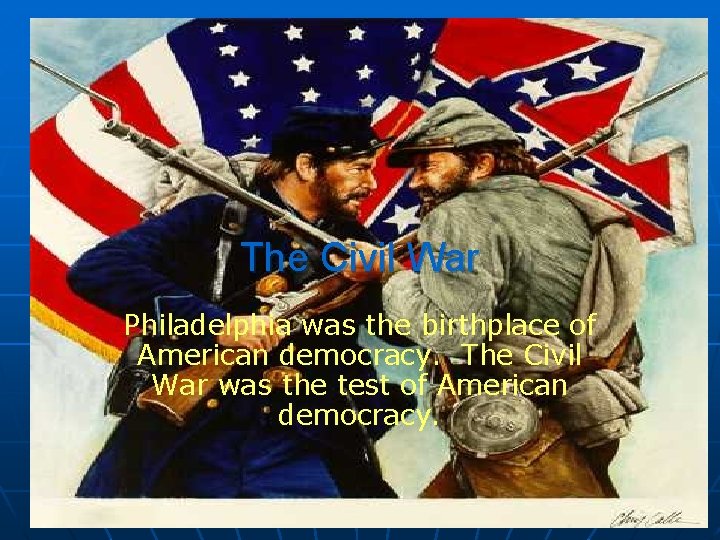
The Civil War Philadelphia was the birthplace of American democracy. The Civil War was the test of American democracy.
Fort Sumter n n n March 5, 1861 -President Lincoln received a note from Major Robert Anderson The fort has six weeks of supplies left South Carolina believed Army personnel are now foreigners President Lincoln refused to surrender fort President Lincoln ordered fort to be re-supplied Jefferson Davis wants to force Army personnel to surrender fort Major Anderson refused April 12, 1861 -Confederate troops open fire on fort April 15 -Major Anderson and his men leave Fort Lincoln-75, 000 volunteers Virginia, NC, Arkansas, and Tennessee secede
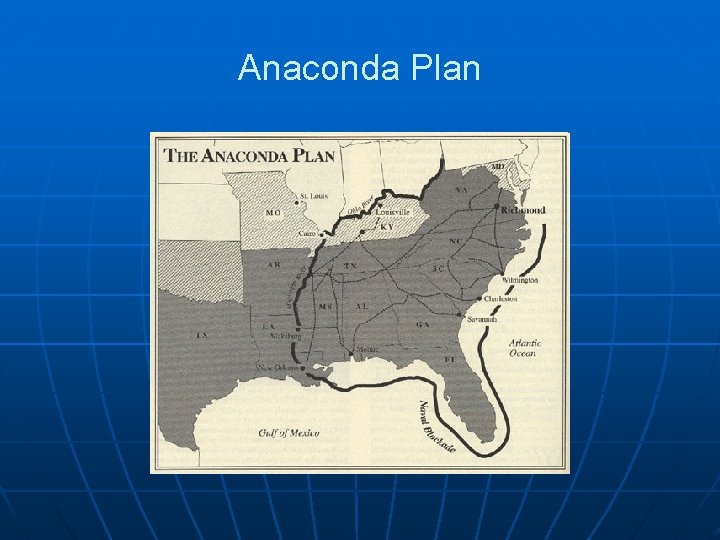
Anaconda Plan
n n n General Winfield Scott 3 part approach for Union to win U. S. Naval blockade of southern ports Divide Confederacy into two parts by controlling Mississippi River Have necessary amount of troops to fight war
Northern Strengths and Weaknesses n n Population-20 million vs. 9 million (including 3. 5 million slaves) Strong industrial base Larger and more efficient railroad system Weak generals at the start of war
Southern Strengths and Weaknesses n n n Geography-the war would be fought South of Mason-Dixon Line Excellent Generals- Robert E. Lee, Stonewall Jackson Knew the territory Fighting for survival Soldiers were farmers, hunters
Early Battles 1861 -1862 n n n After Fort Sumter, Lincoln calls up 75, 000 troops to deal with insurrection Short War Thesis First Bull Run-Manassas, VA (26 miles from Washington D. C. ) First major battle of the war Union army defeated War would not be short
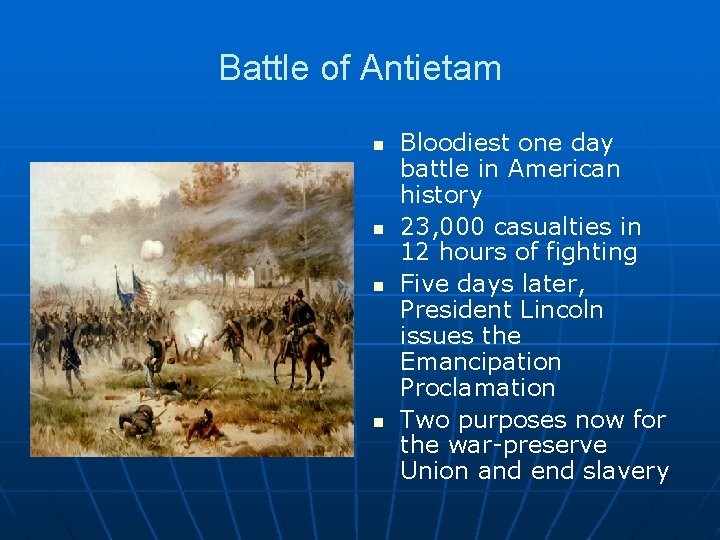
Battle of Antietam n n Bloodiest one day battle in American history 23, 000 casualties in 12 hours of fighting Five days later, President Lincoln issues the Emancipation Proclamation Two purposes now for the war-preserve Union and end slavery
Emancipation Proclamation “An instrument in God’s Hands” n n n Lincoln called it his most important act as president The EP freed slaves in states of rebelling(South), not in the border states EP demonstrates how Lincoln’s thoughts changed on the need to end slavery Emancipation of slaves was not an original goal of the Civil War - this gave the war another goal It had the practical effect that as soon as a slave escaped the control of the Confederate government, by running away or through advances of federal troops, the slave became legally free.
Gettysburg n n n July 1 -3, 1863 General Robert E. Lee brings war into Union territory for the first time A Confederate victory at Gettysburg might have led given the South access to needed supplies and better railroads 51, 000 casualties Major turning point in the war for Union
The Gettysburg Address “A Few Appropriate Remarks” n n n 272 words November 19, 1863 at the dedication of the National Cemetery President Lincoln was the second speaker that day Professor orator Edward Everett was the keynote speaker Speaks for two and a half hours President Lincoln-Two and a half minutes
Conscription n n n Conscription Act passed in March 1863 All men between the ages of 20 -45 Could hire substitutes Could be exempt from serving if you paid $300 “A rich man’s war but a poor man’s fight” Draft Riots Most serious was in New York City in July 1863 right after the Battle of Gettysburg
Union Victory n n n n 3 part approach for Union to win U. S. Naval blockade of southern ports Divide Confederacy into two parts by controlling Mississippi River Have needed troop levels Battle of Vicksburg (Spring 1863) achieved goal of controlling Mississippi River Grant- “Total War” or “Hard War” Sherman’s “March to the Sea” Total destruction from Tennessee to South Carolina
Surrender at Appomattox n n n April 2 - Grant captures Richmond April 4 - Lincoln walks through Richmond April 9 - Lee surrenders at Appomattox Court House April 11 -Lincoln gives his final speech April 14 - Lincoln shot by John Wilkes Booth April 15 - Lincoln dies of wounds suffered the night before
Lincoln’s Second Inaugural Address n n Grant and Sherman’s success greatly improved Lincoln’s chances of re-election in 1864 Lincoln easily defeats General George Mc. Clellan Delivers his second inaugural address on March 4, 1865 Lincoln • Before we can move forward, we must understand what the last four years have been about • Must heal as a nation • Both sides must accept responsibility for the war
With malice toward none, with charity for all, with firmness in the right as God gives us to see the right, let us strive on to finish the work we are in, to bind up the nation's wounds, to care for him who shall have borne the battle and for his widow and his orphan, to do all which may achieve and cherish a just and lasting peace among ourselves and with all nations.
- Slides: 16