
The Civil War Civil War Time Line 1860
- Slides: 46
The Civil War
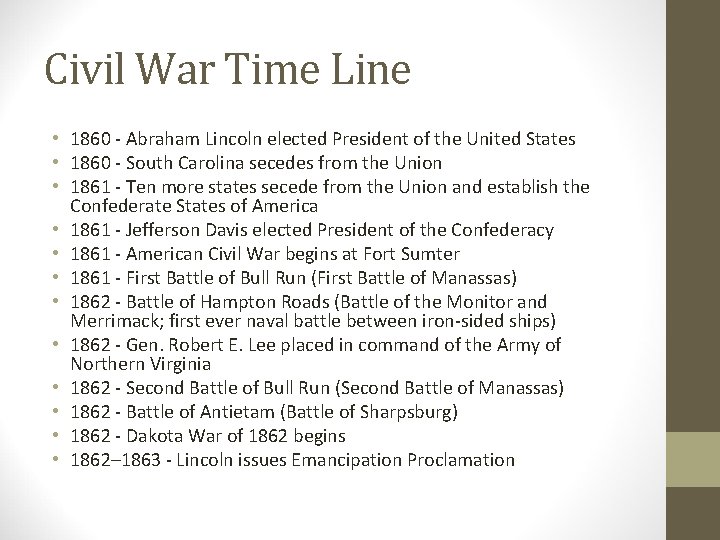
Civil War Time Line • 1860 - Abraham Lincoln elected President of the United States • 1860 - South Carolina secedes from the Union • 1861 - Ten more states secede from the Union and establish the Confederate States of America • 1861 - Jefferson Davis elected President of the Confederacy • 1861 - American Civil War begins at Fort Sumter • 1861 - First Battle of Bull Run (First Battle of Manassas) • 1862 - Battle of Hampton Roads (Battle of the Monitor and Merrimack; first ever naval battle between iron-sided ships) • 1862 - Gen. Robert E. Lee placed in command of the Army of Northern Virginia • 1862 - Second Battle of Bull Run (Second Battle of Manassas) • 1862 - Battle of Antietam (Battle of Sharpsburg) • 1862 - Dakota War of 1862 begins • 1862– 1863 - Lincoln issues Emancipation Proclamation
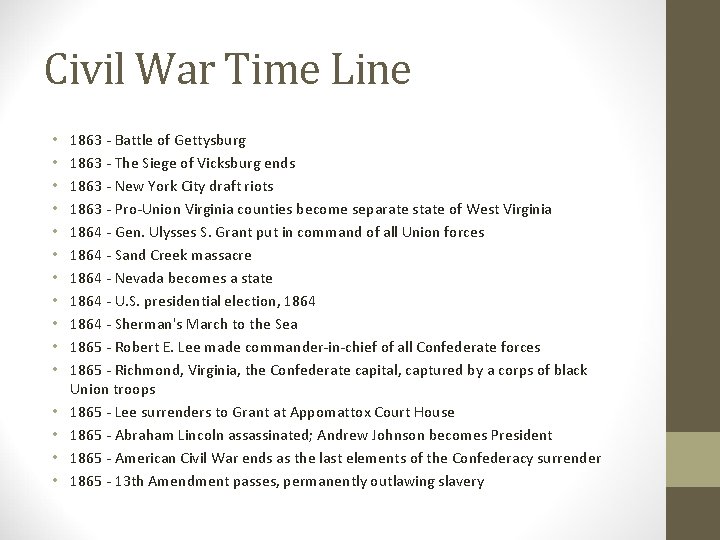
Civil War Time Line • • • • 1863 - Battle of Gettysburg 1863 - The Siege of Vicksburg ends 1863 - New York City draft riots 1863 - Pro-Union Virginia counties become separate state of West Virginia 1864 - Gen. Ulysses S. Grant put in command of all Union forces 1864 - Sand Creek massacre 1864 - Nevada becomes a state 1864 - U. S. presidential election, 1864 - Sherman's March to the Sea 1865 - Robert E. Lee made commander-in-chief of all Confederate forces 1865 - Richmond, Virginia, the Confederate capital, captured by a corps of black Union troops 1865 - Lee surrenders to Grant at Appomattox Court House 1865 - Abraham Lincoln assassinated; Andrew Johnson becomes President 1865 - American Civil War ends as the last elements of the Confederacy surrender 1865 - 13 th Amendment passes, permanently outlawing slavery
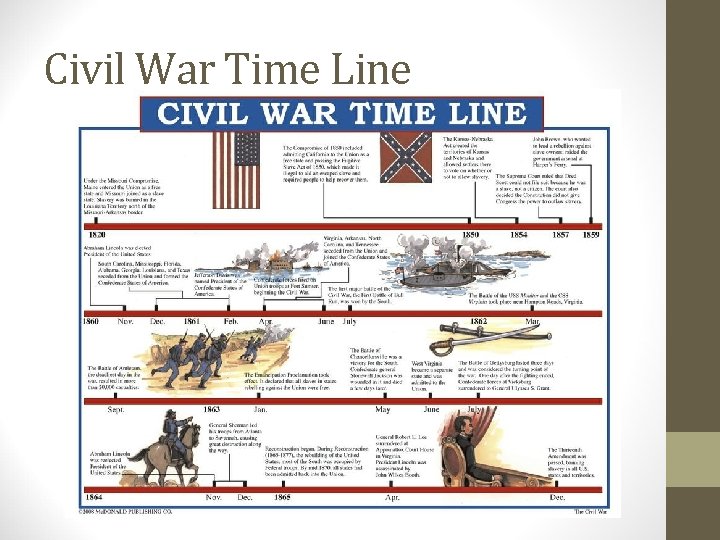
Civil War Time Line
1860 February 27, 1860: Abraham Lincoln, a lawyer from Springfield, Illinois, gave a speech at Cooper Union in New York City. Lincoln delivered a forceful and well-reasoned argument against the spread of slavery, and became an overnight star and a leading candidate for the upcoming presidential election. November 6, 1860: Abraham Lincoln was elected president of the United States. December 20, 1860: In response to Lincoln's election, the state of South Carolina issued an "Ordinance of Secession" and declared it is leaving the Union. Other states would follow.
1861 • April 12, 1861: In the harbor at Charleston, South Carolina, Fort Sumter was attacked by Confederate guns. • Summer and Fall, 1861: Thaddeus Lowe began the U. S. Army Balloon Corps, in which "aeronauts" ascended in balloons to view enemy troops.
1862 • September 17, 1862: The Battle of Antietam was fought in western Maryland. It becomes known as the "America's Bloodiest Day. " • October, 1862: Photographs taken by Alexander Gardner were put on public display at Mathew Brady's gallery in New York City. The public was shocked by the carnage depicted in the photographic prints.
1863 July 1 -3, 1863: The epic Battle of Gettysburg was fought in Pennsylvania. October 3, 1863: President Abraham Lincoln issued a proclamation declaring a Day of Thanksgiving to he observed on the last Thursday in November 19, 1863: President Abraham Lincoln delivered the Gettysburg Address while dedicating a military cemetery at the site of the Battle of Gettysburg.
1864 • May 13, 1864: The first burial took place at Arlington National Cemetery. • November 8, 1864: Abraham Lincoln won a second term as president, defeating General George Mc. Clellan in the election of 1864.
1865 January 16, 1865: General William Tecumseh Sherman issued Special Field Orders, No. 15, which was interpreted as a promise to provide "forty acres and a mule" to each family of freed slaves. January 31, 1865: The Thirteenth Amendment, which abolished slavery in America, was passed by the United States Congress. March 4, 1865: Abraham Lincoln was inaugurated for his second term as president of the United States. Lincoln's second inaugural address is remembered as one of his most notable speeches. April 14, 1865: President Abraham Lincoln was shot at Ford's Theatre and died the next morning.
That was the Overview, • Let’s get down to specifics…
When did the tide turn in the Civil War? • the Battle of Gettysburg in Pennsylvania. • the Battle of Vicksburg in Mississippi.
When did the tide turn in the Civil War? • When the Civil War began in April 1861, most people thought it would be over in a few months. President Abraham Lincoln called for volunteers for 90 days of service, in the hopes that a majority of white Southerners were still loyal to the federal government and would come to their senses against the leaders of the Southern states that had seceded from the U. S. Instead, Lincoln's call for volunteers caused more states to secede.
When did the tide turn in the Civil War? • The North did poorly during the first two years of the war in the Eastern theater, which was primarily fought in Virginia. The Confederate Army won several overwhelming victories, including the battles of Second Bull Run, Fredericksburg and Chancellorsville. (See the videos we watched. ) • Expectations of a quick Union victory were dashed.
When did the tide turn in the Civil War? • The main exception was the Battle of Antietam in Maryland in September 1862, when Northern forces won a bloody victory over the South's push into the North. • But the advantage was lost when the Union's top commander, Gen. George Mc. Clellan, decided against pursuing and destroying Confederate forces, as Lincoln urged. • Remember he sat there and the confederates were amazed that he didn’t attack?
When did the tide turn in the Civil War? • Generals like Mc. Clellan--a supporter of the Democrats, which was the party of slavery in the South and pro-slavery sentiment in the North-were against the abolition of slavery and preferred a moderate approach to the war. • They wanted to preserve the U. S. as it was before the South seceded, with slavery kept intact--and they pursued a war strategy that was consistent with this aim.
When did the tide turn in the Civil War? • Never again would the Confederacy manage a major offensive that posed the possibility of winning the war. • Instead of its incursions into the North to destroy Union morale and gain recognition from the great powers of the time, Britain and France, from this point on, the South was only able to stop the blows coming at it on many fronts.
When did the tide turn in the Civil War? • The Southern ruling class relied on its Black slaves to provide the necessary labor power to keep the economy and war effort going while a large proportion of Southern white men fought. • Black slaves did the backbreaking work of building fortifications for the Southern armies-armies that fought to keep slavery intact. • Without slaves doing the essential work of the southern economy, the Confederacy would crumble.
When did the tide turn in the Civil War? • Lincoln, meanwhile, was facing pressure from below--from Black and white abolitionists in the North, from radicals in his own party who wanted the war to end slavery, and above all from the growing force of Southern slaves who escaped to the lines of the Union Army, wherever they are, recognizing this as a means of emancipation.
When did the tide turn in the Civil War? • Frederick Douglass, the famed Black abolitionist, took the leading in urging Lincoln and Northern leaders to allow Black soldiers to fight in the Union Army--to win their own freedom and to destroy the slave South.
When did the tide turn in the Civil War? • Douglass' newspaper editorial "Fighting Rebels with Only One Hand" hit the crux of the North's strategic problem in the war: • Why does the Government reject the negro? Is he not a man? Can he not wield a sword, fire a gun, march and countermarch, and obey orders like any other? . . . We would tell him [Lincoln] that this is not time to fight with one hand, when both are needed; that this is no time to fight with your white hand, and allow your Black hand to remain tied.
When did the tide turn in the Civil War? • Lincoln was convinced, and Black soldiers entered the fight in 1863. Some 50, 000 Black men had enlisted by August, and 180, 000 would join by the war's end. • From this point on, the war would pit the allwhite armies of the South against a Union force with both white and Black regiments.
When did the tide turn in the Civil War? • Also in 1863, the Emancipation Proclamation, unveiled after the Union victory at Antietam, declared that all slaves in the Southern states still in rebellion would be "forever free" as of January 1, 1863.
When did the tide turn in the Civil War? • Tell me, what was special about the Emancipation Proclamation? • Some people think it meant ALL the slaves were freed. • Were they?
When did the tide turn in the Civil War? • The Emancipation Proclamation was a calculated half-measure--it left slavery intact in the border states like Kentucky and Missouri that hadn't seceded. But Lincoln--along with abolitionists like Douglass--recognized the document would transform the Civil War from an attempt to keep the union intact into a war to destroy slavery. • From January 1, 1863 on, Blacks would win their freedom wherever the Union Army advanced in the Confederate states.
When did the tide turn in the Civil War? • B UT! • Confederate administration of President Jefferson Davis was convinced by its top general, Robert E. Lee, a slave owner himself, to go on a dramatic offensive on Northern soil.
When did the tide turn in the Civil War? • The strategy was to draw the Army of the Potomac--the main Northern force in the Eastern theater--into a battle that would end in a stunning victory for the South. • This would completely demoralize the North, Lee believed, and allow Britain and France to finally recognize the Confederacy as the sole legitimate government of the South. • The Civil War would end with two governments in power.
When did the tide turn in the Civil War? • As Lee's Army of Northern Virginia pushed into Maryland Pennsylvania, it enslaved the free Black residents that it encountered--the opposite role that the Union Army would play when it moved South as an army of liberation.
Gettysburg • The two armies met at a crossroads--the small Pennsylvania town of Gettysburg. • Neither army had planned for a battle to begin there, but it did anyway, starting on July 1 -becoming the most deadly of the Civil War, as both sides fed more and more forces into the fight.
Gettysburg • The battle began badly for the Union, and a Southern victory was actually in Lee's grasp in the first day. • Union soldiers fought on, knowing that this battle had to be won in order to stop the South's advance.
Gettysburg • The Army of the Potomac had a new commander, Gen. George Meade. • Though not a brilliant strategist, he was able to provide a competent leadership during the battle, which put him head and shoulders above Mc. Clellan. • The real heroes of the battle, however, were the rank-and-file soldiers of the Army of the Potomac. • They suffered appalling losses, 23, 000 in all, but they inflicted 28, 000 on Lee's army.
Gettysburg • The Union side repelled one last head-on assault by Confederate soldiers on July 3, and the Army of Northern Virginia retreated. • Once again, Meade didn't pursue and destroy the Army of Northern Virginia as Lincoln urged.
AFTER Gettysburg (1863) • Within the North, there were supporters of the Confederacy, known as the Copperheads, with their base in southern Illinois, Indiana and Ohio. • Not long after Gettysburg, Confederate Gen. John Hunt Morgan rode with nearly 2, 000 cavalry forces onto the north side of the Ohio River, through Indiana and Ohio, in the hopes of stirring a Copperhead uprising.
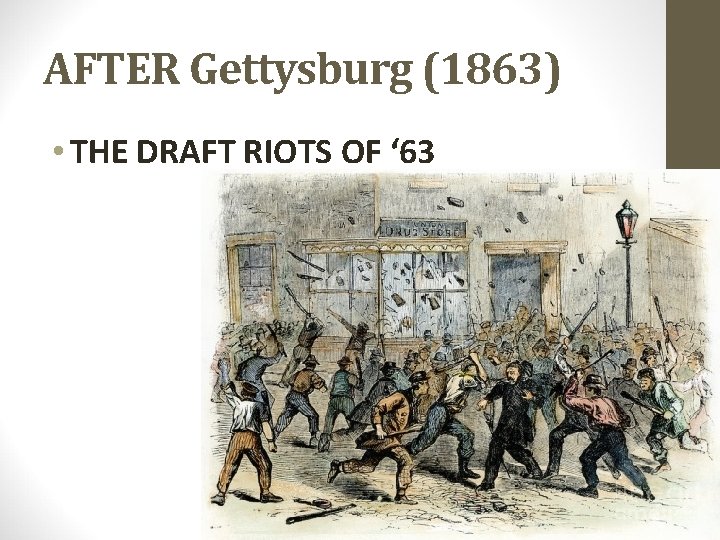
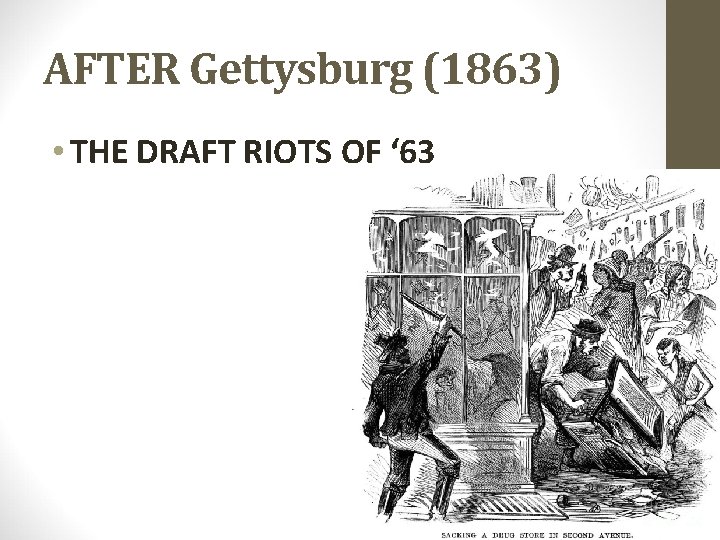
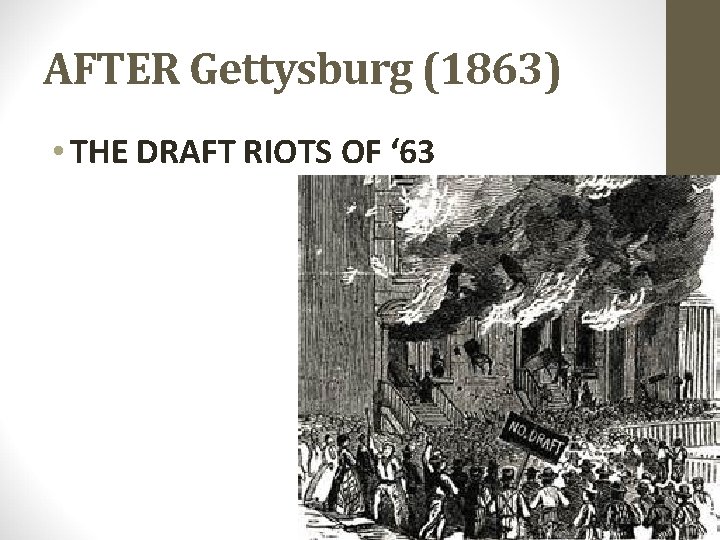
AFTER Gettysburg (1863) • No such uprising took place. But during this incursion into the North, New York City was gripped by the draft riots on July 13 -16.
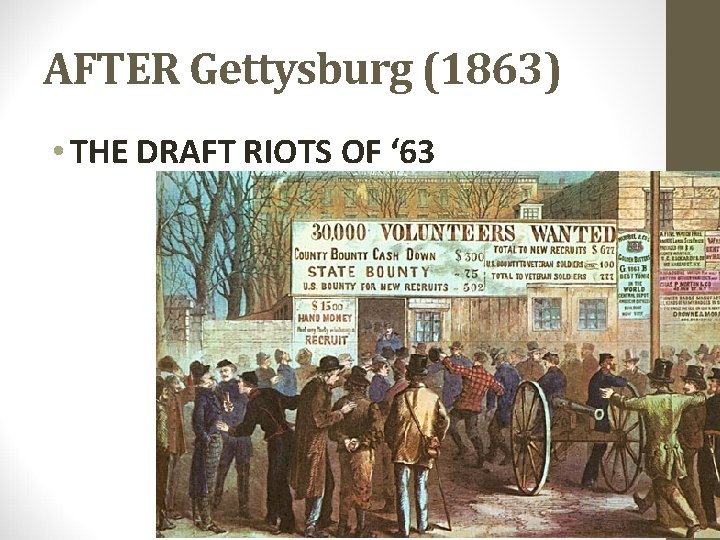
AFTER Gettysburg (1863) • THE DRAFT RIOTS OF ‘ 63 • Less than 10 percent of Union soldiers were drafted into the war--92 percent volunteered. Many of the soldiers who joined up earlier in the war were politically motivated. • But the impact of the draft was on the poorer white population of the North. • Poor immigrants, mainly Irish, protested the draft system, which allowed richer men to pay for a substitute.
AFTER Gettysburg (1863) • THE DRAFT RIOTS OF ‘ 63 • To the city’s poorer citizens, the war increasingly came to be seen as benefitting only the rich, as the coffers of the city’s elites filled with the financial spoils of battle and the conflict became known as a “rich man’s war, poor man’s battle. ” • (Remember that from the video? )
AFTER Gettysburg (1863) • THE DRAFT RIOTS OF ‘ 63 • The passage of the nation’s first military draft act, in March 1863, only worsened the situation. • Not only did it allow men (presumably only the wealthy) to buy their way out of military service by paying a commutation fee of $300 (more than $5, 500 in today’s money), it also exempted blacks from the draft, as they were not yet considered American citizens. • Why would this be upsetting?
AFTER Gettysburg (1863) • THE DRAFT RIOTS OF ’ 63 • The July 1863 draft riots were the largest civilian insurrection in American history. • On July 13, 1863, as the second day of a new military draft lottery in New York City got underway, demonstrations broke out across the city in what began as an organized opposition to the first federally mandated conscription laws in the nation’s history, but soon morphed into a violent uprising against the city’s wealthy elite; its African-American residents; and the very idea of the Civil War itself.
AFTER Gettysburg (1863) • THE DRAFT RIOTS OF ‘ 63
AFTER Gettysburg (1863) • THE DRAFT RIOTS OF ‘ 63
AFTER Gettysburg (1863) • THE DRAFT RIOTS OF ‘ 63
AFTER Gettysburg (1863) • THE DRAFT RIOTS OF ‘ 63
AFTER Gettysburg (1863) • THE DRAFT RIOTS OF ’ 63 • A few days later, on July 18, in South Carolina, the 54 th Massachusetts, an all-Black regiment with white officers, fought heroically in a Union attempt to overrun the defenders of Fort Wagner, an important coastal Confederate fortification. • Their story is told in the movie Glory. • The courage and determination of the Massachusetts 54 th's assault demonstrated to the populations of North and South alike that Black soldiers would fight as well or better than white soldiers.
AFTER Gettysburg (1863) • THE DRAFT RIOTS OF ’ 63 • A few days later, on July 18, in South Carolina, the 54 th Massachusetts, an all-Black regiment with white officers, fought heroically in a Union attempt to overrun the defenders of Fort Wagner, an important coastal Confederate fortification. • Their story is told in the movie Glory. • The courage and determination of the Massachusetts 54 th's assault demonstrated to the populations of North and South alike that Black soldiers would fight as well or better than white soldiers.
Vicksburg(1863) • Next Time
Vicksburg(1863) • From the spring of 1862 until July 1863, during the American Civil War (1861 -65), Union forces waged a campaign to take the Confederate stronghold of Vicksburg, Mississippi, which lay on the east bank of the Mississippi River, halfway between Memphis to the north and New Orleans to the south. • The capture of Vicksburg divided the Confederacy and proved the military genius of Union General Ulysses S. Grant (1822 -85).