
The Civil War Bells Legal Tender Act created
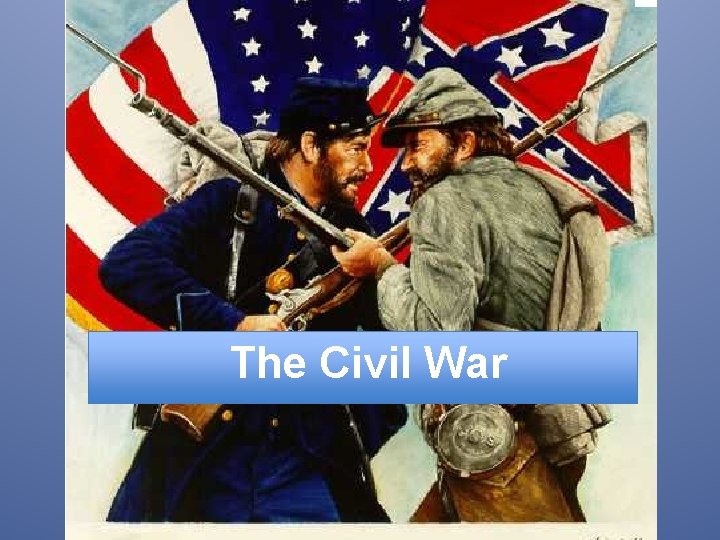
The Civil War
• • • Bells Legal Tender Act created a national currency and issued paper money also known as – green- backs Commander that defeats Union forces at The First Battle of Bull Run. – Thomas J. “Stonewall” Jackson Sherman cuts a path of destruction through Georgia, at times 60 miles wide, known as – Sherman’s March to the Sea Where does Lee surrender to Grant in April 1865? – Appomattox Courthouse What raid is a turning point for the South? – • • • What Party do the Whigs form? – Constitutional Union Party What does the South view secession as similar to ? – the American Revolution- fighting for individual rights What is the government’s initial response to secession – Could not forcibly preserve the Union- conciliatory What was the first state to leave the Union? – South Carolina What did the Southern states that seceded call them selves? – Confederate States of America Lincoln suspended this for anyone who openly supported the rebels or encouraged others to resist the draft. • • John Brown’s raid on Harpers Ferry the writ of habeas corpus By the end of the war, the South had experienced what percent inflation? • 9, 000% 2
Notes The Civil War • John Brown’s raid on Harpers Ferry – turning point for the South – terrified by the idea that Northerners would arm enslaved people and encourage them to rebel. – blamed Republicans for the attack – (Link 1) – (Link 2)
Notes • The Election of 1860 – The Democrats Split • Southern Democrats –uphold the Dred Scott decision –defend slaveholders’ rights in the territories. • Northern Democrats –supported popular sovereignty. – Democrats end up with two candidates
Notes • On the Republican side – Former Whigs fear Southern secession. (Whig party was established in the face of Andrew Jackson and the Democrats) • Form new party - Constitutional Union Party • chose candidate John Bell – The party took no position on issues dividing North and South
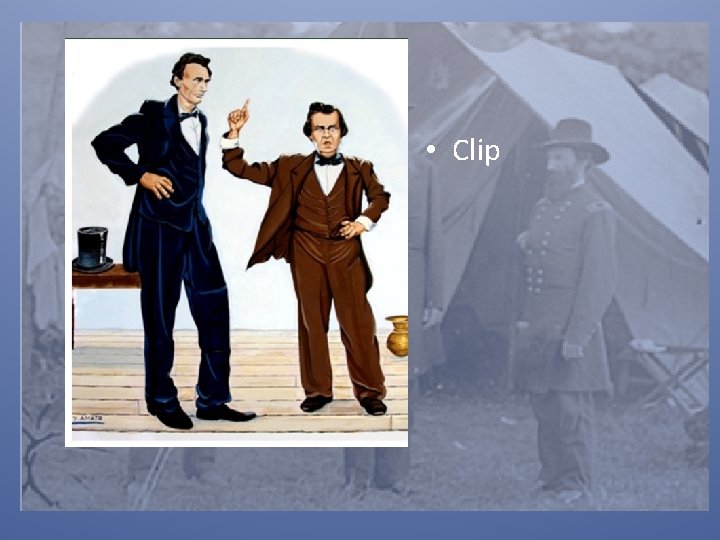
Notes • Republicans – no chance in the South – Needed candidate who could sweep the North – The most prominent Republican at the time was Senator William Seward from New York, but many Republicans did not think Seward had a wide enough appeal. Instead, – Nominated Abraham Lincoln- he had gained a national reputation during the Lincoln - Douglas debates
• Clip
Notes • Lincoln – Not an abolitionist – Did believe that slavery was morally wrong – Opposed spread into the western territories. • Democrats divided – Lincoln won the election of 1860 by winning the electoral votes of all the free states (except New Jersey -split with Douglas. )
Notes • Secession Begins – Southerners see the election of Lincoln as a threat to their way of life. – They saw no choice but to secede. – The dissolution of the Union began with South Carolina. • Shortly after Lincoln’s election, the state legislature called for a convention. On December 20, 1860, amid marching bands, fireworks, and militia drills, the convention voted unanimously to repeal the state’s ratification of the Constitution and dissolve its ties to the Union.
Notes • By February 1861 • six more states in the Lower South— Mississippi, Florida, Alabama, Georgia, Louisiana, and Texas—had voted to secede. • viewed secession as similar to the American Revolution—a necessary course of action to uphold people’s rights.
Notes • Compromise Fails – Lincoln was not inaugurated until March 1861. – Initial response to secession – by President Buchanan. • government had no authority to forcibly preserve the Union • Conciliatory – “intended or likely to placate or pacify”
Notes • Crittenden’s Compromise – Senator Crittenden of Kentucky • amendments to the Constitution. • guarantee slavery where it already existed • reinstate the Missouri Compromise line • extend it all the way to the California border • Slavery would be prohibited in all territories north -protected in those south of the line. • Lincoln asks Republicans to vote against it • “acknowledges that slavery has equal rights with liberty, and surrenders all we have contended for. ”
Notes • The Confederacy – Founded February 8, 1861 – delegates from the seceding states met in Montgomery, Alabama – declared themselves to be a new nation – the Confederate States of America. – drafted a constitution - similar to U. S. ’s – major changes • independence of each state • guaranteed slavery in Confederate territory, • banned tariffs • limited president to a single six-year term.
Notes • The Confederacy (Cont. ) – Jefferson Davis –president – declares, “The time for compromise has now passed. ” – called on the remaining Southern states to join the Confederacy
Notes • The Civil War Begins – inaugural address on March 4, 1861 – Lincoln promises not to interfere with slavery where it existed – “the Union of these States is perpetual” – Lincoln encouraged reconciliation – “If I could save the Union without freeing any slave, I would do it, and if I could save it by freeing all the slaves, I would do it, and if I could save it by freeing some and leaving others alone, I would also do that. What I do about Slavery and the colored race, I do because I believe it helps to save this Union”
Notes • Fort Sumter Falls -April – Lincoln -resupply Fort Sumter in Charleston (In newly succeeded Territory) Harbor one of the few federal military bases that Southerners had not already seized. – Jefferson Davis –problem • tolerate U. S. troops in the South’s most vital Atlantic harbor –or • fire on the supply ship -provoking war • decides to demand the surrender of Fort Sumter before the supply ship arrived
Notes – fort’s commander -U. S. Army Major Robert Anderson -refused. – Confederate forces bombarded Fort Sumter for 33 hours on April 12 and 13, – The exhausted men give up – After the fall, Lincoln calls for 75, 000 volunteers to serve for 90 days – The idea of taking up arms against fellow southerners causes four more states to leave the Union
Notes • The Border States – To prevent Maryland’s secession, Lincoln imposed martial law—military rule—in Baltimore, where angry mobs had already attacked federal troops – suspended the right of habeas corpus • which protects citizens from illegal imprisonment without evidence. • Chief Justice Robert Taney ruled against the suspension, but Lincoln ignored this in the face of impending war.
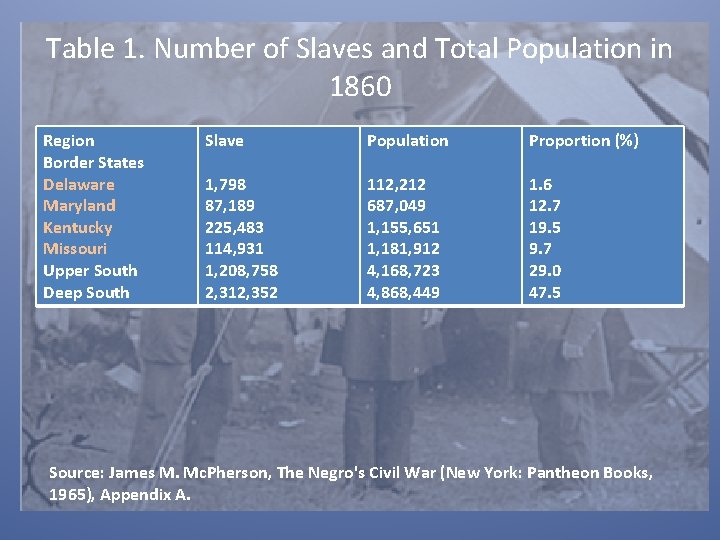
Table 1. Number of Slaves and Total Population in 1860 Region Border States Delaware Maryland Kentucky Missouri Upper South Deep South Slave Population Proportion (%) 1, 798 87, 189 225, 483 114, 931 1, 208, 758 2, 312, 352 112, 212 687, 049 1, 155, 651 1, 181, 912 4, 168, 723 4, 868, 449 1. 6 12. 7 19. 5 9. 7 29. 0 47. 5 Source: James M. Mc. Pherson, The Negro's Civil War (New York: Pantheon Books, 1965), Appendix A.
Notes • Kentucky initially declared neutrality in the conflict, but when Confederate troops occupied part of Kentucky, the state declared war on the Confederacy, and Lincoln sent troops to help. In Missouri, despite strong public support for the Confederacy, the state convention voted to stay in the Union. Federal troops then ended fights between the pro-Union government and secessionists.
Notes • On the same day that he learned his home state of Virginia had voted to secede from the Union, Robert E. Lee—one of the best senior officers in the United States Army— received an offer from General Winfield Scott to command Union troops. Although Lee had spoken against secession and considered slavery “a moral and political evil, ” he refused to fight against the South. Instead, he offered his services to the Confederacy.
Notes • Dynamics of the War • seven of the nation’s eight military colleges were in the South. – provided the region with a large number of trained soldiers • the North had a strong navy – More than three-quarters of the Navy’s officers came from the North – merchant ships were almost entirely in the North
Notes • The Opposing Economies – North -economic advantages. • 1860 -North population -about 22 million • South about 9 million (non slave) – The North’s larger population gave it a great advantage in raising an army and in supporting the war effort.
Notes – North’s industries -important economic advantage over the South. • Had 90% of the factories • Able to provide ammunition and other supplies – South had half as many miles of railroad track -only one line—from Memphis to Chattanooga—connecting the western states of the Confederacy to the east. • easier for Northern troops to -prevent the movement of supplies and troops.
Notes – Union controlled the national treasury • continued revenue from tariffs. – Legal Tender Act -creating a national currency - issue paper money. • came to be known as green- backs, because of its color. • U. S. Congress passes the Legal Tender Act, authorizing the use of paper notes to pay the government's bills. This ended the long-standing policy of using only gold or silver in transactions, and it allowed the government to finance the enormously costly Civil War long after its gold and silver reserves were depleted
Notes – Confederacy’s financial situation was poor –got worse over time. • Southern banks -small -few cash reserves –could not buy many bonds • The Confederacy had to resort to direct taxation of its people –Many refused to pay
Notes • Confederacy -prints paper money to pay its bills – caused rapid inflation – became almost worthless – By the end of the war, the South had experienced 9, 000 percent inflation – only 80 percent in the North.
Notes • Lincoln suspended the writ of habeas corpus for anyone who openly supported the rebels or encouraged others to resist the draft. • “Must I shoot a simple-minded soldier boy who deserts, ” the president asked, “while I must not touch a hair of a wily agitator who induces him to desert?
Notes • Jefferson Davis -political problems. – The Confederate constitution protected states’ rights and limited government’s power. – Hurt ability to conduct the war. – he supported conscription – established martial law early in 1862. – suspension of writs of habeas corpus
Notes • The First Modern War – involved huge armies-mostly civilian volunteers – required vast amounts of supplies. – Military Technology • inexpensive conoidal—or cone- shaped— bullet -accurate at greater distances. • trenches and barricades • resulted in much higher casualties
Notes • War of Attrition—the wearing down of one side by the other through exhaustion of soldiers and resources—played a critical role as the war dragged on. • The South’s Strategy – Davis- By waging a defensive war of attrition -believed they could force the Union to spend its resources until it agreed to negotiate.
Notes • The Union’s Anaconda Plan after a snake that slowly strangles its prey to death. – blockade Confederate ports and send gunboats down the Mississippi River to divide the Confederacy in two. – The South-would gradually run out of resources and surrender.
Notes Fighting the Civil War • The First Battle of Bull Run (aka Manassas) • Thomas J. “Stonewall” Jackson –defeats Union forces. • Message- North would need a large, welltrained army • The day after Bull Run – Lincoln asks- enlistment of 500, 000 men for three years. – Eventually both the Union and the Confederacy instituted the draft
Notes The Naval War • Union -blockade - increasingly effective • blockade runners—small, fast vessels the South used to smuggle • South could ship at least some of its cotton to Europe in exchange for shoes, rifles, and other supplies. • Union navy seizes New Orleans—the South’s largest city -center of the cotton trade.
Notes • The War in the West – Union general Ulysses S. Grant – Union victory- Battle of Shiloh – 20, 000 troops killed or wounded • When newspapers demanded Grant be fired because of the high casualties, Lincoln refused, saying, “I can’t spare this man; he fights. ”
Notes • The War in the East – Confederate General Robert E. Lee – second battle of Bull Run – forced the North to retreat – 20 miles from Washington, D. C. – Lee – Mc. Clellan - meet at Antietam an·TEE·tuhm – bloodiest one-day battle in American history – 6, 000 killed -16, 000 wounded – Lee retreats – crucial - British decides to stay out of war and not recognize the Confederacy – convinced Lincoln –time to end slavery in the South
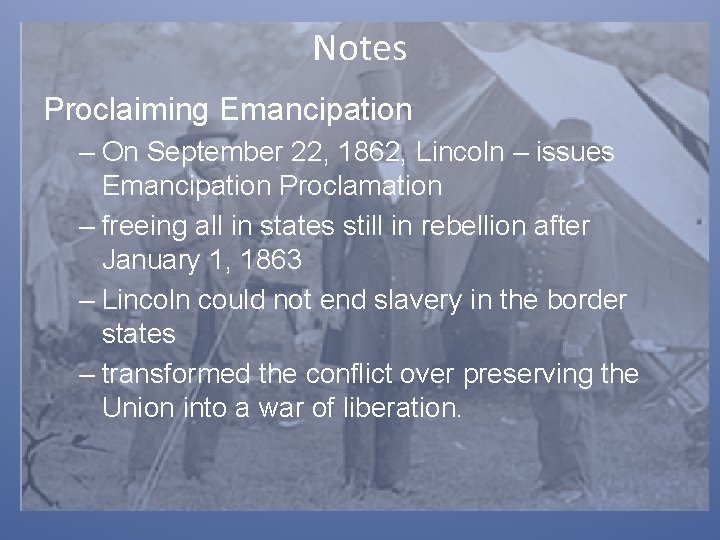
Notes Proclaiming Emancipation – On September 22, 1862, Lincoln – issues Emancipation Proclamation – freeing all in states still in rebellion after January 1, 1863 – Lincoln could not end slavery in the border states – transformed the conflict over preserving the Union into a war of liberation.
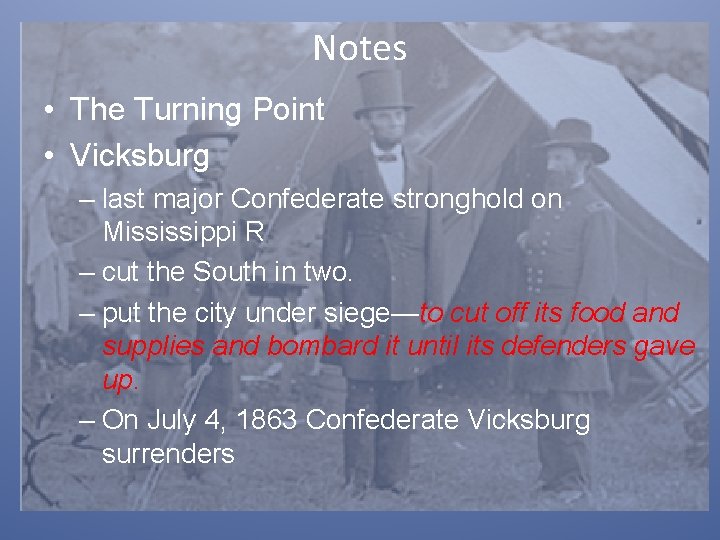
Notes • The Turning Point • Vicksburg – last major Confederate stronghold on Mississippi R – cut the South in two. – put the city under siege—to cut off its food and supplies and bombard it until its defenders gave up. – On July 4, 1863 Confederate Vicksburg surrenders
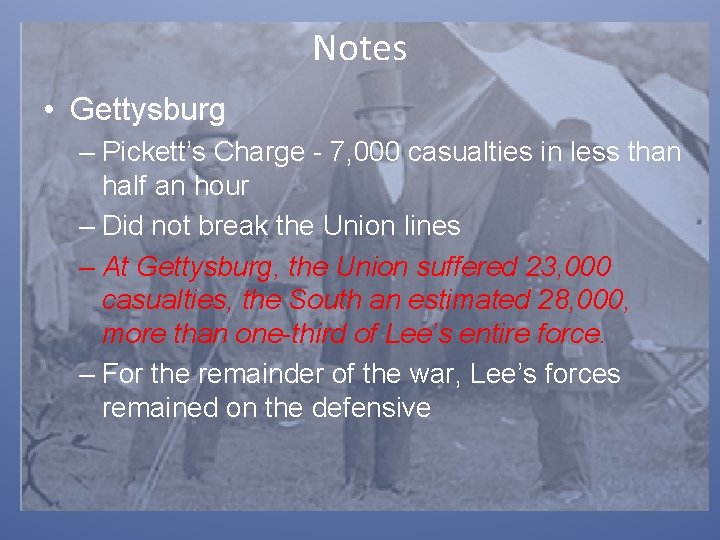
Notes • Gettysburg – Pickett’s Charge - 7, 000 casualties in less than half an hour – Did not break the Union lines – At Gettysburg, the Union suffered 23, 000 casualties, the South an estimated 28, 000, more than one-third of Lee’s entire force. – For the remainder of the war, Lee’s forces remained on the defensive
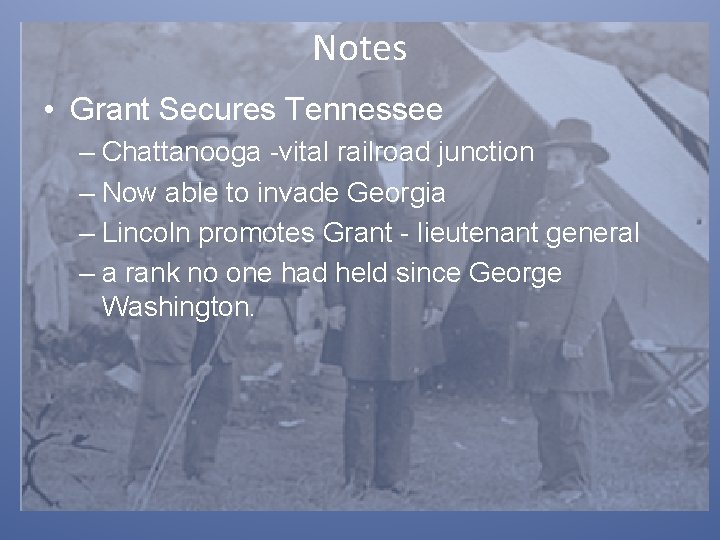
Notes • Grant Secures Tennessee – Chattanooga -vital railroad junction – Now able to invade Georgia – Lincoln promotes Grant - lieutenant general – a rank no one had held since George Washington.
Notes • Grant Versus Lee – Grant attacks Lee’s forces relentlessly – no time to recover. – Wilderness, a densely forested area near Fredericksburg, Virginia, – Spotsylvania Courthouse – Cold Harbor, a strategic crossroads northeast of Richmond. – Petersburg under siege knowing that once it fell, cut Richmond, Virginia- off from supplies.
Notes • Sherman’s March to the Sea – William Tecumseh Sherman, in charge in the west – August 1864 marched into Georgia – capturing Atlanta – set fires to destroy railroads, warehouses, mills, and factories. – The fires spread destroying more than one-third of Atlanta.
Notes • Sherman’s March to the Sea (cont) – east across Georgia -the March to the Sea. – purpose -make Southern civilians understand the horrors of war –get them to give up – path of destruction through Georgia – at times 60 miles wide. – By December 21, 1864 -hit the coast – capture Savannah. – north to South Carolina-the state that many people believed had started the Civil War
Notes • The South Surrenders –capture of Atlanta revitalizes support • Lincoln is reelected –mandate to end slavery permanently –amending the Constitution. –On January 31, 1865 - the Thirteenth Amendment to the Constitutionbanning slavery
Notes • • Appomattox Courthouse troops surrounded and outnumbered Lee surrendered to Grant on April 9, 1865 would not prosecute Confederate soldiers for treason – When Grant agreed to let Confederates take their horses home “to put in a crop to carry themselves and their families through the next winter, ” Lee thanked him, adding that the kindness would “do much toward conciliating our people. ”
Notes • Lincoln - speech - plan to restore the Southern states to the Union – including African Americans in Southern state governments – John Wilkes Booth is there • Ford’s Theater -evening of April 14, 1865 • Booth shot Lincoln in the back of the head
Notes • Civil War – strengthened the power of the federal government over the states. – left the South socially and economically devastated – in the years following the Civil War we have an era known as Reconstruction.
- Slides: 47