
The Civil War Aftermath Reconstruction Questions How would
- Slides: 25
The Civil War Aftermath & Reconstruction
Questions • How would the South rebuild? • 4 million freed slaves – where do they fit in society? • How should the states that left be treated? • Who should make the plan for reconstruction? – President or Congress
Impact of War • Women – Expanded jobs – Military nurses – Increase desire for suffrage
Impact of War - Former Slaves • 13 th Amendment: December 18, 1865, prohibits slavery in the U. S. • Still not citizens, will not be until 14 th in July 1868 • Problems – No education – No property – Divided families
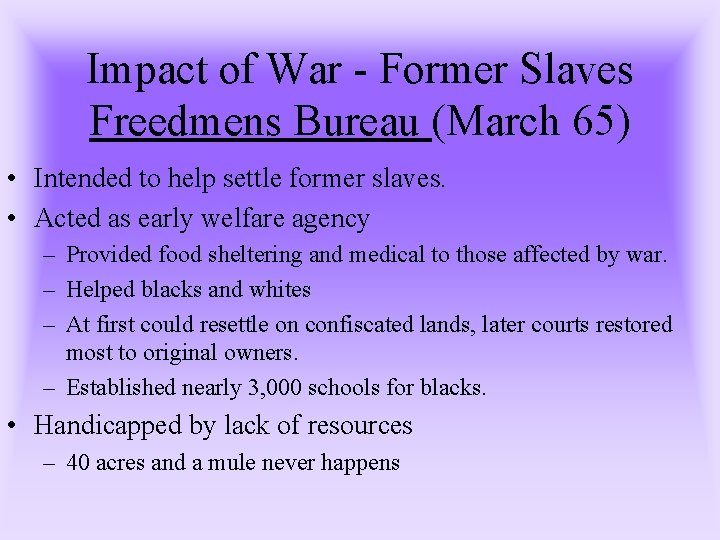
Impact of War - Former Slaves Freedmens Bureau (March 65) • Intended to help settle former slaves. • Acted as early welfare agency – Provided food sheltering and medical to those affected by war. – Helped blacks and whites – At first could resettle on confiscated lands, later courts restored most to original owners. – Established nearly 3, 000 schools for blacks. • Handicapped by lack of resources – 40 acres and a mule never happens
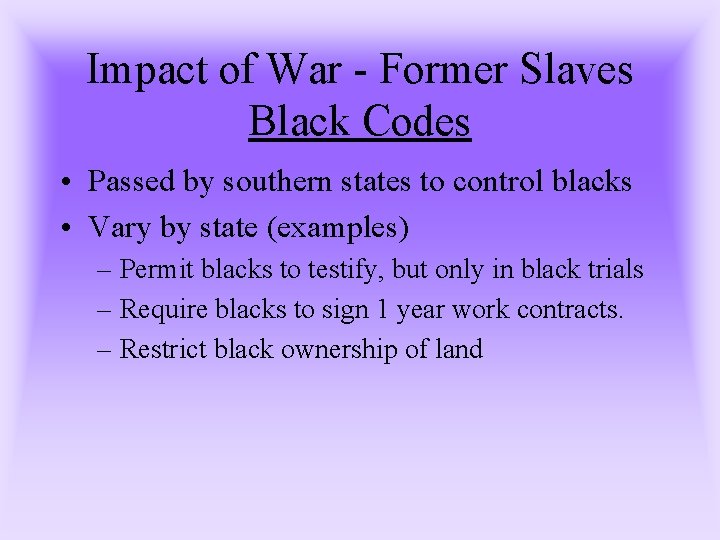
Impact of War - Former Slaves Black Codes • Passed by southern states to control blacks • Vary by state (examples) – Permit blacks to testify, but only in black trials – Require blacks to sign 1 year work contracts. – Restrict black ownership of land
Overall Impact of War • South devastated • Approx. 620, 000 killed • Supremacy of Federal Government
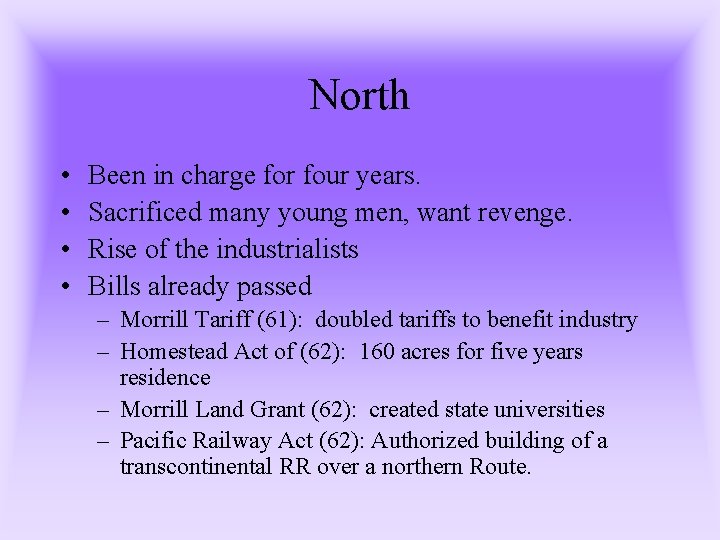
North • • Been in charge for four years. Sacrificed many young men, want revenge. Rise of the industrialists Bills already passed – Morrill Tariff (61): doubled tariffs to benefit industry – Homestead Act of (62): 160 acres for five years residence – Morrill Land Grant (62): created state universities – Pacific Railway Act (62): Authorized building of a transcontinental RR over a northern Route.
South • Destruction of war • Lost 4 billion in slaves alone • Not until 1879 does cotton crop return to pre -war levels • Average income cut almost in half, will not recover until after WWII • Problem of former slaves
th 13 Amendment • Passed in Dec. 1865 • Neither slavery nor involuntary servitude, except as a punishment for crime whereof the party shall have been duly convicted, shall exist within the United States, or any place subject to their Jurisdiction.
Bringing States Back in the Union Plans for Reconstruction
Lincoln’s 10% Plan 1863 • Full Presidential pardons – Loyalty oath – Accept emancipation of the slaves • State could return to the Union as soon as 10% of voters took the loyalty oath. • Meant to allow easy reconciliation. • Opposed by Congress • 4 states came back under this plan
Wade Davis Bill July 1864 • Passed by more radical republicans • Declared that for a state government to form, a majority must take loyalty oath. • Vetoed by Lincoln
Johnson’s Plan • Semi- follow Lincoln’s plan – Must ratify 13 th amendment – Excluded wealthy and high ranking confederates from taking oath • Grants pardons to people worth less that $20, 000 • However, pardons many others – 7 remaining ex-confederate states quickly agree
Johnson’s Veto • Vetoed a bill increasing services and protection offered by the Freedman’s Bureau • A Civil rights bill that nullified the Black Codes and guaranteed full citizenship and equal rights.
Congress • Appalled by South and Johnson • Too many lives lost • Mississippi permitted back in despite refusing to ratify 13 th. • Former southern generals and other leaders voted into office. – Congress refuses to recognize • Forces fight between Johnson and Congress
Johnson vs. Congress • Begins as fight over power. – Johnson’s vetoes • Congress passes 14 th amendment (July 1868) – Citizenship, due process, equal protection • South responds with race riots in Memphis and New Orleans, hundreds of blacks killed. • Congress passes Radical Reconstruction over Johnson’s vetoes.
Radical Reconstruction • Three distinct acts, passed in March of 1867 – Military Reconstruction Act • Does not recognize governments formed under Lincoln/Johnson Plans – Only Tennessee was recognized • • • Divided the South into 5 military districts Governor-generals placed in charge. No removal until South accepted 14 th amendment Force the southern states to reorganize and draw up new constitutions. Excluded confederates from office and voting
Radical Reconstruction – Command of the Army Act • gave Congress greater control of the Army • probably unconstitutional. – Tenure of office Act. • Gave Congress approval over Johnson’s actions in appointing and removing officials
Impeachment • Johnson tries to challenge Tenure of Office Act • Congress impeaches Johnson for violating act. • More likely on trial for opposing Congress in general • Johnson survives vote by one • Has very little power left
Fifteenth Amendment • 1868 – Grant elected – Supported by African Americans • Congress introduced 15 th Amendment – Can not keep someone from voting based on • Race, color or previous conditions of servitude • Adopted in 1870
Reconstruction in the South
Government • Northern whites and southern blacks in charge. • Northern whites: come south for money or to make a difference – Carpetbaggers / Scalawags • Southern blacks: inexperienced in running things. – – Subject to manipulation Some leaders arise Backed by Union Army. Hated by southerners
Social • Blacks still face wide scale discrimination • Rise of KKK – One of many such groups – Seen as southern heroes – try to force blacks back into subsidiary role – lynching
End • Battle will continue through early 1870 s. • South refused to change at the end of bayonet • North begins to lose interest • Compromise of 1877 – Republicans get Presidency – Democrats get end of Reconstruction.