
The Civil War 1861 1865 President Lincoln Abraham

The Civil War 1861 -1865
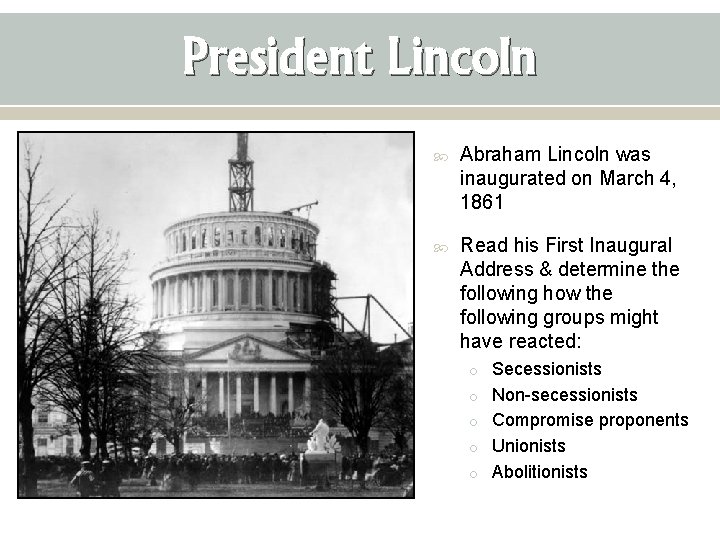
President Lincoln Abraham Lincoln was inaugurated on March 4, 1861 Read his First Inaugural Address & determine the following how the following groups might have reacted: o Secessionists o Non-secessionists o Compromise proponents o Unionists o Abolitionists
President Lincoln
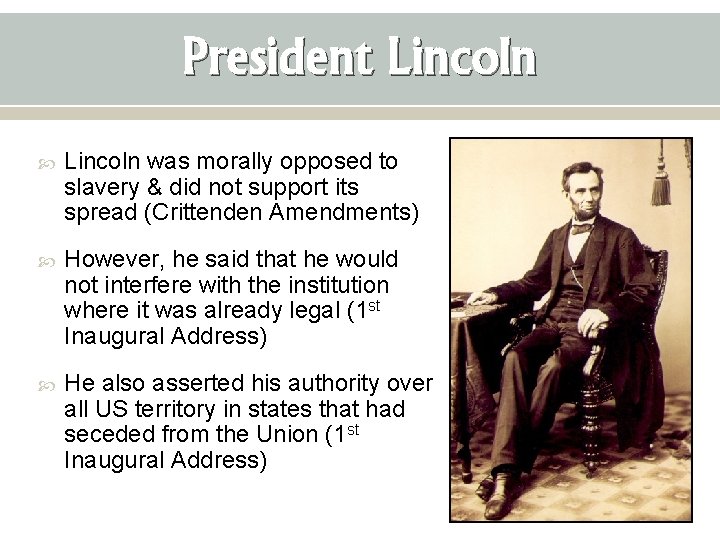
President Lincoln was morally opposed to slavery & did not support its spread (Crittenden Amendments) However, he said that he would not interfere with the institution where it was already legal (1 st Inaugural Address) He also asserted his authority over all US territory in states that had seceded from the Union (1 st Inaugural Address)
Fort Sumter South Carolina’s Fort Sumter needed food & supplies Lincoln informed SC’s governor that he was sending provisions in an unarmed ship o Confederate forces attacked the fort before the ship could reach o o it The American commander surrendered the next day While no one was killed, it did mark the beginning of the war Lincoln requested 75, 000 volunteers to help suppress the rebellion Four more states seceded

Map of Secession
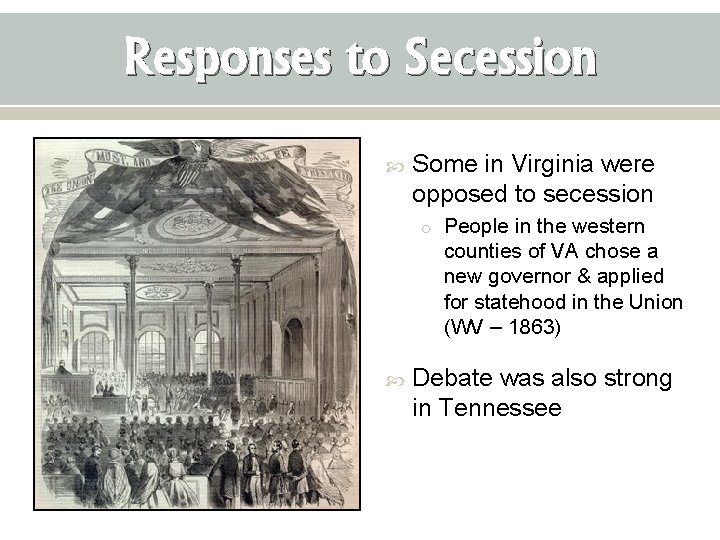
Responses to Secession Some in Virginia were opposed to secession o People in the western counties of VA chose a new governor & applied for statehood in the Union (WV – 1863) Debate was also strong in Tennessee
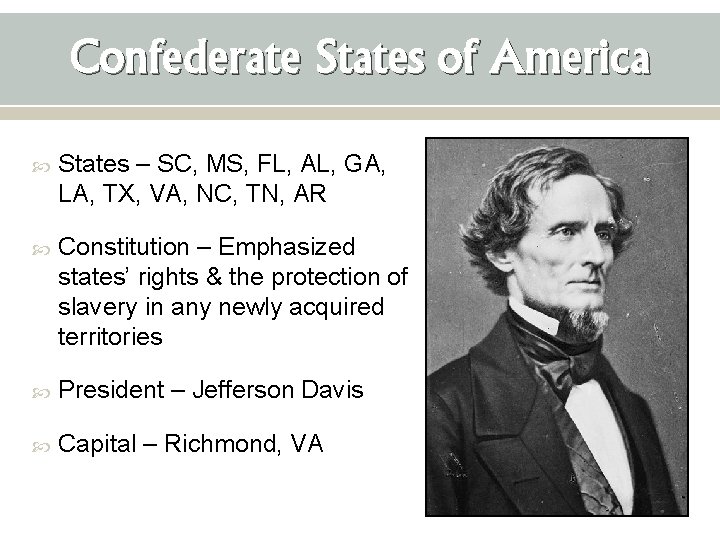
Confederate States of America States – SC, MS, FL, AL, GA, LA, TX, VA, NC, TN, AR Constitution – Emphasized states’ rights & the protection of slavery in any newly acquired territories President – Jefferson Davis Capital – Richmond, VA
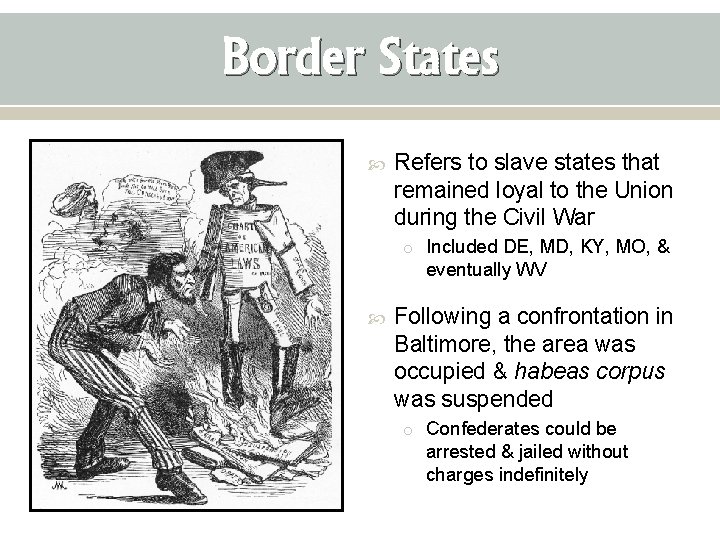
Border States Refers to slave states that remained loyal to the Union during the Civil War o Included DE, MD, KY, MO, & eventually WV Following a confrontation in Baltimore, the area was occupied & habeas corpus was suspended o Confederates could be arrested & jailed without charges indefinitely
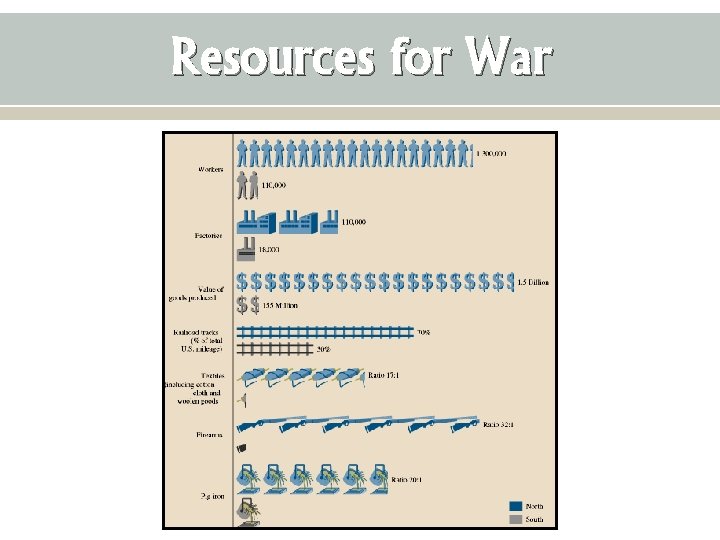
Resources for War

Union Startegies The initial Union strategy was developed by General Winfield Scott o Known as the Anaconda Plan o Called for a blockade of southern ports & the capture of the Mississippi River o Lincoln did attempt to establish a blockade, but did not have the manpower to capture & control the Mississippi River
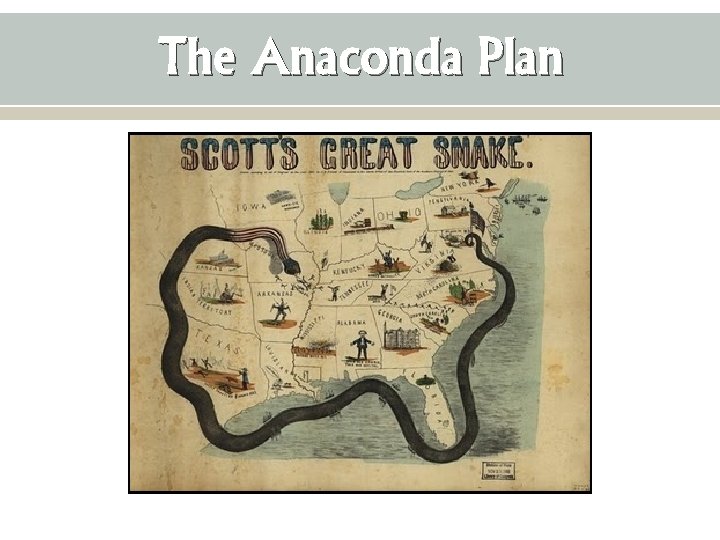
The Anaconda Plan
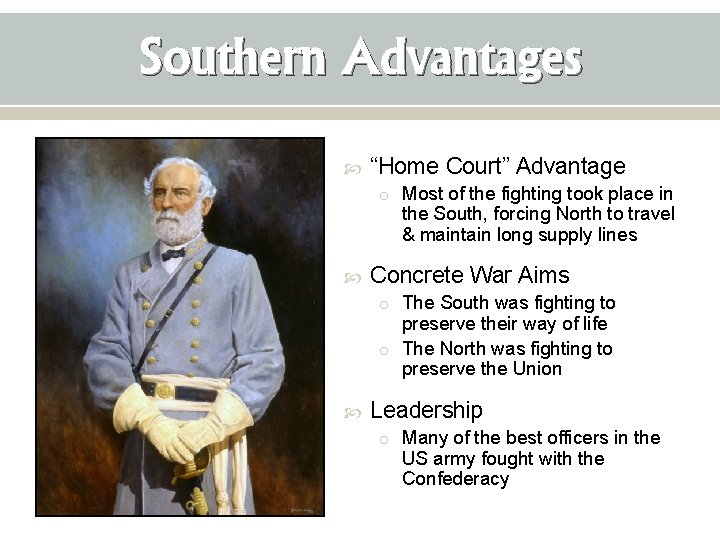
Southern Advantages “Home Court” Advantage o Most of the fighting took place in the South, forcing North to travel & maintain long supply lines Concrete War Aims o The South was fighting to preserve their way of life o The North was fighting to preserve the Union Leadership o Many of the best officers in the US army fought with the Confederacy
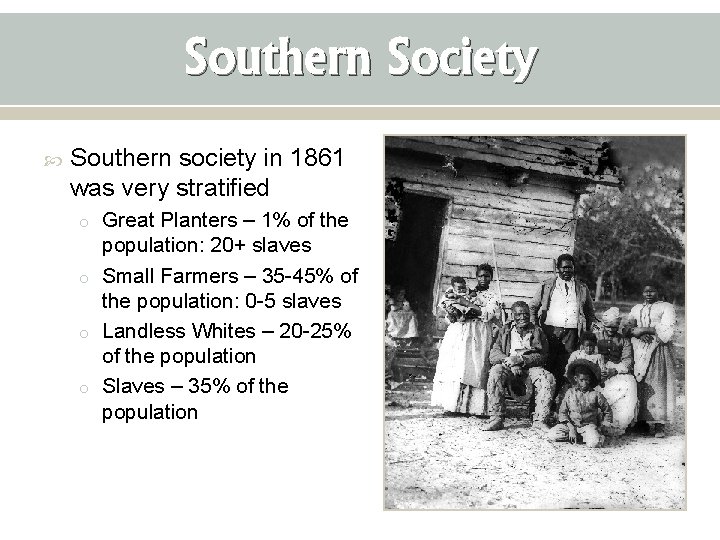
Southern Society Southern society in 1861 was very stratified o Great Planters – 1% of the population: 20+ slaves o Small Farmers – 35 -45% of the population: 0 -5 slaves o Landless Whites – 20 -25% of the population o Slaves – 35% of the population
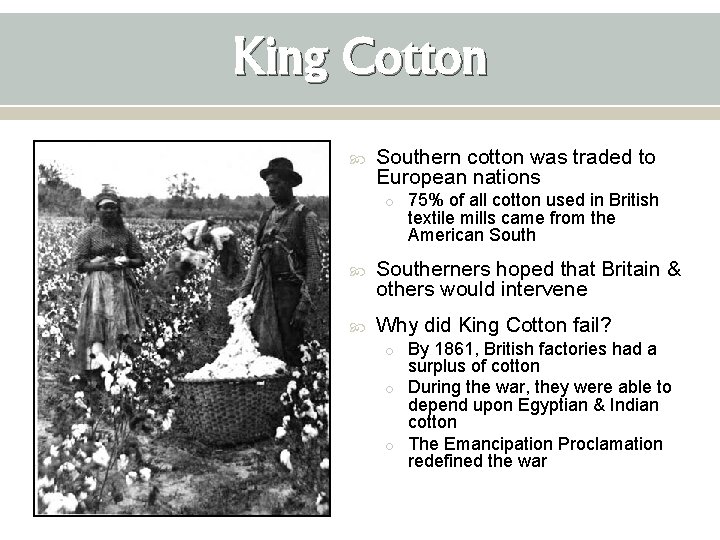
King Cotton Southern cotton was traded to European nations o 75% of all cotton used in British textile mills came from the American Southerners hoped that Britain & others would intervene Why did King Cotton fail? o By 1861, British factories had a surplus of cotton o During the war, they were able to depend upon Egyptian & Indian cotton o The Emancipation Proclamation redefined the war
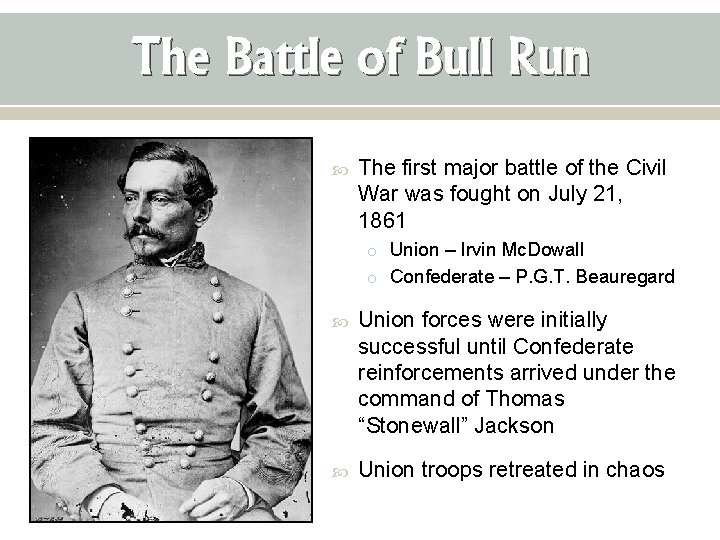
The Battle of Bull Run The first major battle of the Civil War was fought on July 21, 1861 o Union – Irvin Mc. Dowall o Confederate – P. G. T. Beauregard Union forces were initially successful until Confederate reinforcements arrived under the command of Thomas “Stonewall” Jackson Union troops retreated in chaos
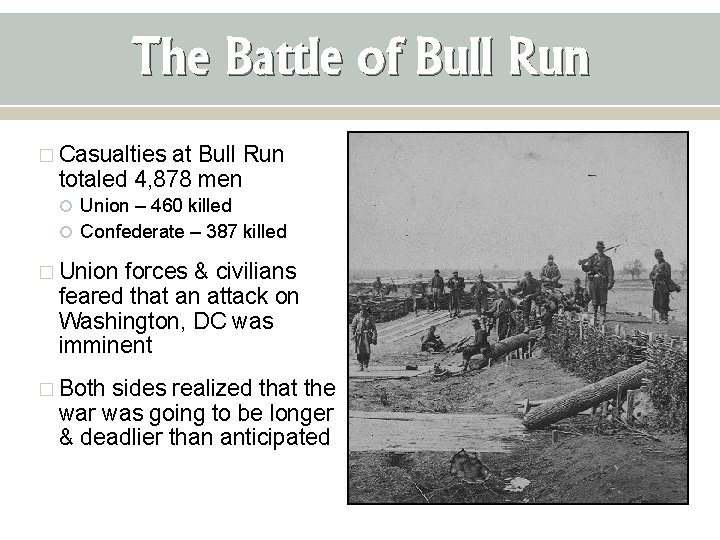
The Battle of Bull Run � Casualties at Bull Run totaled 4, 878 men Union – 460 killed Confederate – 387 killed � Union forces & civilians feared that an attack on Washington, DC was imminent � Both sides realized that the war was going to be longer & deadlier than anticipated
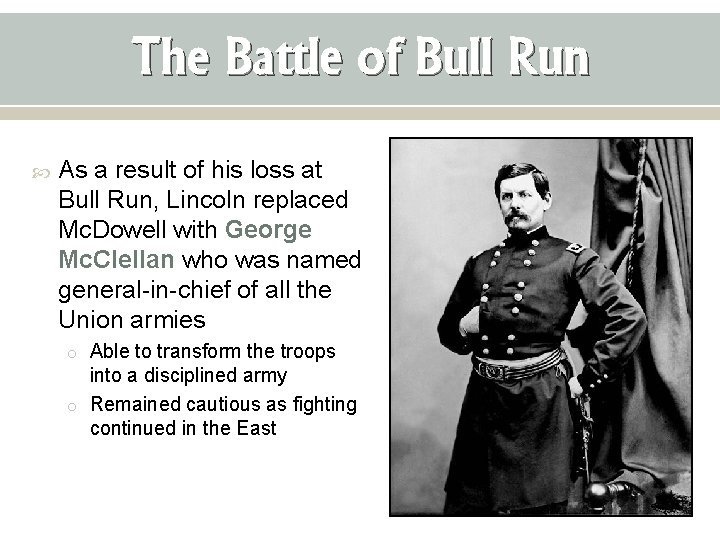
The Battle of Bull Run As a result of his loss at Bull Run, Lincoln replaced Mc. Dowell with George Mc. Clellan who was named general-in-chief of all the Union armies o Able to transform the troops into a disciplined army o Remained cautious as fighting continued in the East
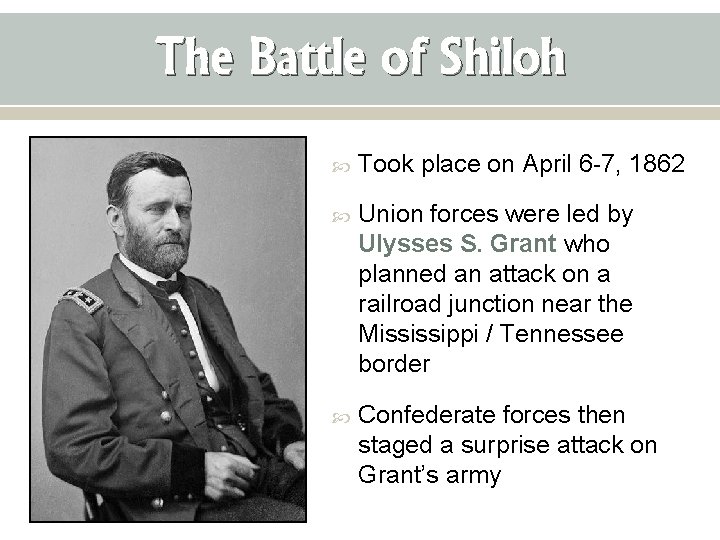
The Battle of Shiloh Took place on April 6 -7, 1862 Union forces were led by Ulysses S. Grant who planned an attack on a railroad junction near the Mississippi / Tennessee border Confederate forces then staged a surprise attack on Grant’s army
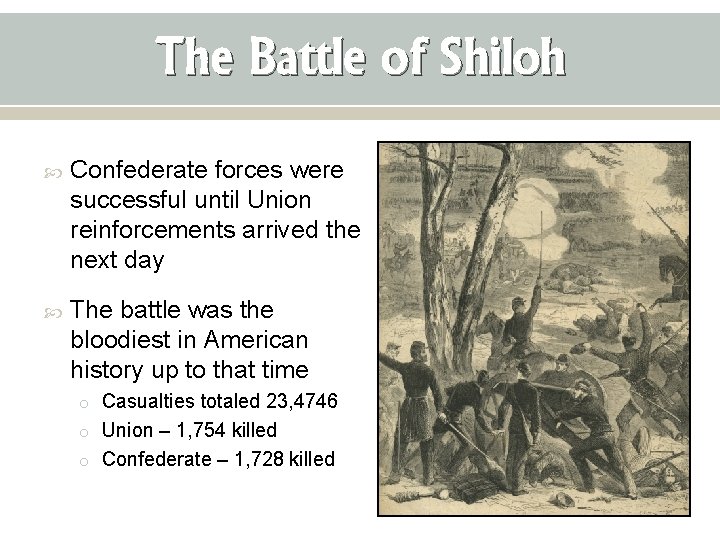
The Battle of Shiloh Confederate forces were successful until Union reinforcements arrived the next day The battle was the bloodiest in American history up to that time o Casualties totaled 23, 4746 o Union – 1, 754 killed o Confederate – 1, 728 killed
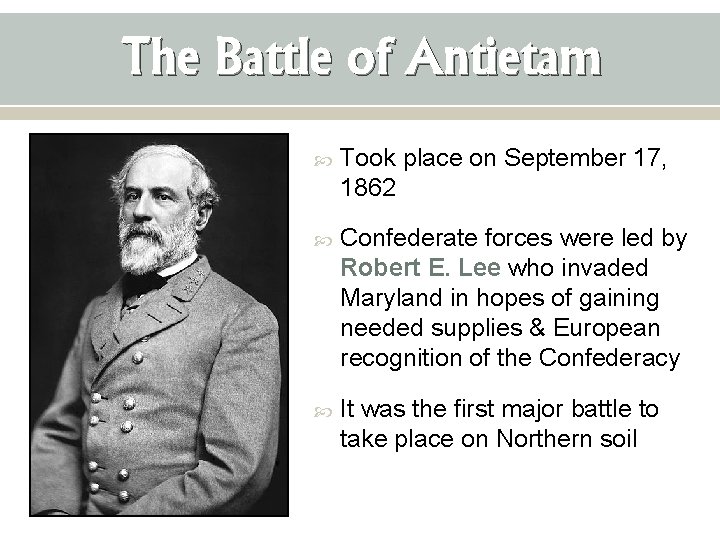
The Battle of Antietam Took place on September 17, 1862 Confederate forces were led by Robert E. Lee who invaded Maryland in hopes of gaining needed supplies & European recognition of the Confederacy It was the first major battle to take place on Northern soil
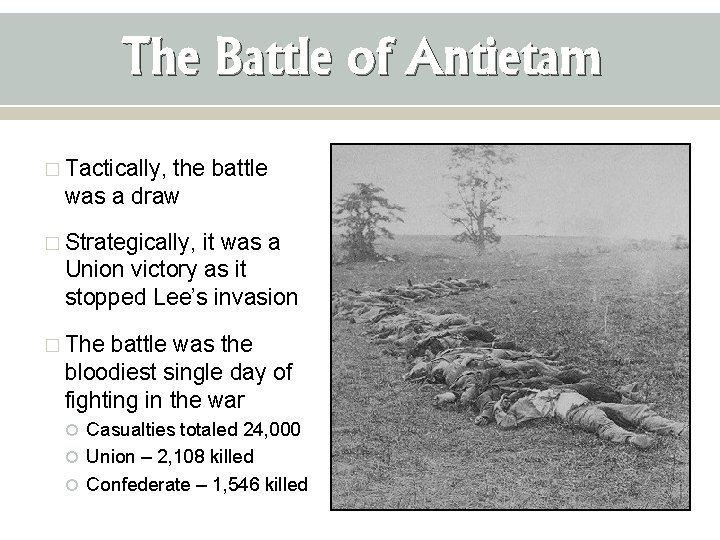
The Battle of Antietam � Tactically, the battle was a draw � Strategically, it was a Union victory as it stopped Lee’s invasion � The battle was the bloodiest single day of fighting in the war Casualties totaled 24, 000 Union – 2, 108 killed Confederate – 1, 546 killed
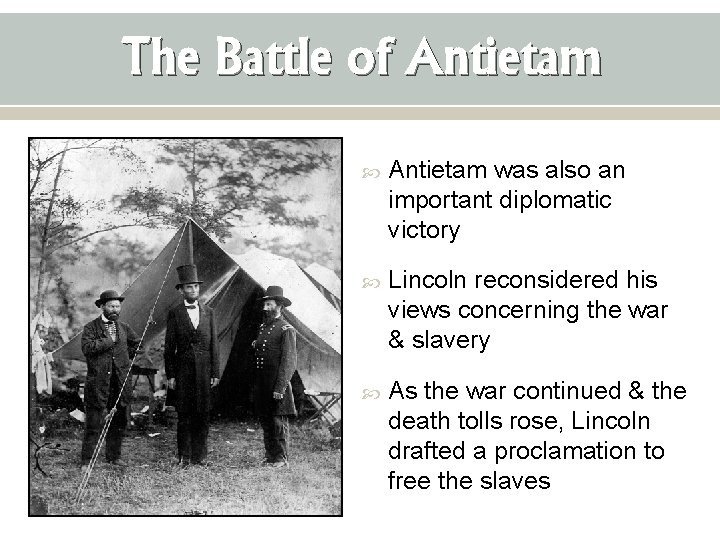
The Battle of Antietam was also an important diplomatic victory Lincoln reconsidered his views concerning the war & slavery As the war continued & the death tolls rose, Lincoln drafted a proclamation to free the slaves
The Emancipation Proclamation Five days after the Battle of Antietam, Lincoln issued the preliminary Emancipation Proclamation o Freed the slaves residing in states in rebellion against the Union o Allowed Lincoln to maintain the support of the border states while pushing them closer to emancipation o Transformed the Union war aims o Further divided the Northern Democrats • Copperhead Democrats – Wanted an immediate end to the war & saw Lincoln as a tyrant • War Democrats – Demanded an aggressive policy towards the Confederacy & supported Lincoln
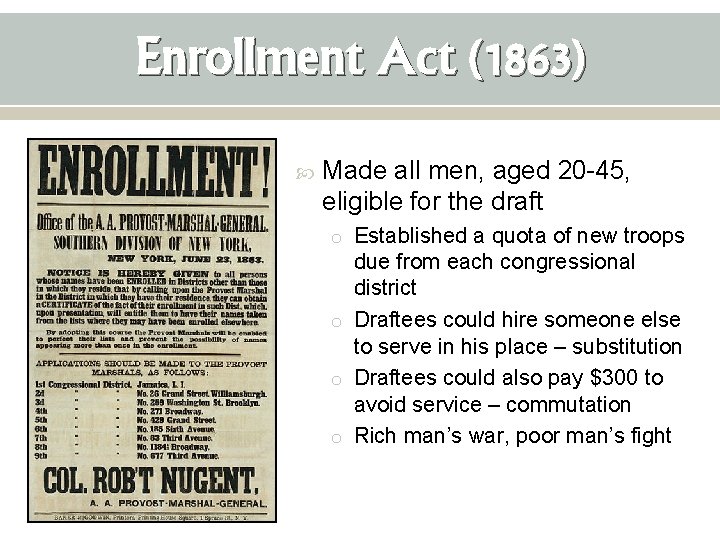
Enrollment Act (1863) Made all men, aged 20 -45, eligible for the draft o Established a quota of new troops due from each congressional district o Draftees could hire someone else to serve in his place – substitution o Draftees could also pay $300 to avoid service – commutation o Rich man’s war, poor man’s fight
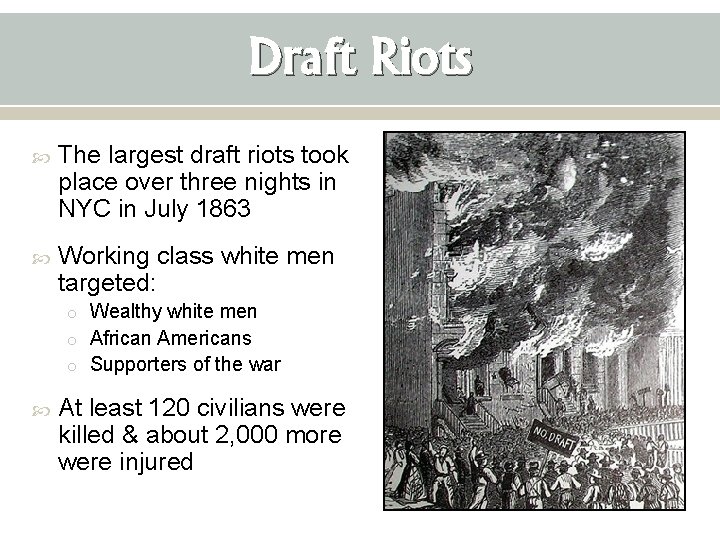
Draft Riots The largest draft riots took place over three nights in NYC in July 1863 Working class white men targeted: o Wealthy white men o African Americans o Supporters of the war At least 120 civilians were killed & about 2, 000 more were injured
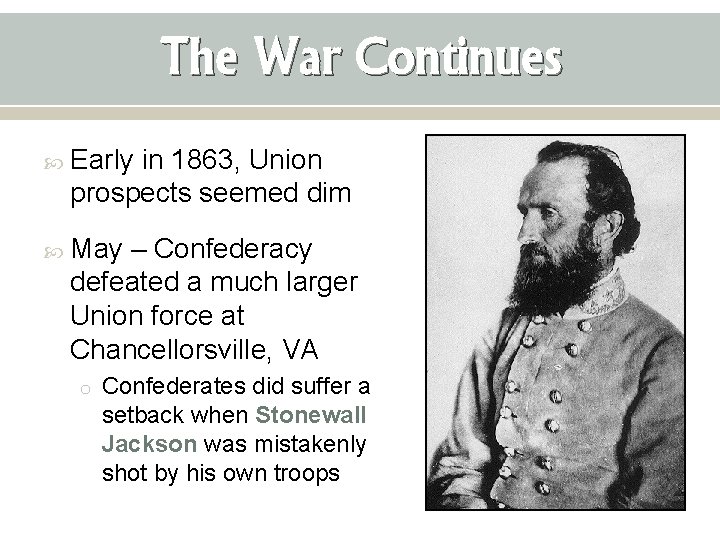
The War Continues Early in 1863, Union prospects seemed dim May – Confederacy defeated a much larger Union force at Chancellorsville, VA o Confederates did suffer a setback when Stonewall Jackson was mistakenly shot by his own troops
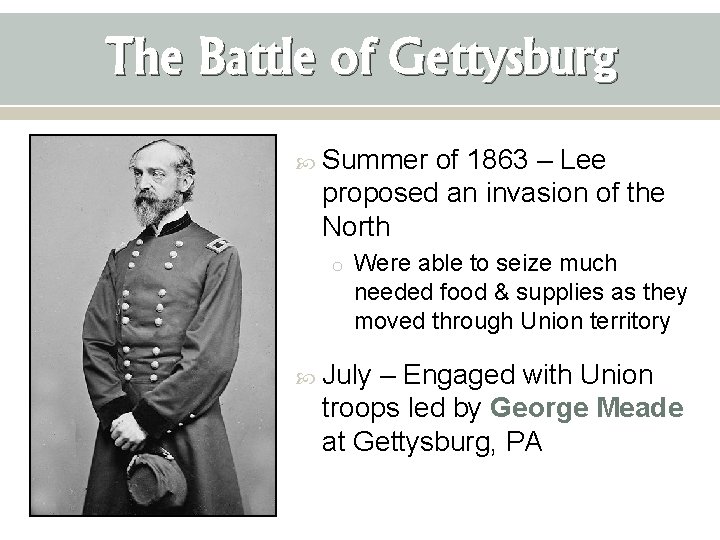
The Battle of Gettysburg Summer of 1863 – Lee proposed an invasion of the North o Were able to seize much needed food & supplies as they moved through Union territory July – Engaged with Union troops led by George Meade at Gettysburg, PA
The Battle of Gettysburg The fighting at Gettysburg took place over three days o Union troops took up a defensive position along what was called Cemetery Ridge o Confederate troops attacked both flanks of the Union line o The largest attack came on July 3 when troops under the command of George Pickett moved to the center • Pickett’s famous “Last Charge” proved to be a tremendous defeat for the Confederates
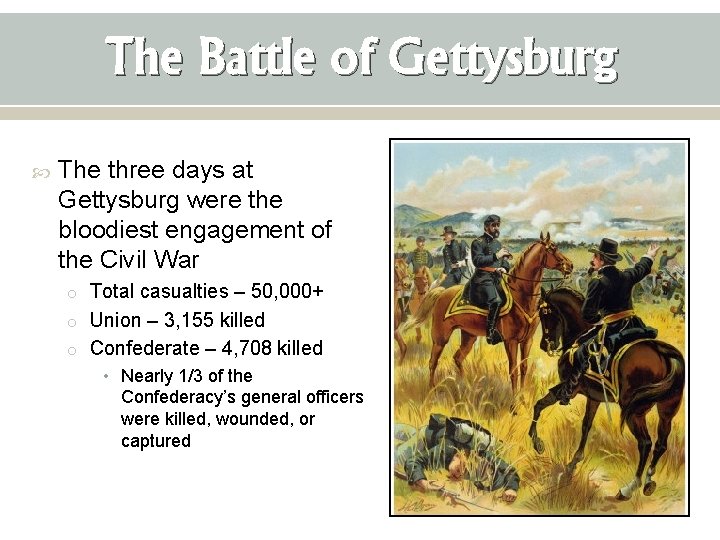
The Battle of Gettysburg The three days at Gettysburg were the bloodiest engagement of the Civil War o Total casualties – 50, 000+ o Union – 3, 155 killed o Confederate – 4, 708 killed • Nearly 1/3 of the Confederacy’s general officers were killed, wounded, or captured
The Siege of Vicksburg Took place from May-July 1863 After a 4 month siege, Union forces were finally able to capture the city Soon after, they took control of the entire Mississippi River Together, the Union victories at Gettysburg & Vicksburg are considered to be turning points in the war
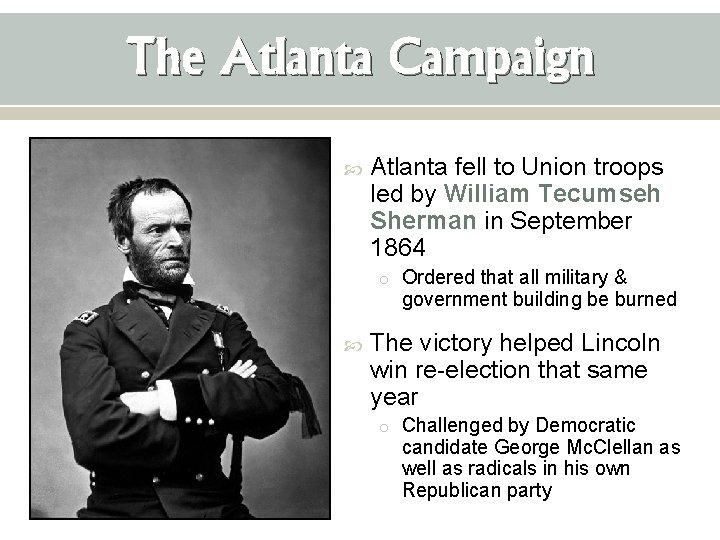
The Atlanta Campaign Atlanta fell to Union troops led by William Tecumseh Sherman in September 1864 o Ordered that all military & government building be burned The victory helped Lincoln win re-election that same year o Challenged by Democratic candidate George Mc. Clellan as well as radicals in his own Republican party
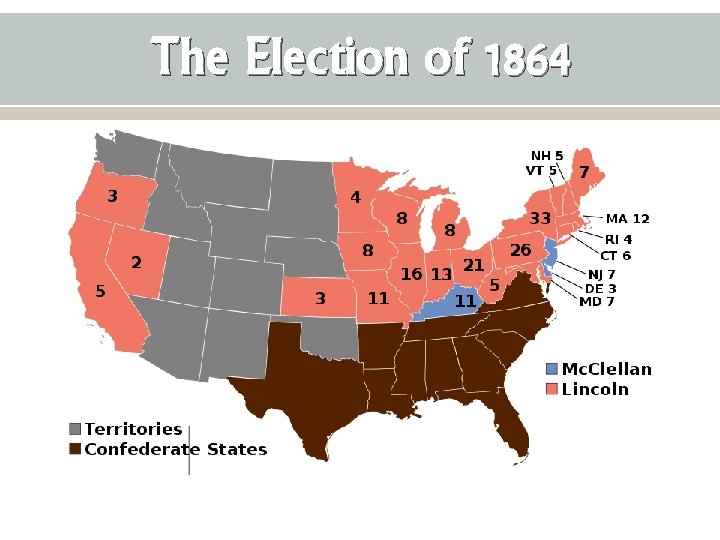
The Election of 1864
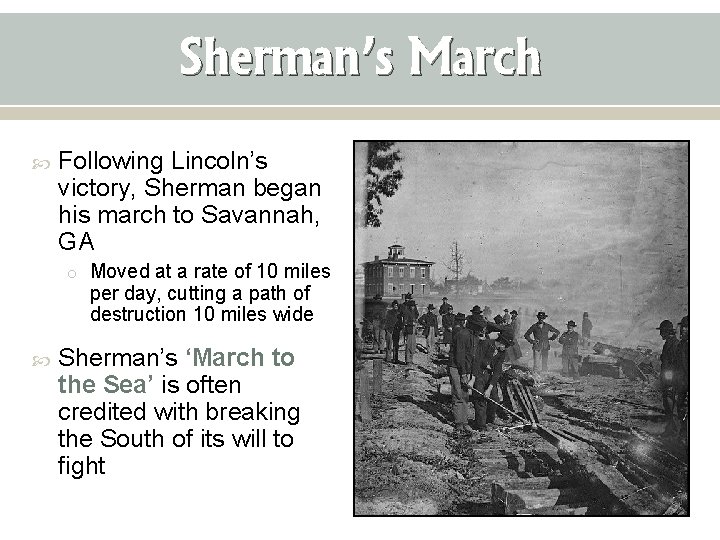
Sherman’s March Following Lincoln’s victory, Sherman began his march to Savannah, GA o Moved at a rate of 10 miles per day, cutting a path of destruction 10 miles wide Sherman’s ‘March to the Sea’ is often credited with breaking the South of its will to fight
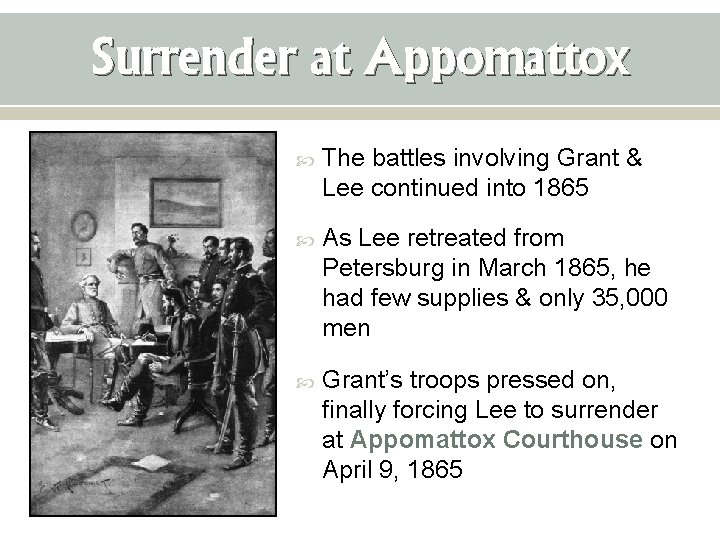
Surrender at Appomattox The battles involving Grant & Lee continued into 1865 As Lee retreated from Petersburg in March 1865, he had few supplies & only 35, 000 men Grant’s troops pressed on, finally forcing Lee to surrender at Appomattox Courthouse on April 9, 1865

The Death of a President Five days after Lee’s surrender, President Lincoln was shot while attending a play at Ford’s Theatre in Washington, DC He died the next day
- Slides: 36