
The Civil War 1861 1865 I Technology and
- Slides: 31
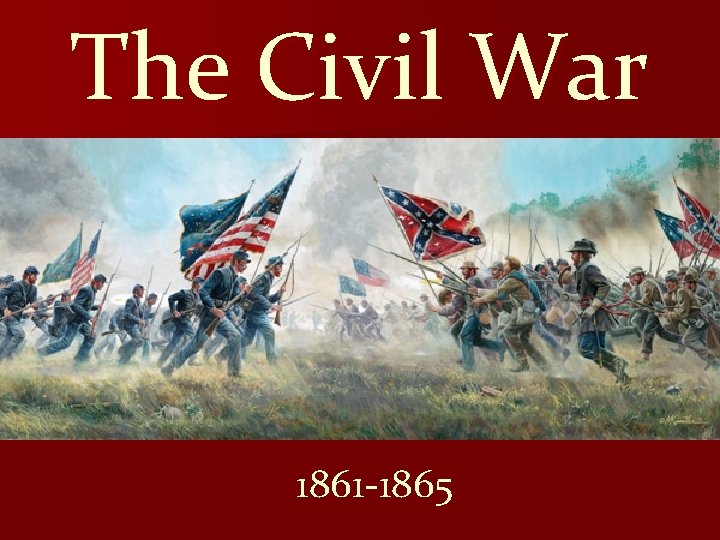
The Civil War 1861 -1865
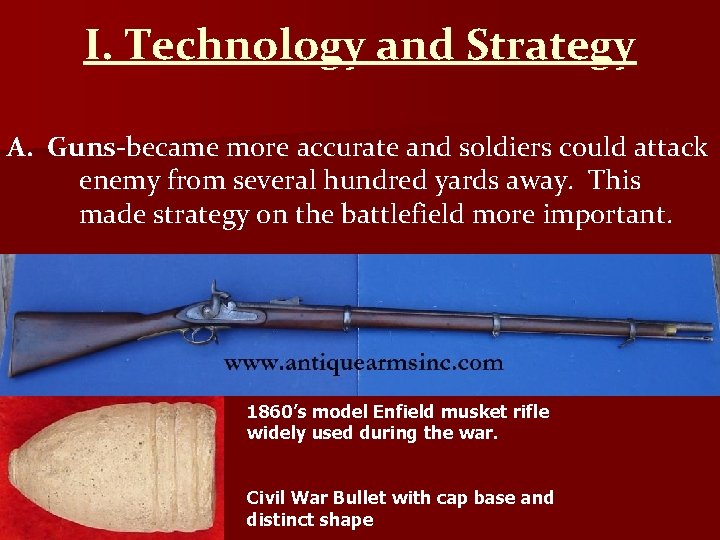
I. Technology and Strategy A. Guns-became more accurate and soldiers could attack enemy from several hundred yards away. This made strategy on the battlefield more important. 1860’s model Enfield musket rifle widely used during the war. Civil War Bullet with cap base and distinct shape
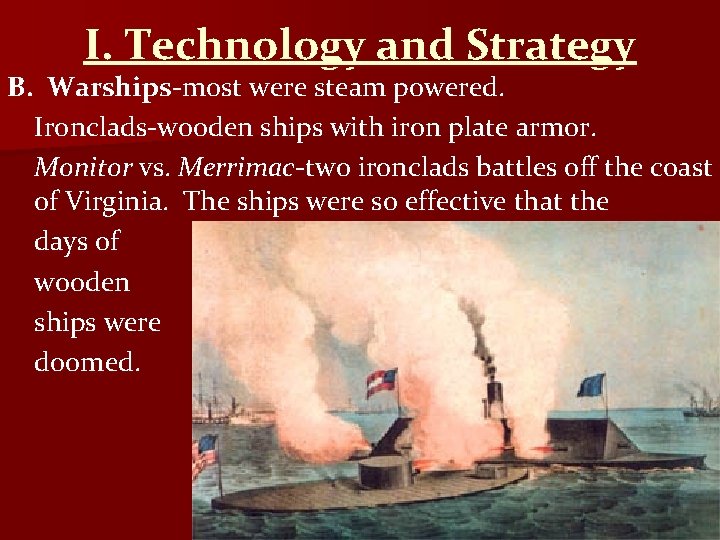
I. Technology and Strategy B. Warships-most were steam powered. Ironclads-wooden ships with iron plate armor. Monitor vs. Merrimac-two ironclads battles off the coast of Virginia. The ships were so effective that the days of wooden ships were doomed.
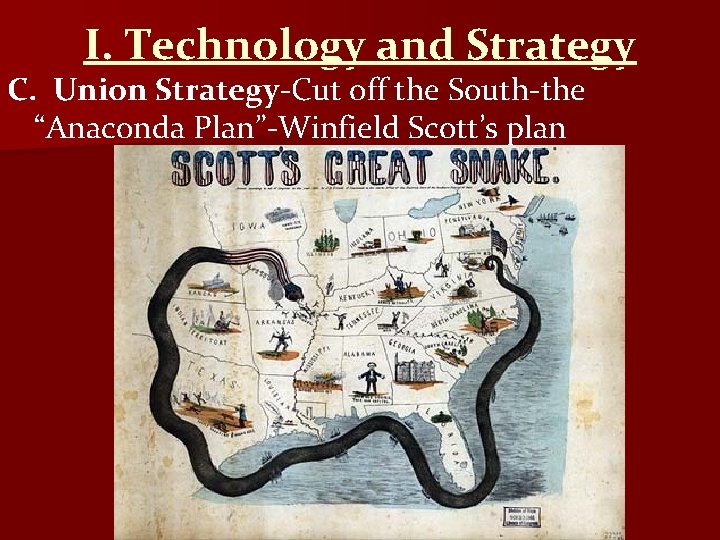
I. Technology and Strategy C. Union Strategy-Cut off the South-the “Anaconda Plan”-Winfield Scott’s plan
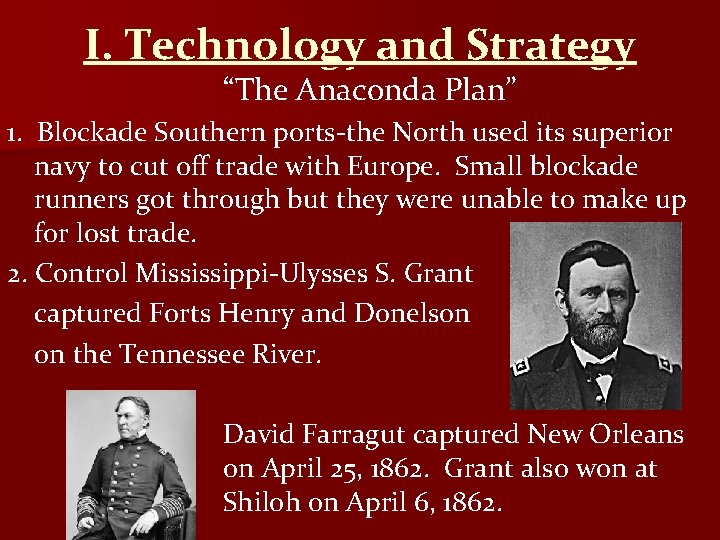
I. Technology and Strategy “The Anaconda Plan” 1. Blockade Southern ports-the North used its superior navy to cut off trade with Europe. Small blockade runners got through but they were unable to make up for lost trade. 2. Control Mississippi-Ulysses S. Grant captured Forts Henry and Donelson on the Tennessee River. David Farragut captured New Orleans on April 25, 1862. Grant also won at Shiloh on April 6, 1862.
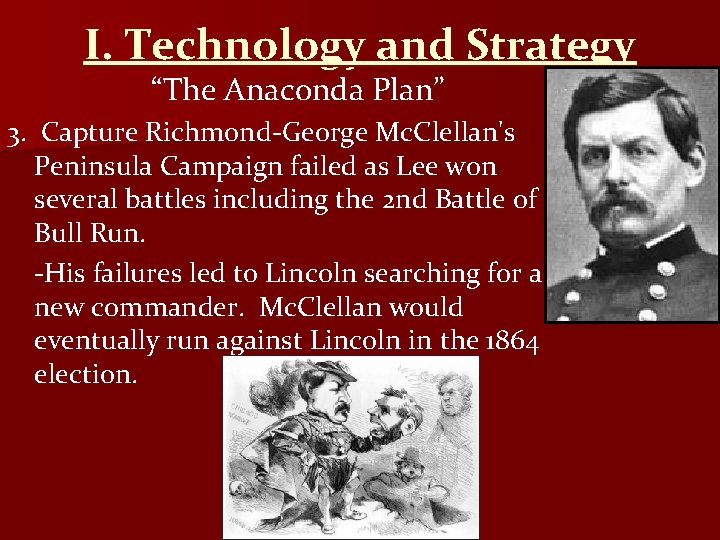
I. Technology and Strategy “The Anaconda Plan” 3. Capture Richmond-George Mc. Clellan's Peninsula Campaign failed as Lee won several battles including the 2 nd Battle of Bull Run. -His failures led to Lincoln searching for a new commander. Mc. Clellan would eventually run against Lincoln in the 1864 election.
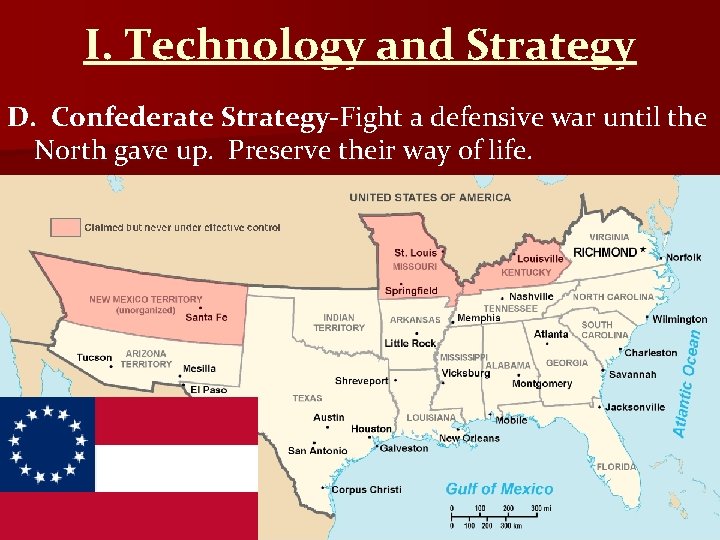
I. Technology and Strategy D. Confederate Strategy-Fight a defensive war until the North gave up. Preserve their way of life.
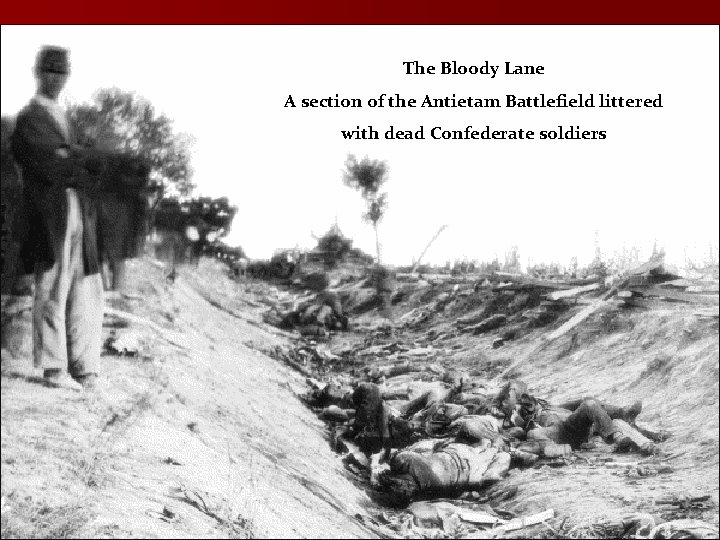
II. Major Battles The Bloody Lane A. Antietam-September 17, 1862 -South invaded A section of the Antietam Battlefield littered Maryland hoping a major victory would bring support with dead Confederate soldiers from Great Britain and France. In one day, almost 23, 000 men were killed or wounded. The bloodiest one day in American history.
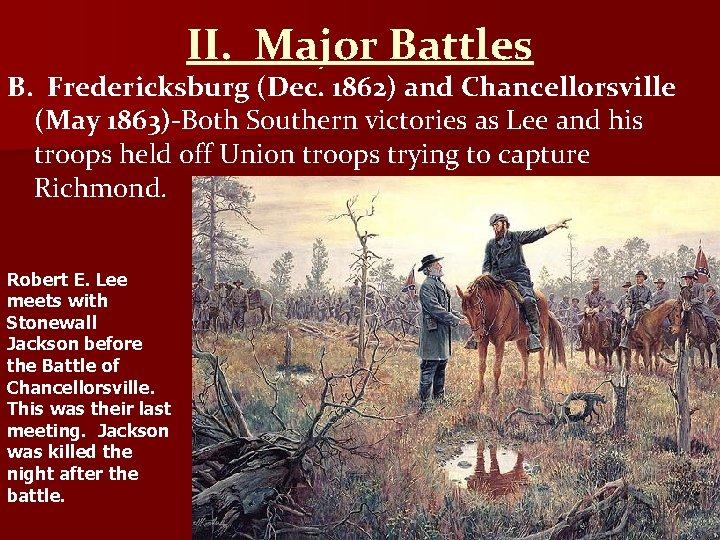
II. Major Battles B. Fredericksburg (Dec. 1862) and Chancellorsville (May 1863)-Both Southern victories as Lee and his troops held off Union troops trying to capture Richmond. Robert E. Lee meets with Stonewall Jackson before the Battle of Chancellorsville. This was their last meeting. Jackson was killed the night after the battle.
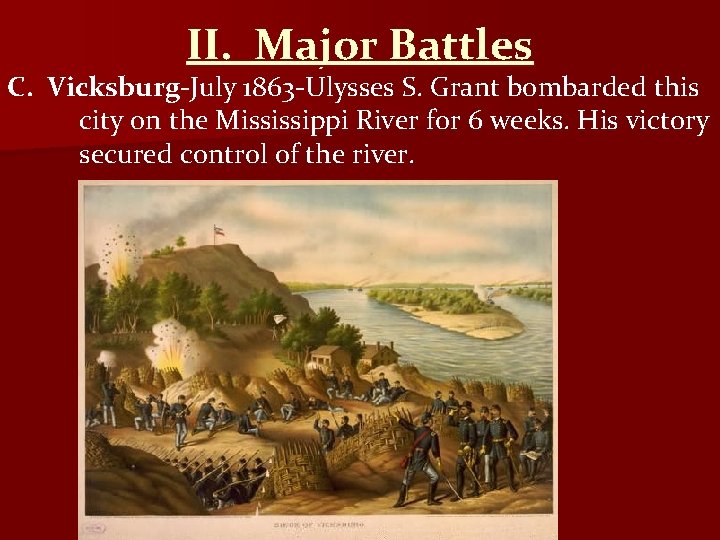
II. Major Battles C. Vicksburg-July 1863 -Ulysses S. Grant bombarded this city on the Mississippi River for 6 weeks. His victory secured control of the river.
II. Major Battles D. Gettysburg-July 1 -3, 1863 -*Turning Point of the War* Lee took 75, 000 men into the North to capture Harrisburg and threaten Washington D. C. The two armies met by accident in eastern Pennsylvania. Results: 23, 000 Union troops dead or wounded. 25, 000 Confederates. Great defeat for Lee. Demoralized the South.
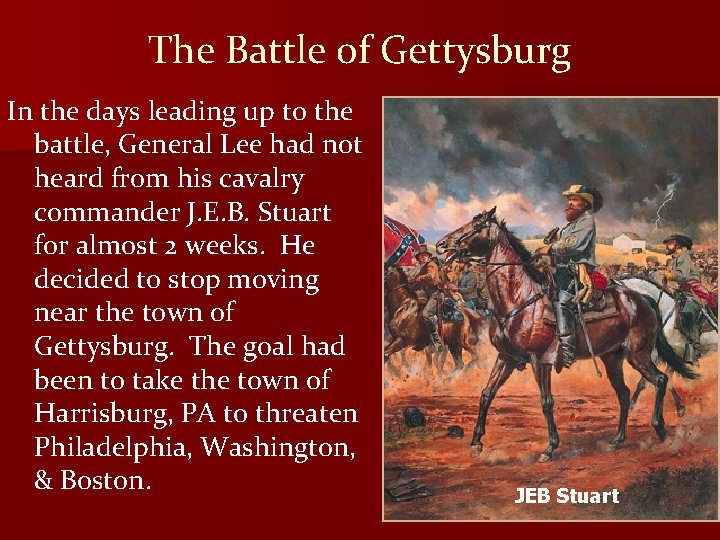
The Battle of Gettysburg In the days leading up to the battle, General Lee had not heard from his cavalry commander J. E. B. Stuart for almost 2 weeks. He decided to stop moving near the town of Gettysburg. The goal had been to take the town of Harrisburg, PA to threaten Philadelphia, Washington, & Boston. JEB Stuart
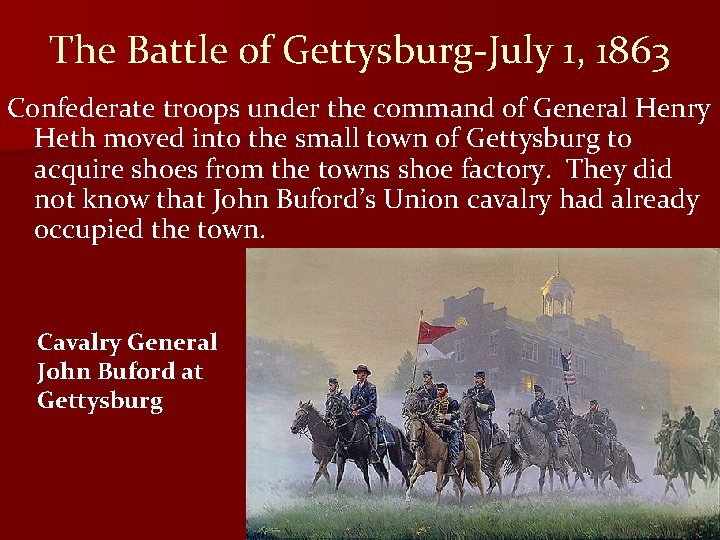
The Battle of Gettysburg-July 1, 1863 Confederate troops under the command of General Henry Heth moved into the small town of Gettysburg to acquire shoes from the towns shoe factory. They did not know that John Buford’s Union cavalry had already occupied the town. Cavalry General John Buford at Gettysburg
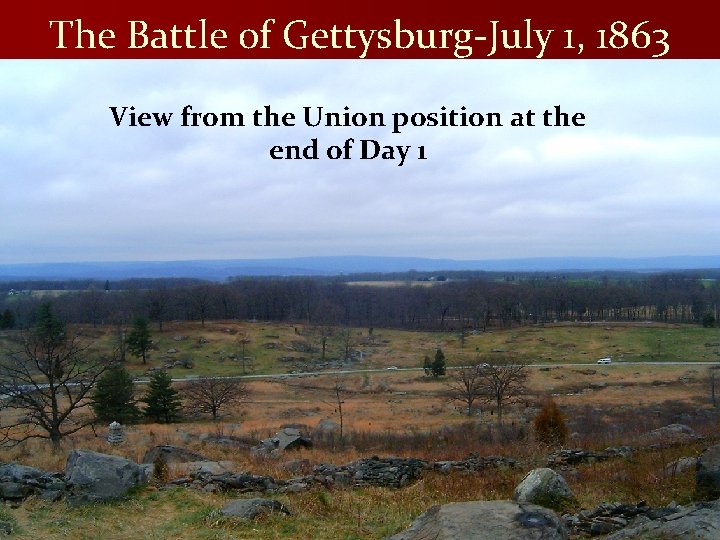
The Battle of Gettysburg-July 1, 1863 As the two groups began to fight, reinforcements poured in from bothfrom sides. the The Unionposition soldiers at were View Union thedriven from the town but settled on 1 the high ground end ofin Day outside of town. There was a collection of ridges and hills that provided an excellent defensive position: Cemetery Hill, Culp’s Hill, Little and Big Round Top, etc.
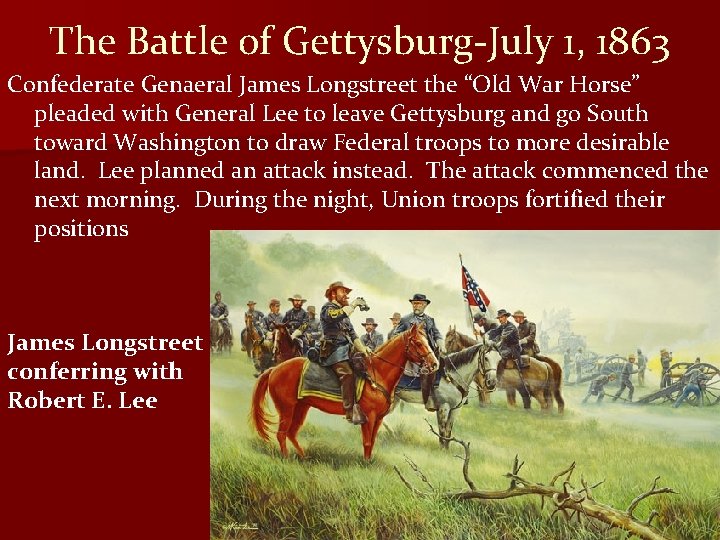
The Battle of Gettysburg-July 1, 1863 Confederate Genaeral James Longstreet the “Old War Horse” pleaded with General Lee to leave Gettysburg and go South toward Washington to draw Federal troops to more desirable land. Lee planned an attack instead. The attack commenced the next morning. During the night, Union troops fortified their positions James Longstreet conferring with Robert E. Lee
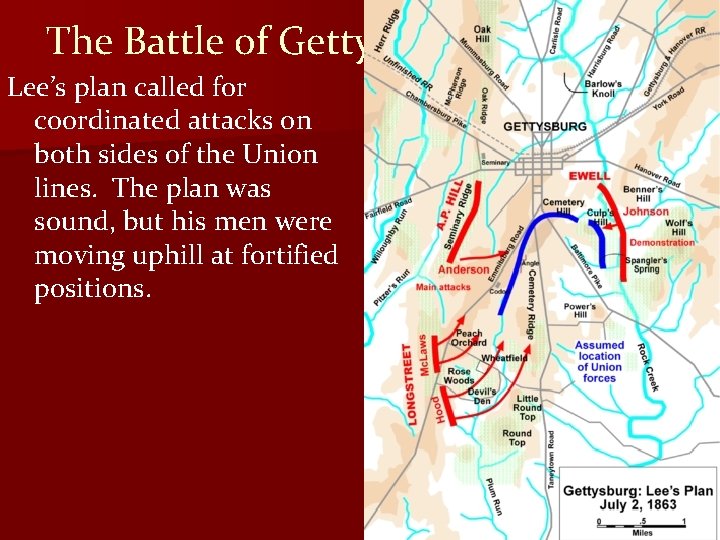
The Battle of Gettysburg-July 2, 1863 Lee’s plan called for coordinated attacks on both sides of the Union lines. The plan was sound, but his men were moving uphill at fortified positions.
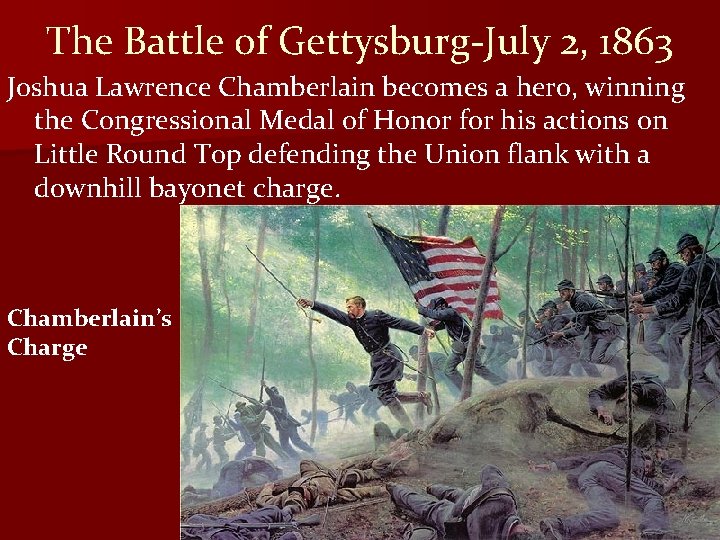
The Battle of Gettysburg-July 2, 1863 Joshua Lawrence Chamberlain becomes a hero, winning the Congressional Medal of Honor for his actions on Little Round Top defending the Union flank with a downhill bayonet charge. Chamberlain’s Charge
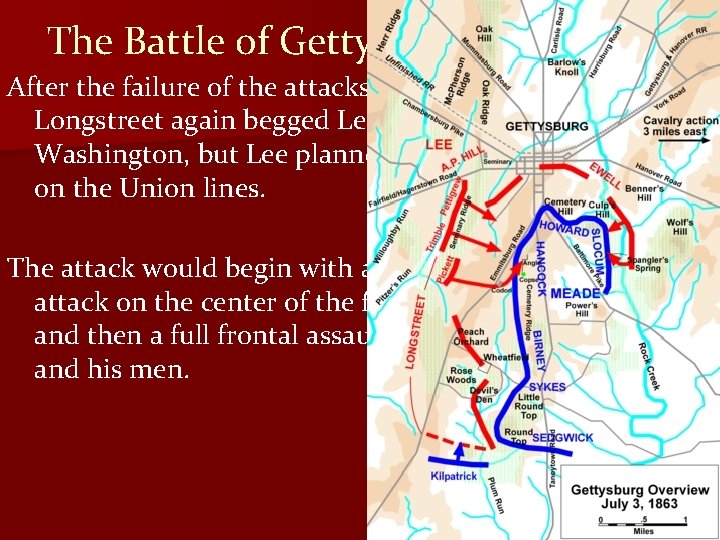
The Battle of Gettysburg-July 3, 1863 After the failure of the attacks on the second day of battle, Longstreet again begged Lee to move South towards Washington, but Lee planned an all out frontal assault on the Union lines. The attack would begin with a concentrated artillery attack on the center of the federal lines in the morning and then a full frontal assault by General George Pickett and his men.
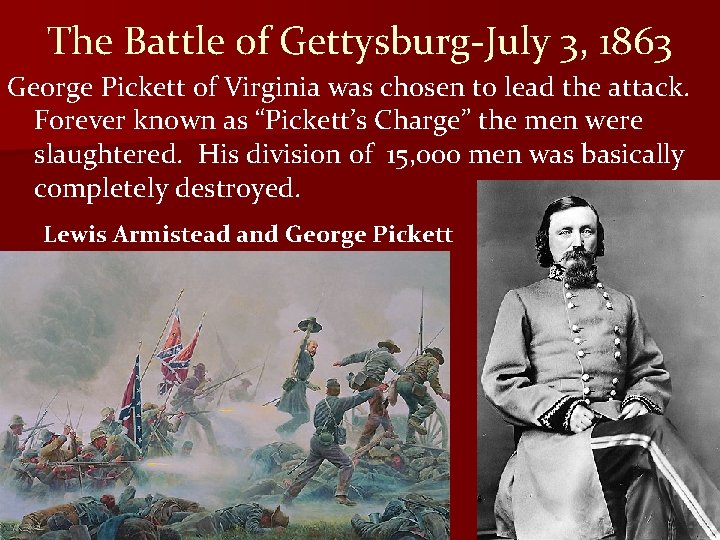
The Battle of Gettysburg-July 3, 1863 George Pickett of Virginia was chosen to lead the attack. Forever known as “Pickett’s Charge” the men were slaughtered. His division of 15, 000 men was basically completely destroyed. Lewis Armistead and George Pickett
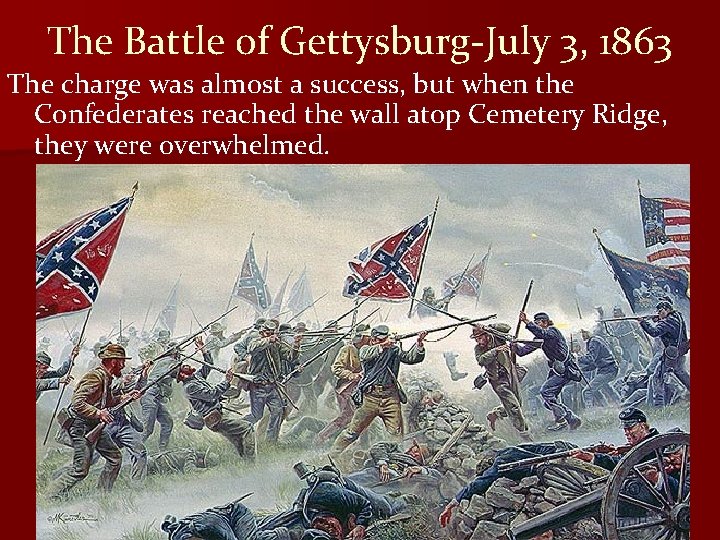
The Battle of Gettysburg-July 3, 1863 The charge was almost a success, but when the Confederates reached the wall atop Cemetery Ridge, they were overwhelmed.
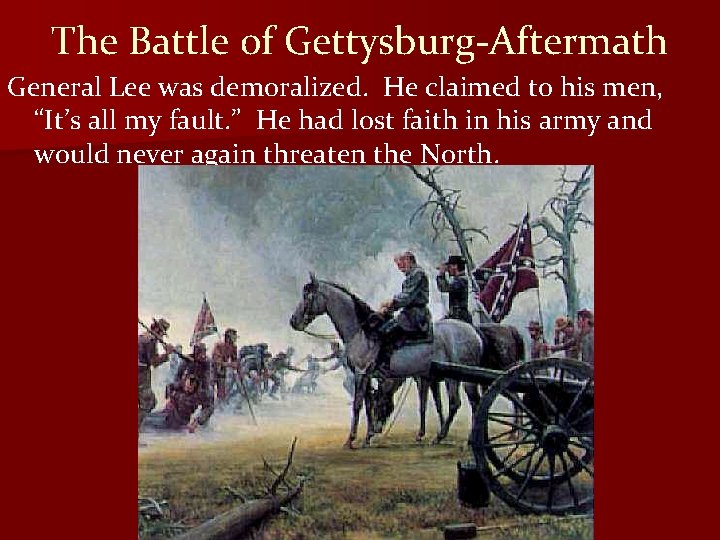
The Battle of Gettysburg-Aftermath General Lee was demoralized. He claimed to his men, “It’s all my fault. ” He had lost faith in his army and would never again threaten the North.
III. Political Issues A. Emancipation Proclamation-Sept. 22, 1862 Freed all slaves in areas still in rebellion. Actually freed no slaves. Results: -Gave union a morale crusade -Convinced Britain and France to withhold support from the Confederacy. -Encouraged blacks to enlist in Northern armies. 54 th Massachusetts-most famous black regiment.
III. Political Issues B. Republicans Divide Radicals insisted on abolition instantly. Lincoln ignored many laws passed while they controlled Congress. C. Draft Begins Difficult life caused many soldiers to desert. Union lost 1/11 men while the Confederacy lost 1/8 men. In the North, anyone could pay $300 and avoid the draft. New York City was the site of the largest draft riot in American history. D. Election of 1864 -Even though there was much opposition to him and the war, Lincoln won because of several major victories.
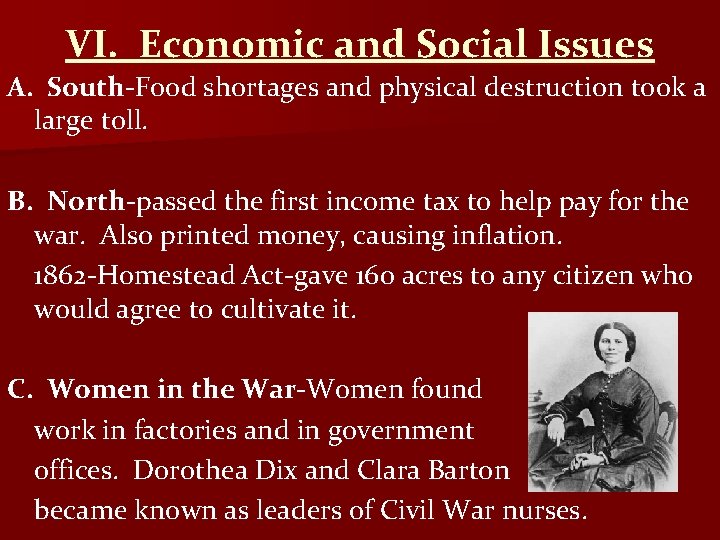
VI. Economic and Social Issues A. South-Food shortages and physical destruction took a large toll. B. North-passed the first income tax to help pay for the war. Also printed money, causing inflation. 1862 -Homestead Act-gave 160 acres to any citizen who would agree to cultivate it. C. Women in the War-Women found work in factories and in government offices. Dorothea Dix and Clara Barton became known as leaders of Civil War nurses.
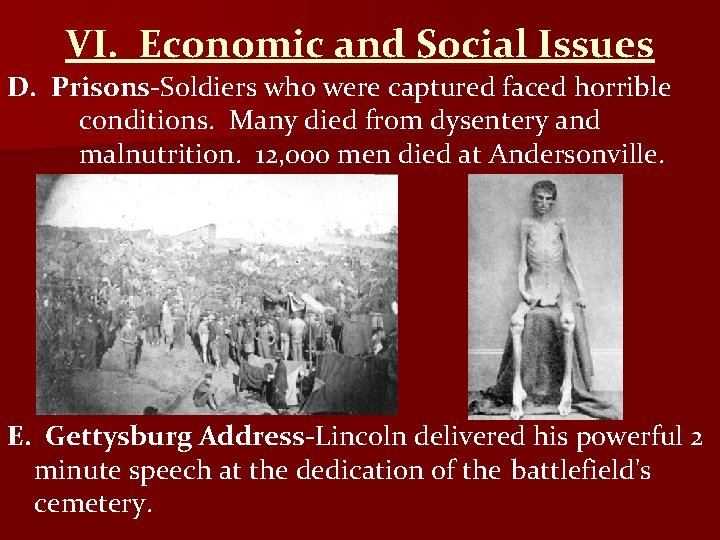
VI. Economic and Social Issues D. Prisons-Soldiers who were captured faced horrible conditions. Many died from dysentery and malnutrition. 12, 000 men died at Andersonville. E. Gettysburg Address-Lincoln delivered his powerful 2 minute speech at the dedication of the battlefield's cemetery.
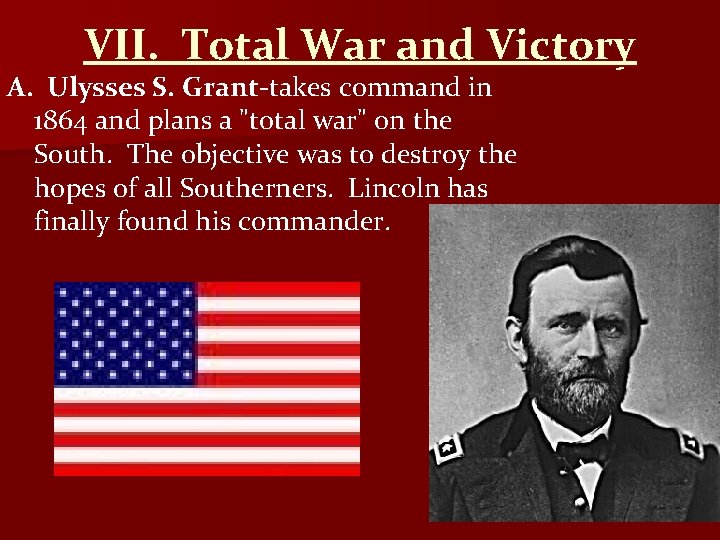
VII. Total War and Victory A. Ulysses S. Grant-takes command in 1864 and plans a "total war" on the South. The objective was to destroy the hopes of all Southerners. Lincoln has finally found his commander.
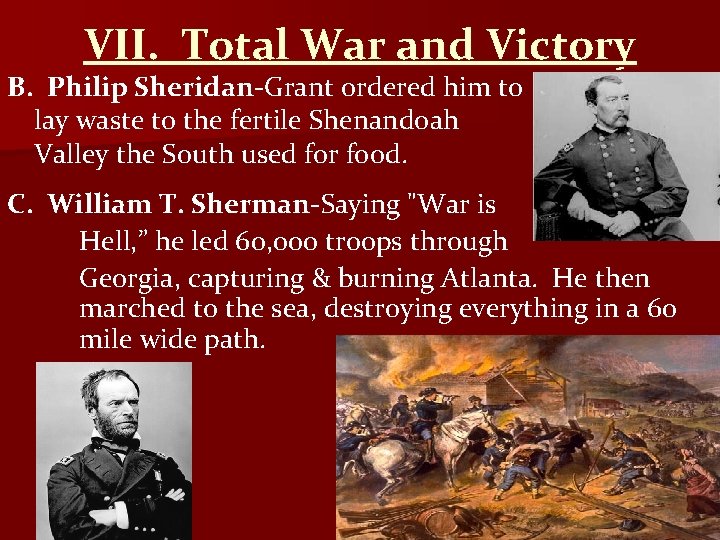
VII. Total War and Victory B. Philip Sheridan-Grant ordered him to lay waste to the fertile Shenandoah Valley the South used for food. C. William T. Sherman-Saying "War is Hell, ” he led 60, 000 troops through Georgia, capturing & burning Atlanta. He then marched to the sea, destroying everything in a 60 mile wide path.
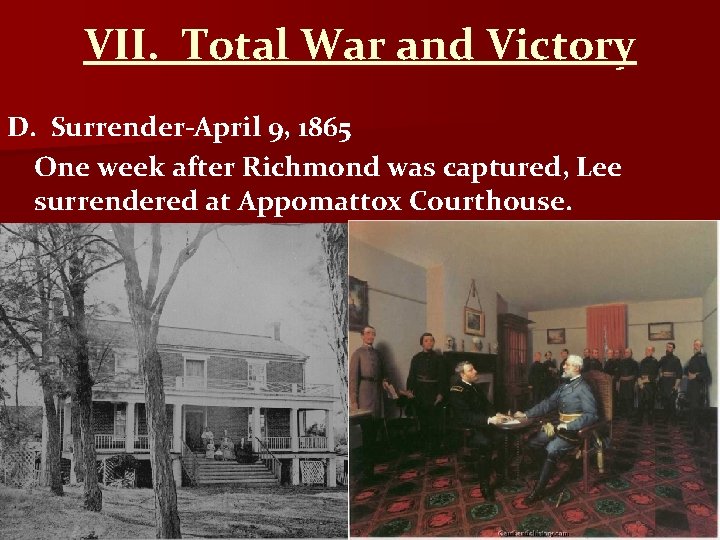
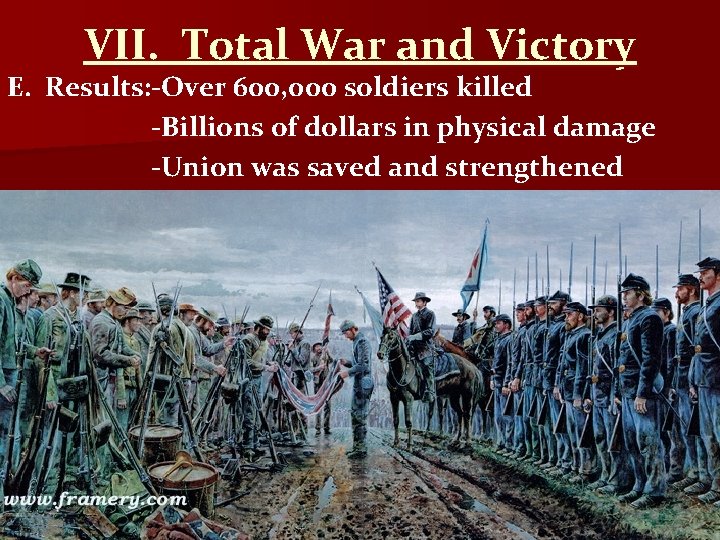
VII. Total War and Victory D. Surrender-April 9, 1865 One week after Richmond was captured, Lee surrendered at Appomattox Courthouse.
VII. Total War and Victory E. Results: -Over 600, 000 soldiers killed -Billions of dollars in physical damage -Union was saved and strengthened
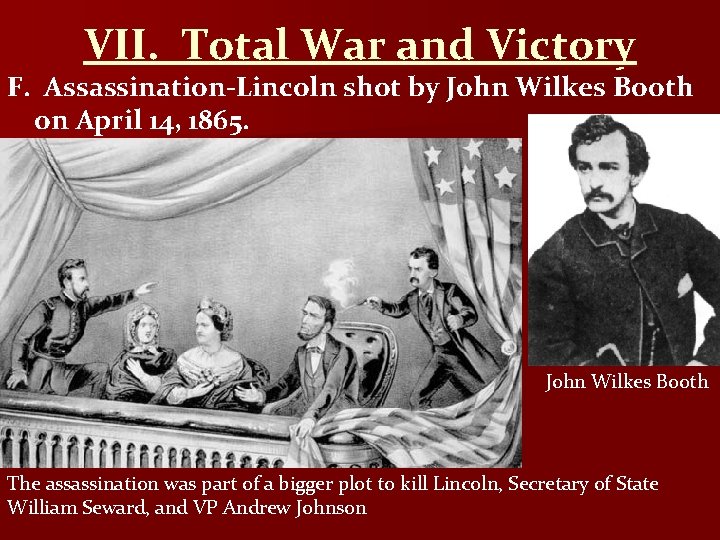
VII. Total War and Victory F. Assassination-Lincoln shot by John Wilkes Booth on April 14, 1865. John Wilkes Booth The assassination was part of a bigger plot to kill Lincoln, Secretary of State William Seward, and VP Andrew Johnson
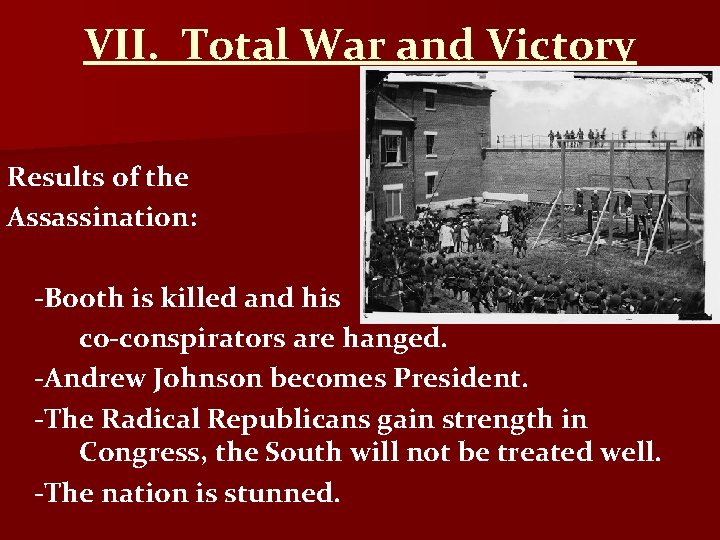
VII. Total War and Victory Results of the Assassination: -Booth is killed and his co-conspirators are hanged. -Andrew Johnson becomes President. -The Radical Republicans gain strength in Congress, the South will not be treated well. -The nation is stunned.