
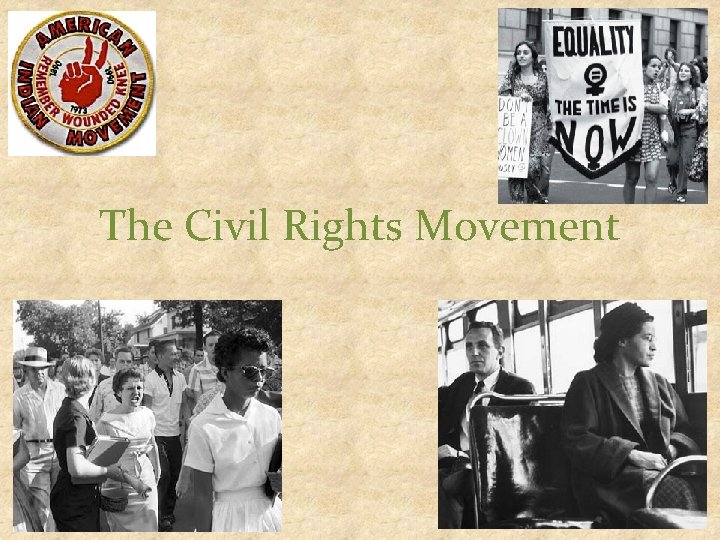
The Civil Rights Movement We hold these truths

- Slides: 82
The Civil Rights Movement
“We hold these truths to be self evident. That all men are created equal. Endowed by their maker with certain inalienably rights among which are life, liberty, and the pursuit of happiness…” -Declaration of Independence of the United States of America
SETTING THE STAGE
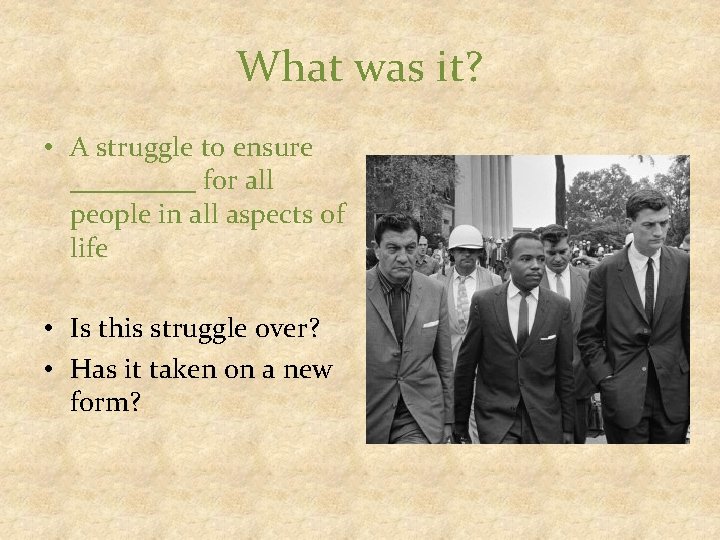
What was it? • A struggle to ensure _____ for all people in all aspects of life • Is this struggle over? • Has it taken on a new form?
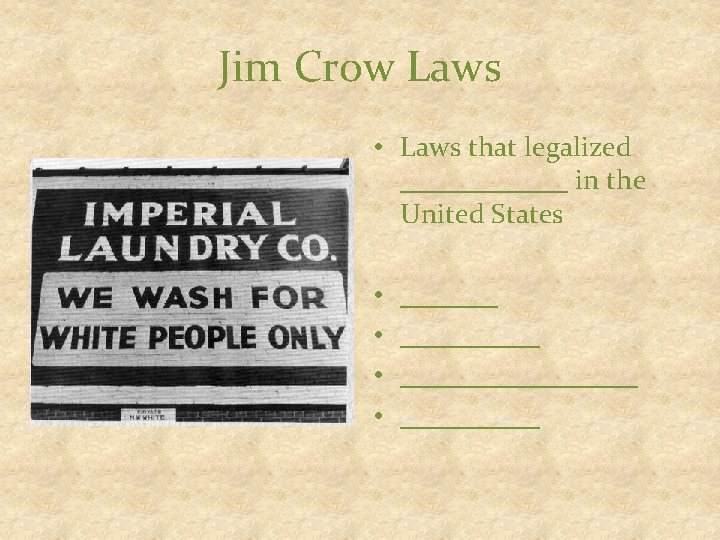
Jim Crow Laws • Laws that legalized ______ in the United States • • __________ _____
Segregation Dividing society along a _______ (i. e. gender, race, social status)
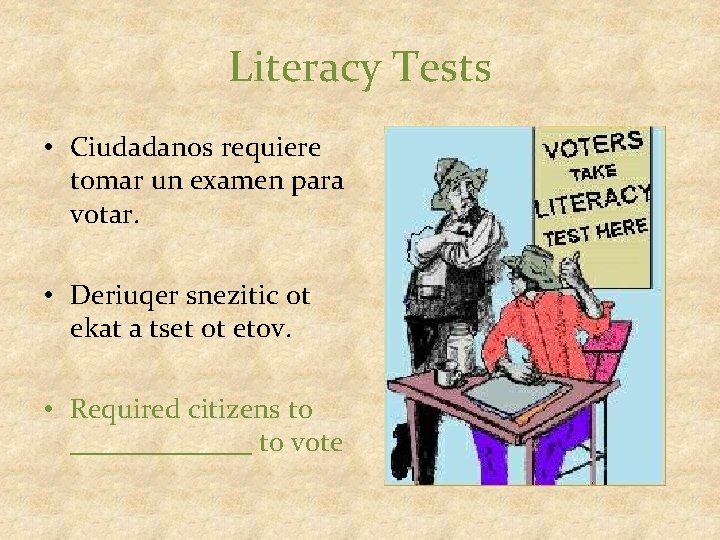
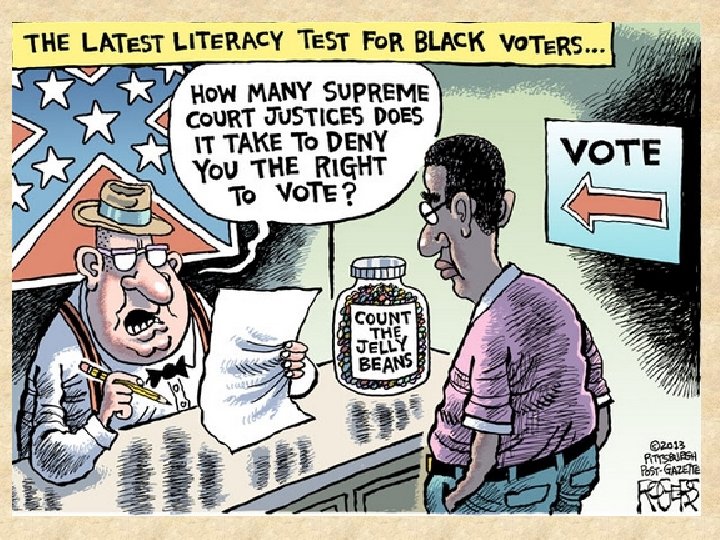
Literacy Tests • Ciudadanos requiere tomar un examen para votar. • Deriuqer snezitic ot ekat a tset ot etov. • Required citizens to _______ to vote
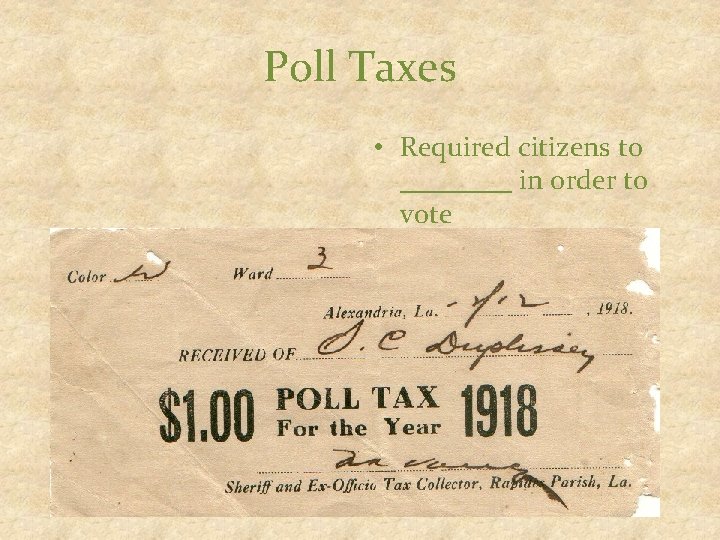
Poll Taxes • Required citizens to ____ in order to vote
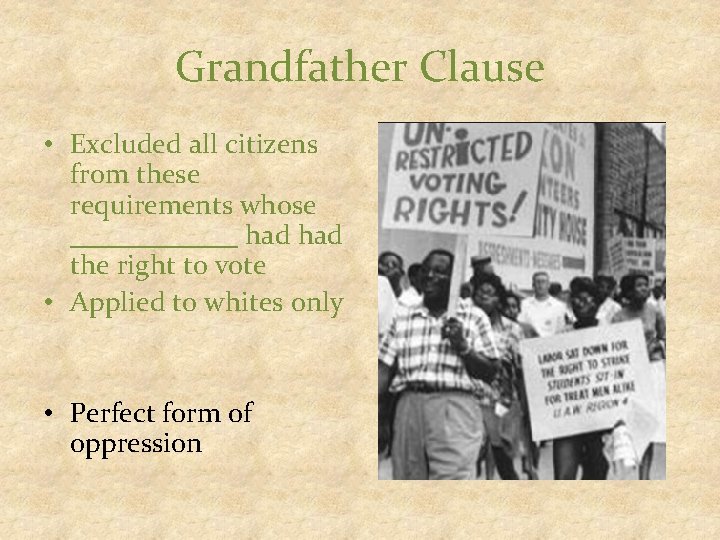
Grandfather Clause • Excluded all citizens from these requirements whose ______ had the right to vote • Applied to whites only • Perfect form of oppression
FIGHTING BACK: 19 TH CENTURY
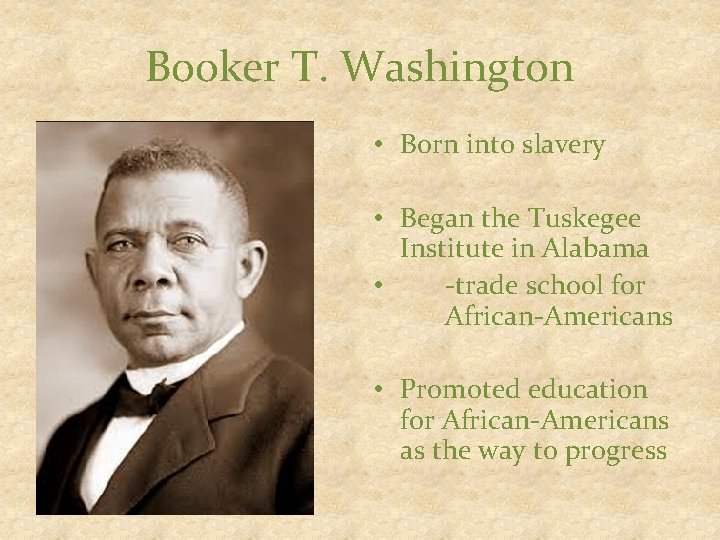
Booker T. Washington • Born into slavery • Began the Tuskegee Institute in Alabama • -trade school for African-Americans • Promoted education for African-Americans as the way to progress
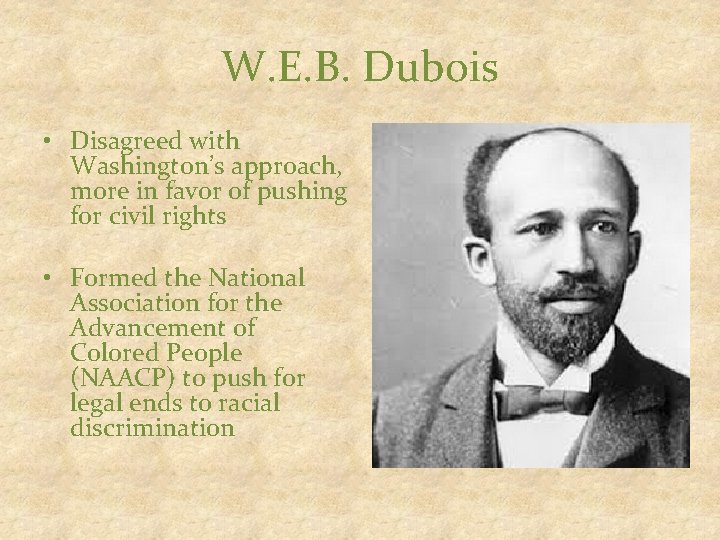
W. E. B. Dubois • Disagreed with Washington’s approach, more in favor of pushing for civil rights • Formed the National Association for the Advancement of Colored People (NAACP) to push for legal ends to racial discrimination
Important Amendments • 13 th: Abolished slavery in the United States (Dec. 6, 1865) • 14 th: Defined what a U. S. citizen is; states cannot deny any citizen of their rights (July 28, 1868) • 15 th: States cannot deny the right to vote to any male U. S. citizen over 21 years old (Mar. 30, 1870)
FIGHTING BACK: 20 TH CENTURY
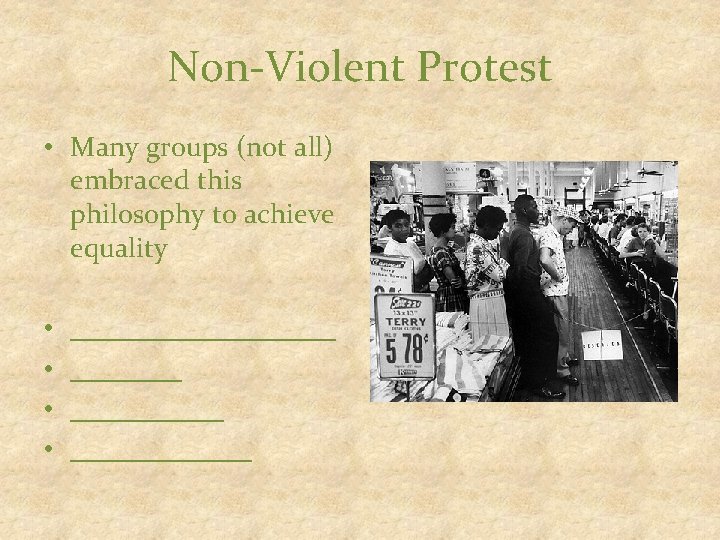
Non-Violent Protest • Many groups (not all) embraced this philosophy to achieve equality • • ___________ _______
NAACP 1. National Association for the Advancement of Colored People 2. ________ group of its kind in the country 3. Active throughout the Civil Rights Movement 1. 2. 3. ____________________
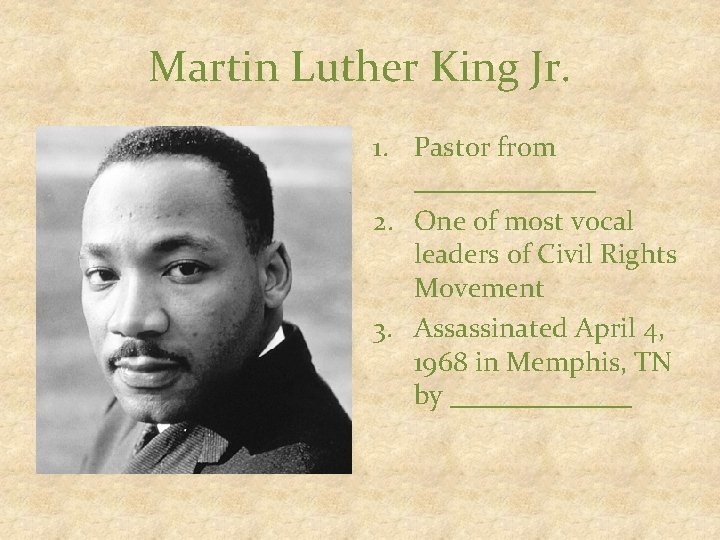
Martin Luther King Jr. 1. Pastor from _______ 2. One of most vocal leaders of Civil Rights Movement 3. Assassinated April 4, 1968 in Memphis, TN by _______
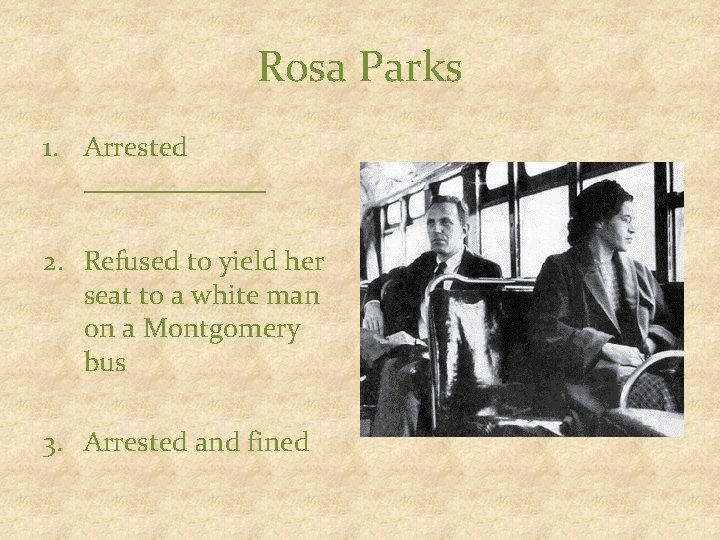
Rosa Parks 1. Arrested _______ 2. Refused to yield her seat to a white man on a Montgomery bus 3. Arrested and fined
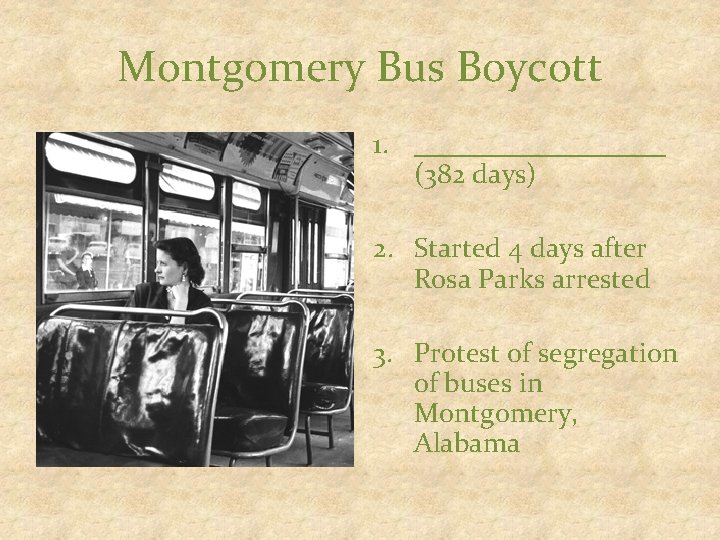
Montgomery Bus Boycott 1. _________ (382 days) 2. Started 4 days after Rosa Parks arrested 3. Protest of segregation of buses in Montgomery, Alabama
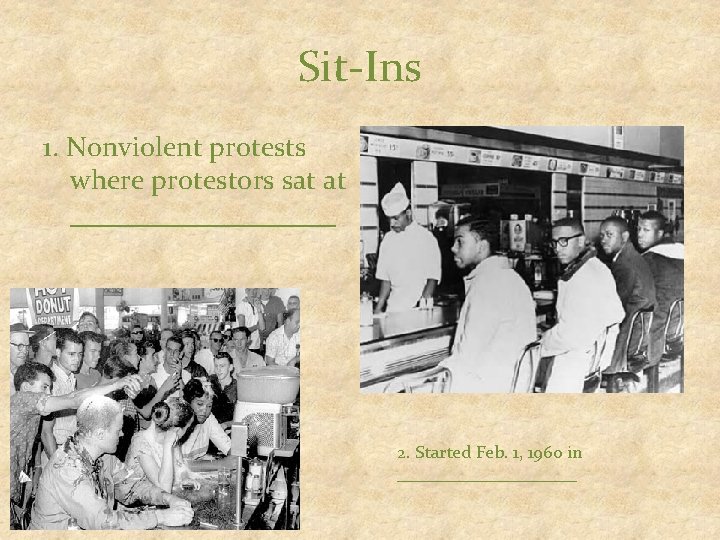
Sit-Ins 1. Nonviolent protests where protestors sat at __________ 2. Started Feb. 1, 1960 in __________
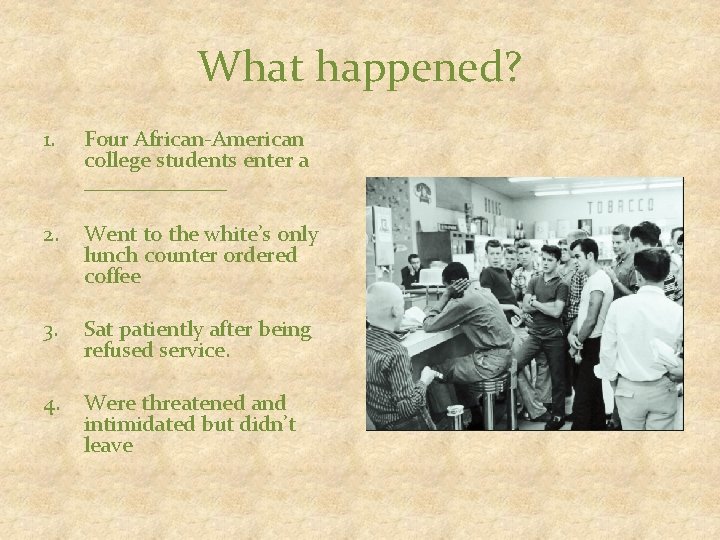
What happened? 1. Four African-American college students enter a _______ 2. Went to the white’s only lunch counter ordered coffee 3. Sat patiently after being refused service. 4. Were threatened and intimidated but didn’t leave
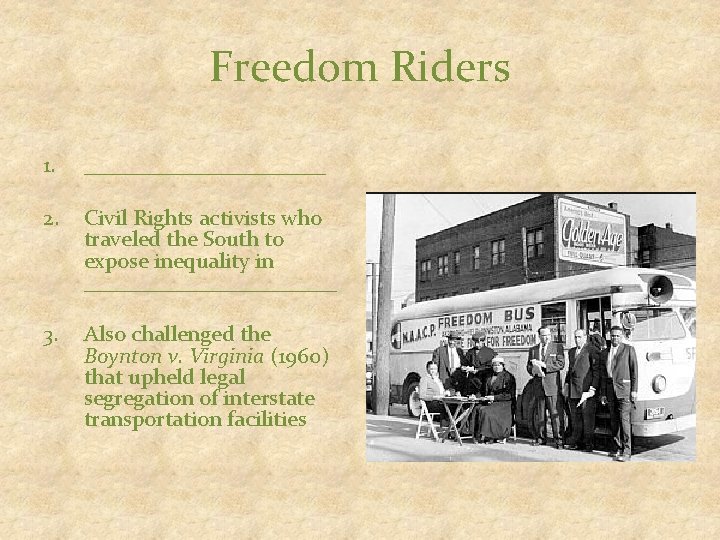
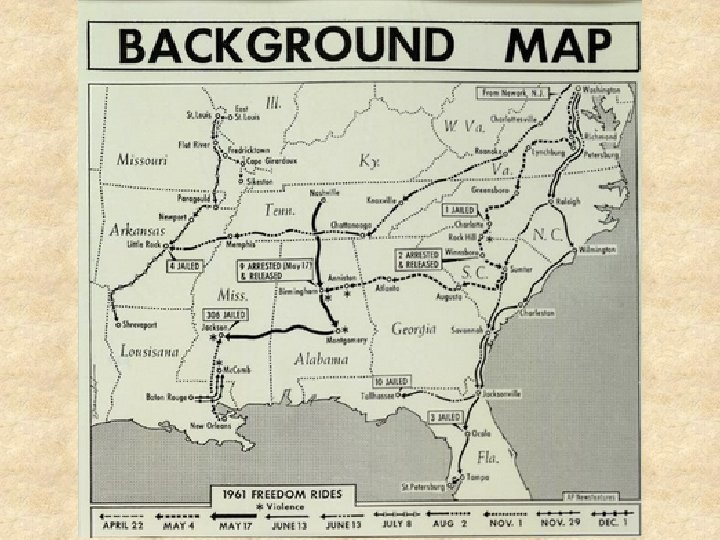
Freedom Riders 1. ___________ 2. Civil Rights activists who traveled the South to expose inequality in ____________ 3. Also challenged the Boynton v. Virginia (1960) that upheld legal segregation of interstate transportation facilities
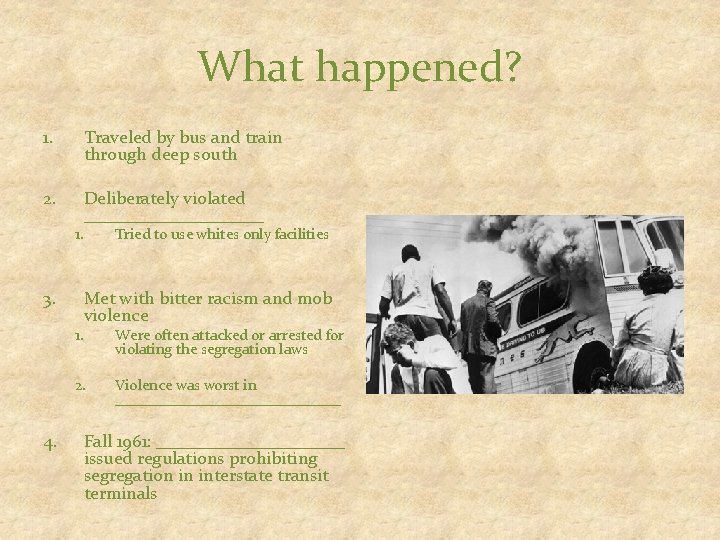
What happened? 1. Traveled by bus and train through deep south 2. Deliberately violated __________ 1. 3. 1. Tried to use whites only facilities Met with bitter racism and mob violence Were often attacked or arrested for violating the segregation laws 2. 4. Violence was worst in _______________ Fall 1961: ___________ issued regulations prohibiting segregation in interstate transit terminals
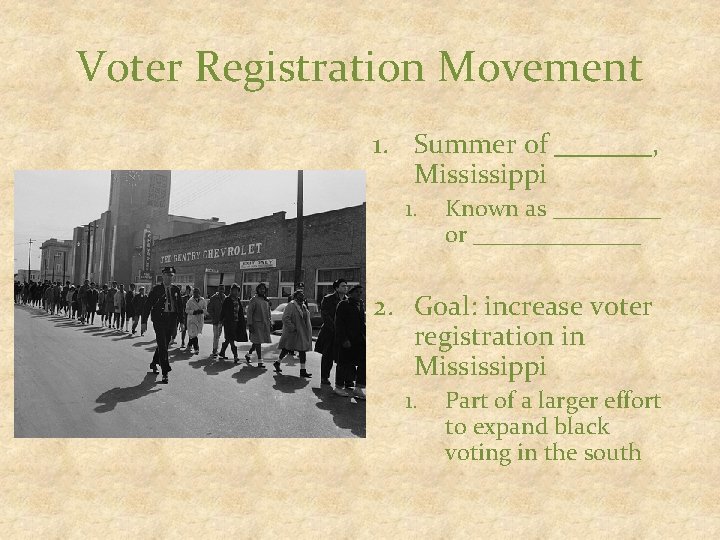
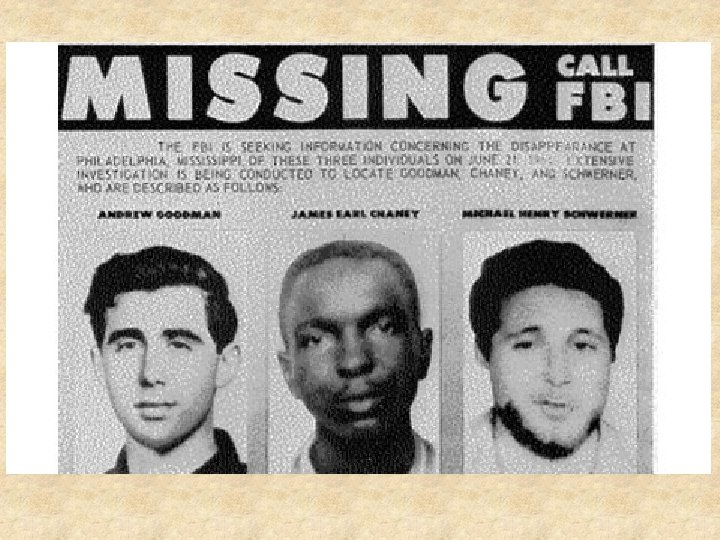
Voter Registration Movement 1. Summer of _______, Mississippi 1. Known as _____ or _______ 2. Goal: increase voter registration in Mississippi 1. Part of a larger effort to expand black voting in the south
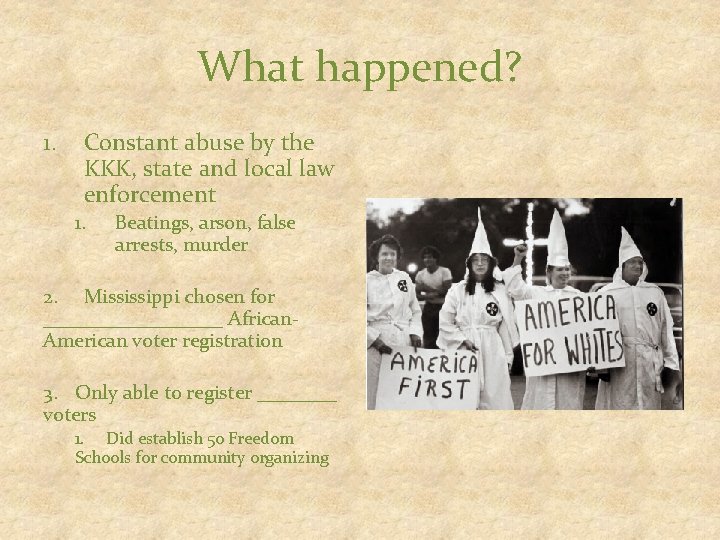
What happened? 1. Constant abuse by the KKK, state and local law enforcement 1. Beatings, arson, false arrests, murder 2. Mississippi chosen for _________ African. American voter registration 3. Only able to register ____ voters 1. Did establish 50 Freedom Schools for community organizing
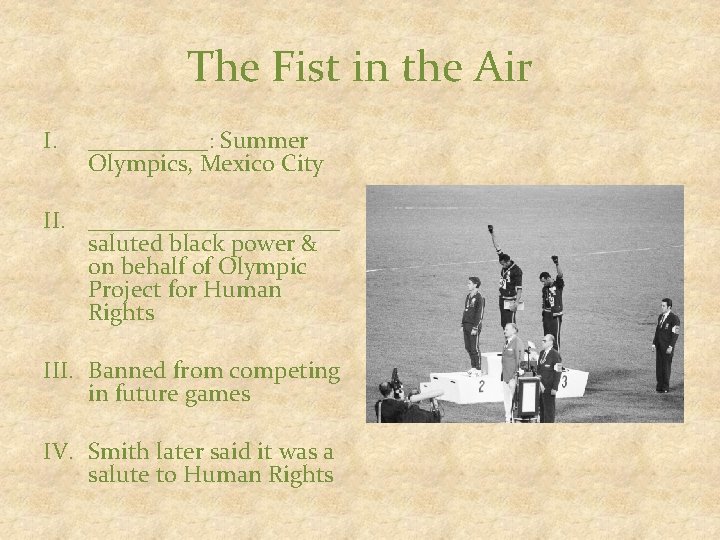
The Fist in the Air I. _____: Summer Olympics, Mexico City II. ___________ saluted black power & on behalf of Olympic Project for Human Rights III. Banned from competing in future games IV. Smith later said it was a salute to Human Rights
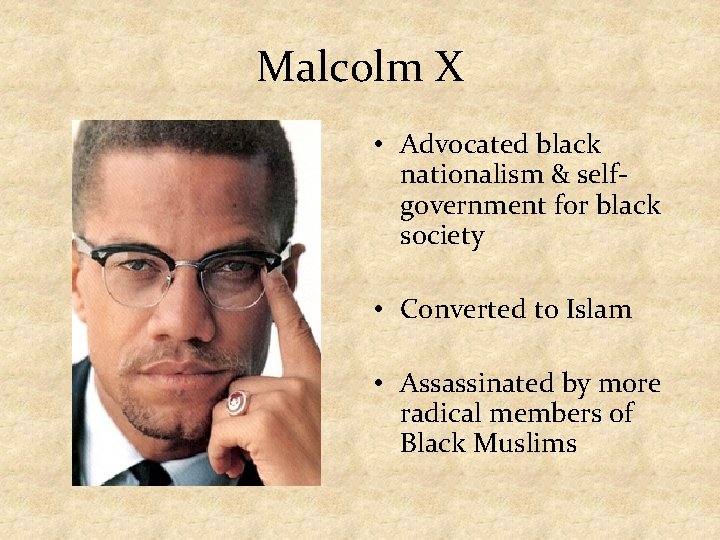
Malcolm X • Advocated black nationalism & selfgovernment for black society • Converted to Islam • Assassinated by more radical members of Black Muslims
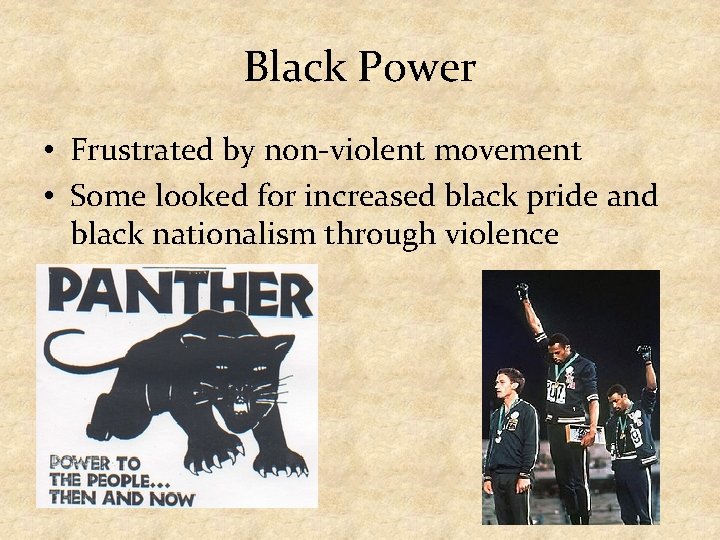
Black Power • Frustrated by non-violent movement • Some looked for increased black pride and black nationalism through violence
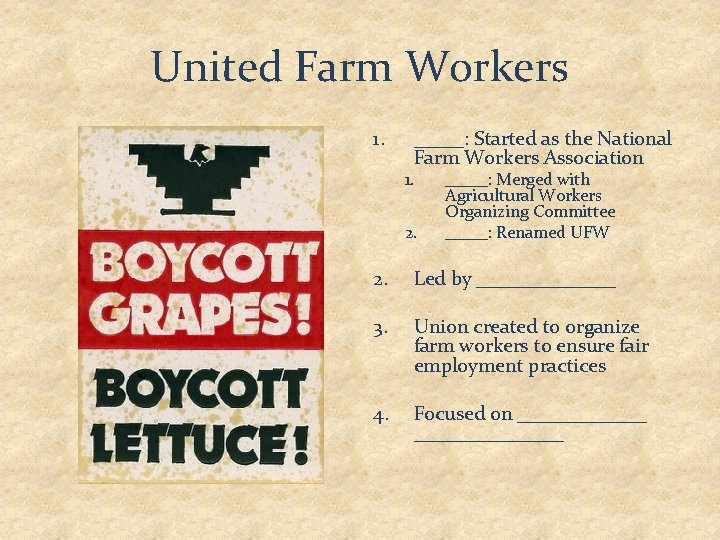
United Farm Workers 1. _____: Started as the National Farm Workers Association 1. 2. _____: Merged with Agricultural Workers Organizing Committee _____: Renamed UFW 2. Led by _______ 3. Union created to organize farm workers to ensure fair employment practices 4. Focused on _______________
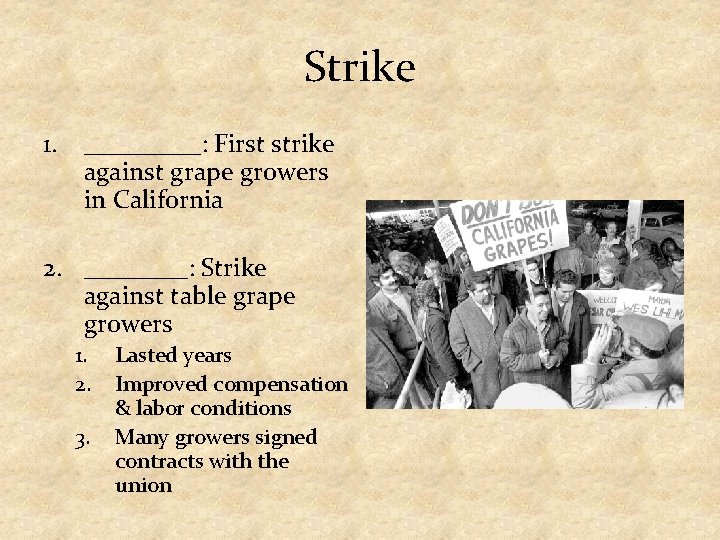
Strike 1. _____: First strike against grape growers in California 2. ____: Strike against table grape growers 1. 2. 3. Lasted years Improved compensation & labor conditions Many growers signed contracts with the union
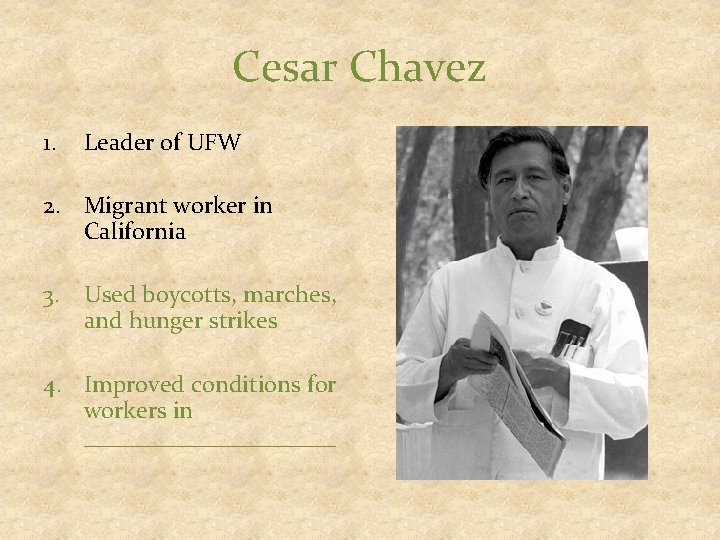
Cesar Chavez 1. Leader of UFW 2. Migrant worker in California 3. Used boycotts, marches, and hunger strikes 4. Improved conditions for workers in ___________
WOMEN’S SUFFRAGE
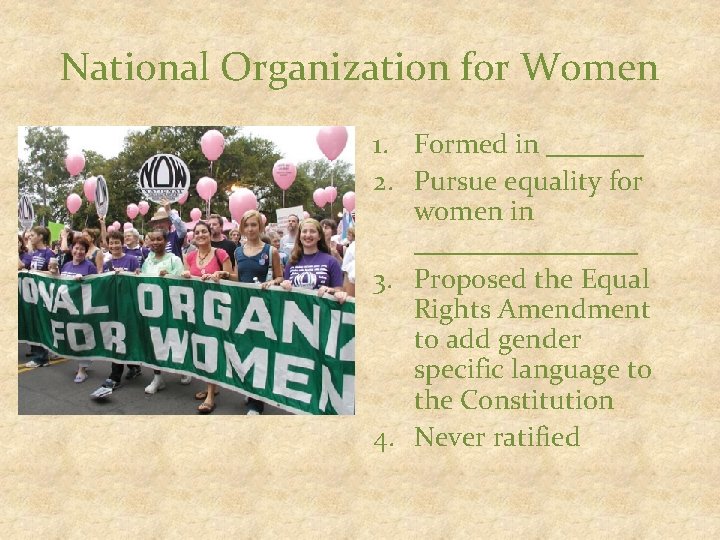
National Organization for Women 1. Formed in _______ 2. Pursue equality for women in ________ 3. Proposed the Equal Rights Amendment to add gender specific language to the Constitution 4. Never ratified
Is this an issue still today for women? On average, women make 77 cents for ever $1 men make
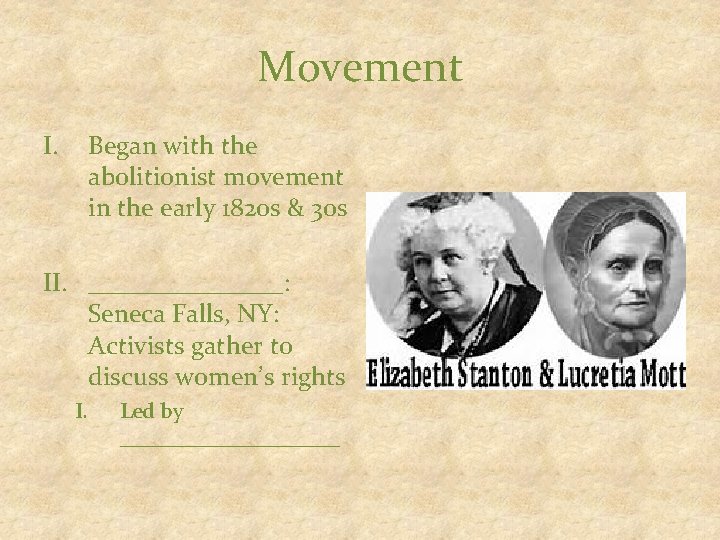
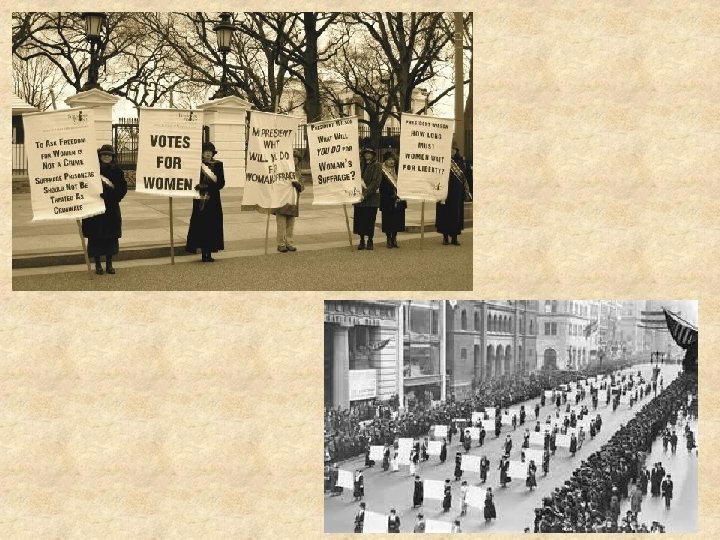
Movement I. Began with the abolitionist movement in the early 1820 s & 30 s II. ________: Seneca Falls, NY: Activists gather to discuss women’s rights I. Led by __________
Movement Continued I. Lost momentum during the Civil War II. Tried to build off of the 14 th & 15 th Amendments III. Split in the movement based on whether or not to use momentum of black rights movements IV. Work state-by-state (American Women’s Suffrage Association) vs. Constitutionalists (National Women Suffrage Association)
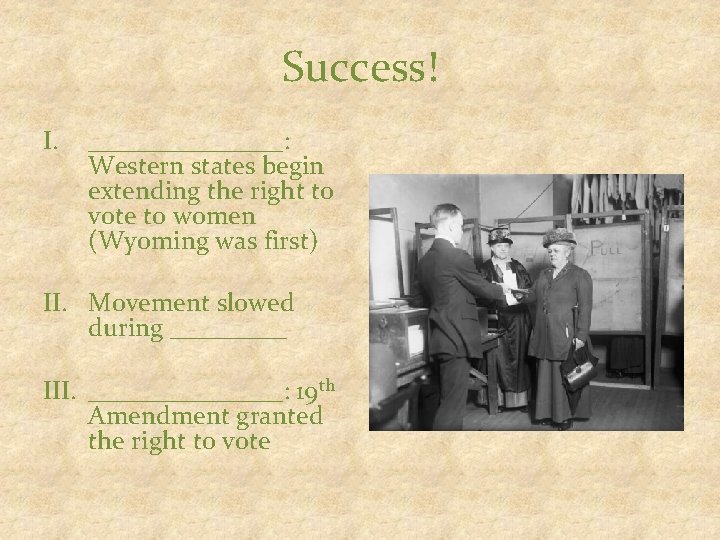
Success! I. ________: Western states begin extending the right to vote to women (Wyoming was first) II. Movement slowed during _____ III. ________: 19 th Amendment granted the right to vote
RESULTS
Supreme Court Cases • The Civil Rights era was defined by a series of landmark Supreme Court Cases that came to define what is fair and what is equal in this country. • We will look at the most influential cases on American society from 1803 to 1975
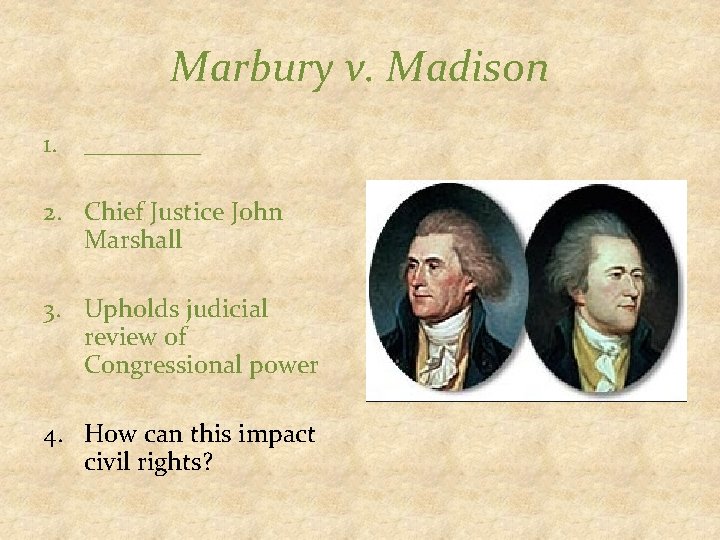
Marbury v. Madison 1. _____ 2. Chief Justice John Marshall 3. Upholds judicial review of Congressional power 4. How can this impact civil rights?
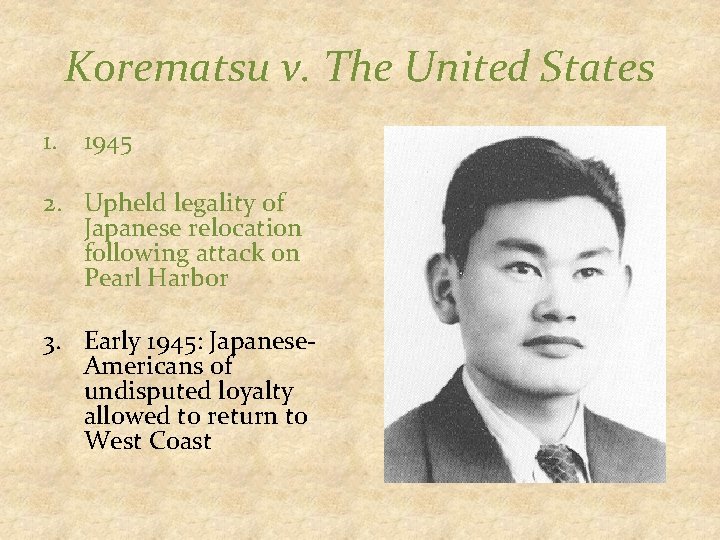
Korematsu v. The United States 1. 1945 2. Upheld legality of Japanese relocation following attack on Pearl Harbor 3. Early 1945: Japanese. Americans of undisputed loyalty allowed to return to West Coast
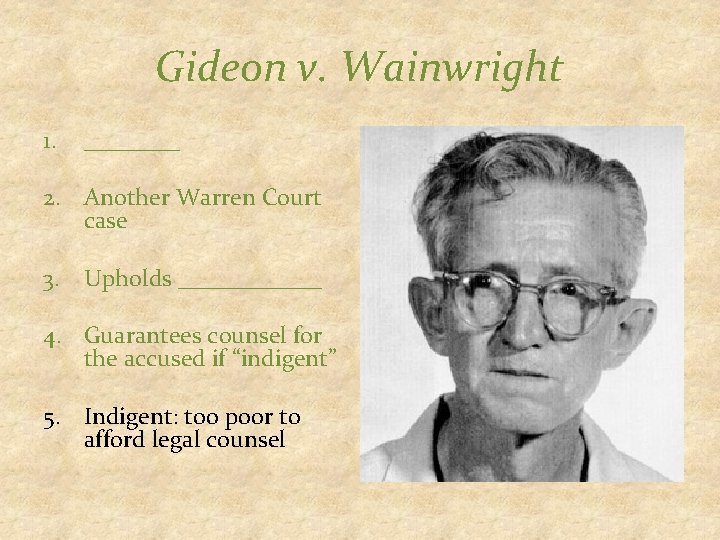
Gideon v. Wainwright 1. ____ 2. Another Warren Court case 3. Upholds ______ 4. Guarantees counsel for the accused if “indigent” 5. Indigent: too poor to afford legal counsel
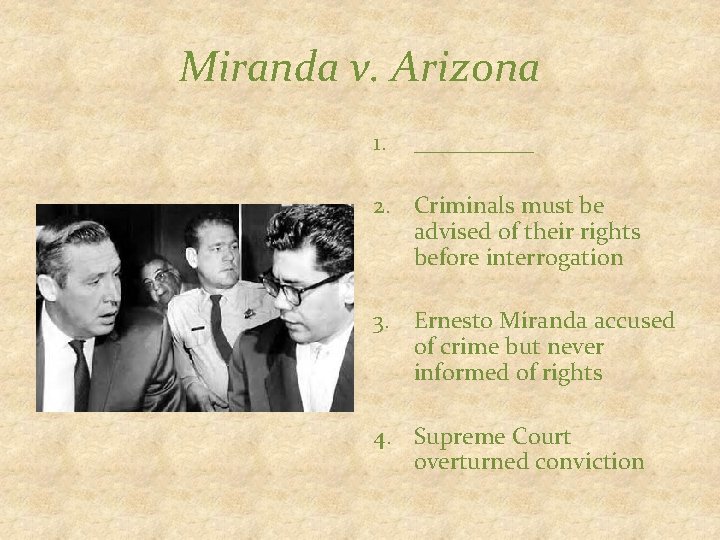
Miranda v. Arizona 1. _____ 2. Criminals must be advised of their rights before interrogation 3. Ernesto Miranda accused of crime but never informed of rights 4. Supreme Court overturned conviction
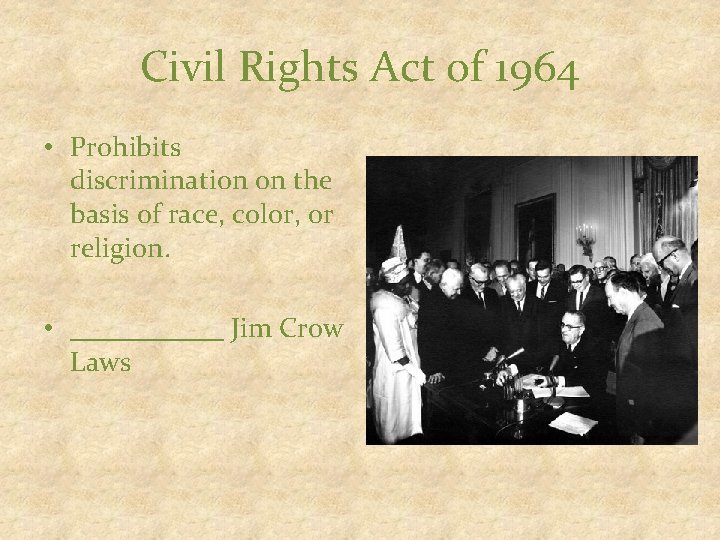
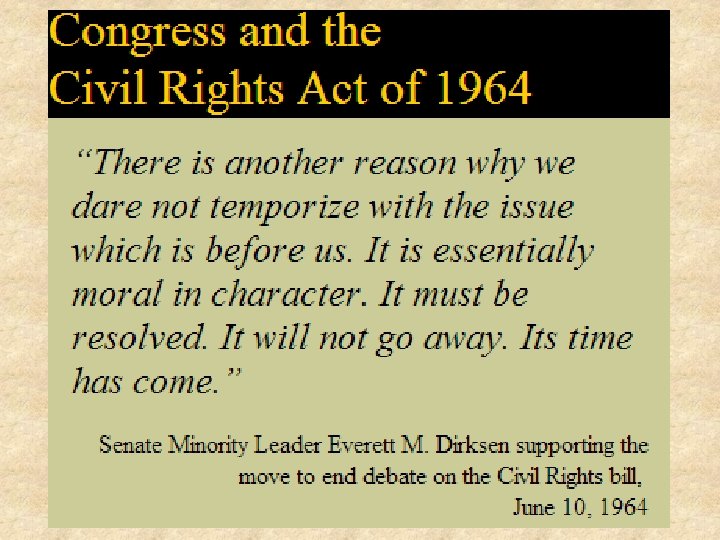
Civil Rights Act of 1964 • Prohibits discrimination on the basis of race, color, or religion. • ______ Jim Crow Laws
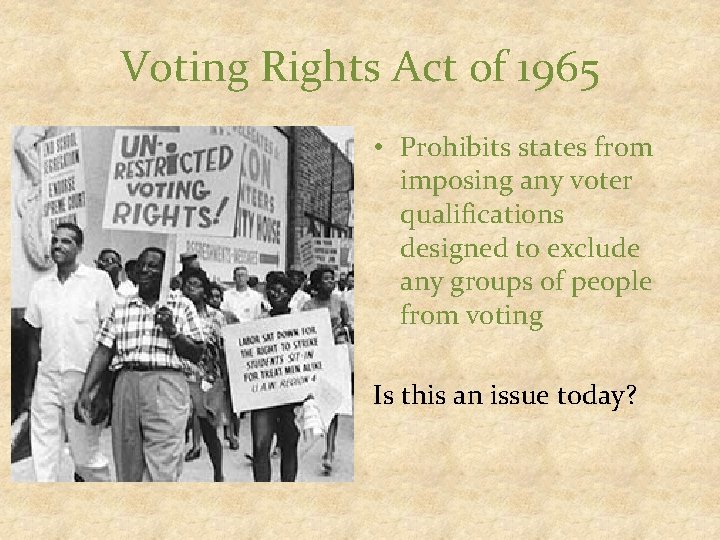
Voting Rights Act of 1965 • Prohibits states from imposing any voter qualifications designed to exclude any groups of people from voting Is this an issue today?
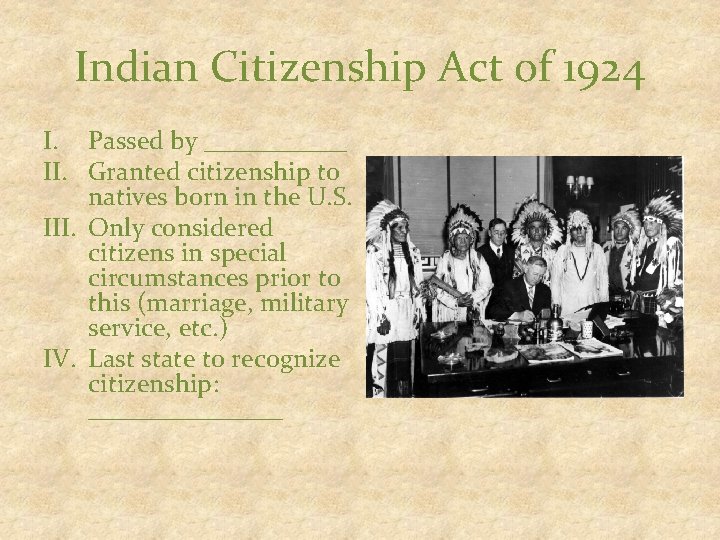
Indian Citizenship Act of 1924 I. Passed by ______ II. Granted citizenship to natives born in the U. S. III. Only considered citizens in special circumstances prior to this (marriage, military service, etc. ) IV. Last state to recognize citizenship: ________
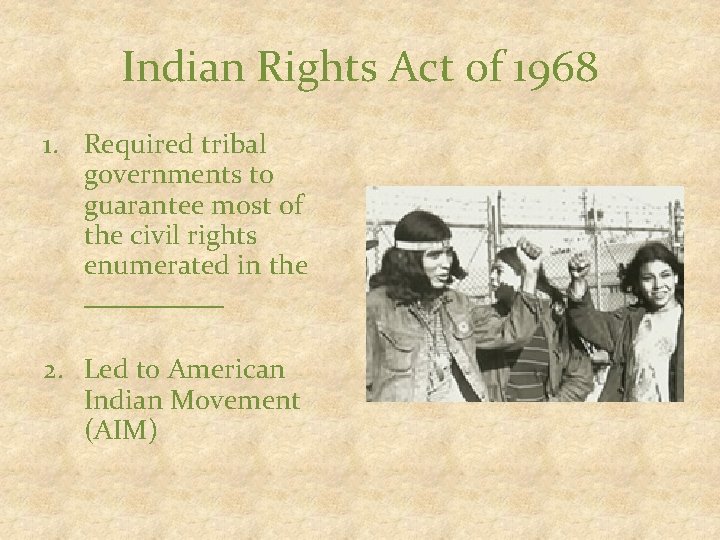
Indian Rights Act of 1968 1. Required tribal governments to guarantee most of the civil rights enumerated in the _____ 2. Led to American Indian Movement (AIM)
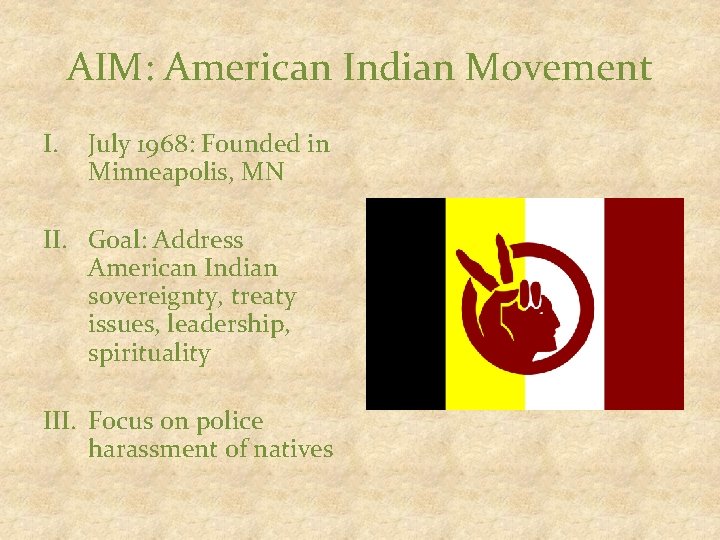
AIM: American Indian Movement I. July 1968: Founded in Minneapolis, MN II. Goal: Address American Indian sovereignty, treaty issues, leadership, spirituality III. Focus on police harassment of natives
Americans with Disabilities Act 1. _____ 2. Guarantees equalities similar to those of Civil Rights Act of 1964 3. Specifically prohibits discrimination based on physical disabilities
DESEGREGATION
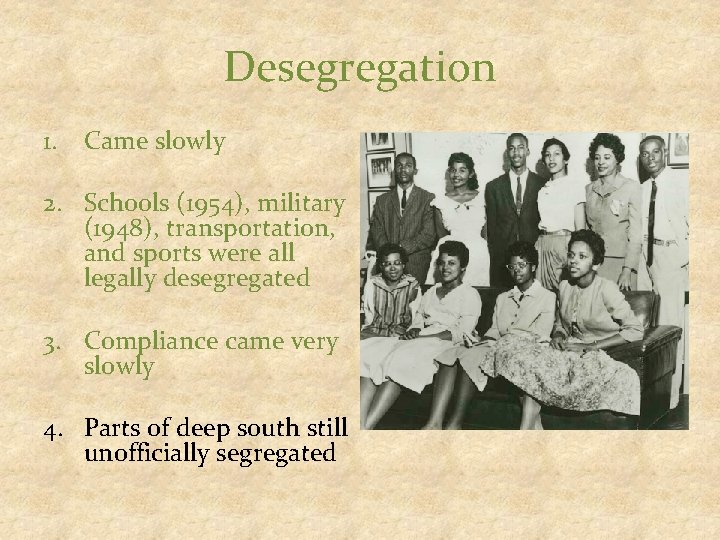
Desegregation 1. Came slowly 2. Schools (1954), military (1948), transportation, and sports were all legally desegregated 3. Compliance came very slowly 4. Parts of deep south still unofficially segregated
SCHOOLS
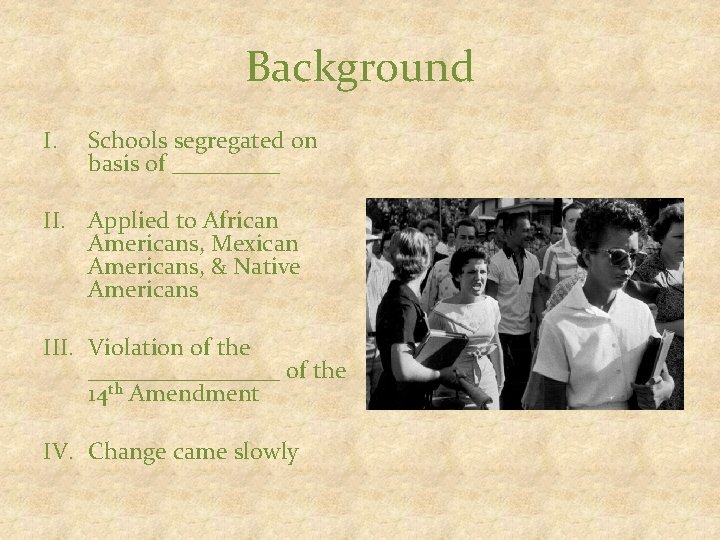
Background I. Schools segregated on basis of _____ II. Applied to African Americans, Mexican Americans, & Native Americans III. Violation of the ________ of the 14 th Amendment IV. Change came slowly
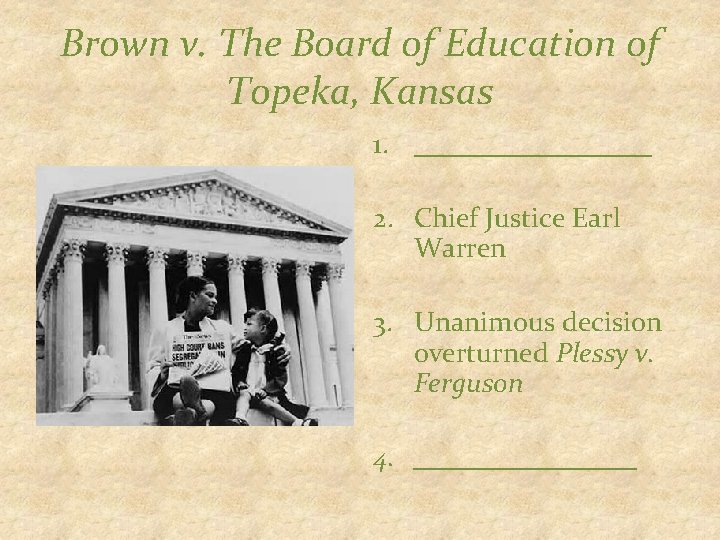
Brown v. The Board of Education of Topeka, Kansas 1. _________ 2. Chief Justice Earl Warren 3. Unanimous decision overturned Plessy v. Ferguson 4. ________
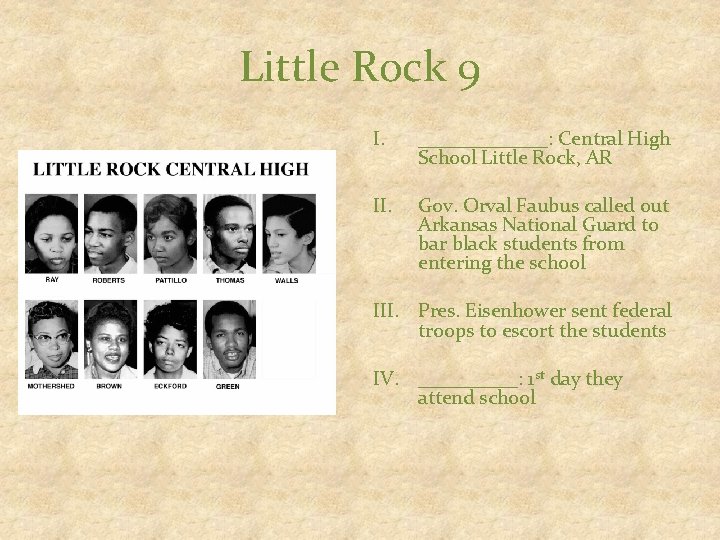
Little Rock 9 I. _______: Central High School Little Rock, AR II. Gov. Orval Faubus called out Arkansas National Guard to bar black students from entering the school III. Pres. Eisenhower sent federal troops to escort the students IV. _____: 1 st day they attend school
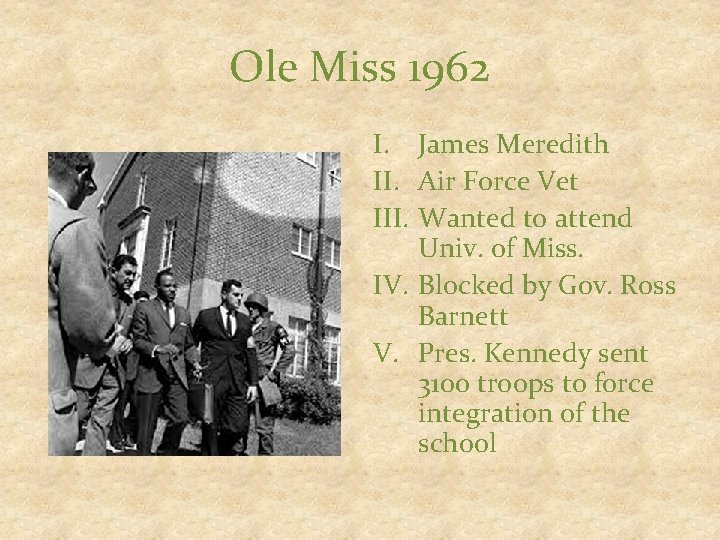
Ole Miss 1962 I. James Meredith II. Air Force Vet III. Wanted to attend Univ. of Miss. IV. Blocked by Gov. Ross Barnett V. Pres. Kennedy sent 3100 troops to force integration of the school
MILITARY
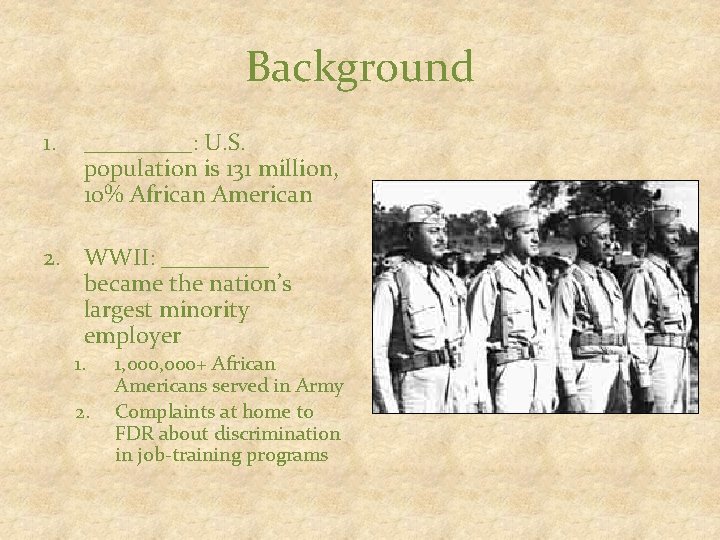
Background 1. _____: U. S. population is 131 million, 10% African American 2. WWII: _____ became the nation’s largest minority employer 1. 2. 1, 000+ African Americans served in Army Complaints at home to FDR about discrimination in job-training programs
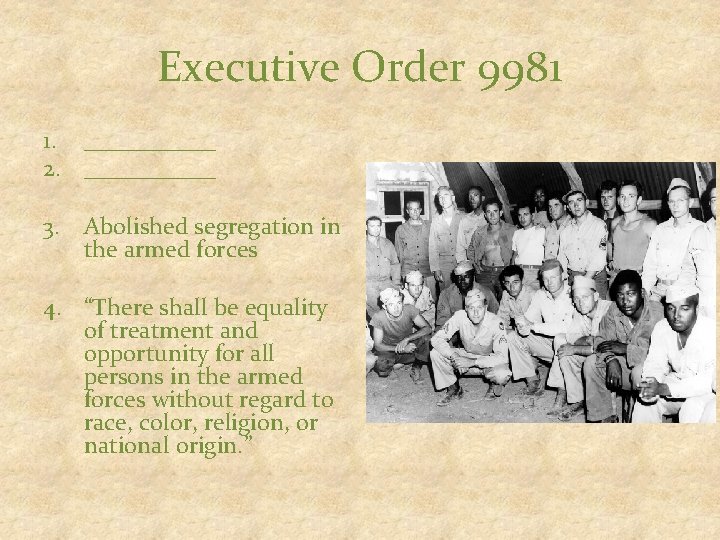
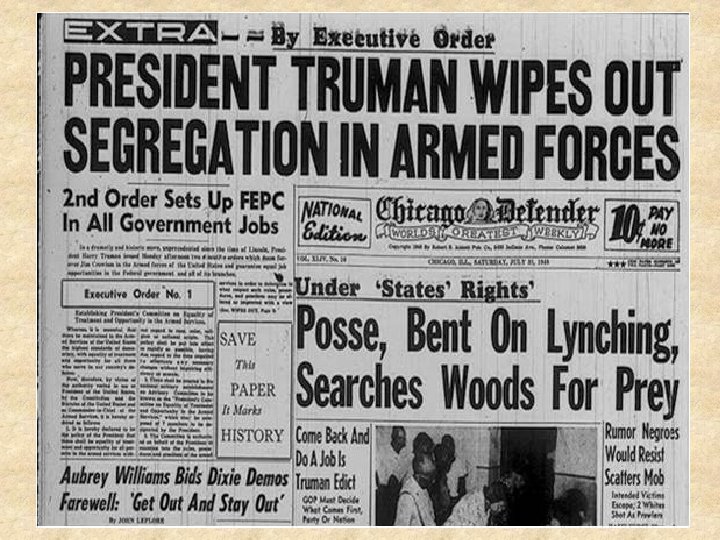
Executive Order 9981 1. ______ 2. ______ 3. Abolished segregation in the armed forces 4. “There shall be equality of treatment and opportunity for all persons in the armed forces without regard to race, color, religion, or national origin. ”
TRANSPORTATION
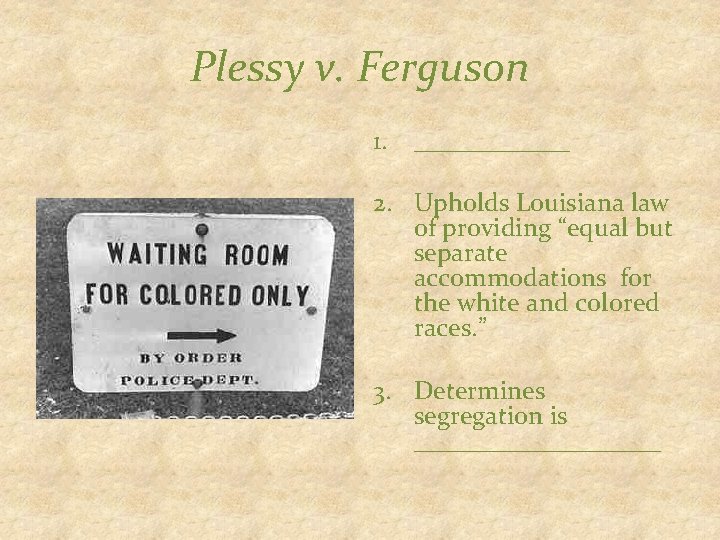
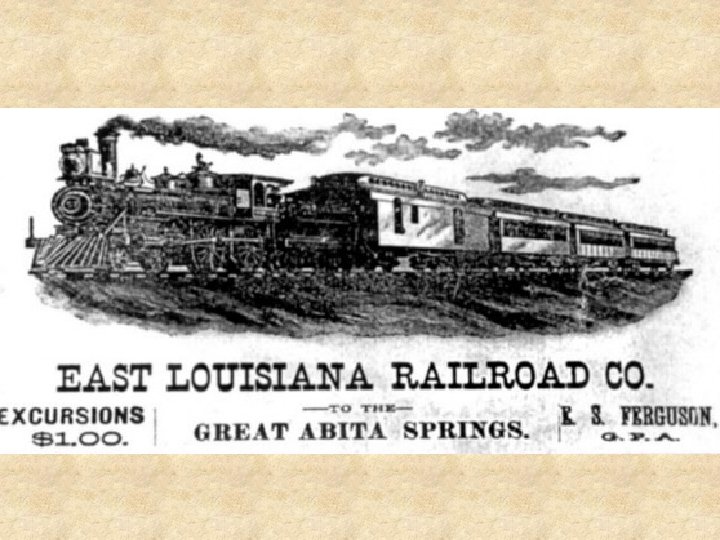
Plessy v. Ferguson 1. ______ 2. Upholds Louisiana law of providing “equal but separate accommodations for the white and colored races. ” 3. Determines segregation is __________
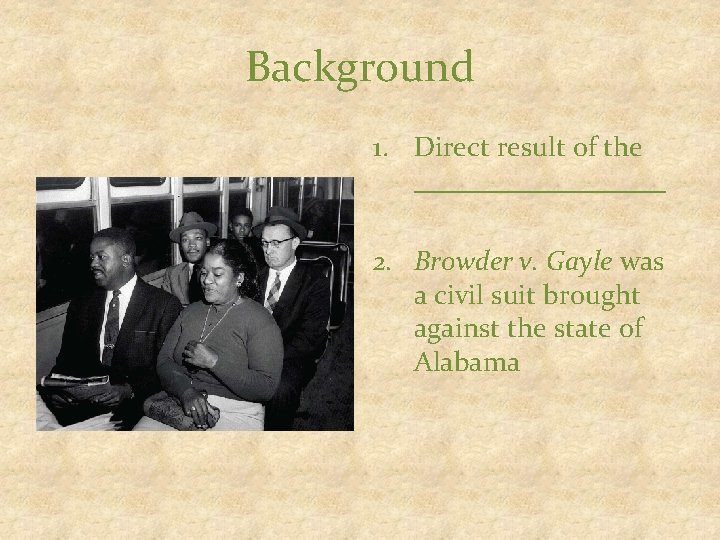
Background 1. Direct result of the _________ 2. Browder v. Gayle was a civil suit brought against the state of Alabama
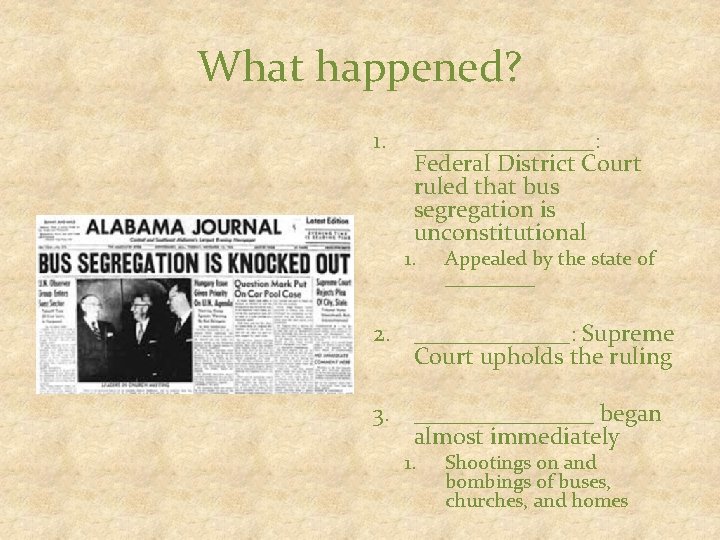
What happened? 1. ________: Federal District Court ruled that bus segregation is unconstitutional 1. Appealed by the state of _____ 2. _______: Supreme Court upholds the ruling 3. ________ began almost immediately 1. Shootings on and bombings of buses, churches, and homes
SPORTS
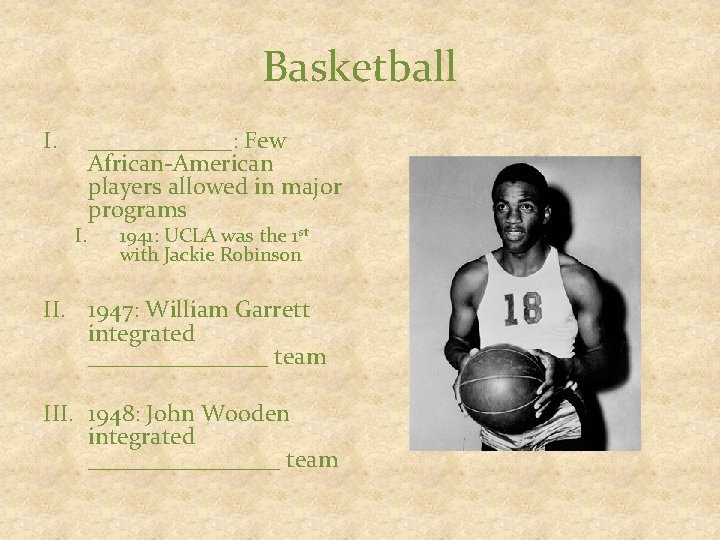
Basketball I. ______: Few African-American players allowed in major programs 1941: UCLA was the 1 st with Jackie Robinson II. 1947: William Garrett integrated ________ team III. 1948: John Wooden integrated ________ team
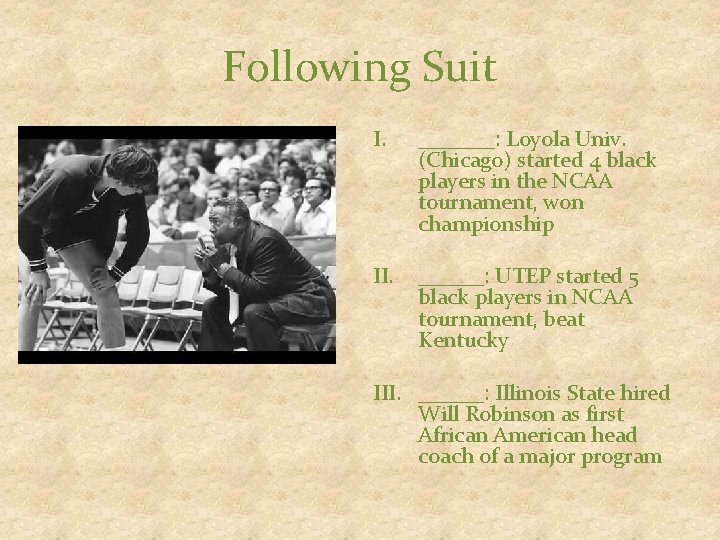
Following Suit I. _______: Loyola Univ. (Chicago) started 4 black players in the NCAA tournament, won championship II. ______: UTEP started 5 black players in NCAA tournament, beat Kentucky III. ______: Illinois State hired Will Robinson as first African American head coach of a major program
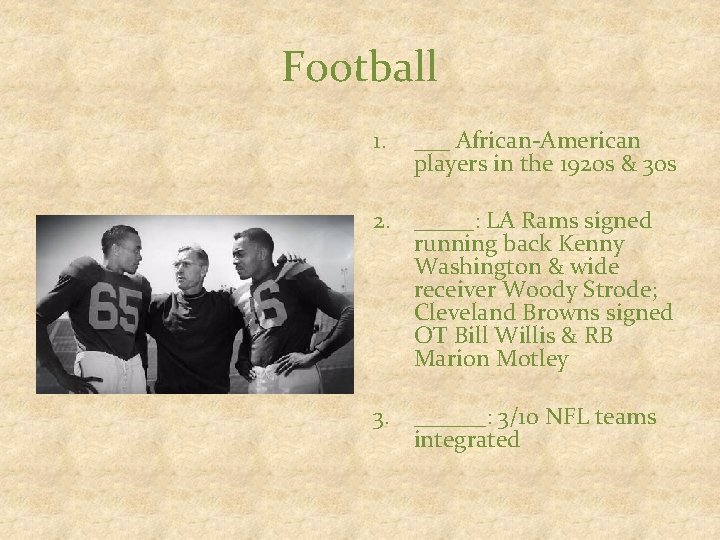
Football 1. ___ African-American players in the 1920 s & 30 s 2. _____: LA Rams signed running back Kenny Washington & wide receiver Woody Strode; Cleveland Browns signed OT Bill Willis & RB Marion Motley 3. ______: 3/10 NFL teams integrated
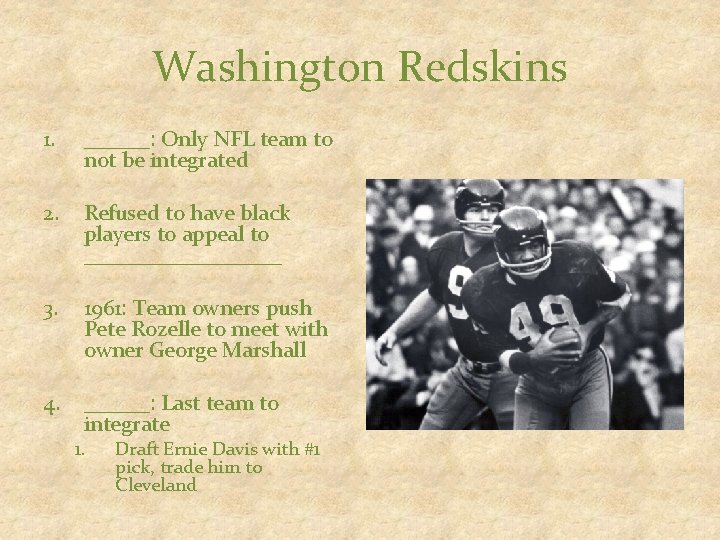
Washington Redskins 1. ______: Only NFL team to not be integrated 2. Refused to have black players to appeal to _________ 3. 1961: Team owners push Pete Rozelle to meet with owner George Marshall 4. ______: Last team to integrate 1. Draft Ernie Davis with #1 pick, trade him to Cleveland
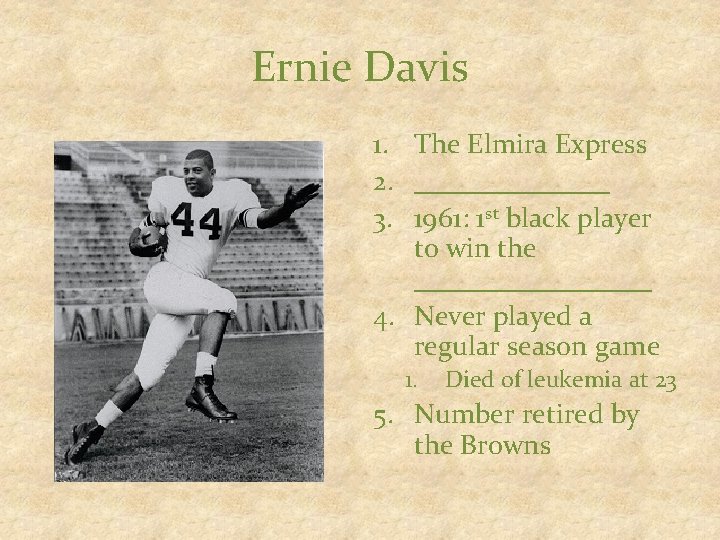
Ernie Davis 1. The Elmira Express 2. _______ 3. 1961: 1 st black player to win the _________ 4. Never played a regular season game 1. Died of leukemia at 23 5. Number retired by the Browns
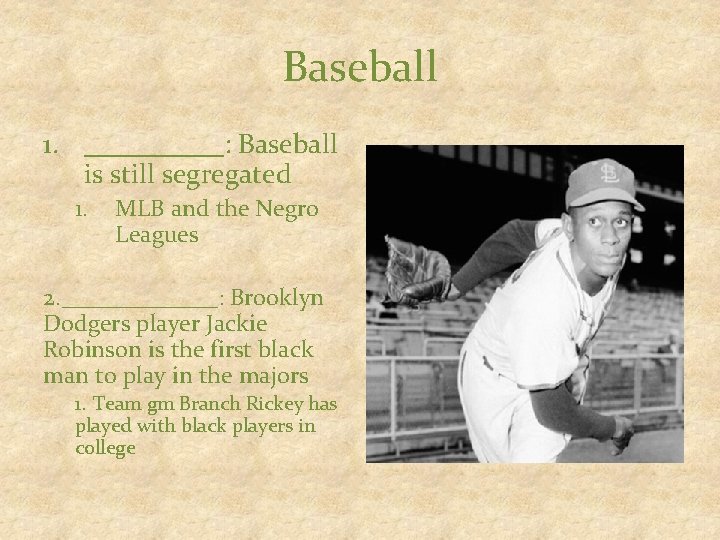
Baseball 1. _____: Baseball is still segregated 1. MLB and the Negro Leagues 2. _______: Brooklyn Dodgers player Jackie Robinson is the first black man to play in the majors 1. Team gm Branch Rickey has played with black players in college
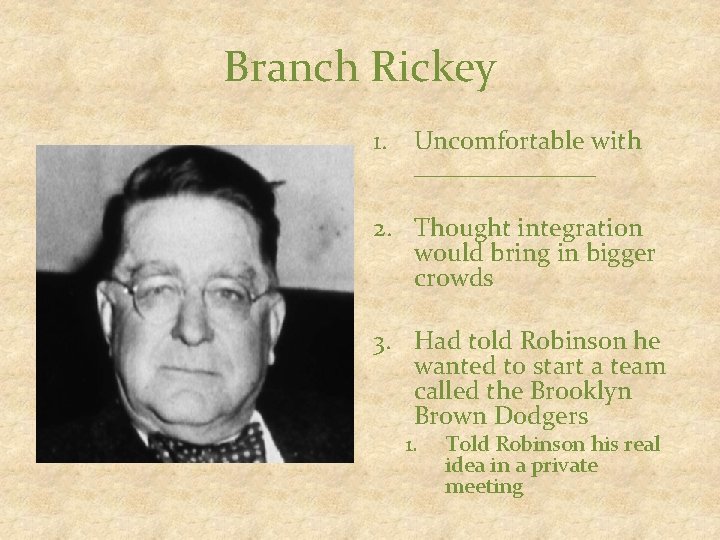
Branch Rickey 1. Uncomfortable with _______ 2. Thought integration would bring in bigger crowds 3. Had told Robinson he wanted to start a team called the Brooklyn Brown Dodgers 1. Told Robinson his real idea in a private meeting
“Mr. Rickey, do you want a ballplayer who is afraid to fight back? ” “I want a ballplayer with guts enough not to fight back. ”
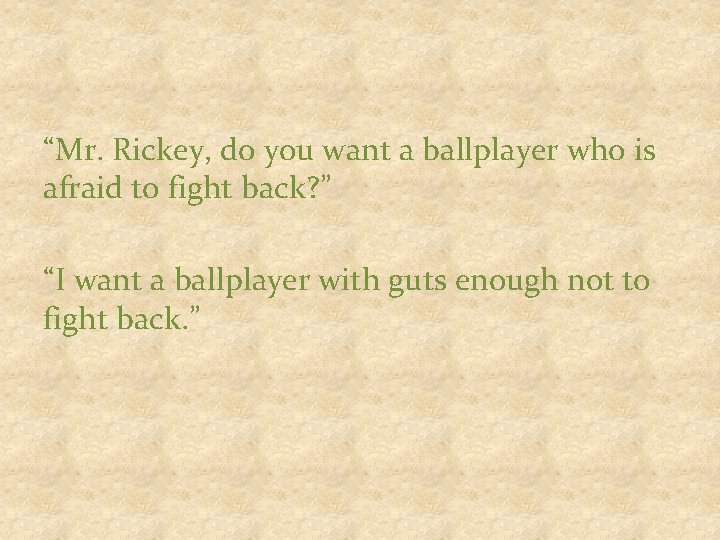
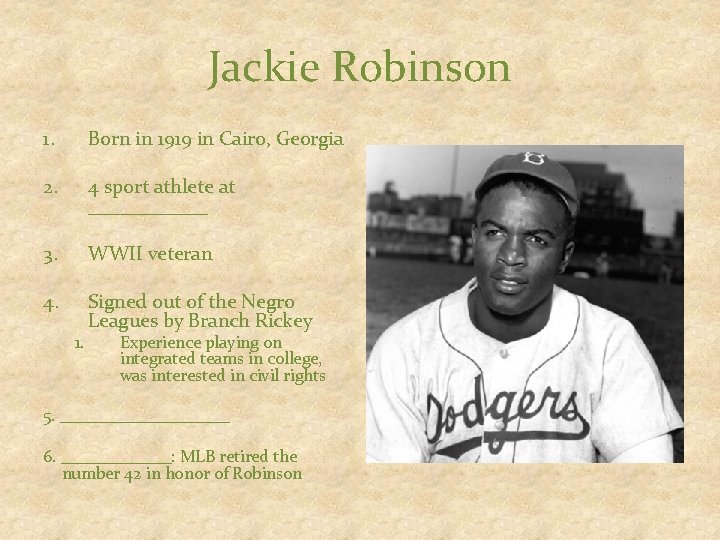
Jackie Robinson 1. Born in 1919 in Cairo, Georgia 2. 4 sport athlete at ______ 3. WWII veteran 4. Signed out of the Negro Leagues by Branch Rickey 1. Experience playing on integrated teams in college, was interested in civil rights 5. __________ 6. _______: MLB retired the number 42 in honor of Robinson
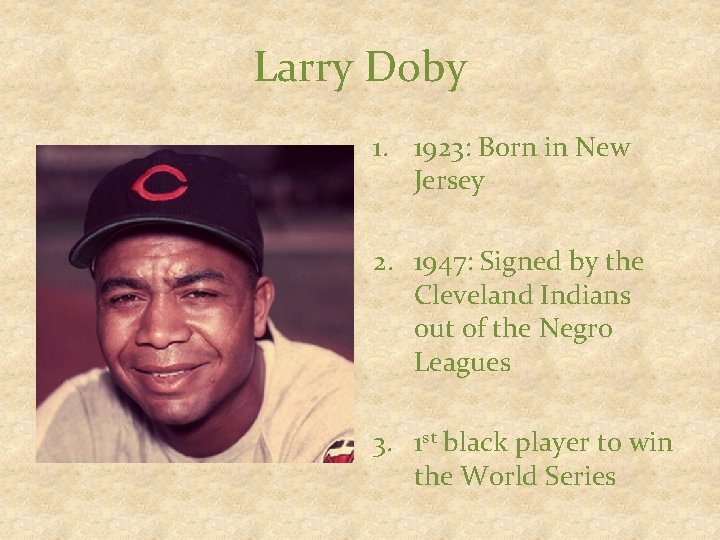
Larry Doby 1. 1923: Born in New Jersey 2. 1947: Signed by the Cleveland Indians out of the Negro Leagues 3. 1 st black player to win the World Series
“We hold these truths to be self evident. That all men are created equal. Endowed by their maker with certain inalienably rights among which are life, liberty, and the pursuit of happiness…” -Declaration of Independence of the United States of America Based on this passage: Should the Civil Rights Movement even have been necessary? Was it more than a racially-charged issue?