
The Civil Rights Movement Segregation School Desegregation The
- Slides: 20
The Civil Rights Movement Segregation School Desegregation The Montgomery Bus Boycott Sit-Ins Freedom Riders Desegregating Southern Universities The March on Washington Voter Registration The End of the Movement
Segregation n The civil rights movement was a political, legal, and social struggle to gain full citizenship rights for African Americans. The civil rights movement was first and foremost a challenge to segregation, the system of laws and customs separating African Americans and whites. During the movement, individuals and civil rights organizations challenged segregation and discrimination with a variety of activities, including protest marches, boycotts, and refusal to abide by segregation laws.
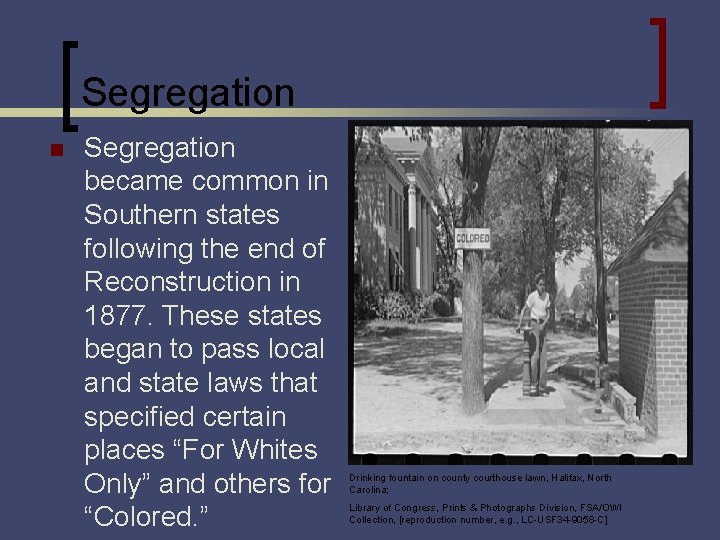
Segregation n Segregation became common in Southern states following the end of Reconstruction in 1877. These states began to pass local and state laws that specified certain places “For Whites Only” and others for “Colored. ” Drinking fountain on county courthouse lawn, Halifax, North Carolina; Library of Congress, Prints & Photographs Division, FSA/OWI Collection, [reproduction number, e. g. , LC-USF 34 -9058 -C]
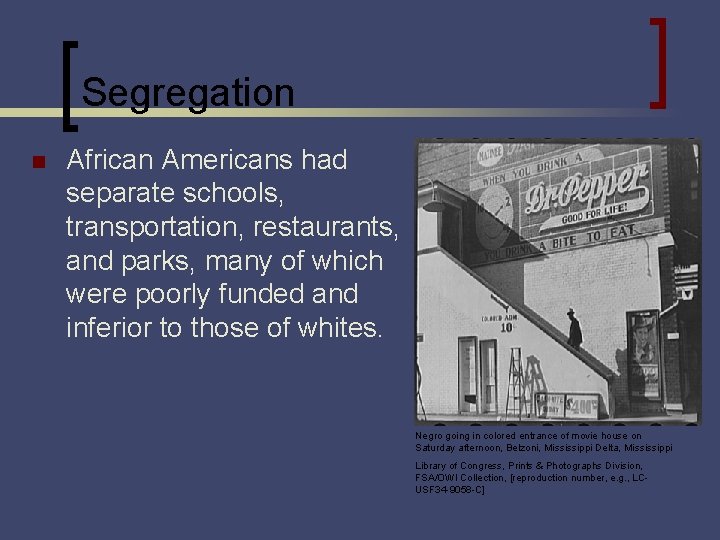
Segregation n African Americans had separate schools, transportation, restaurants, and parks, many of which were poorly funded and inferior to those of whites. Negro going in colored entrance of movie house on Saturday afternoon, Belzoni, Mississippi Delta, Mississippi Library of Congress, Prints & Photographs Division, FSA/OWI Collection, [reproduction number, e. g. , LCUSF 34 -9058 -C]
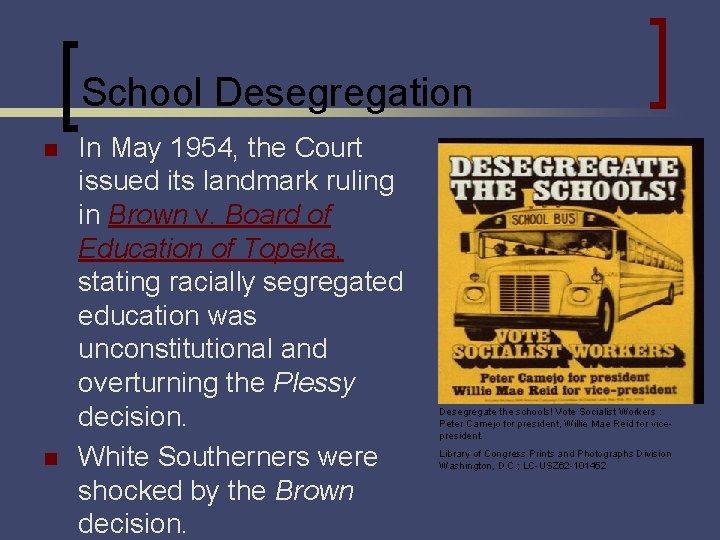
School Desegregation n n In May 1954, the Court issued its landmark ruling in Brown v. Board of Education of Topeka, stating racially segregated education was unconstitutional and overturning the Plessy decision. White Southerners were shocked by the Brown decision. Desegregate the schools! Vote Socialist Workers : Peter Camejo for president, Willie Mae Reid for vicepresident. Library of Congress Prints and Photographs Division Washington, D. C. ; LC-USZ 62 -101452
School Desegregation n n Virtually no schools in the South segregated their schools in the first years following the Brown decision. In Virginia, one county actually closed its public schools. In 1957, Governor Orval Faubus defied a federal court order to admit nine African American students to Central High School in Little Rock, Arkansas. President Dwight Eisenhower sent federal troops to enforce desegregation.
School Desegregation n n The event was covered by the national media, and the fate of the nine students attempting to integrate the school gripped the nation. Not all school desegregation was as dramatic as Little Rock schools gradually desegregated. Often, schools were desegregated only in theory because racially segregated neighborhoods led to segregated schools. To overcome the problem, some school districts began busing students to schools outside their neighborhoods in the 1970 s.
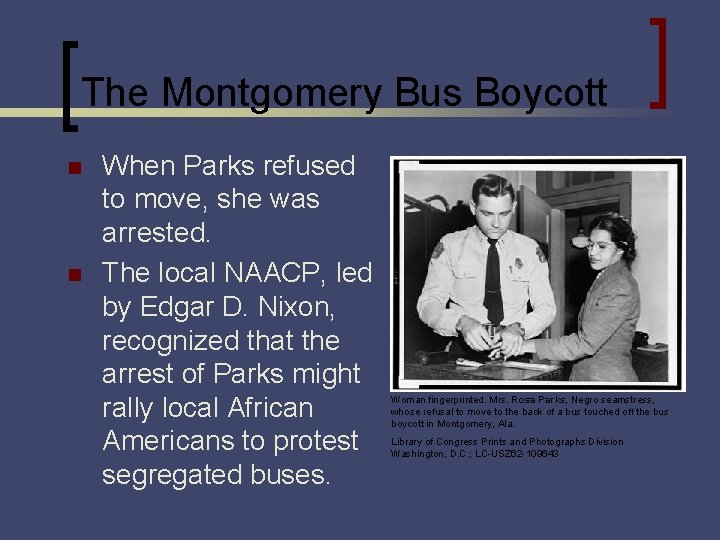
The Montgomery Bus Boycott n n Despite threats and violence, the civil rights movement quickly moved beyond school desegregation to challenge segregation in other areas. In December 1955, Rosa Parks, a member of the Montgomery, Alabama, branch of the NAACP, was told to give up her seat on a city bus to a white person.
The Montgomery Bus Boycott n n When Parks refused to move, she was arrested. The local NAACP, led by Edgar D. Nixon, recognized that the arrest of Parks might rally local African Americans to protest segregated buses. Woman fingerprinted. Mrs. Rosa Parks, Negro seamstress, whose refusal to move to the back of a bus touched off the bus boycott in Montgomery, Ala. Library of Congress Prints and Photographs Division Washington, D. C. ; LC-USZ 62 -109643
The Montgomery Bus Boycott n n n Montgomery’s African American community had long been angry about their mistreatment on city buses where white drivers were rude and abusive. The community had previously considered a boycott of the buses and overnight one was organized. The bus boycott was an immediate success, with almost unanimous support from the African Americans in Montgomery.
The Montgomery Bus Boycott n n The boycott lasted for more than a year, expressing to the nation the determination of African Americans in the South to end segregation. In November 1956, a federal court ordered Montgomery’s buses desegregated and the boycott ended in victory.
The Montgomery Bus Boycott n n A Baptist minister named Martin Luther King, Jr. , was president of the Montgomery Improvement Association, the organization that directed the boycott. His involvement in the protest made him a national figure. Through his eloquent appeals to Christian brotherhood and American idealism he attracted people both inside and outside the South.
The Montgomery Bus Boycott n n n King became the president of the Southern Christian Leadership Conference (SCLC) when it was founded in 1957. The SCLC complemented the NAACP’s legal strategy by encouraging the use of nonviolent, direct action to protest segregation. These activities included marches, demonstrations, and boycotts. The harsh white response to African Americans’ direct action eventually forced the federal government to confront the issue of racism in the South.
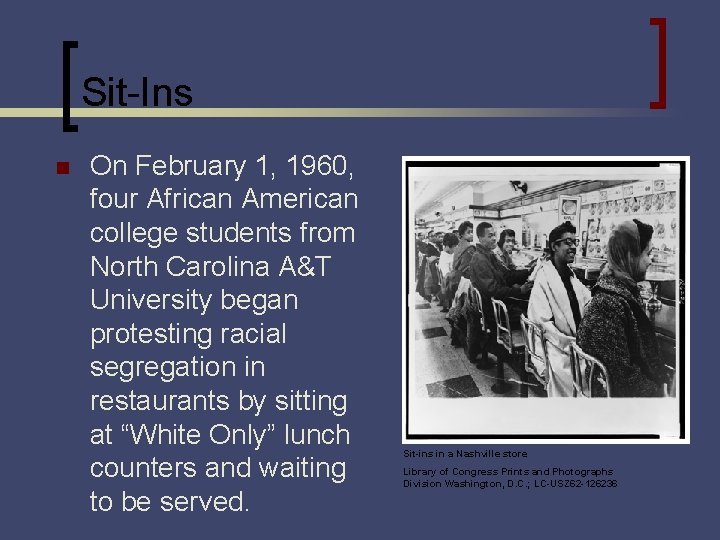
Sit-Ins n On February 1, 1960, four African American college students from North Carolina A&T University began protesting racial segregation in restaurants by sitting at “White Only” lunch counters and waiting to be served. Sit-ins in a Nashville store Library of Congress Prints and Photographs Division Washington, D. C. ; LC-USZ 62 -126236
Sit-Ins n n n This was not a new form of protest, but the response to the sit-ins spread throughout North Carolina, and within weeks sit-ins were taking place in cities across the South. Many restaurants were desegregated in response to the sit-ins. This form of protest demonstrated clearly to African Americans and whites alike that young African Americans were determined to reject segregation.
The March on Washington n Martin Luther King, Jr. , delivered a moving address to an audience of more than 200, 000 people. His “I Have a Dream” speech—delivered in front of the giant statue of Abraham Lincoln—became famous for the way in which it expressed the ideals of the civil rights movement. After President Kennedy was assassinated in November 1963, the new president, Lyndon Johnson, strongly urged the passage of the civil rights legislation as a tribute to Kennedy’s memory.
The March on Washington n n Over fierce opposition from Southern legislators, Johnson pushed the Civil Rights Act of 1964 through Congress. It prohibited segregation in public accommodations and discrimination in education and employment. It also gave the executive branch of government the power to enforce the act’s provisions.
Voter Registration n King and SCLC members led hundreds of people on a five-day, fifty-mile march to Montgomery. The Selma March drummed up broad national support for a law to protect Southern African Americans’ right to vote. President Johnson persuaded Congress to pass the Voting Rights Act of 1965, which suspended the use of literacy and other voter qualification tests in voter registration.
Voter Registration n Over the next three years, almost one million more African Americans in the South registered to vote. By 1968, African American voters had having a significant impact on Southern politics. During the 1970 s, African Americans were seeking and winning public offices in majority African American electoral districts.
The End of the Movement n n n For many people the civil rights movement ended with the death of Martin Luther King, Jr. in 1968. Others believe it was over after the Selma March, because there have not been any significant changes since then. Still others argue the movement continues today because the goal of full equality has not yet been achieved.