
The Civil Rights Movement Beginning of the Movement
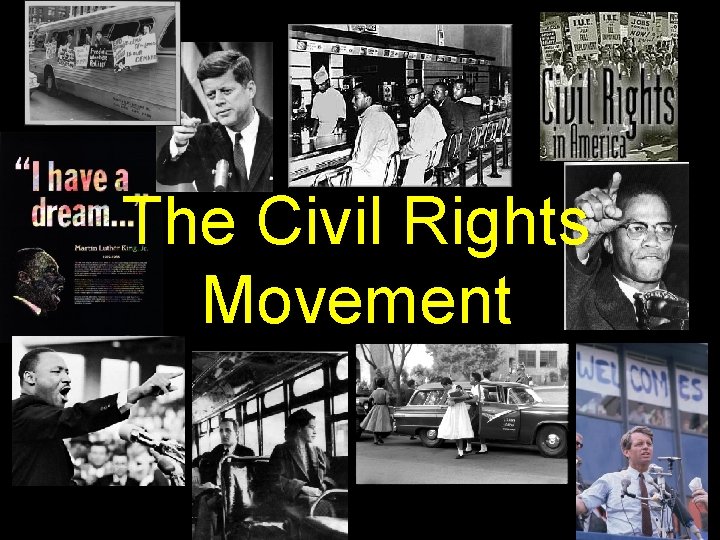
The Civil Rights Movement
Beginning of the Movement �Plessy v. Ferguson- “separate but equal” ◦ After this, laws encouraging segregation (aka Jim Crow laws) spread quickly �They segregated buses, trains, schools, restaurants, pools, parks, etc. �Most common in the South, but existed in North too �Areas w/o segregation laws often had de facto segregation (segregation by tradition) �NAACP years has been fighting segregation for ◦ Some victories, but not many ◦ AAs also got more political power �Great Migration- moved to North, where they can vote
Beginning of the Movement �WWII- AA leaders began using their power for more rights ◦ 1942 - CORE (Congress of Racial Equality) founded �Began using sit-ins (peaceful protest) to desegregate restaurants �Successfully integrated many restaurants, theaters, etc. �Brown v. Board of Education. Segregation in public schools is unconstitutional ◦ Southern Manifesto- White southerners defied the ruling by continuing segregation
Beginning of the Movement �Montgomery Bus Boycott ◦ Rosa Parks decided to challenge segregation of public transportation �This began the boycott ◦ Martin Luther King Jr. led the way �They met in churches, where they were encouraged to protest �This had to be peaceful- getting arrested doesn’t help �Many whites already don’t like AAs, so violence would only make that worse
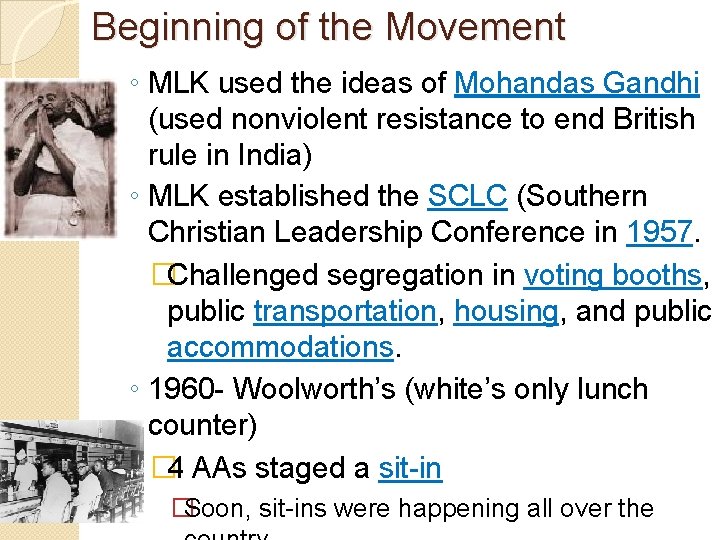
Beginning of the Movement ◦ MLK used the ideas of Mohandas Gandhi (used nonviolent resistance to end British rule in India) ◦ MLK established the SCLC (Southern Christian Leadership Conference in 1957. �Challenged segregation in voting booths, public transportation, housing, and public accommodations. ◦ 1960 - Woolworth’s (white’s only lunch counter) � 4 AAs staged a sit-in �Soon, sit-ins were happening all over the
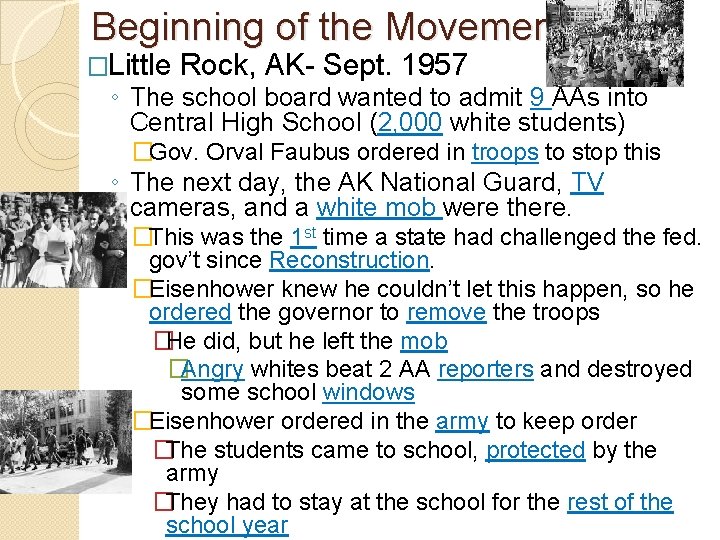
Beginning of the Movement �Little Rock, AK- Sept. 1957 ◦ The school board wanted to admit 9 AAs into Central High School (2, 000 white students) �Gov. Orval Faubus ordered in troops to stop this ◦ The next day, the AK National Guard, TV cameras, and a white mob were there. �This was the 1 st time a state had challenged the fed. gov’t since Reconstruction. �Eisenhower knew he couldn’t let this happen, so he ordered the governor to remove the troops �He did, but he left the mob �Angry whites beat 2 AA reporters and destroyed some school windows �Eisenhower ordered in the army to keep order �The students came to school, protected by the army �They had to stay at the school for the rest of the school year
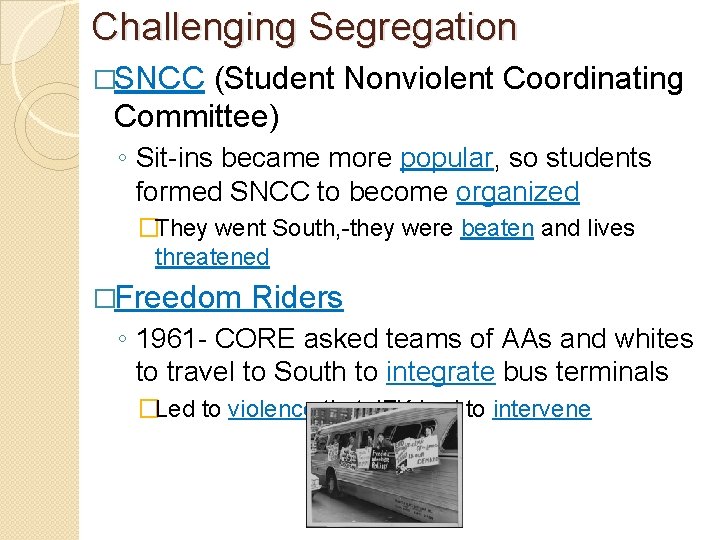
Challenging Segregation �SNCC (Student Nonviolent Coordinating Committee) ◦ Sit-ins became more popular, so students formed SNCC to become organized �They went South, -they were beaten and lives threatened �Freedom Riders ◦ 1961 - CORE asked teams of AAs and whites to travel to South to integrate bus terminals �Led to violence that JFK had to intervene
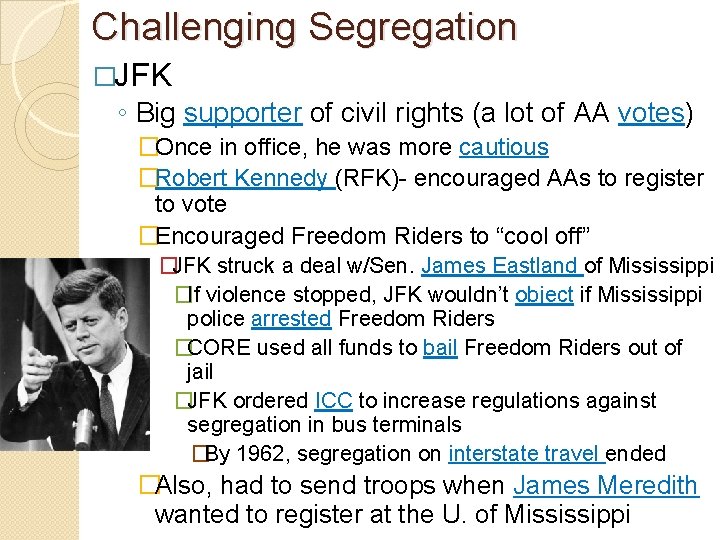
Challenging Segregation �JFK ◦ Big supporter of civil rights (a lot of AA votes) �Once in office, he was more cautious �Robert Kennedy (RFK)- encouraged AAs to register to vote �Encouraged Freedom Riders to “cool off” �JFK struck a deal w/Sen. James Eastland of Mississippi �If violence stopped, JFK wouldn’t object if Mississippi police arrested Freedom Riders �CORE used all funds to bail Freedom Riders out of jail �JFK ordered ICC to increase regulations against segregation in bus terminals �By 1962, segregation on interstate travel ended �Also, had to send troops when James Meredith wanted to register at the U. of Mississippi
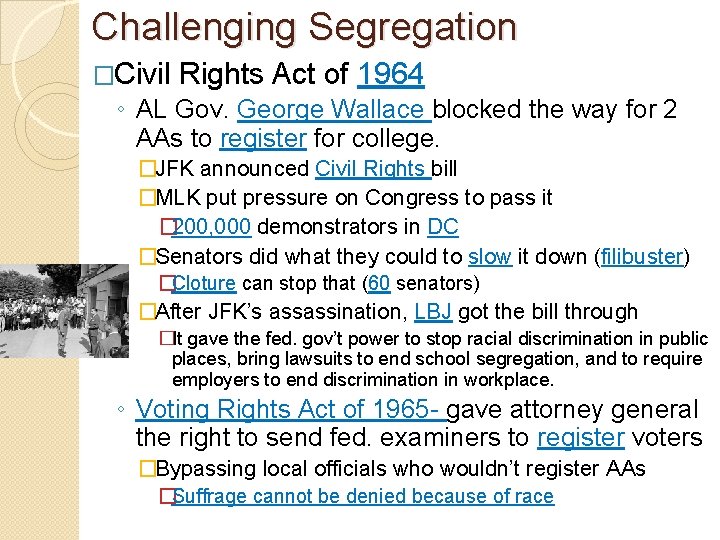
Challenging Segregation �Civil Rights Act of 1964 ◦ AL Gov. George Wallace blocked the way for 2 AAs to register for college. �JFK announced Civil Rights bill �MLK put pressure on Congress to pass it � 200, 000 demonstrators in DC �Senators did what they could to slow it down (filibuster) �Cloture can stop that (60 senators) �After JFK’s assassination, LBJ got the bill through �It gave the fed. gov’t power to stop racial discrimination in public places, bring lawsuits to end school segregation, and to require employers to end discrimination in workplace. ◦ Voting Rights Act of 1965 - gave attorney general the right to send fed. examiners to register voters �Bypassing local officials who wouldn’t register AAs �Suffrage cannot be denied because of race
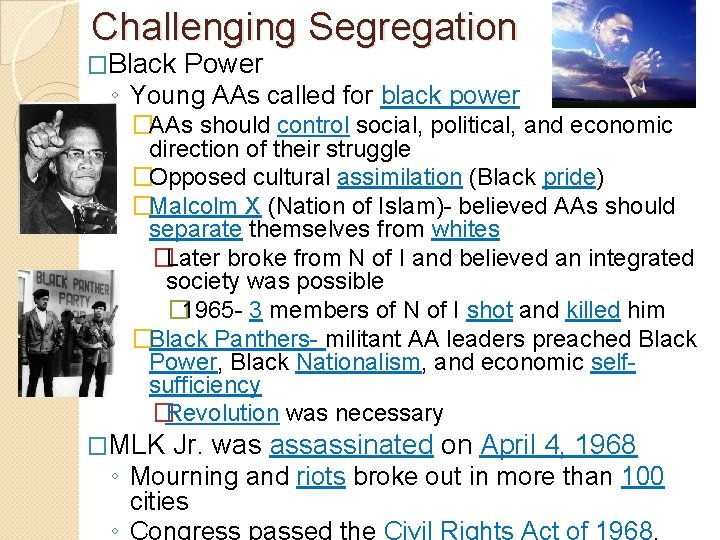
Challenging Segregation �Black Power ◦ Young AAs called for black power �AAs should control social, political, and economic direction of their struggle �Opposed cultural assimilation (Black pride) �Malcolm X (Nation of Islam)- believed AAs should separate themselves from whites �Later broke from N of I and believed an integrated society was possible � 1965 - 3 members of N of I shot and killed him �Black Panthers- militant AA leaders preached Black Power, Black Nationalism, and economic selfsufficiency �Revolution was necessary �MLK Jr. was assassinated on April 4, 1968 ◦ Mourning and riots broke out in more than 100 cities
- Slides: 10