
THE CITRIC ACID CYCLE The final common pathway
- Slides: 49
THE CITRIC ACID CYCLE The final common pathway for the oxidation of fuel molecules. , namely amino acids, fatty acids, and carbohydrates 1
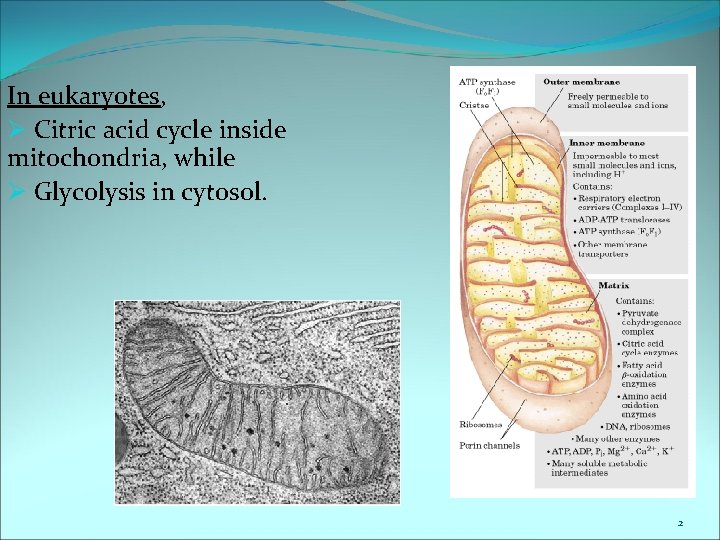
In eukaryotes, Ø Citric acid cycle inside mitochondria, while Ø Glycolysis in cytosol. 2
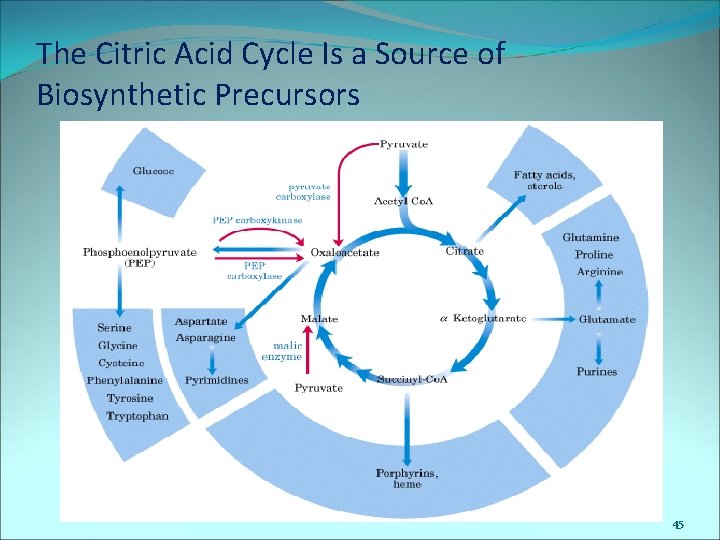
Overview of the Citric Acid Cycle It is the gateway to the aerobic metabolism of any molecule that can be transformed into an acetyl group or dicarboxylic acid. The cycle is an important source of precursors: For the storage forms of fuels. For the building blocks of many other molecules such as amino acids, nucleotide bases, and cholesterol. The citric acid cycle includes a series of redox reactions that result in the oxidation of an acetyl group to two molecules of CO 2. 3
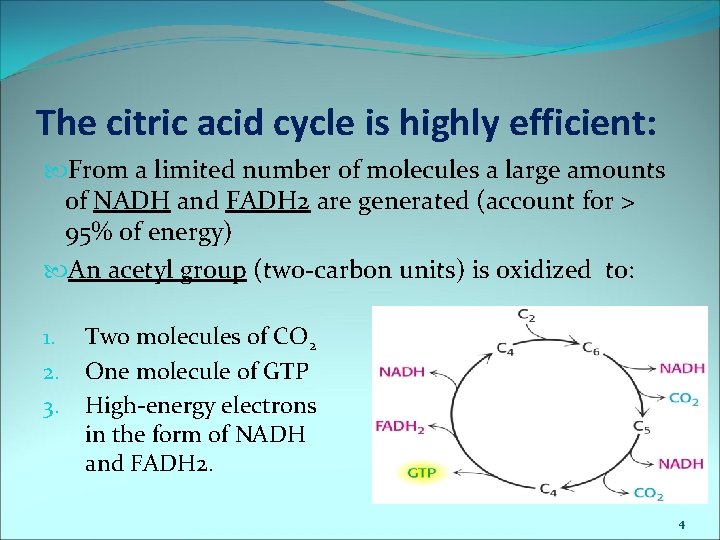
The citric acid cycle is highly efficient: From a limited number of molecules a large amounts of NADH and FADH 2 are generated (account for > 95% of energy) An acetyl group (two-carbon units) is oxidized to: 1. 2. 3. Two molecules of CO 2 One molecule of GTP High-energy electrons in the form of NADH and FADH 2. 4
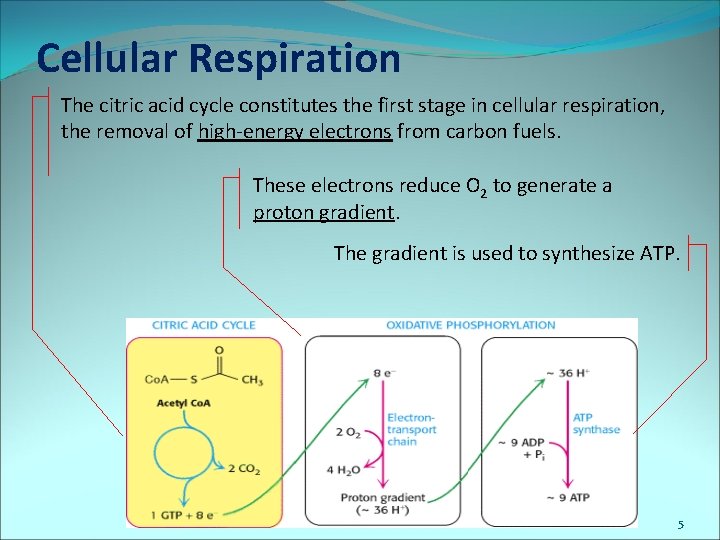
Cellular Respiration The citric acid cycle constitutes the first stage in cellular respiration, the removal of high-energy electrons from carbon fuels. These electrons reduce O 2 to generate a proton gradient. The gradient is used to synthesize ATP. 5
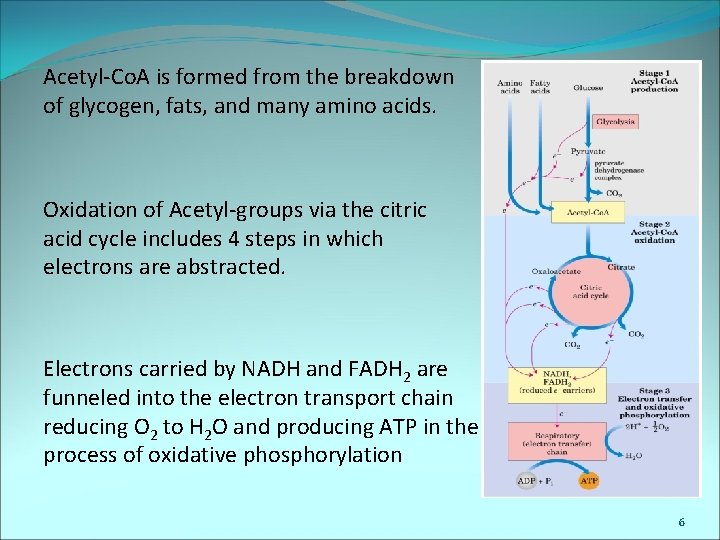
Acetyl-Co. A is formed from the breakdown of glycogen, fats, and many amino acids. Oxidation of Acetyl-groups via the citric acid cycle includes 4 steps in which electrons are abstracted. Electrons carried by NADH and FADH 2 are funneled into the electron transport chain reducing O 2 to H 2 O and producing ATP in the process of oxidative phosphorylation 6
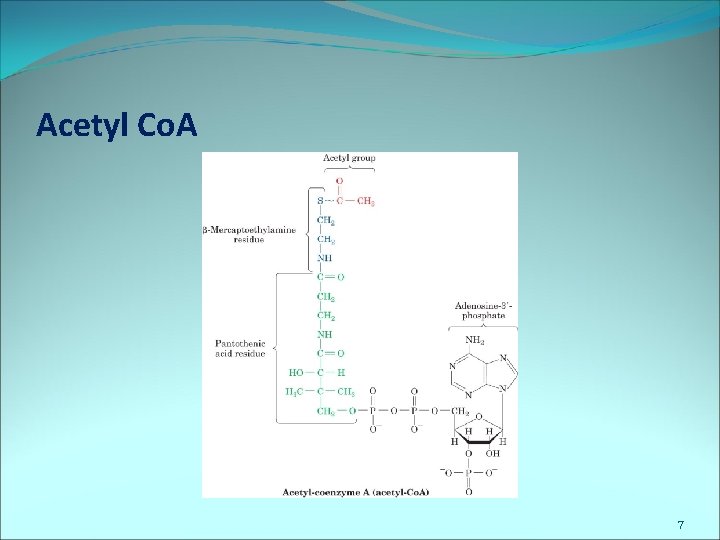
Acetyl Co. A 7
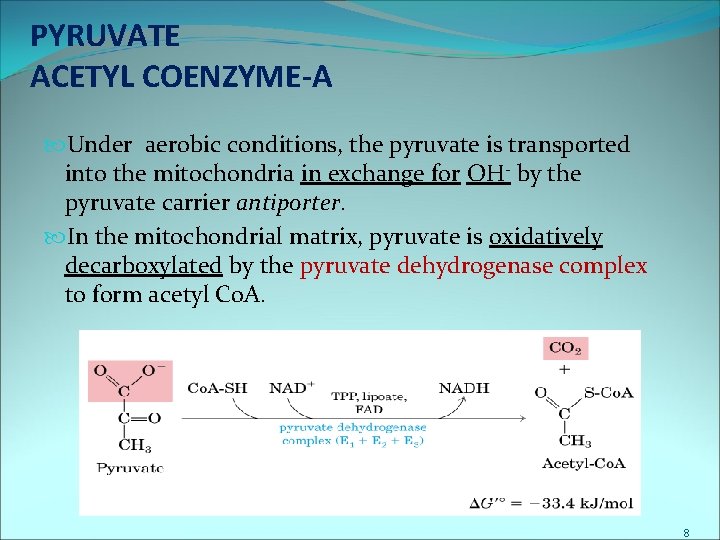
PYRUVATE ACETYL COENZYME-A Under aerobic conditions, the pyruvate is transported into the mitochondria in exchange for OH- by the pyruvate carrier antiporter. In the mitochondrial matrix, pyruvate is oxidatively decarboxylated by the pyruvate dehydrogenase complex to form acetyl Co. A. 8
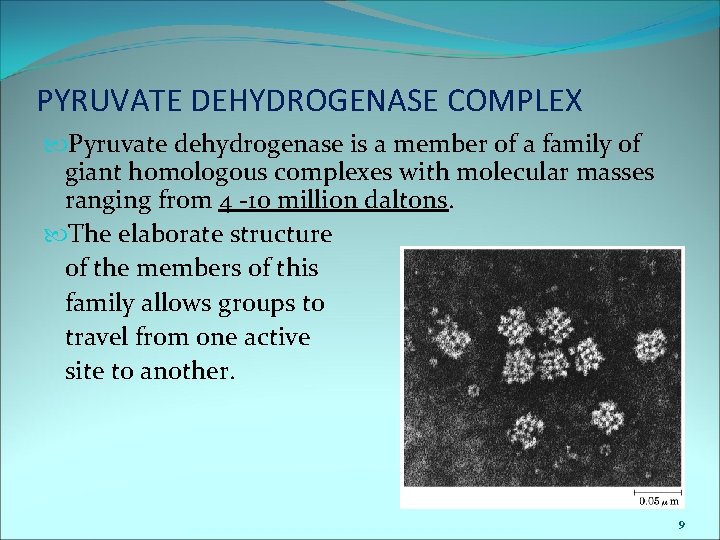
PYRUVATE DEHYDROGENASE COMPLEX Pyruvate dehydrogenase is a member of a family of giant homologous complexes with molecular masses ranging from 4 -10 million daltons. The elaborate structure of the members of this family allows groups to travel from one active site to another. 9
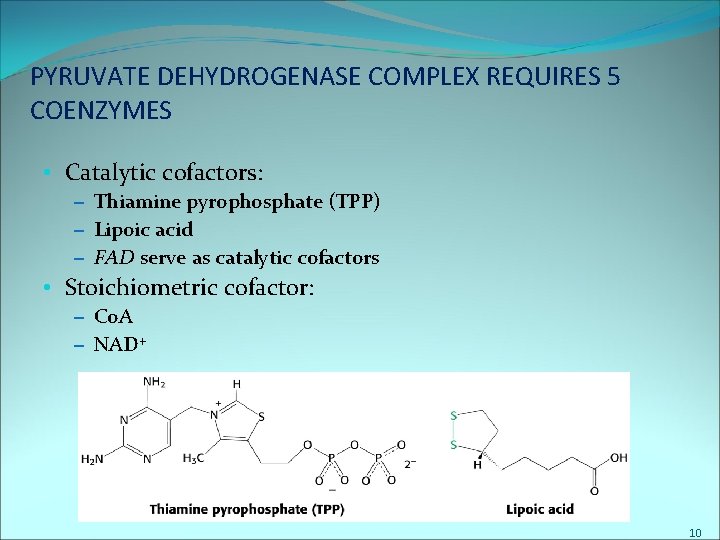
PYRUVATE DEHYDROGENASE COMPLEX REQUIRES 5 COENZYMES • Catalytic cofactors: – Thiamine pyrophosphate (TPP) – Lipoic acid – FAD serve as catalytic cofactors • Stoichiometric cofactor: – Co. A – NAD+ 10
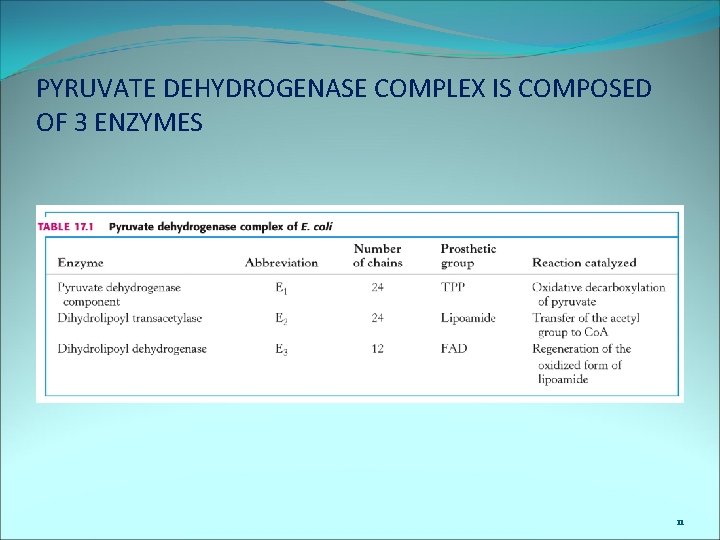
PYRUVATE DEHYDROGENASE COMPLEX IS COMPOSED OF 3 ENZYMES 11
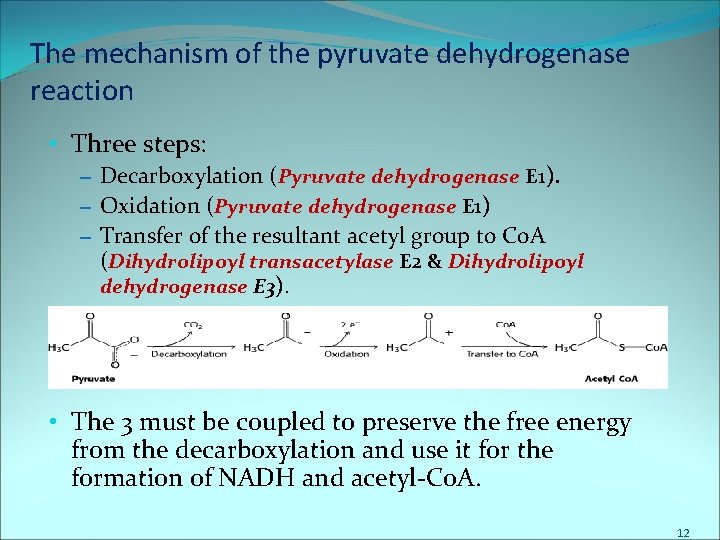
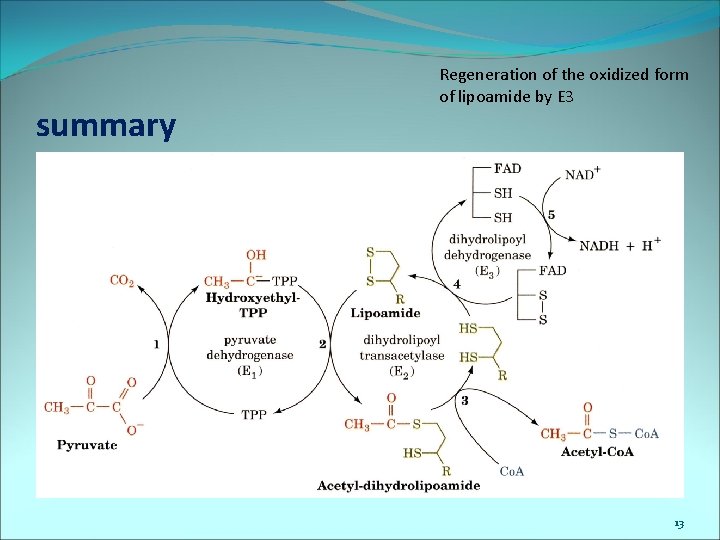
The mechanism of the pyruvate dehydrogenase reaction • Three steps: – Decarboxylation (Pyruvate dehydrogenase E 1). – Oxidation (Pyruvate dehydrogenase E 1) – Transfer of the resultant acetyl group to Co. A (Dihydrolipoyl transacetylase E 2 & Dihydrolipoyl dehydrogenase E 3). • The 3 must be coupled to preserve the free energy from the decarboxylation and use it for the formation of NADH and acetyl-Co. A. 12
summary Regeneration of the oxidized form of lipoamide by E 3 13
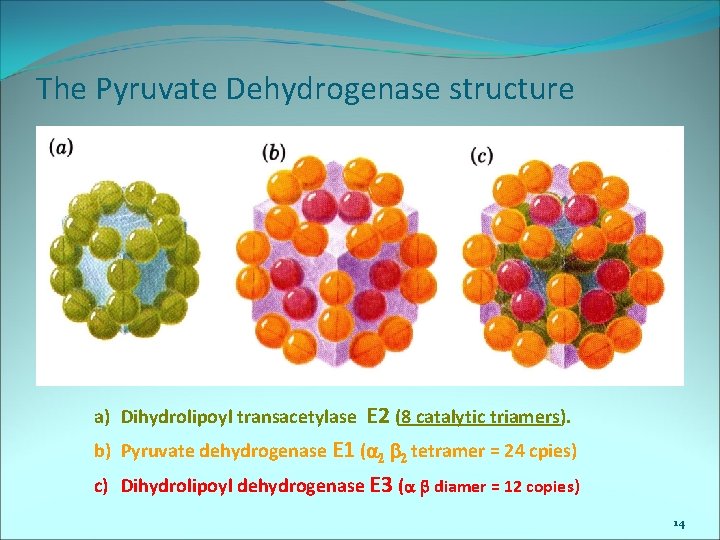
The Pyruvate Dehydrogenase structure a) Dihydrolipoyl transacetylase E 2 (8 catalytic triamers). b) Pyruvate dehydrogenase E 1 (a 2 b 2 tetramer = 24 cpies) c) Dihydrolipoyl dehydrogenase E 3 (a b diamer = 12 copies) 14
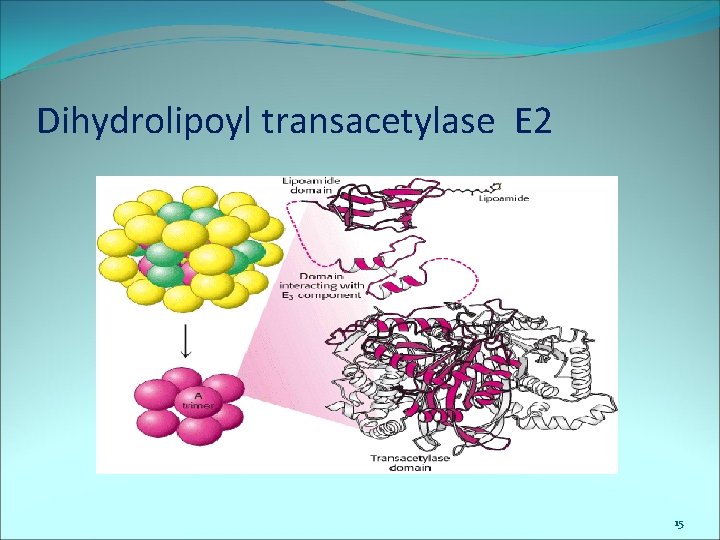
Dihydrolipoyl transacetylase E 2 15
Comments: • The structural integration of three kinds of enzymes makes the coordinated catalysis of a complex reaction possible. • The proximity of one enzyme to another increases the overall reaction rate and minimizes side reactions. • All the intermediates in the oxidative decarboxylation of pyruvate are tightly bound to the complex and are readily transferred because of the ability of the lipoyllysine arm of E 2 to call on each active site in turn 16
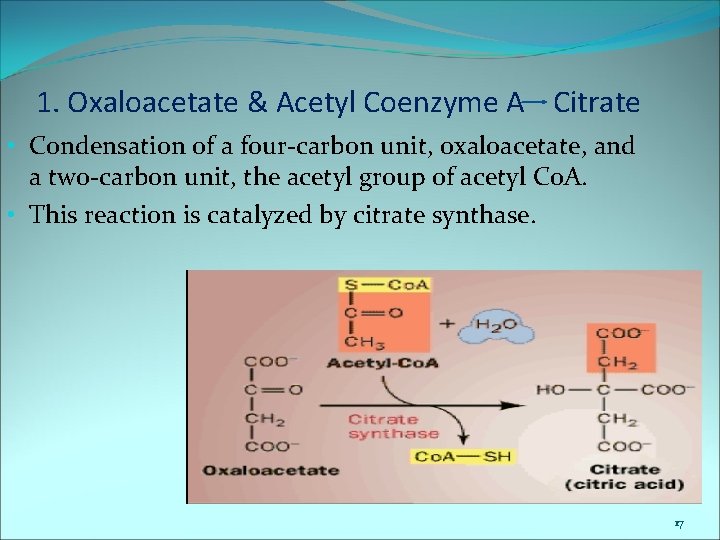
1. Oxaloacetate & Acetyl Coenzyme A Citrate • Condensation of a four-carbon unit, oxaloacetate, and a two-carbon unit, the acetyl group of acetyl Co. A. • This reaction is catalyzed by citrate synthase. 17
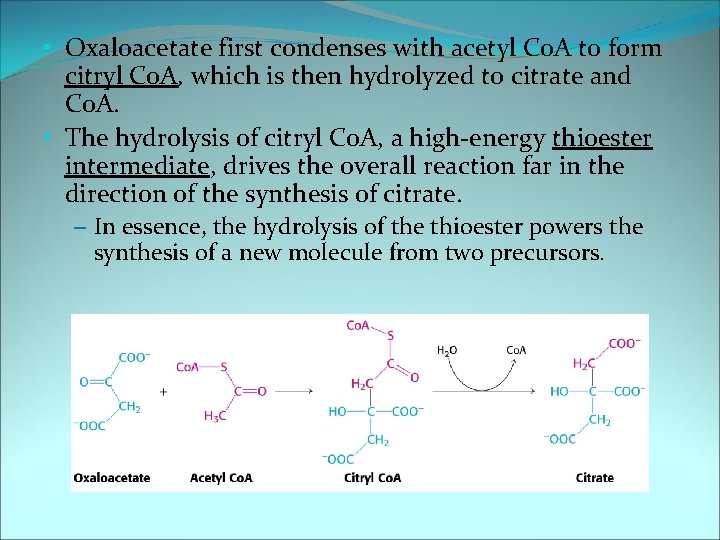
• Oxaloacetate first condenses with acetyl Co. A to form citryl Co. A, which is then hydrolyzed to citrate and Co. A. • The hydrolysis of citryl Co. A, a high-energy thioester intermediate, drives the overall reaction far in the direction of the synthesis of citrate. – In essence, the hydrolysis of the thioester powers the synthesis of a new molecule from two precursors.
Because this reaction initiates the cycle, it is very important that side reactions be minimized. How does citrate synthase prevent wasteful processes such as the hydrolysis of acetyl Co. A? 19
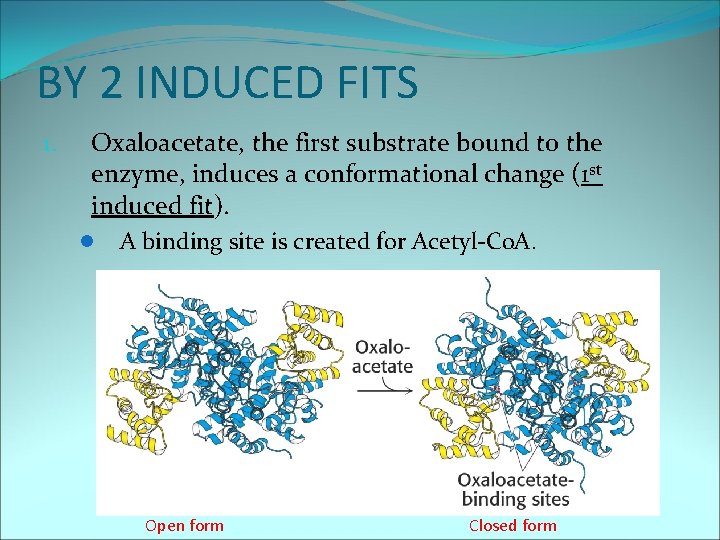
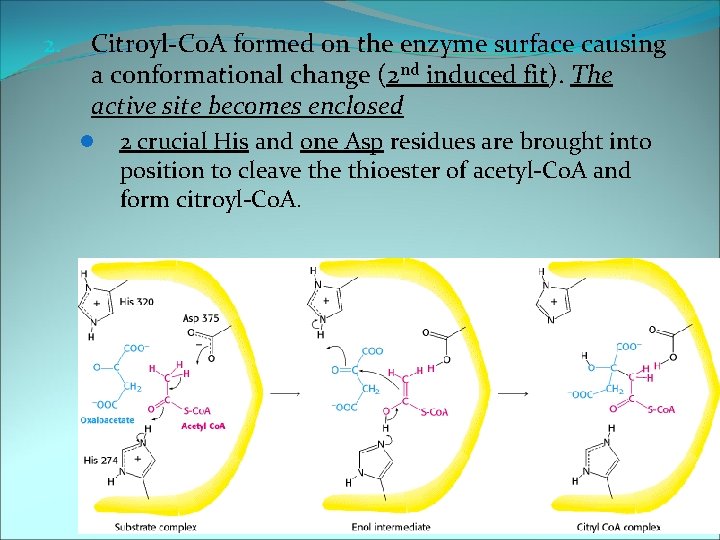
BY 2 INDUCED FITS 1. Oxaloacetate, the first substrate bound to the enzyme, induces a conformational change (1 st induced fit). l A binding site is created for Acetyl-Co. A. Open form Closed form
2. Citroyl-Co. A formed on the enzyme surface causing a conformational change (2 nd induced fit). The active site becomes enclosed l 2 crucial His and one Asp residues are brought into position to cleave thioester of acetyl-Co. A and form citroyl-Co. A.
The dependence of acetyl-Co. A hydrolysis on the two induced fits insures that it is not hydrolyzed unless the acetyl group is condensed with oxaloacetate and not wastefully. 22
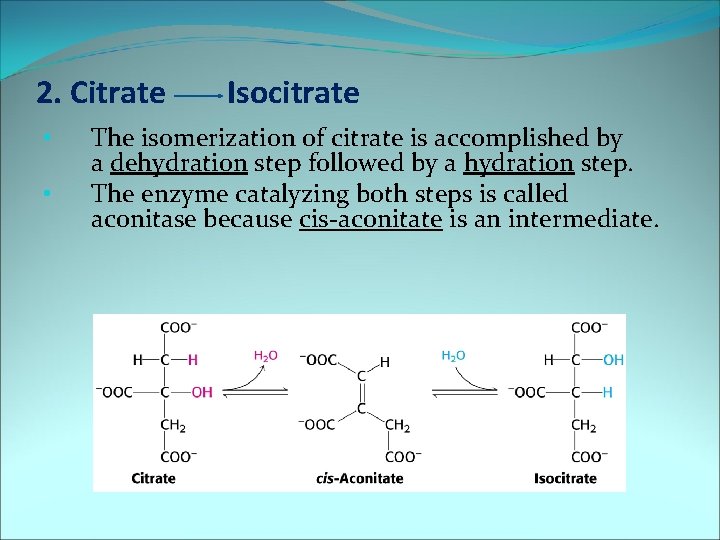
2. Citrate • • Isocitrate The isomerization of citrate is accomplished by a dehydration step followed by a hydration step. The enzyme catalyzing both steps is called aconitase because cis-aconitate is an intermediate.
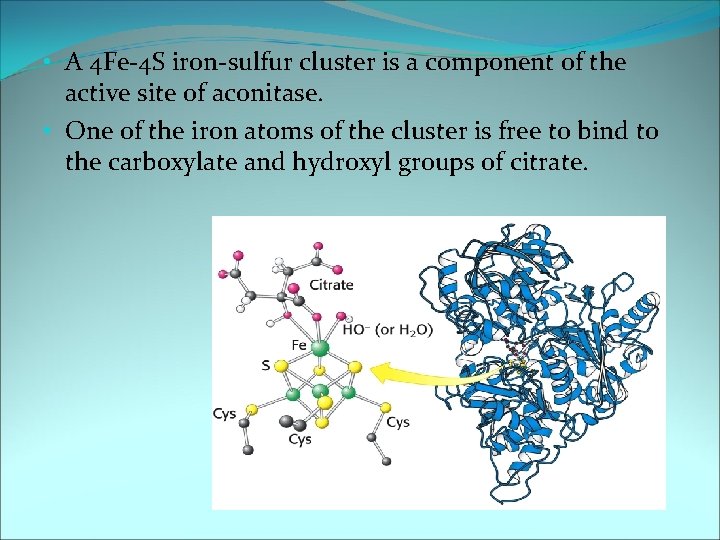
• A 4 Fe-4 S iron-sulfur cluster is a component of the active site of aconitase. • One of the iron atoms of the cluster is free to bind to the carboxylate and hydroxyl groups of citrate.
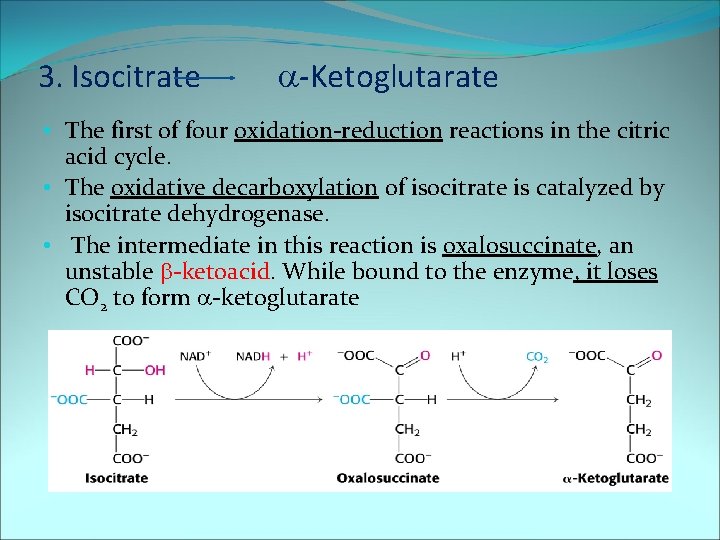
3. Isocitrate a-Ketoglutarate • The first of four oxidation-reduction reactions in the citric acid cycle. • The oxidative decarboxylation of isocitrate is catalyzed by isocitrate dehydrogenase. • The intermediate in this reaction is oxalosuccinate, an unstable b-ketoacid. While bound to the enzyme, it loses CO 2 to form a-ketoglutarate
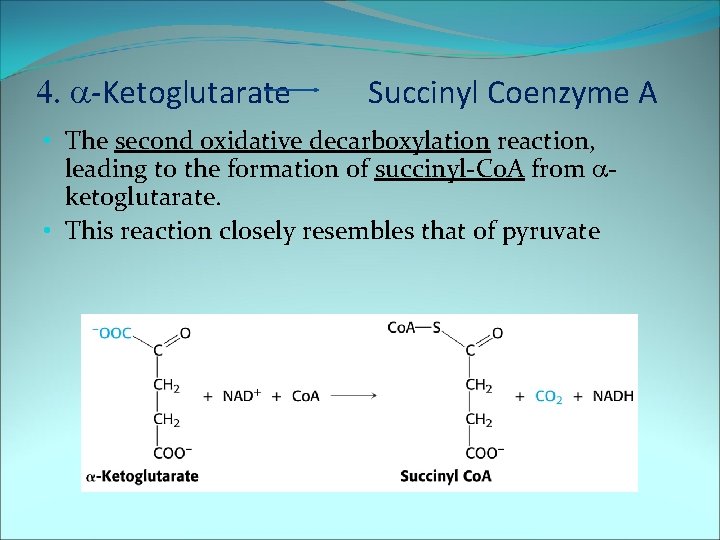
4. a-Ketoglutarate Succinyl Coenzyme A • The second oxidative decarboxylation reaction, leading to the formation of succinyl-Co. A from aketoglutarate. • This reaction closely resembles that of pyruvate
a-ketoglutarate dehydrogenase complex: The complex is homologous to the pyruvate dehydrogenase complex. The reaction mechanism is entirely analogous. 27
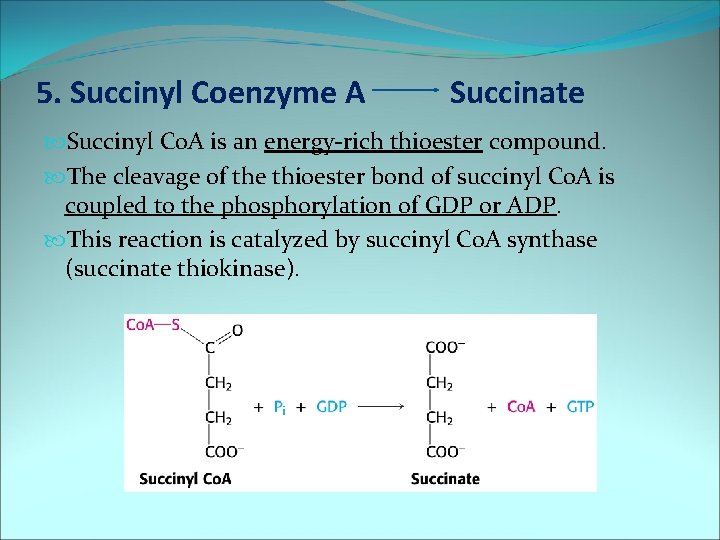
5. Succinyl Coenzyme A Succinate Succinyl Co. A is an energy-rich thioester compound. The cleavage of the thioester bond of succinyl Co. A is coupled to the phosphorylation of GDP or ADP. This reaction is catalyzed by succinyl Co. A synthase (succinate thiokinase).
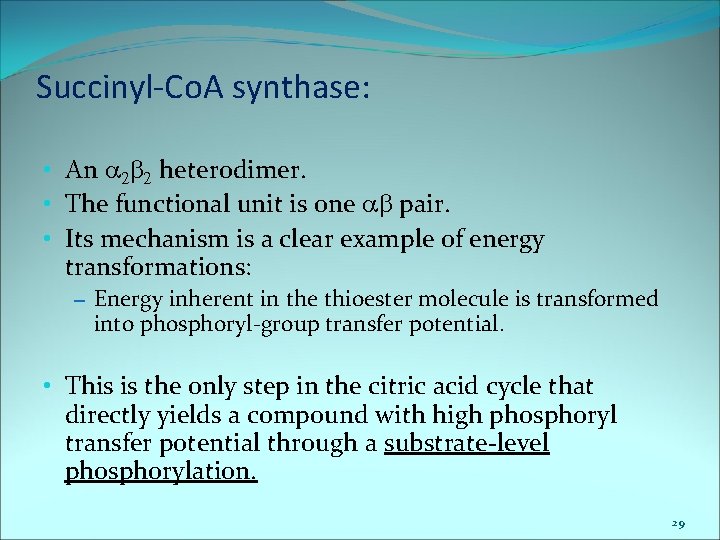
Succinyl-Co. A synthase: • An a 2 b 2 heterodimer. • The functional unit is one ab pair. • Its mechanism is a clear example of energy transformations: – Energy inherent in the thioester molecule is transformed into phosphoryl-group transfer potential. • This is the only step in the citric acid cycle that directly yields a compound with high phosphoryl transfer potential through a substrate-level phosphorylation. 29
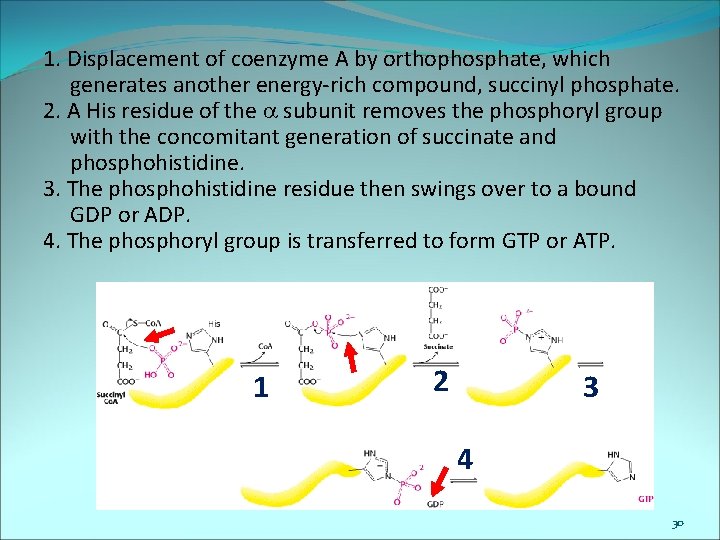
1. Displacement of coenzyme A by orthophosphate, which generates another energy-rich compound, succinyl phosphate. 2. A His residue of the a subunit removes the phosphoryl group with the concomitant generation of succinate and phosphohistidine. 3. The phosphohistidine residue then swings over to a bound GDP or ADP. 4. The phosphoryl group is transferred to form GTP or ATP. 1 2 3 4 30
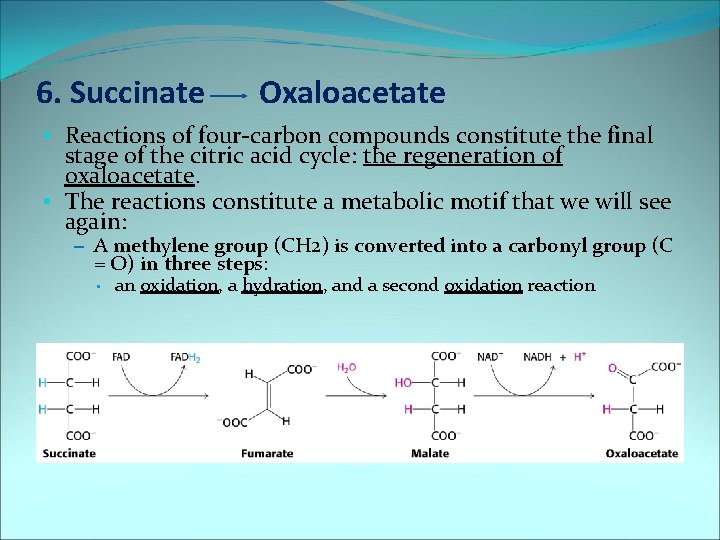
6. Succinate Oxaloacetate • Reactions of four-carbon compounds constitute the final stage of the citric acid cycle: the regeneration of oxaloacetate. • The reactions constitute a metabolic motif that we will see again: – A methylene group (CH 2) is converted into a carbonyl group (C = O) in three steps: • an oxidation, a hydration, and a second oxidation reaction
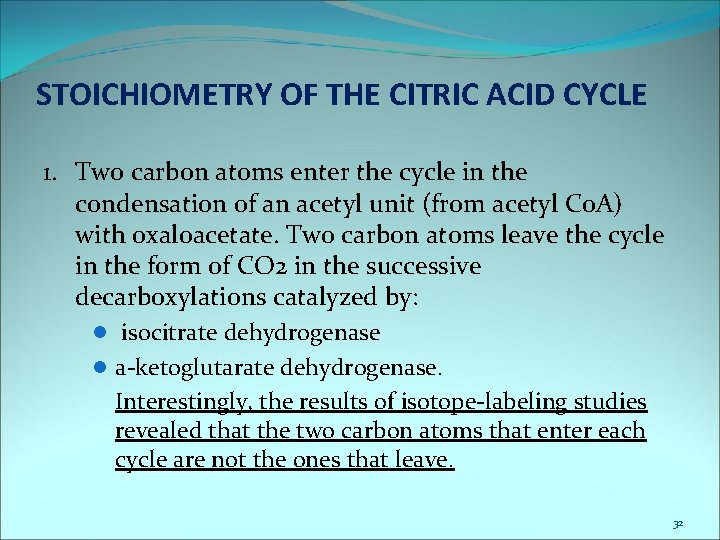
STOICHIOMETRY OF THE CITRIC ACID CYCLE 1. Two carbon atoms enter the cycle in the condensation of an acetyl unit (from acetyl Co. A) with oxaloacetate. Two carbon atoms leave the cycle in the form of CO 2 in the successive decarboxylations catalyzed by: l isocitrate dehydrogenase l a-ketoglutarate dehydrogenase. Interestingly, the results of isotope-labeling studies revealed that the two carbon atoms that enter each cycle are not the ones that leave. 32
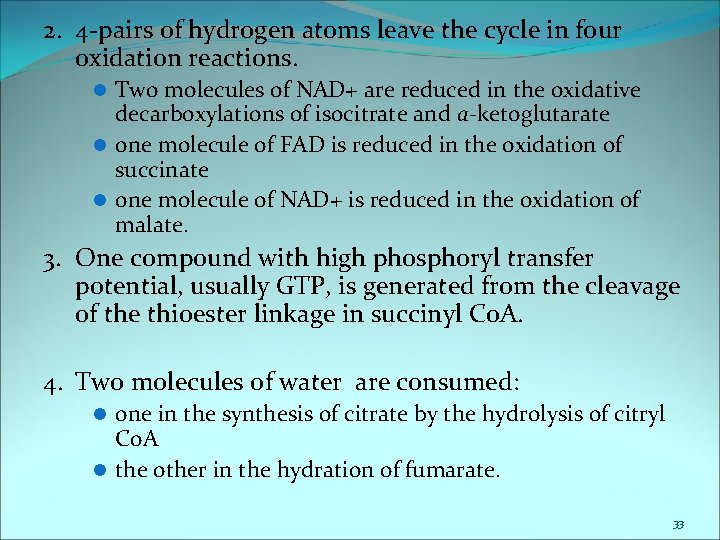
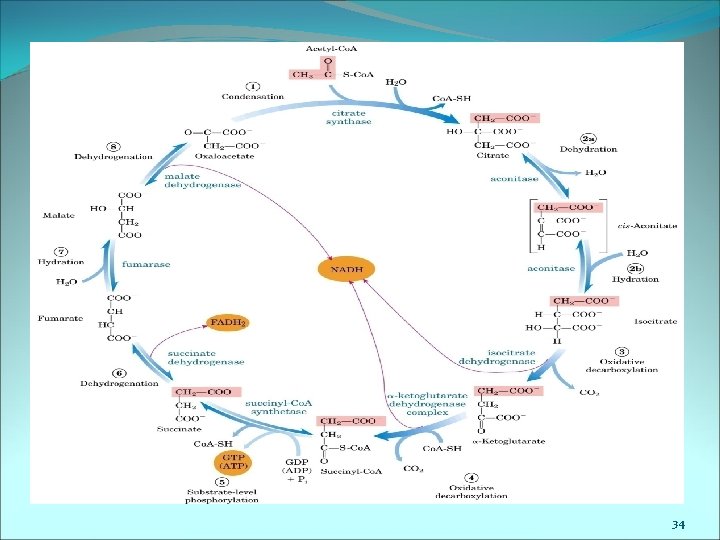
2. 4 -pairs of hydrogen atoms leave the cycle in four oxidation reactions. l Two molecules of NAD+ are reduced in the oxidative decarboxylations of isocitrate and a-ketoglutarate l one molecule of FAD is reduced in the oxidation of succinate l one molecule of NAD+ is reduced in the oxidation of malate. 3. One compound with high phosphoryl transfer potential, usually GTP, is generated from the cleavage of the thioester linkage in succinyl Co. A. 4. Two molecules of water are consumed: l one in the synthesis of citrate by the hydrolysis of citryl Co. A l the other in the hydration of fumarate. 33
34
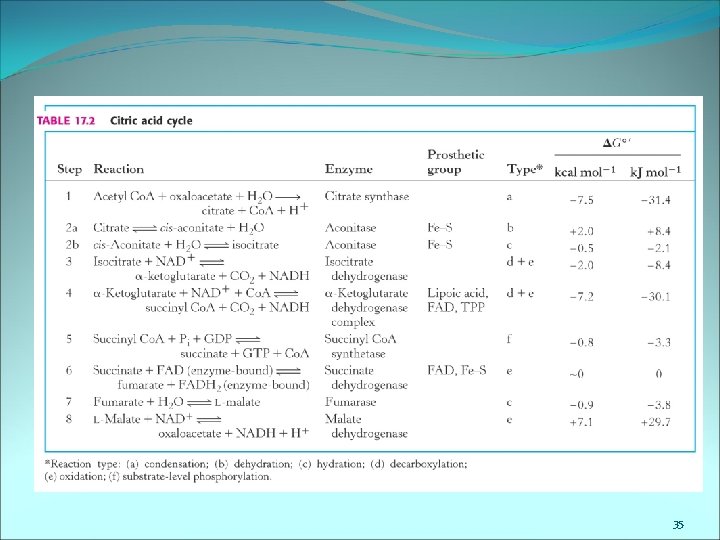
Summary of 8 steps 35
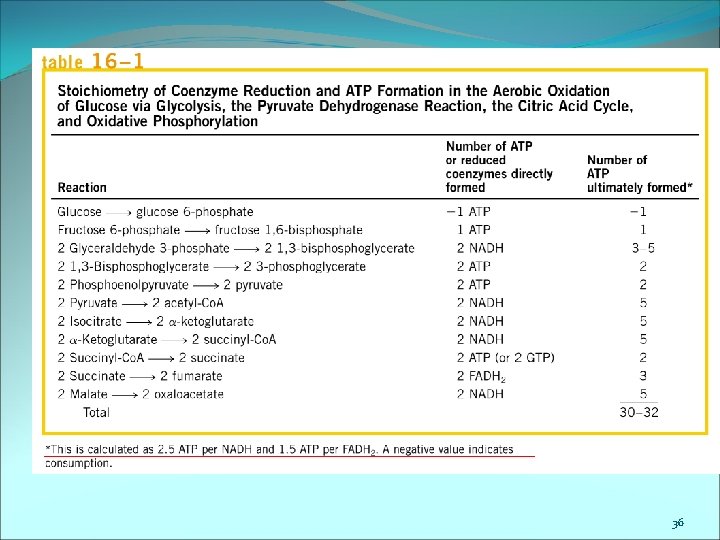
36
CONTROL OF THE CITRIC ACID CYCLE 37
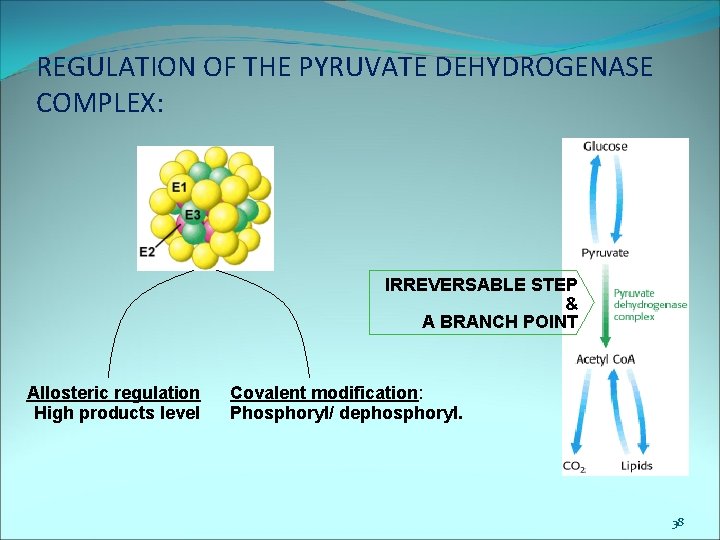
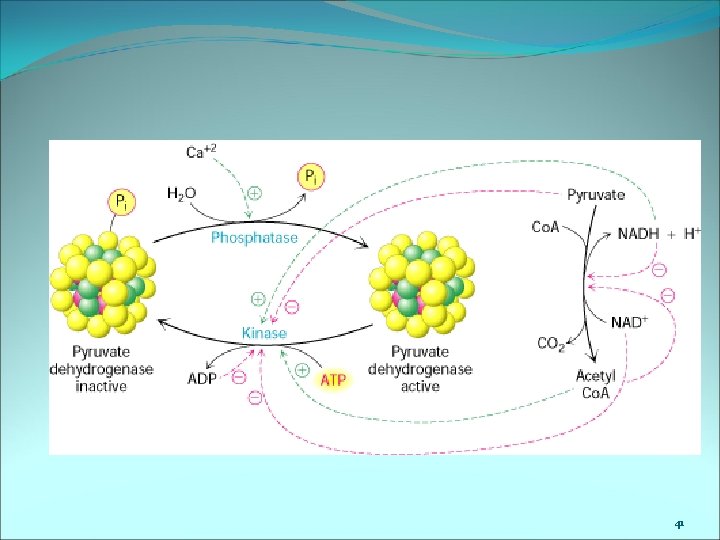
REGULATION OF THE PYRUVATE DEHYDROGENASE COMPLEX: IRREVERSABLE STEP & A BRANCH POINT Allosteric regulation High products level Covalent modification: Phosphoryl/ dephosphoryl. 38
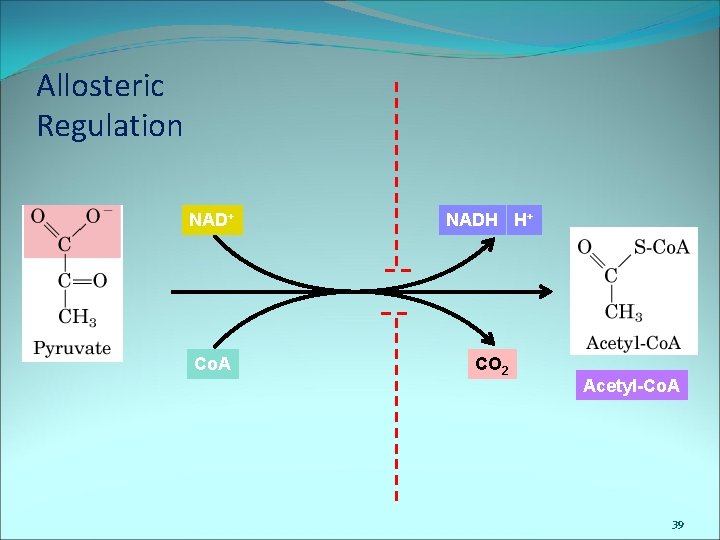
Allosteric Regulation NAD+ NADH H+ Co. A CO 2 Acetyl-Co. A 39
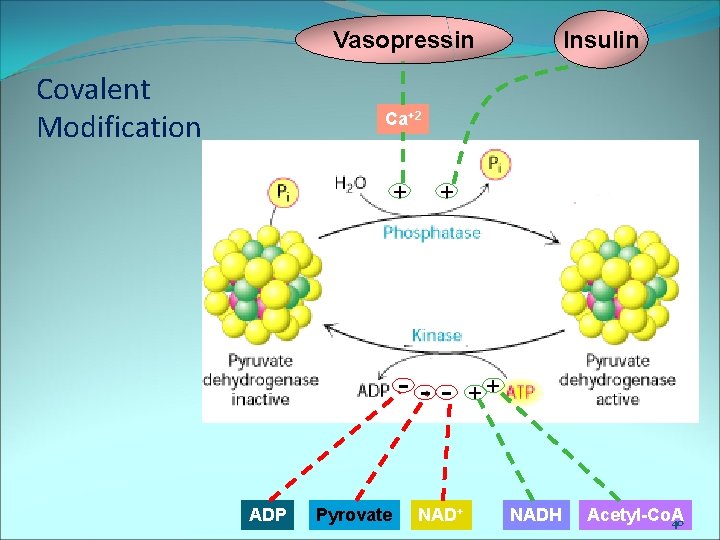
Insulin Vasopressin Covalent Modification Ca+2 + + --- ADP Pyrovate NAD+ ++ NADH Acetyl-Co. A 40
41
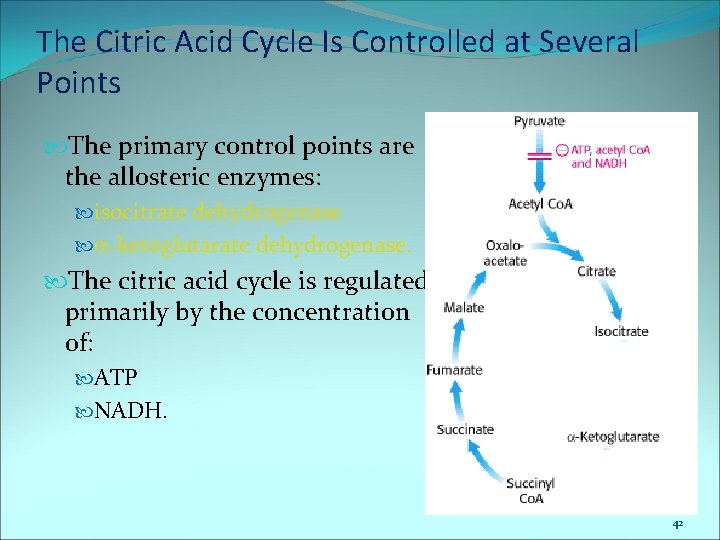
The Citric Acid Cycle Is Controlled at Several Points The primary control points are the allosteric enzymes: isocitrate dehydrogenase a-ketoglutarate dehydrogenase. The citric acid cycle is regulated primarily by the concentration of: ATP NADH. 42
Isocitrate dehydrogenase Allosterically stimulated by ADP, which enhances the enzyme's affinity for substrates. mutually cooperative binding of: Isocitrate NAD+ Mg 2+ ADP. NADH inhibits iso-citrate dehydrogenase by directly displacing NAD+. ATP too, is inhibitory. 43
a-ketoglutarate dehydrogenase Some aspects of this enzyme's control are like those of the pyruvate dehydrogenase complex. inhibited by the products of the reaction that it catalyzes : succinyl Co. A NADH, . high energy charge. The rate of the cycle is reduced when the cell has a high level of ATP. 44
The Citric Acid Cycle Is a Source of Biosynthetic Precursors 45
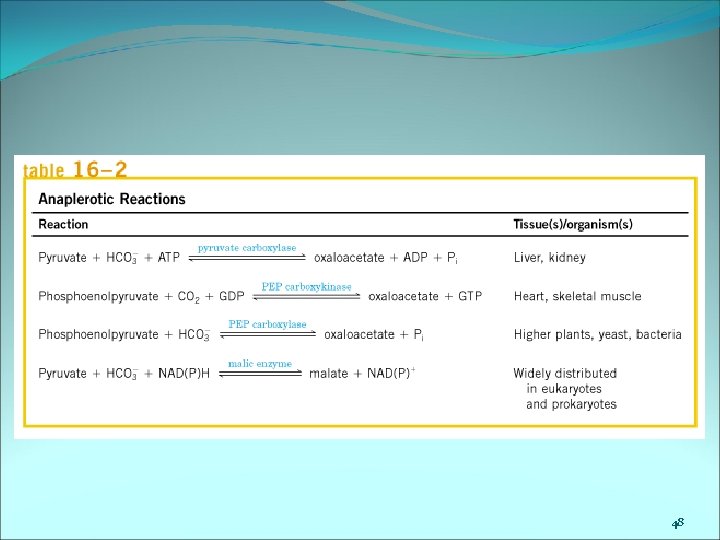
The citric acid cycle intermediates must be replenished if consumed in biosyntheses An anaplerotic reaction: A reaction that leads to the net synthesis, or replenishment, of pathway components. Because the citric acid cycle is a cycle, it can be replenished by the generation of any of the intermediates. 46
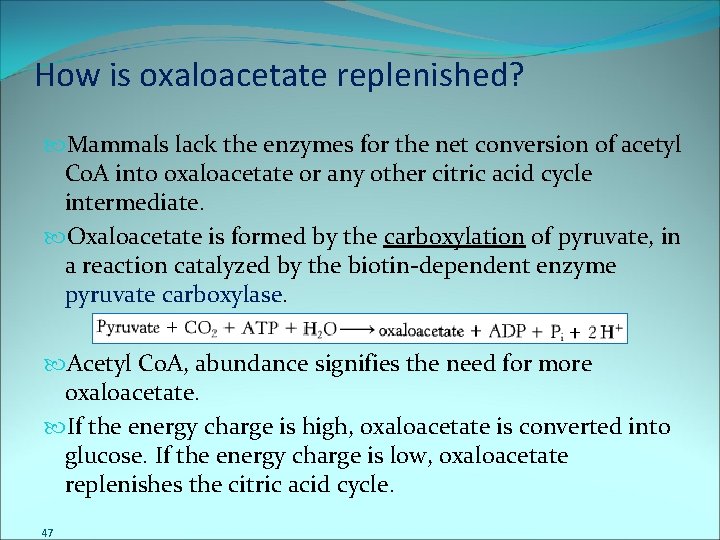
How is oxaloacetate replenished? Mammals lack the enzymes for the net conversion of acetyl Co. A into oxaloacetate or any other citric acid cycle intermediate. Oxaloacetate is formed by the carboxylation of pyruvate, in a reaction catalyzed by the biotin-dependent enzyme pyruvate carboxylase. Acetyl Co. A, abundance signifies the need for more oxaloacetate. If the energy charge is high, oxaloacetate is converted into glucose. If the energy charge is low, oxaloacetate replenishes the citric acid cycle. 47
48
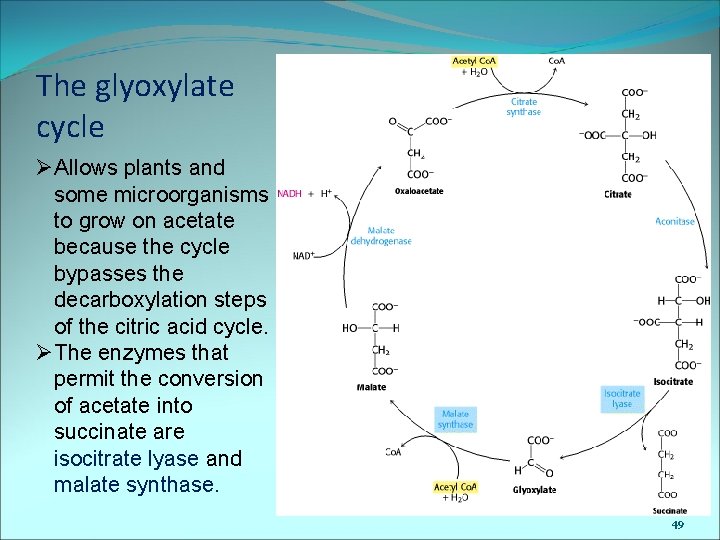
The glyoxylate cycle ØAllows plants and some microorganisms to grow on acetate because the cycle bypasses the decarboxylation steps of the citric acid cycle. ØThe enzymes that permit the conversion of acetate into succinate are isocitrate lyase and malate synthase. 49