
The CITE Initiative Collaborative Inquiry Team in Education
The CITE Initiative Collaborative Inquiry Team in Education Phase 1: January-June 2015 Phase 2: January-June 2016 Presenters: Maria Cantalini-Williams, Debra Curtis, Kim De. Gasperis, Heather Papp, Sherrie Rellinger
Goals of CITE: • Develop a collaborative inquiry model with a concurrent research study • Align with Ontario Education Research Strategy http: //www. edu. gov. on. ca/eng/research/strategy. html • Utilize School Board-University Research Exchange Network (SURE) resources: www. surenetwork. ca • Facilitate teacher efficacy and professional learning • Share and implement effective strategies to promote student learning as outlined in school plans • ‘Name, Frame and Proclaim’ teacher research!
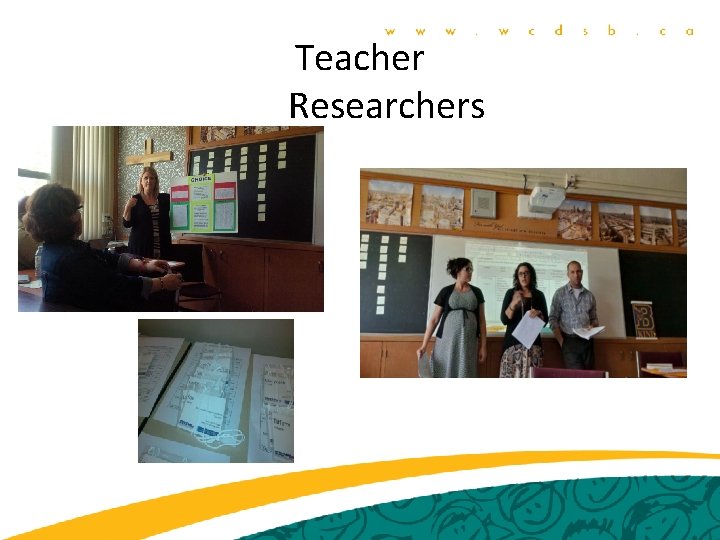
Teacher Researchers
Related Research • • A culture of inquiry whereby research is valued, accessible to practitioners, relevant to particular contexts, and contributes to enhancing teaching to further student learning (Martinovic, Wiebe, Ratkovic, Willard-Holt, Spencer & Cantalini. Williams, 2012) Teachers have been found to be ideal researchers as they are insightful and knowledgeable in regards to current teaching practices and student needs (Blakemore, 2012). Partnerships are successful when universities, schools, and teachers work in collaboration to conduct meaningful research about current educational issues (Gore & Gitlin, 2004; Kyei-Blankson, 2014). Cooper (2014) found that knowledge mobilization facilitates exchange between academic research and professional practice. Collaborative inquiry rarely used online strategies for discussion of information.
Development of CITE 1. Support from Board Superintendents to liaise with Student Work Study Teacher 2. Meetings with SWS teacher and school principal 3. Research ethics approval was received from university and school board 4. Sessions intended to build trust, norms and mutual understandings 5. CITE was not an additional workload 6. Alignment with the work of the SWS teacher in collaboration with SIPSA school team
Research Questions 1. How does the collaborative inquiry process facilitate participants’ awareness of and interest in the research process? 2. How does the collaborative inquiry process create a community of educational researchers? 3. How does the collaborative inquiry process contribute to increased competencies and changes in pedagogical practices? 4. How did the collaborative inquiry initiative enhance student learning and skills? 5. What are the enablers and challenges to developing collaborative inquiry teams in education?
Methodology • Nine Participants: 6 classroom teachers ( grades 1 -7 with 2 males and 4 females), principal, SWS teacher and resource teacher) • Two faculty facilitators who had worked for WCDSB • Five monthly sessions • Each session included a range of activities such as SURE and Ministry videos, discussions, completing an Action Plan with focus and strategies, sharing pedagogical documentation and evidence of student engagement/learning • Professional development included: research process, effective teaching strategies, and cycle of collaborative inquiry
Collection of Data A Qualitative Approach with Triangulation of Data 1. Transcriptions: A portion of each session was audiotaped to gather perceptions of benefits and challenges of the research process and the new learnings related to pedagogy and effective practice. 2. Reflection/Feedback: Forms were completed anonymously by each participant at the end of each session to provide direction and evidence of participants’ learning. Feedback used to plan following sessions. 3. Documents: Artifacts were created such as discussion charts, graphic organizers, action plans and student samples/pedagogical documentation.
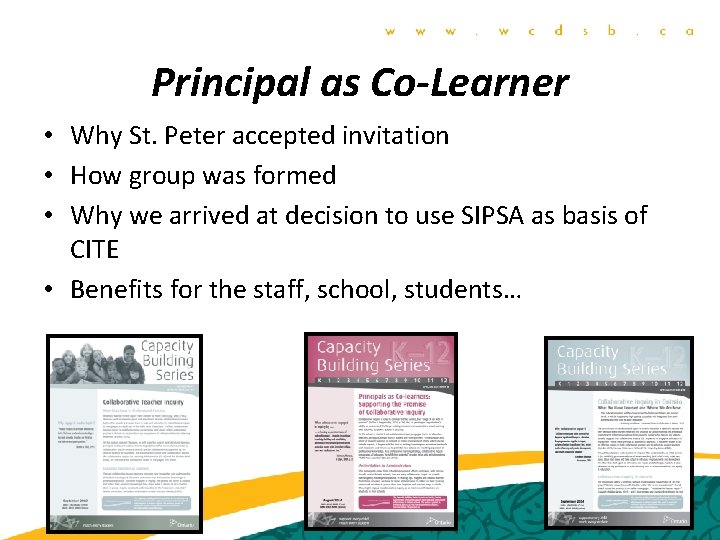
Principal as Co-Learner • Why St. Peter accepted invitation • How group was formed • Why we arrived at decision to use SIPSA as basis of CITE • Benefits for the staff, school, students…
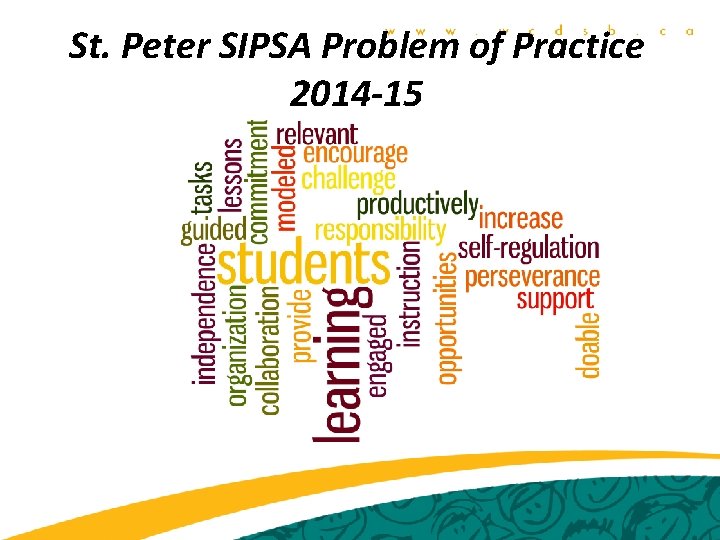
St. Peter SIPSA Problem of Practice 2014 -15
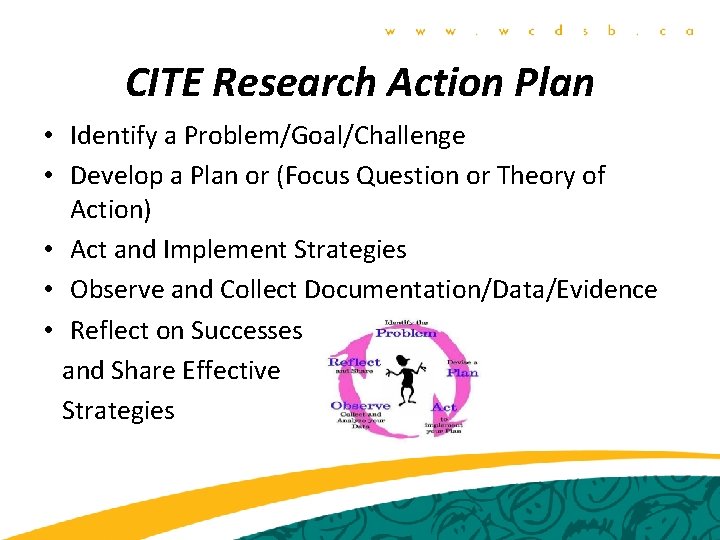
CITE Research Action Plan • Identify a Problem/Goal/Challenge • Develop a Plan or (Focus Question or Theory of Action) • Act and Implement Strategies • Observe and Collect Documentation/Data/Evidence • Reflect on Successes and Share Effective Strategies
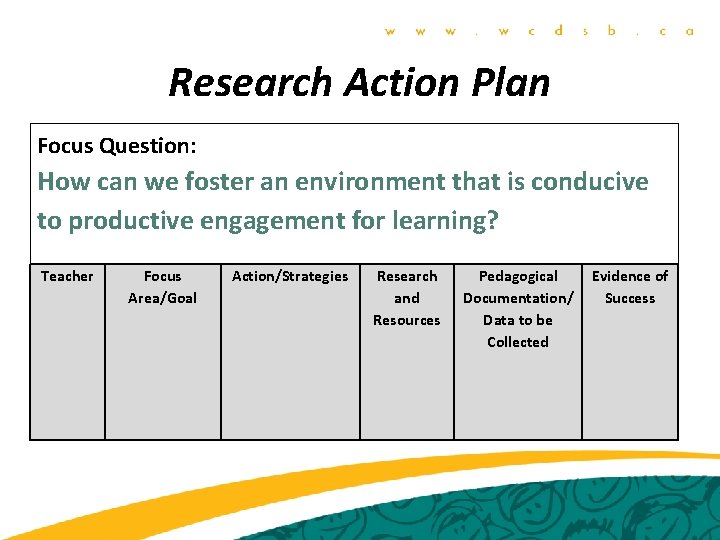
Research Action Plan Focus Question: How can we foster an environment that is conducive to productive engagement for learning? Teacher Focus Area/Goal Action/Strategies Research and Resources Pedagogical Documentation/ Data to be Collected Evidence of Success
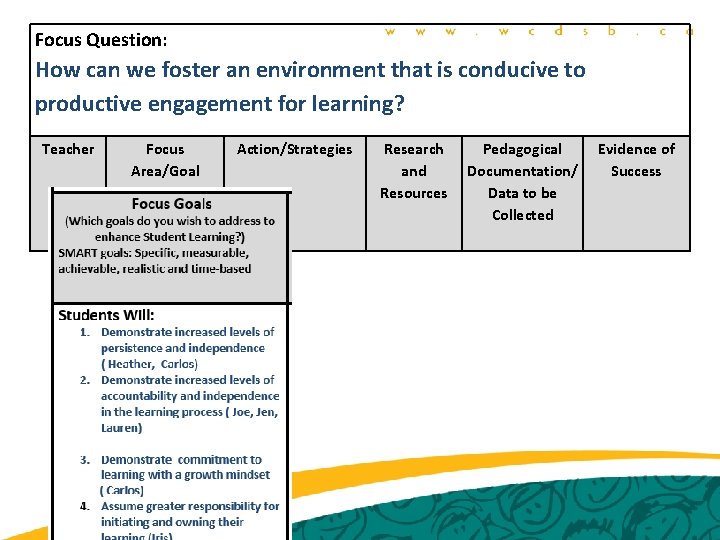
Focus Question: How can we foster an environment that is conducive to productive engagement for learning? Teacher Focus Area/Goal Action/Strategies Research and Resources Pedagogical Documentation/ Data to be Collected Evidence of Success
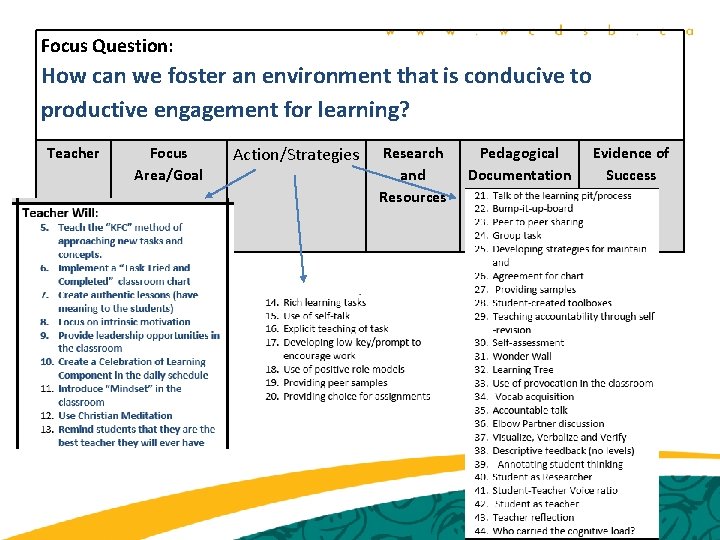
Focus Question: How can we foster an environment that is conducive to productive engagement for learning? Teacher Focus Area/Goal Action/Strategies Research and Resources Pedagogical Documentation /Data to be Collected Evidence of Success
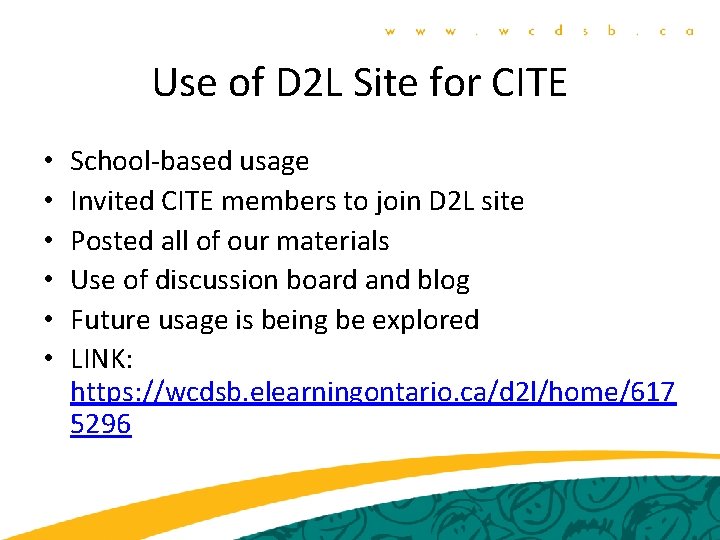
Use of D 2 L Site for CITE • • • School-based usage Invited CITE members to join D 2 L site Posted all of our materials Use of discussion board and blog Future usage is being be explored LINK: https: //wcdsb. elearningontario. ca/d 2 l/home/617 5296
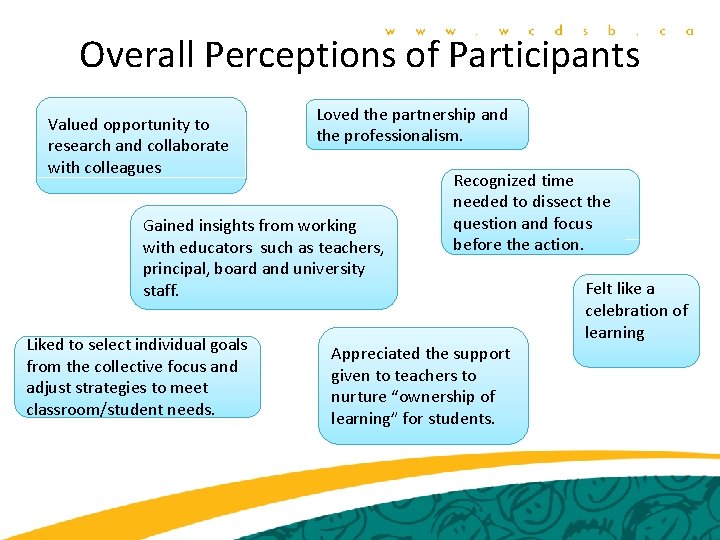
Overall Perceptions of Participants Valued opportunity to research and collaborate with colleagues Loved the partnership and the professionalism. Gained insights from working with educators such as teachers, principal, board and university staff. Liked to select individual goals from the collective focus and adjust strategies to meet classroom/student needs. Recognized time needed to dissect the question and focus before the action. Appreciated the support given to teachers to nurture “ownership of learning” for students. Felt like a celebration of learning
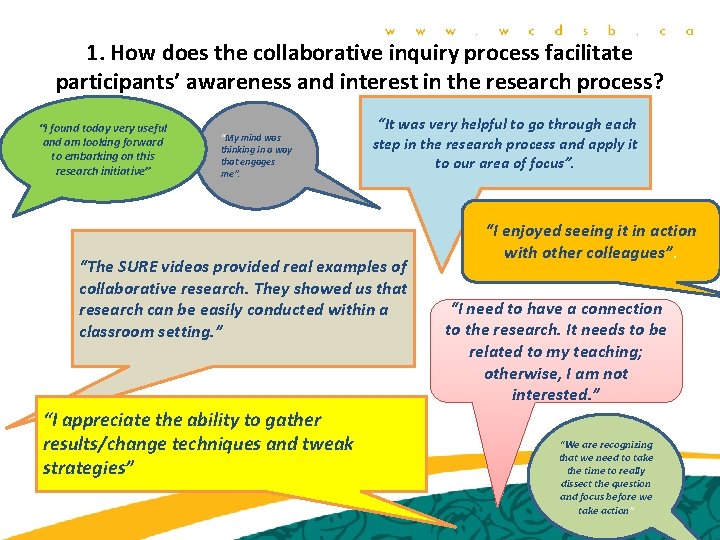
1. How does the collaborative inquiry process facilitate participants’ awareness and interest in the research process? “I found today very useful and am looking forward to embarking on this research initiative” “My mind was thinking in a way that engages me”. “It was very helpful to go through each step in the research process and apply it to our area of focus”. “The SURE videos provided real examples of collaborative research. They showed us that research can be easily conducted within a classroom setting. ” “I appreciate the ability to gather results/change techniques and tweak strategies” “I enjoyed seeing it in action with other colleagues”. “I need to have a connection to the research. It needs to be related to my teaching; otherwise, I am not interested. ” “We are recognizing that we need to take the time to really dissect the question and focus before we take action”
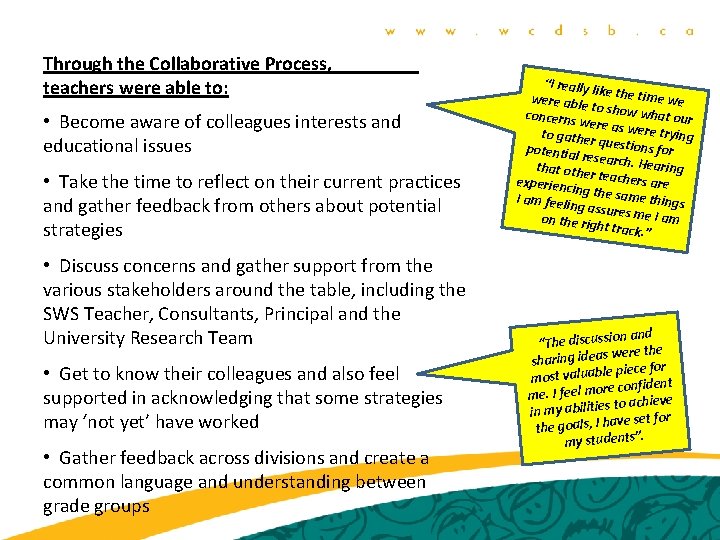
Through the Collaborative Process, teachers were able to: • Become aware of colleagues interests and educational issues • Take the time to reflect on their current practices and gather feedback from others about potential strategies • Discuss concerns and gather support from the various stakeholders around the table, including the SWS Teacher, Consultants, Principal and the University Research Team • Get to know their colleagues and also feel supported in acknowledging that some strategies may ‘not yet’ have worked • Gather feedback across divisions and create a common language and understanding between grade groups “I really li k were able e the time we to show w h concerns were as w at our ere trying to gather questions potential for research. Hearing that othe r t e a c h ers are experienc ing the sa me things I am feeli ng assure s me I am on the rig ht track. ” n and “The discussio were the sharing ideas piece for most valuable confident me. I feel more to achieve s ie it il b a y m in ve set for the goals, I ha. my students”
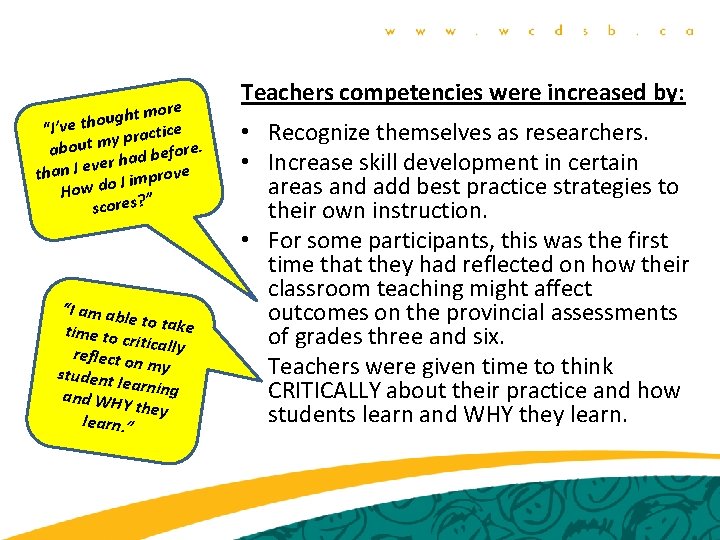
more t h g u o h “I’ve t ctice a r p y m about efore. b d a h r ve than I e prove m i I o d How ” scores? “I am ab le to take time to c ritica reflect on lly student l my earn and WHY ing they learn. ” Teachers competencies were increased by: • Recognize themselves as researchers. • Increase skill development in certain areas and add best practice strategies to their own instruction. • For some participants, this was the first time that they had reflected on how their classroom teaching might affect outcomes on the provincial assessments of grades three and six. • Teachers were given time to think CRITICALLY about their practice and how students learn and WHY they learn.
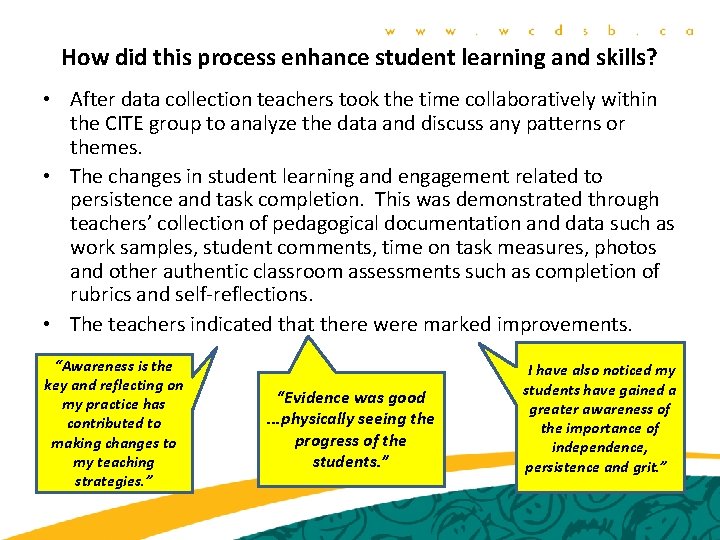
How did this process enhance student learning and skills? • After data collection teachers took the time collaboratively within the CITE group to analyze the data and discuss any patterns or themes. • The changes in student learning and engagement related to persistence and task completion. This was demonstrated through teachers’ collection of pedagogical documentation and data such as work samples, student comments, time on task measures, photos and other authentic classroom assessments such as completion of rubrics and self-reflections. • The teachers indicated that there were marked improvements. “Awareness is the key and reflecting on my practice has contributed to making changes to my teaching strategies. ” “Evidence was good. . . physically seeing the progress of the students. ” I have also noticed my students have gained a greater awareness of the importance of independence, persistence and grit. ”
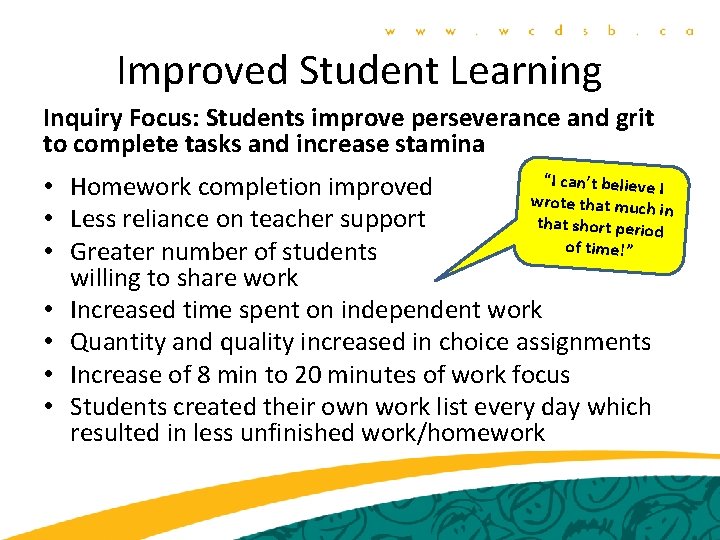
Improved Student Learning Inquiry Focus: Students improve perseverance and grit to complete tasks and increase stamina “I can’t believe I • Homework completion improved wrote that much in • Less reliance on teacher support that short period of time!” • Greater number of students willing to share work • Increased time spent on independent work • Quantity and quality increased in choice assignments • Increase of 8 min to 20 minutes of work focus • Students created their own work list every day which resulted in less unfinished work/homework
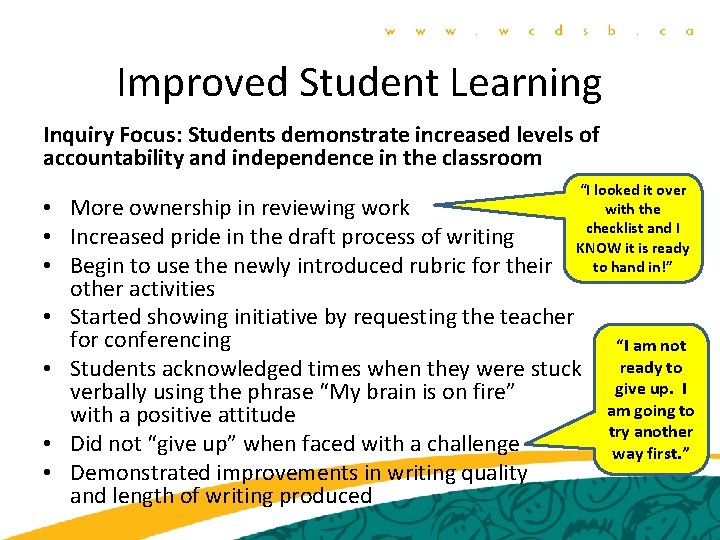
Improved Student Learning Inquiry Focus: Students demonstrate increased levels of accountability and independence in the classroom “I looked it over with the checklist and I KNOW it is ready to hand in!” • More ownership in reviewing work • Increased pride in the draft process of writing • Begin to use the newly introduced rubric for their other activities • Started showing initiative by requesting the teacher for conferencing • Students acknowledged times when they were stuck verbally using the phrase “My brain is on fire” with a positive attitude • Did not “give up” when faced with a challenge • Demonstrated improvements in writing quality and length of writing produced “I am not ready to give up. I am going to try another way first. ”
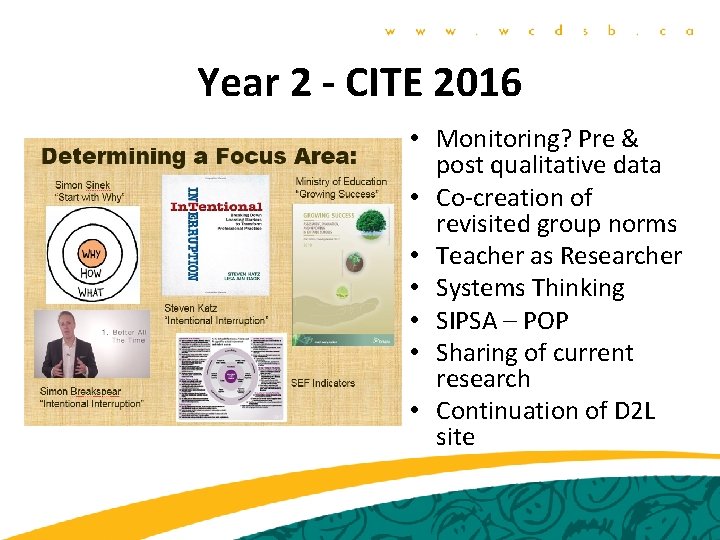
Year 2 - CITE 2016 • Monitoring? Pre & post qualitative data • Co-creation of revisited group norms • Teacher as Researcher • Systems Thinking • SIPSA – POP • Sharing of current research • Continuation of D 2 L site
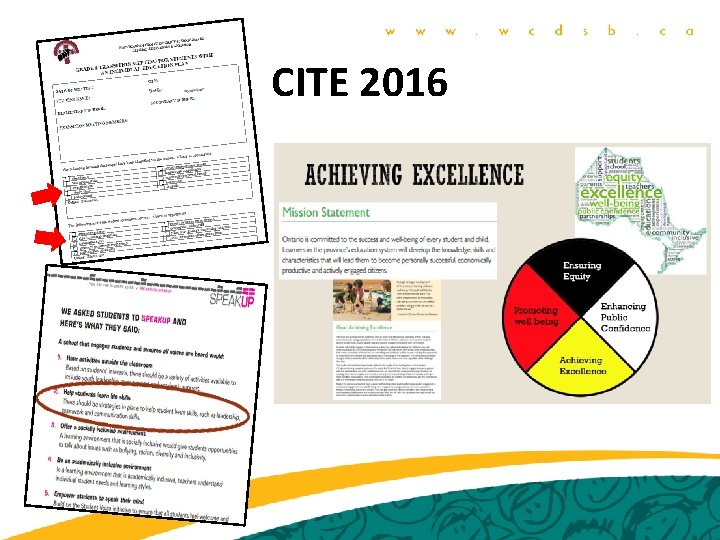
CITE 2016
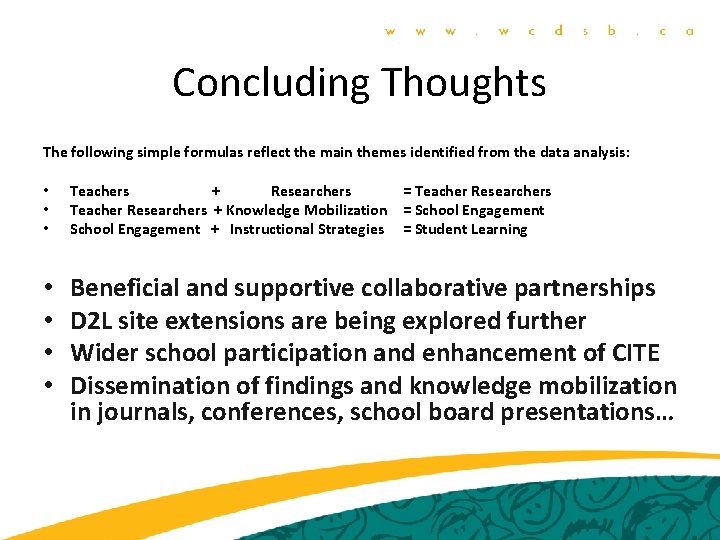
Concluding Thoughts The following simple formulas reflect the main themes identified from the data analysis: • • • Teachers + Researchers = Teacher Researchers + Knowledge Mobilization = School Engagement + Instructional Strategies = Student Learning • • Beneficial and supportive collaborative partnerships D 2 L site extensions are being explored further Wider school participation and enhancement of CITE Dissemination of findings and knowledge mobilization in journals, conferences, school board presentations…
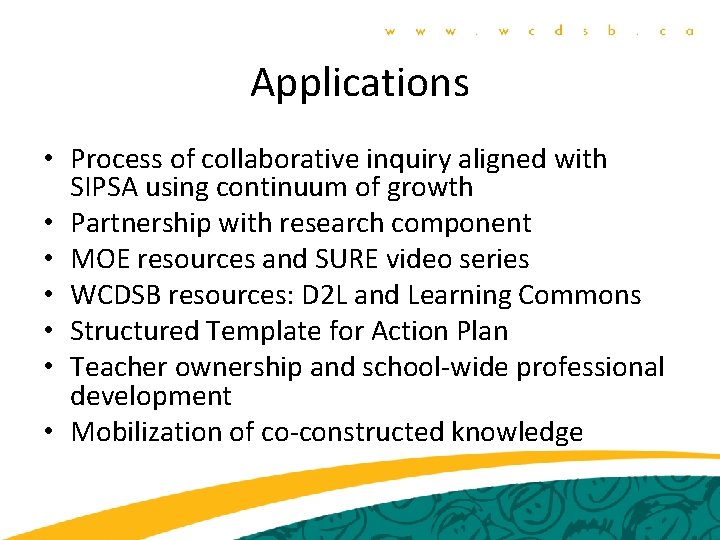
Applications • Process of collaborative inquiry aligned with SIPSA using continuum of growth • Partnership with research component • MOE resources and SURE video series • WCDSB resources: D 2 L and Learning Commons • Structured Template for Action Plan • Teacher ownership and school-wide professional development • Mobilization of co-constructed knowledge
- Slides: 26