
THE CIRCULAR FLOW OF ECONOMIC ACTIVITY Circular Flow

- Slides: 29
THE CIRCULAR FLOW OF ECONOMIC ACTIVITY
Circular Flow ØThe circular-flow diagram is a model that represents the continual movement of money and goods in the economy ØIt is a simplification of how money and goods flow from households to business and back again
Circular Flow Models ØModels can be simple (two-sector) to complex (five-sector) ØAll models show that the economy relies on continuous movement of goods and money to maintain strong economy
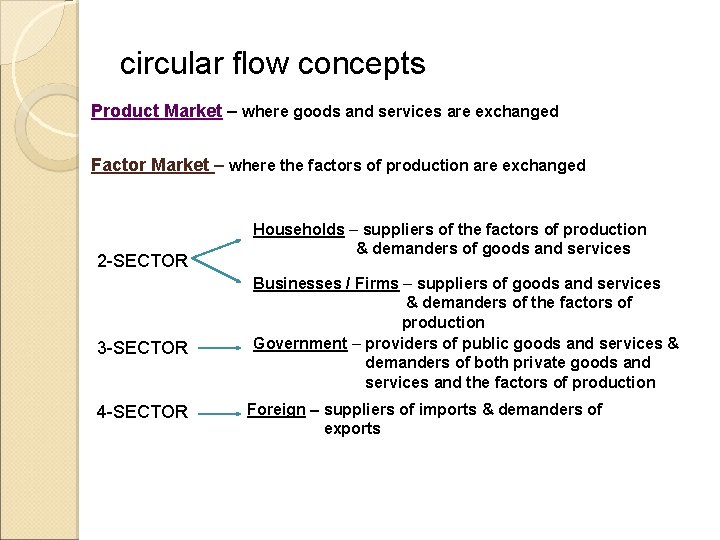
circular flow concepts Product Market – where goods and services are exchanged Factor Market – where the factors of production are exchanged 2 -SECTOR 3 -SECTOR 4 -SECTOR Households – suppliers of the factors of production & demanders of goods and services Businesses / Firms – suppliers of goods and services & demanders of the factors of production Government – providers of public goods and services & demanders of both private goods and services and the factors of production Foreign – suppliers of imports & demanders of exports
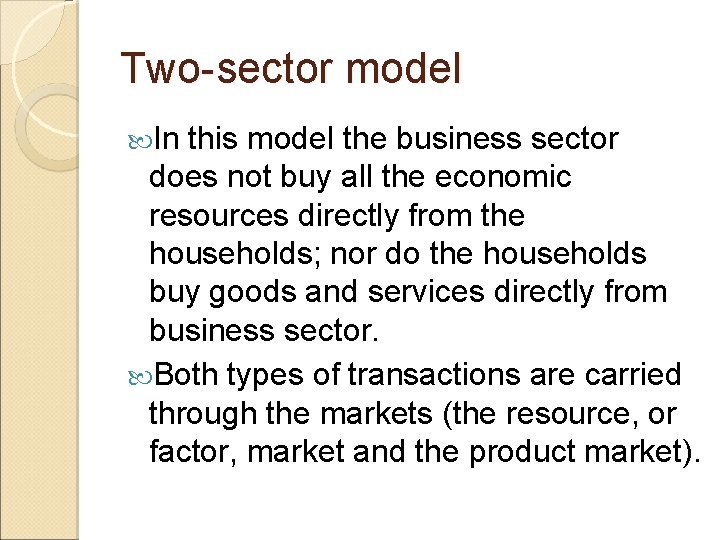
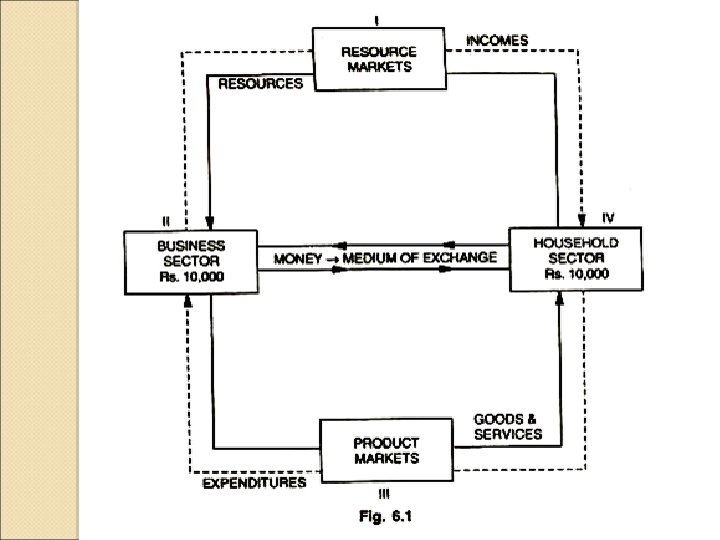
Two-sector model In this model the business sector does not buy all the economic resources directly from the households; nor do the households buy goods and services directly from business sector. Both types of transactions are carried through the markets (the resource, or factor, market and the product market).
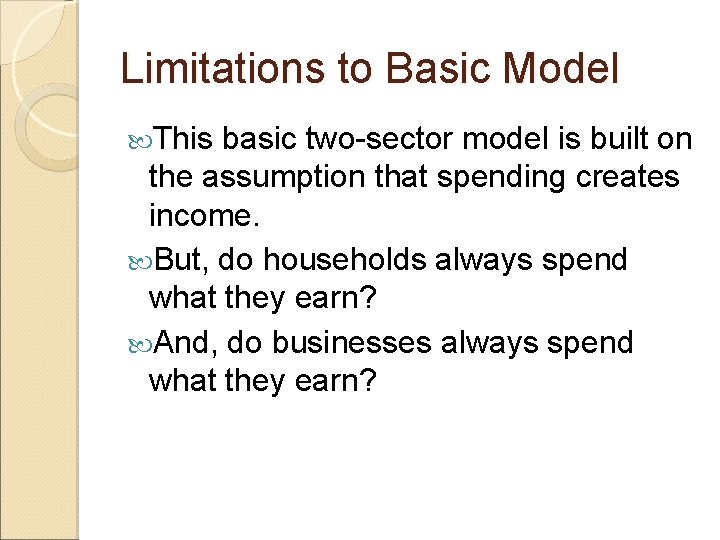
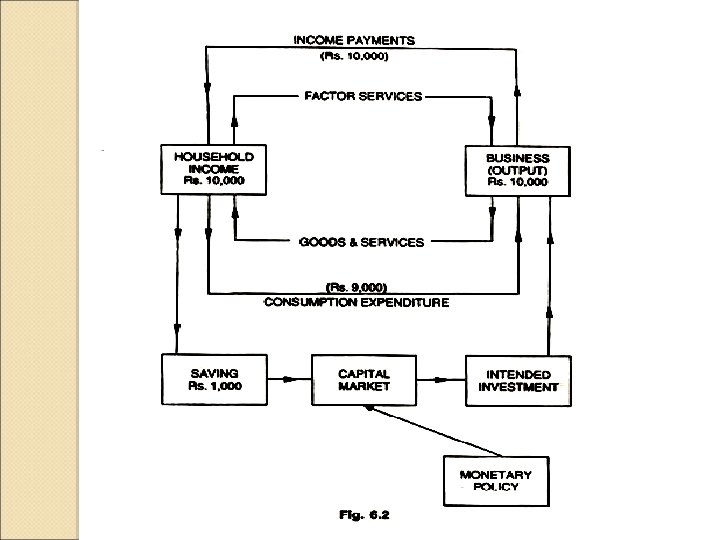
Limitations to Basic Model This basic two-sector model is built on the assumption that spending creates income. But, do households always spend what they earn? And, do businesses always spend what they earn?
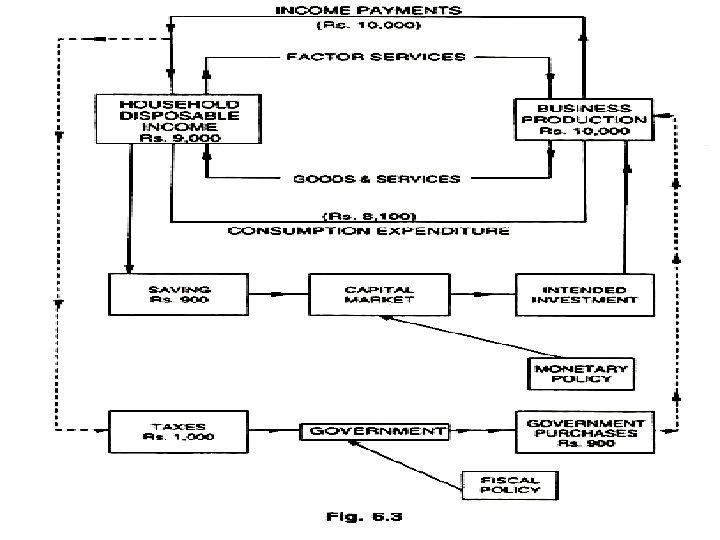
Monetary Policy According to classical theories of economics, the capital market always acts in a manner that will make saving equal to investments automatically through the mechanism of the rate of interest. But modern economists believe that there is no automatic capital market mechanism making S = I. Some outside force or action or mechanism must be geared into action to make S = I. This outside action, force or mechanism is monetary policy, which can stimulate or retard
Two-sector Model What are the limitations of viewing the economy as a two-sector model? What sectors are missing? variables are not taken into consideration?
Add the Government Sector When we give money to governments (Central, State, Local) in the form of taxes, our ability to spend is reduced but the government can offset the effect of this leakage through taxes by spending more on the purchase of goods and services called injection. This act on the part of the government to levy taxes and to spend more is called fiscal action.
ØThree-sector model LEAKAGE ØIn three-sector models, flows from household sector and producing sector to government sector are in the form of taxes. INJECTION ØThe income received from the government sector flows to producing and household sectors in the form of payments for government purchases of goods and services as well as payment of subsides and transfer (benefits) payments.
Role of Fiscal Policy . If I < S, then government should compensate the economy by spending more than it taxes: FISCAL POLICY. It is, therefore, clear that the monetary policy and the fiscal policy are necessary instruments of maintaining circular flows in the economy—in case it is temporarily disrupted by leakages in the form of savings or taxes or imports.
Three-sector Model What are the limitations of viewing the economy as a three-sector model? What sector is missing? variables are not taken into consideration?
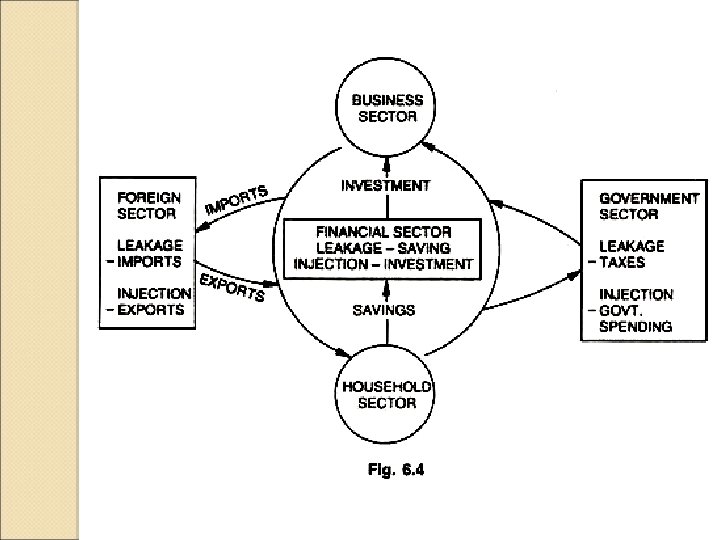
The Addition of Trade When the foreign sector is added in our four-sector model we treat imports as leakages and exports as injections. These flows pass through a sector called ‘balance of payments’ sector— which is influenced by various types of foreign trade policies (say, like free trade or protection). The equilibrium condition for maintaining the circular flow would still
Four-sector Model Technically speaking, so long as lending is equal to the borrowing i. e. leakage is equal to injections, the circular flow will continue indefinitely. However this job is done by financial institutions in the economy, and is complicated by competing economic philosophies.
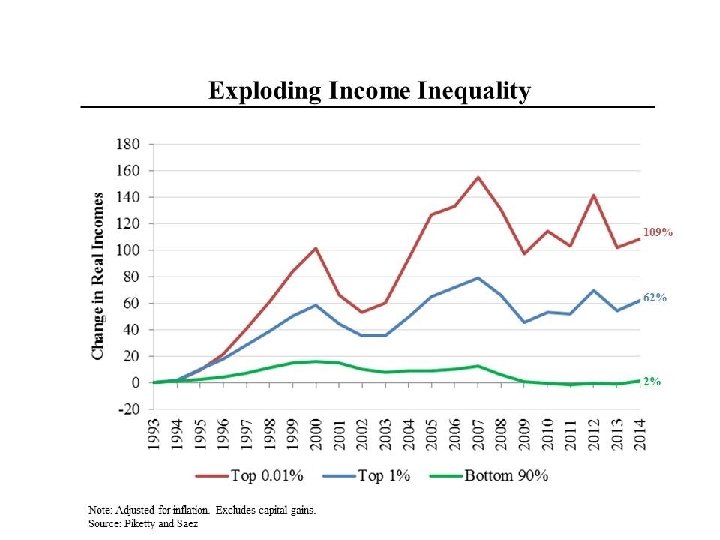
When the Circular Flow Falters… What to do when the economy isn’t circular and doesn’t flow? Areas of Concern with the US economy today: q. Income Inequality q. Resource Allocation q. Worker and Consumer Safety q. Capital Market Accountability q. Globalization
Income Inequality Issues to consider: v. Minimum wage v. Welfare programs v. Tax rates v. Racial inequality v. Gender gap v. Net neutrality v. Health care v. Affordable housing
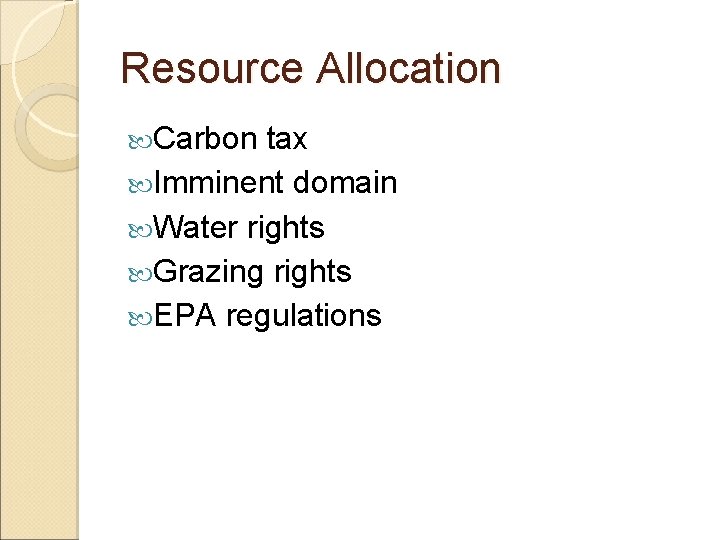
Resource Allocation Carbon tax Imminent domain Water rights Grazing rights EPA regulations
SNACK BREAK! PLEASE COME UP AND HELP YOURSELF TO AS MUCH AS YOU WANT
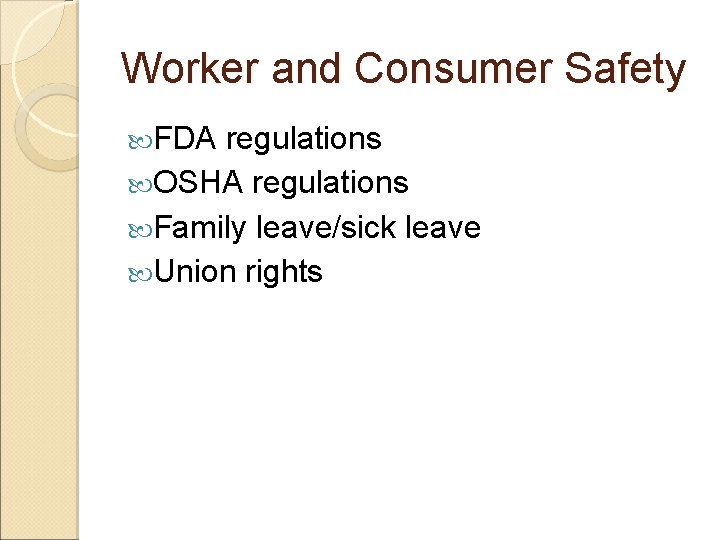
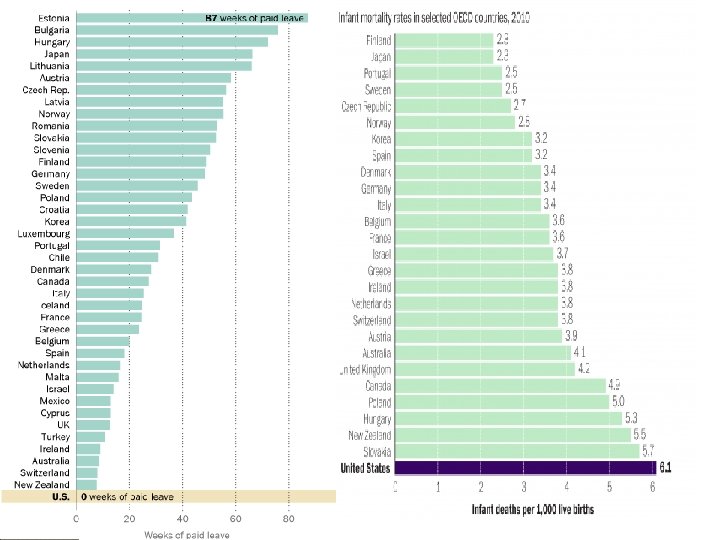
Worker and Consumer Safety FDA regulations OSHA regulations Family leave/sick leave Union rights
Capital Market Accountability Banking regulations Stock market regulations Mergers and acquisitions regulations
Globalization Immigration policy Climate treaties Trade agreements Outsourcing Environmental impacts Human rights issues
Transnational Capital Auction: A game of Survival You are leaders of a poor country. Each of your countries was either colonized by European countries or dominated by them economically or militarily. You need to attract foreign investment (“Capital”) from transnational corporations for many different reasons. Of course not all of your people are poor. Many, including you, are quite wealthy. But your wealth depends largely on making deals with corporations that come to your country…