
The Cigar Box Guitar History of the Cigar
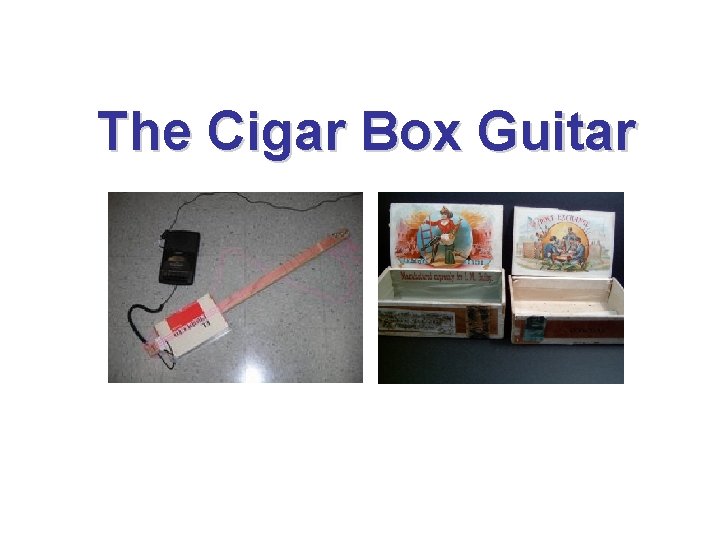
The Cigar Box Guitar
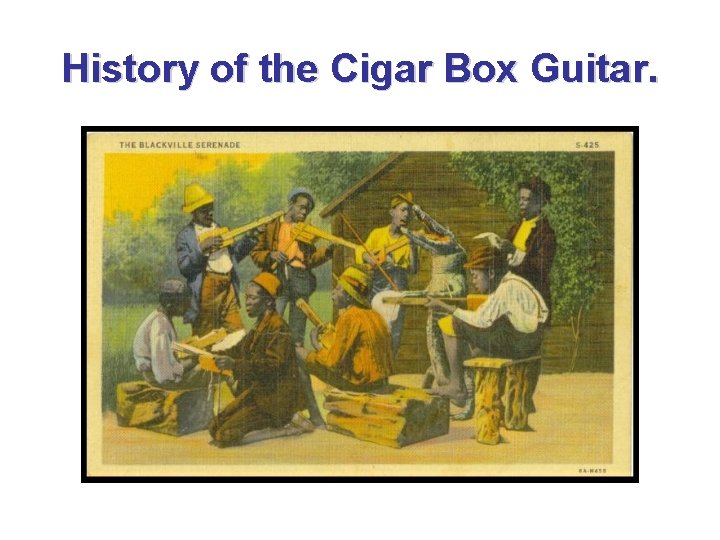
History of the Cigar Box Guitar.
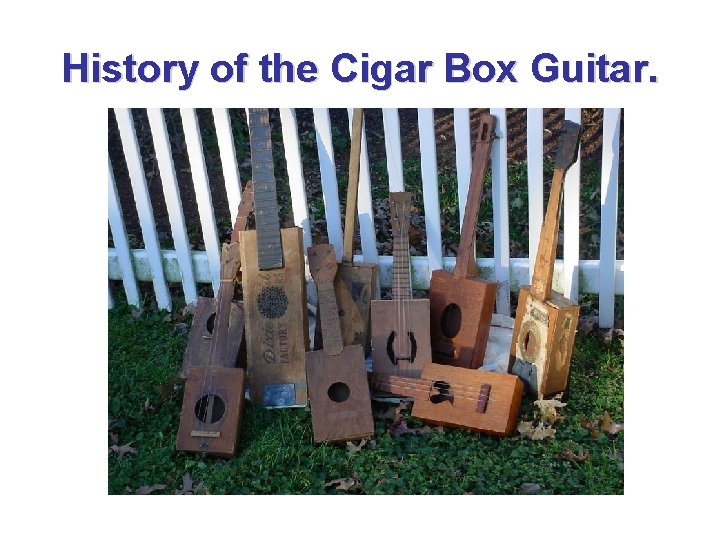
History of the Cigar Box Guitar.
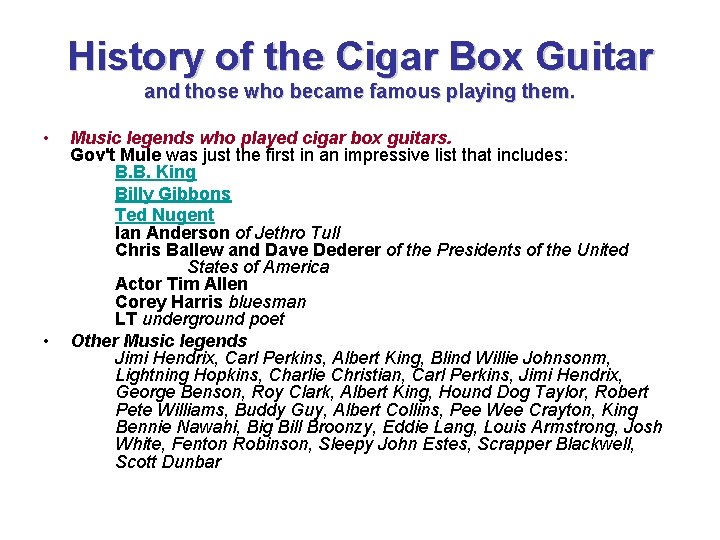
History of the Cigar Box Guitar and those who became famous playing them. • • Music legends who played cigar box guitars. Gov't Mule was just the first in an impressive list that includes: B. B. King Billy Gibbons Ted Nugent Ian Anderson of Jethro Tull Chris Ballew and Dave Dederer of the Presidents of the United States of America Actor Tim Allen Corey Harris bluesman LT underground poet Other Music legends Jimi Hendrix, Carl Perkins, Albert King, Blind Willie Johnsonm, Lightning Hopkins, Charlie Christian, Carl Perkins, Jimi Hendrix, George Benson, Roy Clark, Albert King, Hound Dog Taylor, Robert Pete Williams, Buddy Guy, Albert Collins, Pee Wee Crayton, King Bennie Nawahi, Big Bill Broonzy, Eddie Lang, Louis Armstrong, Josh White, Fenton Robinson, Sleepy John Estes, Scrapper Blackwell, Scott Dunbar
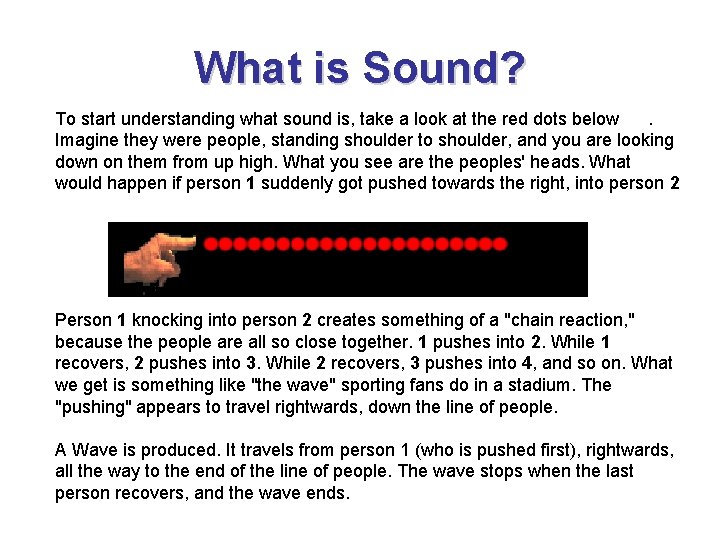
What is Sound? To start understanding what sound is, take a look at the red dots below. Imagine they were people, standing shoulder to shoulder, and you are looking down on them from up high. What you see are the peoples' heads. What would happen if person 1 suddenly got pushed towards the right, into person 2 Person 1 knocking into person 2 creates something of a "chain reaction, " because the people are all so close together. 1 pushes into 2. While 1 recovers, 2 pushes into 3. While 2 recovers, 3 pushes into 4, and so on. What we get is something like "the wave" sporting fans do in a stadium. The "pushing" appears to travel rightwards, down the line of people. A Wave is produced. It travels from person 1 (who is pushed first), rightwards, all the way to the end of the line of people. The wave stops when the last person recovers, and the wave ends.
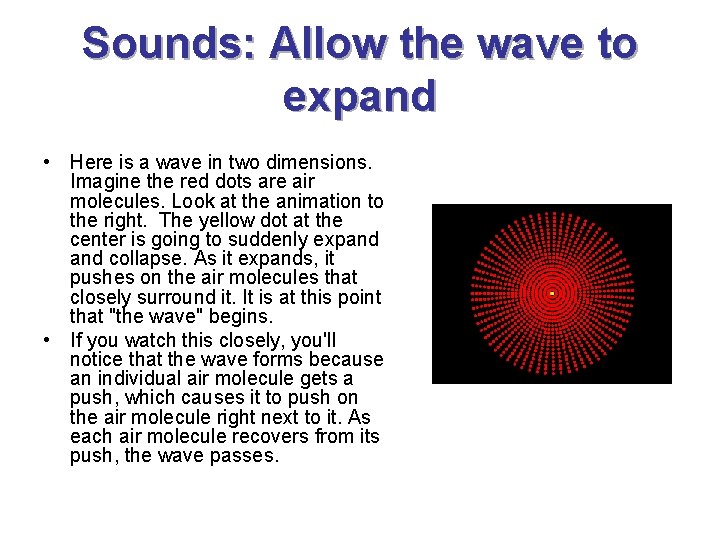
Sounds: Allow the wave to expand • Here is a wave in two dimensions. Imagine the red dots are air molecules. Look at the animation to the right. The yellow dot at the center is going to suddenly expand collapse. As it expands, it pushes on the air molecules that closely surround it. It is at this point that "the wave" begins. • If you watch this closely, you'll notice that the wave forms because an individual air molecule gets a push, which causes it to push on the air molecule right next to it. As each air molecule recovers from its push, the wave passes.
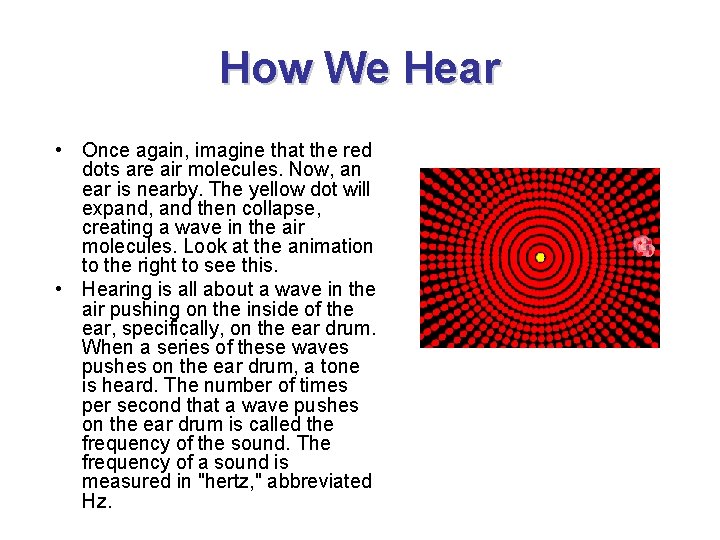
How We Hear • Once again, imagine that the red dots are air molecules. Now, an ear is nearby. The yellow dot will expand, and then collapse, creating a wave in the air molecules. Look at the animation to the right to see this. • Hearing is all about a wave in the air pushing on the inside of the ear, specifically, on the ear drum. When a series of these waves pushes on the ear drum, a tone is heard. The number of times per second that a wave pushes on the ear drum is called the frequency of the sound. The frequency of a sound is measured in "hertz, " abbreviated Hz.

The Frequency of Sound Click Here to Hear Different Frequencies of Sound
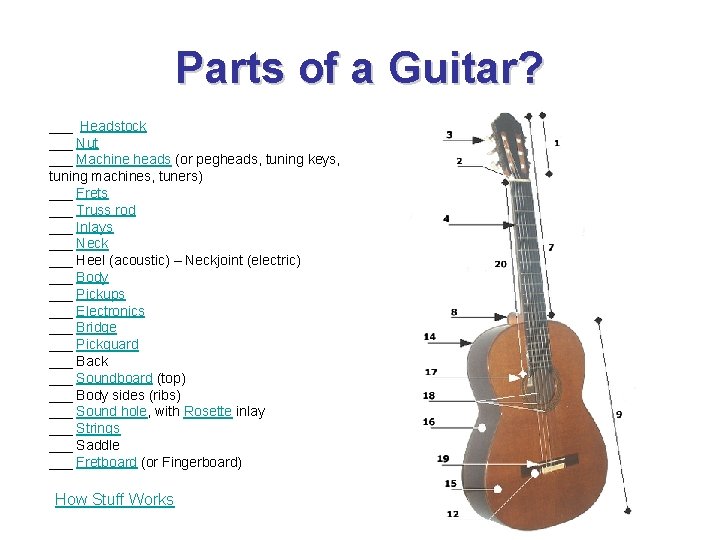
Parts of a Guitar? ___ Headstock ___ Nut ___ Machine heads (or pegheads, tuning keys, tuning machines, tuners) ___ Frets ___ Truss rod ___ Inlays ___ Neck ___ Heel (acoustic) – Neckjoint (electric) ___ Body ___ Pickups ___ Electronics ___ Bridge ___ Pickguard ___ Back ___ Soundboard (top) ___ Body sides (ribs) ___ Sound hole, with Rosette inlay ___ Strings ___ Saddle ___ Fretboard (or Fingerboard) How Stuff Works
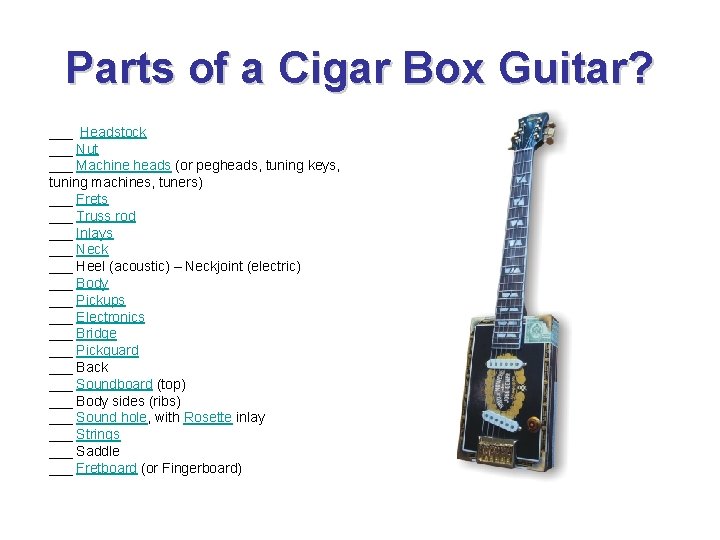
Parts of a Cigar Box Guitar? ___ Headstock ___ Nut ___ Machine heads (or pegheads, tuning keys, tuning machines, tuners) ___ Frets ___ Truss rod ___ Inlays ___ Neck ___ Heel (acoustic) – Neckjoint (electric) ___ Body ___ Pickups ___ Electronics ___ Bridge ___ Pickguard ___ Back ___ Soundboard (top) ___ Body sides (ribs) ___ Sound hole, with Rosette inlay ___ Strings ___ Saddle ___ Fretboard (or Fingerboard)
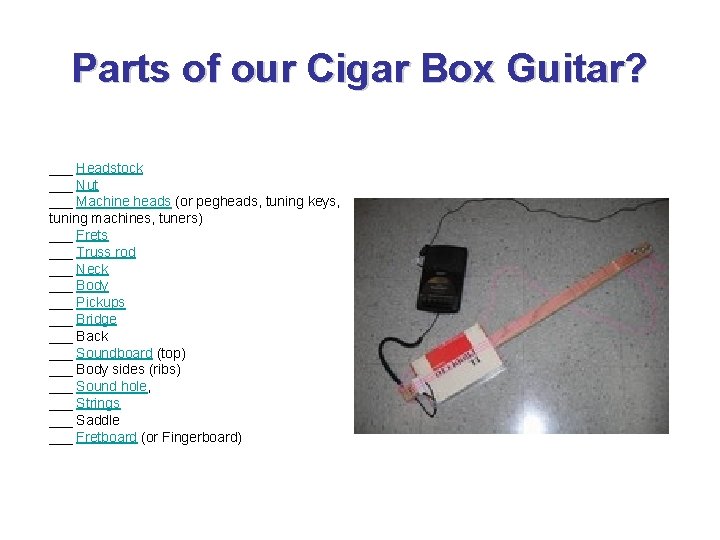
Parts of our Cigar Box Guitar? ___ Headstock ___ Nut ___ Machine heads (or pegheads, tuning keys, tuning machines, tuners) ___ Frets ___ Truss rod ___ Neck ___ Body ___ Pickups ___ Bridge ___ Back ___ Soundboard (top) ___ Body sides (ribs) ___ Sound hole, ___ Strings ___ Saddle ___ Fretboard (or Fingerboard)
How Does a Guitar Work to Create Sound?

The End
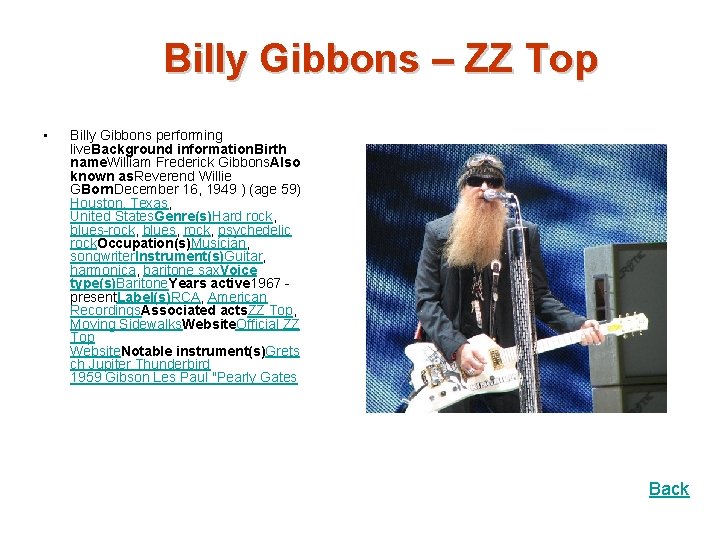
Billy Gibbons – ZZ Top • Billy Gibbons performing live. Background information. Birth name. William Frederick Gibbons. Also known as. Reverend Willie GBorn. December 16, 1949 ) (age 59) Houston, Texas, United States. Genre(s)Hard rock, blues-rock, blues, rock, psychedelic rock. Occupation(s)Musician, songwriter. Instrument(s)Guitar, harmonica, baritone sax. Voice type(s)Baritone. Years active 1967 present. Label(s)RCA, American Recordings. Associated acts. ZZ Top, Moving Sidewalks. Website. Official ZZ Top Website. Notable instrument(s)Grets ch Jupiter Thunderbird 1959 Gibson Les Paul "Pearly Gates Back
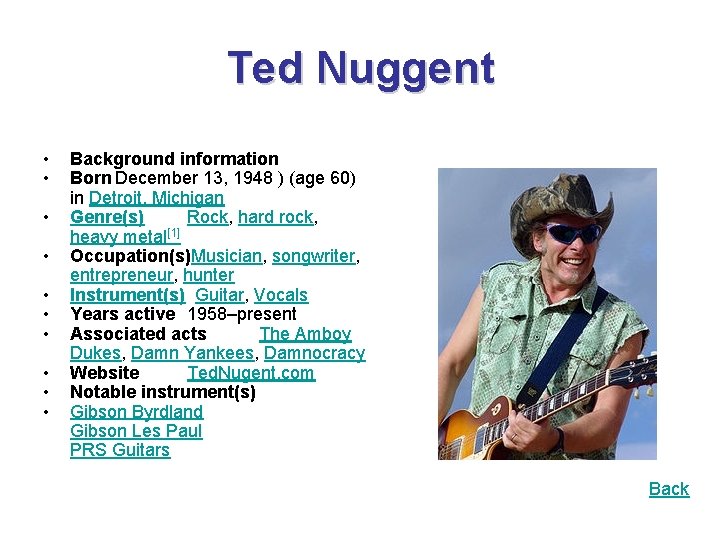
Ted Nuggent • • • Background information Born December 13, 1948 ) (age 60) in Detroit, Michigan Genre(s) Rock, hard rock, heavy metal[1] Occupation(s)Musician, songwriter, entrepreneur, hunter Instrument(s) Guitar, Vocals Years active 1958–present Associated acts The Amboy Dukes, Damn Yankees, Damnocracy Website Ted. Nugent. com Notable instrument(s) Gibson Byrdland Gibson Les Paul PRS Guitars Back
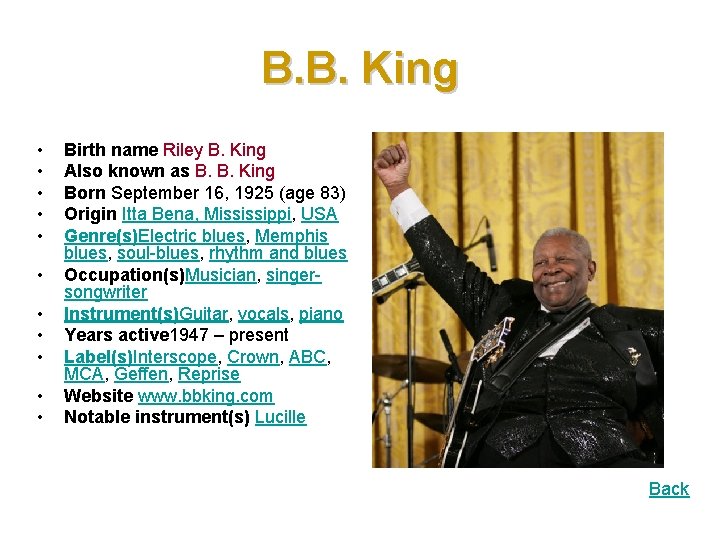
B. B. King • • • Birth name Riley B. King Also known as B. B. King Born September 16, 1925 (age 83) Origin Itta Bena, Mississippi, USA Genre(s)Electric blues, Memphis blues, soul-blues, rhythm and blues Occupation(s)Musician, singersongwriter Instrument(s)Guitar, vocals, piano Years active 1947 – present Label(s)Interscope, Crown, ABC, MCA, Geffen, Reprise Website www. bbking. com Notable instrument(s) Lucille Back
- Slides: 17