
The ChiSquare Distribution Preliminary Idea Sum of n

The Chi-Square Distribution
Preliminary Idea Sum of n values of a random variable
Sum of Squares of random numbers
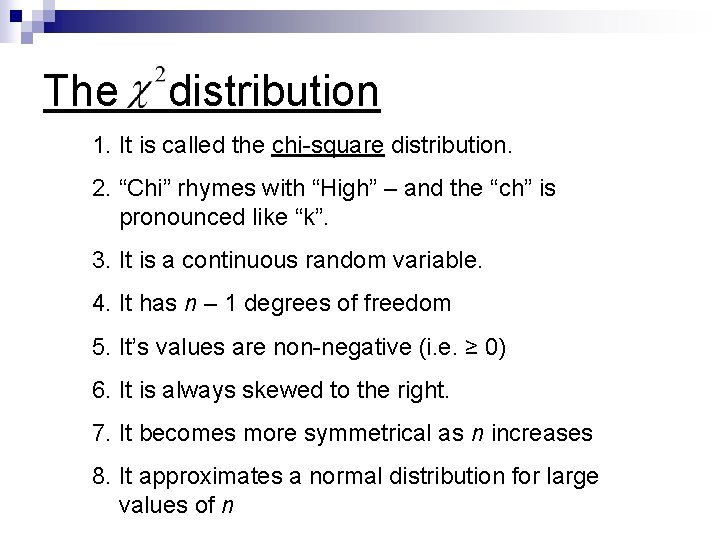
The distribution 1. It is called the chi-square distribution. 2. “Chi” rhymes with “High” – and the “ch” is pronounced like “k”. 3. It is a continuous random variable. 4. It has n – 1 degrees of freedom 5. It’s values are non-negative (i. e. ≥ 0) 6. It is always skewed to the right. 7. It becomes more symmetrical as n increases 8. It approximates a normal distribution for large values of n
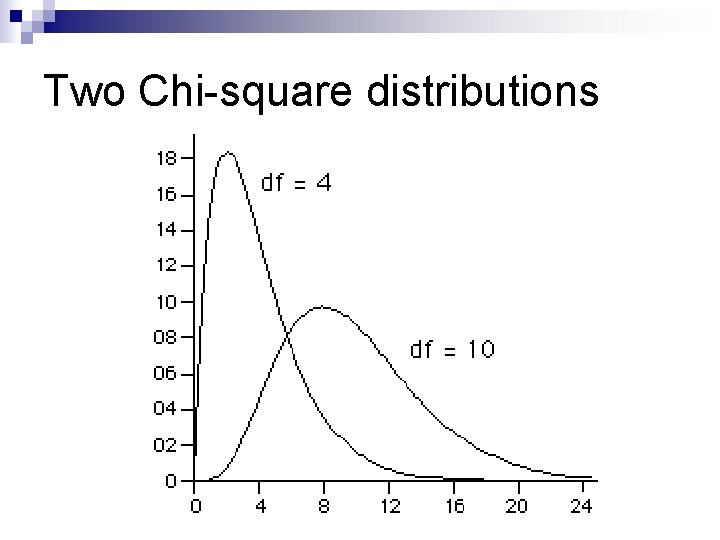
Two Chi-square distributions
The sample variance s 2 follows a chi-square distribution
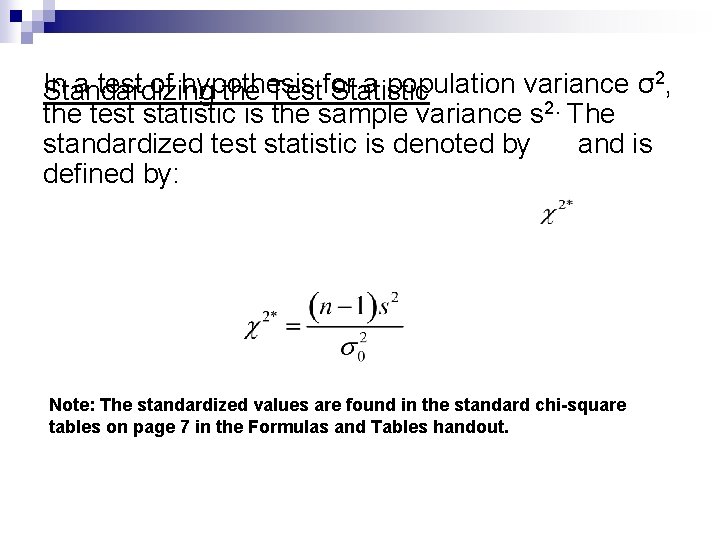
2, In a test of hypothesis for a population variance σ Standardizing the Test Statistic the test statistic is the sample variance s 2. The standardized test statistic is denoted by and is defined by: Note: The standardized values are found in the standard chi-square tables on page 7 in the Formulas and Tables handout.
Chi-square table characteristics The chi-square tables are not symmetrical. Therefore lower-tail values and upper-tail values must be listed separately. In the extract of the chi-square tables shown in the next slide, lower-tail areas are shaded in yellow, upper tail areas are shaded in blue.
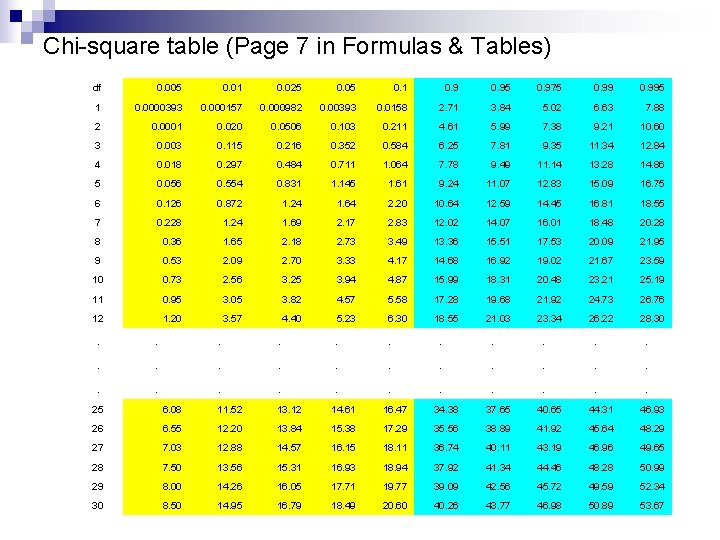
Chi-square table (Page 7 in Formulas & Tables) df 0. 005 0. 01 0. 025 0. 05 0. 1 0. 95 0. 975 0. 995 1 0. 0000393 0. 000157 0. 000982 0. 00393 0. 0158 2. 71 3. 84 5. 02 6. 63 7. 88 2 0. 0001 0. 020 0. 0506 0. 103 0. 211 4. 61 5. 99 7. 38 9. 21 10. 60 3 0. 003 0. 115 0. 216 0. 352 0. 584 6. 25 7. 81 9. 35 11. 34 12. 84 4 0. 018 0. 297 0. 484 0. 711 1. 064 7. 78 9. 49 11. 14 13. 28 14. 86 5 0. 056 0. 554 0. 831 1. 145 1. 61 9. 24 11. 07 12. 83 15. 09 16. 75 6 0. 126 0. 872 1. 24 1. 64 2. 20 10. 64 12. 59 14. 45 16. 81 18. 55 7 0. 228 1. 24 1. 69 2. 17 2. 83 12. 02 14. 07 16. 01 18. 48 20. 28 8 0. 36 1. 65 2. 18 2. 73 3. 49 13. 36 15. 51 17. 53 20. 09 21. 95 9 0. 53 2. 09 2. 70 3. 33 4. 17 14. 68 16. 92 19. 02 21. 67 23. 59 10 0. 73 2. 56 3. 25 3. 94 4. 87 15. 99 18. 31 20. 48 23. 21 25. 19 11 0. 95 3. 05 3. 82 4. 57 5. 58 17. 28 19. 68 21. 92 24. 73 26. 76 12 1. 20 3. 57 4. 40 5. 23 6. 30 18. 55 21. 03 23. 34 26. 22 28. 30 . . . . 25 6. 08 11. 52 13. 12 14. 61 16. 47 34. 38 37. 65 40. 65 44. 31 46. 93 26 6. 55 12. 20 13. 84 15. 38 17. 29 35. 56 38. 89 41. 92 45. 64 48. 29 27 7. 03 12. 88 14. 57 16. 15 18. 11 36. 74 40. 11 43. 19 46. 96 49. 65 28 7. 50 13. 56 15. 31 16. 93 18. 94 37. 92 41. 34 44. 46 48. 28 50. 99 29 8. 00 14. 26 16. 05 17. 71 19. 77 39. 09 42. 56 45. 72 49. 59 52. 34 30 8. 50 14. 95 16. 79 18. 49 20. 60 40. 26 43. 77 46. 98 50. 89 53. 67
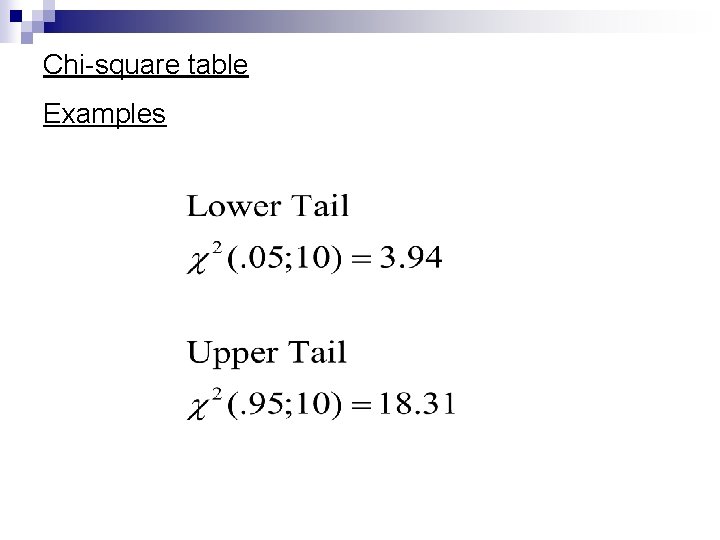
Chi-square table Examples
Two-Tail Test of Hypothesis
Lower Tail Test of Hypothesis
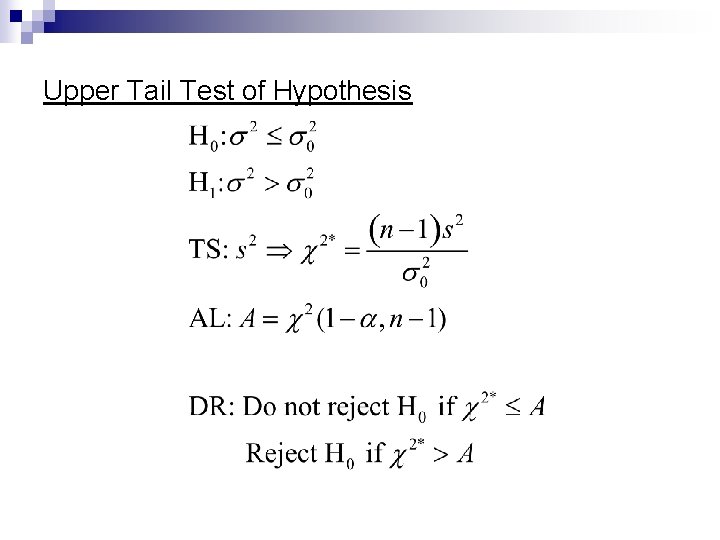
Upper Tail Test of Hypothesis

Example
The test of hypothesis

The F distribution
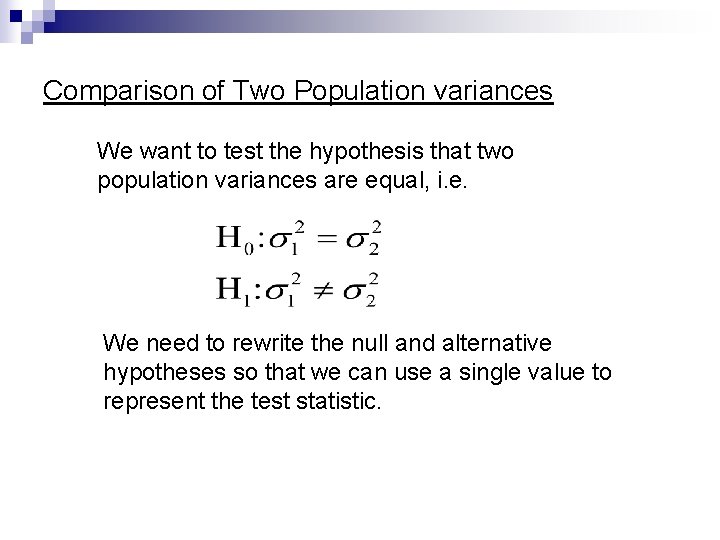
Comparison of Two Population variances We want to test the hypothesis that two population variances are equal, i. e. We need to rewrite the null and alternative hypotheses so that we can use a single value to represent the test statistic.
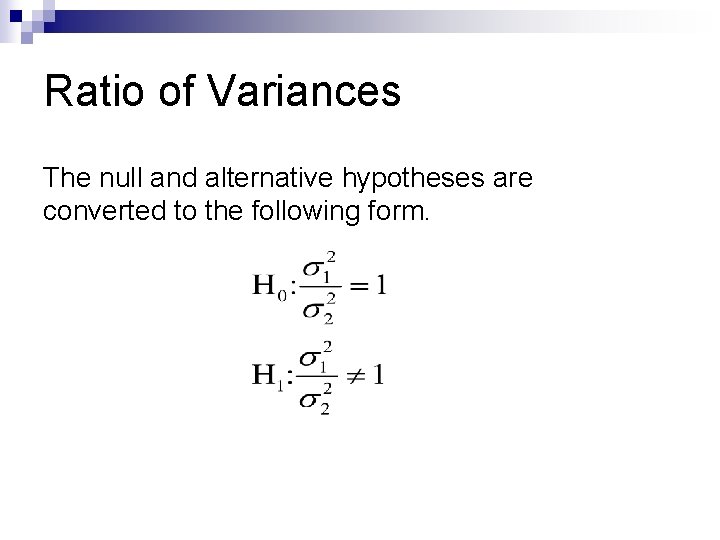
Ratio of Variances The null and alternative hypotheses are converted to the following form.
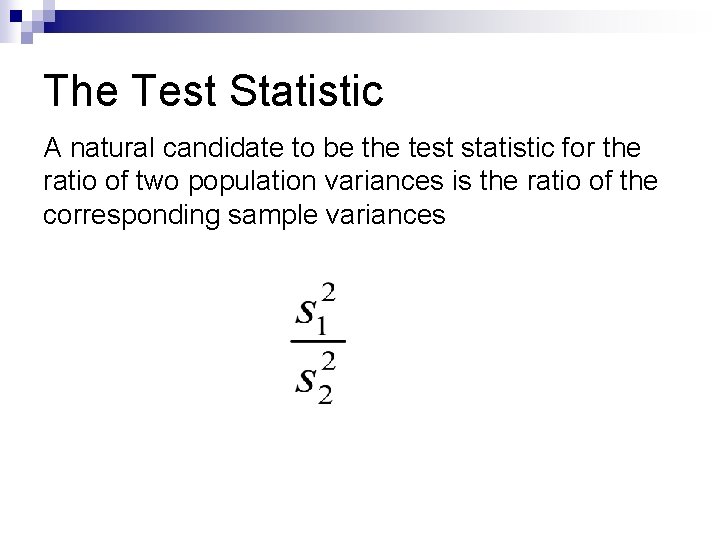
The Test Statistic A natural candidate to be the test statistic for the ratio of two population variances is the ratio of the corresponding sample variances
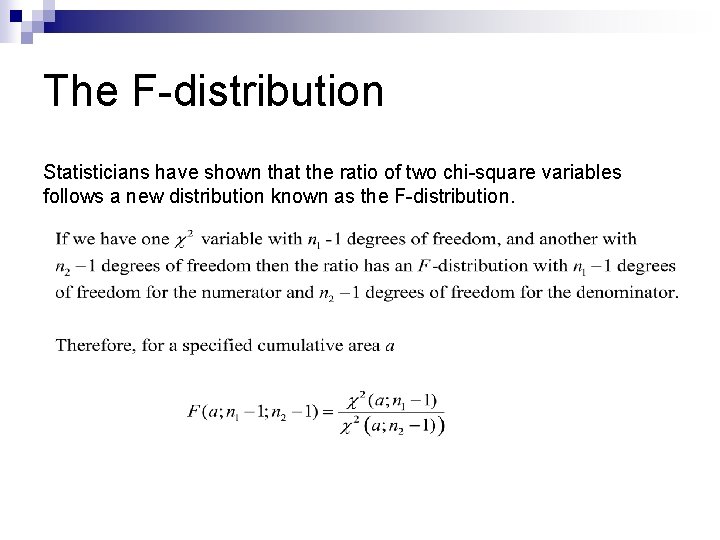
The F-distribution Statisticians have shown that the ratio of two chi-square variables follows a new distribution known as the F-distribution.
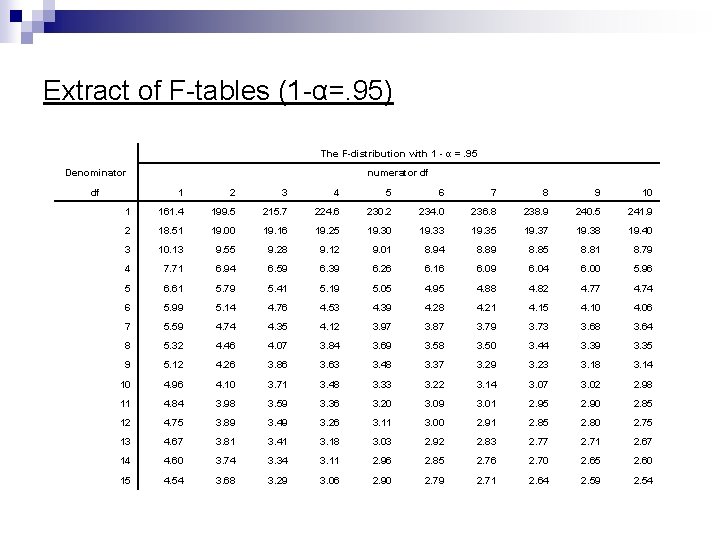
Extract of F-tables (1 -α=. 95) The F-distribution with 1 - α =. 95 Denominator df numerator df 1 2 3 4 5 6 7 8 9 10 1 161. 4 199. 5 215. 7 224. 6 230. 2 234. 0 236. 8 238. 9 240. 5 241. 9 2 18. 51 19. 00 19. 16 19. 25 19. 30 19. 33 19. 35 19. 37 19. 38 19. 40 3 10. 13 9. 55 9. 28 9. 12 9. 01 8. 94 8. 89 8. 85 8. 81 8. 79 4 7. 71 6. 94 6. 59 6. 39 6. 26 6. 16 6. 09 6. 04 6. 00 5. 96 5 6. 61 5. 79 5. 41 5. 19 5. 05 4. 95 4. 88 4. 82 4. 77 4. 74 6 5. 99 5. 14 4. 76 4. 53 4. 39 4. 28 4. 21 4. 15 4. 10 4. 06 7 5. 59 4. 74 4. 35 4. 12 3. 97 3. 87 3. 79 3. 73 3. 68 3. 64 8 5. 32 4. 46 4. 07 3. 84 3. 69 3. 58 3. 50 3. 44 3. 39 3. 35 9 5. 12 4. 26 3. 86 3. 63 3. 48 3. 37 3. 29 3. 23 3. 18 3. 14 10 4. 96 4. 10 3. 71 3. 48 3. 33 3. 22 3. 14 3. 07 3. 02 2. 98 11 4. 84 3. 98 3. 59 3. 36 3. 20 3. 09 3. 01 2. 95 2. 90 2. 85 12 4. 75 3. 89 3. 49 3. 26 3. 11 3. 00 2. 91 2. 85 2. 80 2. 75 13 4. 67 3. 81 3. 41 3. 18 3. 03 2. 92 2. 83 2. 77 2. 71 2. 67 14 4. 60 3. 74 3. 34 3. 11 2. 96 2. 85 2. 76 2. 70 2. 65 2. 60 15 4. 54 3. 68 3. 29 3. 06 2. 90 2. 79 2. 71 2. 64 2. 59 2. 54
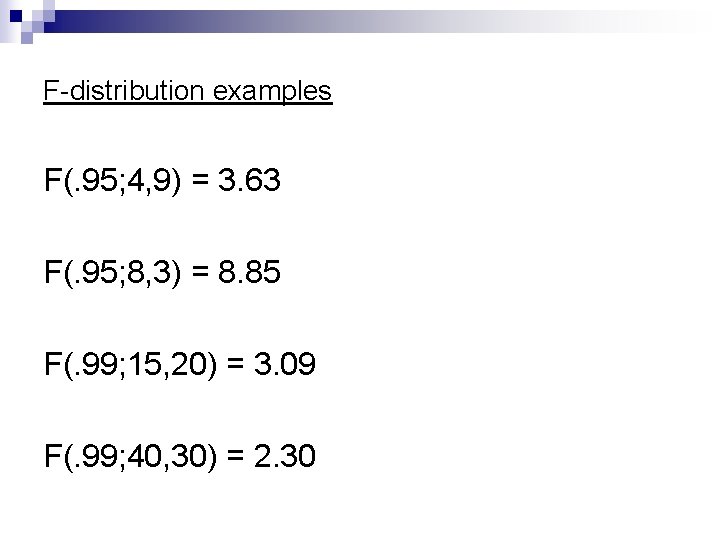
F-distribution examples F(. 95; 4, 9) = 3. 63 F(. 95; 8, 3) = 8. 85 F(. 99; 15, 20) = 3. 09 F(. 99; 40, 30) = 2. 30
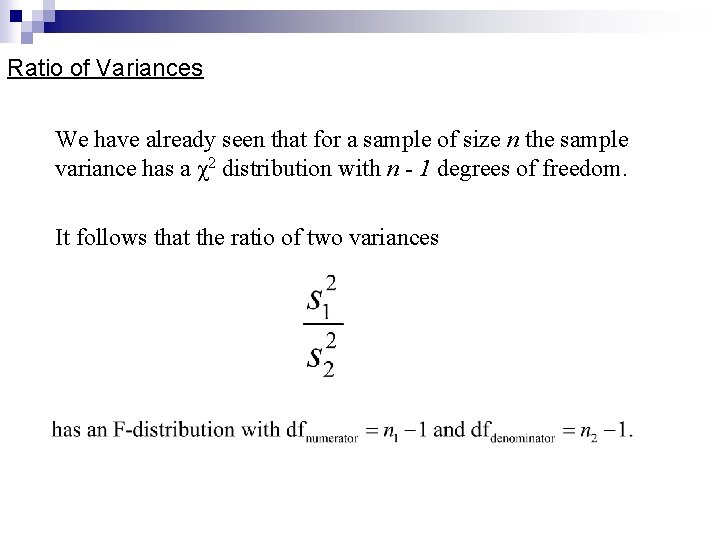
Ratio of Variances We have already seen that for a sample of size n the sample variance has a χ2 distribution with n - 1 degrees of freedom. It follows that the ratio of two variances
Test of Hypothesis for two variances
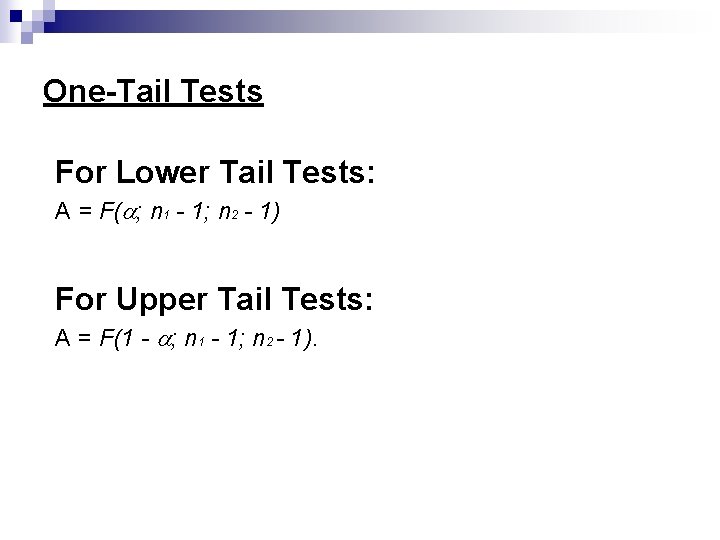
One-Tail Tests For Lower Tail Tests: A = F( ; n 1 - 1; n 2 - 1) For Upper Tail Tests: A = F(1 - ; n 1 - 1; n 2 - 1).
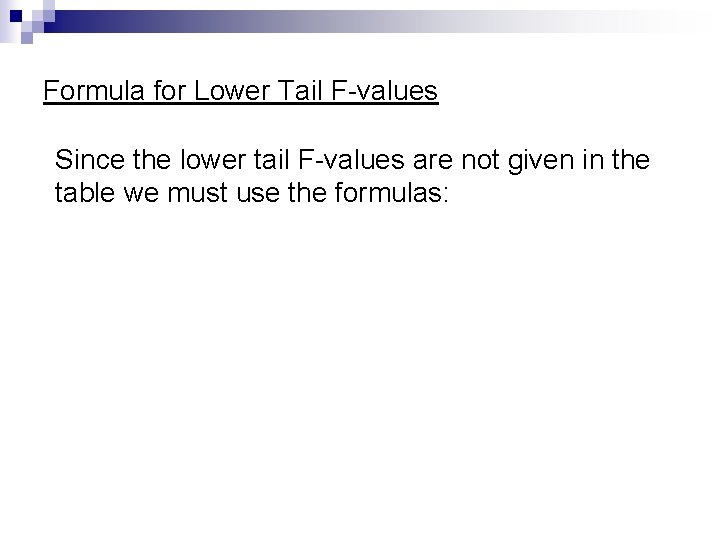
Formula for Lower Tail F-values Since the lower tail F-values are not given in the table we must use the formulas:
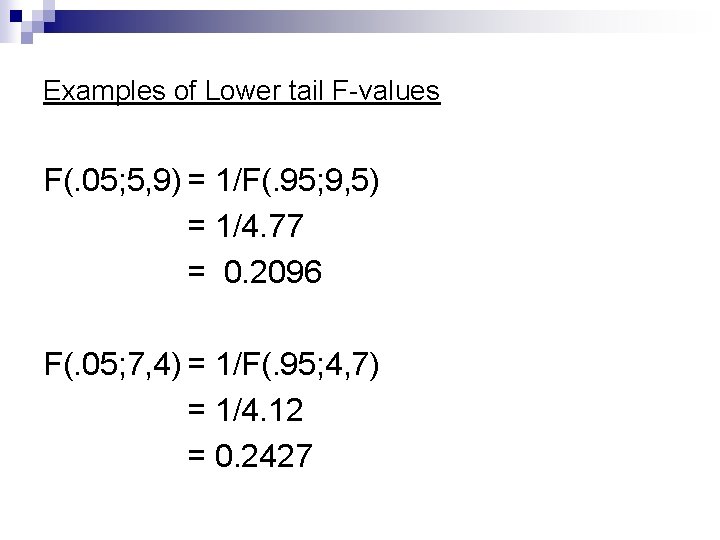
Examples of Lower tail F-values F(. 05; 5, 9) = 1/F(. 95; 9, 5) = 1/4. 77 = 0. 2096 F(. 05; 7, 4) = 1/F(. 95; 4, 7) = 1/4. 12 = 0. 2427
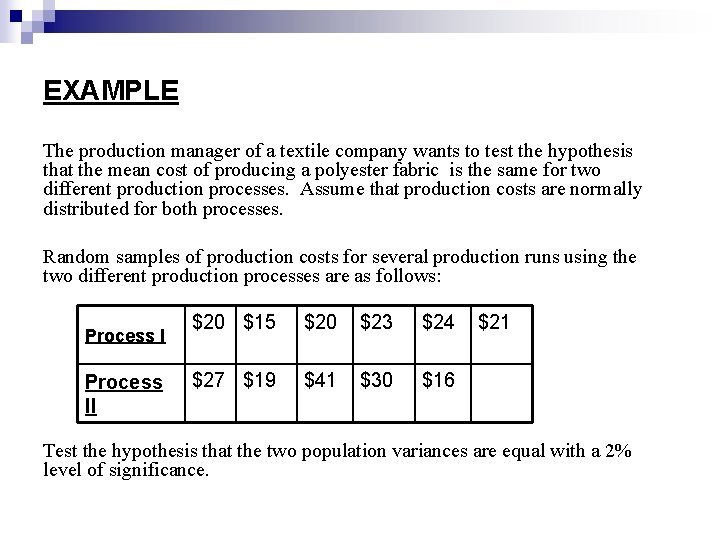
EXAMPLE The production manager of a textile company wants to test the hypothesis that the mean cost of producing a polyester fabric is the same for two different production processes. Assume that production costs are normally distributed for both processes. Random samples of production costs for several production runs using the two different production processes are as follows: Process II $20 $15 $20 $23 $24 $27 $19 $41 $30 $16 $21 Test the hypothesis that the two population variances are equal with a 2% level of significance.
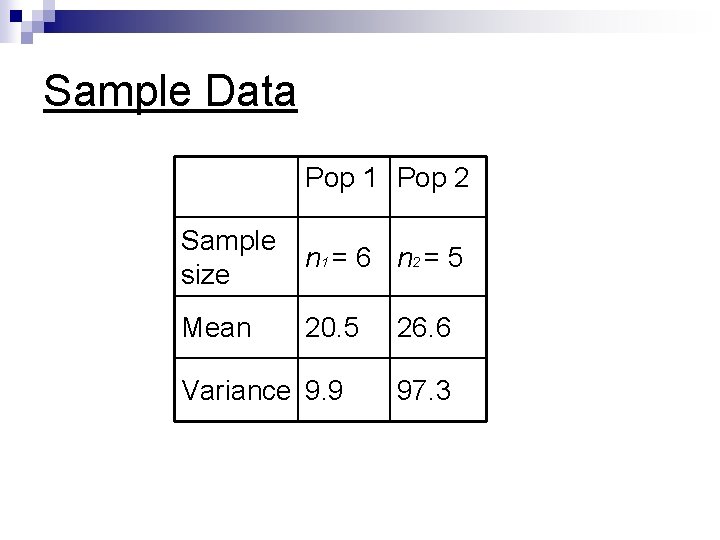
Sample Data Pop 1 Pop 2 Sample size n 1 = 6 n 2 = 5 Mean 20. 5 Variance 9. 9 26. 6 97. 3
Testing the Hypothesis
- Slides: 30