
The Chinese Writing System Origins and Development CHIN
![Classification of Writing Systems • Alphabetic: Each graph represents a single sound (like [b],](https://slidetodoc.com/presentation_image_h2/ede668824c6894f5e740edec535db7cd/image-11.jpg "Classification of Writing Systems • Alphabetic: Each graph represents a single sound (like [b],")
![What do modern Chinese characters represent? • Individual sounds like [b]? NO • Individual](https://slidetodoc.com/presentation_image_h2/ede668824c6894f5e740edec535db7cd/image-12.jpg "What do modern Chinese characters represent? • Individual sounds like [b]? NO • Individual")
- Slides: 38
The Chinese Writing System: Origins and Development CHIN 342/442 Autumn 2019
Writing and Language • So far in this course we have talked almost exclusively about spoken language • For linguists, spoken language is primary • A linguistic analysis of writing proceeds from its relationship to spoken language: writing represents speech
Goals • Definition of writing • Classification of writing systems • Origins of Chinese writing – the rebus principle • Early development of Chinese writing – semantic determinatives – simplification and conventionalization
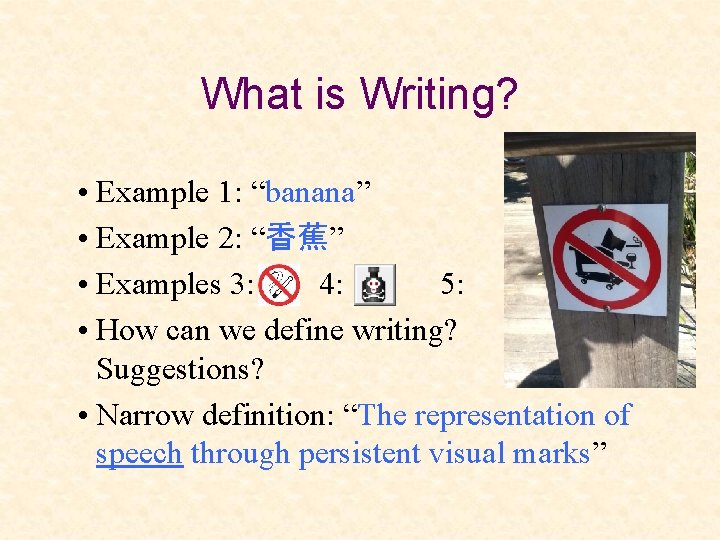
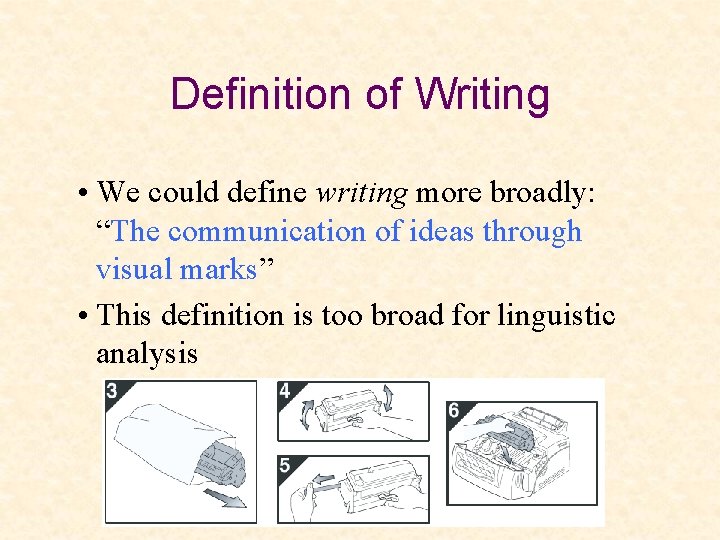
What is Writing? • Example 1: “banana” • Example 2: “香蕉” • Examples 3: 4: 5: • How can we define writing? Suggestions? • Narrow definition: “The representation of speech through persistent visual marks”
Definition of Writing • We could define writing more broadly: “The communication of ideas through visual marks” • This definition is too broad for linguistic analysis
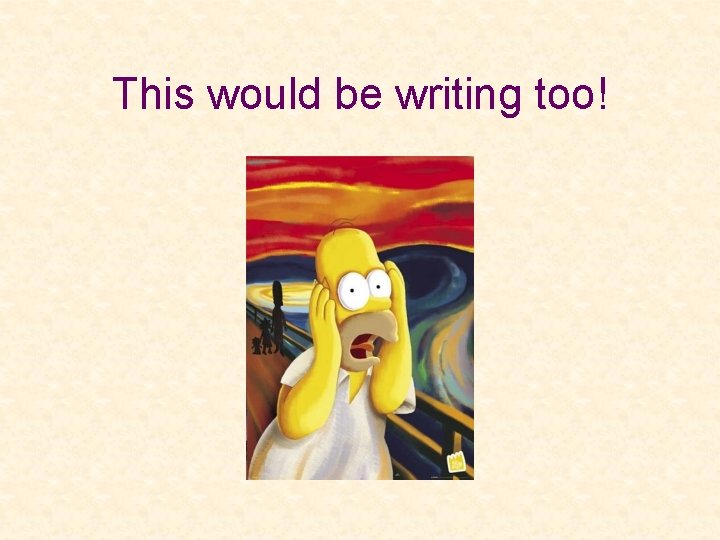
This would be writing too!
Definition of Writing • Linguistic definition of writing (repeated): • “The representation of speech through persistent visual marks”
Definition of Writing • Our definition reflects the idea that writing is a method for projecting speech across time and space, thus overcoming its inherent dimensional limitations • Two different speakers of the same language, looking at the same piece of writing, will produce the same utterance
Writing vs. Speech • Sounds (consonants & vowels), syllables, morphemes, words are all elements of spoken language; they exist prior to and independently of written forms • Graphs (letters, Chinese characters, etc. ) are basic elements of writing systems • We carefully distinguish them; we will explore the relationship between them
Writing System • “One or more scripts (= sets of graphs) together with a set of rules specifying how those graphs are used to represent elements of a particular spoken language. ” • The English and Italian writing systems use the same script (the Roman alphabet), but with different rules of representation
Classification of Writing Systems • Alphabetic: Each graph represents a single sound (like [b], [i], [l]) example: Spanish: b, i, l • Syllabic: Each graph represents a syllable (like [ka], [mi]) example: Japanese hiragana: か, み • Logographic: Each graph represents a morpheme (like {[pʰai] ‘pie’})
What do modern Chinese characters represent? • Individual sounds like [b]? NO • Individual syllables? NO – jī, dōng, shì (compare mǔjī and fēijī) • Individual words? NO – xuésheng ‘student’, fēijī ‘airplane’ • Most Chinese characters represent single morphemes that are one syllable long • mǔjī 母鸡 ‘hen’; fēijī 飞机 ‘airplane’
Morphosyllabographs? • Morphosyllabographic? We will stick with the term logographic. • When morphemes and syllables don’t coincide, there are exceptions to the “graph : one-syllable morpheme” pattern – The subsyllabic morpheme -r (兒/儿) – Bi- and trisyllabic morphemes like pútáo (葡 萄), tǎnkè (坦克), kāfēi (咖啡), qiǎokèlì (巧克力)
Characters Don’t Represent. . . • Myths and half-truths – “Chinese characters write words. ” – “Chinese characters are pictures. ” – “Chinese characters represent ideas. ” • We have already seen that many characters write bound morphemes (which are not words), e. g. 母; many words are written with 2 characters: 父母
Characters Don’t Represent. . . • “Chinese characters are pictures. ” • As we shall see, some Chinese characters are pictographic in origin, but most characters (like 變/变 writing biàn ‘change’) are in no sense pictographic • So this is half-true at best
Characters Don’t Represent. . . • “Chinese characters represent ideas. ” • How many English words can you think of that express the idea of “to talk” ? Talk, speak, converse, tell, … • Mandarin words? • Chinese characters are not ideographic: 說/说 cannot write jiǎng, tán, or gàosu
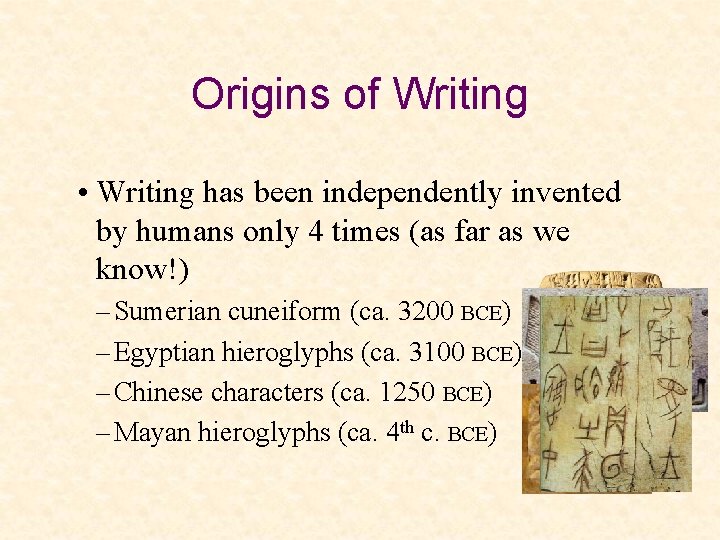
Origins of Writing • Writing has been independently invented by humans only 4 times (as far as we know!) – Sumerian cuneiform (ca. 3200 BCE) – Egyptian hieroglyphs (ca. 3100 BCE) – Chinese characters (ca. 1250 BCE) – Mayan hieroglyphs (ca. 4 th c. BCE)
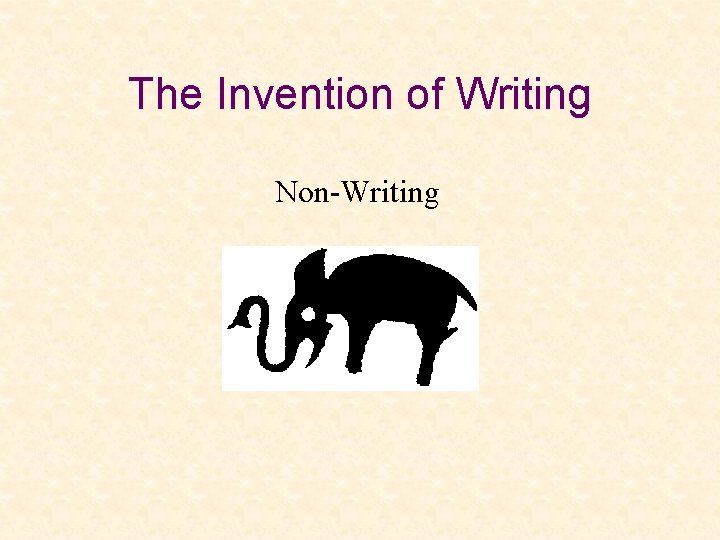
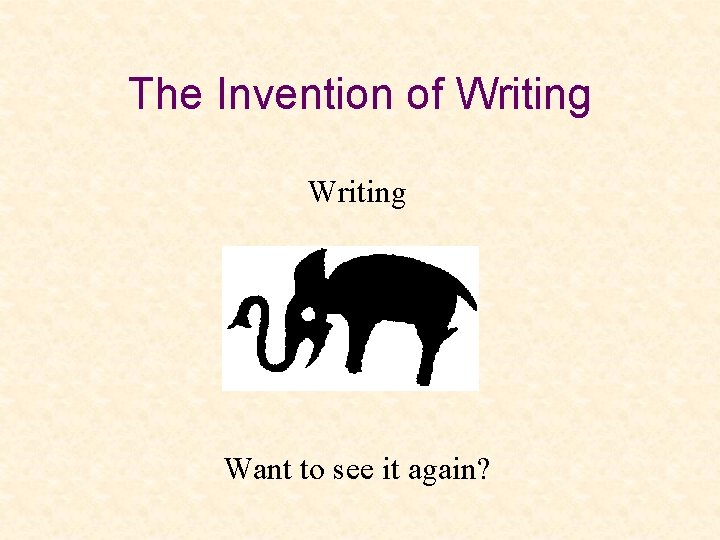
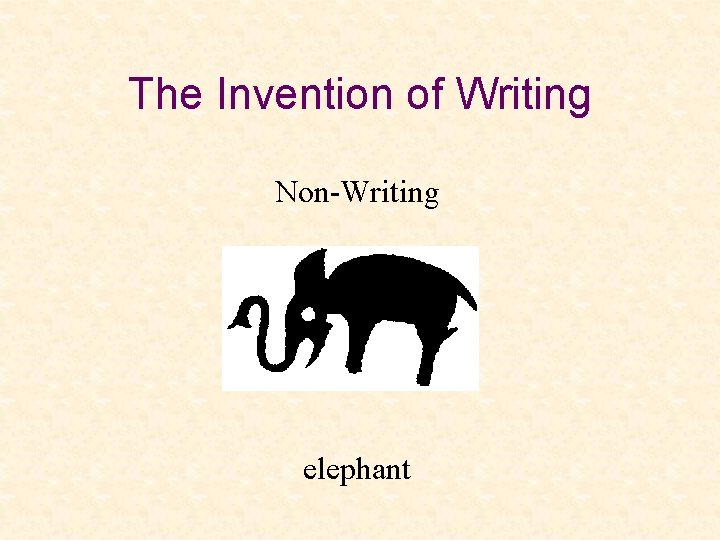
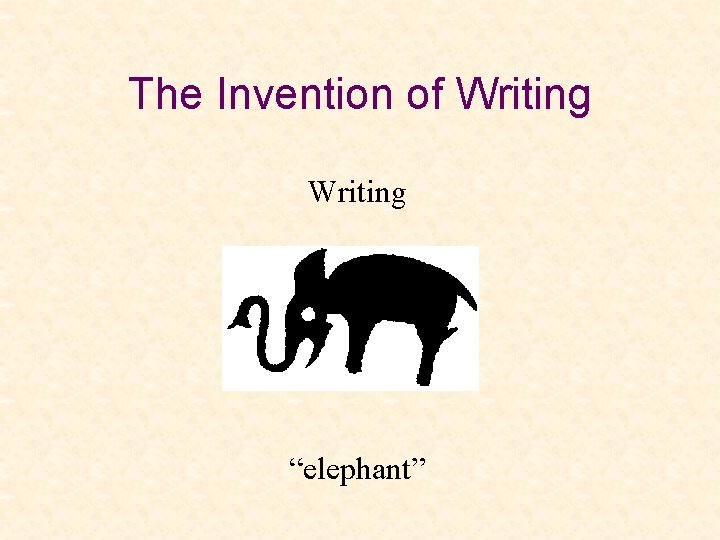
Origins of Writing • Many details are unknown, but the general history is clear in all four cases • There is a crucial moment when visual symbols that are not writing become writing • Want to see an illustration of that key moment in human history?
The Invention of Writing Non-Writing
The Invention of Writing Want to see it again?
The Invention of Writing Non-Writing elephant
The Invention of Writing “elephant”
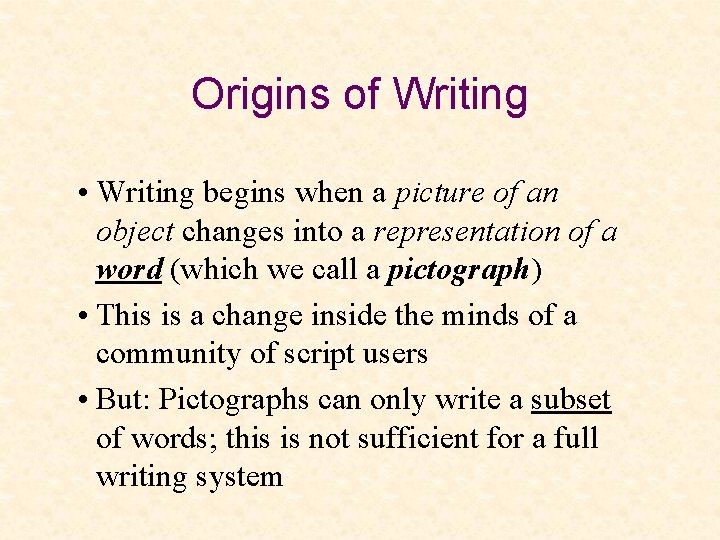
Origins of Writing • Writing begins when a picture of an object changes into a representation of a word (which we call a pictograph) • This is a change inside the minds of a community of script users • But: Pictographs can only write a subset of words; this is not sufficient for a full writing system
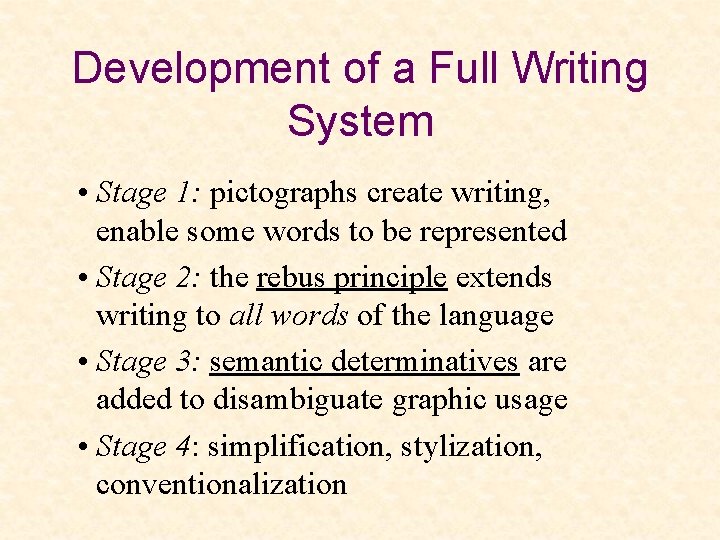
Development of a Full Writing System • Stage 1: pictographs create writing, enable some words to be represented • Stage 2: the rebus principle extends writing to all words of the language • Stage 3: semantic determinatives are added to disambiguate graphic usage • Stage 4: simplification, stylization, conventionalization
Examples • (On board, examples of Stages 1 -3 for “English” as a thought experiment, and for the real history of Chinese writing)
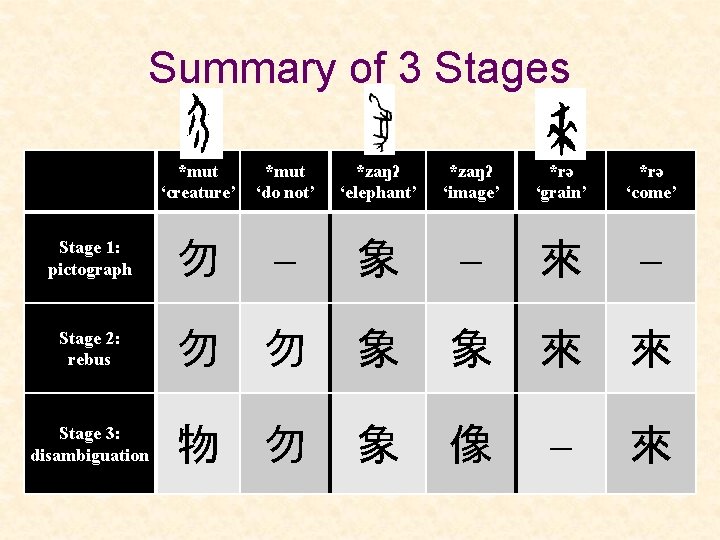
Summary of 3 Stages *mut ‘creature’ *mut ‘do not’ *zaŋʔ ‘elephant’ *zaŋʔ ‘image’ *rə ‘grain’ *rə ‘come’ 勿 – 象 – 來 – Stage 2: rebus 勿 勿 象 象 來 來 Stage 3: disambiguation 物 勿 象 像 – 來 Stage 1: pictograph
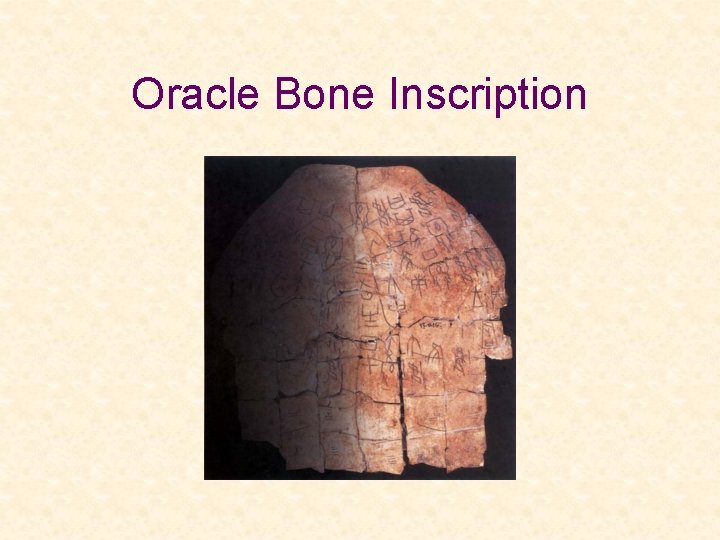
Oracle Bone Inscriptions • Oracle bones: ritually inscribed royal divinatory texts from Shāng 商 dynasty • They are the earliest confirmed examples of Chinese writing (from mid-13 th c. BCE) • They reveal a fully developed writing system, capable of representing all grammatical morphemes • See turtle plastron in the course packet
Oracle Bone Inscription
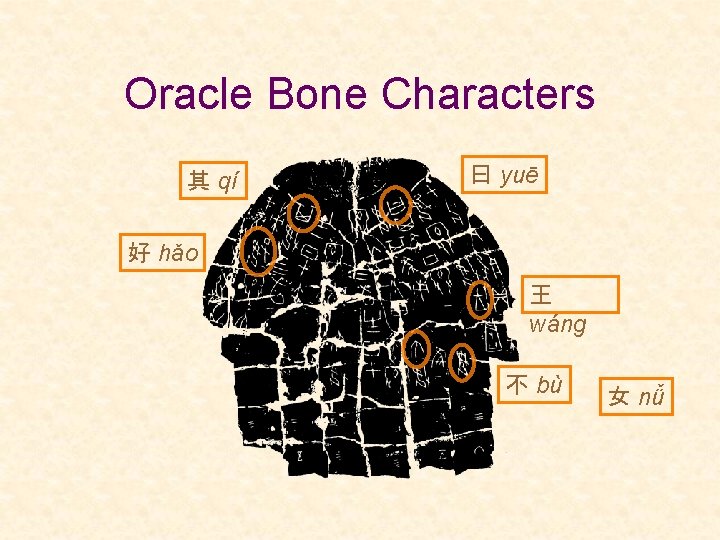
Oracle Bone Characters 其 qí 曰 yuē 好 hǎo 王 wáng 不 bù 女 nǚ
Why do written forms change over time? • Drawing pictures is slow and cumbersome • As writing becomes more widely used, there is pressure for speed and efficiency • Pictures become simpler and more abstract, losing their pictographic quality • As a result conventionalization becomes more crucial to distinguish graphs
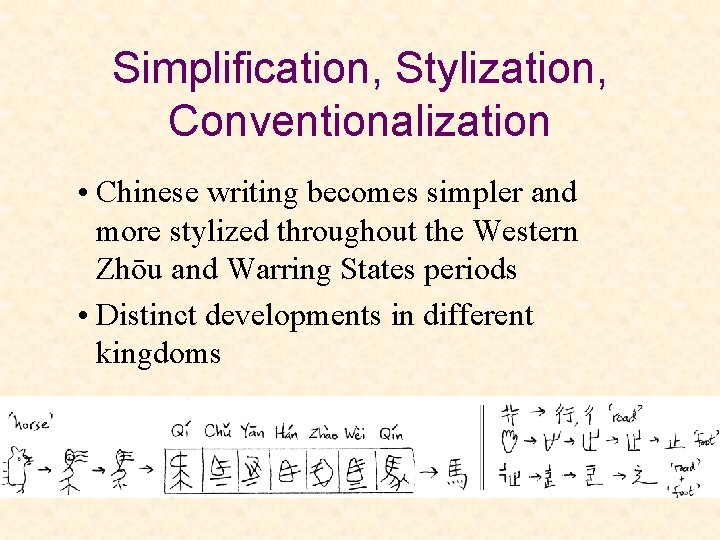
Simplification, Stylization, Conventionalization • Chinese writing becomes simpler and more stylized throughout the Western Zhōu and Warring States periods • Distinct developments in different kingdoms
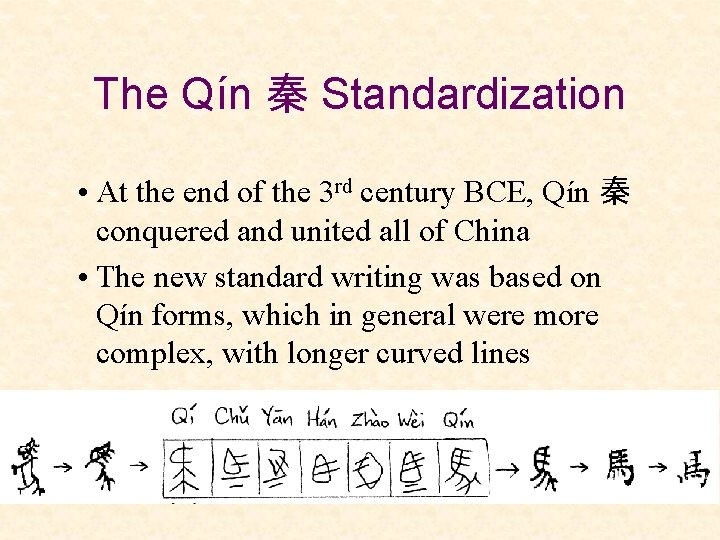
The Qín 秦 Standardization • At the end of the 3 rd century BCE, Qín 秦 conquered and united all of China • The new standard writing was based on Qín forms, which in general were more complex, with longer curved lines
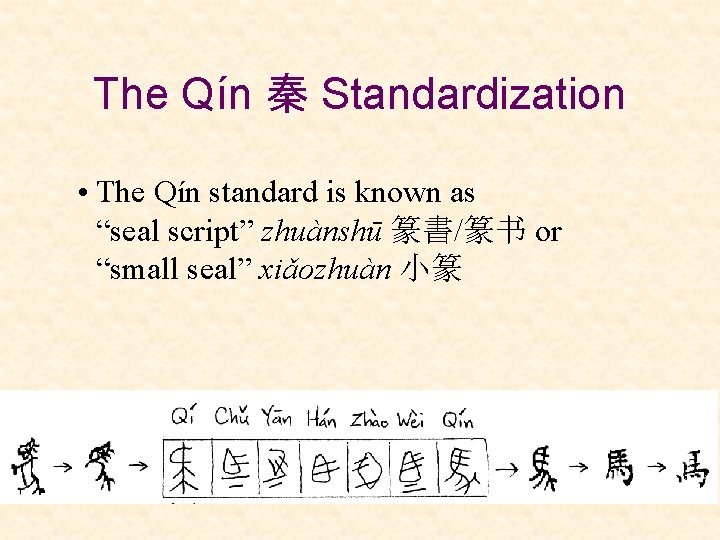
The Qín 秦 Standardization • The Qín standard is known as “seal script” zhuànshū 篆書/篆书 or “small seal” xiǎozhuàn 小篆
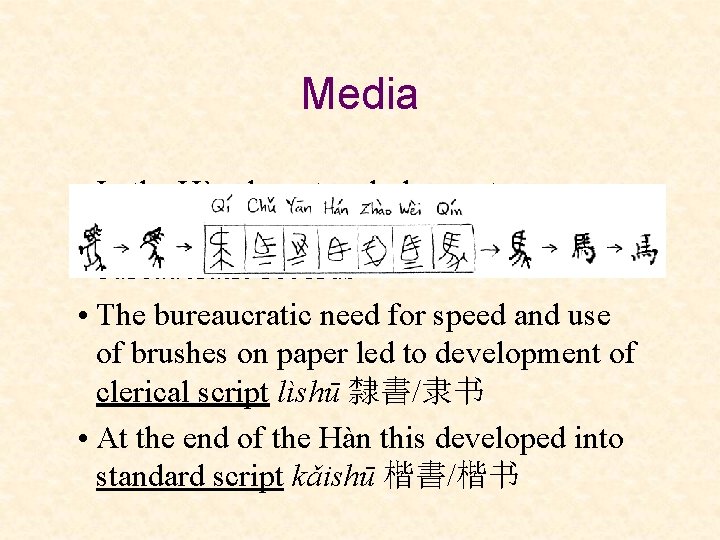
Media • Changes in writing materials (tools and surfaces) also affect the form of graphs • A brush on paper will produce different kinds of lines than carving into bone or impressing into clay • Small seal script is characterized by lines of even thickness and graceful curves; it is not written with a brush
Media • In the Hàn dynasty, clerks wrote increasingly large amounts of bureaucratic records • The bureaucratic need for speed and use of brushes on paper led to development of clerical script lìshū 隸書/隶书 • At the end of the Hàn this developed into standard script kǎishū 楷書/楷书
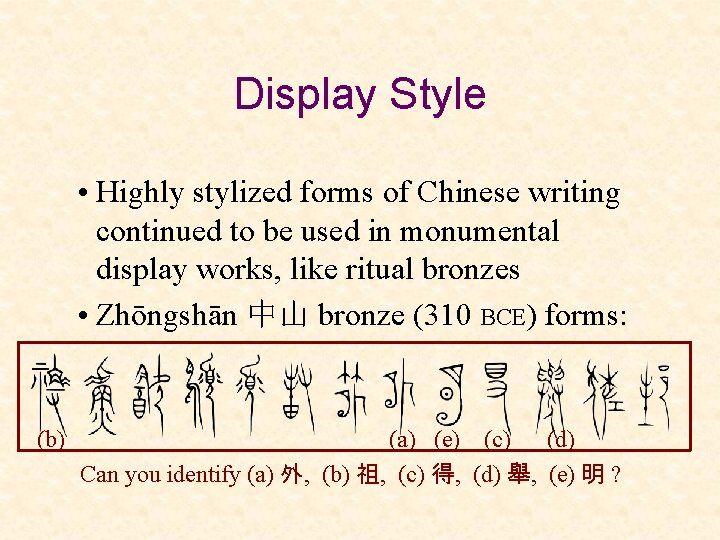
Display Style • Highly stylized forms of Chinese writing continued to be used in monumental display works, like ritual bronzes • Zhōngshān 中山 bronze (310 BCE) forms: (b) (a) (e) (c) (d) Can you identify (a) 外, (b) 祖, (c) 得, (d) 舉, (e) 明 ?
Next • Traditional Chinese classification of character structure • 20 th century developments in Chinese writing (including Cantonese!) • Romanizations, transcriptions, and writing reforms
End • Want to know more about the world history of writing? Take Asian 404! (Spring 2020)